Recognition: unknown
Unraveling Chemical Enrichment in Extreme Emission-Line Galaxies: A Multi-Element Bayesian View of Bursty Star Formation and Galaxy Evolution in DESI
Pith reviewed 2026-05-10 01:13 UTC · model grok-4.3
The pith
Multi-element abundances in extreme emission-line galaxies serve as a direct probe of rapid baryon cycling in low-mass bursty systems.
A machine-rendered reading of the paper's core claim, the machinery that carries it, and where it could break.
Core claim
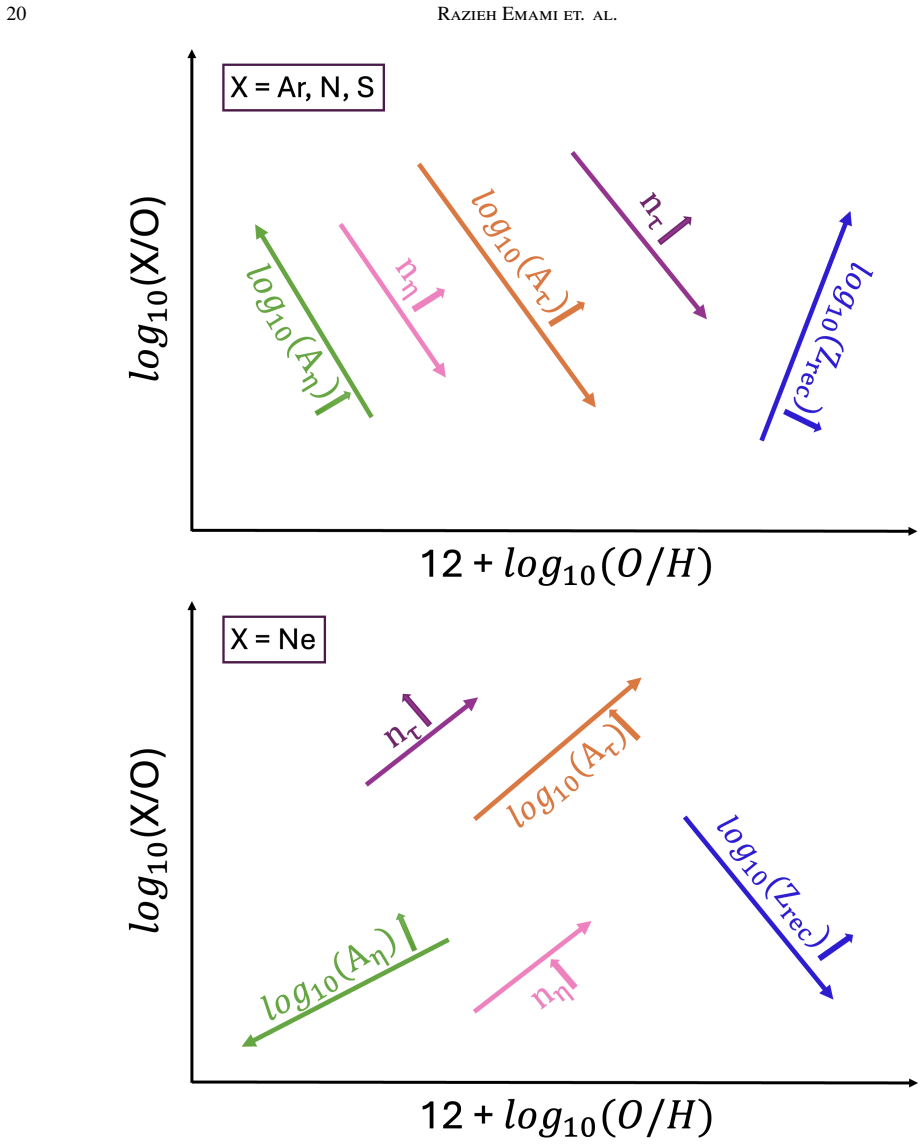
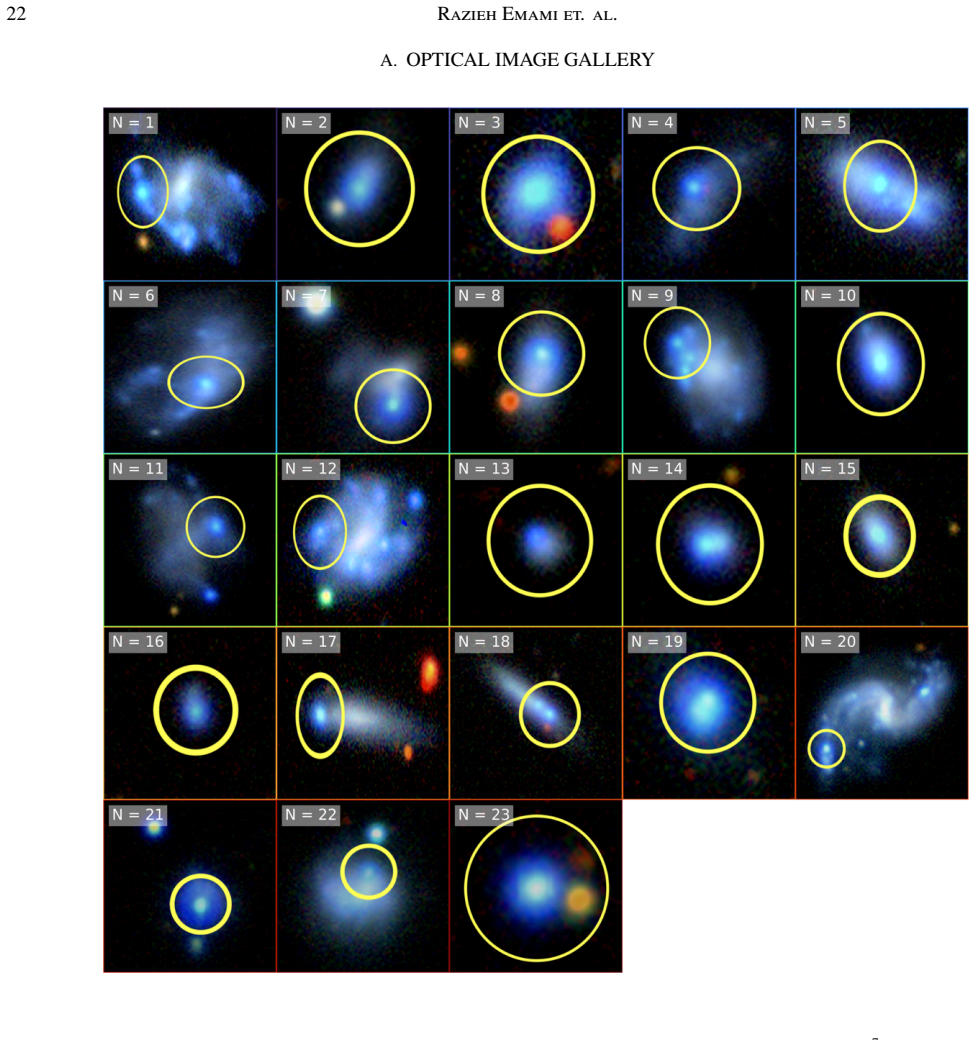
We select 23 nearby EELGs with extreme H-alpha and [O III] equivalent widths and detections of 19 ionic species. We infer non-parametric star-formation histories and fit a Bayesian single-zone chemical-evolution model to O, N, Ne, S, and Ar abundances, allowing time-dependent star-formation efficiency, outflow mass loading, and evolving inflow metallicity. The model yields short depletion timescales and large mass-loading factors, indicating rapid gas cycling in a burst-driven non-equilibrium regime below Kennicutt-Schmidt expectations. Abundance ratios isolate drivers, with N/O constraining burst timing and gas flows, Ne/O nearly invariant, and S/O and Ar/O showing intermediate sensitivity.
What carries the argument
A Bayesian single-zone chemical-evolution model fitted simultaneously to O, N, Ne, S, and Ar abundances while allowing time-dependent star-formation efficiency, outflow mass loading, and evolving inflow metallicity.
If this is right
- Star-formation efficiency sets the evolutionary tracks followed by these galaxies.
- Outflows regulate metal retention and set the normalization of element-to-oxygen ratios.
- Inflow metallicity establishes the baseline enrichment level.
- Nitrogen-to-oxygen ratios provide the strongest constraints on burst timing and gas-flow dynamics.
- Multi-element abundances can serve as a direct diagnostic of baryon-cycle processes in extreme low-mass starbursts.
Where Pith is reading between the lines
- The same modeling approach could be applied to larger samples at higher redshift to test whether bursty regimes dominate early chemical enrichment in low-mass systems.
- If the invariant Ne/O ratio holds across environments, it could act as a stable reference for comparing enrichment histories in different galaxy types.
- Spatial mapping of multiple elements in these galaxies would test whether the single-zone assumption requires refinement for complex inflow or outflow geometries.
Load-bearing premise
The single-zone chemical-evolution model with time-dependent star-formation efficiency, outflow loading, and inflow metallicity is sufficient to capture the dominant physics without major biases from spatial inhomogeneities or unmodeled processes.
What would settle it
Spatially resolved spectroscopy revealing abundance-ratio variations across a single galaxy that exceed what the single-zone model can produce, or independent gas-mass and star-formation-rate measurements yielding depletion times consistent with equilibrium Kennicutt-Schmidt relations rather than the short values inferred here.
Figures


read the original abstract
Extreme emission-line galaxies (EELGs) probe chemical enrichment in low-mass, bursty systems where star formation, feedback, and gas accretion are poorly constrained. Using DESI DR1, we select 23 nearby EELGs with detections of 19 ionic species (S/N $\geq$ 4), stellar masses $ M_* \geq 10^7 M_{\odot}$, and extreme H$\alpha$ and [O III] 5007 equivalent widths (EW $\geq$ 500 Angstrom). We infer non-parametric star-formation histories and fit a Bayesian single-zone chemical-evolution model to O, N, Ne, S, and Ar, allowing time-dependent star-formation efficiency, outflow mass loading, and evolving inflow metallicity. We find short depletion timescales and large mass-loading factors, indicating rapid gas cycling in a burst-driven, non-equilibrium regime, with depletion times below Kennicutt-Schmidt expectations. Star-formation efficiency and outflows are well constrained, while inflow metallicity is weaker due to degeneracies with metal production. Abundance ratios isolate physical drivers: star-formation efficiency sets evolutionary tracks, outflows regulate metal retention and X/O normalization, and inflow metallicity sets baseline enrichment. N/O strongly constrains burst timing and gas flows, Ne/O remains nearly invariant, and S/O and Ar/O show intermediate sensitivity. These results demonstrate that multi-element abundances provide a direct probe of baryon-cycle processes in extreme low-mass starbursts.
Editorial analysis
A structured set of objections, weighed in public.
Referee Report
Summary. The paper selects 23 nearby EELGs from DESI DR1 with extreme Hα and [O III] equivalent widths (≥500 Å), M* ≥ 10^7 M⊙, and detections of 19 ionic species. It derives non-parametric star-formation histories and fits a Bayesian single-zone chemical-evolution model to O, N, Ne, S, and Ar abundances, allowing time-dependent star-formation efficiency, outflow mass-loading factor, and evolving inflow metallicity. The central results are short depletion timescales and large mass-loading factors indicating rapid, non-equilibrium gas cycling, with abundance ratios (especially N/O) used to isolate drivers of burst timing and baryon flows.
Significance. If the single-zone model recovers unbiased parameters, the work would offer useful constraints on baryon-cycle processes in low-mass bursty systems and demonstrate the diagnostic power of multi-element abundances. The Bayesian treatment of time-dependent parameters and the use of 19 species to break degeneracies are methodological strengths that could be extended to larger samples.
major comments (2)
- [model description and results sections] The claim that multi-element abundances provide a 'direct probe' of baryon-cycle processes (abstract) rests on the single-zone model with time-dependent SFE, outflow loading, and inflow metallicity being sufficient. EELGs are selected precisely for extreme burstiness (EW(Hα), [O III] ≥500 Å), where spatial inhomogeneities, patchy enrichment, and non-uniform flows are expected; no explicit test against multi-zone models or hydrodynamical simulations is described to show that inferred depletion times and mass-loading factors remain unbiased under these conditions.
- [Bayesian fitting and interpretation paragraphs] The quantitative results (short depletion times below Kennicutt-Schmidt expectations, large mass-loading factors) are outputs of the Bayesian fit to the same abundance data used to constrain the time-dependent parameters. The interpretation that specific ratios (N/O for burst timing, outflows for X/O normalization) isolate physical drivers therefore inherits the fitted values; the manuscript should demonstrate that these conclusions are robust to prior choices and not circular with the model assumptions.
minor comments (2)
- The abstract states that inflow metallicity is 'weaker due to degeneracies with metal production' but does not quantify the degeneracy strength or show the posterior correlations; adding a corner plot or degeneracy metric would improve clarity.
- The selection criteria (S/N ≥4 for 19 species, EW ≥500 Å) are given but the impact of these cuts on the final sample of 23 galaxies and any post-selection biases are not discussed.
Simulated Author's Rebuttal
We thank the referee for their insightful comments, which have helped us improve the clarity and robustness of our analysis. We address each major comment below.
read point-by-point responses
-
Referee: [model description and results sections] The claim that multi-element abundances provide a 'direct probe' of baryon-cycle processes (abstract) rests on the single-zone model with time-dependent SFE, outflow loading, and inflow metallicity being sufficient. EELGs are selected precisely for extreme burstiness (EW(Hα), [O III] ≥500 Å), where spatial inhomogeneities, patchy enrichment, and non-uniform flows are expected; no explicit test against multi-zone models or hydrodynamical simulations is described to show that inferred depletion times and mass-loading factors remain unbiased under these conditions.
Authors: We recognize that the single-zone model is an approximation, and that EELGs selected for extreme burstiness are expected to exhibit spatial inhomogeneities and non-uniform flows. The integrated nature of the DESI spectra supports the use of a single-zone description as a luminosity-weighted average. Our multi-element approach with 19 species helps constrain the parameters. We have not performed explicit tests against multi-zone models or hydrodynamical simulations, but the results are consistent with other studies of low-mass galaxies. In revision, we will add a dedicated discussion of the model's limitations and potential biases. revision: partial
-
Referee: [Bayesian fitting and interpretation paragraphs] The quantitative results (short depletion times below Kennicutt-Schmidt expectations, large mass-loading factors) are outputs of the Bayesian fit to the same abundance data used to constrain the time-dependent parameters. The interpretation that specific ratios (N/O for burst timing, outflows for X/O normalization) isolate physical drivers therefore inherits the fitted values; the manuscript should demonstrate that these conclusions are robust to prior choices and not circular with the model assumptions.
Authors: The model forward predicts abundances from the SFH using the time-dependent parameters, and the data constrain them via the likelihood. Ratios such as N/O are particularly useful because nitrogen enrichment is delayed relative to oxygen, providing a timing constraint somewhat independent of the overall normalization set by outflows. We will revise the manuscript to include explicit demonstrations of robustness to prior choices, such as varying the priors on mass-loading factor and inflow metallicity and showing the impact on the inferred depletion timescales and interpretations. revision: yes
- Explicit tests of the single-zone model against multi-zone chemical evolution models or hydrodynamical simulations to verify that the inferred depletion times and mass-loading factors are unbiased in the presence of spatial inhomogeneities and patchy enrichment.
Circularity Check
No circularity: Bayesian fitting yields independent parameter constraints from abundance data
full rationale
The paper fits a single-zone chemical-evolution model with time-dependent parameters directly to the observed multi-element abundances in the 23 EELGs, then reports the resulting posterior values for depletion time and mass-loading factor as findings. This is standard inference rather than a prediction that reduces to the input data by construction. No self-definitional loops, fitted quantities renamed as predictions, or load-bearing self-citations appear in the provided abstract or derivation outline. The central claim that abundances probe baryon-cycle processes follows from the model interpretation of the fit results, not from any algebraic identity or prior self-citation that forces the outcome. The single-zone assumption is an explicit modeling choice whose adequacy can be tested externally, keeping the derivation self-contained.
Axiom & Free-Parameter Ledger
free parameters (3)
- time-dependent star-formation efficiency
- outflow mass-loading factor
- evolving inflow metallicity
axioms (2)
- domain assumption Single-zone chemical evolution is an adequate description
- domain assumption Non-parametric star-formation histories can be reliably inferred from the spectra
Reference graph
Works this paper leans on
-
[1]
2021, MNRAS, 505, 2361, doi: 10.1093/mnras/stab1467
Amayo, A., Delgado-Inglada, G., & Stasińska, G. 2021, MNRAS, 505, 2361, doi: 10.1093/mnras/stab1467
-
[2]
Andrews, B. H., & Martini, P. 2013, ApJ, 765, 140, doi: 10.1088/0004-637X/765/2/140 Arellano-Córdova, K. Z., Berg, D. A., Chisholm, J., et al. 2022, ApJL, 940, L23, doi: 10.3847/2041-8213/ac9ab2 Arellano-Córdova, K. Z., Berg, D. A., Mingozzi, M., et al. 2024, ApJ, 968, 98, doi: 10.3847/1538-4357/ad34cf
-
[3]
2022, A&A, 666, A109, doi: 10.1051/0004-6361/202244258
Arnaboldi, M., Bhattacharya, S., Gerhard, O., et al. 2022, A&A, 666, A109, doi: 10.1051/0004-6361/202244258
-
[4]
2011, ApJ, 743, 121, doi: 10.1088/0004-637X/743/2/121 Multi-Element Enrichment in EELGs23
Atek, H., Siana, B., Scarlata, C., et al. 2011, ApJ, 743, 121, doi: 10.1088/0004-637X/743/2/121 Multi-Element Enrichment in EELGs23
-
[5]
doi:10.1088/0004-637X/814/1/69 , journal =
Atek, H., Richard, J., Jauzac, M., et al. 2015, ApJ, 814, 69, doi: 10.1088/0004-637X/814/1/69
-
[6]
2017, A&A, 608, A1, doi: 10.1051/0004-6361/201730833
Bacon, R., Conseil, S., Mary, D., et al. 2017, A&A, 608, A1, doi: 10.1051/0004-6361/201730833
-
[7]
McQuinn, K. B. W. 2019, ApJ, 874, 93, doi: 10.3847/1538-4357/ab020a
-
[8]
Blanton, M. R., Bershady, M. A., Abolfathi, B., et al. 2017, AJ, 154, 28, doi: 10.3847/1538-3881/aa7567
-
[9]
M., Barbosa , D., & Liddle , A
Boissier, S., & Prantzos, N. 1999, MNRAS, 307, 857, doi: 10.1046/j.1365-8711.1999.02699.x
-
[10]
2019, A&A, 622, A103, doi: 10.1051/0004-6361/201834156
Boquien, M., Burgarella, D., Roehlly, Y., et al. 2019, Astronomy and Astrophysics, 622, A103, doi: 10.1051/0004-6361/201834156
work page internal anchor Pith review doi:10.1051/0004-6361/201834156 2019
-
[11]
Bouwens, R. J., Illingworth, G. D., Oesch, P. A., et al. 2015, ApJ, 811, 140, doi: 10.1088/0004-637X/811/2/140
-
[12]
Brammer, G. B., van Dokkum, P. G., Franx, M., et al. 2012, ApJS, 200, 13, doi: 10.1088/0067-0049/200/2/13
-
[13]
Carnall, A. C., Leja, J., McLure, R. J., et al. 2019, Monthly Notices of the Royal Astronomical Society, 490, 417, doi: 10.1093/mnras/stz2339
-
[14]
Carnall, A. C., McLure, R. J., Dunlop, J. S., & Dave, R. 2018, Monthly Notices of the Royal Astronomical Society, 480, 4379, doi: 10.1093/mnras/sty2169
work page internal anchor Pith review doi:10.1093/mnras/sty2169 2018
-
[15]
Carniani, S., Hainline, K., D’Eugenio, F., et al. 2024, Nature, 633, 318, doi: 10.1038/s41586-024-07860-9
-
[16]
2025, A&A, 696, A87, doi: 10.1051/0004-6361/202452451
Carniani, S., D’Eugenio, F., Ji, X., et al. 2025, A&A, 696, A87, doi: 10.1051/0004-6361/202452451
-
[17]
Charlot, S., & Fall, S. M. 2000, The Astrophysical Journal, 539, 718, doi: 10.1086/309250
-
[18]
Chiappini, C., Matteucci, F., & Gratton, R. 1997, ApJ, 477, 765, doi: 10.1086/303726
-
[19]
Choudhury, T. R., Ferrara, A., & Gallerani, S. 2008, MNRAS, 385, L58, doi: 10.1111/j.1745-3933.2008.00433.x
-
[20]
Coil, A. L., Blanton, M. R., Burles, S. M., et al. 2011, ApJ, 741, 8, doi: 10.1088/0004-637X/741/1/8
-
[21]
Colless, M., Dalton, G., Maddox, S., et al. 2001, MNRAS, 328, 1039, doi: 10.1046/j.1365-8711.2001.04902.x Côté, B., O’Shea, B. W., Ritter, C., Herwig, F., & Venn, K. A. 2017, ApJ, 835, 128, doi: 10.3847/1538-4357/835/2/128
-
[22]
2011, ApJS, 197, 17, doi: 10.1088/0067-0049/197/2/17
Cristallo, S., Piersanti, L., Straniero, O., et al. 2011, ApJS, 197, 17, doi: 10.1088/0067-0049/197/2/17
-
[23]
2025, A&A, 697, A89, doi: 10.1051/0004-6361/202451410
Curti, M., Witstok, J., Jakobsen, P., et al. 2025, A&A, 697, A89, doi: 10.1051/0004-6361/202451410
-
[24]
2023, Nature Astronomy, 7, 622, doi: 10.1038/s41550-023-01918-w
Curtis-Lake, E., Carniani, S., Cameron, A., et al. 2023, Nature Astronomy, 7, 622, doi: 10.1038/s41550-023-01918-w
-
[25]
Dawson, K. S., Schlegel, D. J., Ahn, C. P., et al. 2013, AJ, 145, 10, doi: 10.1088/0004-6256/145/1/10
-
[26]
Dawson, K. S., Kneib, J.-P., Percival, W. J., et al. 2016, AJ, 151, 44, doi: 10.3847/0004-6256/151/2/44 DESI Collaboration, Abbas, U., Abdurro’uf, Acosta, A., et al. 2024a, The Astronomical Journal, 168, 58, doi: 10.3847/1538-3881/ad4f1b DESI Collaboration, Abareshi, B., Aguilar, J., et al. 2022, AJ, 164, 207, doi: 10.3847/1538-3881/ac882b DESI Collaborat...
-
[27]
Dors, O. L., Hägele, G. F., Cardaci, M. V., et al. 2013, MNRAS, 432, 2512, doi: 10.1093/mnras/stt610
-
[28]
Draine, B. T., & Li, A. 2007, The Astrophysical Journal, 657, 810, doi: 10.1086/511055
-
[29]
Drinkwater, M. J., Jurek, R. J., Blake, C., et al. 2010, MNRAS, 401, 1429, doi: 10.1111/j.1365-2966.2009.15754.x
-
[30]
2010, , 405, 1025, 10.1111/j.1365-2966.2010.16486.x
Driver, S. P., Hill, D. T., Kelvin, L. S., et al. 2011, MNRAS, 413, 971, doi: 10.1111/j.1365-2966.2010.18188.x
-
[31]
Eisenstein, D. J., Weinberg, D. H., Agol, E., et al. 2011, AJ, 142, 72, doi: 10.1088/0004-6256/142/3/72
-
[32]
Eisenstein, D. J., Johnson, B. D., Robertson, B., et al. 2023, arXiv e-prints, arXiv:2310.12340, doi: 10.48550/arXiv.2310.12340
-
[33]
Esteban, C., Méndez-Delgado, J. E., García-Rojas, J., et al. 2025, A&A, 697, A61, doi: 10.1051/0004-6361/202453379
-
[34]
Finkelstein, S. L., Bagley, M. B., Ferguson, H. C., et al. 2023, ApJL, 946, L13, doi: 10.3847/2041-8213/acade4
-
[35]
Gardner, J. P., Mather, J. C., Clampin, M., et al. 2006, SSRv, 123, 485, doi: 10.1007/s11214-006-8315-7
-
[36]
Gardner, J. P., Mather, J. C., Abbott, R., et al. 2023, PASP, 135, 068001, doi: 10.1088/1538-3873/acd1b5
-
[37]
Grebel, E. K. 1997, Reviews in Modern Astronomy, 10, 29
1997
-
[38]
2014, A&A, 566, A108, doi: 10.1051/0004-6361/201321489
Guzzo, L., Scodeggio, M., Garilli, B., et al. 2014, A&A, 566, A108, doi: 10.1051/0004-6361/201321489
-
[39]
Harikane, Y., Ouchi, M., Oguri, M., et al. 2023, ApJS, 265, 5, doi: 10.3847/1538-4365/acaaa9
-
[40]
Hodge, P. W. 1971, ARA&A, 9, 35, doi: 10.1146/annurev.aa.09.090171.000343
-
[41]
Isobe, Y., Ouchi, M., Tominaga, N., et al. 2023, ApJ, 959, 100, doi: 10.3847/1538-4357/ad09be
-
[42]
2025, MNRAS, 541, L71, doi: 10.1093/mnrasl/slaf056
Isobe, Y., Maiolino, R., D’Eugenio, F., et al. 2025, MNRAS, 541, L71, doi: 10.1093/mnrasl/slaf056
-
[43]
Iwamoto, K., Brachwitz, F., Nomoto, K., et al. 1999, ApJS, 125, 439, doi: 10.1086/313278
-
[44]
Izotov, Y. I., Stasińska, G., Meynet, G., Guseva, N. G., & Thuan, T. X. 2006, A&A, 448, 955, doi: 10.1051/0004-6361:20053763
-
[45]
Johnson, J. W., & Weinberg, D. H. 2020, MNRAS, 498, 1364, doi: 10.1093/mnras/staa2431
-
[46]
Johnson, J. W., Weinberg, D. H., Vincenzo, F., et al. 2021, MNRAS, 508, 4484, doi: 10.1093/mnras/stab2718 24Razieh Emami et. al. Jones,D.H., Read,M.A.,Saunders,W., etal.2009,MNRAS, 399, 683, doi: 10.1111/j.1365-2966.2009.15338.x
-
[47]
2023, ApJL, 951, L17, doi: 10.3847/2041-8213/acd938
Jones, T., Sanders, R., Chen, Y., et al. 2023, ApJL, 951, L17, doi: 10.3847/2041-8213/acd938
-
[48]
Kalirai, J. S., Hansen, B. M. S., Kelson, D. D., et al. 2008, ApJ, 676, 594, doi: 10.1086/527028
-
[49]
Makarov, D. I. 2004, AJ, 127, 2031, doi: 10.1086/382905
-
[50]
Karakas, A. I. 2010, Monthly Notices of the Royal Astronomical Society, 403, 1413, doi: 10.1111/j.1365-2966.2009.16198.x
-
[51]
Kennicutt, Jr., R. C. 1998, ApJ, 498, 541, doi: 10.1086/305588
-
[52]
Kobayashi, C., Karakas, A. I., & Lugaro, M. 2020, ApJ, 900, 179, doi: 10.3847/1538-4357/abae65
-
[53]
Koo, D. C., & Kron, R. G. 1992, ARA&A, 30, 613, doi: 10.1146/annurev.aa.30.090192.003145 Kriek,M., Shapley,A. E.,Reddy, N.A.,et al.2015, ApJS,218, 15, doi: 10.1088/0067-0049/218/2/15 Le Fèvre, O., Vettolani, G., Garilli, B., et al. 2005, A&A, 439, 845, doi: 10.1051/0004-6361:20041960 Le Fèvre, O., Tasca, L. A. M., Cassata, P., et al. 2015, A&A, 576, A79, ...
-
[54]
J., Carollo, C
Lilly, S. J., Carollo, C. M., Pipino, A., Renzini, A., & Peng, Y. 2013, ApJ, 772, 119
2013
-
[55]
J., Le Fèvre, O., Renzini, A., et al
Lilly, S. J., Le Fèvre, O., Renzini, A., et al. 2007, ApJS, 172, 70, doi: 10.1086/516589
-
[56]
2018, ApJS, 237, 13, doi: 10.3847/1538-4365/aacb24
Limongi, M., & Chieffi, A. 2018, ApJS, 237, 13, doi: 10.3847/1538-4365/aacb24
-
[57]
Marques-Chaves, R., Schaerer, D., Kuruvanthodi, A., et al. 2024, A&A, 681, A30, doi: 10.1051/0004-6361/202347411
-
[58]
V., van der Wel, A., da Cunha, E., et al
Maseda, M. V., van der Wel, A., da Cunha, E., et al. 2013, ApJL, 778, L22, doi: 10.1088/2041-8205/778/1/L22
-
[59]
V., van der Wel, A., Rix, H.-W., et al
Maseda, M. V., van der Wel, A., Rix, H.-W., et al. 2014, ApJ, 791, 17, doi: 10.1088/0004-637X/791/1/17
-
[60]
Mateo, M. L. 1998, ARA&A, 36, 435, doi: 10.1146/annurev.astro.36.1.435
-
[61]
Mathis, J. S. 1985, ApJ, 291, 247, doi: 10.1086/163063
-
[62]
Matteucci, F. 2021, A&A Rv, 29, 5, doi: 10.1007/s00159-021-00133-8
-
[63]
1985, MNRAS, 217, 391, doi: 10.1093/mnras/217.2.391 Miranda-Pérez, B
Matteucci, F., & Tosi, M. 1985, MNRAS, 217, 391, doi: 10.1093/mnras/217.2.391 Miranda-Pérez, B. E., & Hidalgo-Gámez, A. M. 2023, ApJ, 952, 76, doi: 10.3847/1538-4357/acdb4b
-
[64]
2024, , 971, 43, 10.3847/1538-4357/ad5290
Morishita, T., Stiavelli, M., Grillo, C., et al. 2024, ApJ, 971, 43, doi: 10.3847/1538-4357/ad5290
-
[65]
2023, ApJS, 269, 33, doi: 10.3847/1538-4365/acd556
Nakajima, K., Ouchi, M., Isobe, Y., et al. 2023, ApJS, 269, 33, doi: 10.3847/1538-4365/acd556
-
[66]
2025, arXiv e-prints, arXiv:2503.11457, doi: 10.48550/arXiv.2503.11457
Nakane, M., Ouchi, M., Nakajima, K., et al. 2025, arXiv e-prints, arXiv:2503.11457, doi: 10.48550/arXiv.2503.11457
-
[67]
Pagel, B. E. J. 1997, Nucleosynthesis and Chemical Evolution of Galaxies
1997
-
[68]
1969, Boletin de los Observatorios Tonantzintla y Tacubaya, 5, 3
Peimbert, M., & Costero, R. 1969, Boletin de los Observatorios Tonantzintla y Tacubaya, 5, 3
1969
-
[69]
1977, MNRAS, 179, 217, doi: 10.1093/mnras/179.2.217
Peimbert, M., & Torres-Peimbert, S. 1977, MNRAS, 179, 217, doi: 10.1093/mnras/179.2.217
-
[70]
Pelupessy, F. I., van der Werf, P. P., & Icke, V. 2004, A&A, 422, 55, doi: 10.1051/0004-6361:20047071 Pérez-Montero, E., Hägele, G. F., Contini, T., & Díaz, Á. I. 2007, MNRAS, 381, 125, doi: 10.1111/j.1365-2966.2007.12213.x
-
[71]
2019, ApJ, 874, 125, doi: 10.3847/1538-4357/ab08ec
Pharo, J., Malhotra, S., Rhoads, J., et al. 2019, ApJ, 874, 125, doi: 10.3847/1538-4357/ab08ec
-
[72]
J., Robertson, B., Tacchella, S., et al
Rieke, M. J., Robertson, B., Tacchella, S., et al. 2023, ApJS, 269, 16, doi: 10.3847/1538-4365/acf44d
-
[73]
Robertson, B., Johnson, B. D., Tacchella, S., et al. 2024, ApJ, 970, 31, doi: 10.3847/1538-4357/ad463d
-
[74]
Robertson, B. E., Ellis, R. S., Furlanetto, S. R., & Dunlop, J. S. 2015, ApJL, 802, L19, doi: 10.1088/2041-8205/802/2/L19
-
[75]
Rogers, N. S. J., Strom, A. L., Rudie, G. C., et al. 2024, ApJL, 964, L12, doi: 10.3847/2041-8213/ad2f37
-
[76]
Roy, J. R., & Kunth, D. 1995, A&A, 294, 432, doi: 10.48550/arXiv.astro-ph/9410023
work page internal anchor Pith review doi:10.48550/arxiv.astro-ph/9410023 1995
-
[77]
2014, MNRAS, 437, L26, doi: 10.1093/mnrasl/slt132
Salvadori, S., Tolstoy, E., Ferrara, A., & Zaroubi, S. 2014, MNRAS, 437, L26, doi: 10.1093/mnrasl/slt132
-
[78]
Sanders, R. L., Shapley, A. E., Reddy, N. A., et al. 2020, MNRAS, 491, 1427, doi: 10.1093/mnras/stz3032
-
[79]
Sargent, W. L. W. 1970, ApJ, 160, 405, doi: 10.1086/150443
-
[80]
, year = 1959, month = mar, volume =
Schmidt, M. 1959, ApJ, 129, 243, doi: 10.1086/146614 —. 1963, ApJ, 137, 758, doi: 10.1086/147553
discussion (0)
Sign in with ORCID, Apple, or X to comment. Anyone can read and Pith papers without signing in.