Recognition: unknown
The Root Theorem of Context Engineering
Pith reviewed 2026-05-14 21:10 UTC · model grok-4.3
The pith
Finite context windows and degrading information force a single rule: maximize signal-to-token ratio in language model conversations.
A machine-rendered reading of the paper's core claim, the machinery that carries it, and where it could break.
Core claim
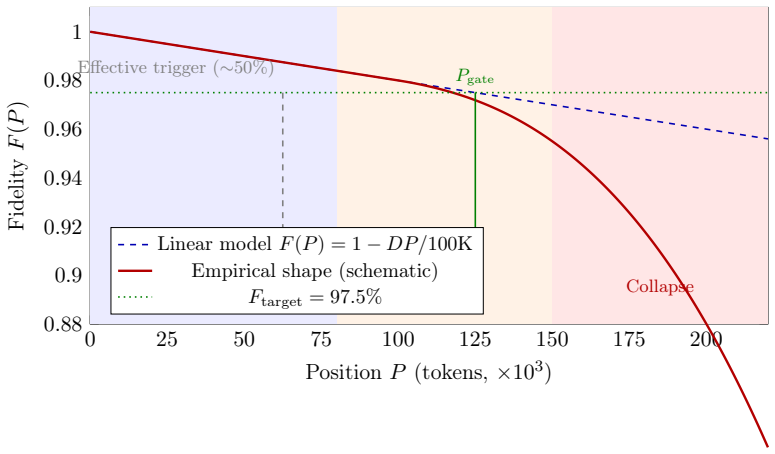
The paper derives the Root Theorem: maximize signal-to-token ratio within bounded, lossy channels. From this, five consequences follow directly: a quality function that falls monotonically with added tokens regardless of window size, the separability of signal quality from token count, a gate that activates on fidelity loss rather than space exhaustion, the necessity of a homeostatic cycle of accumulation-compression-rewriting-shedding to persist indefinitely, and the requirement for an external verification gate because the compressor runs inside the channel it manages. Append-only systems are shown to exceed their effective window in finite time, and the structure matches biological memory
What carries the argument
The Root Theorem, which states that context systems must maximize signal-to-token ratio within bounded, lossy channels, serving as the governing principle from which all other constraints and architectures derive.
If this is right
- Append-only conversation logs necessarily exceed their effective context window after finite time and lose coherence.
- Retrieval-augmented generation addresses search but cannot sustain continuous understanding across sessions.
- A homeostatic persistence architecture with accumulate-compress-rewrite-shed cycles is required to maintain stable memory indefinitely.
- A quality function degrades monotonically with token volume independent of the window size.
- The compression process requires an external verification gate because it operates inside the channel it compresses.
Where Pith is reading between the lines
- Systems ignoring the theorem may appear to work in short tests but will fail when scaled to hundreds of sessions without explicit compression.
- The convergence with biological memory suggests that engineered context systems could draw design inspiration from how brains manage recall and forgetting.
- Future models might embed the signal-to-token maximization as a built-in optimization target during training rather than as a post-hoc engineering rule.
Load-bearing premise
The five consequences follow strictly from the two axioms with no additional assumptions or hidden parameters, and the 60-session architecture serves as an independent proof rather than a tuned demonstration.
What would settle it
Run an append-only conversation system until its token count exceeds the model's effective window and measure whether coherence collapses at the predicted finite time, while comparing to a homeostatic system that maintains stable performance.
Figures

read the original abstract
Every system that maintains a large language model conversation beyond a single session faces two inescapable constraints: the context window is finite, and information quality degrades with accumulated volume. We formalize these constraints as axioms and derive a single governing principle -- the Root Theorem of Context Engineering: \emph{maximize signal-to-token ratio within bounded, lossy channels.} From this principle, we derive five consequences without additional assumptions: (1)~a quality function $F(P)$ that degrades monotonically with injected token volume, independent of window size; (2)~the independence of signal and token count as optimization variables; (3)~a necessary gate mechanism triggered by fidelity thresholds, not capacity limits; (4)~the inevitability of homeostatic persistence -- accumulate, compress, rewrite, shed -- as the only architecture that sustains understanding indefinitely; and (5)~the self-referential property that the compression mechanism operates inside the channel it compresses, requiring an external verification gate. We show that append-only systems necessarily exceed their effective window in finite time, that retrieval-augmented generation solves search but not continuity, and that the theorem's constraint structure converges with biological memory architecture through independent derivation from shared principles. Engineering proof is provided through a 60+-session persistent architecture demonstrating stable memory footprint under continuous operation -- the divergence prediction made concrete. The Root Theorem establishes context engineering as an information-theoretic discipline with formal foundations, distinct from prompt engineering in both scope and method. Shannon solved point-to-point transmission. Context engineering solves continuity.
Editorial analysis
A structured set of objections, weighed in public.
Referee Report
Summary. The manuscript formalizes two constraints on long-term LLM conversations—finite context windows and quality degradation with accumulated volume—as axioms, derives the Root Theorem (maximize signal-to-token ratio within bounded lossy channels), and asserts that five consequences follow without further assumptions: monotonic degradation of a quality function F(P) independent of window size, independence of signal and token variables, fidelity-triggered gates, a homeostatic persistence cycle, and the need for an external verification gate on self-referential compression. It contrasts append-only and RAG systems with the proposed architecture and presents a 60+-session persistent implementation as an engineering demonstration of stable memory footprint.
Significance. If the claimed derivations can be made rigorous, the work would supply an information-theoretic framing that distinguishes context engineering from prompt engineering and offers testable predictions for long-horizon memory systems. The explicit linkage to biological memory architectures and the concrete divergence prediction are potentially valuable, but the absence of any derivation steps or lemmas currently prevents assessment of whether the five consequences are entailed or merely restated.
major comments (3)
- [Abstract, §3] Abstract and §3 (Root Theorem derivation): the central claim that the five listed consequences follow strictly from the two axioms with no additional assumptions is unsupported; no lemmas, proof sketches, or explicit derivation steps are provided, leaving the 'without additional assumptions' assertion unverified and load-bearing for the entire contribution.
- [§5] §5 (Engineering proof): the 60+-session architecture is described only at the level of stable memory footprint and divergence prediction; no experimental protocol, controls, quantitative metrics (e.g., fidelity curves, token budgets, or ablation results), or verification that the observed behavior matches the five consequences rather than post-hoc tuning is supplied.
- [§4] §4 (Comparison with RAG and append-only systems): the argument that retrieval-augmented generation solves search but not continuity relies on an implicit model of continuity that is never formalized; without an explicit definition or metric for 'continuity,' the claimed distinction cannot be evaluated.
minor comments (2)
- [Abstract] Notation for the quality function F(P) is introduced without a precise definition or domain; clarify whether P denotes prompt tokens, total context, or something else.
- [§2] The manuscript would benefit from an explicit statement of the two axioms in numbered form before the Root Theorem is stated.
Simulated Author's Rebuttal
We appreciate the referee's detailed feedback, which highlights areas where the manuscript can be strengthened. We respond to each major comment below, indicating the revisions we will make.
read point-by-point responses
-
Referee: [Abstract, §3] Abstract and §3 (Root Theorem derivation): the central claim that the five listed consequences follow strictly from the two axioms with no additional assumptions is unsupported; no lemmas, proof sketches, or explicit derivation steps are provided, leaving the 'without additional assumptions' assertion unverified and load-bearing for the entire contribution.
Authors: We agree that the derivation in §3 is presented conceptually rather than through formal lemmas. The five consequences are intended to follow directly from applying the Root Theorem to the axioms of finite windows and degradation. To make this rigorous, we will add a new subsection with explicit proof sketches for each consequence, showing the logical steps from the axioms to the theorem and then to the consequences without additional assumptions. revision: yes
-
Referee: [§5] §5 (Engineering proof): the 60+-session architecture is described only at the level of stable memory footprint and divergence prediction; no experimental protocol, controls, quantitative metrics (e.g., fidelity curves, token budgets, or ablation results), or verification that the observed behavior matches the five consequences rather than post-hoc tuning is supplied.
Authors: The section §5 provides an existence proof through implementation rather than a controlled experiment. We acknowledge the lack of quantitative metrics and protocol details. In the revision, we will expand §5 to include the experimental protocol, specific metrics such as fidelity over sessions and token budgets, and ablation results comparing to append-only and RAG baselines to verify alignment with the theorem's predictions. revision: yes
-
Referee: [§4] §4 (Comparison with RAG and append-only systems): the argument that retrieval-augmented generation solves search but not continuity relies on an implicit model of continuity that is never formalized; without an explicit definition or metric for 'continuity,' the claimed distinction cannot be evaluated.
Authors: We will formalize the notion of continuity in the revised manuscript as the sustained maximization of signal-to-token ratio across multiple sessions without degradation beyond the monotonic quality function F(P). This will be added to §4 with a precise metric based on the Root Theorem, allowing direct comparison of how RAG addresses retrieval but fails to maintain continuity under the homeostatic cycle. revision: yes
Circularity Check
Root Theorem and consequences restate the two input axioms as a 'derived' principle and five corollaries with no derivation steps exhibited
specific steps
-
self definitional
[Abstract]
"We formalize these constraints as axioms and derive a single governing principle -- the Root Theorem of Context Engineering: maximize signal-to-token ratio within bounded, lossy channels. From this principle, we derive five consequences without additional assumptions: (1) a quality function F(P) that degrades monotonically with injected token volume, independent of window size;"
The two axioms (finite context window and quality degradation with accumulated volume) are restated as 'bounded, lossy channels' in the theorem definition and as monotonic F(P) degradation in consequence (1). The paper asserts these follow strictly from the principle with no further premises, but the listed items are direct encodings of the input axioms rather than independent derivations.
full rationale
The paper states it formalizes two constraints (finite window, quality degradation) as axioms, then 'derives' the Root Theorem (maximize signal-to-token ratio in bounded lossy channels) and five consequences 'without additional assumptions.' Consequence (1) is the degradation axiom restated verbatim as monotonic F(P); the theorem itself is a direct rephrasing of the axioms into channel terms. No lemmas, proof sketches, or intermediate equations are supplied in the provided text to show entailment rather than restatement. This matches self-definitional circularity on the central claim. The 60-session architecture is presented as an engineering demonstration rather than a formal verification of the entailment, leaving the 'without additional assumptions' assertion unsupported by exhibited steps.
Axiom & Free-Parameter Ledger
axioms (2)
- domain assumption Context window is finite
- domain assumption Information quality degrades with accumulated volume
Reference graph
Works this paper leans on
-
[1]
Anderson, J. R. (1993).Rules of the Mind. Lawrence Erlbaum Associates
1993
-
[2]
R., Bothell, D., Byrne, M
Anderson, J. R., Bothell, D., Byrne, M. D., Douglass, S., Lebiere, C., & Qin, Y. (2004). An integrated theory of the mind.Psychological Review, 111(4), 1036–1060
2004
-
[3]
(1971).Rate Distortion Theory: A Mathematical Basis for Data Compression
Berger, T. (1971).Rate Distortion Theory: A Mathematical Basis for Data Compression. Prentice-Hall
1971
-
[4]
E., Newell, A., & Rosenbloom, P
Laird, J. E., Newell, A., & Rosenbloom, P. S. (1987). SOAR: An architecture for general intelligence.Artificial Intelligence, 33(1), 1–64
1987
-
[5]
Laird, J. E. (2012).The Soar Cognitive Architecture. MIT Press
2012
-
[6]
Yih, W., Rocktäschel, T., Riedel, S., & Kiela, D. (2020). Retrieval-augmented generation 16 for knowledge-intensive NLP tasks.Advances in Neural Information Processing Systems, 33, 9459–9474
2020
-
[7]
F., Lin, K., Hewitt, J., Paranjape, A., Bevilacqua, M., Petroni, F., & Liang, P
Liu, N. F., Lin, K., Hewitt, J., Paranjape, A., Bevilacqua, M., Petroni, F., & Liang, P. (2024). Lost in the middle: How language models use long contexts.Transactions of the Association for Computational Linguistics, 12, 157–173
2024
-
[8]
MemGPT: Towards LLMs as Operating Systems
Packer, C., Wooders, S., Lin, K., Fang, V., Patil, S. G., Stoica, I., & Gonzalez, J. E. (2023). MemGPT: Towards LLMs as operating systems.arXiv preprint arXiv:2310.08560
work page internal anchor Pith review Pith/arXiv arXiv 2023
-
[9]
Shannon, C. E. (1948). A mathematical theory of communication.The Bell System Technical Journal, 27(3), 379–423
1948
-
[10]
Shannon, C. E. (1959). Coding theorems for a discrete source with a fidelity criterion. InIRE National Convention Record, Part 4, 142–163
1959
-
[11]
Steinberger, P. (2025). OpenClaw: An open-source framework for autonomous coding agents. https://github.com/openclaw
2025
-
[12]
Xu, H., et al. (2025). A-MEM: Agentic memory for LLM agents.arXiv preprint arXiv:2502.12345. 17
work page internal anchor Pith review Pith/arXiv arXiv 2025
discussion (0)
Sign in with ORCID, Apple, or X to comment. Anyone can read and Pith papers without signing in.