Recognition: unknown
Focus Session: Hardware and Software Techniques for Accelerating Multimodal Foundation Models
Pith reviewed 2026-05-09 22:59 UTC · model grok-4.3
The pith
A multi-layered hardware-software methodology accelerates multimodal foundation models by combining quantization, pruning, speculative decoding, and custom accelerators.
A machine-rendered reading of the paper's core claim, the machinery that carries it, and where it could break.
Core claim
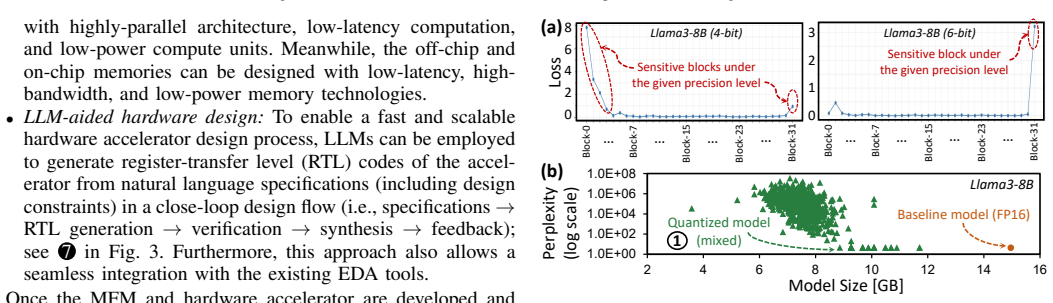
The paper claims that a multi-layered methodology combining hardware and software co-design, model compression through hierarchy-aware mixed-precision quantization and structural pruning of transformer blocks and MLP channels, operation optimization via speculative decoding and model cascading with lightweight self-tests, co-optimization of sequence length, visual resolution and stride plus graph-level operator fusion, optimized dataflow with memory-efficient attention, and specialized hardware accelerators can reduce computational and memory requirements of multimodal foundation models while supporting domain-specific fine-tuning.
What carries the argument
The multi-layered hardware-software co-design methodology for transformer blocks, which integrates compression, inference optimization, dataflow tuning, and accelerators to meet on-chip bandwidth and latency budgets.
If this is right
- The techniques reduce computational and memory requirements for running multimodal foundation models.
- Fine-tuning enables domain-specific adaptation during model development.
- Effectiveness is shown for medical multimodal models and code generation tasks.
- The methodology supports extensions to energy-efficient spiking multimodal models.
- Hardware accelerators can be created via expert design or LLM-aided approaches.
Where Pith is reading between the lines
- Similar co-design patterns might transfer to accelerating other large transformer-based systems beyond multimodal cases.
- The model cascading approach could generalize to reduce average compute in any cascaded inference pipeline.
- LLM-aided hardware design lowers the barrier for creating custom accelerators for specific workloads.
Load-bearing premise
The listed techniques of hierarchy-aware mixed-precision quantization, structural pruning, speculative decoding, model cascading, and hardware accelerators can be co-optimized and applied together to multimodal models without unacceptable accuracy or latency trade-offs.
What would settle it
Applying the full set of techniques together to a medical multimodal foundation model and observing whether accuracy falls below task requirements or end-to-end latency exceeds real-time budgets on standard benchmarks.
Figures




read the original abstract
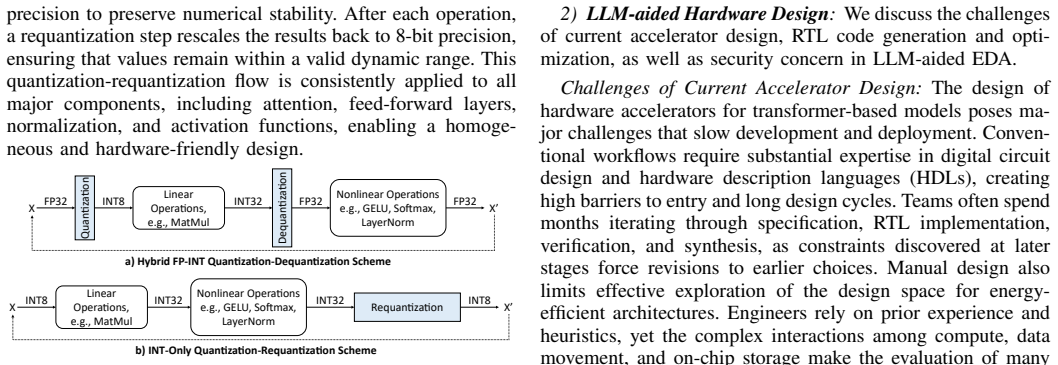
This work presents a multi-layered methodology for efficiently accelerating multimodal foundation models (MFMs). It combines hardware and software co-design of transformer blocks with an optimization pipeline that reduces computational and memory requirements. During model development, it employs performance enhancements through fine-tuning for domain-specific adaptation. Our methodology further incorporates hardware and software techniques for optimizing MFMs. Specifically, it employs MFM compression using hierarchy-aware mixed-precision quantization and structural pruning for transformer blocks and MLP channels. It also optimizes operations through speculative decoding, model cascading that routes queries through a small-to-large cascade and uses lightweight self-tests to determine when to escalate to larger models, as well as co-optimization of sequence length, visual resolution & stride, and graph-level operator fusion. To efficiently execute the model, the processing dataflow is optimized based on the underlying hardware architecture together with memory-efficient attention to meet on-chip bandwidth and latency budgets. To support this, a specialized hardware accelerator for the transformer workloads is employed, which can be developed through expert design or an LLM-aided design approach. We demonstrate the effectiveness of the proposed methodology on medical-MFMs and on code generation tasks, and conclude with extensions toward energy-efficient spiking-MFMs.
Editorial analysis
A structured set of objections, weighed in public.
Referee Report
Summary. The manuscript presents a multi-layered hardware-software co-design methodology for accelerating multimodal foundation models (MFMs). It describes techniques including hierarchy-aware mixed-precision quantization, structural pruning of transformer blocks and MLP channels, speculative decoding, model cascading with lightweight self-tests, co-optimization of sequence length/visual resolution/stride, graph-level operator fusion, memory-efficient attention, and specialized hardware accelerators (expert or LLM-aided design). The paper claims to demonstrate the effectiveness of this methodology on medical-MFMs and code generation tasks and concludes with extensions toward energy-efficient spiking-MFMs.
Significance. If the claimed demonstrations were supported by empirical evidence, the work could be significant as a comprehensive framework for co-optimizing multiple acceleration techniques on real multimodal models, with relevance to resource-constrained domains such as medical imaging and code generation. The integration of compression, inference optimizations, and hardware specialization addresses a timely challenge in deploying large MFMs efficiently.
major comments (2)
- [Abstract] Abstract: The central claim that 'We demonstrate the effectiveness of the proposed methodology on medical-MFMs and on code generation tasks' is unsupported, as the manuscript contains no experimental results, benchmarks, latency/energy metrics, accuracy deltas, ablation studies, implementation details, or comparisons to baselines.
- [Full text] Manuscript body: The text functions as a high-level descriptive overview that enumerates techniques (quantization, pruning, speculative decoding, cascading, accelerators) without any quantitative evaluation, tables, figures, or task-specific results to substantiate co-optimization feasibility or acceptable accuracy/latency trade-offs.
Simulated Author's Rebuttal
We thank the referee for the constructive feedback. The manuscript is a high-level overview and compilation of hardware-software co-design techniques for multimodal foundation models, proposing a multi-layered methodology without presenting new empirical experiments or benchmarks. We will revise the abstract and body to remove any implication of unsupported demonstrations and clarify the paper's scope as a survey with illustrative discussion of applications.
read point-by-point responses
-
Referee: [Abstract] Abstract: The central claim that 'We demonstrate the effectiveness of the proposed methodology on medical-MFMs and on code generation tasks' is unsupported, as the manuscript contains no experimental results, benchmarks, latency/energy metrics, accuracy deltas, ablation studies, implementation details, or comparisons to baselines.
Authors: We agree that the claim is unsupported by new results. The manuscript compiles and organizes existing techniques into a co-design methodology, using medical and code domains as illustrative contexts drawn from prior literature rather than new experiments. We will revise the abstract to state that we discuss the application of the methodology to these tasks, removing the word 'demonstrate' and any implication of original empirical validation. revision: yes
-
Referee: [Full text] Manuscript body: The text functions as a high-level descriptive overview that enumerates techniques (quantization, pruning, speculative decoding, cascading, accelerators) without any quantitative evaluation, tables, figures, or task-specific results to substantiate co-optimization feasibility or acceptable accuracy/latency trade-offs.
Authors: This characterization is correct. The paper presents a conceptual framework and enumeration of techniques with co-optimization strategies, without new quantitative results, tables, or figures. We will add explicit statements in the introduction and conclusion clarifying that the work is an overview paper and that empirical validation of the full co-optimized pipeline is beyond the current scope (or cite relevant prior studies for individual techniques). No new experiments will be added. revision: partial
Circularity Check
No circularity: descriptive methodology overview with no derivations or equations
full rationale
The manuscript is a high-level survey-style description of hardware/software co-design techniques for MFMs. It enumerates methods (quantization, pruning, speculative decoding, cascading, accelerators) and asserts demonstrations on medical-MFMs and code generation, but supplies no equations, fitted parameters, predictions, or self-citation chains. The demonstration claim lacks supporting results, yet this is an evidentiary gap rather than circular reduction of any derivation to its inputs. No load-bearing steps exist that could be self-definitional, fitted-input predictions, or uniqueness imports.
Axiom & Free-Parameter Ledger
Reference graph
Works this paper leans on
-
[1]
Resource-efficient algorithms and systems of foundation models: A survey,
M. Xuet al., “Resource-efficient algorithms and systems of foundation models: A survey,”ACM CSUR, vol. 57, no. 5, Jan. 2025
2025
-
[2]
A survey of resource-efficient llm and multimodal foundation models,
——, “A survey of resource-efficient llm and multimodal foundation models,”arXiv preprint arXiv:2401.08092, 2024
-
[3]
Zero-shot text-to-image generation,
A. Rameshet al., “Zero-shot text-to-image generation,” inICML, 2021
2021
-
[4]
Text2video-zero: Text-to-image diffusion models are zero-shot video generators,
L. Khachatryanet al., “Text2video-zero: Text-to-image diffusion models are zero-shot video generators,” inICCV, 2023, pp. 15 954–15 964
2023
-
[5]
SAM 3: Segment Anything with Concepts
N. Carionet al., “Sam 3: Segment anything with concepts,”arXiv preprint arXiv:2511.16719, 2025
work page internal anchor Pith review Pith/arXiv arXiv 2025
-
[6]
Visual instruction tuning,
H. Liuet al., “Visual instruction tuning,”NeurIPS, vol. 36, 2023
2023
-
[7]
Advancing healthcare in low-resource environments through an optimization and deployment framework for medical mul- timodal large language models,
A. Miret al., “Advancing healthcare in low-resource environments through an optimization and deployment framework for medical mul- timodal large language models,” 11 2024, pp. 1–8
2024
-
[8]
Vision-language-action models for robotics: A review towards real-world applications,
K. Kawaharazukaet al., “Vision-language-action models for robotics: A review towards real-world applications,”IEEE Access, vol. 13, 2025
2025
-
[9]
Dataset distillation.arXiv preprint arXiv:1811.10959, 2018
T. Wanget al., “Dataset distillation,”arXiv preprint:1811.10959, 2018
-
[10]
MPrompt: Exploring multi-level prompt tuning for machine reading comprehension,
G. Chenet al., “MPrompt: Exploring multi-level prompt tuning for machine reading comprehension,” inEMNLP, 2023
2023
-
[11]
Prefix propagation: Parameter-efficient tuning for long sequences,
J. Liet al., “Prefix propagation: Parameter-efficient tuning for long sequences,” inACL (Volume 2: Short Papers), 2023, pp. 1408–1419
2023
-
[12]
On the effectiveness of parameter-efficient fine-tuning,
Z. Fuet al., “On the effectiveness of parameter-efficient fine-tuning,” in AAAI, vol. 37, no. 11, 2023, pp. 12 799–12 807
2023
-
[13]
Towards green AI in fine-tuning large language models via adaptive backpropagation,
K. Huanget al., “Towards green AI in fine-tuning large language models via adaptive backpropagation,” inICLR, 2024
2024
-
[14]
EfficientDM: Efficient quantization-aware fine-tuning of low-bit diffusion models,
Y . Heet al., “EfficientDM: Efficient quantization-aware fine-tuning of low-bit diffusion models,” inICLR, 2024
2024
-
[15]
LoRA: Low-rank adaptation of large language models,
E. J. Huet al., “LoRA: Low-rank adaptation of large language models,” inICLR, 2022
2022
-
[16]
An efficient encoder-decoder architecture with top-down attention for speech separation,
K. Li, R. Yang, and X. Hu, “An efficient encoder-decoder architecture with top-down attention for speech separation,” inICLR, 2023
2023
-
[17]
Mega: Moving average equipped gated attention,
X. Maet al., “Mega: Moving average equipped gated attention,” inICLR, 2023
2023
-
[18]
RWKV: Reinventing RNNs for the transformer era,
B. Penget al., “RWKV: Reinventing RNNs for the transformer era,” in EMNLP, 2023
2023
-
[19]
Mamba: Linear-time sequence modeling with selective state spaces,
A. Gu and T. Dao, “Mamba: Linear-time sequence modeling with selective state spaces,” inCOLM, 2024
2024
-
[20]
Scaling vision with sparse mixture of experts,
C. Riquelmeet al., “Scaling vision with sparse mixture of experts,” NeurIPS, vol. 34, pp. 8583–8595, 2021
2021
-
[21]
Fast and robust early-exiting framework for autoregressive language models with synchronized parallel decoding,
S. Baeet al., “Fast and robust early-exiting framework for autoregressive language models with synchronized parallel decoding,” inEMNLP, 2023
2023
-
[22]
Denoising diffusion implicit models,
J. Songet al., “Denoising diffusion implicit models,” inICLR, 2021
2021
-
[23]
High-resolution image synthesis with latent diffusion models,
R. Rombachet al., “High-resolution image synthesis with latent diffusion models,” inCVPR, 2022, pp. 10 684–10 695
2022
-
[24]
Scalecrafter: Tuning-free higher-resolution visual generation with diffusion models,
Y . Heet al., “Scalecrafter: Tuning-free higher-resolution visual generation with diffusion models,” inICLR, 2023
2023
-
[25]
Sparsegpt: massive language models can be accurately pruned in one-shot,
E. Frantar and D. Alistarh, “Sparsegpt: massive language models can be accurately pruned in one-shot,” inICML, 2023
2023
-
[26]
A simple and effective pruning approach for large language models,
M. Sunet al., “A simple and effective pruning approach for large language models,” inICLR, 2024
2024
-
[27]
Plug-and-play: An efficient post-training pruning method for large language models,
Y . Zhanget al., “Plug-and-play: An efficient post-training pruning method for large language models,” inICLR, 2024
2024
-
[28]
Llm-pruner: On the structural pruning of large language models,
X. Ma, G. Fang, and X. Wang, “Llm-pruner: On the structural pruning of large language models,” inNeurIPS, vol. 36, 2023, pp. 21 702–21 720
2023
-
[29]
Sleb: streamlining llms through redundancy verification and elimination of transformer blocks,
J. Songet al., “Sleb: streamlining llms through redundancy verification and elimination of transformer blocks,” inICML, 2024
2024
-
[30]
Sheared LLaMA: Accelerating language model pre- training via structured pruning,
M. Xiaet al., “Sheared LLaMA: Accelerating language model pre- training via structured pruning,” inICLR, 2024
2024
-
[31]
Smoothquant: Accurate and efficient post-training quan- tization for large language models,
G. Xiaoet al., “Smoothquant: Accurate and efficient post-training quan- tization for large language models,” inICML, 2023
2023
-
[32]
Awq: Activation-aware weight quantization for on-device llm compression and acceleration,
J. Linet al., “Awq: Activation-aware weight quantization for on-device llm compression and acceleration,” inMLSys, vol. 6, 2024, pp. 87–100
2024
-
[33]
Omniquant: Omnidirectionally calibrated quantization for large language models,
W. Shaoet al., “Omniquant: Omnidirectionally calibrated quantization for large language models,” inICLR, 2024
2024
-
[34]
Spinquant: Llm quantization with learned rotations,
Z. Liuet al., “Spinquant: Llm quantization with learned rotations,” in ICLR, 2025
2025
-
[35]
MiniLLM: Knowledge distillation of large language models,
Y . Guet al., “MiniLLM: Knowledge distillation of large language models,” inICLR, 2024
2024
-
[36]
Losparse: Structured compression of large language models based on low-rank and sparse approximation,
Y . Liet al., “Losparse: Structured compression of large language models based on low-rank and sparse approximation,” inICML, 2023
2023
-
[37]
LoRD: Low-rank decomposition of monolingual code LLMs for one-shot compression,
A. Kaushal, T. Vaidhya, and I. Rish, “LoRD: Low-rank decomposition of monolingual code LLMs for one-shot compression,” inICML 2024 Workshop on Foundation Models in the Wild, 2024
2024
-
[38]
H. Guo, Y . Li, and L. Benini, “Optimal brain restoration for joint quantization and sparsification of llms,”arXiv preprint:2509.11177, 2025
-
[39]
Scissorhands: Exploiting the persistence of importance hypothesis for llm kv cache compression at test time,
Z. Liuet al., “Scissorhands: Exploiting the persistence of importance hypothesis for llm kv cache compression at test time,” inNeurIPS, 2023
2023
-
[40]
Spectr: Fast speculative decoding via optimal transport,
Z. Sunet al., “Spectr: Fast speculative decoding via optimal transport,” inNeurIPS, 2023
2023
-
[41]
LLMLingua: Compressing prompts for accelerated inference of large language models,
H. Jianget al., “LLMLingua: Compressing prompts for accelerated inference of large language models,” inEMNLP, 2023
2023
-
[42]
Dynamic context pruning for efficient and interpretable autoregressive transformers,
S. Anagnostidiset al., “Dynamic context pruning for efficient and interpretable autoregressive transformers,” inNeurIPS, 2023
2023
-
[43]
Model cascading for code: A cascaded black-box multi- model framework for cost-efficient code completion with self-testing,
B. Chenet al., “Model cascading for code: A cascaded black-box multi- model framework for cost-efficient code completion with self-testing,” in IJCNN, 2025, pp. 1–9
2025
-
[44]
Efficient streaming language models with attention sinks,
G. Xiaoet al., “Efficient streaming language models with attention sinks,” inICLR, 2024
2024
-
[45]
Romanet: Fine-grained reuse-driven off-chip memory access management and data organization for deep neural network accelerators,
R. V . W. Putraet al., “Romanet: Fine-grained reuse-driven off-chip memory access management and data organization for deep neural network accelerators,”IEEE TVLSI, vol. 29, no. 4, pp. 702–715, 2021
2021
-
[46]
Drmap: A generic dram data mapping policy for energy-efficient processing of convolutional neural networks,
R. V . W. Putra, M. A. Hanif, and M. Shafique, “Drmap: A generic dram data mapping policy for energy-efficient processing of convolutional neural networks,” inDAC, 2020, pp. 1–6
2020
-
[47]
J. Liet al., “Large language model inference acceleration: A comprehen- sive hardware perspective,”arXiv preprint arXiv:2410.04466, 2024
-
[48]
A 3: Accelerating attention mechanisms in neural networks with approximation,
T. J. Hamet al., “A 3: Accelerating attention mechanisms in neural networks with approximation,” inHPCA, 2020, pp. 328–341
2020
-
[49]
Towards fully 8-bit integer inference for the transformer model,
Y . Linet al., “Towards fully 8-bit integer inference for the transformer model,” inIJCAI, 2020, pp. 3759–3765
2020
-
[50]
Swifttron: An efficient hardware accelerator for quantized transformers,
A. Marchisioet al., “Swifttron: An efficient hardware accelerator for quantized transformers,” inIJCNN, 2023, pp. 1–9
2023
-
[51]
A survey on hardware accelerators for large language models,
C. Kachris, “A survey on hardware accelerators for large language models,”Applied Sciences, vol. 15, no. 2, p. 586, 2025
2025
-
[52]
A survey of research in large language models for electronic design automation,
J. Panet al., “A survey of research in large language models for electronic design automation,”ACM TODAES, vol. 30, no. 3, 2025
2025
-
[53]
Survey of different large language model architectures: Trends, benchmarks, and challenges,
M. Shaoet al., “Survey of different large language model architectures: Trends, benchmarks, and challenges,”IEEE Access, 2024
2024
-
[54]
P. E. Calzadaet al., “Verilogdb: The largest, highest-quality dataset with a preprocessing framework for llm-based rtl generation,”arXiv preprint arXiv:2507.13369, 2025
-
[55]
Verilogeval: Evaluating large language models for verilog code generation,
M. Liu, N. Pinckney, B. Khailany, and H. Ren, “Verilogeval: Evaluating large language models for verilog code generation,” inICCAD, 2023
2023
-
[56]
Rtllm: An open-source benchmark for design rtl generation with large language model,
Y . Luet al., “Rtllm: An open-source benchmark for design rtl generation with large language model,” inASP-DAC, 2024, pp. 722–727
2024
-
[57]
Chipnemo: Domain-adapted llms for chip design,
M. Liuet al., “Chipnemo: Domain-adapted llms for chip design,”arXiv preprint arXiv:2311.00176, 2023
-
[58]
Rtlcoder: Fully open-source and efficient llm-assisted rtl code generation technique,
S. Liuet al., “Rtlcoder: Fully open-source and efficient llm-assisted rtl code generation technique,”IEEE TCAD, 2024
2024
-
[59]
Towards llm-powered verilog rtl assistant: Self-verification and self-correction,
H. Huanget al., “Towards llm-powered verilog rtl assistant: Self- verification and self-correction,”arXiv preprint arXiv:2406.00115, 2024
-
[60]
Mage: A multi-agent engine for automated rtl code generation,
Y . Zhao, H. Zhang, H. Huang, Z. Yu, and J. Zhao, “Mage: A multi-agent engine for automated rtl code generation,” inDAC, 2025, pp. 1–7
2025
-
[61]
Chateda: A large language model powered autonomous agent for eda,
H. Wuet al., “Chateda: A large language model powered autonomous agent for eda,”IEEE TCAD, vol. 43, no. 10, pp. 3184–3197, 2024
2024
-
[62]
Z. Wanget al., “Veridispatcher: Multi-model dispatching through pre- inference difficulty prediction for rtl generation optimization,”arXiv preprint arXiv:2511.22749, 2025
-
[63]
Netdetox: Adversarial and efficient evasion of hardware-security gnns via rl-llm orchestration,
——, “Netdetox: Adversarial and efficient evasion of hardware-security gnns via rl-llm orchestration,”arXiv preprint arXiv:2512.00119, 2025
-
[64]
Llms and the future of chip design: Unveiling security risks and building trust,
——, “Llms and the future of chip design: Unveiling security risks and building trust,” inISVLSI, 2024, pp. 385–390
2024
-
[65]
TrojanLoC: Fine-grained hardware Trojan detection from Verilog code,
W. Xiaoet al., “Trojanloc: Llm-based framework for rtl trojan localiza- tion,”arXiv preprint arXiv:2512.00591, 2025
-
[66]
Bugwhisperer: Fine-tuning llms for soc hardware vulnerability detection,
S. Tareket al., “Bugwhisperer: Fine-tuning llms for soc hardware vulnerability detection,” inVTS, 2025, pp. 1–5
2025
-
[67]
Vericontaminated: Assessing llm-driven verilog coding for data contamination,
Z. Wanget al., “Vericontaminated: Assessing llm-driven verilog coding for data contamination,”arXiv preprint arXiv:2503.13572, 2025
-
[68]
Verileaky: Navigating ip protection vs utility in fine-tuning for llm-driven verilog coding,
——, “Verileaky: Navigating ip protection vs utility in fine-tuning for llm-driven verilog coding,”arXiv preprint arXiv:2503.13116, 2025
-
[69]
Salad: Systematic assessment of machine unlearning on llm-aided hardware design,
——, “Salad: Systematic assessment of machine unlearing on llm-aided hardware design,”arXiv preprint arXiv:2506.02089, 2025
-
[70]
Tinyllava: A framework of small-scale large multimodal models,
B. Zhouet al., “Tinyllava: A framework of small-scale large multimodal models,”arXiv preprint arXiv:2402.14289, 2024
-
[71]
Biomedclip: a multimodal biomedical foundation model pretrained from fifteen million scientific image-text pairs,
S. Zhanget al., “Biomedclip: a multimodal biomedical foundation model pretrained from fifteen million scientific image-text pairs,” 2025
2025
-
[72]
Llava-med: Training a large language-and-vision assistant for biomedicine in one day,
C. Liet al., “Llava-med: Training a large language-and-vision assistant for biomedicine in one day,” 2023
2023
-
[73]
Rover: Autonomous open-vocabulary object searching in unexplored environments using vlm-driven scene understanding,
A. Basitet al., “Rover: Autonomous open-vocabulary object searching in unexplored environments using vlm-driven scene understanding,” in IJCNN, 2025, pp. 1–8
2025
-
[74]
Spikenas: A fast memory-aware neural architecture search framework for spiking neural network-based embedded ai systems,
R. V . W. Putra and M. Shafique, “Spikenas: A fast memory-aware neural architecture search framework for spiking neural network-based embedded ai systems,”IEEE TAI, pp. 1–12, 2025
2025
-
[75]
R. V . W. Putra, P. Wickramasinghe, and M. Shafique, “Qslm: A performance- and memory-aware quantization framework with tiered search strategy for spike-driven language models,”arXiv preprint arXiv:2601.00679, 2026
work page internal anchor Pith review Pith/arXiv arXiv 2026
-
[76]
SpikeGPT: Generative pre-trained language model with spiking neural networks,
R.-J. Zhuet al., “SpikeGPT: Generative pre-trained language model with spiking neural networks,”TMLR, 2024
2024
-
[77]
Qsvit: A methodology for quantizing spiking vision transformers,
R. V . W. Putra, S. Iftikhar, and M. Shafique, “Qsvit: A methodology for quantizing spiking vision transformers,” inIJCNN, 2025, pp. 1–8
2025
-
[78]
Spike-driven transformer v2: Meta spiking neural network architecture inspiring the design of next-generation neuromorphic chips,
M. Yaoet al., “Spike-driven transformer v2: Meta spiking neural network architecture inspiring the design of next-generation neuromorphic chips,” inICLR, 2024. 7
2024
discussion (0)
Sign in with ORCID, Apple, or X to comment. Anyone can read and Pith papers without signing in.