Recognition: unknown
Electric potential of insulated conducting objects in presence of electric charges -- some exact and approximate results
Pith reviewed 2026-05-08 08:43 UTC · model grok-4.3
The pith
A new J formalism determines the electric potential of insulated conducting objects exactly or approximately from their geometry alone.
A machine-rendered reading of the paper's core claim, the machinery that carries it, and where it could break.
Core claim
The J formalism reformulates the electrostatic boundary-value problem for insulated conductors so that their electric potential in the presence of external charges follows directly from geometrical properties, giving exact values for spheres and practical approximations for general shapes without determining surface charges or the exterior potential.
What carries the argument
The J formalism, a new way to express the potential of an insulated conductor through its geometrical features rather than solving the full boundary value problem.
If this is right
- The potential on a spherical conductor is obtained exactly from its radius and position relative to charges.
- Non-spherical objects receive good approximations based on their shape and size metrics alone.
- Capacitance calculations for conducting objects become feasible without full electrostatic field solutions.
- The computational effort focuses only on the object geometry instead of volume or surface integrals over charges.
Where Pith is reading between the lines
- This could enable quicker estimates in engineering applications involving conductors in electric fields.
- Similar geometry-based approaches might apply to other boundary problems in electrostatics or heat conduction.
- Extensions to multiple conductors or dynamic cases could be explored using the same formalism.
Load-bearing premise
The J formalism correctly reformulates the electrostatic boundary-value problem for insulated conductors and yields valid exact or approximate potentials solely from geometrical properties.
What would settle it
Solving Laplace's equation numerically for an insulated sphere with a nearby point charge and comparing the surface potential to the value given by the J formalism.
Figures





read the original abstract
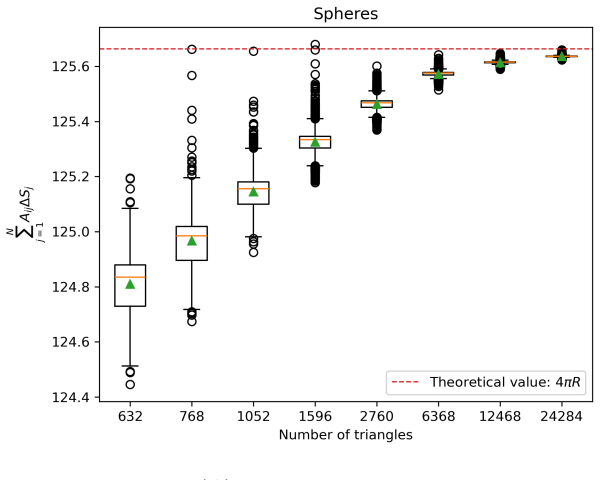
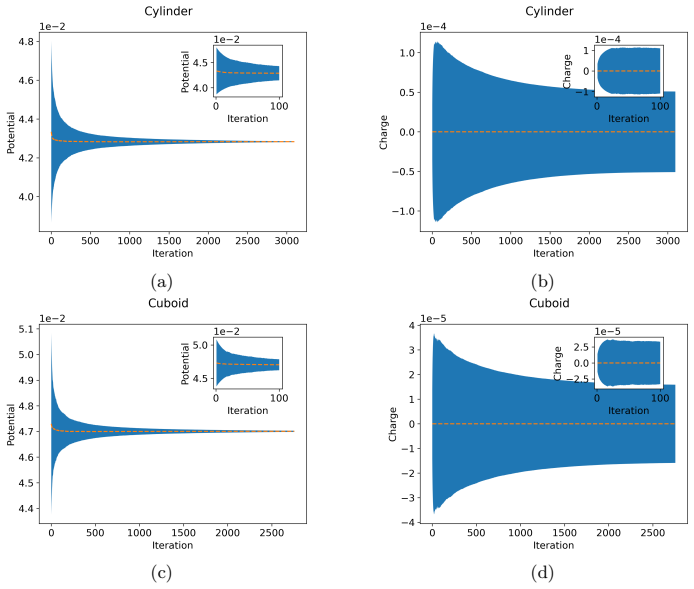
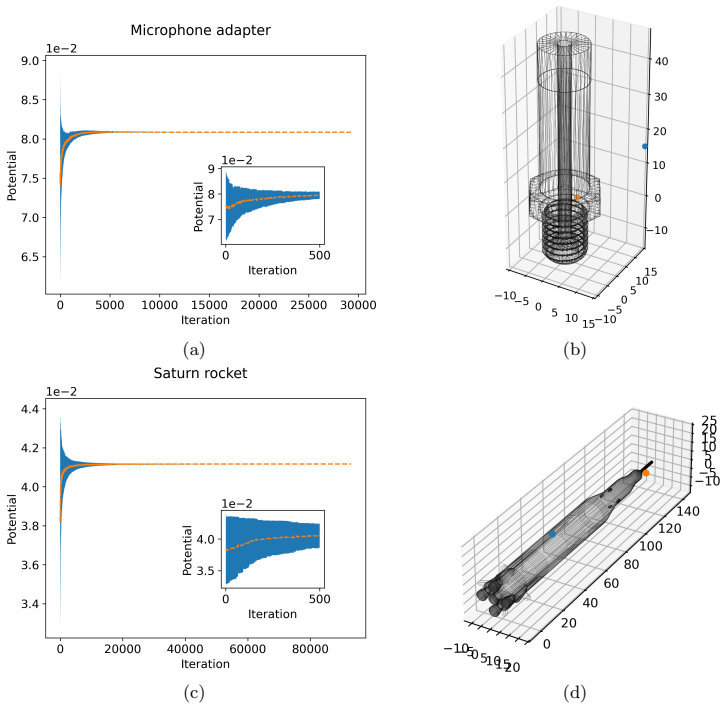
Determination of the electric potential of insulated conducting objects is an important problem both theoretically and practically. For an insulated conducting object in the presence of external charges or charges distributed on the object surface, the problem of potential determination is reformulated using a newly introduced $J$ formalism. Using the $J$ formalism, it is shown how the electric potential can be calculated exactly for spherical objects and efficiently approximated for other object geometries using geometrical properties of the insulated conducting object. This approach does not require calculation of the surface charge distribution at the object surface of the calculation of the electric potential in the surrounding space. Properties and the performance of the approach are investigated numerically using the Robin Hood method. Possible applications of the approach based on the $J$ formalism are outlined for calculation of capacitance of conducting objects.
Editorial analysis
A structured set of objections, weighed in public.
Referee Report
Summary. The manuscript introduces a J formalism to reformulate the electrostatic boundary-value problem for an insulated conducting object in the presence of external charges. It claims that this allows exact determination of the constant potential on spherical objects and efficient approximations for other geometries using only geometrical properties of the object, without explicit computation of the surface charge distribution or the exterior potential field. Numerical properties are investigated via the Robin Hood method, and applications to capacitance calculations are outlined.
Significance. If the J formalism is shown to be mathematically equivalent to the standard BVP (Laplace equation outside, constant potential and fixed total charge on the conductor) while enabling direct geometry-based evaluation, the approach could provide a practical shortcut for potential and capacitance estimates on complex shapes. The exact spherical results would serve as a useful benchmark, but the absence of derivations, error analysis, or quantitative validation in the provided text limits assessment of its advantage over existing methods such as image charges or boundary-element techniques.
major comments (3)
- [J formalism section] The section introducing the J formalism: the reformulation must be shown explicitly to enforce constant potential on the conductor and fixed total charge without implicit reference to the surface charge density or the exterior solution. Provide the step-by-step equivalence proof to the standard boundary conditions, as the central bypass claim depends on this.
- [Spherical objects section] The section on spherical objects: the claimed exact results must be derived or verified against known analytic solutions (e.g., image-charge method for a point charge near an insulated sphere). Include the explicit expression for the potential in terms of J and demonstrate agreement with error bounds.
- [Numerical results] The numerical investigation section: the Robin Hood method tests are referenced but supply no data tables, error metrics, convergence rates, or comparisons to standard solvers. Add quantitative validation (e.g., relative error vs. geometry parameters) to support the approximation claims for non-spherical shapes.
minor comments (2)
- [Abstract] The abstract contains a minor grammatical issue: 'does not require calculation of the surface charge distribution at the object surface or the calculation of the electric potential' should read 'or calculation of the electric potential' for parallelism.
- Notation for the J quantity should be defined with a clear equation number on first use and distinguished from standard electrostatic quantities (e.g., current density or other J symbols) to avoid confusion.
Simulated Author's Rebuttal
We thank the referee for the careful reading and constructive comments on our manuscript. We address each major comment below and will revise the paper accordingly to provide the requested explicit derivations, verifications, and quantitative validations.
read point-by-point responses
-
Referee: [J formalism section] The section introducing the J formalism: the reformulation must be shown explicitly to enforce constant potential on the conductor and fixed total charge without implicit reference to the surface charge density or the exterior solution. Provide the step-by-step equivalence proof to the standard boundary conditions, as the central bypass claim depends on this.
Authors: We agree that an explicit step-by-step equivalence proof is required to fully substantiate the central claim. The manuscript introduces the J formalism as a reformulation that bypasses explicit surface charge and exterior potential calculations by relying on geometrical properties, but we acknowledge the need for a clearer derivation showing direct enforcement of constant potential and fixed total charge. In the revised manuscript, we will add a dedicated subsection with the full equivalence proof to the standard BVP. revision: yes
-
Referee: [Spherical objects section] The section on spherical objects: the claimed exact results must be derived or verified against known analytic solutions (e.g., image-charge method for a point charge near an insulated sphere). Include the explicit expression for the potential in terms of J and demonstrate agreement with error bounds.
Authors: We accept this point. The manuscript states that exact results are obtained for spherical objects via the J formalism, but we will strengthen the section by deriving the explicit potential expression in terms of J, verifying it against the image-charge method for a point charge near an insulated sphere, and including quantitative agreement with error bounds. revision: yes
-
Referee: [Numerical results] The numerical investigation section: the Robin Hood method tests are referenced but supply no data tables, error metrics, convergence rates, or comparisons to standard solvers. Add quantitative validation (e.g., relative error vs. geometry parameters) to support the approximation claims for non-spherical shapes.
Authors: We agree that the numerical section requires more quantitative support. The manuscript investigates properties using the Robin Hood method but does not include detailed metrics. In the revision, we will add data tables, error metrics, convergence rates, and comparisons to standard solvers, with relative errors plotted against geometry parameters for non-spherical shapes. revision: yes
Circularity Check
J formalism is an independent reformulation with no reduction to inputs by construction
full rationale
The paper introduces a new J formalism as a reformulation of the electrostatic BVP for insulated conductors and derives exact results for spheres plus geometry-based approximations for other shapes, all without explicit surface charge or exterior potential. Numerical performance checks rely on the independent Robin Hood method rather than the target quantities themselves. No equations or steps are shown to define J in terms of the predicted potential, fit parameters to the output, or rely on self-citation chains for the central claims. The derivation therefore remains self-contained and does not reduce to its inputs.
Axiom & Free-Parameter Ledger
axioms (1)
- domain assumption The J formalism provides a valid reformulation of the electric potential problem for insulated conducting objects in the presence of charges.
invented entities (1)
-
J formalism
no independent evidence
Reference graph
Works this paper leans on
-
[1]
Llovera-Segovia, Journal of Electrostatics137(2025) 104118
P. Llovera-Segovia, Journal of Electrostatics137(2025) 104118
2025
-
[2]
D. R. Jovel, M. L. R. Walker, and D. Herman, Journal of Propulsion and Power,38(2022) 1051-1081
2022
-
[3]
T, Cai, Y. Fang, Y. Fang, R. Li, Y. Yu, and M. Huang, Beilstein J. Nanotechnol. bf 13 (2022) 390–403
2022
-
[4]
Stamopoulos, Materials17(2024) 5046
D. Stamopoulos, Materials17(2024) 5046
2024
-
[5]
Besley, Acc
E. Besley, Acc. Chem. Res.56(2023) 2267-2277
2023
-
[6]
Zh. Long, J. Meng, L. R. Weddle, P. E. Videla, J. P. Menzel, D. G. A. Cabral, J Liu, T. Qiu, J. M. Palasz, D. Bhattacharyya, C. P. Kubiak, V. S. Batista, and T. Lian, Chem. Rev.125(2025) 1604-1628
2025
-
[7]
J. Cao, Zh. Jin, J. He, G.Ju, L. Mi, Y. Gao, R. Lei, and G. Cheng, Micromachines16(2025) 1285
2025
-
[8]
Huang, G
L. Huang, G. Huang, D. Zhang, X. Chen, Friction13(2) (2025) 9440893
2025
-
[9]
Llovera-Segovia, P
P. Llovera-Segovia, P. Molini´ e, V. Fuster-Roig, A. Quijano-L´ opez, Journal of Electrostatics132(2024) 103986
2024
-
[10]
Lazi´ c, H.ˇStefanˇ ci´ c, H
P. Lazi´ c, H.ˇStefanˇ ci´ c, H. Abraham, J. Comp. Phys.213(2006) 117
2006
-
[11]
Lazi´ c, H.ˇStefanˇ ci´ c, H
P. Lazi´ c, H.ˇStefanˇ ci´ c, H. Abraham, Eng. Anal. Boundary Elem.32 (2008) 76
2008
-
[12]
Lazi´ c, D
P. Lazi´ c, D. Dujmi´ c, J. A. Formaggio, H. Abraham, H. ˇStefanˇ ci´ c, JINST6(2011) P12003
2011
-
[13]
J. A. Formaggio, P. Lazi´ c, T. J. Corona, H. ˇStefanˇ ci´ c, H. Abraham, F. Gluck, Progress In Electromagnetics Research B39(2012) 1
2012
-
[14]
J. D. Jackson, Classical Electrodynamics (Third Edition), John Wi- ley and Sons, Hoboken (1999)
1999
-
[15]
Filipan, H ˇStefanˇ ci´ c, in preparation
K. Filipan, H ˇStefanˇ ci´ c, in preparation. 22
discussion (0)
Sign in with ORCID, Apple, or X to comment. Anyone can read and Pith papers without signing in.