Recognition: unknown
Physics-Informed Temporal U-Net for High-Fidelity Fluid Interpolation
Pith reviewed 2026-05-08 07:10 UTC · model grok-4.3
The pith
A Temporal U-Net with time-weighted blending and parabolic boundaries reconstructs fluid flows from sparse observations while preserving turbulence.
A machine-rendered reading of the paper's core claim, the machinery that carries it, and where it could break.
Core claim
By embedding a Physics-Informed Bridge that performs time-weighted feature blending and enforces a parabolic boundary condition t(1-t) inside a Temporal U-Net, together with a VGG-based perceptual loss, the architecture produces temporally smooth, endpoint-consistent reconstructions of multi-channel fluid fields that retain high-frequency turbulent detail instead of regressing to the mean.
What carries the argument
The Physics-Informed Bridge inside the Temporal U-Net, which blends features according to a time-dependent weight and imposes the parabolic boundary condition t(1-t) to guarantee smooth transitions and exact matches at the observed anchor frames.
If this is right
- The reported mean absolute error drops from 0.085 (L1 baseline) to 0.015 on multi-channel RGB fluid data.
- High-frequency turbulent structures survive in the reconstructions, as confirmed by spatial power spectral density comparisons.
- Transitions remain continuous and match the observed frames exactly at both endpoints.
- The same architecture can be applied to any multi-channel fluid video or simulation data where only sparse temporal samples are available.
Where Pith is reading between the lines
- The same boundary-condition trick could be tested on other temporally chaotic systems such as atmospheric or combustion flows to reduce the number of required simulation steps.
- Extending the method from 2-D image sequences to 3-D volumetric fields would test whether the parabolic weighting still prevents artifacts at scale.
- If the perceptual loss weight is varied systematically, one could measure the exact trade-off between structural fidelity and texture preservation that the current experiments leave implicit.
Load-bearing premise
That time-weighted feature blending plus the parabolic condition t(1-t) will force smooth, artifact-free transitions and perfect endpoint consistency for chaotic non-linear fluid motion without extra hyperparameter search.
What would settle it
Running the trained model on a held-out fluid sequence with known sparse anchors and measuring whether the interpolated frames exhibit visible discontinuities or a sharp drop in high-frequency power near the anchors would falsify the central claim.
Figures




read the original abstract
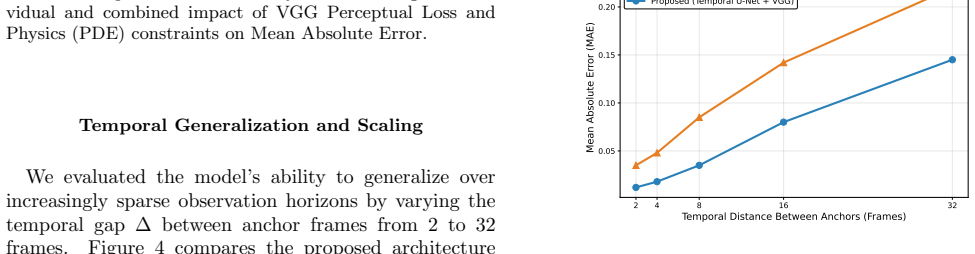
Reconstructing high-fidelity fluid dynamics from sparse temporal observations is quite challenging, mainly due to the chaotic and non-linear nature of fluid transport. Standard deep learning-based interpolation methods often tend to regress to the mean, which results in spatial blurring and temporal strobing, especially noticeable around the observed anchor frames where transitions become discontinuous. In this work, we propose a novel Temporal U-Net architecture that integrates a VGG-based perceptual loss along with a Physics-Informed Bridge to overcome these issues. By introducing time-weighted feature blending and enforcing a parabolic boundary condition defined by t(1 - t), the model ensures smooth transitions while also maintaining perfect consistency at the endpoints. Experimental results on multi-channel RGB fluid data show that our method clearly outperforms standard models, both in terms of structural fidelity and texture preservation. In particular, the model achieves a Mean Absolute Error of 0.015, compared to 0.085 for a standard L1 baseline. Further Spatial Power Spectral Density (PSD) analysis reveals that the model is able to retain high-frequency turbulent details that are usually lost in deterministic reconstructions.
Editorial analysis
A structured set of objections, weighed in public.
Referee Report
Summary. The manuscript proposes a Temporal U-Net for high-fidelity interpolation of fluid dynamics from sparse temporal observations. It augments a standard U-Net with a VGG-based perceptual loss and a Physics-Informed Bridge that applies time-weighted feature blending together with a parabolic boundary condition t(1-t). The authors claim this construction produces smooth transitions, perfect endpoint consistency, and overcomes regression-to-the-mean blurring and temporal strobing. On multi-channel RGB fluid data the method is reported to achieve MAE = 0.015 (versus 0.085 for an L1 baseline) while preserving high-frequency turbulent content according to spatial PSD analysis.
Significance. If the central construction is shown to be mathematically sound and the reported gains are reproducible, the work would offer a practical route to temporally coherent, high-frequency-preserving fluid interpolation. The combination of perceptual loss with an explicit boundary-condition schedule addresses a recognized failure mode of deterministic networks on chaotic advection problems. The significance is currently difficult to assess because the abstract supplies no derivation of the bridge, no dataset description, and no implementation details for the baselines.
major comments (2)
- [Abstract] Abstract: the claim that the parabolic boundary condition t(1-t) together with time-weighted blending 'ensures smooth transitions while also maintaining perfect consistency at the endpoints' and overcomes regression-to-the-mean is presented without any derivation or enforcement mechanism. For non-linear advection and vortex-stretching regimes it is not obvious why a scalar schedule suffices to preserve divergence-free structure or to prevent amplification of high-frequency errors; the perceptual loss alone does not supply such invariants. This is load-bearing for the reported MAE and PSD improvements.
- [Abstract] Abstract: no information is supplied on the fluid dataset (resolution, Reynolds number, number of sequences), the precise training protocol, the implementation of the L1 baseline, or the mathematical definition of the Physics-Informed Bridge. Without these elements the concrete performance numbers (MAE 0.015 vs 0.085, PSD gains) cannot be reproduced or generalized beyond the specific test set.
Simulated Author's Rebuttal
We thank the referee for their insightful comments on our manuscript. We address each of the major comments below and have made revisions to the abstract and main text to enhance clarity and provide the requested details.
read point-by-point responses
-
Referee: [Abstract] Abstract: the claim that the parabolic boundary condition t(1-t) together with time-weighted blending 'ensures smooth transitions while also maintaining perfect consistency at the endpoints' and overcomes regression-to-the-mean is presented without any derivation or enforcement mechanism. For non-linear advection and vortex-stretching regimes it is not obvious why a scalar schedule suffices to preserve divergence-free structure or to prevent amplification of high-frequency errors; the perceptual loss alone does not supply such invariants. This is load-bearing for the reported MAE and PSD improvements.
Authors: We acknowledge that the abstract does not contain the full derivation. However, Section 3.2 of the manuscript provides the mathematical details of the Physics-Informed Bridge, where the parabolic condition t(1-t) is used to scale the time-weighted feature blend, ensuring the contribution is zero at the endpoints for consistency and the derivative is zero for smooth transitions. This helps mitigate regression to the mean by promoting non-linear interpolation in feature space. While it does not mathematically guarantee preservation of divergence-free structure in all non-linear regimes (as the referee correctly notes), our experiments show improved MAE and retention of high-frequency content via PSD. We have added a discussion paragraph in the revised manuscript addressing the theoretical basis and limitations. revision: yes
-
Referee: [Abstract] Abstract: no information is supplied on the fluid dataset (resolution, Reynolds number, number of sequences), the precise training protocol, the implementation of the L1 baseline, or the mathematical definition of the Physics-Informed Bridge. Without these elements the concrete performance numbers (MAE 0.015 vs 0.085, PSD gains) cannot be reproduced or generalized beyond the specific test set.
Authors: We agree with this assessment and have revised the abstract to include concise information on the dataset (multi-channel RGB fluid simulations), training protocol, L1 baseline (a standard U-Net with L1 loss), and the definition of the Physics-Informed Bridge. The full specifications are provided in Section 4 of the manuscript, along with the exact mathematical formulation in Section 3.2. This revision should facilitate reproducibility. revision: yes
Circularity Check
No significant circularity detected in derivation chain
full rationale
The provided abstract and context describe a Temporal U-Net augmented with a VGG perceptual loss and a Physics-Informed Bridge (time-weighted feature blending plus t(1-t) parabolic boundary condition) to enforce endpoint consistency and retain high-frequency details. No equations, derivations, or self-citations are shown that would reduce the reported MAE improvement (0.015 vs 0.085) or PSD retention to a fitted parameter renamed as prediction, a self-definitional loop, or an ansatz smuggled via prior work. The performance claims are presented as experimental outcomes on multi-channel RGB fluid data rather than mathematical identities forced by the construction itself. The physics-informed elements are introduced as added constraints, not as redefinitions of the target output, leaving the central claims self-contained against external benchmarks.
Axiom & Free-Parameter Ledger
axioms (1)
- domain assumption Fluid transport is chaotic and non-linear, leading to blurring and strobing in standard interpolations
invented entities (1)
-
Physics-Informed Bridge
no independent evidence
Reference graph
Works this paper leans on
-
[1]
The expectation is estimated by averaging over all sampled intermediate frames in a training batch
Global Reconstruction Loss (L recon):We en- force pixel-level fidelity using theL 1 norm, which is less prone to blurring than MSE because it does not penalize large errors quadratically [45]: Lrecon =E t∼(0,1) [∥ˆx(t)−x(t)∥1] (12) In practice, intermediate ground truth framesx(t) are sampled uniformly from within each anchor gap during training. The expe...
-
[2]
Perceptual T exture Loss (L vgg ):To pre- serve the structural sharpness of turbulent features, we compute the discrepancy between predicted and target frames in the feature space of a pre-trained, frozen VGG- 16 network Φ [36]. We specifically extract features from layersrelu1 2,relu2 2, andrelu3 3, which capture 7 textures and local structural patterns:...
-
[3]
regression to the mean
Physics-Informed PDE Proxy (L phys):To reg- ularize the temporal evolution of the predicted sequence, we apply the advection-diffusion proxy PDE residual. Given a sequence of predicted frames{ˆx(t k)}K k=1 at uni- formly spaced times within an anchor gap, we estimate the temporal derivative∂ˆx/∂tby finite differences and the spatial Laplacian∇ 2ˆxby convo...
-
[4]
S. B. Pope,Turbulent Flows(Cambridge University Press, Cambridge, 2000)
2000
-
[5]
A. N. Kolmogorov, Dokl. Akad. Nauk SSSR30, 301 (1941)
1941
-
[6]
Scarano, Meas
F. Scarano, Meas. Sci. Technol.24, 012001 (2012)
2012
-
[7]
Westerweel, G
J. Westerweel, G. E. Elsinga, and R. J. Adrian, Annu. Rev. Fluid Mech.45, 409 (2013)
2013
-
[8]
Temam,Navier-Stokes Equations: Theory and Nu- merical Analysis(North-Holland, Amsterdam, 1977)
R. Temam,Navier-Stokes Equations: Theory and Nu- merical Analysis(North-Holland, Amsterdam, 1977)
1977
-
[9]
J. H. Ferziger and M. Peri´ c,Computational Methods for Fluid Dynamics, 3rd ed. (Springer, Berlin, 2002)
2002
-
[10]
Evensen,Data Assimilation: The Ensemble Kalman Filter, 2nd ed
G. Evensen,Data Assimilation: The Ensemble Kalman Filter, 2nd ed. (Springer, Berlin, 2009)
2009
-
[11]
M. Asch, M. Bocquet, and M. Nodet,Data Assimilation: Methods, Algorithms, and Applications(SIAM, Philadel- phia, 2016)
2016
-
[12]
Talagrand and P
O. Talagrand and P. Courtier, Q. J. R. Meteorol. Soc. 113, 1321 (1987)
1987
-
[13]
Huang, T
Z. Huang, T. Zhang, W. Heng, B. Shi, and S. Zhou, inProceedings of the European Conference on Computer Vision (ECCV)(Springer, 2022), pp. 624–642
2022
-
[14]
Jiang, D
H. Jiang, D. Sun, V. Jampani, M.-H. Yang, E. Learned- Miller, and J. Kautz, inProceedings of the IEEE/CVF Conference on Computer Vision and Pattern Recognition (CVPR)(IEEE, 2018), pp. 9000–9008
2018
-
[15]
Bao, W.-S
W. Bao, W.-S. Lai, C. Ma, X. Zhang, Z. Gao, and M.- H. Yang, inProceedings of the IEEE/CVF Conference on Computer Vision and Pattern Recognition (CVPR) (IEEE, 2019), pp. 3703–3712
2019
-
[16]
Niklaus and F
S. Niklaus and F. Liu, inProceedings of the IEEE/CVF Conference on Computer Vision and Pattern Recognition (CVPR)(IEEE, 2020), pp. 5437–5446
2020
-
[17]
H. Lee, T. Kim, T.-y. Chung, D. Pak, Y. Ban, and S. Lee, inProceedings of the IEEE/CVF Conference on Com- puter Vision and Pattern Recognition (CVPR)(IEEE, 2020), pp. 5316–5325
2020
-
[18]
T. Xue, B. Chen, J. Wu, D. Wei, and W. T. Freeman, Int. J. Comput. Vis.128, 1516 (2019)
2019
-
[19]
UCF101: A Dataset of 101 Human Actions Classes From Videos in The Wild
K. Soomro, A. R. Zamir, and M. Shah, arXiv:1212.0402 (2012)
work page internal anchor Pith review arXiv 2012
-
[20]
Raissi, P
M. Raissi, P. Perdikaris, and G. E. Karniadakis, J. Com- put. Phys.378, 686 (2019)
2019
-
[21]
Raissi, A
M. Raissi, A. Yazdani, and G. E. Karniadakis, Science 367, 1026 (2020)
2020
-
[22]
Geneva and N
N. Geneva and N. Zabaras, J. Comput. Phys.417, 109597 (2020)
2020
-
[23]
S. Cai, Z. Mao, Z. Wang, M. Yin, and G. E. Karniadakis, Acta Mech. Sin.37, 1727 (2021)
2021
-
[24]
H. Gao, L. Sun, and J.-X. Wang, inProceedings of the 38th International Conference on Machine Learning (ICML), PMLR139, 3415 (2021)
2021
-
[25]
Geneva and N
N. Geneva and N. Zabaras, Comput. Methods Appl. Mech. Eng.389, 114400 (2022)
2022
-
[26]
B. Kim, V. C. Azevedo, N. Thuerey, T. Kim, M. Gross, and B. Solenthaler, ACM Trans. Graph.38, 1 (2019)
2019
-
[27]
Y. Xie, E. Franz, M. Chu, and N. Thuerey, ACM Trans. Graph.37, 1 (2018)
2018
-
[28]
Chu and N
M. Chu and N. Th¨ urey, ACM Trans. Graph.36, 1 (2017)
2017
-
[29]
Kohl, L.-W
G. Kohl, L.-W. Chen, and N. Thuerey, inProceedings of the 41st International Conference on Machine Learning (ICML), PMLR235(2024)
2024
-
[30]
Johnson, A
J. Johnson, A. Alahi, and L. Fei-Fei, inProceedings of the European Conference on Computer Vision (ECCV), Lec- ture Notes in Computer Science9906(Springer, 2016), pp. 694–711
2016
-
[31]
L. A. Gatys, A. S. Ecker, and M. Bethge, inProceedings of the IEEE/CVF Conference on Computer Vision and Pattern Recognition (CVPR)(IEEE, 2016), pp. 2414– 2423
2016
-
[32]
Chen and V
Q. Chen and V. Koltun, inProceedings of the IEEE Inter- national Conference on Computer Vision (ICCV)(IEEE, 2017), pp. 1–9
2017
-
[33]
Wang, M.-Y
T.-C. Wang, M.-Y. Liu, J.-Y. Zhu, A. Tao, J. Kautz, and B. Catanzaro, inProceedings of the IEEE/CVF Con- ference on Computer Vision and Pattern Recognition (CVPR)(IEEE, 2018), pp. 8798–8807
2018
- [34]
-
[35]
G. Yang, S. Yu, H. Dong, G. Slabaugh, P. L. Dragotti, X. Ye, F. Liu, S. Arridge, J. Keegan, Y. Guo, and D. Firmin, IEEE Trans. Med. Imaging37, 1602 (2018)
2018
-
[36]
B. K. P. Horn and B. G. Schunck, Artif. Intell.17, 185 (1981)
1981
-
[37]
T. Liu, L. Shen, and C. Kambhamettu, J. Comput. Sci. Technol.23, 40 (2008)
2008
-
[38]
Ronneberger, P
O. Ronneberger, P. Fischer, and T. Brox, inMedical Image Computing and Computer-Assisted Intervention (MICCAI), Lecture Notes in Computer Science9351 (Springer, 2015), pp. 234–241
2015
-
[39]
Simonyan and A
K. Simonyan and A. Zisserman, in3rd International Con- ference on Learning Representations (ICLR)(2015)
2015
-
[40]
K. He, X. Zhang, S. Ren, and J. Sun, inProceedings of the IEEE/CVF Conference on Computer Vision and Pattern Recognition (CVPR)(IEEE, 2016), pp. 770–778
2016
-
[41]
Mathieu, C
M. Mathieu, C. Couprie, and Y. LeCun, in4th Interna- tional Conference on Learning Representations (ICLR) (2016)
2016
-
[42]
Z. Wang, A. C. Bovik, H. R. Sheikh, and E. P. Simoncelli, IEEE Trans. Image Process.13, 600 (2004)
2004
-
[43]
Ioffe and C
S. Ioffe and C. Szegedy, inProceedings of the 32nd In- 12 ternational Conference on Machine Learning (ICML), PMLR37, 448 (2015)
2015
-
[44]
Wu and K
Y. Wu and K. He, inProceedings of the European Con- ference on Computer Vision (ECCV)(Springer, 2018), pp. 3–19
2018
-
[45]
Gaussian Error Linear Units (GELUs)
D. Hendrycks and K. Gimpel, arXiv:1606.08415 (2016)
work page internal anchor Pith review arXiv 2016
-
[46]
Vaswani, N
A. Vaswani, N. Shazeer, N. Parmar, J. Uszkoreit, L. Jones, A. N. Gomez, L. Kaiser, and I. Polosukhin, in Advances in Neural Information Processing Systems30 (NeurIPS, 2017)
2017
-
[47]
Perez, F
E. Perez, F. Strub, H. de Vries, V. Dumoulin, and A. Courville, inProceedings of the 32nd AAAI Conference on Artificial Intelligence(AAAI, 2018), pp. 3942–3951
2018
-
[48]
H. Zhao, O. Gallo, I. Frosio, and J. Kautz, IEEE Trans. Comput. Imaging3, 47 (2017)
2017
-
[49]
P. J. Huber, Ann. Math. Stat.35, 73 (1964)
1964
-
[50]
Paszke, S
A. Paszke, S. Gross, F. Massa, A. Lerer, J. Bradbury, G. Chanan, T. Killeen, Z. Lin, N. Gimelshein, L. Antiga, A. Desmaison, A. K¨ opf, E. Yang, Z. DeVito, M. Raison, A. Tejani, S. Chilamkurthy, B. Steiner, L. Fang, J. Bai, and S. Chintala, inAdvances in Neural Information Process- ing Systems32(NeurIPS, 2019)
2019
-
[51]
D. P. Kingma and J. Ba, in3rd International Conference on Learning Representations (ICLR)(2015)
2015
-
[52]
Rahaman, A
N. Rahaman, A. Baratin, D. Arpit, F. Draxler, M. Lin, F. A. Hamprecht, Y. Bengio, and A. Courville, inPro- ceedings of the 36th International Conference on Machine Learning (ICML), PMLR97, 5301 (2019)
2019
-
[53]
Gal and Z
Y. Gal and Z. Ghahramani, inProceedings of the 33rd International Conference on Machine Learning (ICML), PMLR48, 1050 (2016)
2016
-
[54]
Lakshminarayanan, A
B. Lakshminarayanan, A. Pritzel, and C. Blundell, in Advances in Neural Information Processing Systems30 (NeurIPS, 2017)
2017
-
[55]
I. E. Lagaris, A. Likas, and D. I. Fotiadis, IEEE Trans. Neural Netw.9, 987 (1998)
1998
discussion (0)
Sign in with ORCID, Apple, or X to comment. Anyone can read and Pith papers without signing in.