Recognition: unknown
Shared-kernel Wavelet Neural Networks for Poisson Image Reconstruction
Pith reviewed 2026-05-07 17:32 UTC · model grok-4.3
The pith
Any image can be uniquely reconstructed from its sparse Laplacian field by solving the Poisson equation with a tiny shared-kernel neural network.
A machine-rendered reading of the paper's core claim, the machinery that carries it, and where it could break.
Core claim
The image can be uniquely reconstructed from its Laplacian field via solving a Poisson equation with a proper boundary condition. Such uniqueness is mathematically guaranteed. The shared-kernel wavelet neural network solves the Poisson equation and has three advantages: less than 0.0002M parameters, linear computation complexity, and higher accuracy than previous methods.
What carries the argument
The shared-kernel wavelet neural network that solves the Poisson equation from the input Laplacian field by sharing kernels across wavelet scales to keep parameter count and computation low.
If this is right
- The Laplacian field can serve as a compact alternative to storing full images for tasks such as compression and low-light enhancement.
- The network delivers real-time reconstruction because its complexity scales linearly with image size.
- Higher accuracy is obtained compared with earlier Poisson solvers under the same boundary conditions.
- The same representation and solver can be applied to object tracking and other differential-equation-based imaging problems.
Where Pith is reading between the lines
- Storing only the Laplacian field plus boundary values could reduce storage and bandwidth in transmission pipelines.
- The observed stability of the Laplacian distribution might serve as a prior for other inverse problems that involve similar differential operators.
- Applying the identical network to video frames could test whether temporal consistency in Laplacian fields yields efficient frame-to-frame reconstruction.
Load-bearing premise
The Laplacian field must remain sparse and follow a stable distribution on hundreds of images so the network can solve the Poisson equation accurately without extra tuning.
What would settle it
Running the network on a large collection of images where the Laplacian field is not sparse or stable and observing that reconstruction error stays high even with correct boundary conditions.
Figures



read the original abstract
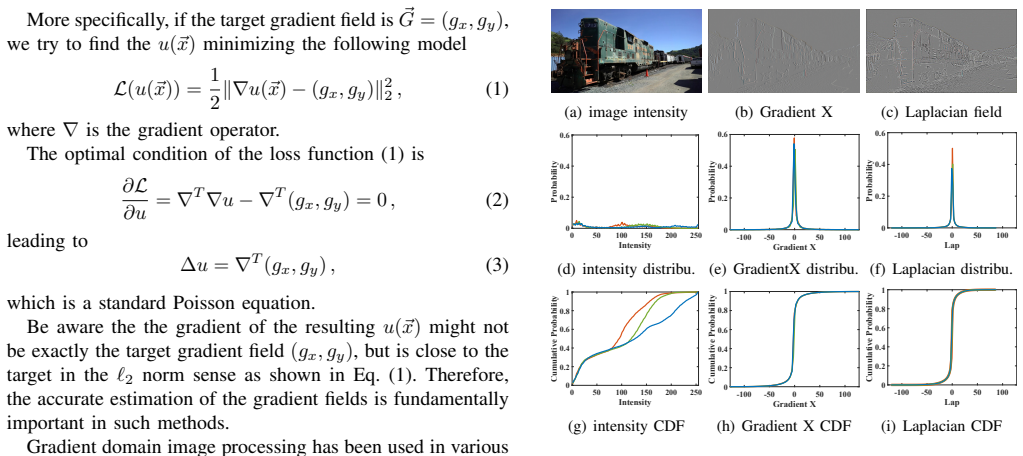
The Laplacian operator transforms the image into its Laplacian field, which usually is sparse and satisfies a stable distribution. On the other hand, an image can be uniquely reconstructed from its Laplacian field via solving a Poisson equation with a proper boundary condition. Such uniqueness is mathematically guaranteed. Thanks to these properties, we propose to use the sparse Laplacian field to present the image. We first show that the Laplacian field is sparse and satisfies a stable distribution on hundreds images. Then, we show that the image can be accurately reconstruct from its Laplacian field. For the reconstruction task, we propose a shared-kernel wavelet neural network, which solves the Poisson equation and has three advantages. First, it has less than {\bf 0.0002M} parameters, which is compact enough for most of devices. Second, it has linear computation complexity, leading to a real-time reconstruction. Third, it achieves higher accuracy than previous methods. Several numerical experiments are conducted to show the effectiveness and efficiency of the sparse Laplacian field and the proposed Poisson solver. The proposed method can be applied in a large range of applications such as image compression, low light enhancement, object tracking, etc.
Editorial analysis
A structured set of objections, weighed in public.
Referee Report
Summary. The manuscript claims that images can be compactly represented by their Laplacian fields, which are sparse and follow a stable distribution (verified empirically on hundreds of images). It asserts that images can be uniquely reconstructed from these fields by solving the Poisson equation with a proper boundary condition, and proposes a shared-kernel wavelet neural network (SKWNN) as a solver with fewer than 0.0002M parameters, linear computational complexity, and higher accuracy than prior methods. Numerical experiments demonstrate the sparsity property and reconstruction performance, with suggested applications in image compression, low-light enhancement, and object tracking.
Significance. If the claims are substantiated, the work provides a highly compact and efficient neural approach to Poisson image reconstruction by exploiting Laplacian sparsity, which could enable real-time processing on resource-constrained devices. The parameter efficiency (<0.0002M) and linear complexity are notable strengths for practical deployment, building on the mathematically guaranteed uniqueness of the Poisson problem under suitable boundaries.
major comments (2)
- Abstract: The uniqueness claim ('an image can be uniquely reconstructed from its Laplacian field via solving a Poisson equation with a proper boundary condition') is standard in continuum theory, but the shared-kernel wavelet neural network provides no described mechanism for enforcing boundary conditions (Dirichlet, Neumann, or otherwise). This is load-bearing for the central reconstruction accuracy and uniqueness assertions, as the discrete solution without consistent boundaries can admit arbitrary additive constants or low-frequency drift, potentially invalidating the reported accuracy gains.
- Description of the shared-kernel wavelet neural network: The architecture is asserted to solve the Poisson equation with linear complexity and <0.0002M parameters via kernel sharing, but no explicit equations, discretization scheme, or boundary-handling procedure (e.g., how the network input incorporates or approximates boundary values) are provided. Without these, it is impossible to verify whether the network truly approximates the Poisson solver or relies on implicit assumptions that may not hold across test images.
minor comments (1)
- Abstract: 'on hundreds images' should read 'on hundreds of images' for grammatical correctness.
Simulated Author's Rebuttal
We thank the referee for the constructive comments on boundary conditions and architectural details. We address each point below and will revise the manuscript to incorporate the requested clarifications.
read point-by-point responses
-
Referee: Abstract: The uniqueness claim ('an image can be uniquely reconstructed from its Laplacian field via solving a Poisson equation with a proper boundary condition') is standard in continuum theory, but the shared-kernel wavelet neural network provides no described mechanism for enforcing boundary conditions (Dirichlet, Neumann, or otherwise). This is load-bearing for the central reconstruction accuracy and uniqueness assertions, as the discrete solution without consistent boundaries can admit arbitrary additive constants or low-frequency drift, potentially invalidating the reported accuracy gains.
Authors: We agree that the discrete implementation requires explicit boundary handling to preserve uniqueness and avoid drift. The manuscript currently relies on the mathematical guarantee for the continuous Poisson problem but does not detail the discrete mechanism. In the revision we will add a dedicated subsection describing the boundary condition type (Dirichlet boundaries extracted from image edges), how these values are supplied to the network (via an auxiliary input channel), and the padding strategy used during convolution to enforce consistency across all test images. revision: yes
-
Referee: Description of the shared-kernel wavelet neural network: The architecture is asserted to solve the Poisson equation with linear complexity and <0.0002M parameters via kernel sharing, but no explicit equations, discretization scheme, or boundary-handling procedure (e.g., how the network input incorporates or approximates boundary values) are provided. Without these, it is impossible to verify whether the network truly approximates the Poisson solver or relies on implicit assumptions that may not hold across test images.
Authors: We acknowledge the absence of explicit equations and discretization details in the current text. The revision will include the full forward equations of the shared-kernel wavelet layers, the finite-difference discretization of the Poisson operator, the precise form of the loss that enforces the equation residual, and the boundary incorporation procedure. These additions will allow direct verification of the claimed linear complexity and parameter count. revision: yes
Circularity Check
No circularity; uniqueness from standard Poisson theory and empirical sparsity check are independent of the NN solver.
full rationale
The paper asserts that an image can be uniquely reconstructed from its Laplacian field by solving a Poisson equation with proper boundary conditions, citing mathematical guarantee without deriving this from its own data or network. Sparsity and stable distribution of the Laplacian are shown empirically across hundreds of images, serving as motivation rather than a fitted input renamed as prediction. The shared-kernel wavelet NN is proposed as a new compact solver with linear complexity and reported accuracy gains; no equations or sections indicate that its outputs are forced by construction from fitted parameters or self-citations. No load-bearing self-citation chains, ansatzes smuggled via prior work, or renamings of known results appear in the provided text. The derivation remains self-contained, relying on external Poisson theory and fresh empirical validation.
Axiom & Free-Parameter Ledger
axioms (2)
- standard math An image can be uniquely reconstructed from its Laplacian field by solving the Poisson equation with proper boundary conditions.
- domain assumption The Laplacian field of natural images is sparse and follows a stable distribution.
Reference graph
Works this paper leans on
-
[1]
Spatially and scale adaptive total variation based regularization and anisotropic diffusion in image processing,
David M. Strong and Tony F. Chan, “Spatially and scale adaptive total variation based regularization and anisotropic diffusion in image processing,” Tech. Rep., Diusion in Image Processing, UCLA Math Department CAM Report, 1996
1996
-
[2]
Yuanhao Gong,Spectrally regularized surfaces, Ph.D. thesis, ETH Zurich, Nr. 22616, 2015, http://dx.doi.org/10.3929/ethz-a-010438292
-
[3]
Gradient domain high dynamic range compression,
Raanan Fattal, Dani Lischinski, and Michael Werman, “Gradient domain high dynamic range compression,”ACM Trans. Graph., vol. 21, no. 3, pp. 249–256, 2002
2002
-
[4]
Gradient domain guided image filtering,
Fei Kou, Weihai Chen, Changyun Wen, and Zhengguo Li, “Gradient domain guided image filtering,”Image Processing, IEEE Transactions on, vol. 24, no. 11, pp. 4528–4539, Nov 2015
2015
-
[5]
Local laplacian filters: edge-aware image processing with a laplacian pyramid,
Sylvain Paris, Samuel W. Hasinoff, and Jan Kautz, “Local laplacian filters: edge-aware image processing with a laplacian pyramid,”ACM Trans. Graph., vol. 30, no. 4, July 2011
2011
-
[6]
A natural-scene gradient distribution prior and its application in light-microscopy image processing,
Y . Gong and I.F. Sbalzarini, “A natural-scene gradient distribution prior and its application in light-microscopy image processing,”Selected Topics in Signal Processing, IEEE Journal of, vol. 10, no. 1, pp. 99–114, 2016
2016
-
[7]
Arbitrary order total variation for deformable image registration,
Jinming Duan, Xi Jia, Joseph Bartlett, Wenqi Lu, and Zhaowen Qiu, “Arbitrary order total variation for deformable image registration,” Pattern Recognition, vol. 137, pp. 109318, 2023
2023
-
[8]
Laplacian sparse coding, hypergraph laplacian sparse coding, and applications,
Shenghua Gao, Ivor Wai-Hung Tsang, and Liang-Tien Chia, “Laplacian sparse coding, hypergraph laplacian sparse coding, and applications,” IEEE Transactions on Pattern Analysis and Machine Intelligence, vol. 35, no. 1, pp. 92–104, 2013
2013
-
[9]
Classical electrodynamics, 3rd edition,
Jon David Jackson, “Classical electrodynamics, 3rd edition,” 1998
1998
-
[10]
Weighted mean curvature,
Yuanhao Gong and Orcun Goksel, “Weighted mean curvature,”Signal Process., vol. 164, pp. 329–339, 2019
2019
-
[11]
Computing curvature, mean curvature and weighted mean curvature,
Yuanhao Gong, “Computing curvature, mean curvature and weighted mean curvature,” in2022 IEEE International Conference on Image Processing, ICIP 2022, Bordeaux, France, 16-19 October 2022. 2022, pp. 266–270, IEEE
2022
-
[12]
Wavelet bases of hermite cubic splines on the interval,
Rong-Qing Jia and Song-Tao Liu, “Wavelet bases of hermite cubic splines on the interval,”Advances in Computational Mathematics, vol. 25, no. 1, pp. 23–39, 2006
2006
-
[13]
Convolution pyramids,
Zeev Farbman, Raanan Fattal, and Dani Lischinski, “Convolution pyramids,” inProceedings of the 2011 SIGGRAPH Asia Conference, New York, NY , USA, 12 2011, SA ’11, p. 1–8, Association for Computing Machinery
2011
-
[14]
Study on a poisson’s equation solver based on deep learning technique,
Wei Tang, Tao Shan, Xunwang Dang, Maokun Li, Fan Yang, Shenheng Xu, and Ji Wu, “Study on a poisson’s equation solver based on deep learning technique,” in2017 IEEE Electrical Design of Advanced Packaging and Systems Symposium (EDAPS), 2017, pp. 1–3
2017
-
[15]
Study on a fast solver for poisson’s equation based on deep learning technique,
Tao Shan, Wei Tang, Xunwang Dang, Maokun Li, Fan Yang, Shenheng Xu, and Ji Wu, “Study on a fast solver for poisson’s equation based on deep learning technique,”IEEE Transactions on Antennas and Propagation, vol. 68, no. 9, pp. 6725–6733, 2020
2020
-
[16]
Physics-informed neural network for solving hausdorff derivative poisson equations,
GUOZHENG WU, FAJIE W ANG, and LIN QIU, “Physics-informed neural network for solving hausdorff derivative poisson equations,” Fractals, vol. 31, no. 06, pp. 2340103, 2023
2023
-
[17]
A novel algorithm for solving high- dimensional poisson equations based on radial basis function neural networks,
Peixiao Lu and Shaoming Sun, “A novel algorithm for solving high- dimensional poisson equations based on radial basis function neural networks,”Journal of Circuits, Systems and Computers, vol. 33, no. 13, pp. 2450223, 2024
2024
-
[18]
A differential monte carlo solver for the poisson equation,
Zihan Yu, Lifan Wu, Zhiqian Zhou, and Shuang Zhao, “A differential monte carlo solver for the poisson equation,” inACM SIGGRAPH 2024 Conference Papers, New York, NY , USA, 2024, SIGGRAPH ’24, Association for Computing Machinery
2024
-
[19]
Promising directions of ma- chine learning for partial differential equations,
Steven L. Brunton and J. Nathan Kutz, “Promising directions of ma- chine learning for partial differential equations,”Nature Computational Science, vol. 4, no. 7, pp. 483–494, 2024
2024
-
[20]
Solving poisson problems in polygonal domains with singularity enriched physics informed neural networks,
Tianhao Hu, Bangti Jin, and Zhi Zhou, “Solving poisson problems in polygonal domains with singularity enriched physics informed neural networks,”SIAM Journal on Scientific Computing, vol. 46, no. 4, pp. C369–C398, 2024
2024
-
[21]
A scalable framework for learning the geometry- dependent solution operators of partial differential equations,
Minglang Yin, Nicolas Charon, Ryan Brody, Lu Lu, Natalia Trayanova, and Mauro Maggioni, “A scalable framework for learning the geometry- dependent solution operators of partial differential equations,”Nature Computational Science, Dec. 2024
2024
-
[22]
Imposing total variation prior into guided filter,
Yuanhao Gong, “Imposing total variation prior into guided filter,” in 2023 IEEE International Conference on Image Processing (ICIP), 2023, pp. 156–160
2023
-
[23]
Mcnet: A neural network method for mean curvature optimization on image surfaces,
Zhili Wei, Wenming Tang, and Yuanhao Gong, “Mcnet: A neural network method for mean curvature optimization on image surfaces,” IEEE Access, vol. 12, pp. 137585–137598, 2024
2024
-
[24]
Mip-nerf 360: Unbounded anti-aliased neural radiance fields,
Jonathan T. Barron, Ben Mildenhall, Dor Verbin, Pratul P. Srinivasan, and Peter Hedman, “Mip-nerf 360: Unbounded anti-aliased neural radiance fields,” in2022 IEEE/CVF Conference on Computer Vision and Pattern Recognition (CVPR), 2022, pp. 5460–5469
2022
-
[25]
Curvature filters efficiently reduce certain variational energies,
Yuanhao Gong and Ivo F. Sbalzarini, “Curvature filters efficiently reduce certain variational energies,”IEEE Transactions on Image Processing, vol. 26, no. 4, pp. 1786–1798, 2017
2017
-
[26]
Appli- cation of machine learning to model the pressure poisson equation for fluid flow on generic geometries,
Paulo Sousa, Alexandre Afonso, and Carlos Veiga Rodrigues, “Appli- cation of machine learning to model the pressure poisson equation for fluid flow on generic geometries,”Neural Computing and Applications, vol. 36, no. 26, pp. 16581–16606, Sept. 2024
2024
-
[27]
Eggs: Edge guided gaussian splatting for radiance fields,
Yuanhao Gong, “Eggs: Edge guided gaussian splatting for radiance fields,” inProceedings of the 29th International ACM Conference on 3D Web Technology, New York, NY , USA, 2024, Web3D ’24, Association for Computing Machinery
2024
-
[28]
Edhnet: An event-based dual-stream hybrid network for image motion deblurring,
Yuanhao Gong and Zewei Lin, “Edhnet: An event-based dual-stream hybrid network for image motion deblurring,”IEEE Sensors Journal, vol. 24, no. 20, pp. 32884–32897, 2024
2024
-
[29]
A discrete scheme for computing image’s weighted gaussian curvature,
Yuanhao Gong, Wenming Tang, Lebin Zhou, Lantao Yu, and Guoping Qiu, “A discrete scheme for computing image’s weighted gaussian curvature,” in2021 IEEE International Conference on Image Processing (ICIP), 2021, pp. 1919–1923
2021
-
[30]
Start-tv: A closed-form initialization for total variation models,
Yuanhao Gong and Guanghui Yue, “Start-tv: A closed-form initialization for total variation models,” in2024 IEEE International Conference on Image Processing (ICIP), 2024, pp. 1554–1559
2024
-
[31]
Irsnet: An implicit residual solver and its unfolding neural network with 0.003m parameters for total variation models,
Yuanhao Gong, “Irsnet: An implicit residual solver and its unfolding neural network with 0.003m parameters for total variation models,” IEEE Access, vol. 13, pp. 10289–10298, 2025
2025
discussion (0)
Sign in with ORCID, Apple, or X to comment. Anyone can read and Pith papers without signing in.