Recognition: unknown
An Information-Geometric Framework for Stability Analysis of Large Language Models under Entropic Stress
Pith reviewed 2026-05-08 03:30 UTC · model grok-4.3
The pith
Incorporating internal integration and reflective capacity into a stability score improves predictions of LLM output reliability under uncertainty compared to utility and entropy alone.
A machine-rendered reading of the paper's core claim, the machinery that carries it, and where it could break.
Core claim
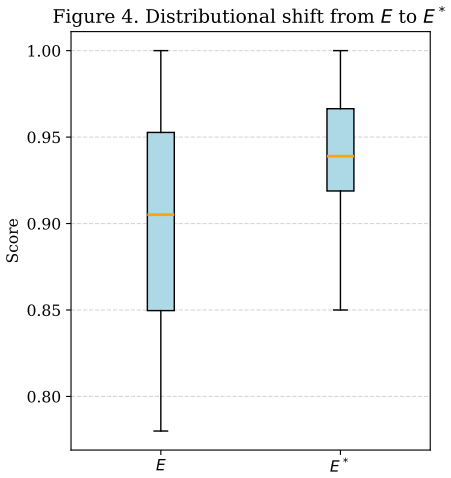
The authors define a composite stability score that combines task utility, entropy as external uncertainty, and two internal structural proxies—internal integration and aligned reflective capacity—drawn from IST-20 metadata. When applied to 80 model-scenario pairs across four contemporary LLMs, this score produces higher values than a reduced utility-entropy baseline, with a mean improvement of 0.0299 (95% CI 0.0247-0.0351). The advantage grows under higher-entropy conditions, which the framework interprets as evidence that internal structure can attenuate the effect of disorder on output stability. The work presents the formulation as a compact modeling perspective intended to complement,,
What carries the argument
The composite stability score formed by integrating task utility, entropy, internal integration, and aligned reflective capacity as an abstraction for how internal structure modulates external uncertainty.
If this is right
- Stability assessments that include internal proxies will rank models differently than accuracy or entropy metrics alone, especially in high-uncertainty scenarios.
- The framework implies that models whose internal structure produces higher integration and reflective-capacity scores will maintain output consistency better when external entropy rises.
- Evaluation protocols can be extended to report the full composite score rather than isolated utility or accuracy figures.
- The observed nonlinear attenuation suggests that internal-structure adjustments could be used to target robustness improvements without changing task performance.
Where Pith is reading between the lines
- If the proxies can be computed from existing metadata, benchmarking suites could routinely include structural assessments to predict real-world reliability.
- The approach offers a quantitative bridge between performance metrics and AI-safety concerns about model behavior under distribution shift.
- Applying the same score construction to other modalities or larger-scale models would test whether the entropy-attenuation pattern generalizes.
- Design choices that increase internal integration might become explicit optimization targets when reliability under uncertainty is the goal.
Load-bearing premise
That the internal integration and aligned reflective capacity values extracted from IST-20 metadata serve as valid proxies for how a model's structure changes the impact of entropy on output stability, and that they add information beyond utility and entropy.
What would settle it
Re-running the comparison on the same or new IST-20 data and finding that the full composite score no longer shows a statistically significant improvement over the utility-entropy baseline, or that the internal proxies fail to correlate with observed stability differences.
Figures


read the original abstract
As large language models (LLMs) are increasingly deployed in high-stakes and operational settings, evaluation strategies based solely on aggregate accuracy are often insucient to characterize system reliability. This study proposes a thermodynamic inspired modeling framework for analyzing the stability of LLM outputs under conditions of uncertainty and perturbation. The framework introduces a composite stability score that integrates task utility, entropy as a measure of external uncertainty, and two internal structural proxies: internal integration and aligned reective capacity. Rather than interpreting these quantities as physical variables, the formulation is intended as an interpretable abstraction that captures how internal structure may modulate the impact of disorder on model behavior. Using the IST-20 benchmarking protocol and associated metadata, we analyze 80 modelscenario observations across four contemporary LLMs. The proposed formulation consistently yields higher stability scores than a reduced utilityentropy baseline, with a mean improvement of 0.0299 (95% CI: 0.02470.0351). The observed gain is more pronounced under higher entropy conditions, suggesting that the framework captures a form of nonlinear attenuation of uncertainty. We do not claim a fundamental physical law or a complete theory of machine ethics. Instead, the contribution of this work is a compact and interpretable modeling perspective that connects uncertainty, performance, and internal structure within a unied evaluation lens. The framework is intended to complement existing benchmarking approaches and to support ongoing discussions in AI safety, reliability, and governance.
Editorial analysis
A structured set of objections, weighed in public.
Referee Report
Summary. The paper proposes an information-geometric framework for assessing LLM output stability under uncertainty, introducing a composite stability score that combines task utility, entropy, and two internal structural proxies (internal integration and aligned reflective capacity) extracted from IST-20 metadata. It reports results from 80 model-scenario observations across four LLMs, claiming the composite yields a mean improvement of 0.0299 (95% CI: 0.0247-0.0351) over a reduced utility-entropy baseline, with larger gains at higher entropy levels. The work positions the framework as an interpretable abstraction rather than a physical theory, intended to complement existing benchmarks for AI reliability and safety.
Significance. If the proxies can be shown to be independently measurable and to contribute explanatory power beyond the baseline, the approach could provide a compact lens for linking internal model structure to robustness under perturbation, with potential relevance to AI governance and evaluation protocols. The reported effect size is modest but accompanied by a confidence interval and a stratified observation under high-entropy conditions, offering limited but concrete empirical grounding.
major comments (2)
- [Abstract] Abstract: The operational definitions, extraction rules, weighting scheme, and scaling factors for the composite stability score components (particularly internal integration and aligned reflective capacity) are not supplied. Because the reported 0.0299 improvement is obtained by comparing the full composite against a reduced utility-entropy baseline, the absence of these details makes it impossible to determine whether the gain reflects genuine structural modulation or an artifact of how the proxies are aggregated from the same metadata.
- [Abstract] Abstract (results paragraph): The claim that the gain is 'more pronounced under higher entropy conditions' and indicates 'nonlinear attenuation of uncertainty' lacks supporting equations, interaction terms, or stratified statistical tests. Without an explicit model of how the internal proxies interact with entropy (e.g., a multiplicative or information-geometric term), the interpretation remains descriptive rather than derived from the framework.
minor comments (2)
- [Abstract] Abstract: Typographical errors include 'insucient' (insufficient), 'reective' (reflective), 'unied' (unified), and 'modelscenario' (model-scenario).
- [Abstract] Abstract: The phrase 'information-geometric framework' is used without reference to any specific divergence, manifold, or geometric construction; if the full manuscript contains such formalism, it should be highlighted in the abstract to clarify the contribution.
Simulated Author's Rebuttal
We thank the referee for the constructive and detailed feedback. We address the two major comments point by point below, indicating the revisions we will undertake to improve clarity and rigor while preserving the manuscript's core contribution as an interpretable abstraction rather than a physical theory.
read point-by-point responses
-
Referee: [Abstract] Abstract: The operational definitions, extraction rules, weighting scheme, and scaling factors for the composite stability score components (particularly internal integration and aligned reflective capacity) are not supplied. Because the reported 0.0299 improvement is obtained by comparing the full composite against a reduced utility-entropy baseline, the absence of these details makes it impossible to determine whether the gain reflects genuine structural modulation or an artifact of how the proxies are aggregated from the same metadata.
Authors: We agree that the abstract omits the operational details needed for full reproducibility and assessment of whether the proxies add explanatory power. The full manuscript describes the proxies as extracted from IST-20 metadata but does not provide explicit extraction rules, weighting, or scaling in sufficient detail. We will revise by adding a concise paragraph to the abstract summarizing the definitions and extraction process, and insert a new Methods subsection with the precise rules, weighting scheme (including any correlation-based or equal weighting), and scaling factors. This will enable readers to evaluate whether the 0.0299 gain arises from structural modulation. revision: yes
-
Referee: [Abstract] Abstract (results paragraph): The claim that the gain is 'more pronounced under higher entropy conditions' and indicates 'nonlinear attenuation of uncertainty' lacks supporting equations, interaction terms, or stratified statistical tests. Without an explicit model of how the internal proxies interact with entropy (e.g., a multiplicative or information-geometric term), the interpretation remains descriptive rather than derived from the framework.
Authors: The referee correctly notes that the abstract's claim is descriptive. The manuscript reports the overall mean improvement and observes a trend in high-entropy strata from the 80 observations, but does not include explicit interaction terms, equations, or formal tests in the presented results. We will revise the abstract to qualify the claim and expand the Results section with stratified summary statistics, a regression model including an entropy-by-composite interaction term, and any supporting information-geometric formulation if derivable from the framework. If the data do not support a full multiplicative term, we will present the stratified findings as empirical observation while noting the limitation. revision: partial
Circularity Check
No significant circularity detected
full rationale
The paper defines a composite stability score from task utility, entropy, internal integration, and aligned reflective capacity, then reports an empirical mean improvement of 0.0299 over a reduced utility-entropy baseline across 80 IST-20 observations. No equations, self-definitional reductions, fitted parameters renamed as predictions, or load-bearing self-citations appear in the abstract or described derivation. The central claim rests on an external data comparison rather than tautological construction from the inputs themselves, rendering the framework self-contained.
Axiom & Free-Parameter Ledger
free parameters (1)
- weights or scaling factors for composite score components
axioms (1)
- domain assumption Internal integration and aligned reflective capacity are measurable proxies that capture how model structure modulates uncertainty impact.
invented entities (2)
-
Composite stability score
no independent evidence
-
Aligned reflective capacity
no independent evidence
Reference graph
Works this paper leans on
-
[1]
International Journal of Theo- retical Physics 21, 905–940
doi: 10.1007/BF02084158. EuropeanDataProtectionSupervisor. AIActRegulation(EU)2024/1689: Regulationof the european parliament and of the council laying down harmonised rules on artificial intelligence (artificial intelligence act). Technical report, Publications Office of the European Union,
-
[2]
A unified framework of five principles for AI in society
doi: 10.1162/99608f92.8cd550d1. Karl Friston. The free-energy principle: A unified brain theory?Nature Reviews Neu- roscience, 11(2):127–138,
-
[3]
Nature Reviews Neuroscience , year =
doi: 10.1038/nrn2787. Jiahao Geng, Fengyu Cai, Yuxia Wang, Heinz Koeppl, Preslav Nakov, and Iryna Gurevych. A survey of confidence estimation and calibration in large language models. InProceedings of the 2024 Conference of the North American Chapter of the Associa- tion for Computational Linguistics: Human Language Technologies (Volume 1: Long Papers), p...
-
[4]
A Survey of Con- fidence Estimation and Calibration in Large Language Models
doi: 10.18653/v1/2024.naacl-long.366. Ching-Wei Huang and Yun-Nung Chen. FactAlign: Long-form factuality alignment of large language models. InFindings of the Association for Computational Linguistics: EMNLP 2024, pages 16363–16375,
-
[5]
doi: 10.18653/v1/2024.findings-emnlp.955. 13 Ziwei Ji, Nayeon Lee, Rita Frieske, Tiezheng Yu, Dan Su, Yan Xu, Etsuko Ishii, Ye Jin Bang, Andrea Madotto, and Pascale Fung. Survey of hallucination in natural language generation.ACM Computing Surveys, 55(12):1–38,
-
[6]
doi: 10.1145/3571730. Anna Jobin, Marcello Ienca, and Effy Vayena. The global landscape of AI ethics guidelines.Nature Machine Intelligence, 1(9):389–399,
-
[7]
doi: 10.1147/rd.53.0183. Junyi Li, Xiaoxue Cheng, Wayne Xin Zhao, Jian-Yun Nie, and Ji-Rong Wen. HaluEval: A large-scale hallucination evaluation benchmark for large language models. InPro- ceedings of the 2023 Conference on Empirical Methods in Natural Language Processing, pages 6449–6464,
-
[8]
H alu E val: A Large-Scale Hallucination Evaluation Benchmark for Large Language Models
doi: 10.18653/v1/2023.emnlp-main.397. Stephanie Lin, Jacob Hilton, and Owain Evans. TruthfulQA: Measuring how models mimic human falsehoods. InProceedings of the 60th Annual Meeting of the Association for Computational Linguistics (Volume 1: Long Papers), pages 3214–3252,
-
[9]
Bradley Efron and Robert J Tibshirani.An introduction to the bootstrap, volume
doi: 10.18653/v1/2022.acl-long.229. GenglinKevin-MingLiu, GalYona, AviCaciularu, IdanSzpektor, TimG.J.Rudner, and Arman Cohan. MetaFaith: Faithful natural language uncertainty expression in LLMs. InProceedings of the 2025 Conference on Empirical Methods in Natural Language Processing, pages 29612–29656,
-
[10]
National Institute of Standards and Technology
doi: 10.18653/v1/2025.emnlp-main.1505. National Institute of Standards and Technology. Artificial intelligence risk management framework: Generative artificial intelligence profile (NIST AI 600-1). Technical report, U.S. Department of Commerce,
-
[11]
URLhttps://www.oecd.org/en/topics/ai-principles. html. Fabio Petroni, Aleksandra Piktus, Angela Fan, Patrick Lewis, Majid Yazdani, Nicola De Cao, James Thorne, Yacine Jernite, Vladimir Karpukhin, and Jean Maillard. KILT: A benchmark for knowledge intensive language tasks. InProceedings of the 2021 Conference of the North American Chapter of the Associatio...
2021
-
[12]
KILT : a benchmark for knowledge intensive language tasks
doi: 10.18653/v1/2021.naacl-main.200. Claude E. Shannon. A mathematical theory of communication.Bell System Technical Journal, 27(3):379–423,
-
[13]
doi: 10.1002/j.1538-7305.1948.tb01338.x. Elham Tabassi. Artificial intelligence risk management framework (AI RMF 1.0) (NIST AI 100-1). Technical report, National Institute of Standards and Technology,
-
[14]
FEVER: A large-scale dataset for fact extraction and verification
James Thorne, Andreas Vlachos, Christos Christodoulopoulos, and Arpit Mittal. FEVER: A large-scale dataset for fact extraction and verification. InProceedings of the 2018 Conference of the North American Chapter of the Association for Compu- tational Linguistics: Human Language Technologies (Volume 1: Long Papers), pages 809–819,
2018
-
[15]
FEVER: a large-scale dataset for Fact Extraction and VERification
doi: 10.18653/v1/N18-1074. 14 Giulio Tononi. An information integration theory of consciousness.BMC Neuroscience, 5:42,
work page internal anchor Pith review doi:10.18653/v1/n18-1074
-
[16]
doi: 10.1186/1471-2202-5-42. UNESCO. Recommendation on the ethics of artificial intelligence. Technical report, UNESCO,
-
[17]
Yuxia Wang, Minghan Wang, Muhammad Arslan Manzoor, Fei Liu, Georgi N
URLhttps://www.unesco.org/en/artificial-intelligence/ recommendation-ethics. Yuxia Wang, Minghan Wang, Muhammad Arslan Manzoor, Fei Liu, Georgi N. Georgiev, Rocktim Jyoti Das, and Preslav Nakov. Factuality of large language models: A survey. InProceedings of the 2024 Conference on Empirical Methods in Natural Language Processing, pages 19519–19529,
2024
-
[18]
doi: 10.18653/v1/2024.emnlp-main.1088. Zhilin Yang, Peng Qi, Saizheng Zhang, Yoshua Bengio, William Cohen, Ruslan Salakhut- dinov, and Christopher D. Manning. HotpotQA: A dataset for diverse, explain- able multi-hop question answering. InProceedings of the 2018 Conference on Empirical Methods in Natural Language Processing, pages 2369–2380,
-
[19]
doi: 10.18653/v1/D18-1259. 15
discussion (0)
Sign in with ORCID, Apple, or X to comment. Anyone can read and Pith papers without signing in.