pith. machine review for the scientific record. sign in

arxiv: 2604.24619 · v1 · submitted 2026-04-27 · 🧮 math.GT · math.DS· math.GR· math.PR

Recognition: unknown

CaTherine wheels

Danny Calegari, Ino Loukidou

Pith reviewed 2026-05-07 17:58 UTC · model grok-4.3

classification 🧮 math.GT math.DSmath.GRmath.PR
keywords catherinetheorywheelshyperbolicassociatedcloseddiskexpanding
0
0 comments X

The pith

CaTherine wheels unify structures across fields by providing a canonical bijection between orbit-equivalence classes of pseudo-Anosov flows without perfect fits, G-equivariant CaTherine wheels, minimal G-zippers, and connected components of uniform quasimorphisms for the fundamental group of any闭ed

A machine-rendered reading of the paper's core claim, the machinery that carries it, and where it could break.

A CaTherine wheel is a continuous wrapping of a circle onto a sphere so that any arc on the circle lands on a disk-shaped region whose boundary contains the arc's endpoints. These maps show up when studying expanding maps on surfaces, random curves in the plane with certain scaling, and other geometric constructions. The authors build a general theory for these wheels and use them as a translation tool between different areas of mathematics. Their main result applies this to closed hyperbolic 3-manifolds, which are spaces of constant negative curvature. They prove that four seemingly different descriptions of certain flow-like or mapping structures on these manifolds are actually equivalent: certain flows on the manifold, the wheels themselves, zipper structures, and components of quasimorphisms on the manifold's fundamental group. This extends older results on how these manifolds can fiber over a circle and on the Thurston norm that measures surface complexity inside them.

Core claim

If M is a closed hyperbolic 3-manifold and G=π1(M), we show that there is a canonical bijection between four kinds of structures associated to M: 1. orbit-equivalence classes of pseudo-Anosov flows on M without perfect fits; 2. G-equivariant CaTherine wheels up to conjugacy; 3. minimal G-zippers; and 4. connected components of the space of uniform quasimorphisms on G.

Load-bearing premise

The definitions of CaTherine wheels and the associated structures (pseudo-Anosov flows without perfect fits, minimal G-zippers) are well-posed and that the canonical bijection exists for every closed hyperbolic 3-manifold without further restrictions on the manifold or the flows.

Figures
Figures reproduced from arXiv: 2604.24619 by Danny Calegari, Ino Loukidou.
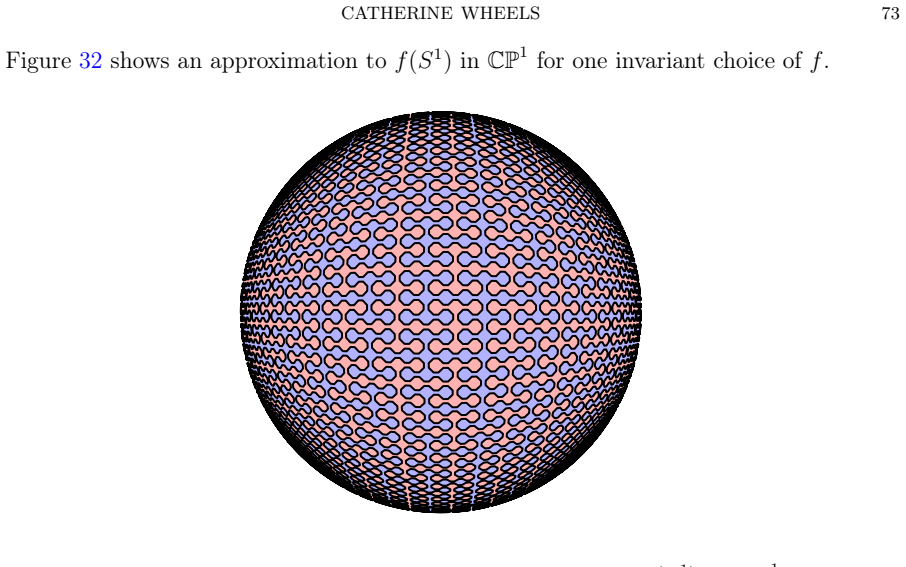
Figure 1
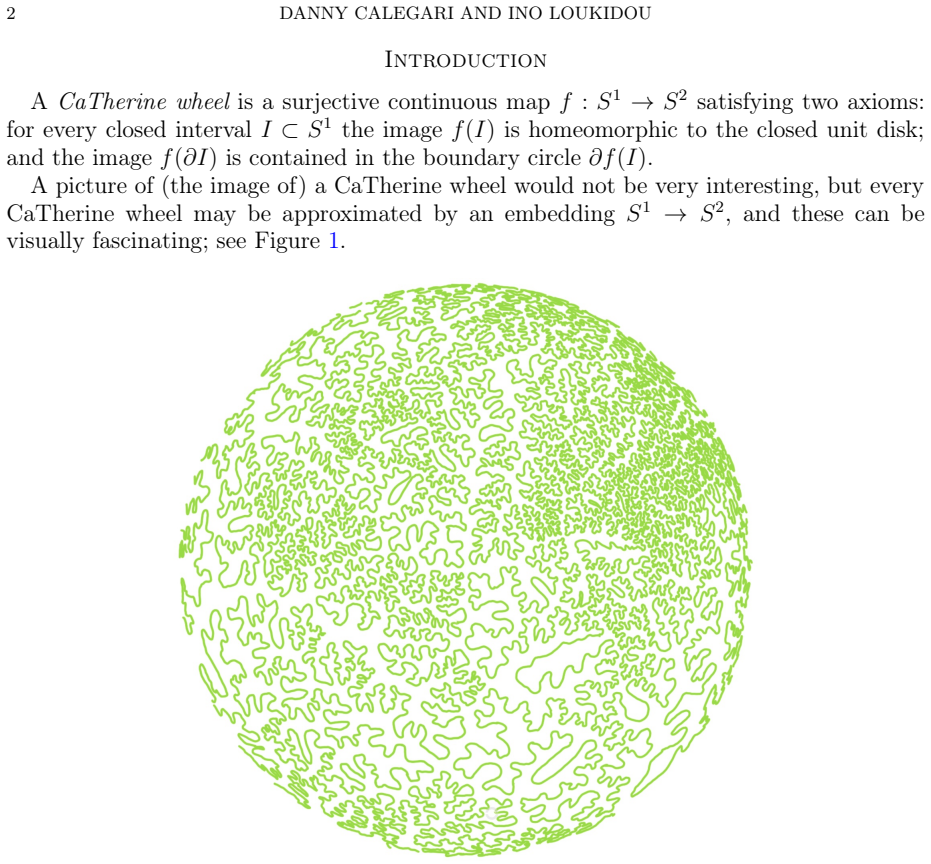
Figure 1. Figure 1: A CaTherine wheel; not to be confused with view at source ↗
Figure 2
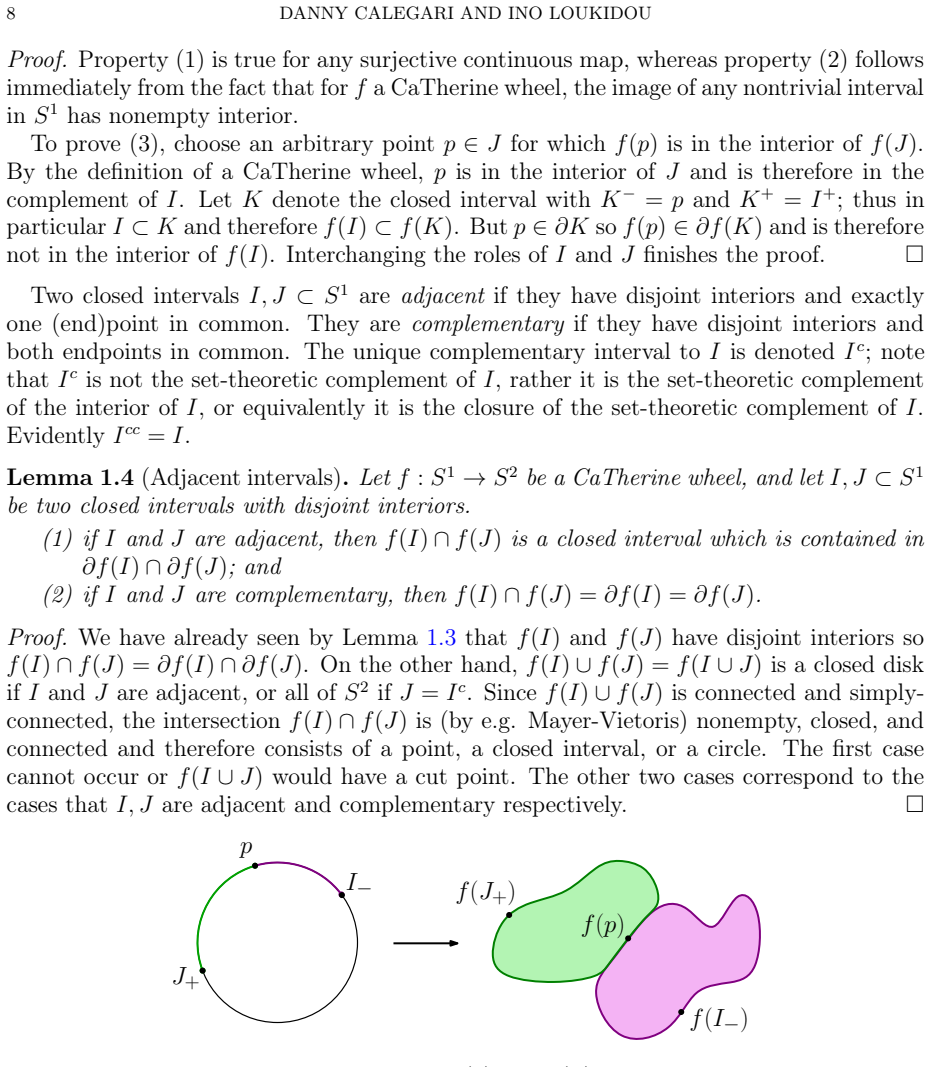
Figure 2. Figure 2: The defining property of a CaTherine wheel Remark 1.2. By the Jordan Curve Theorem every topological embedding of D2 in S 2 is standard, i.e. there is a self-homeomorphism of S 2 taking the boundary to a great circle and the interior to an (open) half-space in the usual round metric. Here is a suggestive image to keep in mind. If we fix f and ‘grow’ the interval I inside S 1 then the image f(I) also grows,… view at source ↗
Figure 3
Figure 3. Figure 3: If I and J are adjacent, f(I) and f(J) share a closed interval in their respective boundaries. Let M˜ denote the set of closed intervals in S 1 . If ∆ ⊂ S 1 × S 1 denotes the diagonal, we may identify M˜ with the space S 1 × S 1 − ∆ of distinct ordered pairs of points in S 1 as follows: given an ordered pair of points p, q ∈ S 1 with p ̸= q there is a unique (oriented) closed interval I ⊂ S 1 with I − = p … view at source ↗
Figure 4
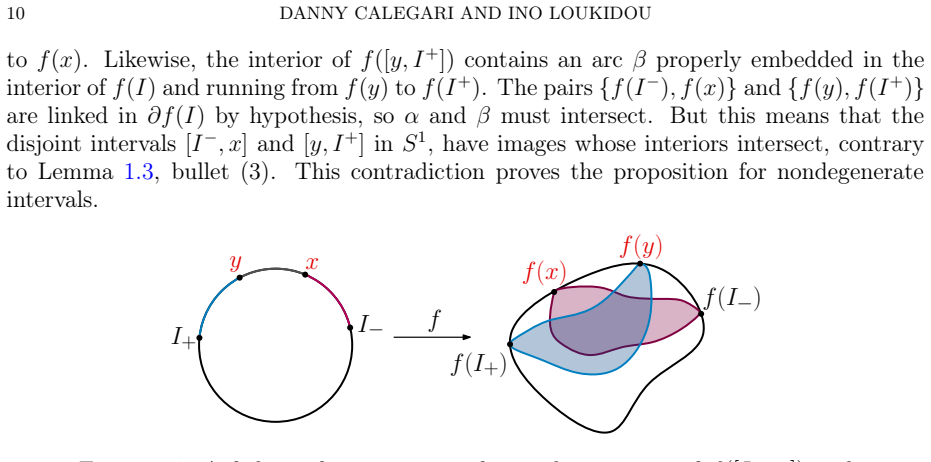
Figure 4. Figure 4: A failure of monotonicity forces the interiors of f([I −, x]) and f([y, I+]) to intersect. Now let’s suppose I is degenerate for f. If we choose two points x, z in C with disjoint image, then we may choose an orientation on Y for which f(x) < f(z) in Y . Now suppose there is y ∈ C with x < y < z but f(x) < f(z) < f(y) in Y (the case f(y) < f(x) < f(z) is similar). Then we have x < y < z < I + in I but {f(x… view at source ↗
Figure 5
Figure 5. Figure 5: The oriented intervals Z ±(I) in ∂f(I) − f(∂I). reflexive relation on a set is a subset of the set of unordered pairs on that set containing the diagonal, and is therefore determined by its restriction to the set of unordered distinct pairs. We may therefore encode the image relation by a (closed) subset of the space M of unordered pairs of distinct points in S 1 ; evidently this subset is precisely the se… view at source ↗
Figure 6
Figure 6. Figure 6: The arc α is the common boundary of f([p, q]) ∩ f([q, s]) and is proper in f([p, s]). By construction each of the (nonempty!) intervals Z +([p, s]) and Z −([p, s]) is entirely contained in ∂f([p, q]) or ∂f([q, s]), and since the parameterization of ∂f([p, q]) by its preimage in [p, q] is monotone non-increasing, it follows that Z −([p, s]) ⊂ ∂f([p, q]) and Z +([p, s]) ⊂ ∂f([q, s]). But f([r, q]) is entirel… view at source ↗
Figure 7
Figure 7. Figure 7: Nontrivial subsets C(ν) in S 2 f . We may repeat the argument with s in place of r and obtain a new boundary leaf {t, t′} with t ∈ (p, s) and t ′ ∈ (s, q). Actually, by Proposition 1.10 we must have t ′ ∈ (s ′ , q). Thus we obtain a sequence of boundary leaves whose endpoints move monotonely towards p and q respectively. A limit of such a monotone sequence is itself a positive leaf by Lemma 1.13 and is eit… view at source ↗
Figure 8
Figure 8. Figure 8: A negative rainbow at p In order to state the next theorem we must recall some elements from decomposition theory. A good reference is Daverman [37] or the notes of Boldizsár Kalmár [56]. We do not state definitions in the greatest possible generality, since our focus is on decompositions of compact Hausdorff spaces. Definition 1.19 (Upper semi-continuous decomposition). Let X be a compact Hausdorff space.… view at source ↗
Figure 9
Figure 9. Figure 9: The union |C| is all of S 2 f . Finally we must prove upper semi-continuity. Let’s fix an element C(ν). First let’s consider the case that C(ν) consists of a single point p ∈ S 1 . This point is a limit of rainbows in both L + and L −. Choose a boundary leaf of L + that cuts off an open half￾space A in P +. The closure of A meets S 1 in a closed interval I with p in its interior. For every point q in the i… view at source ↗
Figure 10
Figure 10. Figure 10: The construction of an open neighborhood U which is a union of elements of C. previous case, for every point q in the interior of any Ii that is contained in a nontrivial leaf of L + there is a rainbow in L − that limits to q, and we may choose a boundary leaf of L − in this rainbow that cuts off an open half-space Bq in P − and whose closure meets S 1 in an interval Jq in the interior of Ii . Then we may… view at source ↗
Figure 11
Figure 11. Figure 11: The restriction of the decomposition of S 2 f to the disk D(I). □ Remark 2.15. If each equivalence class of L ± is finite, then L ± have no perfect fits if and only if Λ ± have no perfect fits. Remark 2.16. A pair of laminar relations L ± with no perfect fits and no isolated sides are a special case of what Frankel–Landry call especial pairs in [49], the only difference being that each pair of equivalence… view at source ↗
Figure 12
Figure 12. Figure 12: Branch points in Z + are in the support of > 2 ideal gaps. Informally, an ideal gap is an equivalence class of pairs consisting of a point p ∈ Z + together with a ‘direction of approaching’ p in the complement S 2 − Z + (and similarly for Z −). A point p as above is said to be contained in the support of the ideal gap (and by abuse of notation, the support of an equivalence class). From the proof of Lemma… view at source ↗
Figure 13
Figure 13. Figure 13: A sequence of 2-valent points pi converging to p gives a sequence of leaves converging to a boundary leaf of ν. With these definitions, we are ready to state the main theorem: Theorem 3.14 (CaTherine wheels from zippers). Let Z ± be a zipper. Then Z ± arises from a CaTherine wheel f : S 1 → S 2 if and only if Z ± is hairy, and has the strong landing property. Proof. A CaTherine wheel gives rise to a hairy… view at source ↗
Figure 14
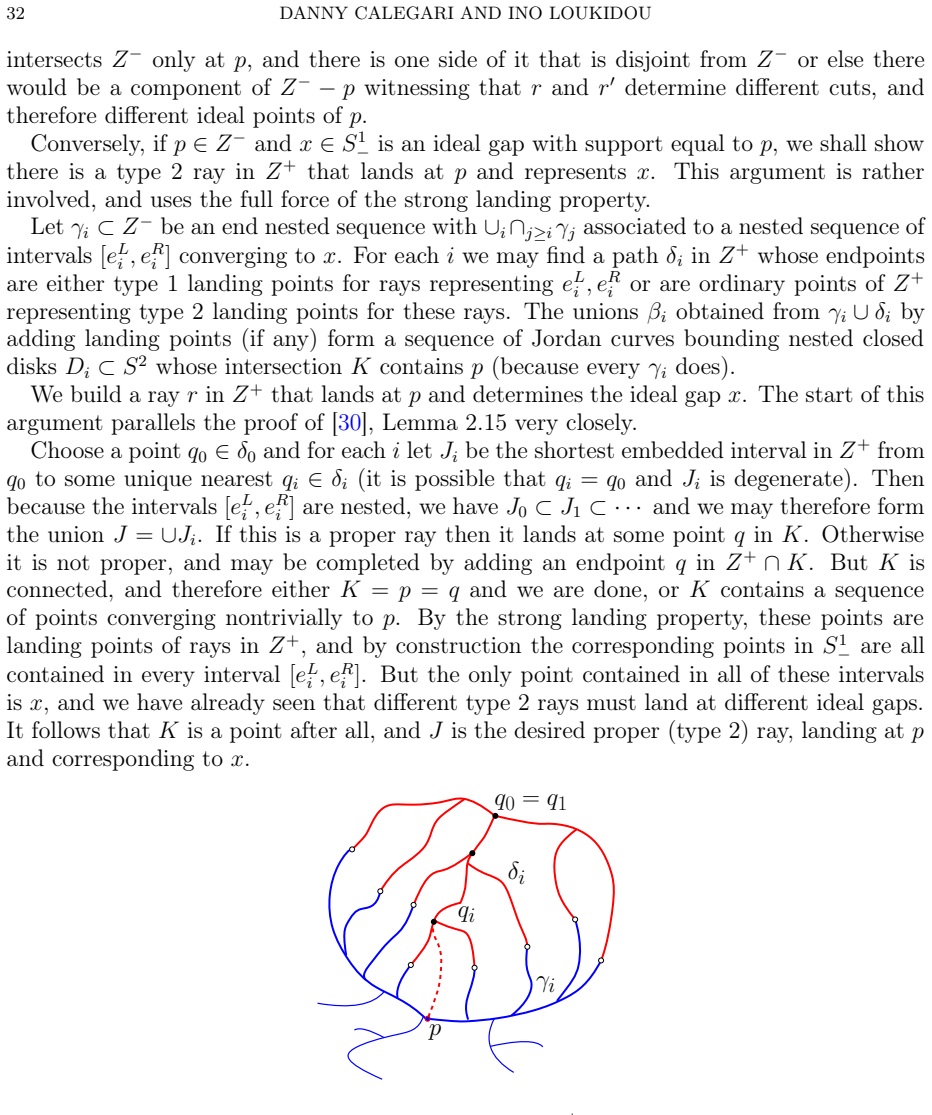
Figure 14. Figure 14: Constructing a ray in Z + that lands at p. Thus, by considering the correspondences of type 1 and 2 we obtain an order-reversing bijection between S 1 + and S 1 −. Since the topology agrees with the (circular) order topology, this extends uniquely to a homeomorphism. It remains to show that in this correspondence the laminar relations L ± have no perfect fits. But this is obvious: we have just shown that … view at source ↗
Figure 15
Figure 15. Figure 15: Two embedded intervals that are close as maps but not close through embedded maps. First, each equivalence class of K± is an entire equivalence class of one of L ±. For, if {p, q} is in K+ and also (say) in L +, then there is a negative rainbow in L − for both p and q; the elements in this rainbow cannot be in K+ so they must be in K−. But then K− cannot have a nontrivial equivalence class containing p or… view at source ↗
Figure 16
Figure 16. Figure 16: The parabolic fixed point in S 2 ∞ is a local cut point of f(J) Example 5.3 (Quasigeodesic flow). Let f : S 1 univ → S 2 ∞ be the map defined by Frankel [48] associated to a quasigeodesic flow X on a closed hyperbolic 3-manifold; the domain S 1 univ of f here is the universal circle associated to the orbit space P of X˜ (which is topologically a plane) defined in [24]. Associated to X˜ are two decompositi… view at source ↗
Figure 17
Figure 17. Figure 17: The image f(J) has two local cut points. One (in black) is genuine; the other (in pink) is fake. The local cut points in Example 5.3 are different in kind from each other. Roughly speaking, one of the local cut points locally separates the track of f (for now, call such a cut point genuine) whereas the other one does not (call such a cut point fake). For example, the local cut point in Example 5.2 is fake… view at source ↗
Figure 18
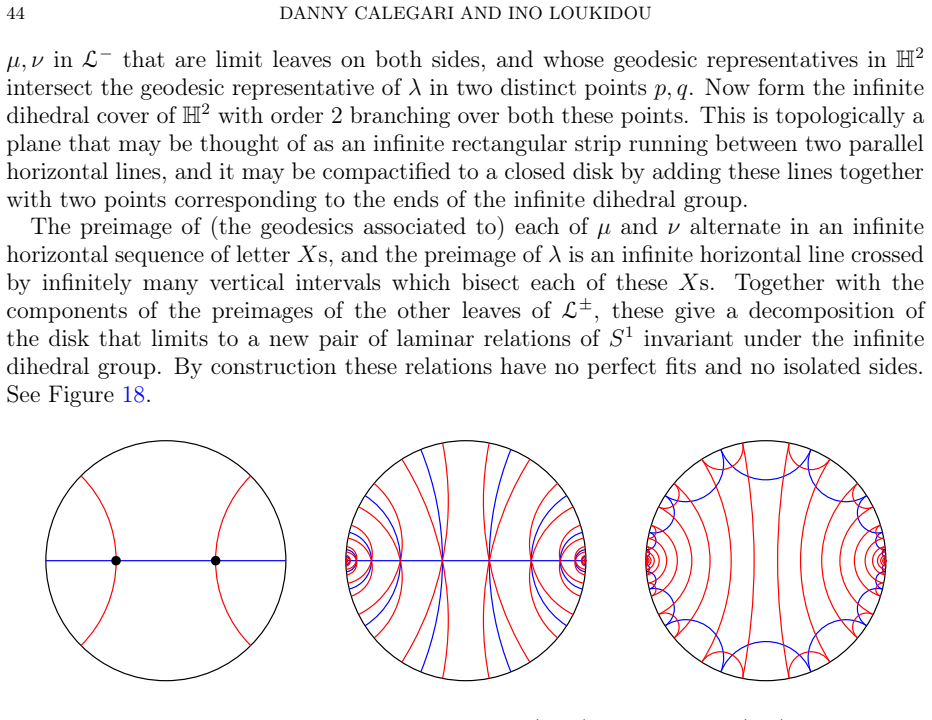
Figure 18. Figure 18: The geodesics associated to λ (blue) and µ and ν (red), their preimages under the infinite dihedral cover, and boundary leaves in the as￾sociated lamination in the cover In the sequel we will consider CaTherine wheels with large automorphism groups. Let’s formalize the notion. Definition 6.5 (G-CaTherine wheel). If G is a group of orientation-preserving homeo￾morphisms of S 2 , a G-CaTherine wheel is a Ca… view at source ↗
Figure 19
Figure 19. Figure 19: Arcs in Z +(fn) for Gn-CaTherine wheels for n = 2, 3, 4, 5, 6, 10, 50. In principle we may obtain explicit lower bounds on Kn, the least number such that fn is a a Kn-CaTherine wheel, as follows. In the faithful action of Gn on S 1 , the fixed points of t are nontrivially permuted by the (order n) commuting element [a, b]. In particular, some power of t has at least n fixed points on S 1 , giving a lower … view at source ↗
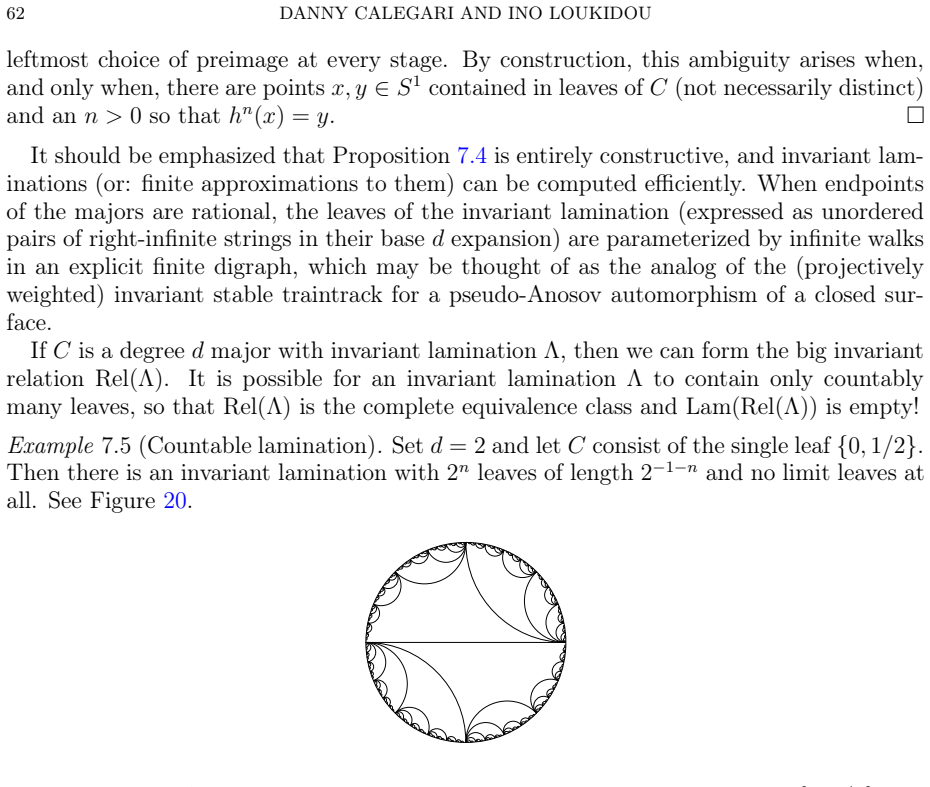
Figure 20
Figure 20. Figure 20: A countable degree 2 invariant lamination with critical leaf {0, 1/2}. However, there are many situations where Λ has only finitely many grand orbits of isolated leaves, and Lam(Rel(Λ)) has no isolated leaves, and only finitely many grand orbits of (finite sided) complementary polygonal regions. Example 7.6 (Misiurewicz point). A Misiurewicz point c ∈ C is a complex number for which the critical point 0 i… view at source ↗
Figure 21
Figure 21. Figure 21: The Julia set for Hi : z → z 2 + i is the quotient of S 1 by the laminar relation associated to the degree 2 major {1/12, 7/12}. 7.1.2. Mating. Mating of (connected polynomial) Julia sets was first described by Douady and worked out in detail by Tan Lei, Rees, Shishikura, Chéritat and others; see [86, 82, 84, 36]. Milnor [75] worked out an explicit example of the mating of two (degree 2) dendrite Julia se… view at source ↗
Figure 22
Figure 22. Figure 22: The laminar relations L ± have no perfect fits. The geometric mating is a degree 2 rational map H : CP1 → CP1 whose Julia set is all of CP1 , and the map f : S 1 → CP1 is a CaTherine wheel admitting a degree 2 endomorphism. This is a Lattès example, derived from complex multiplication on the Euclidean torus E := C/⟨1, η⟩ where one has η = 1 + i √ 7 2 and H(z) = η 2 z + 1 z(z + η 2 ) (see [75] § B.4). A fu… view at source ↗
Figure 23
Figure 23. Figure 23: A sequence of approximations to ˜f(I) ⊂ C 7.1.3. Zippers. If L is an invariant laminar relation for a postcritically finite major C there is a minimal nonempty finite forward-invariant subset X ⊂ S 1 containing at least one point in the forward image of every leaf of C. Let’s suppose L is the laminar relation associated to an equivariant parameterization f : S 1 → J ⊂ CP1 of a dendritic Julia set associat… view at source ↗
Figure 24
Figure 24. Figure 24: The preimage of the Hubbard tree in C/⟨1, η⟩ is a quasiarc. Based on this example, and in analogy with Proposition 6.9, we make the following conjecture: Conjecture 7.10 (Quasicircles). Let f : S 1 → CP1 be a CaTherine wheel arising from an expanding Thurston map. Then f is a K-CaTherine wheel for some K. Some evidence in favor of this conjecture comes from Lin–Rohde [66], especially The￾orem 1.5 and Prop… view at source ↗
Figure 25
Figure 25. Figure 25: The zipper is the union of the preimages of the trimmed Hub￾bard trees: Z ± := ∪nH−nT ± o . Each half of the zipper is double covered by a topological R-tree in C, and these trees are in blue and red. necessary so that the germ of Γ through P is invariant. We need one further combinatorial condition: there should be an H-invariant Jordan curve Γ˜ (also containing the postcritical set) and such that Γ˜ is … view at source ↗
Figure 26
Figure 26. Figure 26: The map hθ for θ = 0.13 Let us describe one family for which all preimages are ordinary. Example 7.14 (Ordinary family). For each θ ∈ [0, 1/3) define ξ : S 1 → S 1 of geometric degree 3 by ξ(x) = ( 3x if x ∈ [0, 1/3] or x ∈ [2/3, 1] −3x else view at source ↗
Figure 27
Figure 27. Figure 27: Invariant degree 3 origami laminations Λθ for θ = i/36 where i = 0, · · · , 5 Ordinary families are all alike; every folded family is folded in its own way. In an ordinary family the map admits a unique (maximal) seed that generates a degree d invariant lamination. In order to construct CaTherine wheels we need a pair of seeds generating laminations without perfect fits; in particular the seeds themselves… view at source ↗
Figure 28
Figure 28. Figure 28: The map hθ for θ = 0.141 Define C ± θ to be the seeds C + θ = {θ, θ + 1/3, θ + 2/3} C − θ = {θ + 1/6, θ + 1/2, θ + 5/6} Each seed decomposes S 1 into three intervals. In either subdivision, one of the three intervals is ordinary: it maps with slope 3 to the entire interval [0, 1]. Again in either subdivision, the other two intervals are folded: one maps with slopes 3 and −3 to [0, 1/2] and the other maps … view at source ↗
Figure 29
Figure 29. Figure 29: Invariant degree 3 origami laminations Λ ± θ for θ = 0.141 One may produce many interesting endomorphisms of CaTherine wheels from folded families. 7.2.2. Expanding origamis. Expanding origamis H : S 2 → S 2 are defined as follows: Definition 7.16 (Expanding origami). A map H : CP1 → CP1 is an expanding origami if there is a 2-colored graph Γ in CP1 so that (1) the sequence of graphs on CP1 obtained as it… view at source ↗
Figure 30
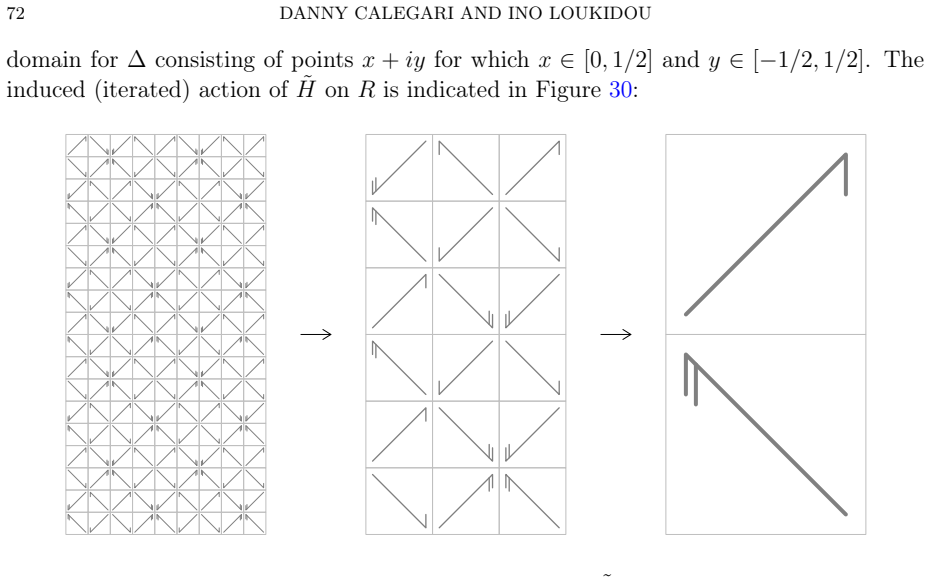
Figure 30. Figure 30: The ‘restriction’ of H˜ to R At the same time one can build an origami h : S 1 → S 1 as indicated in view at source ↗
Figure 31
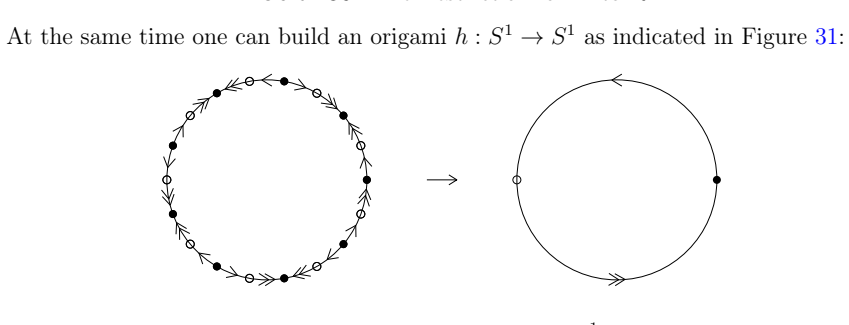
Figure 31. Figure 31: The map h on S 1 The two arrows in the rightmost copy of R in view at source ↗
Figure 32
Figure 32. Figure 32: shows an approximation to f(S 1 ) in CP1 for one invariant choice of f view at source ↗
Figure 33
Figure 33. Figure 33: A nearly filling map fϵ : I → D and the pinching laminations Taking the mesh size to zero, a subsequence converges in probability to a measure sup￾ported on filling maps f : I → D. Two such maps can be welded along their boundaries to view at source ↗
Figure 34
Figure 34. Figure 34: A numerical approximation to part of a LQG metric tree [28] Theorem 1.6 says that the set Z∞ is a half-zipper with short hair in the sense of Definition 3.18, and [28] Theorem 1.3 says that every half-zipper with short hair is Z + for some zipper Z ± associated to a unique CaTherine wheel f : S 1 → S 2 ; in particular, one obtains a ‘complementary’ half-zipper Z − whose meaning in the context of the γ-LQG… view at source ↗
Figure 35
Figure 35. Figure 35: Saint Catherine with her wheel [95]. References [1] W. Abikoff, Some remarks on Kleinian groups, Advances in the Theory of Riemann surfaces, Ann. Math. Stud. 61 (1970), 1–6 [2] I. Agol, Ideal triangulations of pseudo-Anosov mapping tori, Contemp. Math. 560 (2010) 1–19 [3] L. Ahlfors, Lectures on quasiconformal mappings, D. Van Nostrand Publishing, Princeton, NJ. 1966 [4] Y. An, Y. He, Z. Li and R. Zhong, … view at source ↗
read the original abstract

A CaTherine wheel is a surjective continuous map $f:S^1 \to S^2$ such that for every closed interval $I\subset S^1$ the image $f(I)$ is homeomorphic to a disk, and $f(\partial I)$ is contained in the boundary of this disk. CaTherine wheels arise in many areas of low-dimensional geometry and topology, including conformal dynamics (expanding Thurston maps, expanding origamis), probability theory (whole plane ${\rm SLE}_\kappa$ for $\kappa \ge 8$, LQG metric trees) and elsewhere. We develop their theory in generality, and explain how CaTherine wheels and their associated structures can serve as a dictionary between these various fields. Our most substantial applications are to the theory of hyperbolic 3-manifolds. If $M$ is a closed hyperbolic 3-manifold and $G=\pi_1(M)$, we show that there is a canonical bijection between four kinds of structures associated to $M$: 1. orbit-equivalence classes of pseudo-Anosov flows on $M$ without perfect fits; 2. $G$-equivariant CaTherine wheels up to conjugacy; 3. minimal $G$-zippers; and 4. connected components of the space of uniform quasimorphisms on $G$. This generalizes and amplifies the theory of fiberings of hyperbolic 3-manifolds over the circle and the Thurston norm.

Editorial analysis

A structured set of objections, weighed in public.

Desk editor's note, referee report, simulated authors' rebuttal, and a circularity audit. Tearing a paper down is the easy half of reading it; the pith above is the substance, this is the friction.

Axiom & Free-Parameter Ledger

0 free parameters · 1 axioms · 1 invented entities

The central claim rests on standard axioms of topology and geometry plus the newly introduced definition of CaTherine wheels; no free parameters or additional invented entities beyond the wheel itself are indicated in the abstract.

axioms (1)
  • standard math Standard axioms of point-set topology and manifold theory (continuous maps, homeomorphisms, fundamental groups)
    Invoked implicitly when defining surjective continuous maps, homeomorphic images, and π1(M)
invented entities (1)
  • CaTherine wheel no independent evidence
    purpose: Unifying object that serves as dictionary between dynamics, probability, and 3-manifold structures
    Newly defined surjective map S^1 to S^2 with interval-to-disk property; no independent evidence outside the paper is provided in the abstract

pith-pipeline@v0.9.0 · 5574 in / 1505 out tokens · 61705 ms · 2026-05-07T17:58:16.122348+00:00 · methodology

discussion (0)

Sign in with ORCID, Apple, or X to comment. Anyone can read and Pith papers without signing in.

Forward citations

Cited by 2 Pith papers

Reviewed papers in the Pith corpus that reference this work. Sorted by Pith novelty score.

  1. Convex Hull Volumes in Hyperbolic 3-Space

    math.GT 2026-04 unverdicted novelty 7.0

    A geometric condition on closed subsets of the Riemann sphere implies that their hyperbolic convex hulls in H^3 have infinite volume, with corollaries characterizing continua and planar self-similar sets with this property.

  2. Convex Hull Volumes in Hyperbolic 3-Space

    math.GT 2026-04 unverdicted novelty 5.0

    A geometric condition on closed subsets of the Riemann sphere implies that their hyperbolic convex hulls in H^3 have infinite volume, yielding characterizations of continua and planar self-similar sets.

Reference graph

Works this paper leans on

97 extracted references · 15 canonical work pages · cited by 1 Pith paper · 2 internal anchors

  1. [1]

    Abikoff,Some remarks on Kleinian groups, Advances in the Theory of Riemann surfaces, Ann

    W. Abikoff,Some remarks on Kleinian groups, Advances in the Theory of Riemann surfaces, Ann. Math. Stud.61(1970), 1–6

  2. [2]

    Agol,Ideal triangulations of pseudo-Anosov mapping tori, Contemp

    I. Agol,Ideal triangulations of pseudo-Anosov mapping tori, Contemp. Math.560(2010) 1–19

  3. [3]

    Ahlfors,Lectures on quasiconformal mappings, D

    L. Ahlfors,Lectures on quasiconformal mappings, D. Van Nostrand Publishing, Princeton, NJ. 1966

  4. [4]

    Y. An, Y. He, Z. Li and R. Zhong,Zippers for expanding Thurston maps, preprint in preparation

  5. [5]

    Arnoux,Un exemple de semi-conjugaison entre un échange d’intervalles et une translation sur le tore, Bull

    P. Arnoux,Un exemple de semi-conjugaison entre un échange d’intervalles et une translation sur le tore, Bull. SMF116(1988), no. 4, 489–500

  6. [6]

    Astala,Area distortion of quasiconformal mappings, Acta Math.173(1994), 37–60

    K. Astala,Area distortion of quasiconformal mappings, Acta Math.173(1994), 37–60

  7. [7]

    Baik and K

    H. Baik and K. KimLaminar Groups and 3-Manifolds, In: K. Ohshika, A. Papadopoulos (eds) In the Tradition of Thurston. Springer, Cham. 2000

  8. [8]

    H. Baik, H. Jung and K. Kim,Groups acting on veering pairs and Kleinian groups, Jour. LMS111 (2025), no. 1, Paper No. e70052

  9. [9]

    H. Baik, C. Wu and B. Zhao,Reconstruction of Anosov flows from infinity, preprint,https://arxiv. org/abs/2407.07634

  10. [10]

    Barbot and S

    T. Barbot and S. Fenley,Orbital equivalence classes of finite coverings of geodesic flows, preprint, https://arXiv.org/abs/2205.02495

  11. [11]

    Barthelmé, C

    T. Barthelmé, C. Bonatti and K. Mann,Completing prelaminations, Math. Ann.392(2025), 4983– 5044

  12. [12]

    Barthelmé, S

    T. Barthelmé, S. Frankel and K. Mann,Orbit equivalences of pseudo-Anosov flows, Invent. Math.240 (2025), 1119–1192 78 DANNY CALEGARI AND INO LOUKIDOU

  13. [13]

    Barthelmé, C.-C

    T. Barthelmé, C.-C. Tsang and J. Zung,Finiteness of pseudo-Anosov flows without perfect fits, preprint, in preparation

  14. [14]

    I.Bhattacharyya, R.Halder, N.LazarovichandM.MjFiniteness of Cannon–Thurston fibers, preprint, https://arxiv.org/abs/2603.22428

  15. [15]

    Bieri, W

    R. Bieri, W. Neumann and R. Strebel,A geometric invariant of discrete groups, Invent. Math.90 (1987), no. 3, 451–477

  16. [16]

    R. H. Bing,Upper semicontinuous decompositions ofE3, Ann. Math.65(1957), 363–374

  17. [17]

    growing trees

    A. Blokh and G. Levin,An inequality for laminations, Julia sets and “growing trees”, Erg. Thy. Dyn. Sys.22(2002) 63–97

  18. [18]

    Blokh and L

    A. Blokh and L. Oversteegen,Wandering triangles exist, C. R. Math. Acad. Sci. Paris339(2004), no. 5, 365–370

  19. [19]

    Bonk and D

    M. Bonk and D. Meyer,Expanding Thurston maps, AMS Mathematical Surveys and Monographs 225, Providence, RI. 2017

  20. [20]

    Borga and E

    J. Borga and E. Gwynne,Reconstructing SLE-decorated Liouville quantum gravity surfaces from ran- dom permutons, preprint,https://arxiv.org/pdf/2409.15494

  21. [21]

    Bourdon,Au bord de certains polyèdres hyperboliques, Ann

    M. Bourdon,Au bord de certains polyèdres hyperboliques, Ann. Inst. Fourier (Grenoble)45(1995), no. 1, 119–141

  22. [22]

    Bowen and C

    R. Bowen and C. Series,Markov maps associated with Fuchsian groups, IHES Pub. Math.50(1979), 153–170

  23. [23]

    Workshop on polynomial matings

    X. Buff, A. Epstein, S. Koch, D. Meyer, K. Pilgrim, M. Rees and T. Lei,Questions about polynomial matings, Ann. Fac. Sci. Toulouse, Mathématiques, Serie 6, Numéro Spécial à l’occasion du “Workshop on polynomial matings” 8–11 juin 2011, Toulouse, Volume21(2012), 1149–1176

  24. [24]

    Calegari,Universal circles for quasigeodesic flows, Geom

    D. Calegari,Universal circles for quasigeodesic flows, Geom. Top.10(2006), 2271–2298

  25. [25]

    Calegari,Foliations and the Geometry of 3-Manifolds, Oxford Mathematical Monographs, Oxford, 2007

    D. Calegari,Foliations and the Geometry of 3-Manifolds, Oxford Mathematical Monographs, Oxford, 2007

  26. [26]

    Calegari,scl, MSJ Memoirs20Mathematical Society of Japan, Tokyo, 2009

    D. Calegari,scl, MSJ Memoirs20Mathematical Society of Japan, Tokyo, 2009

  27. [27]

    Calegari,Sausages and butcher paper, Kang, Nam-Gyu (ed.) et al., Recent progress in mathematics

    D. Calegari,Sausages and butcher paper, Kang, Nam-Gyu (ed.) et al., Recent progress in mathematics. Singapore: Springer. KIAS Springer Ser. Math. 1 (2022), 155–200

  28. [28]

    CaTherine wheels from trees and Liouville quantum gravity

    D. Calegari and E. Gwynne,CaTherine wheels from trees and Liouville quantum gravity, preprint, https://arxiv.org/abs/2604.17170

  29. [29]

    Calegari and F

    D. Calegari and F. Herr,Expanding origamis, preprint, in preparation

  30. [30]

    Calegari and T

    D. Calegari and T. Loukidou,Zippers, Geom. Top. to appearhttps://arxiv.org/abs/2411.15610

  31. [31]

    Calegari and J

    D. Calegari and J. Zung,Quasimorphisms and pseudo-Anosov flows, preprint, in preparation

  32. [32]

    Cannon,The combinatorial Riemann mapping theorem, Acta Math.173(1994), no

    J. Cannon,The combinatorial Riemann mapping theorem, Acta Math.173(1994), no. 2, 155–234

  33. [33]

    Cannon and W

    J. Cannon and W. Dicks,On hyperbolic once-punctured-torus bundles, Geom. Ded.94(2002), 141–183

  34. [34]

    Cannon and W

    J. Cannon and W. Dicks,On hyperbolic once-punctured-torus bundles. II. Fractal tessellations of the plane, Geom. Ded.123(2006), 11–63

  35. [35]

    Cannon and W

    J. Cannon and W. Thurston,Group invariant Peano curves, Geom. Top.11(3) (2007), 1315–1356

  36. [36]

    Chéritat,Tan Lei and Shishikura’s example of non-mateable degree 3 polynomials without a Levy cycle, Ann

    A. Chéritat,Tan Lei and Shishikura’s example of non-mateable degree 3 polynomials without a Levy cycle, Ann. Fac. Sci. Toulouse Math. (2012) 21 (5), 935–980

  37. [37]

    Daverman,Decompositions of Manifolds, AMS Chelsea Publishing, 2007

    R. Daverman,Decompositions of Manifolds, AMS Chelsea Publishing, 2007

  38. [38]

    Davis and D

    C. Davis and D. Knuth,Number representations and dragon curves I, J. Rec. Math.3(1970), no. 2, 66–81

  39. [39]

    Davis and D

    C. Davis and D. Knuth,Number representations and dragon curves II, J. Rec. Math.3(1970), no. 3, 133–149

  40. [40]

    Dicks and D

    W. Dicks and D. Wright,On hyperbolic once-punctured-torus bundles IV: Automata for lightning curves, Top. Appl.159(2012), no. 1, 98–132

  41. [41]

    Duplantier, J

    B. Duplantier, J. Miller and S. Sheffield,Liouville quantum gravity as a mating of trees, Astérisque 427SMF, Marseilles, 2021

  42. [42]

    Douady and J

    A. Douady and J. Hubbard,Etude dynamique des polynômes complexes. Parts I and II, Publ. Math. d’Orsay 84–02, 1984https://pi.math.cornell.edu/~hubbard/OrsayFrench.pdf CATHERINE WHEELS 79

  43. [43]

    Farb and L

    B. Farb and L. Mosher,Convex cocompact subgroups of mapping class groups, Geom. Top.6(1) (2002), 91–152

  44. [44]

    Fenley,Foliations with good geometry, JAMS12(1999), no

    S. Fenley,Foliations with good geometry, JAMS12(1999), no. 3, 619–676

  45. [45]

    Fenley,Geometry of foliations and flows I: Almost transverse Pseudo-Anosov flows and asymptotic behavior of foliations, JDG81(2009), no

    S. Fenley,Geometry of foliations and flows I: Almost transverse Pseudo-Anosov flows and asymptotic behavior of foliations, JDG81(2009), no. 1, 1–89

  46. [46]

    Fenley,Ideal boundaries of pseudo-Anosov flows and uniform convergence groups, with connections and applications to large scale geometry, Geom

    S. Fenley,Ideal boundaries of pseudo-Anosov flows and uniform convergence groups, with connections and applications to large scale geometry, Geom. Top.16(2012), 1–110

  47. [47]

    Frankel,Quasigeodesic flows and Möbius-like groups, J

    S. Frankel,Quasigeodesic flows and Möbius-like groups, J. Diff. Geom.93(2013), 401–429

  48. [48]

    Frankel,Quasigeodesic flows and sphere-filling curves, Geom

    S. Frankel,Quasigeodesic flows and sphere-filling curves, Geom. Top.19(2015), no. 3, 1249–1262

  49. [49]

    Frankel and M

    S. Frankel and M. Landry,From quasigeodesic to pseudo-Anosov flows, preprint,https://arxiv. org/abs/2510.02217

  50. [50]

    Frankel, S

    S. Frankel, S. Schleimer and H. Segerman,From veering triangulations to link spaces and back again, Mem. AMS to appear,https://arxiv.org/abs/1911.00006

  51. [51]

    Gromov,Asymptotic invariants of infinite groups, Geometric group theory, Vol

    M. Gromov,Asymptotic invariants of infinite groups, Geometric group theory, Vol. 2 (Sussex, 1991), Cambridge Univ. Press, Cambridge, 1993, pp. 1–295

  52. [52]

    Gwynne, N

    E. Gwynne, N. Holden and X. Sun,Mating of trees for random planar maps and Liouville quantum gravity: a survey, Pan. et Synth.59Topics in Statistical Mechanics, Cédric Boutillier, Béatrice de Tilière, Kilian Raschel (eds.) (2023), 41–120

  53. [53]

    Gwynne, J

    E. Gwynne, J. Miller and S. Sheffield,The Tutte embedding of the mated-CRT map converges to Liouville quantum gravity, Ann. Prob.49(2021) no. 4, 1677–1717

  54. [54]

    Hubbard,Teichmüller theory and applications to geometry, topology, and dynamics

    J. Hubbard,Teichmüller theory and applications to geometry, topology, and dynamics. Volume 1: Teichmüller theory, Matrix Editions, Ithaca NY. 2006

  55. [55]

    Jung,Quadratic matings and ray connections, preprint,https://arxiv.org/pdf/1707.00630

    W. Jung,Quadratic matings and ray connections, preprint,https://arxiv.org/pdf/1707.00630

  56. [56]

    Kalmár,Decomposition space theory,https://arxiv.org/abs/2103.02977

    B. Kalmár,Decomposition space theory,https://arxiv.org/abs/2103.02977

  57. [57]

    Kapovich,A note on properly discontinuous actions,https://arxiv.org/abs/2301.05325v3

    M. Kapovich,A note on properly discontinuous actions,https://arxiv.org/abs/2301.05325v3

  58. [58]

    Kerbs,Pinched Jordan Curves, Cannon-Thurston Maps, and their Decompositions, preprint, in preparation

    L. Kerbs,Pinched Jordan Curves, Cannon-Thurston Maps, and their Decompositions, preprint, in preparation

  59. [59]

    von Kérékjartò,Über die periodischen Transformationen der Kreisscheibe und der Kugelfläche, Math

    B. von Kérékjartò,Über die periodischen Transformationen der Kreisscheibe und der Kugelfläche, Math. Ann.80(1919–1920), 36–38

  60. [60]

    Eclipses on Zippers

    K. Kim,Eclipses on zippers, preprint,https://arxiv.org/abs/2604.21792

  61. [61]

    Kiwi,Wandering orbit portraits, TAMS354(2002), no

    J. Kiwi,Wandering orbit portraits, TAMS354(2002), no. 4, 1473–1485

  62. [62]

    Landry and C.-C

    M. Landry and C.-C. Tsiang,Endperiodic maps, splitting sequences, and branched surfaces, Geom. Top.29(2025), no. 9, 4531–4663

  63. [63]

    Lawler,Conformally invariant processes in the plane, Math

    G. Lawler,Conformally invariant processes in the plane, Math. Surveys Mon.114, AMS, Providence, RI, 2005

  64. [64]

    Lawler, O

    G. Lawler, O. Schramm and W. Werner,Conformal invariance of planar loop-erased random walks and uniform spanning trees, Ann. Prob.32(2004), no. 1B, 939–995

  65. [65]

    Li,Finiteness of Singular Orbits of pseudo-Anosov Flows, preprint, in preparation

    Q. Li,Finiteness of Singular Orbits of pseudo-Anosov Flows, preprint, in preparation

  66. [66]

    Lin and S

    P. Lin and S. Rohde,Conformal welding of dendrites, preprint,https://sites.math.washington. edu/~rohde/papers/conformalweldingofdendrites.pdf

  67. [67]

    Loewner,Untersuchungen über schlichte konforme abbildungen des einheitskreises, Math

    K. Loewner,Untersuchungen über schlichte konforme abbildungen des einheitskreises, Math. Ann.89 (1923), 103–121

  68. [68]

    McMullen,Local connectivity, Kleinian groups and geodesics on the blowup of the torus, Invent

    C. McMullen,Local connectivity, Kleinian groups and geodesics on the blowup of the torus, Invent. Math.146, (2001), no. 1, 35–91

  69. [69]

    McMullen, personal communication

    C. McMullen, personal communication

  70. [70]

    Meyer,Expanding Thurston maps as quotients, preprint,https://arxiv.org/abs/0910.2003

    D. Meyer,Expanding Thurston maps as quotients, preprint,https://arxiv.org/abs/0910.2003

  71. [71]

    Miller and S

    J. Miller and S. Sheffield,Imaginary geometry IV: interior rays, whole-plane reversibility, and space- filling trees, Prob. Thy. and Related Fields,169(2017), 729–869

  72. [72]

    Miller and S

    J. Miller and S. Sheffield,Liouville quantum gravity and the Brownian map I: theQLE(8/3,0)metric, Invent. Math.219(1) (2020), 75–152

  73. [73]

    Miller and S

    J. Miller and S. Sheffield,An axiomatic characterization of the Brownian map, J. Éc. Pol. Math. (8) (2021), 609–731 80 DANNY CALEGARI AND INO LOUKIDOU

  74. [74]

    Miller and H

    J. Miller and H. Wu,Intersections of SLE paths: the double and cut point dimension of SLE, Prob. Thy. Related Fields167(2017), no. 1–2, 45–105

  75. [75]

    Milnor,Pasting Together Julia Sets: A Worked Out Example of Mating, Exper

    J. Milnor,Pasting Together Julia Sets: A Worked Out Example of Mating, Exper. Math.13(2004), no. 1, 55–92

  76. [76]

    Mineyev,Flows and joins of metric spaces, Geom

    I. Mineyev,Flows and joins of metric spaces, Geom. Top.9(2005), 403–482

  77. [77]

    Mitra,Ending laminations for hyperbolic group extensions, GAFA7(1997), 379–402

    M. Mitra,Ending laminations for hyperbolic group extensions, GAFA7(1997), 379–402

  78. [78]

    R. L. Moore,Concerning upper semicontinuous collections of compacta, Trans. AMS27(1925), 416– 428

  79. [79]

    Mosher,Laminations and flows transverse to finite depth foliations, preprint

    L. Mosher,Laminations and flows transverse to finite depth foliations, preprint

  80. [80]

    Mosher,Dynamical systems and the homology norm of a 3-manifold II, Invent

    L. Mosher,Dynamical systems and the homology norm of a 3-manifold II, Invent. Math.107(1992), 243–281

Showing first 80 references.