Recognition: unknown
Internet of Everything in the 6G Era: Paradigms, Enablers, Potentials and Future Directions
Pith reviewed 2026-05-07 16:51 UTC · model grok-4.3
The pith
IoE evolves IoT by integrating people, data, processes, and things for automation in 6G networks.
A machine-rendered reading of the paper's core claim, the machinery that carries it, and where it could break.
Core claim
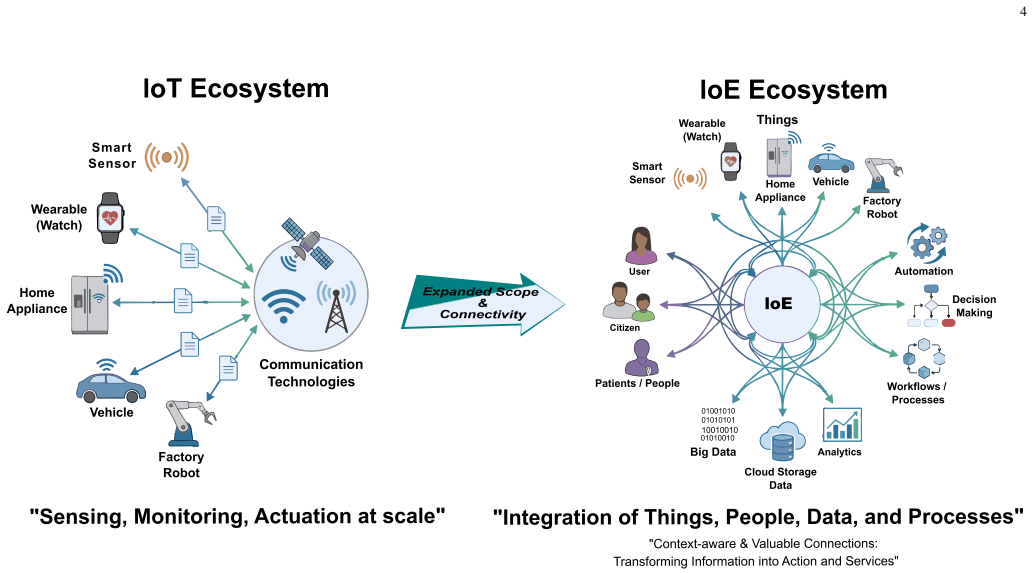
IoE represents an evolution of the Internet of Things (IoT) by integrating people, data, processes, and things into a unified intelligent ecosystem. It aims to enhance automation, decision-making, and service efficiency across multiple application domains such as smart cities, healthcare, industry, and next-generation wireless networks. The paper provides a structured overview of the IoE concept, its core components, architectural foundations, enabling technologies, and major research challenges, along with open research directions toward 6G-enabled intelligent IoE systems.
What carries the argument
The IoE ecosystem that unifies people, processes, data, and things, supported by 6G enabling technologies for intelligent automation.
Load-bearing premise
The overview assumes that the selected literature on IoE components, architectures, and 6G enablers provides a complete and unbiased representation of the field without gaps in coverage or selection bias.
What would settle it
Discovery of major recent papers on IoE or 6G enablers that are not covered or referenced in the review, indicating selection bias or incomplete coverage.
Figures




read the original abstract
The Internet of Everything (IoE) represents an evolution of the Internet of Things (IoT) by integrating people, data, processes, and things into a unified intelligent ecosystem. IoE aims to enhance automation, decision-making, and service efficiency across multiple application domains such as smart cities, healthcare, industry, and next-generation wireless networks. This paper provides a structured overview of the IoE concept, its core components, architectural foundations, enabling technologies, and major research challenges. Finally, open research directions toward 6G-enabled intelligent IoE systems are discussed, with emphasis on scalability, security, privacy, and energy efficiency.
Editorial analysis
A structured set of objections, weighed in public.
Referee Report
Summary. The paper provides a structured overview of the Internet of Everything (IoE) as an evolution of the Internet of Things (IoT), integrating people, data, processes, and things into an intelligent ecosystem. It covers the IoE concept, core components, architectural foundations, enabling technologies in the 6G context, major research challenges, and open research directions with emphasis on scalability, security, privacy, and energy efficiency across domains such as smart cities, healthcare, industry, and next-generation wireless networks.
Significance. If the literature synthesis is balanced and comprehensive, the paper can serve as a useful reference consolidating existing work on IoE paradigms and 6G enablers, helping researchers navigate the transition from IoT to intelligent, 6G-enabled systems. As a survey without new derivations, data, or predictions, its primary contribution is organizational clarity rather than novel technical insight.
minor comments (2)
- [Abstract] Abstract: The description of the paper's structure is clear but does not indicate the total number of references reviewed or the criteria used for literature selection, which would strengthen the claim of providing a representative overview.
- The manuscript would benefit from an explicit comparison table (e.g., IoT vs. IoE vs. 6G-IoE) to highlight differences in components, architectures, and enablers, improving readability for the target audience in emerging technologies.
Simulated Author's Rebuttal
We thank the referee for their review and recommendation of minor revision. The assessment of the paper as a structured overview of IoE paradigms and 6G enablers is appreciated. No specific major comments were provided under the MAJOR COMMENTS section.
Circularity Check
No significant circularity: literature survey with external citations only
full rationale
This is a review paper providing a structured overview of IoE concepts, components, architectures, enabling technologies, and open directions for 6G. It contains no derivations, equations, predictions, fitted parameters, or self-referential claims that reduce to the paper's own inputs. All content draws from and cites external literature without any load-bearing self-citation chains, ansatzes, or renamings of known results as novel derivations. The central claim is a summary of existing work, which is self-contained against external benchmarks and does not exhibit any of the enumerated circularity patterns.
Axiom & Free-Parameter Ledger
Reference graph
Works this paper leans on
-
[1]
The Computer for the 21st Century,
M. Weiser, “The Computer for the 21st Century,”Scientific American, vol. 265, no. 3, pp. 94–104, Sep. 1991
1991
-
[2]
Internet of Things (IoT) and New Computing Paradigms,
C. Chang, S. N. Srirama, and R. Buyya, “Internet of Things (IoT) and New Computing Paradigms,” inFog and Edge Computing: Principles and Paradigms. Wiley, 2019
2019
-
[3]
The Internet of Things vision: Key features, appli- cations and open issues,
E. Borgia, “The Internet of Things vision: Key features, appli- cations and open issues,”Computer Communications, vol. 54, pp. 1–31, 2014
2014
-
[4]
Implementation of Sensing and Actuation Capabilities for IoT Devices Using oneM2M Platforms,
J. Yun, I.-Y . Ahn, J. Song, and J. Kim, “Implementation of Sensing and Actuation Capabilities for IoT Devices Using oneM2M Platforms,”Sensors, vol. 19, no. 20, p. 4567, 2019
2019
-
[5]
Number of connected IoT devices growing 14% to 21.1 billion globally in 2025,
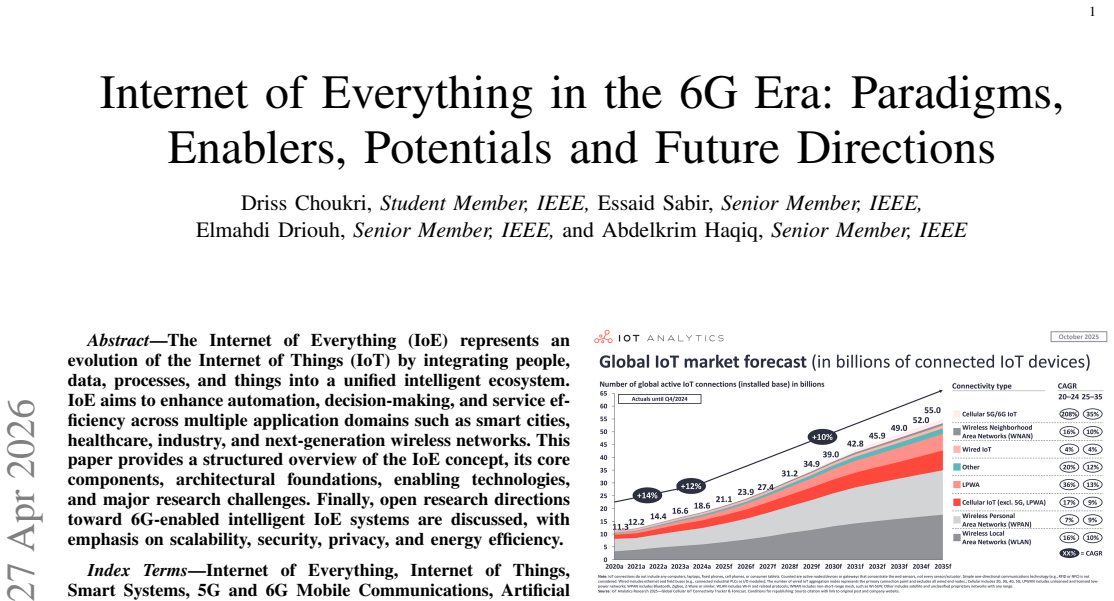
IoT Analytics, “Number of connected IoT devices growing 14% to 21.1 billion globally in 2025,” https://iot-analytics .com/number-connected-iot-devices/, Oct. 2025, accessed: 2026-01-31
2025
-
[6]
The Internet of Things: A Survey,
L. Atzori, A. Iera, and G. Morabito, “The Internet of Things: A Survey,”Computer Networks, vol. 54, no. 15, pp. 2787–2805, 2010
2010
-
[7]
Internet of Things: A Survey on Enabling Tech- nologies, Protocols, and Applications,
A. Al-Fuqaha, M. Guizani, M. Mohammadi, M. Aledhari, and M. Ayyash, “Internet of Things: A Survey on Enabling Tech- nologies, Protocols, and Applications,”IEEE Communications Surveys & Tutorials, vol. 17, no. 4, pp. 2347–2376, 2015
2015
-
[8]
The Internet of Everything: How More Relevant and Valuable Connections Will Change the World,
D. Evans, “The Internet of Everything: How More Relevant and Valuable Connections Will Change the World,” Cisco Internet Business Solutions Group (IBSG), White Paper, 2012, 40 accessed: 2026-02-03. [Online]. Available: https://www.cisco. com/c/dam/global/en my/assets/ciscoinnovate/pdfs/IoE.pdf
2012
-
[9]
Internet of Everything (IoE) Value at Stake: FAQ,
Cisco Systems, “Internet of Everything (IoE) Value at Stake: FAQ,” Cisco white paper (PDF), 2013, accessed: 2026-01-31. [Online]. Available: https://www.cisco.com/c/dam/en us/abou t/business-insights/docs/ioe-value-at-stake-public-sector-ana lysis-faq.pdf
2013
-
[10]
A Vision of 6G Wireless Systems: Applications, Trends, Technologies, and Open Re- search Problems,
W. Saad, M. Bennis, and M. Chen, “A Vision of 6G Wireless Systems: Applications, Trends, Technologies, and Open Re- search Problems,”IEEE Network, vol. 34, no. 3, pp. 134–142, 2020
2020
-
[11]
An Overview for De- signing 6G Networks: Technologies, Spectrum Management, Enhanced Air Interface, and AI/ML Optimization,
D. Sharma, V . Tilwari, and S. Pack, “An Overview for De- signing 6G Networks: Technologies, Spectrum Management, Enhanced Air Interface, and AI/ML Optimization,”IEEE In- ternet of Things Journal, vol. 12, no. 6, pp. 6133–6157, 2025
2025
-
[12]
An Overview on Economic Analysis of Internet of Everything,
N. Ding, X. Ouyang, L. Gao, J. Huang, and G. Xing, “An Overview on Economic Analysis of Internet of Everything,” IEEE Communications Surveys & Tutorials, vol. 27, no. 6, pp. 3742–3771, 2025
2025
-
[13]
Q. Cui, X. You, N. Wei, G. Nan, X. Zhang, J. Zhang, X. Lyu, M. Ai, X. Tao, Z. Feng, P. Zhang, Q. Wu, M. Tao, Y . Huang, C. Huang, G. Liu, C. Peng, Z. Pan, T. Sun, D. Niyato, T. Chen, M. K. Khan, A. Jamalipour, M. Guizani, and C. Yuen, “Overview of AI and Communication for 6G Network: Fundamentals, Challenges, and Future Research Opportunities,”Science Chi...
-
[14]
A Survey of Blockchain and Artificial Intelligence for 6G Wireless Communications,
Y . Zuo, J. Guo, N. Gao, Y . Zhu, S. Jin, and X. Li, “A Survey of Blockchain and Artificial Intelligence for 6G Wireless Communications,”IEEE Communications Surveys & Tutorials, vol. 25, no. 4, pp. 2494–2528, 2023
2023
-
[15]
Exploring the Synergy: AI Enhancing Blockchain, Blockchain Empowering AI, and Their Convergence Across IoT Applications and Beyond,
Y . Zuo, “Exploring the Synergy: AI Enhancing Blockchain, Blockchain Empowering AI, and Their Convergence Across IoT Applications and Beyond,”IEEE Internet of Things Jour- nal, vol. 12, no. 6, pp. 6171–6195, 2025
2025
-
[16]
Exploring the key technologies and applications of 6G wireless communication network,
P. Li, J. Fan, and J. Wu, “Exploring the key technologies and applications of 6G wireless communication network,”iScience, vol. 28, no. 5, p. 112281, 2025
2025
-
[17]
Exploring the 6G Potentials: Immersive, Hyperreliable, and Low-Latency Communication,
A. A. Shamsabadi, A. Yadav, Y . Gadallah, and H. Yanikomeroglu, “Exploring the 6G Potentials: Immersive, Hyperreliable, and Low-Latency Communication,”IEEE Vehicular Technology Magazine, vol. 20, no. 1, pp. 74–82, 2025
2025
-
[18]
Wireless powered IoE for 6G: Massive access meets scalable cell-free massive MIMO,
S. Chen, J. Zhang, Y . Jin, and B. Ai, “Wireless powered IoE for 6G: Massive access meets scalable cell-free massive MIMO,” China Communications, vol. 17, no. 12, pp. 92–109, 2020
2020
-
[19]
Fog of Everything: Energy-Efficient Networked Computing Architectures, Research Challenges, and a Case Study,
E. Baccarelli, P. G. Naranjo, M. Scarpiniti, M. Shojafar, and J. Abawajy, “Fog of Everything: Energy-Efficient Networked Computing Architectures, Research Challenges, and a Case Study,”IEEE Access, vol. 5, pp. 9882–9910, 2017
2017
-
[20]
Blockchain for Edge of Things: Applications, Opportunities, and Challenges,
T. R. Gadekallu, Q.-V . Pham, D. C. Nguyen, P. K. R. Mad- dikunta, N. Deepa, B. Prabadevi, P. N. Pathirana, J. Zhao, and W.-J. Hwang, “Blockchain for Edge of Things: Applications, Opportunities, and Challenges,”IEEE Internet of Things Jour- nal, vol. 9, no. 2, pp. 964–988, 2022
2022
-
[21]
Blockchain-Based Incentive Mech- anism in Internet of Things: Survey and Vision,
Y . Peng and H. Duan, “Blockchain-Based Incentive Mech- anism in Internet of Things: Survey and Vision,” in2024 IEEE International Conference on Smart Internet of Things (SmartIoT), 2024, pp. 555–562
2024
-
[22]
The Performance Evaluation of Blockchain-Based Security and Privacy Systems for the Inter- net of Things: A Tutorial,
M. A. Ferrag and L. Shu, “The Performance Evaluation of Blockchain-Based Security and Privacy Systems for the Inter- net of Things: A Tutorial,”IEEE Internet of Things Journal, vol. 8, no. 24, pp. 17 236–17 260, 2021
2021
-
[23]
Intro- duction to Federated Learning and Its Application in Industry,
M. Gulhane, A. Chauhan, N. Rakesh, and Y . Tripathi, “Intro- duction to Federated Learning and Its Application in Industry,” inFederated Learning Applications in the Industrial Internet of Everything (IoE), ser. Studies in Systems, Decision and Control, R. Mohana, A. Sharma, A. Nayyar, and P. Saini, Eds. Springer Nature Switzerland, 2025, vol. 611
2025
-
[24]
Mohana, A
R. Mohana, A. Sharma, A. Nayyar, and P. Saini, Eds., Federated Learning Applications in the Industrial Internet of Everything (IoE), ser. Studies in Systems, Decision and Control. Springer Nature Switzerland, 2025, vol. 611
2025
-
[25]
6G Enablers for Zero-Carbon Network Slices and Vertical Edge Services,
R. Bolla, R. Bruschi, C. Lombardo, and B. Siccardi, “6G Enablers for Zero-Carbon Network Slices and Vertical Edge Services,”IEEE Networking Letters, vol. 5, no. 3, pp. 173–176, 2023
2023
-
[26]
From Massive IoT Toward IoE: Evolution of Energy Efficient Au- tonomous Wireless Networks,
H. Babbar, S. Rani, O. Bouachir, and M. Aloqaily, “From Massive IoT Toward IoE: Evolution of Energy Efficient Au- tonomous Wireless Networks,”IEEE Communications Stan- dards Magazine, vol. 7, no. 2, pp. 32–39, 2023
2023
-
[27]
Energy-Efficient Industrial Internet of Things in Green 6G Networks,
X. Fernando and G. L ˘az˘aroiu, “Energy-Efficient Industrial Internet of Things in Green 6G Networks,”Applied Sciences, vol. 14, no. 18, 2024. [Online]. Available: https://www.mdpi.com/2076-3417/14/18/8558
2024
-
[28]
Green concerns in federated learning over 6G,
B. Zhao, Q. Cui, S. Liang, J. Zhai, Y . Hou, X. Huang, M. Pan, and X. Tao, “Green concerns in federated learning over 6G,” China Communications, vol. 19, no. 3, pp. 50–69, 2022
2022
-
[29]
Federated learning for green and sustainable 6G IIoT applications,
V . K. Quy, D. C. Nguyen, D. Van Anh, and N. M. Quy, “Federated learning for green and sustainable 6G IIoT applications,”Internet of Things, vol. 25, p. 101061, 2024. [Online]. Available: https://www.sciencedirect.com/science/ar ticle/pii/S2542660524000039
2024
-
[30]
Green Federated Learning: A New Era of Green Aware AI,
D. Thakur, A. Guzzo, G. Fortino, and F. Piccialli, “Green Federated Learning: A New Era of Green Aware AI,”ACM Comput. Surv., vol. 57, no. 8, Mar. 2025. [Online]. Available: https://doi.org/10.1145/3718363
-
[31]
Security and Privacy by Design is Key in the Internet of Everything (IoE) Era,
S. P. Mohanty, “Security and Privacy by Design is Key in the Internet of Everything (IoE) Era,”IEEE Consumer Electronics Magazine, vol. 9, no. 2, pp. 4–5, 2020
2020
-
[32]
Roadmap to Secure 6G Networks,
V . Bolgouras, A. Farao, and C. Xenakis, “Roadmap to Secure 6G Networks,” in2024 IEEE 29th International Workshop on Computer Aided Modeling and Design of Communication Links and Networks (CAMAD), 2024, pp. 1–6
2024
-
[33]
R. Prasad and A. Koren,Safeguarding 6G: Security and Privacy for the Next Generation, 1st ed. New York: River Publishers, 2025. [Online]. Available: https: //doi.org/10.1201/9788770047951
-
[34]
IoT-Enabled Hierarchical Energy Trading for Multi-Community Sharing in the Internet of Energy,
C.-C. Lin, S.-Y . Zhang, J. Lian, and D.-J. Deng, “IoT-Enabled Hierarchical Energy Trading for Multi-Community Sharing in the Internet of Energy,”IEEE Internet of Things Journal, pp. 1–1, 2026
2026
-
[35]
Harnessing Large Language Models for Intelligent Resource Allocation in the Internet of Everything,
H. Zhang, Z. Duan, Z. Wu, X. Ma, and Y . Ren, “Harnessing Large Language Models for Intelligent Resource Allocation in the Internet of Everything,”IEEE Network, pp. 1–8, 2026
2026
-
[36]
Embedded Cognitive Radio for Next Generation IoE: Framework, Solution, and Future Directions,
M. Zheng, W. Peng, and M. Guizani, “Embedded Cognitive Radio for Next Generation IoE: Framework, Solution, and Future Directions,”IEEE Network, pp. 1–1, 2025
2025
-
[37]
RIS-Assisted Physical Layer Security in Emerging RF and Optical Wireless Communications Systems: A Comprehensive Survey,
M. H. Khoshafa, O. Maraqa, J. M. Moualeu, S. Aboagye, T. M. N. Ngatched, M. H. Ahmed, Y . Gadallah, and M. Di Renzo, “RIS-Assisted Physical Layer Security in Emerging RF and Optical Wireless Communications Systems: A Comprehensive Survey,”IEEE Communications Surveys & Tutorials, vol. 27, no. 4, pp. 2156–2203, 2025
2025
-
[38]
Fu- ture of Connectivity: A Comprehensive Review of Innovations and Challenges in 7G Smart Networks,
V . Chamola, M. Shall Peelam, M. Guizani, and D. Niyato, “Fu- ture of Connectivity: A Comprehensive Review of Innovations and Challenges in 7G Smart Networks,”IEEE Open Journal of the Communications Society, vol. 6, pp. 3555–3613, 2025
2025
-
[40]
Channel Characterization and Modeling for VLC- IoE Applications in 6G: A Survey,
P. Tang, Y . Yin, Y . Tong, S. Liu, L. Li, T. Jiang, Q. Wang, and M. Chen, “Channel Characterization and Modeling for VLC- IoE Applications in 6G: A Survey,”IEEE Internet of Things Journal, vol. 11, no. 21, pp. 34 872–34 895, 2024
2024
-
[41]
6G-Enabled Ultra-Reliable Low- 41 Latency Communication in Edge Networks,
M. Adhikari and A. Hazra, “6G-Enabled Ultra-Reliable Low- 41 Latency Communication in Edge Networks,”IEEE Communi- cations Standards Magazine, vol. 6, no. 1, pp. 67–74, 2022
2022
-
[42]
Edge Computing for Internet of Everything: A Survey,
X. Kong, Y . Wu, H. Wang, and F. Xia, “Edge Computing for Internet of Everything: A Survey,”IEEE Internet of Things Journal, vol. 9, no. 23, pp. 23 472–23 485, 2022
2022
-
[43]
6G Internet of Things: A Comprehensive Survey,
D. C. Nguyen, M. Ding, P. N. Pathirana, A. Seneviratne, J. Li, D. Niyato, O. Dobre, and H. V . Poor, “6G Internet of Things: A Comprehensive Survey,”IEEE Internet of Things Journal, vol. 9, no. 1, pp. 359–383, 2022
2022
-
[44]
Internet of Everything (IoE) Taxonomies: A Survey and a Novel Knowledge-Based Taxonomy,
V . C. Farias da Costa, L. Oliveira, and J. de Souza, “Internet of Everything (IoE) Taxonomies: A Survey and a Novel Knowledge-Based Taxonomy,”Sensors, vol. 21, no. 2, 2021. [Online]. Available: https://www.mdpi.com/1424-8220/21/2/5 68
2021
-
[45]
Edge Computing in Industrial Internet of Things: Ar- chitecture, Advances and Challenges,
T. Qiu, J. Chi, X. Zhou, Z. Ning, M. Atiquzzaman, and D. O. Wu, “Edge Computing in Industrial Internet of Things: Ar- chitecture, Advances and Challenges,”IEEE Communications Surveys & Tutorials, vol. 22, no. 4, pp. 2462–2488, 2020
2020
-
[46]
Deep Learning for Edge Computing Applications: A State-of-the- Art Survey,
F. Wang, M. Zhang, X. Wang, X. Ma, and J. Liu, “Deep Learning for Edge Computing Applications: A State-of-the- Art Survey,”IEEE Access, vol. 8, pp. 58 322–58 336, 2020
2020
-
[47]
Fog Computing: A Comprehensive Architec- tural Survey,
P. Habibi, M. Farhoudi, S. Kazemian, S. Khorsandi, and A. Leon-Garcia, “Fog Computing: A Comprehensive Architec- tural Survey,”IEEE Access, vol. 8, pp. 69 105–69 133, 2020
2020
-
[48]
Federated Learning in Mobile Edge Networks: A Comprehensive Survey,
W. Y . B. Lim, N. C. Luong, D. T. Hoang, Y . Jiao, Y .-C. Liang, Q. Yang, D. Niyato, and C. Miao, “Federated Learning in Mobile Edge Networks: A Comprehensive Survey,”IEEE Communications Surveys & Tutorials, vol. 22, no. 3, pp. 2031– 2063, 2020
2031
-
[49]
Towards a Definition of the Internet of Things (IoT),
IEEE Internet of Things Initiative, “Towards a Definition of the Internet of Things (IoT),” White paper (Revision 1, Published 27 May 2015), 2015, accessed: 2026-01-29. [Online]. Available: https://iot.ieee.org/images/files/pdf/IEEE IoT Towards Definition Internet of Things Revision1 27M AY15.pdf
2015
-
[50]
Survey on the Internet of Vehicles: Network Archi- tectures and Applications,
B. Ji, X. Zhang, S. Mumtaz, C. Han, C. Li, H. Wen, and D. Wang, “Survey on the Internet of Vehicles: Network Archi- tectures and Applications,”IEEE Communications Standards Magazine, vol. 4, no. 1, pp. 34–41, 2020
2020
-
[51]
Ar- chitectures, Benefits, Security, and Privacy Issues of Internet of Nano Things: A Comprehensive Survey, Opportunities, and Research Challenges,
A. Rana, D. Gautam, P. Kumar, and A. Kumar Das, “Ar- chitectures, Benefits, Security, and Privacy Issues of Internet of Nano Things: A Comprehensive Survey, Opportunities, and Research Challenges,”IEEE Communications Surveys & Tutorials, vol. 27, no. 2, pp. 1152–1190, 2025
2025
-
[52]
Internet of Everything (IoE) - From Molecules to the Universe,
O. B. Akan, E. Dinc, M. Kuscu, O. Cetinkaya, and B. A. Bilgin, “Internet of Everything (IoE) - From Molecules to the Universe,”IEEE Communications Magazine, vol. 61, no. 10, pp. 122–128, 2023
2023
-
[53]
The internet of Bio-Nano things,
I. F. Akyildiz, M. Pierobon, S. Balasubramaniam, and Y . Koucheryavy, “The internet of Bio-Nano things,”IEEE Communications Magazine, vol. 53, no. 3, pp. 32–40, 2015
2015
-
[54]
A Comprehensive Survey of Recent Advancements in Molecular Communication,
N. Farsad, H. B. Yilmaz, A. Eckford, C.-B. Chae, and W. Guo, “A Comprehensive Survey of Recent Advancements in Molecular Communication,”IEEE Communications Surveys & Tutorials, vol. 18, no. 3, pp. 1887–1919, 2016
1919
-
[55]
Moving forward with molecular communication: from theory to human health applications [point of view],
I. F. Akyildiz, M. Pierobon, and S. Balasubramaniam, “Moving forward with molecular communication: from theory to human health applications [point of view],”Proceedings of the IEEE, vol. 107, no. 5, pp. 858–865, 2019
2019
-
[56]
Bacterial Communications and Computing in Internet of Everything (IoE),
B. Yagmur Koca and O. B. Akan, “Bacterial Communications and Computing in Internet of Everything (IoE),”IEEE Com- munications Surveys & Tutorials, vol. 27, no. 3, pp. 1839– 1866, 2025
2025
-
[57]
Exhaled Breath Analysis Through the Lens of Molecular Communication: A Survey,
S. Bhattacharjee, D. Bi, P. Hofmann, A. Wietfeld, S. Becke, M. Lommel, P. Zhou, R. Zheng, U. Kertzscher, Y . Deng, W. Kellerer, F. H. P. Fitzek, and F. Dressler, “Exhaled Breath Analysis Through the Lens of Molecular Communication: A Survey,”IEEE Communications Surveys & Tutorials, vol. 28, pp. 412–445, 2026
2026
-
[58]
Semantic Learning for Molecular Communication in Internet of Bio-Nano Things,
H. Cai and O. B. Akan, “Semantic Learning for Molecular Communication in Internet of Bio-Nano Things,” inPro- ceedings of the 9th International Workshop on Molecular Communications (MolCom), Catania, Italy, 2025
2025
-
[59]
A Survey on the Edge Computing for the Internet of Things,
W. Yu, F. Liang, X. He, W. G. Hatcher, C. Lu, J. Lin, and X. Yang, “A Survey on the Edge Computing for the Internet of Things,”IEEE Access, vol. 6, pp. 6900–6919, 2018, early access online: 2017-11-28
2018
-
[60]
Edge Comput- ing for the Internet of Things: A Case Study,
G. Premsankar, M. Di Francesco, and T. Taleb, “Edge Comput- ing for the Internet of Things: A Case Study,”IEEE Internet of Things Journal, vol. 5, no. 2, pp. 1275–1284, 2018
2018
-
[61]
On the Road to 6G: Visions, Requirements, Key Technologies, and Testbeds,
C.-X. Wang, X. You, X. Gao, X. Zhu, Z. Li, C. Zhang, H. Wang, Y . Huang, Y . Chen, H. Haas, J. S. Thompson, E. G. Larsson, M. Di Renzo, W. Tong, P. Zhu, X. Shen, H. V . Poor, and L. Hanzo, “On the Road to 6G: Visions, Requirements, Key Technologies, and Testbeds,”IEEE Communications Sur- veys & Tutorials, vol. 25, no. 2, pp. 905–974, 2023
2023
-
[62]
Fog computing and its role in the internet of things,
F. Bonomi, R. Milito, J. Zhu, and S. Addepalli, “Fog computing and its role in the internet of things,” in Proceedings of the First Edition of the MCC Workshop on Mobile Cloud Computing, ser. MCC ’12. New York, NY , USA: Association for Computing Machinery, 2012, p. 13–16. [Online]. Available: https://doi.org/10.1145/2342509.2342513
-
[63]
Edge Computing: Vision and Challenges,
W. Shi, J. Cao, Q. Zhang, Y . Li, and L. Xu, “Edge Computing: Vision and Challenges,”IEEE Internet of Things Journal, vol. 3, no. 5, pp. 637–646, 2016
2016
-
[64]
A Survey on Mobile Edge Computing: The Communication Per- spective,
Y . Mao, C. You, J. Zhang, K. Huang, and K. B. Letaief, “A Survey on Mobile Edge Computing: The Communication Per- spective,”IEEE Communications Surveys & Tutorials, vol. 19, no. 4, pp. 2322–2358, 2017
2017
-
[65]
Edge Intelligence: Paving the Last Mile of Artificial Intelligence With Edge Computing,
Z. Zhou, X. Chen, E. Li, L. Zeng, K. Luo, and J. Zhang, “Edge Intelligence: Paving the Last Mile of Artificial Intelligence With Edge Computing,”Proceedings of the IEEE, vol. 107, no. 8, pp. 1738–1762, 2019
2019
-
[66]
Liu,Cloud-Edge-End Collaboration Technology and Inno- vative Application Concepts for Smart Cities
F. Liu,Cloud-Edge-End Collaboration Technology and Inno- vative Application Concepts for Smart Cities. Singapore: Springer Nature Singapore, 2026, pp. 77–139
2026
-
[67]
Wireless powered communica- tion networks: an overview,
S. Bi, Y . Zeng, and R. Zhang, “Wireless powered communica- tion networks: an overview,”IEEE Wireless Communications, vol. 23, no. 2, pp. 10–18, 2016
2016
-
[68]
Throughput Maximization in Wireless Powered Communication Networks,
H. Ju and R. Zhang, “Throughput Maximization in Wireless Powered Communication Networks,”IEEE Transactions on Wireless Communications, vol. 13, no. 1, pp. 418–428, 2014
2014
-
[69]
Wire- less Networks With RF Energy Harvesting: A Contemporary Survey,
X. Lu, P. Wang, D. Niyato, D. I. Kim, and Z. Han, “Wire- less Networks With RF Energy Harvesting: A Contemporary Survey,”IEEE Communications Surveys & Tutorials, vol. 17, no. 2, pp. 757–789, 2015
2015
-
[70]
Sustainable RF Wireless Energy Transfer for Massive IoT: Enablers and Challenges,
O. M. Rosabal, O. L. A. L ´opez, H. Alves, and M. Latva-Aho, “Sustainable RF Wireless Energy Transfer for Massive IoT: Enablers and Challenges,”IEEE Access, vol. 11, pp. 133 979– 133 992, 2023
2023
-
[71]
On Multi-Access Edge Computing: A Survey of the Emerging 5G Network Edge Cloud Architecture and Orchestration,
T. Taleb, K. Samdanis, B. Mada, H. Flinck, S. Dutta, and D. Sabella, “On Multi-Access Edge Computing: A Survey of the Emerging 5G Network Edge Cloud Architecture and Orchestration,”IEEE Communications Surveys & Tutorials, vol. 19, no. 3, pp. 1657–1681, 2017
2017
-
[72]
Orchestration in the Cloud- to-Things Compute Continuum: Taxonomy, Survey and Future Directions,
A. Ullah, T. Kiss, J. Kov ´acs, F. Tusa, J. Deslauriers, H. Dagde- viren, R. Arjun, and H. Hamzeh, “Orchestration in the Cloud- to-Things Compute Continuum: Taxonomy, Survey and Future Directions,”Journal of Cloud Computing, vol. 12, no. 1, p. 135, 2023
2023
-
[73]
Management and Orchestration of Edge Computing for IoT: A Comprehen- sive Survey,
Y . Chiang, Y . Zhang, H. Luo, T.-Y . Chen, G.-H. Chen, H.-T. Chen, Y .-J. Wang, H.-Y . Wei, and C.-T. Chou, “Management and Orchestration of Edge Computing for IoT: A Comprehen- sive Survey,”IEEE Internet of Things Journal, vol. 10, no. 16, pp. 14 307–14 331, 2023
2023
-
[74]
Enabling 5G QoS configuration capabilities for IoT applications on container orchestration platform,
Y . Liu and A. H. Herranz, “Enabling 5G QoS configuration capabilities for IoT applications on container orchestration platform,” in2023 IEEE International Conference on Cloud 42 Computing Technology and Science (CloudCom), 2023, pp. 63–68
2023
-
[75]
AI-Based Resource Provisioning of IoE Services in 6G: A Deep Re- inforcement Learning Approach,
H. Sami, H. Otrok, J. Bentahar, and A. Mourad, “AI-Based Resource Provisioning of IoE Services in 6G: A Deep Re- inforcement Learning Approach,”IEEE Transactions on Net- work and Service Management, vol. 18, no. 3, pp. 3527–3540, 2021
2021
-
[76]
Intelligent Reflecting Surface Versus Decode-and-Forward: How Large Surfaces are Needed to Beat Relaying?
E. Bj ¨ornson, ¨o. ¨ozdogan, and E. G. Larsson, “Intelligent Reflecting Surface Versus Decode-and-Forward: How Large Surfaces are Needed to Beat Relaying?”IEEE Wireless Com- munications Letters, vol. 9, no. 2, pp. 244–248, 2020
2020
-
[77]
A Hybrid Near-Far Field Channel Model for RIS-Assisted Healthcare Monitoring and Precision Positioning in Internet of Everything,
Y . Wu, H. Chu, H. Zhou, and X. Ma, “A Hybrid Near-Far Field Channel Model for RIS-Assisted Healthcare Monitoring and Precision Positioning in Internet of Everything,”IEEE Internet of Things Journal, vol. 12, no. 13, pp. 22 599–22 609, 2025
2025
-
[78]
Near-Field MIMO Communications for 6G: Fundamentals, Challenges, Poten- tials, and Future Directions,
M. Cui, Z. Wu, Y . Lu, X. Wei, and L. Dai, “Near-Field MIMO Communications for 6G: Fundamentals, Challenges, Poten- tials, and Future Directions,”IEEE Communications Magazine, vol. 61, no. 1, pp. 40–46, 2023
2023
-
[79]
Power Scaling Laws and Near-Field Behaviors of Massive MIMO and Intelligent Re- flecting Surfaces,
E. Bj ¨ornson and L. Sanguinetti, “Power Scaling Laws and Near-Field Behaviors of Massive MIMO and Intelligent Re- flecting Surfaces,”IEEE Open Journal of the Communications Society, vol. 1, pp. 1306–1324, 2020
2020
-
[80]
Incentives for Mobile Crowd Sensing: A Survey,
X. Zhang, Z. Yang, W. Sun, Y . Liu, S. Tang, K. Xing, and X. Mao, “Incentives for Mobile Crowd Sensing: A Survey,” IEEE Communications Surveys & Tutorials, vol. 18, no. 1, pp. 54–67, 2016
2016
-
[81]
Mobile Edge Computing: A Survey on Architecture and Computation Offloading,
P. Mach and Z. Becvar, “Mobile Edge Computing: A Survey on Architecture and Computation Offloading,”IEEE Commu- nications Surveys & Tutorials, vol. 19, no. 3, pp. 1628–1656, 2017
2017
discussion (0)
Sign in with ORCID, Apple, or X to comment. Anyone can read and Pith papers without signing in.