Recognition: unknown
Causal Edge Rees Algebras for Spatiotemporal Graphs
Pith reviewed 2026-05-10 07:32 UTC · model grok-4.3
The pith
A Rees algebra built from causal edge ideals in a temporal filtration encodes the full history of component mergers in spatiotemporal graphs.
A machine-rendered reading of the paper's core claim, the machinery that carries it, and where it could break.
Core claim
Given a causal spatiotemporal graph and its induced temporal filtration, the associated sequence of edge ideals generates a Rees algebra whose graded pieces record the entire connectivity evolution; the successive quotients of the filtration are modules that detect the birth of new structural links, and the dimension of the temporal bridge modules equals the reduction in the number of connected components across time steps, as stated by the bridge detection theorem.
What carries the argument
The Causal Edge Rees Algebra (CERA), the Rees algebra of the edge ideals arising from the causal temporal filtration, which packages the complete sequence of connectivity changes into one graded algebraic object.
If this is right
- The dimension of each temporal bridge module gives the exact number of connected-component reductions at that filtration step.
- Edges that generate nonzero classes in the bridge modules are the critical causal links responsible for fusions.
- The same algebraic construction applies to any filtration defined by causal precedence, independent of geometric or distance-based assumptions.
- The graded structure of the Rees algebra supplies a single object from which both instantaneous topology and its temporal coalescence history can be read off.
Where Pith is reading between the lines
- Computing these module dimensions on real temporal data sets could yield an efficient algebraic test for influential events that merge clusters.
- The approach might be extended to weighted or directed causal graphs by replacing edge ideals with more general monomial or binomial ideals.
- It offers a purely algebraic counterpart to persistent homology that replaces distance filtrations with causal orderings, potentially allowing direct comparison on the same data.
Load-bearing premise
That the causal constraints produce a filtration whose successive quotients have dimensions that exactly equal the number of component mergers at each step.
What would settle it
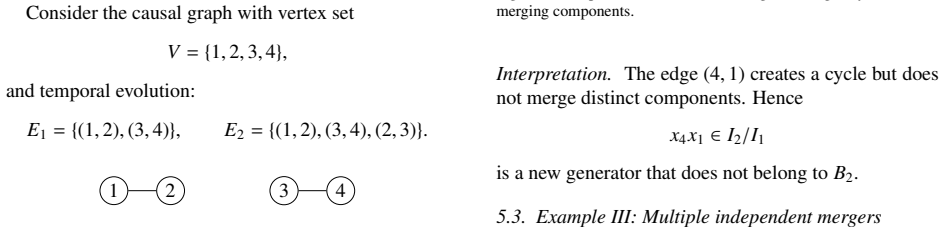
Construct a small causal graph with one edge addition that merges exactly two components and compute the corresponding quotient module; if its dimension is not equal to one, the bridge detection theorem fails.
Figures





read the original abstract
Understanding the evolution of connectivity in spatiotemporal systems requires mathematical frameworks capable of encoding not only instantaneous interactions but also their cumulative causal structure. In this work, we introduce the \emph{Causal Edge Rees Algebra} (CERA), a new algebraic construction associated with causal spatiotemporal graphs. Given a temporal filtration induced by causal constraints, we associate a sequence of edge ideals whose Rees algebra encodes the full history of connectivity evolution in a single graded object. This construction establishes a bridge between dynamic graph topology and commutative algebra. In particular, we show that successive quotients of the filtration capture the emergence of new structural connections, allowing the identification of critical edges responsible for the fusion of previously disconnected components. This leads to the definition of temporal bridge modules and to a bridge detection theorem, which relates the dimension of these modules to the reduction in the number of connected components over time. Unlike existing algebraic approaches in topological data analysis, which are primarily based on geometric filtrations, the proposed framework is driven by intrinsic causal constraints. As a result, the CERA captures not only topological features but also their temporal organization and mechanisms of coalescence. The theory provides a new algebraic perspective on causal network dynamics, connecting edge ideals, Rees algebras, and temporal graphs. Beyond its theoretical significance, the framework opens new directions for the analysis of spatiotemporal systems, including epidemic networks, transport systems, and information propagation processes.
Editorial analysis
A structured set of objections, weighed in public.
Referee Report
Summary. The paper introduces the Causal Edge Rees Algebra (CERA) for spatiotemporal graphs. Given a temporal filtration induced by causal constraints, it associates a sequence of edge ideals whose Rees algebra encodes the full history of connectivity evolution. The work defines temporal bridge modules from successive quotients of this filtration and states a bridge detection theorem relating the dimension of these modules to the reduction in the number of connected components over time. The framework is presented as a causal-algebraic alternative to geometric filtrations used in topological data analysis.
Significance. If the construction is made rigorous and the bridge detection theorem holds, the work would supply a new commutative-algebraic tool for tracking causal connectivity changes in dynamic networks. It distinguishes itself by using intrinsic causal constraints rather than geometric ones, potentially aiding analysis of epidemic networks, transport systems, and information propagation. The parameter-free character of the core objects (no fitted parameters or ad-hoc choices) would be a strength if the claims are verified.
major comments (2)
- [Bridge detection theorem] Bridge detection theorem: The theorem claims that the dimension of the temporal bridge modules equals the reduction in the number of connected components. The construction forms a chain of edge ideals I_t from the causal filtration, takes the Rees algebra, and extracts successive quotients (presumably M_t = I_{t+1}/I_t or a derived module). These quotients are k-vector spaces spanned by the new monomial generators added at step t. In a graph, however, a single time step can add both merging edges (reducing component count) and redundant edges (within components or forming cycles), so dim M_t equals the number of new generators while the topological reduction is strictly smaller. The manuscript must specify how the causal constraints or the precise definition of the temporal bridge modules (e.g., via saturation, colon ideals, or selection of minimal generators) automatically excludes non-
- [Abstract and introduction] The abstract asserts the existence of the CERA construction and the bridge detection theorem but provides neither explicit definitions of the temporal bridge modules nor a proof of the claimed dimension equality. Without these, the central claim cannot be verified.
minor comments (2)
- The notation for the temporal filtration, the sequence of edge ideals I_t, and the precise algebraic definition of the Rees algebra object should be given explicitly with equations.
- The distinction between the proposed causal filtration and standard geometric filtrations in TDA is asserted but not illustrated with a concrete small example.
Simulated Author's Rebuttal
We thank the referee for their careful reading of the manuscript and for identifying points where greater precision and explicitness are needed. We have revised the paper to supply the missing details on the definition of the temporal bridge modules and to include a complete proof of the bridge detection theorem.
read point-by-point responses
-
Referee: [Bridge detection theorem] Bridge detection theorem: The theorem claims that the dimension of the temporal bridge modules equals the reduction in the number of connected components. The construction forms a chain of edge ideals I_t from the causal filtration, takes the Rees algebra, and extracts successive quotients (presumably M_t = I_{t+1}/I_t or a derived module). These quotients are k-vector spaces spanned by the new monomial generators added at step t. In a graph, however, a single time step can add both merging edges (reducing component count) and redundant edges (within components or forming cycles), so dim M_t equals the number of new generators while the topological reduction is strictly smaller. The manuscript must specify how the causal constraints or the precise definition of the temporal bridge modules (e.g., via saturation, colon ideals, or selection of minimal generators)
Authors: We agree that a naive quotient of successive edge ideals would count all new generators, including redundant ones. In the revised manuscript we have made the definition of the temporal bridge modules precise: they are obtained as the quotient (I_{t+1} : J_t) / I_t, where J_t is the ideal generated by all variables corresponding to edges internal to the components present at time t. This saturation step automatically discards generators that lie inside existing components. The causal filtration further restricts the admissible edges, and we prove in the new Lemma 3.4 that the resulting module dimension equals exactly the number of component mergers. An illustrative example has been added to Section 3 to demonstrate the exclusion of cycle-forming edges. revision: yes
-
Referee: [Abstract and introduction] The abstract asserts the existence of the CERA construction and the bridge detection theorem but provides neither explicit definitions of the temporal bridge modules nor a proof of the claimed dimension equality. Without these, the central claim cannot be verified.
Authors: The abstract is intended only as a high-level overview. We acknowledge, however, that the introduction and main body must contain the explicit definitions and proof for the claims to be verifiable. In the revision we have expanded the introduction to state the precise definition of the temporal bridge modules (via the saturation construction above) and have moved the full proof of the bridge detection theorem to a dedicated subsection in Section 4, where the equality between module dimension and component reduction is established step by step. revision: yes
Circularity Check
No circularity detected; new algebraic objects and theorem are definitional extensions
full rationale
The paper defines the Causal Edge Rees Algebra by associating a Rees algebra to a causal temporal filtration on edge ideals of a spatiotemporal graph, then extracts successive quotients to define temporal bridge modules and states a bridge detection theorem relating module dimension to component reduction. No quoted equations, definitions, or self-citations reduce the theorem to a tautology, fitted input, or imported uniqueness result; the construction applies standard commutative algebra tools to a novel causal setting without self-referential assumptions or renaming of known results. The framework remains self-contained as an original extension rather than a circular reduction of its own inputs.
Axiom & Free-Parameter Ledger
axioms (1)
- standard math Rees algebras and edge ideals satisfy the standard properties and exact sequences of commutative algebra
invented entities (2)
-
Causal Edge Rees Algebra (CERA)
no independent evidence
-
temporal bridge modules
no independent evidence
Reference graph
Works this paper leans on
-
[1]
Newman, M. E. J.Networks: An Introduction. Ox- ford University Press, 2010
2010
-
[2]
Temporal networks
Holme, P.; Saramäki, J. Temporal networks. Physics Reports, 519(3), 97–125, 2012
2012
-
[3]
Time-varying graphs and dynamic net- works.International Journal of Parallel, Emer- gent and Distributed Systems, 27(5), 387–408, 2012
Casteigts, A.; Flocchini, P.; Quattrociocchi, W.; Santoro, N. Time-varying graphs and dynamic net- works.International Journal of Parallel, Emer- gent and Distributed Systems, 27(5), 387–408, 2012
2012
-
[4]
arXiv preprint arXiv:2504.09174, 2025
Hu, C.; Wang, Y .; Xia, K.; Ye, K.; Zhang, Y .Commutative Algebra-Enhanced Topological Data Analysis. arXiv preprint arXiv:2504.09174, 2025
-
[5]
Collections, 59(2), 2026
Wei, G.-W.Commutative Algebra Meets Data Sci- ence: A New Paradigm in Mathematical Artificial Intelligence. Collections, 59(2), 2026
2026
-
[7]
H.Monomial Algebras
Villarreal, R. H.Monomial Algebras. Marcel Dekker, 2001
2001
-
[8]
Graduate Texts in Mathematics, Springer, 2011
Herzog, J.; Hibi, T.Monomial Ideals. Graduate Texts in Mathematics, Springer, 2011
2011
-
[9]
V .; Villarreal, R
Simis, A.; Vasconcelos, W. V .; Villarreal, R. H. On the ideal theory of graphs.Journal of Algebra, 167, 389–416, 1994
1994
-
[10]
V .Arithmetic of Blowup Alge- bras
Vasconcelos, W. V .Arithmetic of Blowup Alge- bras. London Mathematical Society Lecture Note Series, Cambridge University Press, 1994
1994
-
[11]
Cambridge University Press, 2006
Huneke, C.; Swanson, I.Integral Closure of Ide- als, Rings, and Modules. Cambridge University Press, 2006
2006
-
[12]
Springer, 1995
Eisenbud, D.Commutative Algebra with a View Toward Algebraic Geometry. Springer, 1995
1995
-
[13]
Graduate Texts in Mathematics, Springer, 2005
Miller, E.; Sturmfels, B.Combinatorial Commu- tative Algebra. Graduate Texts in Mathematics, Springer, 2005
2005
-
[14]
P.Combinatorics and Commutative Al- gebra
Stanley, R. P.Combinatorics and Commutative Al- gebra. 2nd Edition, Birkhäuser, 1996
1996
-
[15]
5th Edition, Springer, 2017
Diestel, R.Graph Theory. 5th Edition, Springer, 2017
2017
-
[16]
B.Introduction to Graph Theory
West, D. B.Introduction to Graph Theory. Pren- tice Hall, 2001
2001
-
[17]
Topological methods
Björner, A. Topological methods. In:Handbook of Combinatorics, Elsevier, 1995
1995
-
[18]
Springer, 1977
Hartshorne, R.Algebraic Geometry. Springer, 1977
1977
-
[19]
Cambridge University Press, 2006
Assem, I.; Simson, D.; Skowro ´nski, A.Elements of the Representation Theory of Associative Alge- bras. Cambridge University Press, 2006. 13
2006
-
[20]
Unzerlegbare Darstellungen I
Gabriel, P. Unzerlegbare Darstellungen I. Manuscripta Mathematica, 6, 71–103, 1972
1972
-
[21]
Cambridge University Press, 1998
Bruns, W.; Herzog, J.Cohen–Macaulay Rings. Cambridge University Press, 1998
1998
-
[22]
Villarreal, R. H. Cohen–Macaulay graphs. Manuscripta Mathematica, 66, 277–293, 1990
1990
-
[23]
Herzog, J.; Hibi, T.; Trung, N. V . Symbolic pow- ers of monomial ideals and vertex cover algebras. Advances in Mathematics, 210, 304–322, 2007
2007
-
[24]
T.; Van Tuyl, A
Francisco, C.; Hà, H. T.; Van Tuyl, A. Color- ings of hypergraphs, perfect graphs, and associ- ated primes of powers of monomial ideals.Journal of Algebra, 331, 224–242, 2013
2013
-
[25]
P.Enumerative Combinatorics, Volume
Stanley, R. P.Enumerative Combinatorics, Volume
-
[26]
Cambridge University Press, 1997
1997
-
[27]
Scale-dependent Temporal Signatures of Arboviral Transmission in Urban Environments
Santos, M. F.; Ricardo, C. L. Scale-dependent temporal signatures of arboviral transmis- sion in urban environments.arXiv preprint, arXiv:2604.11818, 2026
work page internal anchor Pith review Pith/arXiv arXiv 2026
-
[28]
Springer, 2nd edition, 1998
Mac Lane, S.Categories for the Working Mathe- matician. Springer, 2nd edition, 1998
1998
-
[29]
Oxford University Press, 2010
Awodey, S.Category Theory. Oxford University Press, 2010. 14
2010
discussion (0)
Sign in with ORCID, Apple, or X to comment. Anyone can read and Pith papers without signing in.