Recognition: unknown
Nothing Deceives Like Success: Social Learning and the Illusion of Understanding in Science
Pith reviewed 2026-05-07 10:15 UTC · model grok-4.3
The pith
In simulations of scientific communities, success-driven social learning creates an illusion of understanding that reduces actual performance and generates real-world inequality.
A machine-rendered reading of the paper's core claim, the machinery that carries it, and where it could break.
Core claim
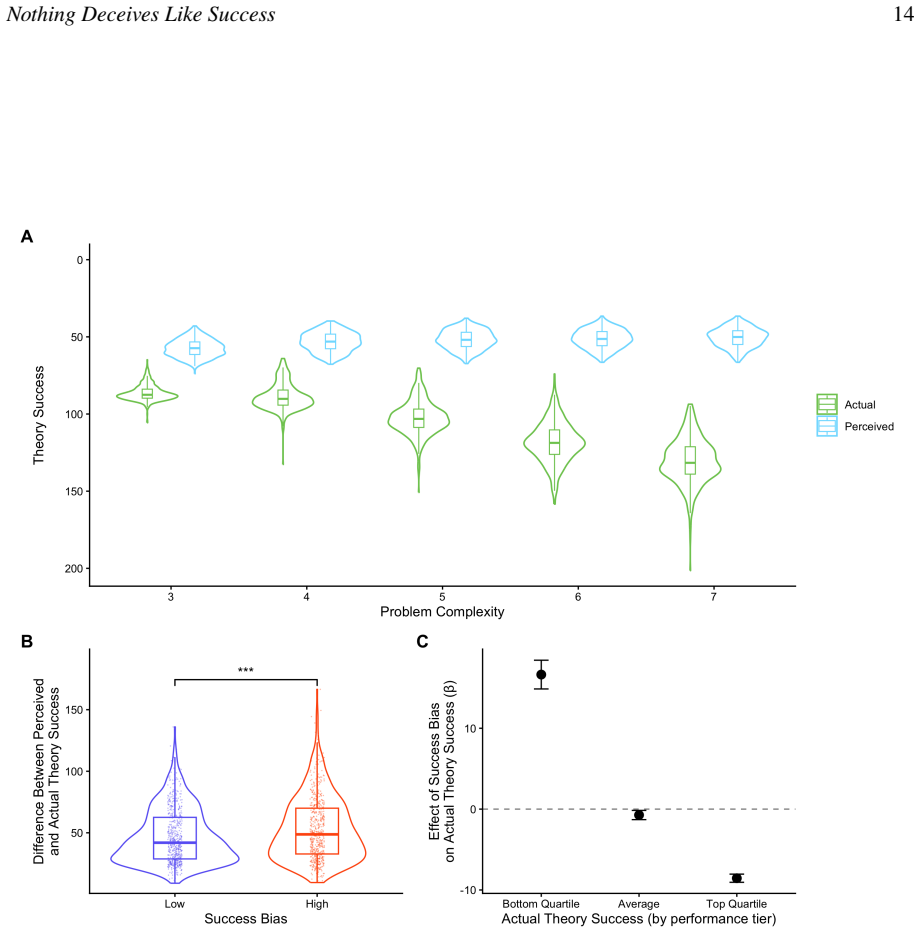
In agent-based models of collective theory-building, success bias amplifies a persistent gap between perceived and actual performance. Communities that preferentially copy apparently successful theories filter out poor explanations but fail to discover better ones. This effect strengthens with problem complexity. When agents optimize their social learning rules to maximize perceived success, they paradoxically lower their real performance and produce inequality distributions that match those observed in real scientific communities.
What carries the argument
Agent-based simulation of scientists who adopt theories according to observed apparent success, with limited ability to evaluate true explanatory quality.
If this is right
- Success bias narrows the range of explored theories while efficiently discarding weak ones.
- The gap between perceived and actual performance grows as the underlying problem becomes more complex.
- Optimizing social learning for perceived success lowers true collective performance.
- The resulting distribution of success across agents reproduces inequality levels documented in real scientific communities.
Where Pith is reading between the lines
- The model implies that metrics emphasizing visible success may systematically undervalue exploratory work in complex domains.
- Similar dynamics could appear in other collective search settings where quality is difficult to measure directly, such as technological innovation.
- Mechanisms that reward evaluation of underlying quality rather than surface success might counteract the performance drop.
Load-bearing premise
Agents have no reliable way to assess true theory quality except by observing apparent success.
What would settle it
Empirical evidence that scientists who optimize their behavior for visible success metrics achieve higher actual performance than those who do not would contradict the simulation outcomes.
Figures




read the original abstract
Success-driven social learning, in which individuals preferentially adopt the ideas and methods that appear most successful, is a foundational principle of collective behavior across systems ranging from ant colonies to scientific communities. But science is a particular kind of collective search -- one in which the quality of an explanation is itself difficult to assess. Is success bias adaptive in this setting? In agent-based simulations of collective theory building, we find that it is not. Scientists in our model systematically overestimate the quality of their own theories, creating an illusion of understanding: a persistent gap between perceived and actual performance. Success bias amplifies this illusion; communities that favor apparently successful theories explore a narrower range of possibilities, efficiently filtering out poor explanations but failing to discover better ones. This effect intensifies with problem complexity, as scientists in more complex environments become increasingly unable to assess how well their theories actually perform. Most strikingly, when agents optimize their social behavior to maximize the perceived success of their theories, they paradoxically undermine their actual performance, and produce levels of inequality that mirror those found in real scientific communities.
Editorial analysis
A structured set of objections, weighed in public.
Referee Report
Summary. The paper uses agent-based simulations of collective theory-building to argue that success-biased social learning is maladaptive in science. Agents preferentially adopt apparently successful theories, which creates a persistent gap between perceived and actual performance (an 'illusion of understanding'), narrows exploration, and worsens with increasing problem complexity. When agents are allowed to optimize their social learning rules to maximize perceived success, actual performance declines while inequality in outcomes rises to levels observed in real scientific communities.
Significance. If the simulation results prove robust under variation of parameters and modeling assumptions, the work would offer a mechanistic account of how success-driven learning can produce deceptive collective outcomes and reproduce empirical patterns of inequality in science. The agent-based approach allows exploration of emergent effects that are difficult to derive analytically, and the finding that optimization over perceived success is self-undermining is a potentially falsifiable prediction with implications for understanding cumulative advantage in research communities.
major comments (3)
- [Model description and simulation protocol] The central claims rest entirely on forward simulation outputs, yet the manuscript provides no information on parameter sensitivity, robustness to alternative implementations of 'actual performance' versus 'perceived success', or validation against any empirical benchmarks. Without these checks, it is impossible to determine whether the reported illusion, narrowed exploration, and inequality effects are load-bearing results or artifacts of specific modeling choices.
- [Agent decision rules and environment definition] The weakest assumption—that agents have no reliable way to assess true theory quality beyond observing apparent success—is stated as foundational, but the text does not specify how actual performance is computed in the environment or whether agents receive any noisy but informative signal of quality. If even modest direct feedback on quality is introduced, the illusion and performance drop may disappear, undermining the claim that success bias is inherently maladaptive.
- [Optimization experiments] The optimization result (agents choosing social rules to maximize perceived success thereby lowering actual performance) is presented as the most striking finding, but no details are given on the optimization procedure, the objective function, or the search space over social behaviors. It is therefore unclear whether this paradox is a general consequence of the setup or specific to the particular optimization method employed.
minor comments (2)
- [Abstract and introduction] The abstract and introduction use the phrase 'levels of inequality that mirror those found in real scientific communities' without citing the specific empirical distributions or metrics being matched; a reference or explicit comparison would strengthen the claim.
- [Model section] Notation for perceived versus actual performance is introduced without a clear table or equation summarizing the two quantities and their relationship; adding such a summary would improve readability.
Simulated Author's Rebuttal
We thank the referee for their constructive comments, which identify key areas where the manuscript can be strengthened through additional detail and checks. We address each major comment below and will incorporate the necessary revisions.
read point-by-point responses
-
Referee: [Model description and simulation protocol] The central claims rest entirely on forward simulation outputs, yet the manuscript provides no information on parameter sensitivity, robustness to alternative implementations of 'actual performance' versus 'perceived success', or validation against any empirical benchmarks. Without these checks, it is impossible to determine whether the reported illusion, narrowed exploration, and inequality effects are load-bearing results or artifacts of specific modeling choices.
Authors: We agree that explicit robustness checks are required. In the revised manuscript we will add a new section reporting parameter sensitivity analyses over ranges of population size, theory count, and complexity. We will also test alternative operationalizations of perceived success (different adoption-weighting schemes) and actual performance (alternative objective metrics) and confirm that the core illusion and inequality patterns remain. For empirical grounding we will expand the discussion to include direct quantitative comparisons between simulated inequality levels and observed distributions of citations and productivity in real scientific communities, while noting the limits of abstract models for full benchmarking. revision: yes
-
Referee: [Agent decision rules and environment definition] The weakest assumption—that agents have no reliable way to assess true theory quality beyond observing apparent success—is stated as foundational, but the text does not specify how actual performance is computed in the environment or whether agents receive any noisy but informative signal of quality. If even modest direct feedback on quality is introduced, the illusion and performance drop may disappear, undermining the claim that success bias is inherently maladaptive.
Authors: The model premise is that scientific quality is intrinsically difficult to evaluate directly, which is why agents rely on social signals. We will clarify in the methods that actual performance is defined by a hidden objective function (e.g., predictive accuracy against an underlying ground truth) that agents cannot access. Agents observe only apparent success via adoption or reported outcomes. To address the concern we will add supplementary simulations that introduce controlled levels of noisy direct feedback and show the boundary conditions under which the illusion and performance penalty persist, thereby supporting the claim that success bias is maladaptive precisely when reliable quality signals are absent. revision: yes
-
Referee: [Optimization experiments] The optimization result (agents choosing social rules to maximize perceived success thereby lowering actual performance) is presented as the most striking finding, but no details are given on the optimization procedure, the objective function, or the search space over social behaviors. It is therefore unclear whether this paradox is a general consequence of the setup or specific to the particular optimization method employed.
Authors: We will expand the methods section with a complete description of the optimization procedure. Agents' social-learning parameters (success-bias strength and exploration rate) are evolved via a genetic algorithm whose objective is the population-average perceived success. The search space consists of both discrete and continuous parameter combinations; we will report convergence criteria, results from multiple independent runs, and comparisons against random search baselines to establish that the self-undermining effect is robust to the specific optimizer. revision: yes
Circularity Check
No significant circularity
full rationale
The paper presents results from forward agent-based simulations of scientists using success-biased social learning in a collective theory-building environment. The reported outcomes—an illusion of understanding (perceived vs. actual performance gap), narrower exploration, and higher inequality when agents optimize for perceived success—emerge directly from executing the model under the stated assumptions about agents' inability to evaluate true theory quality. No equations embed the target quantities by definition, no parameters are fitted to subsets of data and then relabeled as predictions, and no load-bearing self-citations or uniqueness theorems are invoked to force the conclusions. The derivation chain consists of explicit simulation rules and their observable outputs rather than any self-referential reduction.
Axiom & Free-Parameter Ledger
Reference graph
Works this paper leans on
-
[1]
R.Boyd,P.J.Richerson,CultureandtheEvolutionaryProcess(UniversityofChicagoPress, Chicago, IL) (1988)
1988
-
[2]
K. N. Laland, Social Learning Strategies.Learning & Behavior32(1), 4–14 (2004), doi:10.3758/BF03196002
-
[3]
R. L. Goldstone, T. W. Wisdom, M. E. Roberts, S. Frey, Learning along with Others, inThe PsychologyofLearningandMotivation,Vol.58,ThePsychologyofLearningandMotivation (Elsevier Academic Press, San Diego, CA, US), pp. 1–45 (2013)
2013
-
[4]
D. Barkoczi, M. Galesic, Social Learning Strategies Modify the Effect of Network Structure on Group Performance.Nature Communications7(1), 13109 (2016), doi: 10.1038/ncomms13109
-
[5]
Science328(5975), 208–213 (2010)
L.Rendell,etal.,WhyCopyOthers?InsightsfromtheSocialLearningStrategiesTournament. Science (New York, N.Y.)328(5975), 208–213 (2010), doi:10.1126/science.1184719
-
[6]
R.Baldini,Success-BiasedSocialLearning:CulturalandEvolutionaryDynamics.Theoretical Population Biology82(3), 222–228 (2012), doi:10.1016/j.tpb.2012.06.005
-
[7]
C.M.Wu,etal.,Adaptivemechanismsofsocialandasociallearninginimmersivecollective foraging.Nature communications16(1), 3539 (2025)
2025
-
[8]
J. E. Hirsch, An Index to Quantify an Individual’s Scientific Research Output.Proceedings of the National Academy of Sciences102(46), 16569–16572 (2005), doi:10.1073/pnas. 0507655102
-
[9]
Research England, Research Excellence Framework 2029, https://2029.ref.ac.uk/ (2024), https://2029.ref.ac.uk/
2029
-
[10]
Bibliometrics: The Leiden manifesto for research metrics
D. Hicks, P. Wouters, L. Waltman, S. de Rijcke, I. Rafols, Bibliometrics: The Leiden Manifesto for Research Metrics.Nature520(7548), 429–431 (2015), doi:10.1038/520429a
-
[11]
Wu, Better than Best: Epistemic Landscapes and Diversity of Practice in Science
J. Wu, Better than Best: Epistemic Landscapes and Diversity of Practice in Science. Philosophy of Science91(5), 1189–1198 (2024), doi:10.1017/psa.2023.129
-
[12]
J. P. A. Ioannidis, Why Most Published Research Findings Are False.PLOS Medicine2(8), e124 (2005), doi:10.1371/journal.pmed.0020124. Nothing Deceives Like Success29
-
[13]
Langmuir, Pathological Science.Research Technology Management32(5), 11–17 (1989)
I. Langmuir, Pathological Science.Research Technology Management32(5), 11–17 (1989)
1989
-
[14]
Potochnik,Idealization and the Aims of Science(University of Chicago Press, Chicago, IL) (2020)
A. Potochnik,Idealization and the Aims of Science(University of Chicago Press, Chicago, IL) (2020)
2020
-
[15]
K.P.Kepp,N.K.Robakis,P.F.Høilund-Carlsen,S.L.Sensi,B.Vissel,Theamyloidcascade hypothesis: an updated critical review.Brain146(10), 3969–3990 (2023)
2023
-
[16]
M. J. Nye, N-Rays: An Episode in the History and Psychology of Science.Historical Studies in the Physical Sciences11(1), 125–156 (1980), doi:10.2307/27757473
-
[17]
W.F.Brewer,TheTheoryLadennessoftheMentalProcessesUsedintheScientificEnterprise: Evidence from Cognitive Psychology and the History of Science, inPsychology of Science: Implicit and Explicit Processes, R. W. Proctor, E. Capaldi, Eds. (Oxford University Press), pp. 289–334 (2012), doi:10.1093/acprof:oso/9780199753628.003.0013
work page doi:10.1093/acprof:oso/9780199753628.003.0013 2012
-
[18]
M.F.McBride,F.Fidler,M.A.Burgman,EvaluatingtheAccuracyandCalibrationofExpert Predictions under Uncertainty: Predicting the Outcomes of Ecological Research.Diversity and Distributions18(8), 782–794 (2012), doi:10.1111/j.1472-4642.2012.00884.x
-
[19]
P. E. Tetlock,Expert Political Judgment: How Good Is It? How Can We Know?(Princeton University Press, Princeton) (2017)
2017
-
[20]
L.Messeri,M.J.Crockett,ArtificialIntelligenceandIllusionsofUnderstandinginScientific Research.Nature627(8002), 49–58 (2024), doi:10.1038/s41586-024-07146-0
-
[21]
M. Dubova, A. Moskvichev, K. Zollman, Against Theory-Motivated Experimentation: Can Random Experimental Choice Lead to Better Theories?Collective Intelligence5(1) (2026), doi:10.1177/26339137261421577
-
[22]
R. K. Merton, The Matthew Effect in Science.Science159(3810), 56–63 (1968), doi: 10.1126/science.159.3810.56
-
[23]
M. Perc, The Matthew Effect in Empirical Data.Journal of The Royal Society Interface 11(98), 20140378 (2014), doi:10.1098/rsif.2014.0378
-
[24]
A. Clauset, S. Arbesman, D. B. Larremore, Systematic Inequality and Hierarchy in Faculty Hiring Networks.Science Advances1(1), e1400005 (2015), doi:10.1126/sciadv.1400005. Nothing Deceives Like Success30
-
[25]
W. C. Wimsatt, Levels, Robustness, Emergence, and Heterogeneous Dynamics: Finding Partial Organization in Causal Thickets, inLevels of Organization in the Biological Sciences, D. S. Brooks, J. DiFrisco, W. C. Wimsatt, Eds. (The MIT Press), pp. 21–38 (2021), doi:10.7551/mitpress/12389.003.0005
-
[26]
H. A. Simon, The Architecture of Complexity.Proceedings of the American Philosophical Society106(6), 467–482 (1962)
1962
-
[27]
N. Cartwright,The Dappled World: A Study of the Boundaries of Science(Cambridge University Press, Cambridge) (1999), doi:10.1017/CBO9781139167093
-
[28]
S. D. Mitchell,Unsimple Truths: Science, Complexity, and Policy(University of Chicago Press, Chicago, IL) (2012)
2012
-
[29]
H. W. Kuhn, The Hungarian Method for the Assignment Problem.Naval Research Logistics Quarterly2(1-2), 83–97 (1955), doi:10.1002/nav.3800020109
-
[30]
Y.Bengio,A.Courville,P.Vincent,RepresentationLearning:AReviewandNewPerspectives (2014), doi:10.48550/arXiv.1206.5538
-
[31]
V. D. Blondel, J.-L. Guillaume, R. Lambiotte, E. Lefebvre, Fast Unfolding of Communities in Large Networks.Journal of Statistical Mechanics: Theory and Experiment2008(10), P10008 (2008), doi:10.1088/1742-5468/2008/10/P10008
-
[32]
B. Shahriari, K. Swersky, Z. Wang, R. P. Adams, N. de Freitas, Taking the Human Out of the Loop: A Review of Bayesian Optimization.Proceedings of the IEEE104(1), 148–175 (2016), doi:10.1109/JPROC.2015.2494218
-
[33]
I. M. Sobol’, On the Distribution of Points in a Cube and the Approximate Evaluation of Integrals.USSR Computational Mathematics and Mathematical Physics7(4), 86–112 (1967), doi:10.1016/0041-5553(67)90144-9
-
[34]
M. W. Nielsen, J. P. Andersen, Global Citation Inequality Is on the Rise.Proceedings of the National Academy of Sciences118(7), e2012208118 (2021), doi:10.1073/pnas.2012208118
-
[35]
B. Baribault,et al., Metastudies for Robust Tests of Theory.Proceedings of the National Academy of Sciences115(11), 2607–2612 (2018), doi:10.1073/pnas.1708285114
-
[36]
C. M. Campbell, E. J. Izquierdo, R. L. Goldstone, Partial Copying and the Role of Diversity in Social Learning Performance.Collective Intelligence1(1), 26339137221081849 (2022), doi:10.1177/26339137221081849. Nothing Deceives Like Success31
-
[37]
L. Hong, S. E. Page, Groups of Diverse Problem Solvers Can Outperform Groups of High-Ability Problem Solvers.Proceedings of the National Academy of Sciences101(46), 16385–16389 (2004), doi:10.1073/pnas.0403723101
-
[38]
K. J. S. Zollman, The Epistemic Benefit of Transient Diversity.Erkenntnis72(1), 17–35 (2010), doi:10.1007/s10670-009-9194-6
-
[39]
P. E. Smaldino, C. Moser, A. Pérez Velilla, M. Werling, Maintaining Transient Diversity Is a General Principle for Improving Collective Problem Solving.Perspectives on Psychological Science19(2), 454–464 (2024), doi:10.1177/17456916231180100
-
[40]
Page,The Difference: How the Power of Diversity Creates Better Groups, Firms, Schools, and Societies - New Edition(Princeton University Press, Princeton, NJ) (2008)
S. Page,The Difference: How the Power of Diversity Creates Better Groups, Firms, Schools, and Societies - New Edition(Princeton University Press, Princeton, NJ) (2008)
2008
-
[41]
Wu, Epistemic advantage on the margin: A network standpoint epistemology.Philosophy and Phenomenological Research106(3), 755–777 (2023)
J. Wu, Epistemic advantage on the margin: A network standpoint epistemology.Philosophy and Phenomenological Research106(3), 755–777 (2023)
2023
-
[42]
T. Williamson, Overfitting and Degrees of Freedom, inOverfitting and Heuristics in Philosophy(Oxford University Press), chap. 2 (2024), doi:10.1093/oso/9780197779217.003. 0002
-
[43]
Á. V. Jiménez, A. Mesoudi, Prestige-Biased Social Learning: Current Evidence and Outstanding Questions.Palgrave Communications5(1), 1–12 (2019), doi:10.1057/ s41599-019-0228-7
2019
-
[44]
D. Fanelli, Do Pressures to Publish Increase Scientists’ Bias? An Empirical Support from US States Data.PLOS ONE5(4), e10271 (2010), doi:10.1371/journal.pone.0010271
-
[45]
Mastroianni, Science Is a Strong-Link Problem, https://www.experimental- history.com/p/science-is-a-strong-link-problem (2025)
A. Mastroianni, Science Is a Strong-Link Problem, https://www.experimental- history.com/p/science-is-a-strong-link-problem (2025)
2025
-
[46]
K. O. Stanley, J. Lehman,Why Greatness Cannot Be Planned: The Myth of the Objective (Springer International Publishing : Imprint: Springer, Cham), 1st ed. 2015 ed. (2015), doi:10.1007/978-3-319-15524-1
-
[47]
C.Goodhart,ProblemsofMonetaryManagement:TheU.K.Experience.Papersinmonetary economics 1975 ; 11, 1 (1975)
1975
-
[48]
J. G. March, Exploration and Exploitation in Organizational Learning.Organization Science 2(1), 71–87 (1991). Nothing Deceives Like Success32
1991
-
[49]
H. Chang, Epistemic Iteration and Natural Kinds: Realism and Pluralism in Taxonomy, in Philosophical Issues in Psychiatry IV: Classification of Psychiatric Illness, K. S. Kendler, J. Parnas, K. S. Kendler, J. Parnas, Eds. (Oxford University Press), pp. 229–245 (2017), doi:10.1093/med/9780198796022.003.0029
-
[50]
Chang,Inventing Temperature: Measurement and Scientific Progress, Oxford Studies in Philosophy of Science (Oxford University Press, Oxford, New York) (2007)
H. Chang,Inventing Temperature: Measurement and Scientific Progress, Oxford Studies in Philosophy of Science (Oxford University Press, Oxford, New York) (2007)
2007
-
[51]
W. C. Wimsatt,Re-Engineering Philosophy for Limited Beings: Piecewise Approximations to Reality(Harvard University Press, Cambridge, Mass) (2007)
2007
-
[52]
M.Massimi,PluralismandPerspectivism,inPerspectivalRealism(OxfordUniversityPress), chap. 3 (2022), doi:10.1093/oso/9780197555620.003.0003
-
[53]
K. Friston,et al., The Anatomy of Choice: Dopamine and Decision-Making.Philosophical Transactions of the Royal Society B: Biological Sciences369(1655), 20130481 (2014), doi:10.1098/rstb.2013.0481
- [54]
-
[55]
Feyerabend,Against Method
P. Feyerabend,Against Method. Third Edition.(London: Verso.) (1993)
1993
-
[56]
D. T. Campbell, Blind Variation and Selective Retentions in Creative Thought as in Other KnowledgeProcesses.PsychologicalReview67(6),380–400(1960),doi:10.1037/h0040373
-
[57]
K. R. Popper,Objective Knowledge: An Evolutionary Approach(Oxford University Press, Oxford Eng. : New York) (1979)
1979
-
[58]
D. L. Hull,Science as a Process: An Evolutionary Account of the Social and Conceptual Development of Science, Science and Its Conceptual Foundations Series (University of Chicago Press, Chicago, IL) (1990)
1990
-
[59]
Chang, Joseph Priestley (1733–1804), inHandbook of the Philosophy of Science
H. Chang, Joseph Priestley (1733–1804), inHandbook of the Philosophy of Science. Vol. 6: PhilosophyofChemistry,A.I.Woody,R.F.Hendry,P.Needham,Eds.(Elsevier,Amsterdam), pp. 55–62 (2012)
2012
-
[60]
C. H. Legare, A. Shtulman, Explanatory Pluralism across Cultures and Development, in Metacognitive Diversity: An Interdisciplinary Approach, J. Proust, M. Fortier, Eds. (Oxford University Press), pp. 415–432 (2018), doi:10.1093/oso/9780198789710.003.0019. Nothing Deceives Like Success33
-
[61]
Chang,Is Water H2O?: Evidence, Realism and Pluralism(Springer, Cambridge, England ; New York) (2014)
H. Chang,Is Water H2O?: Evidence, Realism and Pluralism(Springer, Cambridge, England ; New York) (2014). Nothing Deceives Like Success34 Acknowledgments The authors thank Mirta Galesic for productive discussions that led to the improvement of this work. Funding:A. L. was supported by the National Science Foundation under Award No. 2349052, the The Bengier...
2014
discussion (0)
Sign in with ORCID, Apple, or X to comment. Anyone can read and Pith papers without signing in.