Recognition: unknown
Sure About That Line? Approaching Confidence-Based, Real-Time Line Assignment in Reading Gaze Data
Pith reviewed 2026-05-09 20:47 UTC · model grok-4.3
The pith
A new method assigns gaze fixations to reading lines in real time by scoring confidence and deferring uncertain cases.
A machine-rendered reading of the paper's core claim, the machinery that carries it, and where it could break.
Core claim
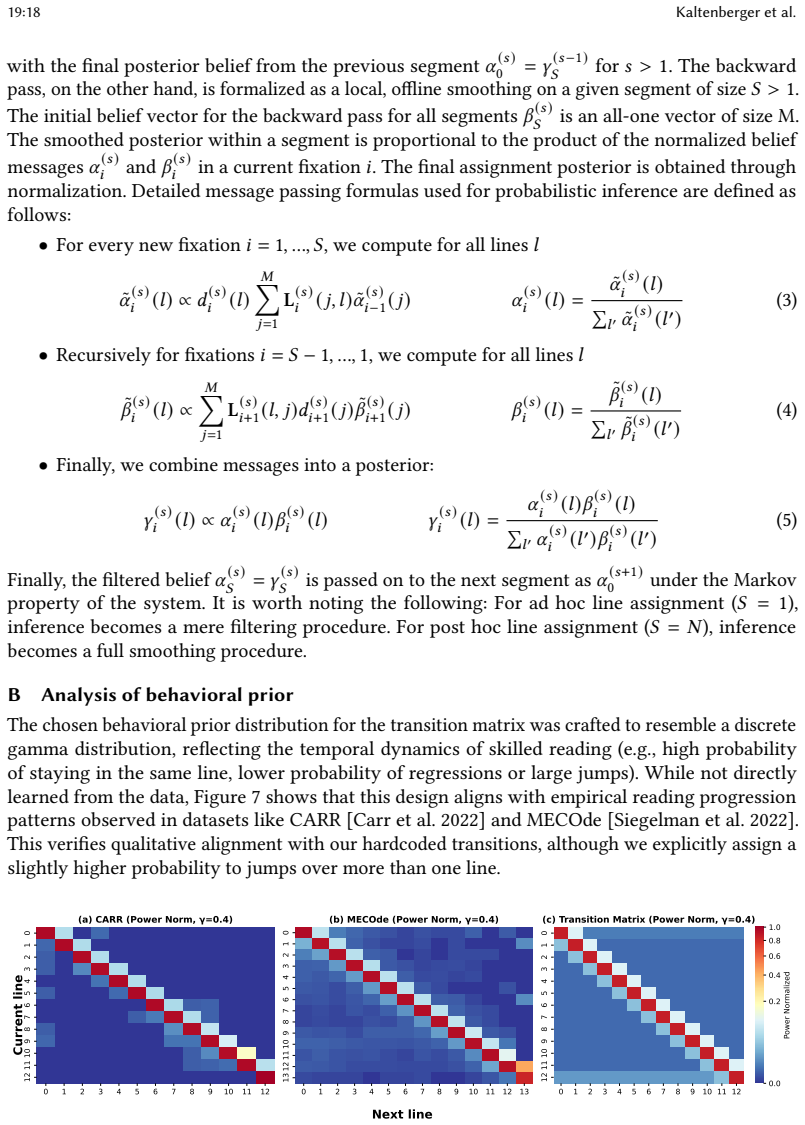
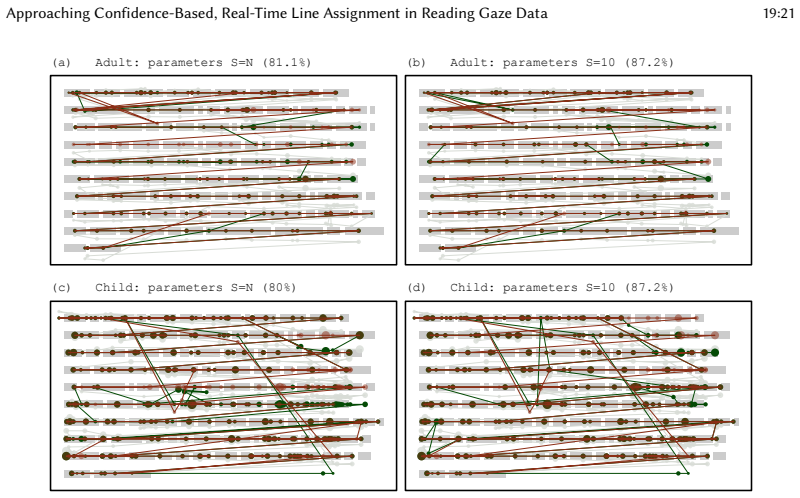
CONF-LA integrates Gaussian line likelihoods with generic reading-behavior priors to compute a posterior-line-score for each fixation and defers the assignment when uncertainty remains high. This produces stable post-hoc results, reduces the online-offline performance gap to 1-2 percent, and delivers a mean latency of 0.348 ms per fixation while showing strong invariance to regressions and yielding approximately 95 percent median accuracy on children data.
What carries the argument
CONF-LA (Confidence-score-based Online Fixation-to-Line Assignment), which calculates posterior-line-scores from Gaussian likelihoods of fixation position combined with reading priors and defers low-confidence cases.
If this is right
- Interactive reading-support tools can now operate on natural behavior including regressions without sacrificing accuracy.
- The online-offline accuracy difference shrinks to only 1-2 percent while keeping per-fixation processing at 0.348 ms.
- Median line-assignment accuracy reaches about 95 percent on children's reading data where prior algorithms performed worse.
- The same framework remains stable when re-reading occurs, removing the need to restrict reader movement during live sessions.
Where Pith is reading between the lines
- The deferral mechanism could feed into adaptive displays that wait for clearer signals before changing text or adding highlights.
- Extending the priors to include language-specific or device-specific patterns might further reduce deferrals without adding calibration.
- The low latency opens the door to closed-loop experiments that alter reading material based on detected line-by-line processing difficulty.
Load-bearing premise
Gaussian line likelihoods together with standard reading-behavior priors will generate trustworthy posterior scores for every combination of noise, layout, and reader group without any per-user calibration or later tuning.
What would settle it
A new test set containing higher noise, unusual layouts, or reader populations outside the open-source data used, where accuracy drops well below the reported levels or the number of deferred assignments rises enough to break real-time use.
Figures




read the original abstract
Remote and webcam-based eye tracking in multi-line reading suffers from various noise factors and layout ambiguity, precisely where real-time reading support needs reliable, per-fixation line assignment. Prior work largely addresses this challenge post hoc or by restricting behavior (e.g., disallowing re-reading), undermining interactive use. We propose CONF-LA (Confidence-score-based Online Fixation-to-Line Assignment), a principled, low-latency approach that integrates knowledge about reading behavior and Gaussian line likelihoods over fixations to compute a posterior-line-score and defers assignments when uncertainty is high. Evaluated on existing open-source data, CONF-LA demonstrates stable performance in post hoc analysis and closes the online-offline gap (1-2 %) with a mean per-fixation latency of 0.348 ms. Our approach exhibits particular invariance toward regressions, yielding significant improvement in ad hoc median accuracies on children data (approx. 95 %) over all tested algorithms. We encourage further research in this direction and discuss possibilities for future development.
Editorial analysis
A structured set of objections, weighed in public.
Referee Report
Summary. The manuscript proposes CONF-LA, a confidence-score-based online fixation-to-line assignment algorithm for multi-line reading gaze data. It computes posterior line scores by combining Gaussian likelihoods of vertical gaze position relative to line centers with generic priors derived from reading behavior, then defers assignment when uncertainty exceeds a threshold. Evaluated on existing open-source datasets, the method is reported to achieve stable post-hoc performance, close the online-offline accuracy gap to 1-2%, deliver a mean per-fixation latency of 0.348 ms, attain approximately 95% median accuracy on children's data, and exhibit invariance to regressions without per-user calibration or post-hoc tuning.
Significance. If the performance claims hold under realistic noise conditions, the work could meaningfully advance real-time eye-tracking applications in reading research and assistive technologies, especially for remote/webcam setups and child populations where prior methods struggle with layout ambiguity and regressions. The low reported latency, use of open data, and emphasis on deferral rather than forced assignment are notable strengths for practical deployment.
major comments (2)
- [§3] §3 (Method, posterior computation): The central modeling choice of Gaussian line likelihoods for vertical gaze positions combined with generic reading priors is load-bearing for the claimed posterior scores and deferral mechanism. However, this assumption risks mis-estimating uncertainty under the heavy-tailed or multimodal noise typical of webcam-based and child fixation data (head motion, calibration drift). Without explicit robustness tests or alternative noise models in the evaluation, the reported invariance to regressions and 95% median accuracy on children data cannot be taken as generalizable.
- [§4] §4 (Results and evaluation): The specific quantitative claims (1-2% online-offline gap closure, 0.348 ms mean latency, ~95% ad hoc median accuracy) are presented without accompanying equations for the posterior, full parameter values, exclusion criteria, or statistical tests in the abstract and summary. This makes it difficult to verify whether the gains over baseline algorithms are statistically significant or sensitive to the chosen deferral threshold.
minor comments (2)
- [Abstract] The abstract would benefit from a brief mention of the key equations or pseudocode for the posterior-line-score computation to improve accessibility.
- [Discussion] Consider adding a limitations subsection discussing performance under varying text layouts, font sizes, or extreme head movements not covered in the open-source datasets.
Simulated Author's Rebuttal
We thank the referee for the constructive feedback on our manuscript describing CONF-LA. The comments highlight important aspects of our modeling assumptions and presentation of results, which we address point by point below. We believe these can be clarified and strengthened in a revision.
read point-by-point responses
-
Referee: [§3] §3 (Method, posterior computation): The central modeling choice of Gaussian line likelihoods for vertical gaze positions combined with generic reading priors is load-bearing for the claimed posterior scores and deferral mechanism. However, this assumption risks mis-estimating uncertainty under the heavy-tailed or multimodal noise typical of webcam-based and child fixation data (head motion, calibration drift). Without explicit robustness tests or alternative noise models in the evaluation, the reported invariance to regressions and 95% median accuracy on children data cannot be taken as generalizable.
Authors: We acknowledge that the Gaussian likelihood is a core modeling assumption whose validity depends on the noise characteristics of the data. However, the evaluations were performed on existing open-source datasets that explicitly include webcam-based recordings and child participants, which are known to contain heavy-tailed noise from head motion, calibration drift, and other factors. The reported invariance to regressions and ~95% median accuracy on children's data were obtained without per-user calibration or post-hoc tuning, indicating that the approach performs stably under these realistic conditions. We agree that dedicated robustness experiments using alternative distributions (such as heavier-tailed models) would provide additional support. In the revised manuscript we will add a dedicated subsection discussing the Gaussian assumption, its potential limitations, and results from supplementary simulations that test sensitivity to noise tail behavior. revision: partial
-
Referee: [§4] §4 (Results and evaluation): The specific quantitative claims (1-2% online-offline gap closure, 0.348 ms mean latency, ~95% ad hoc median accuracy) are presented without accompanying equations for the posterior, full parameter values, exclusion criteria, or statistical tests in the abstract and summary. This makes it difficult to verify whether the gains over baseline algorithms are statistically significant or sensitive to the chosen deferral threshold.
Authors: The equations defining the posterior line scores, the exact parameter values (Gaussian variances, prior weights, and deferral threshold), and the dataset exclusion criteria are all provided in the full Methods and Evaluation sections of the manuscript. The abstract and summary present only high-level results. We agree that the absence of explicit statistical significance tests and a sensitivity analysis for the deferral threshold in the summary sections makes verification harder. In the revision we will (1) add a results table reporting paired statistical comparisons (e.g., Wilcoxon signed-rank tests) between CONF-LA and the baselines with p-values, (2) include a brief sensitivity plot or table for the deferral threshold, and (3) ensure all numerical claims are cross-referenced to the corresponding equations and parameter settings. revision: yes
Circularity Check
No circularity: method derives posteriors from stated Gaussian likelihoods plus external reading priors, evaluated on independent open data
full rationale
The paper proposes CONF-LA by combining Gaussian line likelihoods (vertical gaze position to line centers) with generic reading-behavior priors to compute posterior line scores, then defers on high uncertainty. This construction is presented as a direct application of the chosen likelihood model and priors rather than a fit to the target evaluation metrics. Evaluation is performed on existing open-source datasets without any indication that parameters were tuned on the same data later used for accuracy or latency reporting. No self-citation is invoked as a load-bearing uniqueness theorem, no ansatz is smuggled via prior work, and no renaming of known results occurs. The derivation chain therefore remains self-contained against external benchmarks and does not reduce to its inputs by construction.
Axiom & Free-Parameter Ledger
Reference graph
Works this paper leans on
-
[1]
In 2015 IEEE 7th International Conference on Biometrics Theory, Applications and Systems (BTAS)
Person verification via eye movement-driven text reading model. In 2015 IEEE 7th International Conference on Biometrics Theory, Applications and Systems (BTAS). IEEE, Arlington, VA, USA, 1–8. doi:10.1109/BTAS.2015.7358786 Victoria I. Adedeji, Julie A. Kirkby, Martin R. Vasilev, and Timothy J. Slattery
-
[2]
doi:10.1080/10888438.2023.2259522 Naser Al Madi
Children’s Reading of Sublexical Units in Years Three to Five: A Combined Analysis of Eye-Movements and Voice Recording.Scientific Studies of Reading28, 2 (2024), 214–233. doi:10.1080/10888438.2023.2259522 Naser Al Madi
-
[3]
doi:10.16910/jemr.17.1.4 Naser Al Madi
Advancing Dynamic-Time Warp Techniques for Correcting Eye Tracking Data in Reading Source Code.Journal of Eye Movement Research17, 1 (2024), 1–19. doi:10.16910/jemr.17.1.4 Naser Al Madi
-
[4]
On the Validity and Benefit of Manual and Automated Drift Correction in Reading Tasks.Journal of Eye Movement Research18, 3 (May 2025),
2025
-
[5]
doi:10.3390/jemr18030017 Naser Al Madi, Brett Torra, Yixin Li, and Najam Tariq
-
[6]
Combining Automation and Expertise: A Semi-Automated Approach to Correcting Eye-Tracking Data in Reading Tasks.Behavior Research Methods57, 2 (2025),
2025
-
[7]
The Contribution of Executive Functions to Naming Digits, Objects, and Words.Reading and Writing30, 1 (2017), 121–141. doi:10.1007/s11145-016-9666-4 Bernhard Angele, Zeynep Gunes Ozkan, Marina Serrano-Carot, and Jon Andoni Duñabeitia
-
[8]
How Low Can You Go? Tracking Eye Movements during Reading at Different Sampling Rates.Behavior Research Methods57, 7 (2025),
2025
-
[9]
doi:10.3758/s13428-025-02713-3 Hazel I. Blythe
-
[10]
doi:10.1177/0963721414530145 Hazel I
Developmental Changes in Eye Movements and Visual Information Encoding Associated With Learning to Read.Current Directions in Psychological Science23, 3 (2014), 201–207. doi:10.1177/0963721414530145 Hazel I. Blythe, Tuomo Häikiö, Raymond Bertam, Simon P. Liversedge, and Jukka Hyönä
-
[11]
doi:10.1016/j.visres.2010.10.003 Stephen Bottos and Balakumar Balasingam
Reading Disappearing Text: Why Do Children Refixate Words?Vision Research51, 1 (2011), 84–92. doi:10.1016/j.visres.2010.10.003 Stephen Bottos and Balakumar Balasingam. 2019a. A Novel Slip-Kalman Filter to Track the Progression of Reading Through Eye-Gaze Measurements. In2019 IEEE Global Conference on Signal and Information Processing (GlobalSIP)(2019-11)....
-
[12]
Tracking the Progression of Reading Using Eye-Gaze Point Measurements and Hidden Markov Models.IEEE Transactions on Instrumentation and Measurement69, 10 (2020), 7857–7868. doi:10. 1109/TIM.2020.2983525 Jon W. Carr, Valentina N. Pescuma, Michele Furlan, Maria Ktori, and Davide Crepaldi
-
[13]
Niehorster, Raimondas Zemblys, Tanya Beelders, and Kenneth Holmqvist
Algorithms for the Automated Correction of Vertical Drift in Eye-Tracking Data.Behavior Research Methods54, 1 (Feb. 2022), 287–310. doi:10.3758/s13428- 021-01554-0 Andrew L. Cohen
-
[14]
Behavior Research Methods45, 3 (2013), 679–683
Software for the Automatic Correction of Recorded Eye Fixation Locations in Reading Experiments. Behavior Research Methods45, 3 (2013), 679–683. doi:10.3758/s13428-012-0280-3 Wolf Culemann, Leana Neuber, and Angela Heine
-
[15]
2024), 2821–2830
Systematic Drift Correction in Eye Tracking Reading Studies: Integrating Line Assignments with Implicit Recalibration.Procedia Computer Science246 (Jan. 2024), 2821–2830. doi:10. 1016/j.procs.2024.09.389 John D. E. Gabrieli and Elizabeth S. Norton
2024
-
[16]
doi:10.1016/j.cub.2012.03.041 Gregory P
Reading Abilities: Importance of Visual-Spatial Attention.Current Biology 22, 9 (2012), R298–R299. doi:10.1016/j.cub.2012.03.041 Gregory P. Hindmarsh, Alex A. Black, Sonia Lj White, Shelley Hopkins, and Joanne M. Wood
-
[17]
pubmed:34431543 doi:10.1111/opo.12854 Aulikki Hyrskykari
Eye Movement Patterns and Reading Ability in Children.Ophthalmic & Physiological Optics: The Journal of the British College of Ophthalmic Opticians (Optometrists)41, 5 (2021), 1134–1143. pubmed:34431543 doi:10.1111/opo.12854 Aulikki Hyrskykari
-
[18]
doi:10.1016/j.chb.2005.12.013 Enkelejda Kasneci, Gjergji Kasneci, Thomas C
Utilizing Eye Movements: Overcoming Inaccuracy While Tracking the Focus of Attention during Reading.Computers in Human Behavior22, 4 (July 2006), 657–671. doi:10.1016/j.chb.2005.12.013 Enkelejda Kasneci, Gjergji Kasneci, Thomas C. Kübler, and Wolfgang Rosenstiel
-
[19]
The applicability of probabilistic methods to the online recognition of fixations and saccades in dynamic scenes. InProceedings of the Symposium on Eye Tracking Research and Applications(Safety Harbor, Florida)(ETRA ’14). Association for Computing Machinery, New York, NY, USA, 323–326. doi:10.1145/2578153.2578213 Proc. ACM Comput. Graph. Interact. Tech., ...
-
[20]
doi:10.1007/s11881-023-00281-9 Sebastian Lohmeier
Impact of Text-to-Speech Features on the Reading Comprehension of Children with Reading and Language Difficulties.Annals of Dyslexia73, 3 (2023), 469–486. doi:10.1007/s11881-023-00281-9 Sebastian Lohmeier. 2015.Experimental evaluation and modelling of the comprehension of indirect anaphors in a programming language. Master’s thesis. Technische Universität...
-
[21]
Adaptive Real-Time Translation Assistance Through Eye-Tracking.AI6, 1 (2025),
2025
-
[22]
doi:10.3390/ai6010005 Abhijit Mishra, Michael Carl, and Pushpak Bhattacharyya
-
[23]
InProceedings of the first workshop on eye-tracking and natural language processing
A heuristic-based approach for systematic error correction of gaze data for reading. InProceedings of the first workshop on eye-tracking and natural language processing. Association for Computational Linguistics (COLING 2012), Mumbai, India, 71–80. Ryugo Morita, Ko Watanabe, Jinjia Zhou, Andreas Dengel, and Shoya Ishimaru. 2025.GenAIReading: Augmenting Hu...
-
[24]
doi:10.1038/s41598-017-17983-x Valentina N
A New and General Approach to Signal Denoising and Eye Movement Classification Based on Segmented Linear Regression.Scientific Reports7, 1 (2017), 17726. doi:10.1038/s41598-017-17983-x Valentina N. Pescuma, Davide Crepaldi, and Maria Ktori
-
[25]
doi:10.17605/OSF.IO/HX2SJ Athanassios Protopapas, Angeliki Altani, and George K
EyeReadIt: A Developmental Eye-tracking Corpus of Text Reading in Italian. doi:10.17605/OSF.IO/HX2SJ Athanassios Protopapas, Angeliki Altani, and George K. Georgiou
-
[26]
doi:10.1016/j.jecp.2013.08.004 Keith Rayner
Development of Serial Processing in Reading and Rapid Naming.Journal of Experimental Child Psychology116, 4 (2013), 914–929. doi:10.1016/j.jecp.2013.08.004 Keith Rayner
-
[27]
Eye Movements in Reading and Rnformation Processing: 20 Years of Research.Psychological Bulletin 124, 3 (1998),
1998
-
[28]
pubmed:19449261 doi:10.1080/17470210902816461 Keith Rayner and Martin H
Eye Movements and Attention in Reading, Scene Perception, and Visual Search.The Quarterly Journal of Experimental Psychology62, 8 (2009), 1457–1506. pubmed:19449261 doi:10.1080/17470210902816461 Keith Rayner and Martin H. Fischer
-
[29]
doi:10.3758/BF03213106 Keith Rayner, Alexander Pollatsek, Jane Ashby, and Charles Clifton Jr
Mindless Reading Revisited: Eye Movements during Reading and Scanning Are Different.Perception & Psychophysics58, 5 (July 1996), 734–747. doi:10.3758/BF03213106 Keith Rayner, Alexander Pollatsek, Jane Ashby, and Charles Clifton Jr. 2012.Psychology of reading. Psychology Press, New York, NY. Erik D Reichle and Denis Drieghe
-
[30]
Using EZ Reader to examine the consequences of fixation-location measurement error.Journal of Experimental Psychology: Learning, Memory, and Cognition41, 1 (2015),
2015
-
[31]
Local path opti- mization in the latent space using learned distance gradient
Gaze-Based Word Highlighting Boosts Reading Performance: An Eye Tracking Study in Second Graders.Ergonomics0, 0 (2025), 1–13. pubmed:40504601 doi:10.1080/00140139.2025.2514600 Charles Lima Sanches, Koichi Kise, and Olivier Augereau
-
[32]
Eye gaze and text line matching for reading analysis. In Adjunct proceedings of the 2015 ACM International Joint Conference on Pervasive and Ubiquitous Computing and proceedings of the 2015 ACM International Symposium on Wearable Computers (UbiComp/ISWC’15 Adjunct). Association for Computing Machinery, New York, NY, USA, 1227–1233. doi:10.1145/2800835.280...
-
[33]
doi:10.1111/jcal.12530 Sascha Schroeder
Attention-Driven Read-Aloud Technology Increases Reading Comprehension in Children with Reading Disabilities.Journal of Computer Assisted Learning37, 3 (2021), 875–886. doi:10.1111/jcal.12530 Sascha Schroeder. 2019.popEye – An R package to analyse eye movement data from reading experiments. GitHub repository, https://github.com/sascha2schroeder/popEye. Mo...
-
[34]
Identifying Lines and Interpreting Vertical Jumps in Eye Tracking Studies of Reading Text and Code.ACM Trans. Appl. Percept.20, 2 (April 2023), 6:1–6:20. doi:10.1145/3579357 Proc. ACM Comput. Graph. Interact. Tech., Vol. 9, No. 2, Article
-
[35]
Reading Progress Tracking Using Convolutional Neural Net- works on High-Noise Eye-Tracking Data.Pattern Recognition and Image Analysis35, 2 (2025), 179–188. doi:10.1134/ S1054661824050018 Noam Siegelman, Sascha Schroeder, Cengiz Acartürk, Hee-Don Ahn, Svetlana Alexeeva, Simona Amenta, Raymond Bertram, Rolando Bonandrini, Marc Brysbaert, Daria Chernova, Sa...
2025
-
[36]
Expanding Horizons of Cross-Linguistic Research on Reading: The Multilingual Eye-movement Corpus (MECO).Behavior Research Methods54, 6 (2022), 2843–
2022
-
[37]
doi:10.3758/s13428-021-01772-6 Timothy J. Slattery and Martin R. Vasilev
-
[38]
Attention, Perception, & Psychophysics81, 5 (July 2019), 1197–1203
An Eye-Movement Exploration into Return-Sweep Targeting during Reading. Attention, Perception, & Psychophysics81, 5 (July 2019), 1197–1203. doi:10.3758/s13414-019-01742-3 Oleg Špakov, Howell Istance, Aulikki Hyrskykari, Harri Siirtola, and Kari-Jouko Räihä
-
[39]
Improving the Performance of Eye Trackers with Limited Spatial Accuracy and Low Sampling Rates for Reading Analysis by Heuristic Fixation-to-Word Mapping.Behavior Research Methods51, 6 (Dec. 2019), 2661–2687. doi:10.3758/s13428-018-1120-x Enkeleda Thaqi, Mohamed Omar Mantawy, and Enkelejda Kasneci
-
[40]
InProceedings of the 2024 Symposium on Eye Tracking Research and Applications(2024-06-04)(ETRA ’24)
SARA: Smart AI Reading Assistant for Reading Comprehension. InProceedings of the 2024 Symposium on Eye Tracking Research and Applications(2024-06-04)(ETRA ’24). Association for Computing Machinery, New York, NY, USA, 1–3. doi:10.1145/3649902.3655661 Miguel A. Vadillo, Chris N. H. Street, Tom Beesley, and David R. Shanks
-
[41]
A Simple Algorithm for the Offline Recalibration of Eye-Tracking Data through Best-Fitting Linear Transformation.Behavior Research Methods47, 4 (2015), 1365–1376. pubmed:25552423 doi:10.3758/s13428-014-0544-1 Sietske van Viersen, Angeliki Altani, Peter F De Jong, and Athanassios Protopapas
-
[42]
doi:10.1007/s11145-024-10533-8 Alex L
Between-Word Processing and Text-Level Skills Contributing to Fluent Reading of (Non)Word Lists and Text.Reading and Writing38, 3 (2025), 671–697. doi:10.1007/s11145-024-10533-8 Alex L. White, Geoffrey M. Boynton, and Jason D. Yeatman
-
[43]
pubmed:31542467 doi:10.1016/j.cortex.2019.08.011 Akito Yamaya, Goran Topić, and Akiko Aizawa
The Link between Reading Ability and Visual Spatial Attention across Development.Cortex; a journal devoted to the study of the nervous system and behavior121 (2019), 44–59. pubmed:31542467 doi:10.1016/j.cortex.2019.08.011 Akito Yamaya, Goran Topić, and Akiko Aizawa
-
[44]
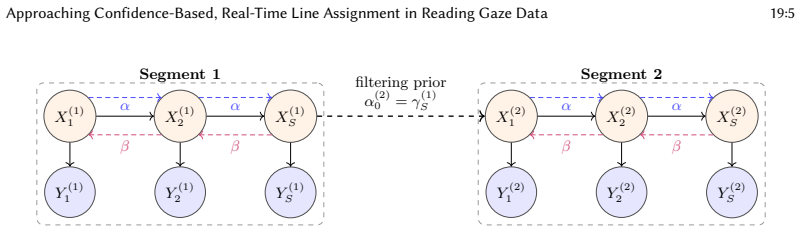
Vertical Error Correction Using Classification of Transitions between Sequential Reading Segments.Journal of Information Processing25 (2017), 100–106. doi:10.2197/ipsjjip.25.100 A HMM equations A.1 Generative model This appendix provides a detailed mathematical specification of the HMM used in this work, which models𝑀lines as hidden states𝑋 𝑖 and vertical...
-
[45]
The smoothed posterior within a segment is proportional to the product of the normalized belief messages 𝛼 (𝑠) 𝑖 and 𝛽 (𝑠) 𝑖 in a current fixation 𝑖
The initial belief vector for the backward pass for all segments 𝛽 (𝑠) 𝑆 is an all-one vector of size M. The smoothed posterior within a segment is proportional to the product of the normalized belief messages 𝛼 (𝑠) 𝑖 and 𝛽 (𝑠) 𝑖 in a current fixation 𝑖. The final assignment posterior is obtained through normalization. Detailed message passing formulas us...
2022
-
[46]
Distinct accuracies on adult and children data show a performance gap between these two groups
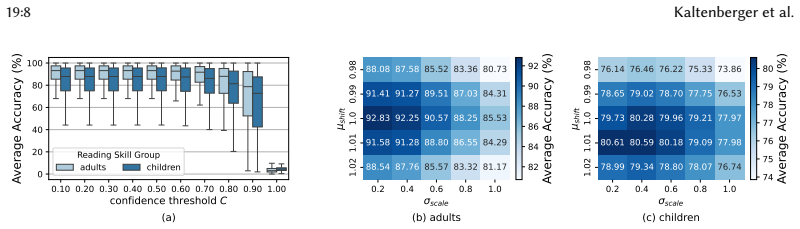
Parameter combinations from grid search for best combined line assignment accuracy averaged over all reading trials. Distinct accuracies on adult and children data show a performance gap between these two groups. Multiple values for one parameters indicate identical best accuracy values. 𝑆 𝜇 𝑠ℎ𝑖 𝑓 𝑡 𝜎𝑠𝑐𝑎𝑙𝑒 𝐶ΩMean Accuracy (in %) Adults Children Combined 𝑁...
2022
-
[47]
Publication date: June 2026
2026
discussion (0)
Sign in with ORCID, Apple, or X to comment. Anyone can read and Pith papers without signing in.