Recognition: unknown
Causal Foundations of Collective Agency
Pith reviewed 2026-05-09 19:51 UTC · model grok-4.3
The pith
A group of agents counts as a collective agent when a high-level rational model of their joint actions accurately predicts what they will do.
A machine-rendered reading of the paper's core claim, the machinery that carries it, and where it could break.
Core claim
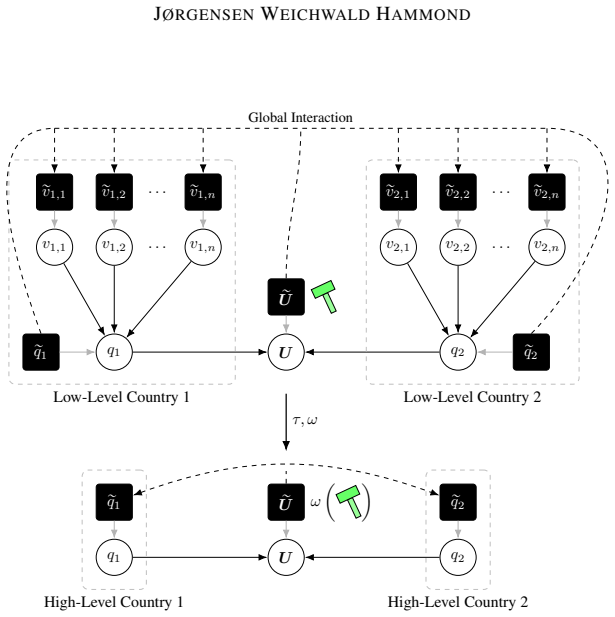
We adopt a behavioral perspective in answering this question, ascribing collective agency to a group when viewing the group's joint actions as rational and goal-directed successfully predicts its behavior. We formalize this perspective on collective agency using causal games -- which are causal models of strategic, multi-agent interactions -- and causal abstraction -- which formalizes when a simple, high-level model faithfully captures a more complex, low-level model. We use this framework to solve a puzzle regarding multi-agent incentives in actor-critic models and to make quantitative assessments of the degree of collective agency exhibited by different voting mechanisms.
What carries the argument
Causal games that represent strategic interactions together with causal abstraction that determines when a high-level rational model faithfully summarizes the low-level agent dynamics.
If this is right
- Actor-critic training in multi-agent settings can be analyzed to identify and correct misaligned joint incentives that arise only at the collective level.
- Voting rules can be compared directly by the numerical degree of collective agency each rule induces under the same causal-abstraction measure.
- Designers of multi-agent AI systems gain a criterion for anticipating when simpler agents will begin to act as a single more powerful entity with distinct goals.
- Empirical studies of both artificial and biological groups can use the same prediction test to decide whether a collective description is warranted.
Where Pith is reading between the lines
- The same abstraction test could be applied to human institutions to decide when a committee or firm should be treated as having its own preferences for policy analysis.
- If the behavioral criterion is accepted, safety evaluations of deployed AI systems would need to include checks for emergent collective behavior rather than examining agents only in isolation.
- Extending the framework to continuous time or partially observable settings would allow quantitative tracking of how collective agency forms or dissolves during training runs.
Load-bearing premise
Successful prediction of a group's actions by a rational high-level model is sufficient to attribute genuine collective agency rather than simply describing correlated individual behaviors.
What would settle it
A concrete multi-agent simulation in which the high-level rational model predicts observed group actions with high accuracy yet the individual agents' separate incentives show no alignment with any shared objective that the high-level model assumes.
Figures



read the original abstract
A key challenge for the safety of advanced AI systems is the possibility that multiple simpler agents might inadvertently form a collective agent with capabilities and goals distinct from those of any individual. More generally, determining when a group of agents can be viewed as a unified collective agent is a foundational question in the study of interactions and incentives in both biological and artificial systems. We adopt a behavioral perspective in answering this question, ascribing collective agency to a group when viewing the group's joint actions as rational and goal-directed successfully predicts its behavior. We formalize this perspective on collective agency using causal games -- which are causal models of strategic, multi-agent interactions -- and causal abstraction -- which formalizes when a simple, high-level model faithfully captures a more complex, low-level model. We use this framework to solve a puzzle regarding multi-agent incentives in actor-critic models and to make quantitative assessments of the degree of collective agency exhibited by different voting mechanisms. Our framework aims to provide a foundation for theoretical and empirical work to understand, predict, and control emergent collective agents in multi-agent AI systems.
Editorial analysis
A structured set of objections, weighed in public.
Referee Report
Summary. The manuscript develops a behavioral definition of collective agency: a group of agents constitutes a collective agent when a high-level causal model that treats the group's joint actions as rational and goal-directed successfully predicts the observed behavior. The definition is formalized by combining causal games (to represent strategic multi-agent interactions) with causal abstraction (to ensure the high-level model is a faithful abstraction of the underlying low-level dynamics). The framework is then applied to resolve an incentive puzzle arising in actor-critic reinforcement learning and to produce quantitative comparisons of the degree of collective agency induced by different voting mechanisms.
Significance. If the formalization is internally consistent, the work supplies an operational, mathematically grounded criterion for detecting emergent collective agency that is directly relevant to AI safety and multi-agent incentive design. By anchoring the ascription of agency in predictive success rather than intrinsic mental states, the approach yields testable predictions and quantitative metrics that could guide both theoretical analysis and empirical measurement in biological and artificial systems.
major comments (2)
- [formal definition and applications to voting mechanisms] The central definition equates collective agency with successful prediction by a rational high-level model, yet the manuscript does not specify a precise success criterion (e.g., a bound on approximation error within the causal abstraction or a statistical test of predictive accuracy). Without such a criterion, the claim that the framework yields quantitative assessments of voting mechanisms remains difficult to evaluate rigorously.
- [actor-critic incentive analysis] In the actor-critic application, the manuscript asserts that the framework resolves an incentive puzzle, but it is unclear whether the resolution follows deductively from the causal-game and abstraction machinery or whether additional modeling assumptions are introduced. A step-by-step derivation showing how the high-level rational model predicts the observed joint behavior (and why lower-level models fail) would strengthen the claim.
minor comments (2)
- [preliminaries] Notation for causal games and abstraction maps should be introduced with a short self-contained example before the main applications, to improve readability for readers unfamiliar with the cited literature.
- [voting mechanisms section] The abstract states that the framework makes 'quantitative assessments'; the main text should include an explicit table or formula showing the numerical values obtained for each voting rule and the precise mapping from abstraction error to the reported degree of collective agency.
Simulated Author's Rebuttal
We thank the referee for the careful reading and constructive comments on our manuscript. We address each major comment below and will revise the paper accordingly to strengthen the formalization and clarity of the applications.
read point-by-point responses
-
Referee: [formal definition and applications to voting mechanisms] The central definition equates collective agency with successful prediction by a rational high-level model, yet the manuscript does not specify a precise success criterion (e.g., a bound on approximation error within the causal abstraction or a statistical test of predictive accuracy). Without such a criterion, the claim that the framework yields quantitative assessments of voting mechanisms remains difficult to evaluate rigorously.
Authors: We agree that an explicit success criterion would improve rigor. The current definition relies on the existence of a high-level causal game that is a valid abstraction (in the sense of the cited causal abstraction framework) and that predicts the observed joint behavior better than alternatives. In the revised manuscript we will augment the formal definition (Section 3) with a quantitative criterion: the high-level model must achieve an abstraction error below a user-specified threshold ε, where error is measured as the maximum total variation distance between the interventional distributions of the low-level and high-level models over a finite set of interventions. This bound is taken directly from the causal abstraction literature and will be used to produce the quantitative comparisons of voting mechanisms by reporting the minimal ε for which the rational high-level model succeeds. revision: yes
-
Referee: [actor-critic incentive analysis] In the actor-critic application, the manuscript asserts that the framework resolves an incentive puzzle, but it is unclear whether the resolution follows deductively from the causal-game and abstraction machinery or whether additional modeling assumptions are introduced. A step-by-step derivation showing how the high-level rational model predicts the observed joint behavior (and why lower-level models fail) would strengthen the claim.
Authors: The resolution is intended to follow deductively from the causal-game representation of the actor-critic dynamics together with the abstraction theorem. In the revised manuscript we will insert a new subsection (or appendix) containing an explicit step-by-step derivation: (i) formalize the low-level causal game with separate actor and critic nodes for each agent; (ii) exhibit the high-level abstraction that collapses the group into a single rational agent whose utility is the joint objective; (iii) verify that the high-level model exactly reproduces the observed joint policy and value estimates under the relevant interventions; and (iv) show that any disaggregated low-level model without the collective abstraction fails to predict the emergent incentive alignment. No auxiliary assumptions beyond the standard causal-game and abstraction definitions are required. revision: yes
Circularity Check
No significant circularity in derivation chain
full rationale
The paper explicitly adopts a behavioral definition of collective agency as its starting point (successful prediction of group behavior by a rational high-level model) and then applies independent prior frameworks (causal games for strategic interactions, causal abstraction for high-level faithfulness) to formalize it. No load-bearing step reduces a prediction or result to the input definition by construction, nor relies on self-citation chains or fitted parameters renamed as predictions. The applications (actor-critic puzzle, voting mechanisms) are presented as illustrations of the framework rather than empirical loops or validations that presuppose the target claim. The derivation is therefore self-contained against external benchmarks.
Axiom & Free-Parameter Ledger
axioms (2)
- domain assumption Causal games accurately represent strategic multi-agent interactions
- domain assumption Causal abstraction correctly identifies when a high-level model faithfully summarizes a low-level one
invented entities (1)
-
Collective agent
no independent evidence
Reference graph
Works this paper leans on
-
[1]
David Abel, Andr \'e Barreto, Michael Bowling, Will Dabney, Shi Dong, Steven Hansen, Anna Harutyunyan, Khimya Khetarpal, Clare Lyle, Razvan Pascanu, et al. Agency is frame-dependent. arXiv, 2025. arXiv:2502.04403
-
[2]
P. W. Anderson. More is different: Broken symmetry and the nature of the hierarchical structure of science. Science, 177 0 (4047): 0 393--396, 1972
1972
-
[3]
Sander Beckers and Joseph Y. Halpern. Abstracting causal models. In AAAI Conference on Artificial Intelligence, 2019
2019
-
[4]
Sander Beckers, Frederick Eberhardt, and Joseph Y. Halpern. Approximate causal abstractions. In Uncertainty in Artificial Intelligence, 2020
2020
-
[5]
Swarm Intelligence: From Natural to Artificial Systems
Eric Bonabeau, Marco Dorigo, and Guy Theraulaz. Swarm Intelligence: From Natural to Artificial Systems. Oxford University Press, 1999
1999
-
[6]
Michael E. Bratman. Shared Agency: A Planning Theory of Acting Together. Oxford University Press, 2014
2014
-
[7]
Harms from increasingly agentic algorithmic systems
Alan Chan, Rebecca Salganik, Alva Markelius, Chris Pang, Nitarshan Rajkumar, Dmitrii Krasheninnikov, Lauro Langosco, Zhonghao He, Yawen Duan, Micah Carroll, et al. Harms from increasingly agentic algorithmic systems. In Conference on Fairness, Accountability, and Transparency, 2023
2023
-
[8]
Nagl, and Christopher D
Chih-Chun Chen, Sylvia B. Nagl, and Christopher D. Clack. A formalism for multi-level emergent behaviours in designed component-based systems and agent-based simulations. In Moulay Aziz-Alaoui and Cyrille Bertelle, editors, From System Complexity to Emergent Properties, chapter 4, pages 101--114. Springer, 2009
2009
-
[9]
Iain D. Couzin. Collective cognition in animal groups. Trends in Cognitive Sciences, 13 0 (1): 0 36--43, 2009
2009
- [10]
-
[11]
Influence diagrams for causal modelling and inference
A Philip Dawid. Influence diagrams for causal modelling and inference. International Statistical Review, 2002
2002
-
[12]
The intentional stance
Daniel C Dennett. The intentional stance. MIT Press, 1989
1989
-
[13]
Eric Drexler
K. Eric Drexler. Reframing superintelligence: Comprehensive AI services as general intelligence. Technical Report 2019-1, Future of Humanity Institute, University of Oxford, 2019
2019
-
[14]
Tenenbaum, and Igor Mordatch
Yilun Du, Shuang Li, Antonio Torralba, Joshua B. Tenenbaum, and Igor Mordatch. Improving factuality and reasoning in language models through multiagent debate. In International Conference on Learning Representations, 2024
2024
-
[15]
Wooldridge
Joel Dyer, Nicholas George Bishop, Yorgos Felekis, Fabio Massimo Zennaro, Ani Calinescu, Theodoros Damoulas, and Michael J. Wooldridge. Interventionally consistent surrogates for complex simulation models. In Advances in Neural Information Processing Systems, 2024
2024
-
[16]
Cooperative Game Theory, chapter 3, pages 135--193
Edith Elkind and Jörg Rothe. Cooperative Game Theory, chapter 3, pages 135--193. Springer, 2016
2016
-
[17]
Agent incentives: A causal perspective
Tom Everitt, Ryan Carey, Eric D Langlois, Pedro A Ortega, and Shane Legg. Agent incentives: A causal perspective. In AAAI Conference on Artificial Intelligence, 2021
2021
-
[18]
Evaluating the goal-directedness of large language models
Tom Everitt, Cristina Garbacea, Alexis Bellot, Jonathan Richens, Henry Papadatos, Siméon Campos, and Rohin Shah. Evaluating the goal-directedness of large language models. arXiv, 2025. arXiv:2504.11844
-
[19]
Designing ecosystems of intelligence from first principles
Karl J Friston, Maxwell J D Ramstead, Alex B Kiefer, Alexander Tschantz, Christopher L Buckley, Mahault Albarracin, Riddhi J Pitliya, Conor Heins, Brennan Klein, Beren Millidge, Dalton A R Sakthivadivel, Toby St Clere Smithe, Magnus Koudahl, Safae Essafi Tremblay, Capm Petersen, Kaiser Fung, Jason G Fox, Steven Swanson, Dan Mapes, and Gabriel René. Design...
2024
-
[20]
Factored space models: Towards causality between levels of abstraction
Scott Garrabrant, Matthias Georg Mayer, Magdalena Wache, Leon Lang, Sam Eisenstat, and Holger Dell. Factored space models: Towards causality between levels of abstraction. arXiv, 2024. arXiv:2412.02579
-
[21]
Causal abstraction: A theoretical foundation for mechanistic interpretability
Atticus Geiger, Duligur Ibeling, Amir Zur, Maheep Chaudhary, Sonakshi Chauhan, Jing Huang, Aryaman Arora, Zhengxuan Wu, Noah Goodman, Christopher Potts, et al. Causal abstraction: A theoretical foundation for mechanistic interpretability. Journal of Machine Learning Research, 26, 2025
2025
-
[22]
Collective intentions and team agency
Natalie Gold and Robert Sugden. Collective intentions and team agency. Journal of Philosophy, 104 0 (3): 0 109--137, 2007
2007
-
[23]
Halpern and Max Kleiman - Weiner
Joseph Y. Halpern and Max Kleiman - Weiner. Towards formal definitions of blameworthiness, intention, and moral responsibility. In AAAI Conference on Artificial Intelligence, 2018
2018
-
[24]
Reasoning about causality in games
Lewis Hammond, James Fox, Tom Everitt, Ryan Carey, Alessandro Abate, and Michael Wooldridge. Reasoning about causality in games. Artificial Intelligence, 320: 0 103919, 2023
2023
-
[25]
Lewis Hammond, Alan Chan, Jesse Clifton, Jason Hoelscher-Obermaier, Akbir Khan, Euan McLean, Chandler Smith, Wolfram Barfuss, Jakob Foerster, Tomáš Gavenčiak, The Anh Han, Edward Hughes, Vojtěch Kovařík, Jan Kulveit, Joel Z. Leibo, Caspar Oesterheld, Christian Schroeder de Witt, Nisarg Shah, Michael Wellman, Paolo Bova, Theodor Cimpeanu, Carson Ezell, Que...
2025
-
[26]
Geoffrey Irving, Paul Christiano, and Dario Amodei. AI safety via debate. arXiv preprint arXiv:1805.00899, 2018
work page internal anchor Pith review arXiv 2018
-
[27]
arXiv preprint arXiv:2406.14595 , year=
Erik Jones, Anca Dragan, and Jacob Steinhardt. Adversaries can misuse combinations of safe models. arXiv, 2024. arXiv:2406.14595
-
[28]
What is causal about causal models and representations? arXiv, 2025
Frederik Hytting J rgensen, Luigi Gresele, and Sebastian Weichwald. What is causal about causal models and representations? arXiv, 2025. arXiv:2501.19335
-
[29]
Discovering agents
Zachary Kenton, Ramana Kumar, Sebastian Farquhar, Jonathan Richens, Matt MacDermott, and Tom Everitt. Discovering agents. Artificial Intelligence, 2023
2023
-
[30]
Multi-agent influence diagrams for representing and solving games
Daphne Koller and Brian Milch. Multi-agent influence diagrams for representing and solving games. Games and Economic Behavior, 45 0 (1): 0 181--221, 2003
2003
-
[31]
Konda and John N
Vijay R. Konda and John N. Tsitsiklis. Actor-critic algorithms. In S. A. Solla, T. K. Leen, and K. M\" u ller, editors, Advances in Neural Information Processing Systems, pages 1008--1014. MIT Press, 2000
2000
-
[32]
Toward a formalization of emergence
Aleš Kub\' i k. Toward a formalization of emergence. Artificial Life, 9 0 (1): 0 41--65, 2003
2003
-
[33]
Levesque, Philip R
Hector J. Levesque, Philip R. Cohen, and Jos \' e H. T. Nunes. On acting together. In Proceedings of the 8th National Conference on Artificial Intelligence. Boston, Massachusetts, USA, July 29 - August 3, 1990, 2 Volumes, 1990
1990
-
[34]
Towards scalable oversight with collaborative multi-agent debate in error detection
Qian Li et al. Towards scalable oversight with collaborative multi-agent debate in error detection. arXiv preprint, 2025
2025
-
[35]
Group Agency: The Possibility, Design, and Status of Corporate Agents
Christian List and Philip Pettit. Group Agency: The Possibility, Design, and Status of Corporate Agents. Oxford University Press, 2011
2011
-
[36]
Collective intentional behavior from the standpoint of semantics
Kirk Ludwig. Collective intentional behavior from the standpoint of semantics. Noûs, 41 0 (3): 0 355--393, 2007
2007
-
[37]
Measuring goal-directedness
Matt MacDermott, James Fox, Francesco Belardinelli, and Tom Everitt. Measuring goal-directedness. In Advances in Neural Information Processing Systems, 2024
2024
-
[38]
Malone and Michael S
Thomas W. Malone and Michael S. Bernstein. Handbook of Collective Intelligence. MIT Press, 2015
2015
-
[39]
Causal abstraction with soft interventions
Riccardo Massidda, Atticus Geiger, Thomas Icard, and Davide Bacciu. Causal abstraction with soft interventions. In Causal Learning and Reasoning, 2023
2023
-
[40]
The Society of Mind
Marvin Minsky. The Society of Mind. Simon and Schuster, 6. pb-pr. edition, 1988
1988
-
[41]
Complexity A Guided Tour
Melanie Mitchell. Complexity A Guided Tour. Oxford University Press, 2009
2009
-
[42]
Brain bisection and the unity of consciousness
Thomas Nagel. Brain bisection and the unity of consciousness. Synthese, 22 0 (3/4): 0 396--413, 1971
1971
-
[43]
Algorithms for inverse reinforcement learning
Andrew Y Ng, Stuart Russell, et al. Algorithms for inverse reinforcement learning. In International Conference on Machine Learning, 2000
2000
-
[44]
Similarity-based cooperative equilibrium
Caspar Oesterheld, Johannes Treutlein, Roger B Grosse, Vincent Conitzer, and Jakob Foerster. Similarity-based cooperative equilibrium. In Advances in Neural Information Processing Systems, 2023
2023
-
[45]
Agents and Goals in Evolution
Samir Okasha. Agents and Goals in Evolution. Oxford University Press, 2018
2018
-
[46]
Agents and devices: A relative definition of agency
Laurent Orseau, Simon McGregor McGill, and Shane Legg. Agents and devices: A relative definition of agency. arXiv, 2018. arXiv:1805.12387
-
[47]
Intentional joint agency: Shared intention lite
Elisabeth Pacherie. Intentional joint agency: Shared intention lite. Synthese, 190 0 (10): 0 1817--1839, 2013
2013
-
[48]
Causality
Judea Pearl. Causality. Cambridge University Press, 2009
2009
-
[49]
Elements of Causal Inference: Foundations and Learning Algorithms
Jonas Peters, Dominik Janzing, and Bernhard Sch \"o lkopf. Elements of Causal Inference: Foundations and Learning Algorithms. MIT Press, 2017
2017
-
[50]
Cooperate or collapse: emergence of sustainable cooperation in a society of LLM agents
Giorgio Piatti, Zhijing Jin, Max Kleiman-Weiner, Bernhard Sch\" o lkopf, Mrinmaya Sachan, and Rada Mihalcea. Cooperate or collapse: emergence of sustainable cooperation in a society of LLM agents. In Advances in Neural Information Processing Systems, 2024
2024
-
[51]
Goal-directedness is in the eye of the beholder
Nina Rajcic and Anders S gaard. Goal-directedness is in the eye of the beholder. arXiv, 2025. arXiv:2508.13247
-
[52]
Bayesian inverse reinforcement learning
Deepak Ramachandran and Eyal Amir. Bayesian inverse reinforcement learning. In Proceedings of the 20th International Joint Conference on Artificial Intelligence, 2007
2007
-
[53]
A Game-Theoretic Perspective on Coalition Formation
Debraj Ray. A Game-Theoretic Perspective on Coalition Formation. Oxford University Press, 2007
2007
-
[54]
The Case for Time in Causal DAGs
Alexander G. Reisach, Alberto Su \'a rez, Sebastian Weichwald, and Antoine Chambaz. The case for time in causal DAGs . arXiv, 2025. arXiv:2501.19311
work page internal anchor Pith review Pith/arXiv arXiv 2025
-
[55]
Rischel and Sebastian Weichwald
Eigil F. Rischel and Sebastian Weichwald. Compositional abstraction error and a category of causal models. In Uncertainty in Artificial Intelligence, 2021
2021
-
[56]
Shared Agency
Abraham Sesshu Roth. Shared Agency . In Edward N. Zalta, editor, The Stanford Encyclopedia of Philosophy . Metaphysics Research Lab, Stanford University, 2017
2017
-
[57]
Rubenstein, Sebastian Weichwald, Stephan Bongers, Joris M
Paul K. Rubenstein, Sebastian Weichwald, Stephan Bongers, Joris M. Mooij, Dominik Janzing, Moritz Grosse-Wentrup, and Bernhard Sch \"o lkopf. Causal consistency of structural equation models. In Uncertainty in Artificial Intelligence, 2017
2017
-
[58]
Schweikard and Hans Bernhard Schmid
David P. Schweikard and Hans Bernhard Schmid. Collective Intentionality . In Edward N. Zalta, editor, The Stanford Encyclopedia of Philosophy . Metaphysics Research Lab, Stanford University, 2021
2021
-
[59]
Collective intentions and actions
John Searle. Collective intentions and actions. In Philip R. Cohen Jerry Morgan and Martha Pollack, editors, Intentions in Communication, pages 401--415. MIT Press, 1990
1990
-
[60]
Measuring emergence via nonlinear granger causality
Anil Seth. Measuring emergence via nonlinear granger causality. In Artificial Life XI: Proceedings of the Eleventh International Conference on the Simulation and Synthesis of Living Systems, 2006
2006
-
[61]
Partial identifiability and misspecification in inverse reinforcement learning
Joar Skalse and Alessandro Abate. Partial identifiability and misspecification in inverse reinforcement learning. arXiv, 2024. arXiv:2411.15951
-
[62]
The Major Transitions in Evolution
John Maynard Smith and Eörs Szathmáry. The Major Transitions in Evolution. Oxford University Press, 2020. Previously issued in print: Oxford : W.H. Freeman/Spektrum, 1995; Oxford: Oxford University Press, 1997. - Includes bibliographical references and index. - Description based on print version record and publisher information
2020
-
[63]
Cooperation and control in delegation games
Oliver Sourbut, Lewis Hammond, and Harriet Wood. Cooperation and control in delegation games. In International Joint Conference on Artificial Intelligence, 2024
2024
-
[64]
Formalization of weak emergence in multiagent systems
Claudia Szabo and Yong Meng Teo. Formalization of weak emergence in multiagent systems. ACM Transactions on Modeling and Computer Simulation, 26 0 (1): 0 1--25, 2015
2015
-
[65]
Game theory: an introduction
Steven Tadelis. Game theory: an introduction. Princeton University Press, 2013
2013
-
[66]
Formalization of emergence in multi-agent systems
Yong Meng Teo, Ba Linh Luong, and Claudia Szabo. Formalization of emergence in multi-agent systems. In Proceedings of the 1st ACM SIGSIM Conference on Principles of Advanced Discrete Simulation, 2013
2013
-
[67]
Joint intention, we-mode and I -mode
Raimo Tuomela. Joint intention, we-mode and I -mode. Midwest Studies in Philosophy, 30 0 (1): 0 35--58, 2006
2006
-
[68]
The reasons that agents act: Intention and instrumental goals
Francis Rhys Ward, Matt MacDermott, Francesco Belardinelli, Francesca Toni, and Tom Everitt. The reasons that agents act: Intention and instrumental goals. In International Conference on Autonomous Agents and Multiagent Systems, 2024
2024
-
[69]
Wellman, Karl Tuyls, and Amy Greenwald
Michael P. Wellman, Karl Tuyls, and Amy Greenwald. Empirical game theoretic analysis: A survey. Journal of Artificial Intelligence Research, 82, 2025
2025
-
[70]
Neural causal abstractions
Kevin Xia and Elias Bareinboim. Neural causal abstractions. In AAAI Conference on Artificial Intelligence, 2024
2024
-
[71]
Towards measuring goal-directedness in AI systems
Dylan Xu and Juan-Pablo Rivera. Towards measuring goal-directedness in AI systems. arXiv, 2024. arXiv:2410.04683
-
[72]
Ziebart, J
Brian D. Ziebart, J. Andrew Bagnell, and Anind K. Dey. Modeling interaction via the principle of maximum causal entropy. In International Conference on Machine Learning, 2010
2010
-
[73]
Martin Zinkevich, Amy Greenwald, and Michael L. Littman. Cyclic equilibria in M arkov games. In Advances in Neural Information Processing Systems, volume 18, pages 1641--1648, 2005
2005
discussion (0)
Sign in with ORCID, Apple, or X to comment. Anyone can read and Pith papers without signing in.