Recognition: unknown
How Thick Is the Sierpi\'nski Triangle?
Pith reviewed 2026-05-10 16:23 UTC · model grok-4.3
The pith
The Sierpiński triangle's local convex hull always contains an equilateral triangle of side equal to the radius, fixing its thickness at exactly √3/6.
A machine-rendered reading of the paper's core claim, the machinery that carries it, and where it could break.
Core claim
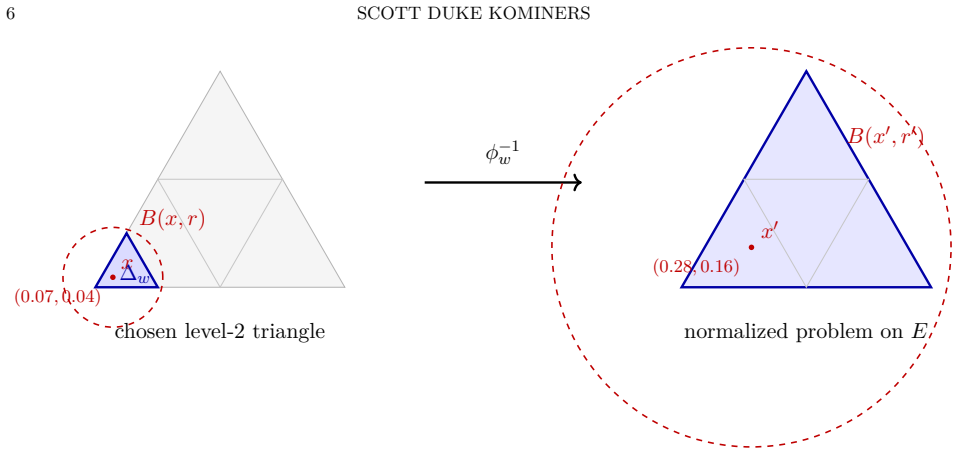
Let E be the standard Sierpiński triangle of side length 1. For every x in E and every 0 < r ≤ 1, the convex hull of E ∩ B(x,r) contains an equilateral triangle of side length r. Consequently, conv(E ∩ B(x,r)) contains a closed disk of radius (√3/6)r, and this constant is best possible.
What carries the argument
Persistence of boundary edges from the iterative construction in the limit set E, which combines with self-similarity to reduce the thickness verification to the normalized interval 1/2 ≤ r ≤ 1.
If this is right
- The Feng-Wu thickness of the Sierpiński triangle equals exactly √3/6.
- The set is uniformly non-flat: every local convex hull contains a disk whose radius is a fixed positive fraction of the observation scale.
- The bound is achieved at the inradius of an equilateral triangle and cannot be improved.
- The property holds uniformly for every point in the set and every scale up to the diameter.
Where Pith is reading between the lines
- The same edge-persistence argument may extend to other self-similar sets built by iterated removal of open triangles.
- Finite-stage approximations of the Sierpiński triangle could be checked numerically to see how quickly their local thickness approaches the limit value √3/6.
- The result supplies a concrete lower bound on the two-dimensional content of zero-area sets that might be compared with other notions of thickness or dimension in the plane.
Load-bearing premise
Boundary edges of the construction triangles survive in the completed limit set E.
What would settle it
Locate a point x in E and a radius r ≤ 1 such that conv(E ∩ B(x,r)) contains no equilateral triangle of side length r.
Figures



read the original abstract
Although the Sierpi\'nski triangle has planar area $0$, it is uniformly non-flat: at every point and every scale, its nearby points span a two-dimensional region of comparable size. We prove a sharp version of this statement, showing that the Feng--Wu thickness of $E$ is exactly $\sqrt{3}/6$, the inradius of a unit equilateral triangle. More precisely, if $E$ is the standard Sierpi\'nski triangle of side length $1$ and $B(x,r)$ denotes the closed disk of radius $r$ centered at $x$, then for every $x\in E$ and every $0<r\le 1$, the convex hull of $E\cap B(x,r)$ contains an equilateral triangle of side length $r$. Consequently, $\operatorname{conv}(E\cap B(x,r))$ contains a closed disk of radius $(\sqrt{3}/6)r$; this constant is best possible. The proof is elementary -- boundary edges of all construction triangles survive in the limit set, and self-similarity reduces the problem to the normalized range $1/2\le r\le 1$.
Editorial analysis
A structured set of objections, weighed in public.
Referee Report
Summary. The manuscript proves that the Feng-Wu thickness of the standard Sierpiński triangle E (side length 1) is exactly √3/6. For every x ∈ E and 0 < r ≤ 1, conv(E ∩ B(x,r)) contains an equilateral triangle of side length r and hence a closed disk of radius (√3/6)r; the constant is shown to be sharp. The argument is elementary, using persistence of boundary edges in the construction and self-similarity to reduce to the normalized range 1/2 ≤ r ≤ 1.
Significance. If the result holds, it supplies a sharp, scale-invariant geometric measure of the uniform two-dimensionality of the Sierpiński gasket at every point and scale, despite zero area. The elementary self-similarity proof, free of fitted parameters and relying only on the standard construction, is a clear strength and makes the claim readily verifiable.
minor comments (2)
- The reduction to 1/2 ≤ r ≤ 1 via self-similarity is central; a short explicit statement of the surviving boundary-edge property (with a reference to the standard construction) would make the base of the induction fully transparent.
- A single illustrative figure showing the equilateral triangle of side r inside conv(E ∩ B(x,r)) for a non-vertex point would help readers visualize the geometric step.
Simulated Author's Rebuttal
We thank the referee for the careful reading, positive summary, and favorable significance assessment of our manuscript. The recommendation of minor revision is noted; however, the major comments section contains no specific points requiring clarification or correction. We have re-examined the argument and believe the elementary self-similarity proof is complete and the sharpness statement is correctly established.
Circularity Check
No circularity: direct geometric proof from construction and self-similarity
full rationale
The derivation relies on an elementary geometric argument: boundary edges of the construction triangles persist in the limit set E, and self-similarity reduces the problem to the normalized interval 1/2 ≤ r ≤ 1. The key statement—that conv(E ∩ B(x,r)) contains an equilateral triangle of side exactly r—is established by direct inspection of the iterative construction at each scale, without any parameter fitting, redefinition of the target constant, or load-bearing self-citation. Sharpness follows from exhibiting explicit points in E where the inradius bound is attained. The proof is self-contained against the standard Sierpiński construction and does not reduce any claimed prediction or uniqueness result to its own inputs by construction.
Axiom & Free-Parameter Ledger
axioms (2)
- domain assumption The Sierpiński triangle E is the attractor of the standard iterated function system consisting of three contractions by factor 1/2 toward the vertices of an equilateral triangle.
- domain assumption Boundary edges of every construction-stage triangle remain in the final set E.
Reference graph
Works this paper leans on
-
[1]
Wacław Sierpiński,Sur une courbe dont tout point est un point de ramification, Comptes Rendus de l’Académie des Sciences Paris160(1915), 302–305
1915
-
[2]
25, 629–632
,Sur une courbe cantorienne qui contient une image biunivoque et continue de toute courbe donnée, Comptes Rendus de l’Académie des Sciences Paris162(1916), no. 25, 629–632
1916
-
[3]
Kenneth Falconer,Fractal Geometry: Mathematical Foundations and Applications, 3rd ed., John Wiley & Sons, 2014
2014
-
[4]
3, 2291–2315
Kenneth Falconer and Alexia Yavicoli,Intersections of thick compact sets inRd, Mathematische Zeitschrift 301(2022), no. 3, 2291–2315
2022
-
[5]
1, 35–65
De-Jun Feng and Yu-Feng Wu,On arithmetic sums of fractal sets in Rd, Journal of the London Mathematical Society104(2021), no. 1, 35–65
2021
-
[6]
Hutchinson,Fractals and self-similarity, Indiana University Mathematics Journal30(1981), no
John E. Hutchinson,Fractals and self-similarity, Indiana University Mathematics Journal30(1981), no. 5, 713–747
1981
-
[7]
Scott Duke Kominers,An improved bound for sumsets of thick compact sets via the Shapley–Folkman theorem, arXiv 2604.04889, 2026
work page internal anchor Pith review Pith/arXiv arXiv 2026
-
[8]
Newhouse,Nondensity of Axiom A(a) onS2, Global Analysis, Proceedings of Symposia in Pure Mathematics, vol
Sheldon E. Newhouse,Nondensity of Axiom A(a) onS2, Global Analysis, Proceedings of Symposia in Pure Mathematics, vol. XIV, American Mathematical Society, Providence, RI, 1970, pp. 191–202
1970
-
[9]
,The abundance of wild hyperbolic sets and non-smooth stable sets for diffeomorphisms, Publica- tions Mathématiques de l’IHÉS50(1979), 101–151
1979
-
[10]
Alexia Yavicoli,A survey on Newhouse thickness, fractal intersections and patterns, Mathematical and Computational Applications27(2022), no. 6, Art. 111. Harvard Business School; Department of Economics and Center of Mathematical Sciences and Applications, Harvard University; and a16z crypto Email address:kominers@fas.harvard.edu
2022
discussion (0)
Sign in with ORCID, Apple, or X to comment. Anyone can read and Pith papers without signing in.