Recognition: 3 theorem links
· Lean TheoremFaster Mixing for Triangulations via Transport Flows
Pith reviewed 2026-05-08 19:05 UTC · model grok-4.3
The pith
The triangulation flip chain on a convex (n+2)-gon mixes in Õ(n²) time.
A machine-rendered reading of the paper's core claim, the machinery that carries it, and where it could break.
Core claim
We prove an Õ(n²) bound for the relaxation time and the log-Sobolev time (inverse log-Sobolev constant) of the classical triangulation flip chain on a convex (n+2)-gon, implying a mixing time of Õ(n²). The previous state of the art for the mixing time of this chain, due to Eppstein and Frishberg, was Õ(n³), while the best known lower bound on the mixing time, due to Molloy, Reed, and Steiger, is Ω(n^{3/2}). Our relaxation time bound makes significant progress towards Aldous' conjectured bound of Θ(n^{3/2}) for the relaxation time. We improve upon the analysis of Eppstein and Frishberg by further developing the framework of transport flows introduced in the work of Chen et al.
What carries the argument
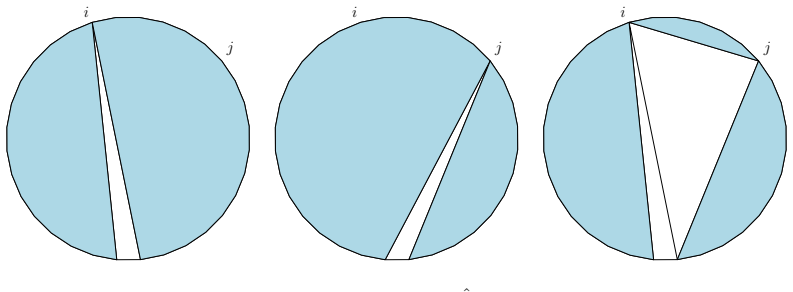
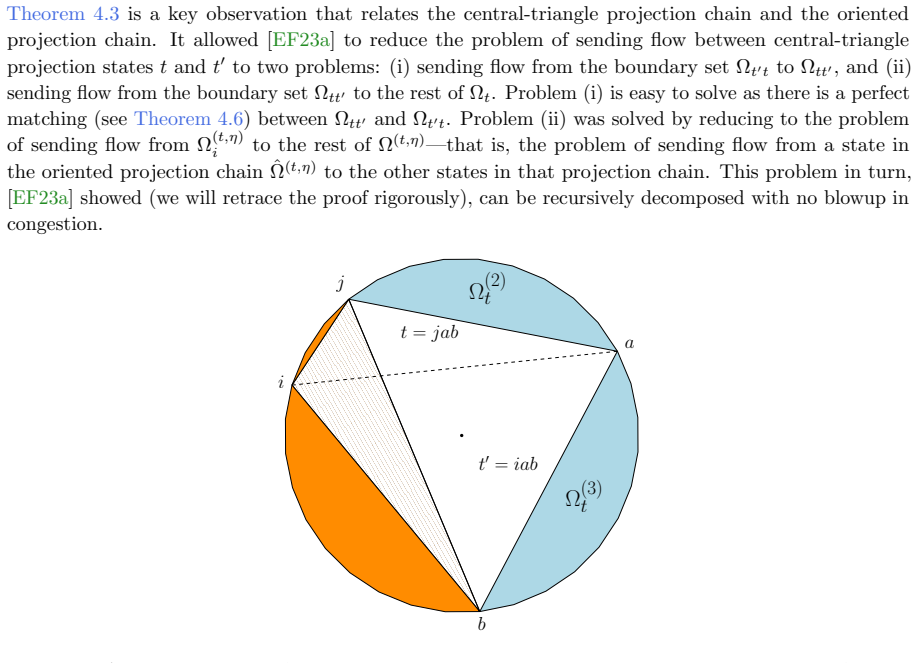
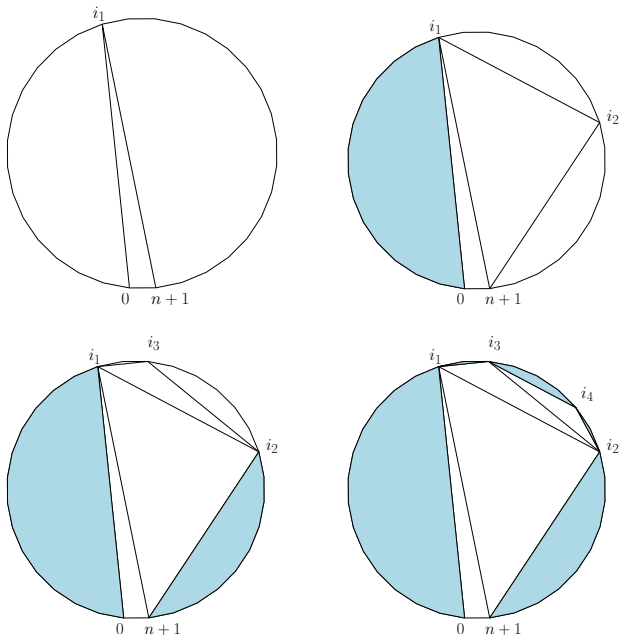
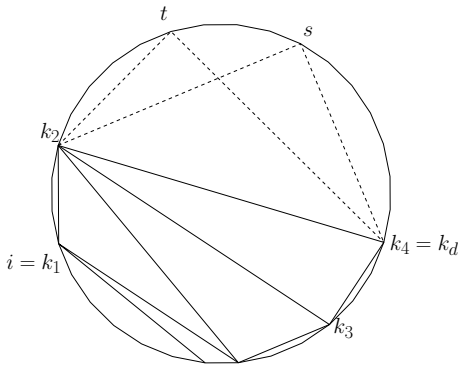
Transport flows constructed on a combinatorial decomposition of the space of all triangulations, used to bound the Dirichlet form and obtain Poincaré and log-Sobolev inequalities for the flip chain.
If this is right
- The mixing time of the flip chain is at most Õ(n²).
- The log-Sobolev constant is at least the reciprocal of Õ(n²).
- The analysis advances toward the conjectured Θ(n^{3/2}) relaxation time.
- Combinatorial decompositions can be used more efficiently to derive functional inequalities for other Markov chains.
Where Pith is reading between the lines
- The same transport-flow refinement may yield quadratic bounds for flip chains on triangulations of other convex surfaces.
- If the hidden constants are moderate, practical algorithms for uniform sampling could safely run for far fewer than the previously proven cubic number of steps.
- Tighter control on the flow costs might eventually close the remaining gap to the n^{3/2} lower bound.
Load-bearing premise
The transport flows can be built from the decomposition so that their total cost is at most quadratic in n, without hidden polynomial factors that would spoil the bound.
What would settle it
An explicit set S of triangulations for which the total flow cost out of S exceeds the quadratic allowance by more than a constant factor would invalidate the claimed relaxation-time bound.
Figures



read the original abstract
We prove an $\widetilde O(n^2)$ bound for the \emph{relaxation time} and the \emph{log-Sobolev time} (inverse log-Sobolev constant) of the classical triangulation flip chain on a convex $(n+2)$-gon, implying a mixing time of $\widetilde O(n^2)$. The previous state of the art for the mixing time of this chain, due to Eppstein and Frishberg, was $\widetilde O(n^3)$, while the best known lower bound on the mixing time, due to Molloy, Reed, and Steiger, is $\Omega(n^{3/2})$. Our relaxation time bound makes significant progress towards Aldous' conjectured bound of $\Theta(n^{3/2})$ for the relaxation time. We improve upon the analysis of Eppstein and Frishberg by further developing the framework of \emph{transport flows} introduced in the work of Chen et al. In this light, our results can be seen as a more efficient way of using combinatorial decompositions to obtain functional inequalities for Markov chains. We hope our ideas will find other applications in the future.
Editorial analysis
A structured set of objections, weighed in public.
Referee Report
Summary. The manuscript proves an Õ(n²) upper bound on the relaxation time and the log-Sobolev time (inverse log-Sobolev constant) of the classical triangulation flip chain on triangulations of a convex (n+2)-gon. This yields a mixing time of Õ(n²) and improves the prior Õ(n³) bound of Eppstein and Frishberg while approaching Aldous' conjectured Θ(n^{3/2}) relaxation time. The argument refines the transport-flows framework of Chen et al. by supplying an explicit recursive combinatorial decomposition of the triangulation space together with a flow that routes mass along controlled flip paths.
Significance. If correct, the result constitutes clear progress on a well-studied mixing-time problem for a combinatorially natural Markov chain. The explicit use of the Catalan recursive structure to obtain congestion and cost bounds of O(n² polylog n) for both the Dirichlet form and entropy decay is a methodological strength that may transfer to other recursively decomposable state spaces. The work also supplies a concrete example of how transport flows can be instantiated without introducing hidden n-dependent factors that would spoil the claimed scaling.
major comments (1)
- [§3] §3 (transport-flow construction): the congestion and path-length bounds derived from the recursive decomposition must be stated as an explicit lemma (with the precise polylog factors) before invoking the Chen et al. framework; without this, it is impossible to confirm that the resulting relaxation-time and log-Sobolev-time bounds are truly Õ(n²) rather than Õ(n² log^c n) for some c that would affect the final claim.
minor comments (2)
- [Theorem 1.1] The statement of the main theorem should include a short sentence recalling the precise relationship between relaxation time, log-Sobolev time, and mixing time that is being used (including any absolute constants).
- [Introduction] A one-sentence clarification of the precise meaning of “convex (n+2)-gon” (i.e., the number of vertices and the role of the two fixed boundary edges) would prevent minor confusion for readers unfamiliar with the triangulation literature.
Simulated Author's Rebuttal
We thank the referee for the careful review and constructive comment. We agree that the transport-flow bounds should be stated explicitly and have revised the manuscript accordingly to strengthen the presentation.
read point-by-point responses
-
Referee: §3 (transport-flow construction): the congestion and path-length bounds derived from the recursive decomposition must be stated as an explicit lemma (with the precise polylog factors) before invoking the Chen et al. framework; without this, it is impossible to confirm that the resulting relaxation-time and log-Sobolev-time bounds are truly Õ(n²) rather than Õ(n² log^c n) for some c that would affect the final claim.
Authors: We agree with the referee that an explicit lemma is needed for clarity and to allow direct verification of the claimed scaling. In the revised manuscript we have added Lemma 3.1, which states that the recursive decomposition yields a transport flow with congestion O(n² log² n) and average path length O(n log n). These bounds follow from a direct counting argument on the number of flips along the canonical paths in the Catalan recursion and the multiplicity of each edge in the flow. Substituting these explicit quantities into the Chen et al. transport-flow theorem immediately produces relaxation and log-Sobolev times of O(n² log³ n), which is absorbed into the stated Õ(n²) notation. No further hidden n-dependent factors arise. revision: yes
Circularity Check
No significant circularity; derivation self-contained via external framework and explicit construction
full rationale
The paper derives the Õ(n²) relaxation and log-Sobolev bounds by instantiating the transport-flows framework of Chen et al. on an explicit recursive decomposition of triangulations together with a flow routing mass along flip paths whose congestion and cost are controlled by Catalan numbers and path lengths. This construction is presented as independent of the target bound and does not reduce any prediction to a fitted parameter or self-referential definition. The citation to Eppstein-Frishberg (prior work by one co-author) is used only to state the previous Õ(n³) bound and is not load-bearing for the new argument. No self-definitional steps, ansatz smuggling, or uniqueness theorems imported from the authors' own prior work appear in the derivation chain.
Axiom & Free-Parameter Ledger
axioms (1)
- standard math Functional inequalities (relaxation time, log-Sobolev) apply to the flip chain and can be bounded via transport flows.
Reference graph
Works this paper leans on
-
[1]
50th International Colloquium on Automata, Languages, and Programming (ICALP 2023) , year =
Eppstein, David and Frishberg, Daniel , title =. 50th International Colloquium on Automata, Languages, and Programming (ICALP 2023) , year =
2023
-
[2]
arXiv preprint , year =
Eppstein, David and Frishberg, Daniel , title =. arXiv preprint , year =
- [3]
-
[4]
Proceedings of the 2024 Annual ACM-SIAM Symposium on Discrete Algorithms (SODA) , chapter =
Zongchen Chen , title =. Proceedings of the 2024 Annual ACM-SIAM Symposium on Discrete Algorithms (SODA) , chapter =. 2024 , doi =
2024
-
[5]
34th International Symposium on Algorithms and Computation (ISAAC 2023) , year =
Eppstein, David and Frishberg, Daniel , title =. 34th International Symposium on Algorithms and Computation (ISAAC 2023) , year =
2023
-
[6]
Cambrian lattices , author=. Adv. Math. , volume=. 2006 , pages=
2006
-
[7]
2003 , pages=
Fomin, Sergey and Zelevinsky, Andrei , journal=. 2003 , pages=
2003
-
[8]
arXiv preprint math/0505518 , year=
Root systems and generalized associahedra , author=. arXiv preprint math/0505518 , year=
work page internal anchor Pith review arXiv
-
[9]
European Journal of Combinatorics , volume=
The diameter of type D associahedra and the non-leaving-face property , author=. European Journal of Combinatorics , volume=. 2016 , publisher=
2016
-
[12]
Aldous, David J. , title =. 2000 , issue_date =. doi:10.1017/S096354830000417X , journal =
-
[13]
, title =
Aldous, David J. , title =
-
[14]
Tetali , booktitle=
Lisa McShine and P. Tetali , booktitle=. On the mixing time of the triangulation walk and other
-
[15]
Combinatorics, Probability and Computing , volume=
Intersection Conductance and Canonical Alternating Paths: Methods for General Finite Markov Chains , author=. Combinatorics, Probability and Computing , volume=. 2014 , publisher=
2014
-
[16]
On the Mixing Rate of the Triangulation Walk , journal =
Molloy, Michael and Reed, Bruce and Steiger, William , year =. On the Mixing Rate of the Triangulation Walk , journal =
-
[17]
Annals of Applied Probability , year=
Random lattice triangulations: structure and algorithms , author=. Annals of Applied Probability , year=
-
[18]
Probability Theory and Related Fields , year=
Caraceni, Alessandra and Stauffer, Alexandre , title=. Probability Theory and Related Fields , year=
-
[19]
Feder, Tom\'. Balanced matroids , year =. doi:10.1145/129712.129716 , booktitle =
-
[20]
SIAM journal on computing , volume=
Approximating the permanent , author=. SIAM journal on computing , volume=. 1989 , publisher=
1989
-
[21]
2025 , eprint=
Faster Mixing of the Jerrum-Sinclair Chain , author=. 2025 , eprint=
2025
-
[22]
Alexandre Stauffer , journal=. A. 2015 , volume=
2015
-
[23]
Faster Mixing via Average Conductance , year =
Lov\'. Faster Mixing via Average Conductance , year =. doi:10.1145/301250.301317 , booktitle =
-
[24]
2017 , publisher=
Markov Chains and Mixing Times: Second Edition , author=. 2017 , publisher=
2017
-
[25]
Jerrum, Mark and Sinclair, Alistair , title =. 1988 , publisher =. doi:10.1145/62212.62234 , booktitle =
-
[26]
Anari, Nima and Liu, Kuikui and Gharan, Shayan Oveis and Vinzant, Cynthia , title =. 2019 , publisher =. doi:10.1145/3313276.3316385 , booktitle =
-
[27]
2023 , eprint=
Lecture Notes on Spectral Independence and Bases of a Matroid: Local-to-Global and Trickle-Down from a Markov Chain Perspective , author=. 2023 , eprint=
2023
-
[28]
Efthymiou, Charilaos and Hayes, Thomas P. and. Optimal Mixing via Tensorization for Random Independent Sets on Arbitrary Trees , booktitle =. 2023 , publisher =
2023
-
[29]
SIAM Journal on Computing , year =
Chen, Zongchen and Liu, Kuikui and Vigoda, Eric , title =. SIAM Journal on Computing , year =
-
[30]
Spectral Independence in High-Dimensional Expanders and Applications to the Hardcore Model , year=
Anari, Nima and Liu, Kuikui and Gharan, Shayan Oveis , booktitle=. Spectral Independence in High-Dimensional Expanders and Applications to the Hardcore Model , year=
-
[31]
Alev, Vedat Levi and Lau, Lap Chi , title =. 2020 , publisher =. doi:10.1145/3357713.3384317 , booktitle =
-
[32]
The Sharpest Cut: The Impact of Manfred Padberg and His Work , pages=
On the expansion of graphs of 0/1-polytopes , author=. The Sharpest Cut: The Impact of Manfred Padberg and His Work , pages=. 2004 , publisher=
2004
-
[33]
Kaufman, Tali and Oppenheim, Izhar , title =. 2020 , publisher =. doi:10.1007/s00493-019-3847-0 , journal =
-
[34]
Eppstein, David , title =. 2007 , publisher =. doi:10.1145/1247069.1247084 , booktitle =
-
[35]
Caputo, Pietro and Martinelli, Fabio and Sinclair, Alistair and Stauffer, Alexandre , title =. 2013 , publisher =. doi:10.1145/2488608.2488685 , series =
-
[36]
Probability Theory and Related Fields , year=
Stauffer, Alexandre , title=. Probability Theory and Related Fields , year=. doi:10.1007/s00440-016-0735-z , url=
-
[37]
Analyzing Glauber dynamics by comparison of Markov chains
Randall, Dana and Tetali, Prasad. Analyzing Glauber dynamics by comparison of Markov chains. LATIN'98: Theoretical Informatics. 1998
1998
-
[38]
Elementary Bounds on
Mark Jerrum and Jung-Bae Son and Prasad Tetali and Eric Vigoda , journal =. Elementary Bounds on
-
[39]
The Annals of Applied Probability , volume=
Logarithmic Sobolev inequalities for finite Markov chains , author=. The Annals of Applied Probability , volume=. 1996 , publisher=
1996
-
[40]
The Annals of Applied Probability , number =
Persi Diaconis and Daniel Stroock , title =. The Annals of Applied Probability , number =. 1991 , doi =
1991
-
[41]
Combinatorics, Probability and Computing , publisher=
Sinclair, Alistair , year=. Combinatorics, Probability and Computing , publisher=. doi:10.1017/S0963548300000390 , number=
-
[42]
The Annals of Applied Probability , volume=
Modified log-Sobolev inequalities for strong-Rayleigh measures , author=. The Annals of Applied Probability , volume=. 2023 , publisher=
2023
-
[43]
Chung, F. R. K. and Tetali, Prasad , year=. Isoperimetric Inequalities for. doi:10.1017/S0963548397003350 , journal=
-
[44]
The Annals of Applied Probability , publisher =
Persi Diaconis and Laurent Saloff-Coste , title =. The Annals of Applied Probability , publisher =. 1993 , doi =
1993
-
[45]
Electronic Journal of Combinatorics , volume=
Cluster algebras of type D: pseudotriangulations approach , author=. Electronic Journal of Combinatorics , volume=
-
[46]
Combinatorics, Probability and Computing , author=
The Distribution of Heights of Binary Trees and Other Simple Trees , DOI=. Combinatorics, Probability and Computing , author=
-
[47]
Canadian Journal of Mathematics , author=
On the Altitude of Nodes in Random Trees , DOI=. Canadian Journal of Mathematics , author=
-
[48]
Lectures on finite
Saloff-Coste, Laurent , booktitle=. Lectures on finite. 1997 , publisher=
1997
-
[49]
Foundations and Trends
Mathematical aspects of mixing times in Markov chains , author=. Foundations and Trends. 2006 , publisher=
2006
-
[50]
2003 , doi =
The Catalan matroid , journal =. 2003 , doi =
2003
-
[51]
2016 , publisher=
Problems in catalan mixing and matchings in regular hypergraphs , author=. 2016 , publisher=
2016
-
[52]
The Annals of Applied Probability , year=
Mixing times of lozenge tiling and card shuffling Markov chains , author=. The Annals of Applied Probability , year=
-
[53]
41st International Symposium on Computational Geometry (SoCG 2025) , year=
Rapid Mixing of the Flip Chain over Non-Crossing Spanning Trees , author=. 41st International Symposium on Computational Geometry (SoCG 2025) , year=
2025
-
[54]
Journal of Combinatorial Theory, Series B , volume=
_1 , isoperimetric inequalities for graphs, and superconcentrators , author=. Journal of Combinatorial Theory, Series B , volume=. 1985 , publisher=
1985
-
[55]
Problems in analysis , pages=
A lower bound for the smallest eigenvalue of the Laplacian , author=. Problems in analysis , pages=. 2015 , publisher=
2015
-
[56]
Combinatorica , volume=
High order random walks: Beyond spectral gap , author=. Combinatorica , volume=. 2020 , publisher=
2020
-
[57]
Proceedings of the 54th Annual ACM SIGACT Symposium on Theory of Computing , pages=
Entropic independence: optimal mixing of down-up random walks , author=. Proceedings of the 54th Annual ACM SIGACT Symposium on Theory of Computing , pages=
-
[58]
Proceedings of the 53rd Annual ACM SIGACT Symposium on Theory of Computing , pages=
Optimal mixing of Glauber dynamics: Entropy factorization via high-dimensional expansion , author=. Proceedings of the 53rd Annual ACM SIGACT Symposium on Theory of Computing , pages=
-
[59]
arXiv preprint arXiv:2012.14317 , year=
Local-to-global contraction in simplicial complexes , author=. arXiv preprint arXiv:2012.14317 , year=
-
[60]
Proceedings of the 2021 ACM-SIAM Symposium on Discrete Algorithms (SODA) , pages=
Rapid mixing for colorings via spectral independence , author=. Proceedings of the 2021 ACM-SIAM Symposium on Discrete Algorithms (SODA) , pages=. 2021 , organization=
2021
-
[61]
ACM Transactions on Algorithms (TALG) , volume=
Rapid mixing from spectral independence beyond the Boolean domain , author=. ACM Transactions on Algorithms (TALG) , volume=. 2022 , publisher=
2022
-
[62]
The American Mathematical Monthly , volume=
Triangulating the circle, at random , author=. The American Mathematical Monthly , volume=. 1994 , publisher=
1994
-
[63]
and Knuth, Donald E
Graham, Ronald L. and Knuth, Donald E. and Patashnik, Oren , title =. 1994 , publisher =
1994
-
[64]
The Mathematical Intelligencer , year=
Catalan Numbers, Their Generalization, and Their Uses , author=. The Mathematical Intelligencer , year=
-
[65]
Journal of the American Mathematical Society , volume=
Rotation distance, triangulations, and hyperbolic geometry , author=. Journal of the American Mathematical Society , volume=
-
[66]
Available at:
Lecture notes on expansion, sparsest cut, and spectral graph theory , author =. Available at:
-
[67]
Ford, L. R. jun. and Fulkerson, D. R. , title =. Can. J. Math. , issn =. 1956 , doi =
1956
discussion (0)
Sign in with ORCID, Apple, or X to comment. Anyone can read and Pith papers without signing in.