Recognition: unknown
Distributions of particles accelerated by strong Alfv\'enic turbulence
Pith reviewed 2026-05-08 02:57 UTC · model grok-4.3
The pith
Strong Alfvénic turbulence produces power-law particle distributions with index -3 through saturation of curvature acceleration.
A machine-rendered reading of the paper's core claim, the machinery that carries it, and where it could break.
Core claim
Strong Alfvénic turbulence energizes plasma particles through curvature acceleration, particularly for particles with Larmor radii comparable to the scales of turbulence. When the energy density of the energized particles increases, the efficiency of the energy exchange process diminishes. As a result, the acceleration process saturates, leading to power-law distributions of particle momentum and energy. In the non-relativistic case, the momentum probability density function scales as f(p) dp ∝ p^{-3} dp, while in the ultrarelativistic case, the energy probability density function scales as f(γ) dγ ∝ γ^{-3} dγ.
What carries the argument
Curvature acceleration for particles whose Larmor radii match turbulence scales, combined with the reduction in energy-exchange efficiency as particle energy density rises.
If this is right
- The model supplies a unified description of particle acceleration that works for both non-relativistic and ultrarelativistic regimes.
- Its predicted distributions match the energetic ion spectra observed in the heliosphere.
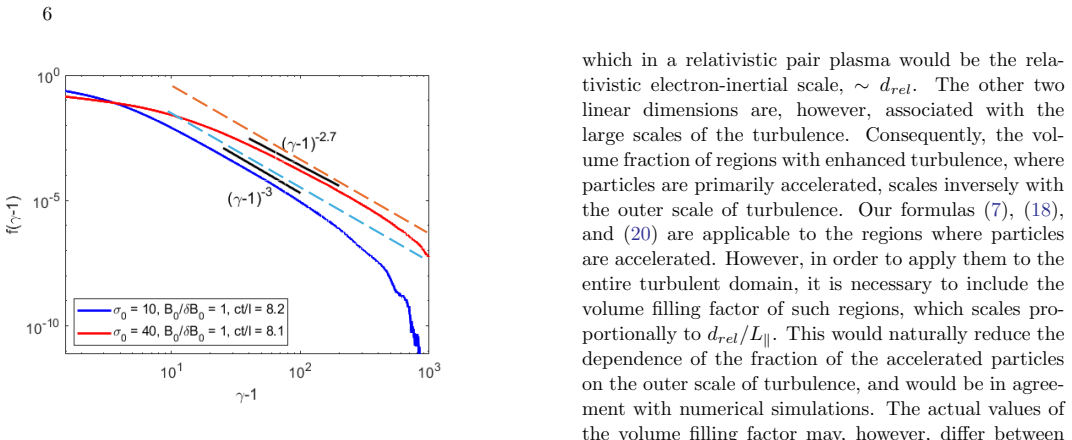
- The same scaling is recovered in numerical simulations of ultrarelativistic particles in magnetically dominated turbulence.
Where Pith is reading between the lines
- The mechanism could be tested in laboratory plasma devices by driving strong Alfvénic turbulence and measuring the resulting particle spectra.
- If other damping channels or continuous injection are present they would likely shift the index away from -3, offering a way to diagnose additional physics in specific environments.
- The saturation picture may connect to acceleration in other astrophysical turbulent plasmas where curvature effects dominate at the injection scale.
Load-bearing premise
The energy-exchange efficiency diminishes in exactly the right way to saturate the acceleration at the index of -3, without additional damping or injection terms altering the exponent.
What would settle it
A high-resolution simulation of Alfvénic turbulence or a detailed measurement of heliospheric ion spectra that yields a power-law index clearly different from -3 would falsify the saturation mechanism.
Figures
read the original abstract
This work presents a model for generating nonthermal power-law tails of particles' energy probability density functions in turbulent collisionless plasmas, applicable to both non-relativistic and relativistic scenarios. We propose that strong Alfv\'enic turbulence energizes plasma particles through curvature acceleration, particularly for particles with Larmor radii comparable to the scales of turbulence. When the energy density of the energized particles increases, the efficiency of the energy exchange process diminishes. As a result, the acceleration process saturates, leading to power-law distributions of particle momentum and energy. In the non-relativistic case, the momentum probability density function scales as $f(p) dp \propto p^{-3} dp $, while in the ultrarelativistic case, the energy probability density function scales as $ f(\gamma) d\gamma \propto \gamma^{-3} d\gamma $. This model provides a unified framework for understanding particle acceleration in both energy regimes, complementing existing analytical approaches. Its predictions are consistent with available observations of energetic ion distributions in the heliosphere and with the findings from numerical simulations of ultrarelativistic particle acceleration in magnetically dominated plasma turbulence.
Editorial analysis
A structured set of objections, weighed in public.
Referee Report
Summary. The manuscript proposes a model for nonthermal particle acceleration in strong Alfvénic turbulence via curvature acceleration acting on particles whose Larmor radii match turbulence scales. It asserts that rising particle energy density reduces the efficiency of energy exchange, causing saturation that produces universal power-law tails: f(p) dp ∝ p^{-3} dp (non-relativistic) and f(γ) dγ ∝ γ^{-3} dγ (ultra-relativistic). The model is presented as consistent with heliospheric ion observations and ultrarelativistic turbulence simulations, offering a unified framework across regimes.
Significance. If the saturation mechanism can be shown to lock the index at exactly -3 independently of turbulence spectrum, injection rate, and damping, the result would supply a simple, parameter-free explanation for power-law tails in collisionless turbulent plasmas. This would complement existing stochastic and shock-acceleration theories and could be directly testable against kinetic simulations and spacecraft data.
major comments (1)
- [Abstract] The central saturation argument (efficiency diminishes with rising particle energy density, locking the index at -3) is stated in the abstract but is not supported by a kinetic equation, an explicit functional form for the efficiency reduction (e.g., dependence on ∫E f(E) dE or particle pressure), or a derivation showing that the resulting steady-state exponent is independent of auxiliary parameters. Without these steps the claim that the index is fixed at -3 cannot be verified and remains an assertion.
Simulated Author's Rebuttal
We thank the referee for their careful reading and constructive criticism. We address the single major comment below and will revise the manuscript to strengthen the presentation of the saturation mechanism.
read point-by-point responses
-
Referee: [Abstract] The central saturation argument (efficiency diminishes with rising particle energy density, locking the index at -3) is stated in the abstract but is not supported by a kinetic equation, an explicit functional form for the efficiency reduction (e.g., dependence on ∫E f(E) dE or particle pressure), or a derivation showing that the resulting steady-state exponent is independent of auxiliary parameters. Without these steps the claim that the index is fixed at -3 cannot be verified and remains an assertion.
Authors: We agree that the abstract is necessarily brief and that the saturation argument would benefit from a more explicit derivation. The manuscript presents the model heuristically: curvature acceleration operates efficiently only while the particle energy density U_p remains a small fraction of the turbulent magnetic energy density U_B; as U_p grows, the effective acceleration efficiency is taken to decline as η ∝ (U_B − U_p)/U_B. This dependence is introduced in Section 2 and used to argue that the process saturates once U_p approaches a fixed fraction of U_B. In the revised version we will add a short subsection containing the corresponding kinetic equation ∂f/∂t = −∂/∂p (f ṗ) with ṗ ∝ η(p) p / τ_0, where τ_0 is the eddy turnover time at the resonant scale. Setting the steady-state energy input rate equal to the diminishing efficiency and integrating yields f(p) ∝ p^{-3} (non-relativistic) and f(γ) ∝ γ^{-3} (ultra-relativistic) independently of the precise turbulence spectrum or injection rate, because the saturation condition fixes the exponent required for the integrated particle energy to remain bounded by the available turbulent energy. We will also include the explicit functional form η(U_p) and the resulting differential equation for f. revision: yes
Circularity Check
No significant circularity detected
full rationale
The paper presents a proposed physical model in which curvature acceleration in strong Alfvénic turbulence, combined with a back-reaction that diminishes energy-exchange efficiency as particle energy density rises, leads to saturation and power-law tails with index -3. The abstract and available text contain no explicit kinetic equation, no functional form for the efficiency reduction, and no self-citation or fitted parameter that reduces the index -3 to the model inputs by construction. No step matches the enumerated circularity patterns; the claimed result is offered as an emergent consequence of the stated mechanism rather than a renaming, fit, or self-referential definition.
Axiom & Free-Parameter Ledger
axioms (2)
- domain assumption Strong Alfvénic turbulence energizes plasma particles through curvature acceleration, particularly for particles with Larmor radii comparable to the scales of turbulence.
- domain assumption When the energy density of the energized particles increases, the efficiency of the energy exchange process diminishes, causing the acceleration to saturate at a power-law distribution.
Forward citations
Cited by 1 Pith paper
-
Particle Acceleration, Coronal Neutrino Production, and the Diffuse Extragalactic Neutrino Background from Supermassive Black Holes
The cosmologically integrated neutrino emission from supermassive black hole coronae in Seyfert galaxies can account for the sub-PeV diffuse extragalactic neutrino flux observed by IceCube.
Reference graph
Works this paper leans on
-
[1]
A., Ackermann, M., Ajello, M., et al
Abdo, A. A., Ackermann, M., Ajello, M., et al. 2011a, ApJ, 727, 129, doi: 10.1088/0004-637X/727/2/129
-
[2]
A., Ackermann, M., Ajello, M., et al
Abdo, A. A., Ackermann, M., Ajello, M., et al. 2011b, ApJ, 736, 131, doi: 10.1088/0004-637X/736/2/131
-
[3]
Atoyan, A. M., & Aharonian, F. A. 1996, MNRAS, 278, 525, doi: 10.1093/mnras/278.2.525
-
[4]
2024, ApJ, 977, 91, doi: 10.3847/1538-4357/ad91a1
Banik, U., Bhattacharjee, A., & Sengupta, W. 2024, ApJ, 977, 91, doi: 10.3847/1538-4357/ad91a1
-
[5]
2006, PhRvL, 96, 115002, doi: 10.1103/PhysRevLett.96.115002
Boldyrev, S. 2006, PhRvL, 96, 115002, doi: 10.1103/PhysRevLett.96.115002
-
[6]
2022, PhRvD, 106, 023028, doi: 10.1103/PhysRevD.106.023028
Bresci, V., Lemoine, M., Gremillet, L., et al. 2022, PhRvD, 106, 023028, doi: 10.1103/PhysRevD.106.023028
-
[7]
Bykov, A. M. 2001, SSRv, 99, 317, doi: 10.1023/A:1013817721725
-
[8]
Chandran, B. D. G., Schekochihin, A. A., & Mallet, A. 2015, The Astrophysical Journal, 807, 39, doi: 10.1088/0004-637X/807/1/39 7
-
[9]
2021, ApJL, 923, L13, doi: 10.3847/2041-8213/ac3afa
Chernoglazov, A., Ripperda, B., & Philippov, A. 2021, ApJL, 923, L13, doi: 10.3847/2041-8213/ac3afa
-
[10]
Comisso, L., & Sironi, L. 2018, PhRvL, 121, 255101, doi: 10.1103/PhysRevLett.121.255101
-
[11]
2019, ApJ, 886, 122, doi: 10.3847/1538-4357/ab4c33 —
Comisso, L., & Sironi, L. 2019, ApJ, 886, 122, doi: 10.3847/1538-4357/ab4c33
-
[12]
Studying the mirror acceleration via kinetic simulations of relativistic plasma turbulence
Das, S., Xu, S., & N¨ attil¨ a, J. 2025, arXiv e-prints, arXiv:2506.04212, doi: 10.48550/arXiv.2506.04212
work page internal anchor Pith review Pith/arXiv arXiv doi:10.48550/arxiv.2506.04212 2025
-
[13]
2022, Science Advances, 8, eabn7627, doi: 10.1126/sciadv.abn7627
Dong, C., Wang, L., Huang, Y.-M., et al. 2022, Science Advances, 8, eabn7627, doi: 10.1126/sciadv.abn7627
-
[14]
Drake, J. F., Swisdak, M., & Fermo, R. 2013, ApJL, 763, L5, doi: 10.1088/2041-8205/763/1/L5
-
[15]
E., Ahmadi, N., Kromyda, L., et al
Ergun, R. E., Ahmadi, N., Kromyda, L., et al. 2020, ApJ, 898, 153, doi: 10.3847/1538-4357/ab9ab5
-
[16]
Ewart, R. J., Nastac, M. L., Bilbao, P. J., et al. 2025, Proceedings of the National Academy of Science, 122, e2417813122, doi: 10.1073/pnas.2417813122
-
[17]
Fisk, L. A., & Gloeckler, G. 2014, Journal of Geophysical Research (Space Physics), 119, 8733, doi: 10.1002/2014JA020426
-
[18]
French, O., Guo, F., Zhang, Q., & Uzdensky, D. A. 2023, ApJ, 948, 19, doi: 10.3847/1538-4357/acb7dd
-
[19]
Gloeckler, G., Fisk, L. A., Mason, G. M., & Hill, M. E. 2008, in American Institute of Physics Conference Series, Vol. 1039, Particle Acceleration and Transport in the Heliosphere and Beyond: 7th Annual International AstroPhysics Conference, ed. G. Li, Q. Hu, O. Verkhoglyadova, G. P. Zank, R. P. Lin, & J. Luhmann (AIP), 367–374, doi: 10.1063/1.2982473
-
[20]
1992, A&AS, 92, 267
Gloeckler, G., Geiss, J., Balsiger, H., et al. 1992, A&AS, 92, 267
1992
-
[21]
Goldreich, P., & Sridhar, S. 1995, The Astrophysical Journal, 438, 763, doi: 10.1086/175121 Groˇ selj, D., Philippov, A., Beloborodov, A. M., &
-
[22]
2026, ApJ, 1001, 64, doi: 10.3847/1538-4357/ae50fc
Mushotzky, R. 2026, ApJ, 1001, 64, doi: 10.3847/1538-4357/ae50fc
-
[23]
2026, ApJ, 997, 276, doi: 10.3847/1538-4357/ae3173
Humphrey, D., Vega, C., Boldyrev, S., & Roytershteyn, V. 2026, ApJ, 997, 276, doi: 10.3847/1538-4357/ae3173
-
[24]
Kollmann, P., Hill, M. E., McNutt, Jr., R. L., et al. 2019, ApJ, 876, 46, doi: 10.3847/1538-4357/ab125f
-
[25]
2021, Physical Review D, 104, doi: 10.1103/physrevd.104.063020
Lemoine, M. 2021, PhRvD, 104, 063020, doi: 10.1103/PhysRevD.104.063020
-
[26]
2023, arXiv e-prints, arXiv:2312.04443, doi: 10.48550/arXiv.2312.04443
Lemoine, M., Murase, K., & Rieger, F. 2023, arXiv e-prints, arXiv:2312.04443, doi: 10.48550/arXiv.2312.04443
-
[27]
The microphysics of collisionless shock waves
Marcowith, A., Bret, A., Bykov, A., et al. 2016, Reports on Progress in Physics, 79, 046901, doi: 10.1088/0034-4885/79/4/046901
-
[28]
Mason, G. M., & Gloeckler, G. 2012, SSRv, 172, 241, doi: 10.1007/s11214-010-9741-0
-
[29]
Particle-acceleration mechanisms in multispecies relativistic plasmas
Meringolo, C., Imbrogno, M., Cruz-Osorio, A., Servidio, S., & Rezzolla, L. 2026, arXiv e-prints, arXiv:2604.06749, doi: 10.48550/arXiv.2604.06749
work page internal anchor Pith review Pith/arXiv arXiv doi:10.48550/arxiv.2604.06749 2026
-
[30]
Meyer, M., Horns, D., & Zechlin, H. S. 2010, A&A, 523, A2, doi: 10.1051/0004-6361/201014108 N¨ attil¨ a, J., & Beloborodov, A. M. 2021, ApJ, 921, 87, doi: 10.3847/1538-4357/ac1c76 N¨ attil¨ a, J., & Beloborodov, A. M. 2022, PhRvL, 128, 075101, doi: 10.1103/PhysRevLett.128.075101
-
[31]
1963, The Adiabatic Motion of Charged Particles (Interscience Publishers, Inc., John Wiley & Sons, New York)
Northrop, Theodore, G. 1963, The Adiabatic Motion of Charged Particles (Interscience Publishers, Inc., John Wiley & Sons, New York)
1963
-
[32]
Pezzi, O., Blasi, P., & Matthaeus, W. H. 2022, ApJ, 928, 25, doi: 10.3847/1538-4357/ac5332
-
[33]
Sebastian, S. T., & Comisso, L. 2025, ApJL, 994, L1, doi: 10.3847/2041-8213/ae1696
-
[34]
Servidio, S., Haynes, C. T., Matthaeus, W. H., et al. 2016, PhRvL, 117, 095101, doi: 10.1103/PhysRevLett.117.095101
-
[35]
2022, PhRvL, 128, 145102, doi: 10.1103/PhysRevLett.128.145102
Sironi, L. 2022, PhRvL, 128, 145102, doi: 10.1103/PhysRevLett.128.145102
-
[36]
2014, ApJL, 783, L21, doi: 10.1088/2041-8205/783/1/L21
Sironi, L., & Spitkovsky, A. 2014, ApJL, 783, L21, doi: 10.1088/2041-8205/783/1/L21
-
[37]
2020, ApJ, 894, 136, doi: 10.3847/1538-4357/ab873c
Trotta, D., Franci, L., Burgess, D., & Hellinger, P. 2020, ApJ, 894, 136, doi: 10.3847/1538-4357/ab873c
-
[38]
2022a, ApJL, 931, L10, doi: 10.3847/2041-8213/ac6cde
Vega, C., Boldyrev, S., & Roytershteyn, V. 2022a, ApJL, 931, L10, doi: 10.3847/2041-8213/ac6cde
-
[39]
2023, ApJ, 949, 98, doi: 10.3847/1538-4357/accd73
Vega, C., Boldyrev, S., & Roytershteyn, V. 2023, ApJ, 949, 98, doi: 10.3847/1538-4357/accd73
-
[40]
2024, ApJ, 971, 106, doi: 10.3847/1538-4357/ad5f8f
Vega, C., Boldyrev, S., & Roytershteyn, V. 2024, ApJ, 971, 106, doi: 10.3847/1538-4357/ad5f8f
-
[41]
2025, ApJ, 985, 231, doi: 10.3847/1538-4357/add147
Vega, C., Boldyrev, S., & Roytershteyn, V. 2025, ApJ, 985, 231, doi: 10.3847/1538-4357/add147
-
[42]
2022b, ApJL, 924, L19, doi: 10.3847/2041-8213/ac441e
Vega, C., Boldyrev, S., Roytershteyn, V., & Medvedev, M. 2022b, ApJL, 924, L19, doi: 10.3847/2041-8213/ac441e
-
[43]
Vega, C., Roytershteyn, V., Delzanno, G. L., & Boldyrev, S. 2020, ApJL, 893, L10, doi: 10.3847/2041-8213/ab7eba
-
[44]
Wong, K., Zhdankin, V., Uzdensky, D. A., Werner, G. R., & Begelman, M. C. 2020, ApJL, 893, L7, doi: 10.3847/2041-8213/ab8122
-
[45]
Wong, K. W., Zhdankin, V., Uzdensky, D. A., Werner, G. R., & Begelman, M. C. 2025, MNRAS, 543, 1842, doi: 10.1093/mnras/staf1589
-
[46]
Turbulent Reconnection Acceleration
Xu, S., & Lazarian, A. 2023, ApJ, 942, 21, doi: 10.3847/1538-4357/aca32c
-
[47]
2022, Journal of Plasma Physics, 88, 175880303, doi: 10.1017/S0022377822000551
Zhdankin, V. 2022, Journal of Plasma Physics, 88, 175880303, doi: 10.1017/S0022377822000551
-
[48]
Begelman, M. C. 2017, PhRvL, 118, 055103, doi: 10.1103/PhysRevLett.118.055103
discussion (0)
Sign in with ORCID, Apple, or X to comment. Anyone can read and Pith papers without signing in.