Recognition: unknown
TRACE: A Metrologically-Grounded Engineering Framework for Trustworthy Agentic AI Systems in Operationally Critical Domains
Pith reviewed 2026-05-07 16:25 UTC · model grok-4.3
The pith
TRACE framework grounds AI trust in metrology standards and a parsimony ratio for critical domains.
A machine-rendered reading of the paper's core claim, the machinery that carries it, and where it could break.
Core claim
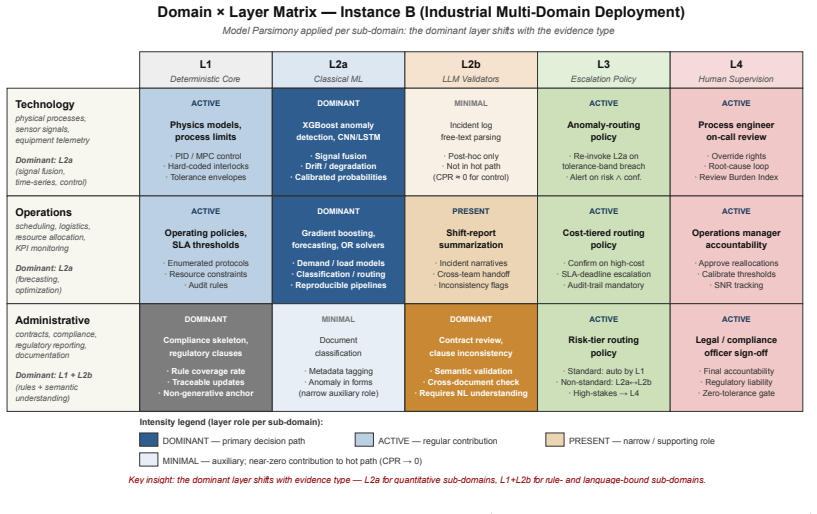
TRACE combines a four-layer reference architecture with an explicit classical-ML vs. LLM-validator split (L2a/L2b), a stateful orchestration-and-escalation policy (L3), and bounded human supervision (L4); a metrologically grounded trust-metric suite mapped to GUM/VIM/ISO 17025; and a Model-Parsimony principle quantified by the Computational Parsimony Ratio (CPR). The L2a/L2b separation makes the use of large language models a deliberate design decision rather than an architectural default, with parsimony quantified through CPR. TRACE introduces CPR as a first-class design principle in trustworthy-AI engineering.
What carries the argument
The four-layer reference architecture with its L2a classical-ML and L2b LLM-validator split, plus the Computational Parsimony Ratio that quantifies and enforces model simplicity as a core constraint.
If this is right
- The same architecture and metrics transfer across clinical decision support, industrial multi-domain operations, and judicial AI assistant without domain-specific redesign.
- LLM components are used only when the Computational Parsimony Ratio justifies them rather than as the default choice.
- Trust can be expressed in quantities comparable to those used in physical measurement and laboratory accreditation.
- Model parsimony becomes an explicit, quantifiable requirement instead of an informal preference.
- Escalation policies provide clear handoff points from automated layers to bounded human oversight.
Where Pith is reading between the lines
- The framework could support formal certification or regulatory review by supplying auditable metrics already aligned with existing standards bodies.
- The enforced separation of classical ML from LLM layers may limit error types such as hallucinations in ways that monolithic LLM agents do not.
- Extending the parsimony ratio to include runtime cost or energy use would make it directly relevant to operational constraints beyond accuracy.
- Because the paper supplies no counter-example analysis, the central claim remains a hypothesis that requires empirical trials in live critical environments.
Load-bearing premise
That mapping metrological standards to AI trust metrics and enforcing the ML-LLM split plus the parsimony ratio will produce trustworthy behavior in operationally critical domains.
What would settle it
A controlled deployment of a TRACE-designed system that still produces untrustworthy outputs in a simulated clinical, industrial, or judicial task, or a non-TRACE system that meets the same trust thresholds without the split or ratio.
Figures

read the original abstract
We introduce TRACE, a cross-domain engineering framework for trustworthy agentic AI in operationally critical domains. TRACE combines a four-layer reference architecture with an explicit classical-ML vs. LLM-validator split (L2a/L2b), a stateful orchestration-and-escalation policy (L3), and bounded human supervision (L4); a metrologically grounded trust-metric suite mapped to GUM/VIM/ISO 17025; and a Model-Parsimony principle quantified by the Computational Parsimony Ratio (CPR). Three instantiations--clinical decision support, industrial multi-domain operations, and a judicial AI assistant--transfer the samearchitecture and metrics across principally different governance contexts. The L2a/L2b separation makes the use of large language models a deliberate design decision rather than an architectural default, with parsimony quantified through CPR. TRACE introduces CPR as a first-class design principle in trustworthy-AI engineering.
Editorial analysis
A structured set of objections, weighed in public.
Referee Report
Summary. The manuscript introduces TRACE, a cross-domain engineering framework for trustworthy agentic AI in operationally critical domains. It combines a four-layer reference architecture featuring an explicit classical-ML vs. LLM-validator split (L2a/L2b), stateful orchestration-and-escalation at L3, and bounded human supervision at L4; a trust-metric suite explicitly mapped to GUM/VIM/ISO 17025 metrological standards; and a Model-Parsimony principle quantified by the Computational Parsimony Ratio (CPR). Three instantiations (clinical decision support, industrial multi-domain operations, judicial AI assistant) are sketched to illustrate transfer of the same architecture and metrics across different governance contexts. The L2a/L2b separation is presented as making LLM use a deliberate design choice rather than default.
Significance. If the proposed mappings and architectural constraints can be shown to yield reproducible, actionable trust scores and reduced risk relative to baselines, TRACE would supply a concrete engineering template that bridges metrology standards with agentic-AI design. The explicit CPR metric and the enforced ML-LLM split could become useful reference points for standards bodies and practitioners working in safety-critical settings. At present the contribution remains prospective because no empirical linkage between the design choices and measured trustworthiness is supplied.
major comments (2)
- Abstract and §3 (architecture description): The central claim that the L2a/L2b split, L3 orchestration, L4 supervision, GUM/VIM/ISO 17025-mapped metrics, and CPR together 'deliver measurable trustworthiness' is unsupported. The manuscript defines the components and sketches three instantiations but contains no experiments, simulations, error-rate measurements, calibration checks, or failure-mode analyses that would demonstrate the split reduces risk below existing baselines or that the metrological mappings produce reproducible scores.
- §4 (instantiations): The three transfer examples are presented only as architectural sketches. No quantitative comparison (e.g., CPR values, trust-metric scores, or escalation rates) against non-TRACE baselines is reported, leaving the cross-domain transfer claim untested.
minor comments (3)
- The definition and computation of the Computational Parsimony Ratio (CPR) should be given a dedicated subsection or equation with an explicit formula and worked example.
- Specific citations and page references for GUM, VIM, and ISO 17025 should be supplied together with a table showing the exact mapping from each metrological concept to the corresponding AI trust metric.
- A diagram of the four-layer architecture with labeled data flows between L2a and L2b would improve readability.
Simulated Author's Rebuttal
We thank the referee for the careful reading and for identifying areas where the scope and claims of this framework paper require clearer articulation. We address each major comment below.
read point-by-point responses
-
Referee: Abstract and §3 (architecture description): The central claim that the L2a/L2b split, L3 orchestration, L4 supervision, GUM/VIM/ISO 17025-mapped metrics, and CPR together 'deliver measurable trustworthiness' is unsupported. The manuscript defines the components and sketches three instantiations but contains no experiments, simulations, error-rate measurements, calibration checks, or failure-mode analyses that would demonstrate the split reduces risk below existing baselines or that the metrological mappings produce reproducible scores.
Authors: We agree that the manuscript contains no empirical experiments, simulations, or quantitative risk-reduction measurements. TRACE is presented as a reference engineering framework whose components are explicitly mapped to metrological standards so that trustworthiness can be measured; it does not claim to have already produced such measurements. We will revise the abstract and §3 to remove any phrasing that could be read as asserting demonstrated delivery of trustworthiness, replace it with language stating that the architecture and metrics enable reproducible measurement, and add an explicit limitations subsection noting the absence of empirical validation together with a brief outline of planned follow-on studies. revision: partial
-
Referee: §4 (instantiations): The three transfer examples are presented only as architectural sketches. No quantitative comparison (e.g., CPR values, trust-metric scores, or escalation rates) against non-TRACE baselines is reported, leaving the cross-domain transfer claim untested.
Authors: The three examples are intentionally high-level architectural sketches intended only to illustrate that the same four-layer structure, L2a/L2b split, and CPR metric can be adapted to domains with different regulatory and operational constraints. They are not evaluated implementations. We will revise §4 to label them explicitly as illustrative transfer sketches, remove any implication of tested transferability, and add a short forward-looking paragraph describing how quantitative CPR and trust-metric comparisons could be performed once domain-specific deployments exist. revision: partial
Circularity Check
No circularity: TRACE is a definitional engineering framework with no equations, predictions, or self-referential reductions.
full rationale
The manuscript presents TRACE as a four-layer reference architecture, metrological mappings to GUM/VIM/ISO 17025, and the CPR parsimony ratio as design principles and templates for instantiations in clinical, industrial, and judicial domains. No derivation chain, fitted parameters, predictions, or equations appear in the provided text or abstract. The L2a/L2b split, L3 orchestration, L4 supervision, and CPR are introduced as explicit choices rather than derived quantities that reduce to prior inputs by construction. Self-citations are absent from the load-bearing claims, and the work does not invoke uniqueness theorems or smuggle ansatzes. This is a standard non-circular proposal of an engineering template whose validity rests on future empirical testing rather than internal self-definition.
Axiom & Free-Parameter Ledger
axioms (1)
- domain assumption Metrological standards GUM/VIM/ISO 17025 can be meaningfully mapped to AI system trust metrics.
invented entities (2)
-
TRACE four-layer architecture
no independent evidence
-
Computational Parsimony Ratio (CPR)
no independent evidence
Reference graph
Works this paper leans on
-
[1]
Karim Lekadir, Alejandro F. Frangi, Antonio R. Porras, Ben Glocker, Celia Cintas, Curtis P. Langlotz, et al. FUTURE-AI: International consensus guideline for trustwor- thy and deployable artificial intelligence in healthcare.BMJ, 388:e081554, 2025. doi: 10.1136/bmj-2024-081554. Correction: BMJ 2025;388:r340, doi:10.1136/bmj.r340
-
[2]
Jing Li, Zhen-Chang Zhou, Zi-Chen Wang, Hui Lv, et al. Prioritizing human-AI col- laboration in healthcare: the TRIAD framework for trustworthy governance, real-world value, and integrated adaptive deployment.Military Medical Research, 12:97, 2026. doi: 10.1186/s40779-026-00684-w. DOI to be revalidated at camera-ready
-
[3]
Yubin Kim, Hyewon Jeong, Chanwoo Park, Eugene Park, Haipeng Zhang, Xin Liu, Hyeonhoon Lee, Daniel McDuff, Marzyeh Ghassemi, Cynthia Breazeal, Samir Tulebaev, and Hae Won Park. Tiered agentic oversight: A hierarchical multi-agent system for healthcare safety.arXiv preprint arXiv:2506.12482v2, September 2025. URLhttps: //arxiv.org/abs/2506.12482. Accepted a...
-
[4]
Heterogeneous Scientific Foundation Model Collaboration
Zihao Li, Jiaru Zou, Feihao Fang, Xuying Ning, Mengting Ai, Tianxin Wei, Sirui Chen, Xiyuan Yang, and Jingrui He. Eywa: Heterogeneous scientific foundation model collab- oration.arXiv preprint, 2026. URLhttps://arxiv.org/abs/2604.27351. Introduces the FM–LLM Tsaheylu interface; instantiations EywaAgent / EywaMAS / EywaOrchestra; benchmark EywaBench across...
work page internal anchor Pith review Pith/arXiv arXiv 2026
-
[5]
Steven Bilson, Maurice Cox, Alexandra Pustogvar, and Andrew Thompson. A metrological framework for uncertainty evaluation in machine learning classification models.Metrologia, 62(6):064001, 2025. doi: 10.1088/1681-7575/ae1bae
-
[6]
Cartesian vs. Radial – A Comparative Evaluation of Two Visualization Tools
Andrew Thompson, Tameem Adel, Steven Bilson, and Mark Levene. Trustworthy artificial intelligence in the context of metrology. InProducing Artificial Intelligent Systems: The Roles of Benchmarking, Standardisation and Certification.Springer, 2024. doi: 10.1007/978- 3-031-55817-7_4. arXiv:2406.10117
-
[7]
Peter Belcak, Greg Heinrich, Shizhe Diao, Yonggan Fu, Xin Dong, Saurav Muralidharan, Yingyan Celine Lin, and Pavlo Molchanov. Small language models are the future of agentic AI.arXiv preprint arXiv:2506.02153, June 2025. doi: 10.48550/arXiv.2506.02153. NVIDIA Research position paper
-
[8]
Roy Schwartz, Jesse Dodge, Noah A. Smith, and Oren Etzioni. Green AI.Communications of the ACM, 63(12):54–63, 2020. doi: 10.1145/3381831
-
[9]
Artificial intelligence risk management framework (ai rmf 1.0)
Elham Tabassi. Artificial intelligence risk management framework (ai rmf 1.0). Nist ai 100-1, National Institute of Standards and Technology, January 2023
2023
-
[10]
Artificial intelligence risk management framework: Generative artificial intelligence profile
National Institute of Standards and Technology. Artificial intelligence risk management framework: Generative artificial intelligence profile. Nist ai 600-1, NIST, July 2024
2024
-
[11]
ISO/IEC 42001:2023 — information technology — artificial intelligence — man- agement system
ISO/IEC. ISO/IEC 42001:2023 — information technology — artificial intelligence — man- agement system. International Standard, December 2023. URLhttps://www.iso.org/ standard/81230.html. 9
2023
-
[12]
Regulation (eu) 2024/1689 of 13 june 2024 laying down harmonised rules on artificial intelligence (AI Act)
European Parliament and Council of the European Union. Regulation (eu) 2024/1689 of 13 june 2024 laying down harmonised rules on artificial intelligence (AI Act). Official Journal of the European Union, L 2024/1689, 12 July 2024, 2024. URLhttp://data.europa.eu/ eli/reg/2024/1689/oj
2024
-
[13]
Andres Herrera-Poyatos, Javier Del Ser, Marcos Lopez de Prado, Fei-Yue Wang, Enrique Herrera-Viedma, and Francisco Herrera. A framework for responsible AI systems: Building societal trust through domain definition, trustworthy AI design, auditability, accountability, and governance.arXiv preprint arXiv:2503.04739, 2025. URLhttps://arxiv.org/abs/ 2503.04739
-
[14]
Serhii Zabolotnii, Viktoriia Holinko, and Olha Antonenko. From black-box confidence to measurabletrustinclinicalAI:Aframeworkforevidence, supervision, andstagedautonomy. IEEE Instrumentation and Measurement Magazine, September 2026. doi: 10.48550/arXiv. 2604.26671. URLhttps://arxiv.org/abs/2604.26671. arXiv:2604.26671. Special Issue "A Measure of Trust in...
work page internal anchor Pith review Pith/arXiv arXiv doi:10.48550/arxiv 2026
-
[15]
A method for controlling the drilling process at oil and gas fields using agentic artificial intelligence
Andrii Shcherban. A method for controlling the drilling process at oil and gas fields using agentic artificial intelligence. Ukrainian Utility Model Patent Application, August 2025. Filed 19 August 2025; applicant: A. Shcherban. Status: utility model application
2025
-
[16]
Agentic AI for upstream operational intelligence: A unified framework
Andrii Shcherban. Agentic AI for upstream operational intelligence: A unified framework. U.S. Copyright Office (deposit copy submitted), March 2026. Submitted 15 March 2026; application number pending final registration confirmation. Update before camera-ready
2026
-
[17]
International vocabulary of metrology — basic and general concepts and associated terms (VIM), 3rd edition
JCGM. International vocabulary of metrology — basic and general concepts and associated terms (VIM), 3rd edition. JCGM 200:2012, 2012
2012
-
[18]
Eduardo Mosqueira-Rey, Elena Hernández-Pereira, David Alonso-Ríos, José Bobes- Bascarán, and Álvaro Fernández-Leal. Human-in-the-loop machine learning: a state of the art.Artificial Intelligence Review, 56(4):3005–3054, 2023. doi: 10.1007/s10462-022-10246-w
-
[19]
Evaluation of measurement data — guide to the expression of uncertainty in mea- surement (GUM)
JCGM. Evaluation of measurement data — guide to the expression of uncertainty in mea- surement (GUM). JCGM 100:2008, 2008
2008
-
[20]
On calibration of modern neural networks,
Chuan Guo, Geoff Pleiss, Yu Sun, and Kilian Q. Weinberger. On calibration of modern neural networks. InProceedings of the 34th International Conference on Machine Learning (ICML), volume 70 ofPMLR, pages 1321–1330, 2017. arXiv:1706.04599
-
[21]
Efficient deep learning: A survey on making deep learning models smaller, faster, and better.ACM Computing Surveys, 55(12):259:1–259:37, 2023
Gaurav Menghani. Efficient deep learning: A survey on making deep learning models smaller, faster, and better.ACM Computing Surveys, 55(12):259:1–259:37, 2023. doi: 10. 1145/3578938
2023
-
[22]
Reliability Assessment and Safety Arguments for Machine Learning Components in System Assurance
Yi Dong, Wenjie Huang, Vikas Bharti, Victoria Cox, Alec Banks, Sen Wang, Xingyu Zhao, Sven Schewe, and Xiaowei Huang. Reliability assessment and safety arguments for machine learning components in system assurance.ACM Transactions on Embedded Computing Systems, 22(3):39:1–39:48, 2023. doi: 10.1145/3570918
-
[23]
European ethical charter on the use of artificial intelligence in judicial systems and their environment
Council of Europe / CEPEJ. European ethical charter on the use of artificial intelligence in judicial systems and their environment. Strasbourg, 3–4 December 2018, 2018. URLhttps: //rm.coe.int/ethical-charter-en-for-publication-4-december-2018/16808f699c
2018
-
[24]
Operationalisation of the CEPEJ ethical charter — assessment tool
Council of Europe / CEPEJ. Operationalisation of the CEPEJ ethical charter — assessment tool. Cepej(2023)16rev, Council of Europe, June 2025. Revised 5 June 2025. 10
2023
-
[25]
Hallucination-free? assessing the reliability of leading AI legal research tools.Journal of Empirical Legal Studies, 22:216, 2025
Varun Magesh et al. Hallucination-free? assessing the reliability of leading AI legal research tools.Journal of Empirical Legal Studies, 22:216, 2025
2025
-
[26]
Daan Kolkman, Floris Bex, Nidhi Narayan, and Michelle van der Put. Justitia ex machina: The impact of an AI system on legal decision-making and discretionary authority.Big Data & Society, 11(2), 2024. doi: 10.1177/20539517241255101
-
[27]
Support to Justice Sector Reforms in Ukraine (PRAVO-JUSTICE III)
High Qualification Commission of Judges of Ukraine. The European Union funded project “Support to Justice Sector Reforms in Ukraine (PRAVO-JUSTICE III)”.https://vkksu.gov.ua/en/page/european-union-funded-project-support- justice-sector-reforms-ukraine-pravo-justice-iii, 2024. Implementing agency: Ex- pertise France S.A.S.; duration: January 2024 – June 2026
2024
-
[28]
EU Project Pravo-Justice. Database of legal positions of the Supreme Court: Uniformity of jurisprudence online.https://www.pravojustice.eu/en/post/baza-pravovih-pozicij- verhovnogo-sudu-yednist-sudovoyi-praktiki-onlajn-en, April 2024. Implemented by Expertise France; funded by the European Union. 11
2024
discussion (0)
Sign in with ORCID, Apple, or X to comment. Anyone can read and Pith papers without signing in.