Recognition: unknown
Noise-accelerated Kramers Escape and Coherence Resonance in a 5D Neural Manifold
Pith reviewed 2026-05-09 20:25 UTC · model grok-4.3
The pith
Bounded multiplicative noise accelerates escape from the resting state in a 5D neuron model, converting regular firing into irregular bursting.
A machine-rendered reading of the paper's core claim, the machinery that carries it, and where it could break.
Core claim
Under extreme multiplicative noise characteristic of sparse channel populations, strictly bounded fluctuations actively amplify escape rates from the hyperpolarized slow manifold, transforming regular pacing into high-frequency, irregular bursting in the 5D model.
What carries the argument
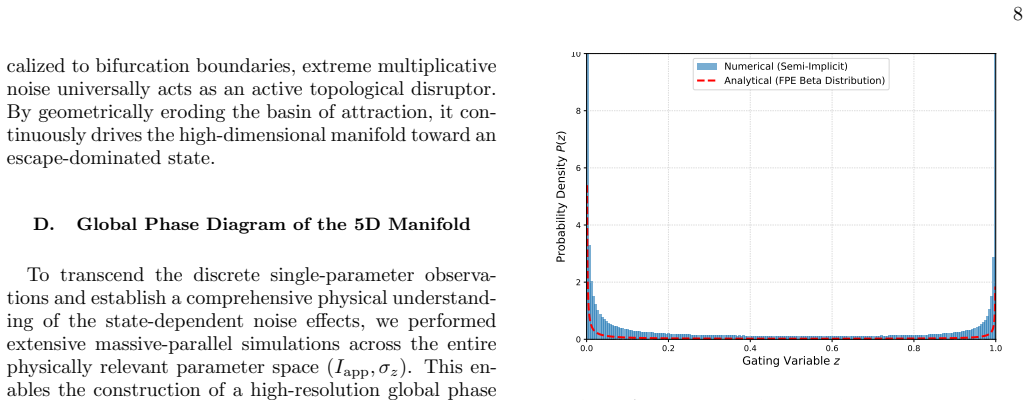
The full-truncation semi-implicit Euler scheme that enforces probability conservation and domain-preserving integration for strictly bounded multiplicative noise, enabling detection of generalized Kramers escape across the bifurcation structure.
If this is right
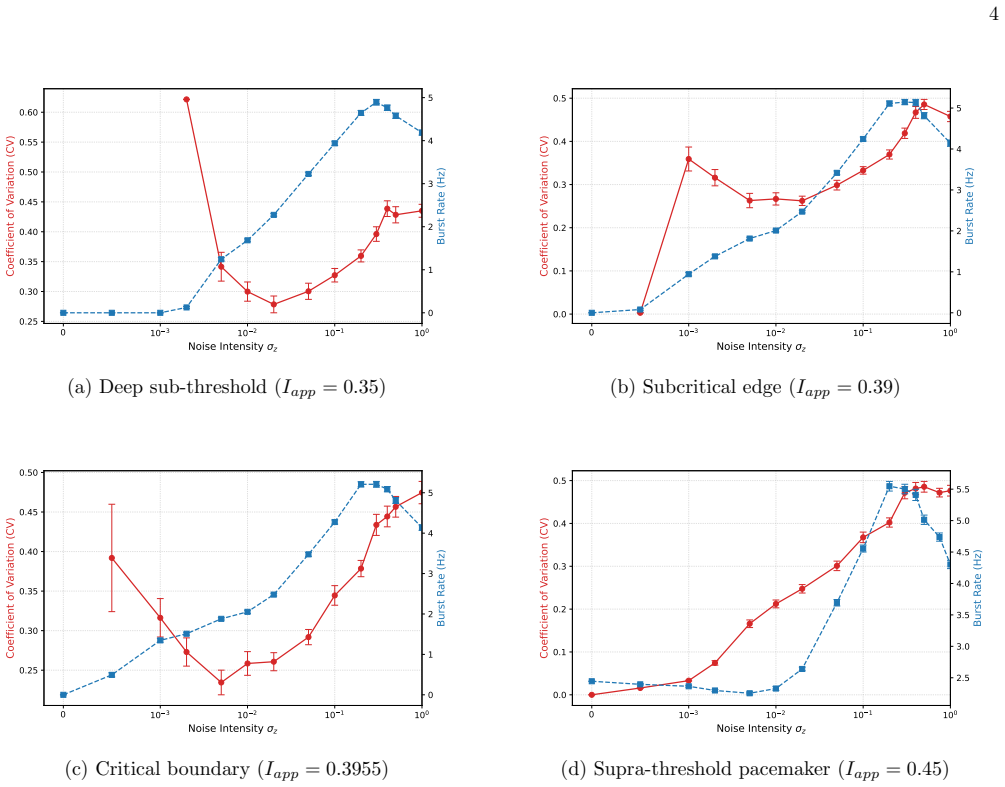
- Deep in the subthreshold regime, multiplicative noise triggers stochastic awakening via Kramers escape.
- Near the subcritical Hopf bifurcation the noise produces robust coherence resonance.
- In the supra-threshold regime the same bounded noise accelerates escape from the slow manifold and yields irregular bursting.
- Conductance perturbation experiments establish that the transition to hyperexcitability remains robust under biological variation.
Where Pith is reading between the lines
- The mechanism supplies a candidate explanation for how low channel density could initiate hyperexcitable regimes such as seizure-like activity.
- Reduced-order models might isolate whether the acceleration depends on the specific five-dimensional geometry or on the boundary constraint alone.
- Targeted experiments that vary channel number while holding mean conductance fixed could test whether the triphasic noise response appears in living neurons.
Load-bearing premise
The numerical integration scheme accurately preserves the strict boundaries and probability conservation of the multiplicative noise without introducing artifacts that mimic the observed triphasic transitions.
What would settle it
Repeating the parameter sweeps with an alternative boundary-preserving integrator or a structurally different 5D model yields no accelerated escape or triphasic landscape, or direct recordings from cortical pacemakers with controlled channel densities show no shift to irregular high-frequency bursting under high noise.
Figures




read the original abstract
Intrinsic channel noise is fundamental to neural processing, yet its state-dependent nature, when constrained by strict Feller boundary conditions, is often overlooked. Here, we demonstrate that this bounded multiplicative noise is not merely a source of jitter but an active dynamical force that fundamentally reshapes neural excitability. Investigating a 5D Hodgkin-Huxley-type cortical pacemaker model, we utilize a full-truncation semi-implicit Euler scheme to ensure rigorous probability conservation and domain-preserving integration. Through comprehensive parameter sweeps, we uncover a rich triphasic landscape of noise-induced transitions dictated by the underlying bifurcation structure. Deep in the subthreshold regime, multiplicative noise acts as a constructive force, triggering stochastic awakening via Kramers escape. Near the subcritical Hopf bifurcation, this evolves into highly robust coherence resonance (CR). Crucially, in the supra-threshold oscillatory regime, our framework reveals a striking dynamical shift: a generalized, noise-accelerated Kramers escape. Under extreme multiplicative noise - characteristic of sparse channel populations - strictly bounded fluctuations actively amplify escape rates from the hyperpolarized slow manifold, transforming regular pacing into high-frequency, irregular bursting. Conductance perturbation experiments confirm the profound biological robustness of this transition. These findings establish a physically rigorous mechanism for how boundary-constrained noise drives high-dimensional oscillators toward states of pathological hyperexcitability.
Editorial analysis
A structured set of objections, weighed in public.
Referee Report
Summary. The paper numerically explores a 5D Hodgkin-Huxley-type cortical pacemaker model driven by bounded multiplicative channel noise. Using a full-truncation semi-implicit Euler integrator, it reports a triphasic noise-induced transition landscape: stochastic awakening via Kramers escape deep in the subthreshold regime, robust coherence resonance near a subcritical Hopf bifurcation, and, crucially, noise-accelerated escape from the hyperpolarized slow manifold in the supra-threshold regime that converts regular pacing into high-frequency irregular bursting under extreme noise intensities characteristic of sparse channel populations. Conductance perturbations are used to argue biological robustness.
Significance. If the numerical results hold, the work supplies a concrete, physically grounded mechanism by which strictly bounded multiplicative noise can actively promote pathological hyperexcitability in high-dimensional neural oscillators. The emphasis on Feller boundary conditions and the explicit integrator choice are positive features that distinguish the study from many prior noise-in-neural-dynamics papers.
major comments (2)
- [Numerical Methods / Integration Scheme] The manuscript asserts that the full-truncation semi-implicit Euler scheme 'ensures rigorous probability conservation and domain-preserving integration' in the 5D system, yet provides no convergence tests, boundary-violation statistics, or probability-mass conservation checks at the extreme noise intensities used for the supra-threshold sweeps. Because the central claim of noise-accelerated Kramers escape rests on the noise remaining strictly bounded and the slow-manifold escape dynamics being undistorted, this omission is load-bearing.
- [Results / Supra-threshold regime] In the supra-threshold regime the paper reports a 'generalized, noise-accelerated Kramers escape' that transforms regular pacing into irregular bursting. No quantitative escape-rate measurements, comparison against the classical Kramers formula (or its multiplicative-noise extensions), or controls that isolate the effect of the integrator from the model dynamics are presented. Without these, it is unclear whether the observed triphasic transition reflects the intended bounded-noise mechanism or an artifact of the truncation procedure near the slow manifold.
minor comments (2)
- [Results] The abstract and results sections refer to 'comprehensive parameter sweeps' and 'triphasic landscape' but do not tabulate the exact ranges of noise intensity, bifurcation parameter, and other conductances explored, nor do they indicate how many independent realizations were averaged for each point.
- [Figures] Figure captions and axis labels should explicitly state whether the plotted trajectories are single realizations or ensemble averages, and whether the noise intensity is the dimensionless parameter or the physical channel-noise variance.
Simulated Author's Rebuttal
We thank the referee for their thorough review and valuable suggestions. We address each major comment below and have revised the manuscript accordingly to enhance the numerical rigor and quantitative support for our claims.
read point-by-point responses
-
Referee: [Numerical Methods / Integration Scheme] The manuscript asserts that the full-truncation semi-implicit Euler scheme 'ensures rigorous probability conservation and domain-preserving integration' in the 5D system, yet provides no convergence tests, boundary-violation statistics, or probability-mass conservation checks at the extreme noise intensities used for the supra-threshold sweeps. Because the central claim of noise-accelerated Kramers escape rests on the noise remaining strictly bounded and the slow-manifold escape dynamics being undistorted, this omission is load-bearing.
Authors: We agree that explicit validation of the integrator is important for the credibility of the results, especially at high noise levels. Although the full-truncation semi-implicit Euler method is constructed to maintain the state space within the physical domain and conserve probability (as referenced in the methods section), the manuscript did not include dedicated convergence or conservation checks. In the revised manuscript, we will add a new subsection in the Methods or Supplementary Material presenting convergence tests with respect to time step, boundary violation statistics (showing zero violations due to the truncation), and probability mass conservation metrics over long simulations at the extreme noise intensities used in the supra-threshold regime. These additions will directly address the load-bearing nature of this aspect for the noise-accelerated escape claim. revision: yes
-
Referee: [Results / Supra-threshold regime] In the supra-threshold regime the paper reports a 'generalized, noise-accelerated Kramers escape' that transforms regular pacing into irregular bursting. No quantitative escape-rate measurements, comparison against the classical Kramers formula (or its multiplicative-noise extensions), or controls that isolate the effect of the integrator from the model dynamics are presented. Without these, it is unclear whether the observed triphasic transition reflects the intended bounded-noise mechanism or an artifact of the truncation procedure near the slow manifold.
Authors: The referee raises a valid point regarding the need for more quantitative support. Our primary focus was on demonstrating the qualitative triphasic behavior through extensive numerical exploration of the 5D model, where direct analytical comparison to Kramers' formula is challenging due to the multiplicative bounded noise and high dimensionality. We did not include mean escape time calculations or explicit integrator controls in the original submission. In the revision, we will incorporate quantitative escape-rate measurements by computing mean first-passage times from the slow manifold across noise intensities, along with comparisons to simulations using an alternative integration scheme (e.g., Euler-Maruyama with reflection) to isolate potential integrator effects. While we believe the observed transitions are genuine and tied to the bifurcation structure—as supported by the conductance perturbation robustness tests—we acknowledge that these additions will help rule out numerical artifacts and strengthen the evidence for noise-accelerated escape. revision: yes
Circularity Check
No circularity: numerical exploration of 5D model with no self-referential reductions.
full rationale
The paper describes a numerical study of a 5D Hodgkin-Huxley-type model using full-truncation semi-implicit Euler integration and parameter sweeps to identify triphasic noise-induced transitions. No load-bearing steps reduce by construction to fitted inputs, self-citations, or ansatzes; the central claims rest on simulation outputs and bifurcation structure rather than equations that equate to their own definitions or prior self-referential results. The numerical scheme is presented as a tool for domain preservation, not as a derived prediction.
Axiom & Free-Parameter Ledger
free parameters (1)
- noise intensity
axioms (2)
- domain assumption Feller boundary conditions strictly constrain the multiplicative noise
- domain assumption The 5D Hodgkin-Huxley-type model faithfully represents cortical pacemaker dynamics
Reference graph
Works this paper leans on
-
[1]
valley of coherence
to trace the stochastic evolution of the 5D manifold. In the following subsection, we analyze the micro-dynamics of the system along these four specificI app coordinates, revealing a complex triphasic transition driven by noise- accelerated Kramers escape across the fast-slow mani- fold. This triphasic evolution is not a local artifact but a fundamental g...
2000
-
[2]
A. S. Pikovsky and J. Kurths, Coherence resonance in a noise-driven excitable system, Physical Review Letters 78, 775 (1997)
1997
-
[3]
Gammaitoni, P
L. Gammaitoni, P. H¨ anggi, P. Jung, and F. Marchesoni, Stochastic resonance, Reviews of Modern Physics70, 223 (1998)
1998
-
[4]
Lindner, J
B. Lindner, J. Garcia-Ojalvo, A. Neiman, and L. Schimansky-Geier, Effects of noise in excitable sys- tems, Physics Reports392, 321 (2004)
2004
-
[5]
I. H. R. Yoon, G. Henselman-Petrusek, Y. Yu, R. Ghrist, S. L. Smith, and C. Giusti, Tracking the topology of neu- ral manifolds across populations, Proceedings of the Na- tional Academy of Sciences121, e2407997121 (2024)
2024
-
[6]
M. I. Freidlin and A. D. Wentzell,Random Perturbations of Dynamical Systems, 3rd ed., Grundlehren der math- ematischen Wissenschaften, Vol. 260 (Springer Berlin, Heidelberg, 2012)
2012
-
[7]
M. E. Yamakou, P. G. Hjorth, and E. A. Martens, Opti- mal self-induced stochastic resonance in multiplex neural networks: Electrical vs. chemical synapses, Frontiers in Computational Neuroscience14, 62 (2020)
2020
-
[8]
Wechselberger,Geometric Singular Perturbation The- ory Beyond the Standard Form, Frontiers in Applied Dy- namical Systems: Reviews and Tutorials, Vol
M. Wechselberger,Geometric Singular Perturbation The- ory Beyond the Standard Form, Frontiers in Applied Dy- namical Systems: Reviews and Tutorials, Vol. 6 (Springer Cham, 2020) eBook ISBN: 978-3-030-36399-4
2020
-
[9]
Berglund and B
N. Berglund and B. Gentz,Noise-Induced Phenomena in Slow-Fast Dynamical Systems: A Sample-Paths Ap- proach, Probability and Its Applications (Springer Lon- don, 2006) eBook ISBN: 978-1-84628-186-0
2006
-
[10]
E. Slepukhina, I. Bashkirtseva, P. K¨ ugler, and L. Ryashko, Analysis of multiplicative-noise-induced ef- fects in the formation of early afterdepolarizations in a 4d cardiomyocyte model, Fluctuation and Noise Letters 24, 10.1142/S021947752550052X (2025)
-
[11]
A. A. Faisal, L. P. J. Selen, and D. M. Wolpert, Noise in the nervous system, Nature Reviews Neuroscience9, 292 (2008)
2008
-
[12]
J. H. Goldwyn and E. Shea-Brown, The what and where of adding channel noise to the hodgkin-huxley equations, PLoS Computational Biology7, e1002247 (2011). 12
2011
-
[13]
D. Yu, G. Wang, Q. Ding, T. Li, and Y. Jia, Effects of bounded noise and time delay on signal transmission in excitable neural networks, Chaos, Solitons & Fractals 157, 111929 (2022)
2022
-
[14]
D. J. Higham and X. Mao, Convergence of monte carlo simulations involving the mean-reverting square root process, The Journal of Computational Finance8, 10.21314/JCF.2005.136 (2005)
-
[15]
R. Lord, R. Koekkoek, and D. Van Dijk, A comparison of biased simulation schemes for stochastic volatility mod- els, Quantitative Finance10, 177 (2010)
2010
-
[16]
Hutzenthaler and A
M. Hutzenthaler and A. Jentzen, On a perturbation the- ory and on strong convergence rates for stochastic ordi- nary and partial differential equations with nonglobally monotone coefficients, The Annals of Probability48, 53 (2020)
2020
-
[17]
Golomb, C
D. Golomb, C. Yue, and Y. Yaari, Contribution of per- sistent na+ current and m-type k+ current to somatic bursting in ca1 pyramidal cells: combined experimental and modeling study, Journal of Neurophysiology96, 1912 (2006)
1912
-
[18]
Mittal and R
D. Mittal and R. Narayanan, Heterogeneous stochastic bifurcations explain intrinsic oscillatory patterns in en- torhinal cortical stellate cells, Proceedings of the Na- tional Academy of Sciences119, e2202962119 (2022)
2022
-
[19]
R. F. Fox and Y.-N. Lu, Emergent collective behavior in large numbers of globally coupled independently stochas- tic ion channels, Physical Review E49, 3421 (1994)
1994
-
[20]
D. T. Gillespie, Exact stochastic simulation of coupled chemical reactions, The Journal of Physical Chemistry 81, 2340 (1977)
1977
-
[21]
B. S. Gutkin and G. B. Ermentrout, Dynamics of mem- brane excitability determine interspike interval variabil- ity: a link between spike generation mechanisms and cor- tical spike train statistics, Neural Computation10, 1047 (1998)
1998
-
[22]
G. B. Ermentrout and D. H. Terman,Mathematical Foundations of Neuroscience, Interdisciplinary Applied Mathematics (Springer New York, NY, 2010)
2010
-
[23]
H¨ anggi, P
P. H¨ anggi, P. Talkner, and M. Borkovec, Reaction-rate theory: fifty years after kramers, Reviews of Modern Physics62, 251 (1990)
1990
-
[24]
Kuehn,Multiple Time Scale Dynamics, Applied Mathematical Sciences, Vol
C. Kuehn,Multiple Time Scale Dynamics, Applied Mathematical Sciences, Vol. 191 (Springer International Publishing, 2015)
2015
-
[25]
Rush and H
S. Rush and H. Larsen, A practical algorithm for solv- ing dynamic membrane equations, IEEE Transactions on Biomedical EngineeringBME-25, 389 (1978)
1978
-
[26]
R. E. L. DeVille, E. Vanden-Eijnden, and C. B. Muratov, Two distinct mechanisms of coherence in randomly per- turbed dynamical systems, Physical Review E72, 031105 (2005)
2005
-
[27]
S. N. Ethier and T. G. Kurtz,Markov Processes: Char- acterization and Convergence(John Wiley & Sons, New York, 1986)
1986
-
[28]
Karlin and H
S. Karlin and H. M. Taylor,A Second Course in Stochas- tic Processes, 1st ed. (Academic Press, 1981)
1981
-
[29]
Gardiner,Stochastic methods: a handbook for the nat- ural and social sciences, 4th ed
C. Gardiner,Stochastic methods: a handbook for the nat- ural and social sciences, 4th ed. (Springer, Berlin, Hei- delberg, 2009)
2009
-
[30]
P. E. Kloeden and E. Platen,Numerical Solution of Stochastic Differential Equations, Stochastic Modelling and Applied Probability (Springer Berlin, Heidelberg, 1992)
1992
-
[31]
Horsthemke and R
W. Horsthemke and R. Lefever,Noise-Induced Transi- tions: Theory and Applications in Physics, Chemistry, and Biology(Springer-Verlag, Berlin, Heidelberg, 1984)
1984
-
[32]
T. J. Jentsch, Neuronal kcnq potassium channels: phys- iology and role in disease, Nature Reviews Neuroscience 1, 21 (2000)
2000
-
[33]
D. A. Brown and G. M. Passmore, Neural kcnq (kv7) channels, British Journal of Pharmacology156, 1185 (2009)
2009
-
[34]
Baspinar, L
E. Baspinar, L. Sch¨ ulen, S. Olmi, and A. Zakharova, Co- herence resonance in neuronal populations: Mean-field versus network model, Physical Review E103, 032308 (2021)
2021
discussion (0)
Sign in with ORCID, Apple, or X to comment. Anyone can read and Pith papers without signing in.