Recognition: unknown
Listwise Policy Optimization: Group-based RLVR as Target-Projection on the LLM Response Simplex
Pith reviewed 2026-05-08 13:51 UTC · model grok-4.3
The pith
Group-based RL for LLMs implicitly projects policies toward targets on the response simplex; LPO makes the projection explicit and exact.
A machine-rendered reading of the paper's core claim, the machinery that carries it, and where it could break.
Core claim
Group-based methods share the structure of defining a target on the response simplex and approximating its projection; LPO demystifies this by restricting the proximal objective to the simplex and projecting exactly through divergence minimization, which supplies monotonic listwise gains, bounded self-correcting gradients, and divergence flexibility.
What carries the argument
Target-projection on the LLM response simplex, achieved by restricting the proximal RL objective to the simplex and performing exact divergence minimization in a decoupled step.
Load-bearing premise
That the implicit targets of existing group-based methods can be recovered or improved by restricting the proximal RL objective to the response simplex and minimizing a divergence exactly.
What would settle it
A controlled experiment on a reasoning benchmark where LPO, using the same implicit target as a standard group-relative baseline, shows no monotonic improvement or loses stability and diversity.
Figures






read the original abstract
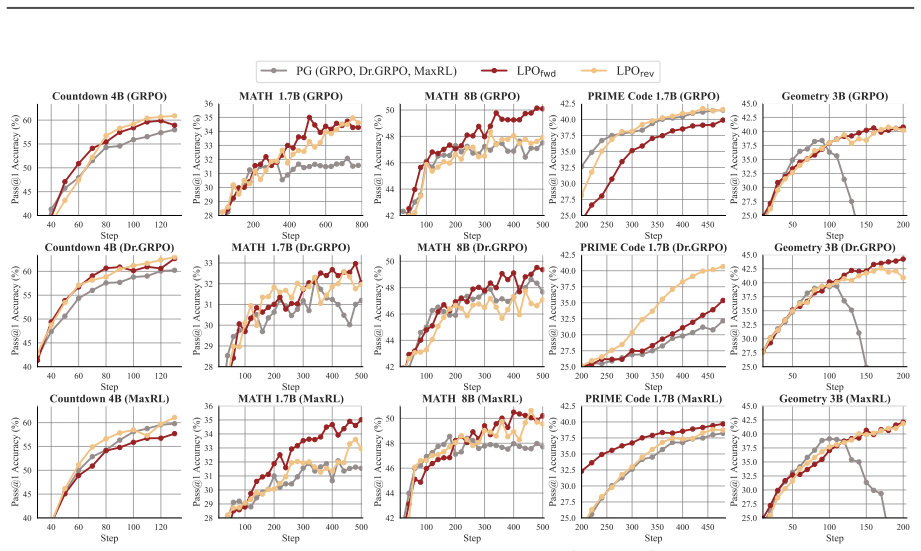
Reinforcement learning with verifiable rewards (RLVR) has become a standard approach for large language models (LLMs) post-training to incentivize reasoning capacity. Among existing recipes, group-based policy gradient is prevalent, which samples a group of responses per prompt and updates the policy via group-relative advantage signals. This work reveals that these optimization strategies share a common geometric structure: each implicitly defines a target distribution on the response simplex and projects toward it via first-order approximation. Building on this insight, we propose Listwise Policy Optimization (LPO) to explicitly conduct the target-projection, which demystifies the implicit target by restricting the proximal RL objective to the response simplex, and then projects the policy via exact divergence minimization. This framework provides (i) monotonic improvement on the listwise objective with bounded, zero-sum, and self-correcting projection gradients, and (ii) flexibility in divergence selection with distinct structural properties through the decoupled projection step. On diverse reasoning tasks and LLM backbones, LPO consistently improves training performance over typical policy gradient baselines under matched targets, while intrinsically preserving optimization stability and response diversity.
Editorial analysis
A structured set of objections, weighed in public.
Referee Report
Summary. The paper claims that group-based policy gradient methods in RLVR implicitly define target distributions on the response simplex and perform first-order approximations to project toward them. It proposes Listwise Policy Optimization (LPO), which explicitly restricts the proximal RL objective to the response simplex and conducts exact divergence minimization for the projection step. This is asserted to deliver monotonic improvement on the listwise objective with bounded, zero-sum, and self-correcting gradients, plus flexibility in divergence selection, while yielding better empirical results than standard policy gradient baselines on reasoning tasks with preserved stability and diversity.
Significance. If the geometric unification and exact-projection guarantees hold, the work offers a principled framework that demystifies implicit targets in group-based RLVR and enables divergence-flexible optimization with theoretical stability properties. This could improve post-training for LLM reasoning by providing monotonicity assurances absent in many current methods, and the empirical gains under matched targets suggest practical utility. The explicit target-projection view is a notable conceptual contribution if the implementation details support the claims.
major comments (2)
- [§3 (target-projection construction)] The central claim of monotonic improvement via exact divergence minimization (abstract and §3) rests on performing an exact argmin over the response simplex. For autoregressive LLMs the policy is token-level, so the induced full-response distribution is not directly parameterized; any practical implementation must rely on sampling or variational approximations. It is not shown that these preserve the exact projection, the zero-sum property, or the self-correcting gradient behavior required for the monotonicity guarantee.
- [§3.3 (gradient properties)] The bounded, zero-sum, and self-correcting properties of the projection gradients are asserted to follow from the decoupled projection step, but the derivation (likely §3.3 or §4) does not address how these properties survive the necessary approximations for LLM-scale response spaces. Without this, the geometric equivalence to group-based methods and the claimed superiority over first-order policy gradients remain unverified.
minor comments (2)
- [§2] Notation for the response simplex and the listwise objective could be introduced earlier with an explicit definition of the target distribution to aid readability.
- [§5] The experiments section would benefit from an ablation isolating the effect of the exact vs. approximate projection on the reported stability metrics.
Simulated Author's Rebuttal
We thank the referee for the constructive and insightful comments, which help clarify the distinction between the theoretical framework and its practical realization for autoregressive LLMs. We address each major comment point by point below, proposing targeted revisions to strengthen the manuscript.
read point-by-point responses
-
Referee: [§3 (target-projection construction)] The central claim of monotonic improvement via exact divergence minimization (abstract and §3) rests on performing an exact argmin over the response simplex. For autoregressive LLMs the policy is token-level, so the induced full-response distribution is not directly parameterized; any practical implementation must rely on sampling or variational approximations. It is not shown that these preserve the exact projection, the zero-sum property, or the self-correcting gradient behavior required for the monotonicity guarantee.
Authors: We appreciate this observation on the gap between the idealized projection and LLM-scale implementation. Section 3 develops the exact target-projection operator over the response simplex to establish monotonicity and gradient properties in the continuous setting. In practice, LPO (like the group-based baselines) approximates the simplex via a finite set of sampled responses per prompt, performing the divergence minimization over this empirical support. This Monte Carlo approximation is explicitly used in the algorithm and experiments. The zero-sum property is preserved exactly within each sampled group by construction of the normalized target, while boundedness and self-correction hold approximately with variance controlled by group size. We will revise §3 to include a new paragraph and appendix derivation explicitly stating the sampling approximation, its effect on the guarantees (monotonicity in expectation), and why the geometric unification with group-based RLVR remains valid. revision: partial
-
Referee: [§3.3 (gradient properties)] The bounded, zero-sum, and self-correcting properties of the projection gradients are asserted to follow from the decoupled projection step, but the derivation (likely §3.3 or §4) does not address how these properties survive the necessary approximations for LLM-scale response spaces. Without this, the geometric equivalence to group-based methods and the claimed superiority over first-order policy gradients remain unverified.
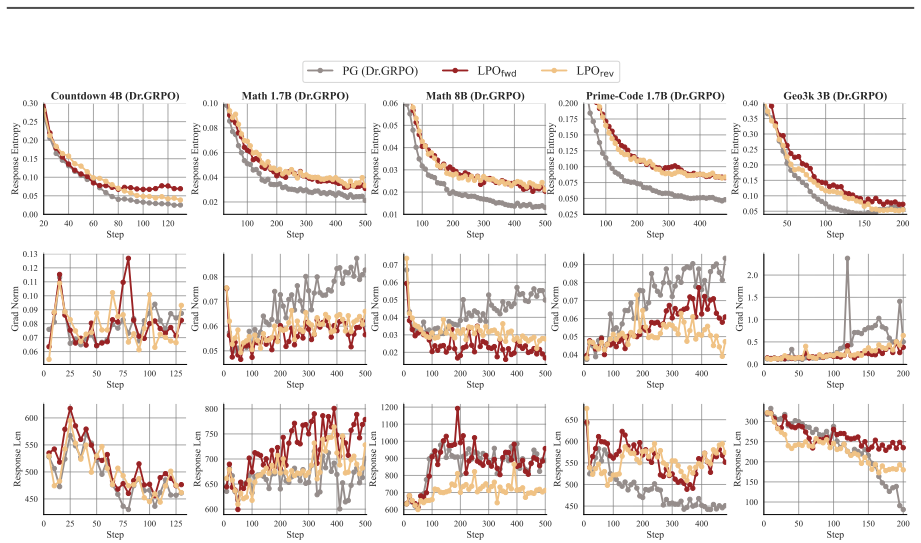
Authors: We agree that the survival of these properties under approximation requires explicit treatment. The decoupled projection in LPO separates the target computation from the policy parameters, so that even with sampled responses the resulting gradient remains a normalized, zero-sum vector whose magnitude is bounded by the chosen divergence (e.g., KL or reverse KL). We will expand §3.3 with a short derivation showing that the self-correcting behavior (negative feedback when the policy overshoots the target) holds in expectation over the sampling distribution, and add empirical plots of gradient norms across training to verify stability. This addition will also reinforce the equivalence to implicit targets in group-based methods and the observed empirical gains under matched targets. revision: partial
Circularity Check
No circularity: explicit target-projection construction is independent of inputs
full rationale
The paper reinterprets group-based RLVR methods as implicitly defining targets on the response simplex and performing first-order projections, then introduces LPO as an explicit version by restricting the proximal objective to the simplex and performing exact divergence minimization. This geometric reframing and the resulting claims of monotonic improvement, bounded zero-sum gradients, and divergence flexibility are derived from the new decoupled projection step rather than reducing to fitted parameters, self-definitions, or author self-citations. The abstract and claimed derivation chain introduce independent structure (listwise objective, exact argmin) without tautological equivalence to the original group-relative advantages. No load-bearing steps match the enumerated circularity patterns.
Axiom & Free-Parameter Ledger
axioms (2)
- domain assumption The space of LLM responses for a given prompt forms a probability simplex on which a target distribution can be defined and projected onto.
- domain assumption First-order policy gradient updates are equivalent to a proximal projection step toward an implicit target.
Reference graph
Works this paper leans on
-
[1]
Neural computation , volume=
Natural gradient works efficiently in learning , author=. Neural computation , volume=. 1998 , publisher=
1998
-
[2]
Maximum a posteriori policy optimisation
Maximum a posteriori policy optimisation , author=. arXiv preprint arXiv:1806.06920 , year=
-
[3]
Encyclopedia of Machine Learning , pages=
Kullback-leibler divergence , author=. Encyclopedia of Machine Learning , pages=
-
[4]
Proceedings of the 62nd Annual Meeting of the Association for Computational Linguistics (Volume 1: Long Papers) , pages=
Back to basics: Revisiting REINFORCE-style optimization for learning from human feedback in LLMs , author=. Proceedings of the 62nd Annual Meeting of the Association for Computational Linguistics (Volume 1: Long Papers) , pages=
-
[5]
Machine learning , volume=
Simple statistical gradient-following algorithms for connectionist reinforcement learning , author=. Machine learning , volume=. 1992 , publisher=
1992
-
[6]
Journal of Machine Learning Research , volume=
Gflownet foundations , author=. Journal of Machine Learning Research , volume=
-
[7]
Learning , volume=
From ranknet to lambdarank to lambdamart: An overview , author=. Learning , volume=
-
[8]
Proceedings of the 24th international conference on Machine learning , pages=
Learning to rank: from pairwise approach to listwise approach , author=. Proceedings of the 24th international conference on Machine learning , pages=
-
[9]
Neural Computation , volume=
Using expectation-maximization for reinforcement learning , author=. Neural Computation , volume=. 1997 , publisher=
1997
-
[10]
DeepSeek-R1: Incentivizing Reasoning Capability in LLMs via Reinforcement Learning
Deepseek-r1: Incentivizing reasoning capability in llms via reinforcement learning , author=. arXiv preprint arXiv:2501.12948 , year=
work page internal anchor Pith review arXiv
-
[11]
arXiv e-prints , pages=
Reinforce++: A simple and efficient approach for aligning large language models , author=. arXiv e-prints , pages=
-
[12]
Openai o1 system card , author=. arXiv preprint arXiv:2412.16720 , year=
work page internal anchor Pith review Pith/arXiv arXiv
-
[13]
Reinforcement Learning and Control as Probabilistic Inference: Tutorial and Review
Reinforcement learning and control as probabilistic inference: Tutorial and review , author=. arXiv preprint arXiv:1805.00909 , year=
work page internal anchor Pith review arXiv
-
[14]
Maximum likelihood reinforcement learning, 2026
Maximum Likelihood Reinforcement Learning , author=. arXiv preprint arXiv:2602.02710 , year=
-
[15]
Understanding R1-Zero-Like Training: A Critical Perspective
Understanding r1-zero-like training: A critical perspective , author=. arXiv preprint arXiv:2503.20783 , year=
work page internal anchor Pith review arXiv
-
[16]
2018 , publisher=
Lectures on convex optimization , author=. 2018 , publisher=
2018
-
[17]
arXiv preprint arXiv:2602.01970 , year=
Small Generalizable Prompt Predictive Models Can Steer Efficient RL Post-Training of Large Reasoning Models , author=. arXiv preprint arXiv:2602.01970 , year=
-
[18]
2025 , eprint=
Group Sequence Policy Optimization , author=. 2025 , eprint=
2025
-
[19]
arXiv preprint arXiv:2502.18548 , year=
What is the Alignment Objective of GRPO? , author=. arXiv preprint arXiv:2502.18548 , year=
-
[20]
Advances in neural information processing systems , volume=
A natural policy gradient , author=. Advances in neural information processing systems , volume=
-
[21]
arXiv preprint arXiv:1909.12238 , year=
V-mpo: On-policy maximum a posteriori policy optimization for discrete and continuous control , author=. arXiv preprint arXiv:1909.12238 , year=
-
[22]
Mirror descent policy optimization
Mirror descent policy optimization , author=. arXiv preprint arXiv:2005.09814 , year=
-
[23]
International conference on machine learning , pages=
A theory of regularized markov decision processes , author=. International conference on machine learning , pages=. 2019 , organization=
2019
-
[24]
Reinforcement Learning with Verifiable Rewards: GRPO's Effective Loss, Dynamics, and Success Amplification , author=. arXiv preprint arXiv:2503.06639 , year=
-
[25]
Evaluating Large Language Models Trained on Code
Evaluating large language models trained on code , author=. arXiv preprint arXiv:2107.03374 , year=
work page internal anchor Pith review arXiv
-
[26]
Machine learning , volume=
Learning to predict by the methods of temporal differences , author=. Machine learning , volume=. 1988 , publisher=
1988
-
[27]
Measuring Mathematical Problem Solving With the MATH Dataset
Measuring Mathematical Problem Solving With the MATH Dataset , author=. arXiv preprint arXiv:2103.03874 , year=
work page internal anchor Pith review arXiv
-
[28]
Qwen2. 5-vl technical report , author=. arXiv preprint arXiv:2502.13923 , year=
work page internal anchor Pith review arXiv
-
[29]
Inter-GPS: Interpretable Geometry Problem Solving with Formal Language and Symbolic Reasoning , author =. The Joint Conference of the 59th Annual Meeting of the Association for Computational Linguistics and the 11th International Joint Conference on Natural Language Processing (ACL-IJCNLP 2021) , year =
2021
-
[30]
Process Reinforcement through Implicit Rewards
Process reinforcement through implicit rewards , author=. arXiv preprint arXiv:2502.01456 , year=
work page internal anchor Pith review arXiv
-
[31]
Olympiadbench: A challenging benchmark for promoting agi with olympiad-level bilingual multimodal scientific problems , author=. arXiv preprint arXiv:2402.14008 , year=
work page internal anchor Pith review arXiv
-
[32]
Advances in Neural Information Processing Systems , volume=
Solving quantitative reasoning problems with language models , author=. Advances in Neural Information Processing Systems , volume=
-
[33]
The Twelfth International Conference on Learning Representations , year=
Let's verify step by step , author=. The Twelfth International Conference on Learning Representations , year=
-
[34]
Qwen3 technical report , author=. arXiv preprint arXiv:2505.09388 , year=
work page internal anchor Pith review arXiv
-
[35]
Prompt curriculum learning for efficient llm post-training, 2025
Prompt curriculum learning for efficient llm post-training , author=. arXiv preprint arXiv:2510.01135 , year=
-
[36]
2017 , eprint=
Trust Region Policy Optimization , author=. 2017 , eprint=
2017
-
[37]
Search-R1: Training LLMs to Reason and Leverage Search Engines with Reinforcement Learning
Search-r1: Training llms to reason and leverage search engines with reinforcement learning , author=. arXiv preprint arXiv:2503.09516 , year=
work page internal anchor Pith review arXiv
-
[38]
2026 , eprint=
Target Policy Optimization , author=. 2026 , eprint=
2026
-
[39]
Adam: A Method for Stochastic Optimization
Adam: A method for stochastic optimization , author=. arXiv preprint arXiv:1412.6980 , year=
work page internal anchor Pith review arXiv
-
[40]
POLARIS: A Post-Training Recipe for Scaling Reinforcement Learning on Advanced Reasoning Models , url =
An, Chenxin and Xie, Zhihui and Li, Xiaonan and Li, Lei and Zhang, Jun and Gong, Shansan and Zhong, Ming and Xu, Jingjing and Qiu, Xipeng and Wang, Mingxuan and Kong, Lingpeng , year =. POLARIS: A Post-Training Recipe for Scaling Reinforcement Learning on Advanced Reasoning Models , url =
-
[41]
Jiayi Pan and Junjie Zhang and Xingyao Wang and Lifan Yuan and Hao Peng and Alane Suhr , title =
-
[42]
arXiv preprint arXiv:2603.10887 , year=
Dynamics-predictive sampling for active RL finetuning of large reasoning models , author=. arXiv preprint arXiv:2603.10887 , year=
-
[43]
arXiv preprint arXiv:2507.04632 , year=
Can prompt difficulty be online predicted for accelerating rl finetuning of reasoning models? , author=. arXiv preprint arXiv:2507.04632 , year=
-
[44]
Advantage-Weighted Regression: Simple and Scalable Off-Policy Reinforcement Learning
Advantage-weighted regression: Simple and scalable off-policy reinforcement learning , author=. arXiv preprint arXiv:1910.00177 , year=
work page internal anchor Pith review arXiv 1910
-
[45]
Remax: A simple, effective, and efficient reinforcement learning method for aligning large language models , author=. arXiv preprint arXiv:2310.10505 , year=
-
[46]
Notion Blog , year=
Deepcoder: A fully open-source 14b coder at o3-mini level , author=. Notion Blog , year=
-
[47]
Proceedings of the AAAI Conference on Artificial Intelligence , volume=
Relative entropy policy search , author=. Proceedings of the AAAI Conference on Artificial Intelligence , volume=
-
[48]
Proximal Policy Optimization Algorithms
Proximal policy optimization algorithms , author=. arXiv preprint arXiv:1707.06347 , year=
work page internal anchor Pith review arXiv
-
[49]
DeepSeekMath: Pushing the Limits of Mathematical Reasoning in Open Language Models
Deepseekmath: Pushing the limits of mathematical reasoning in open language models , author=. arXiv preprint arXiv:2402.03300 , year=
work page internal anchor Pith review arXiv
-
[50]
The American Statistician , volume=
A tutorial on MM algorithms , author=. The American Statistician , volume=. 2004 , publisher=
2004
-
[51]
Proceedings of the Royal Society of London
An invariant form for the prior probability in estimation problems , author=. Proceedings of the Royal Society of London. Series A. Mathematical and Physical Sciences , volume=. 1946 , publisher=
1946
-
[52]
Learning in graphical models , pages=
A view of the EM algorithm that justifies incremental, sparse, and other variants , author=. Learning in graphical models , pages=. 1998 , publisher=
1998
-
[53]
International conference on machine learning , pages=
Soft actor-critic: Off-policy maximum entropy deep reinforcement learning with a stochastic actor , author=. International conference on machine learning , pages=. 2018 , organization=
2018
-
[54]
IEEE Transactions on Information theory , volume=
Divergence measures based on the Shannon entropy , author=. IEEE Transactions on Information theory , volume=. 2002 , publisher=
2002
-
[55]
1959 , publisher=
Individual choice behavior , author=. 1959 , publisher=
1959
-
[56]
arXiv preprint arXiv:2511.06134 , year=
Maestro: Learning to Collaborate via Conditional Listwise Policy Optimization for Multi-Agent LLMs , author=. arXiv preprint arXiv:2511.06134 , year=
-
[57]
Advances in Neural Information Processing Systems , volume=
Mmlu-pro: A more robust and challenging multi-task language understanding benchmark , author=. Advances in Neural Information Processing Systems , volume=
-
[58]
First Conference on Language Modeling , year=
Gpqa: A graduate-level google-proof q&a benchmark , author=. First Conference on Language Modeling , year=
-
[59]
Think you have Solved Question Answering? Try ARC, the AI2 Reasoning Challenge
Think you have solved question answering? try arc, the ai2 reasoning challenge , author=. arXiv preprint arXiv:1803.05457 , year=
work page internal anchor Pith review arXiv
-
[60]
Journal of the Royal Statistical Society Series C: Applied Statistics , volume=
The analysis of permutations , author=. Journal of the Royal Statistical Society Series C: Applied Statistics , volume=. 1975 , publisher=
1975
-
[61]
2024 , journal =
HybridFlow: A Flexible and Efficient RLHF Framework , author =. 2024 , journal =
2024
-
[62]
Yilun Du, Shuang Li, Antonio Torralba, Joshua B
It takes two: Your grpo is secretly dpo , author=. arXiv preprint arXiv:2510.00977 , year=
-
[63]
DAPO: An Open-Source LLM Reinforcement Learning System at Scale
Dapo: An open-source llm reinforcement learning system at scale , author=. arXiv preprint arXiv:2503.14476 , year=
work page internal anchor Pith review arXiv
-
[64]
MiniMax-M1: Scaling Test-Time Compute Efficiently with Lightning Attention
Minimax-m1: Scaling test-time compute efficiently with lightning attention , author=. arXiv preprint arXiv:2506.13585 , year=
work page internal anchor Pith review arXiv
-
[65]
2024 , eprint=
Direct Preference Optimization: Your Language Model is Secretly a Reward Model , author=. 2024 , eprint=
2024
-
[66]
Advances in neural information processing systems , volume=
Policy gradient methods for reinforcement learning with function approximation , author=. Advances in neural information processing systems , volume=
-
[67]
arXiv preprint arXiv:2509.15207 , year=
Flowrl: Matching reward distributions for llm reasoning , author=. arXiv preprint arXiv:2509.15207 , year=
-
[68]
Training a Helpful and Harmless Assistant with Reinforcement Learning from Human Feedback
Training a helpful and harmless assistant with reinforcement learning from human feedback , author=. arXiv preprint arXiv:2204.05862 , year=
work page internal anchor Pith review arXiv
-
[69]
Advances in neural information processing systems , volume=
Training language models to follow instructions with human feedback , author=. Advances in neural information processing systems , volume=
-
[70]
2025 , eprint=
LiPO: Listwise Preference Optimization through Learning-to-Rank , author=. 2025 , eprint=
2025
-
[71]
2010 , publisher=
Modeling purposeful adaptive behavior with the principle of maximum causal entropy , author=. 2010 , publisher=
2010
-
[72]
arXiv preprint arXiv:2309.16240 , year=
Beyond reverse kl: Generalizing direct preference optimization with diverse divergence constraints , author=. arXiv preprint arXiv:2309.16240 , year=
-
[73]
The choice of divergence: A neglected key to mitigating diversity collapse in reinforcement learning with verifiable reward , author=. arXiv preprint arXiv:2509.07430 , year=
-
[74]
Reverse-KL Reinforcement Learning Can Sample From Multiple Diverse Modes , author=
discussion (0)
Sign in with ORCID, Apple, or X to comment. Anyone can read and Pith papers without signing in.