Recognition: unknown
Equidistribution of Eigenfunctions of Quantum Cat Maps
Pith reviewed 2026-05-08 06:40 UTC · model grok-4.3
The pith
Short-period eigenfunctions of quantum cat maps equidistribute on the torus while concentrating their norms on few coordinates.
A machine-rendered reading of the paper's core claim, the machinery that carries it, and where it could break.
Core claim
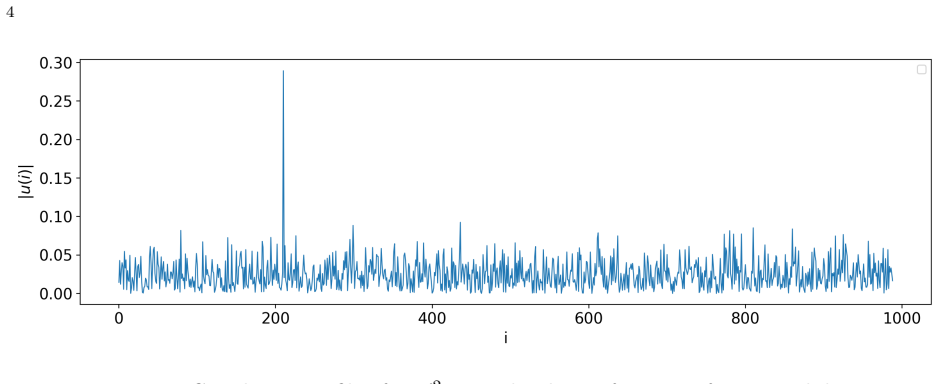
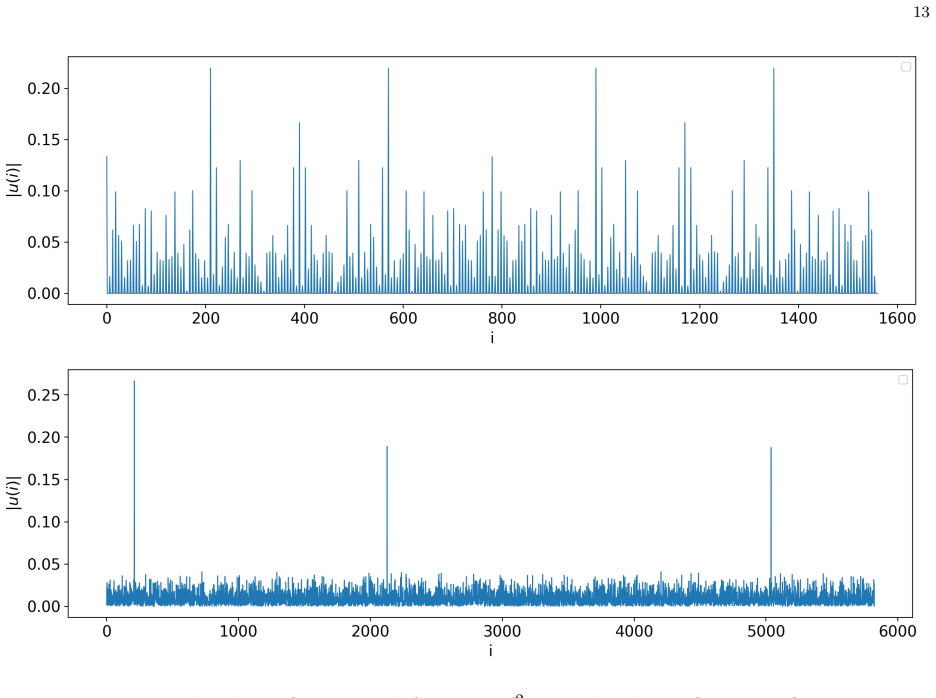
The short-period eigenfunctions of quantum cat maps constructed by Kim and the author equidistribute on the torus in the sense of semiclassical measures. Their logarithmically large ell-infinity norm is asymptotically concentrated on a bounded number of coordinates, allowing strong coordinate localization to coexist with semiclassical equidistribution.
What carries the argument
The explicit construction of short-period eigenfunctions for quantum cat maps, analyzed through semiclassical measures and estimates on the concentration of their supremum norms.
If this is right
- This family provides an example where equidistribution occurs despite logarithmic growth in the L^infty norm.
- The results confirm numerical evidence from earlier work by Kim and the author.
- These eigenfunctions avoid the scarring phenomena observed in other short-period eigenfunctions of quantum cat maps.
Where Pith is reading between the lines
- Similar constructions in other quantum chaotic systems might allow equidistribution with partial localization.
- Investigating whether the number of concentrated coordinates stays bounded independently of the period length could test the robustness of the result.
Load-bearing premise
The specific construction of these short-period eigenfunctions is valid and permits the direct application of semiclassical measure analysis and norm concentration estimates.
What would settle it
Computing the semiclassical measure for these eigenfunctions and finding it does not approach the Lebesgue measure on the torus, or observing that the positions of large norm values become unbounded in number for large periods.
Figures

read the original abstract
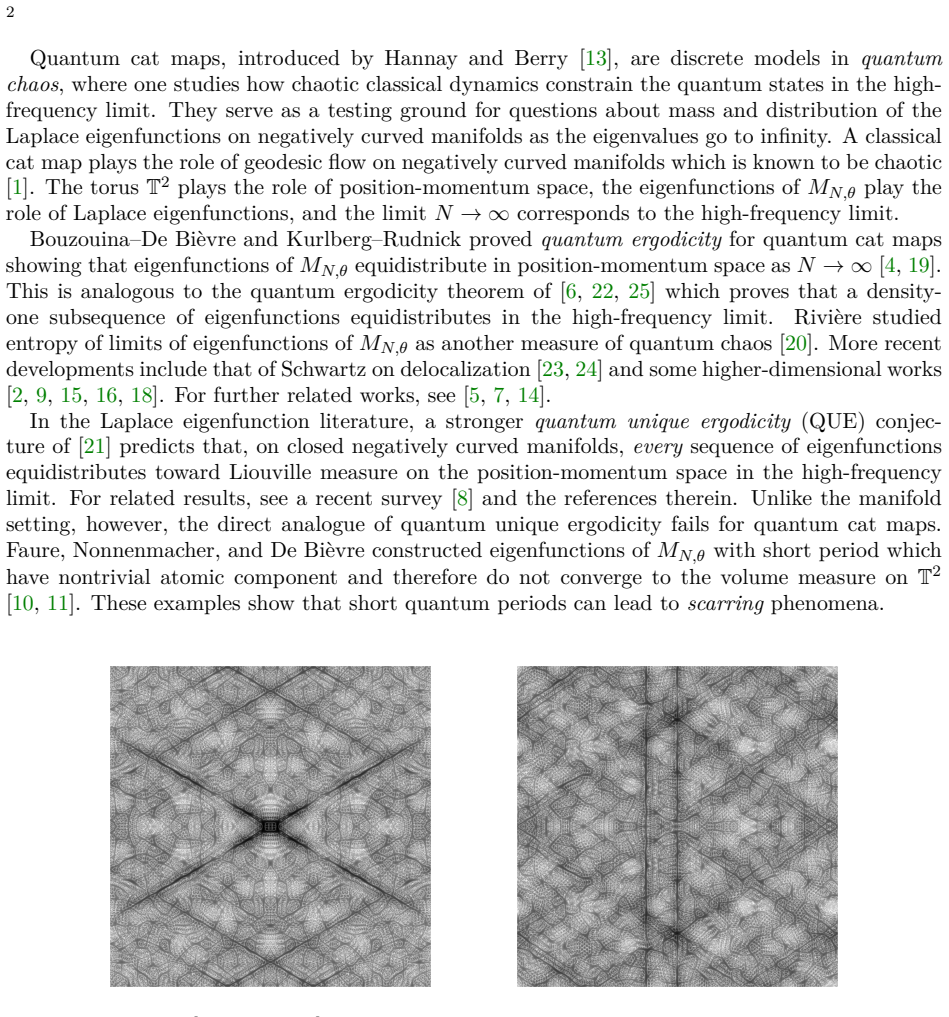
We prove that the short-period eigenfunctions of quantum cat maps constructed by Kim and the author equidistribute on $\mathbb{T}^2$ in the sense of semiclassical measures. We also show that their logarithmically large $\ell^\infty$-norm is asymptotically concentrated on a bounded number of coordinates. Thus, for this explicit family, strong coordinate localization coexists with semiclassical equidistribution. These results confirm the behavior suggested by earlier numerical evidence of Kim and the author, and contrast with the scarring phenomena for short-period eigenfunctions observed by Faure, Nonnenmacher, and De Bi\`evre.
Editorial analysis
A structured set of objections, weighed in public.
Referee Report
Summary. The paper proves that the short-period eigenfunctions of quantum cat maps constructed by Kim and the author equidistribute on T^2 in the sense of semiclassical measures. It also shows that their logarithmically large ℓ^∞-norm is asymptotically concentrated on a bounded number of coordinates. This establishes coexistence of strong coordinate localization with semiclassical equidistribution for this explicit family, confirming prior numerical evidence and contrasting with scarring phenomena observed by Faure, Nonnenmacher, and De Bièvre.
Significance. If the results hold, this contributes to semiclassical analysis and quantum chaos by providing a rigorous, explicit example of equidistributing short-period eigenfunctions for quantized cat maps. The self-contained argument verifies invariance and ergodicity of the associated semiclassical measures under the dynamics, combined with coordinate-wise estimates exploiting the finite support from the construction. This strengthens understanding of when localization and equidistribution can coexist, with potential implications for general questions on semiclassical measures of eigenfunctions of hyperbolic maps.
minor comments (3)
- In the introduction, the reference to the prior construction by Kim and the author should include the specific arXiv identifier or full bibliographic details for immediate accessibility.
- §4 (or the section on norm estimates): the statement that the concentration is on a 'bounded number' of coordinates would benefit from an explicit bound in terms of the cat map parameter or period length, even if h-independent.
- Ensure that the definition of the semiclassical measures (likely around Eq. (2.3) or similar) explicitly lists the class of test functions used, to avoid any ambiguity in the weak-* convergence.
Simulated Author's Rebuttal
We thank the referee for their positive summary of our work and for recommending minor revision. No specific major comments were raised in the report, so we have no points requiring detailed rebuttal or revision at this stage.
Circularity Check
No significant circularity; proof builds independently on cited construction
full rationale
The manuscript establishes equidistribution of semiclassical measures and coordinate concentration for the short-period eigenfunctions via direct verification of invariance/ergodicity under the cat map and explicit coordinate estimates that exploit the finite-support structure of the given construction. This argument does not reduce any claimed result to a fitted parameter, self-definition, or unverified self-citation chain; the reference to the Kim-Koirala construction supplies the objects to which the new estimates apply but is not invoked as a uniqueness theorem or ansatz that forces the conclusions. The numerical evidence mentioned in the abstract is presented only as motivation, not as part of the derivation. The overall chain therefore remains self-contained against external benchmarks.
Axiom & Free-Parameter Ledger
axioms (1)
- standard math Standard properties of quantum cat maps, semiclassical measures, and microlocal analysis hold as established in the literature.
Reference graph
Works this paper leans on
-
[1]
D. V. Anosov. Geodesic flows on closed Riemannian manifolds of negative curvature. Trudy Mat. Inst. Steklov. , 90:209, 1967
1967
-
[2]
On quantum ergodicity for higher-dimensional cat maps modulo prime powers
Subham Bhakta and Igor E Shparlinski. On quantum ergodicity for higher-dimensional cat maps modulo prime powers. Bulletin of the London Mathematical Society , 58(3):e70300, 2026
2026
-
[3]
Exponential mixing and | ln ℏ| time scales in quantized hyperbolic maps on the torus
Francesco Bonechi and Stephan De Bièvre. Exponential mixing and | ln ℏ| time scales in quantized hyperbolic maps on the torus. Comm. Math. Phys. , 211(3):659–686, 2000
2000
-
[4]
Equipartition of the eigenfunctions of quantized ergodic maps on the torus
Abdelhamid Bouzouina and Stephan De Bièvre. Equipartition of the eigenfunctions of quantized ergodic maps on the torus. Comm. Math. Phys. , 178(1):83–105, 1996
1996
-
[5]
On the entropy of quantum limits for 2-dimensional cat maps
Shimon Brooks. On the entropy of quantum limits for 2-dimensional cat maps. Comm. Math. Phys. , 293(1):231– 255, 2010
2010
-
[6]
Colin de Verdière
Y. Colin de Verdière. Ergodicité et fonctions propres du laplacien. Comm. Math. Phys. , 102(3):497–502, 1985
1985
-
[7]
Classical limit of the quantized hyperbolic toral automor- phisms
Mirko Degli Esposti, Sandro Graffi, and Stefano Isola. Classical limit of the quantized hyperbolic toral automor- phisms. Comm. Math. Phys. , 167(3):471–507, 1995
1995
-
[8]
Macroscopic limits of chaotic eigenfunctions
Semyon Dyatlov. Macroscopic limits of chaotic eigenfunctions. In International Congress of Mathematicians , pages 3704–3723. European Mathematical Society-EMS-Publishing House GmbH, 2023
2023
-
[9]
Semiclassical measures for higher-dimensional quantum cat maps
Semyon Dyatlov and Malo Jézéquel. Semiclassical measures for higher-dimensional quantum cat maps. Ann. Henri Poincaré, 25(2):1545–1605, 2024
2024
-
[10]
On the maximal scarring for quantum cat map eigenstates
Frédéric Faure and Stéphane Nonnenmacher. On the maximal scarring for quantum cat map eigenstates. Comm. Math. Phys. , 245(1):201–214, 2004
2004
-
[11]
Scarred eigenstates for quantum cat maps of minimal periods
Frédéric Faure, Stéphane Nonnenmacher, and Stephan De Bièvre. Scarred eigenstates for quantum cat maps of minimal periods. Comm. Math. Phys. , 239(3):449–492, 2003
2003
-
[12]
Paul R. Halmos. On automorphisms of compact groups. Bull. Amer. Math. Soc. , 49:619–624, 1943. 16
1943
-
[13]
J. H. Hannay and M. V. Berry. Quantization of linear maps on a torus-Fresnel diffraction by a periodic grating. Phys. D , 1(3):267–290, 1980
1980
-
[14]
J. P. Keating. The cat maps: quantum mechanics and classical motion. Nonlinearity, 4(2):309–341, 1991
1991
-
[15]
Arithmetic quantum unique ergodicity for symplectic linear maps of the multidimensional torus
Dubi Kelmer. Arithmetic quantum unique ergodicity for symplectic linear maps of the multidimensional torus. Ann. of Math. (2) , 171(2):815–879, 2010
2010
-
[16]
Anderson, and Robert J
Elena Kim, Theresa C. Anderson, and Robert J. Lemke Oliver. Characterizing the support of semiclassical measures for higher-dimensional cat maps. Analysis & PDE , pages 1–66, 2026. to appear
2026
-
[17]
Bounds on eigenfunctions of quantum cat maps
Elena Kim and Robert Koirala. Bounds on eigenfunctions of quantum cat maps. Physica Scripta, 98(11):115123, 2023
2023
-
[18]
Shparlinski
Pär Kurlberg, Alina Ostafe, Zeev Rudnick, and Igor E. Shparlinski. On quantum ergodicity for higher dimensional cat maps. Comm. Math. Phys. , 406(8):Paper No. 174, 29, 2025
2025
-
[19]
On quantum ergodicity for linear maps of the torus
Pär Kurlberg and Zeév Rudnick. On quantum ergodicity for linear maps of the torus. Comm. Math. Phys. , 222(1):201–227, 2001
2001
-
[20]
Entropy of semiclassical measures for symplectic linear maps of the multidimensional torus
Gabriel Rivière. Entropy of semiclassical measures for symplectic linear maps of the multidimensional torus. International Mathematics Research Notices , 2011(11):2396–2443, 2011
2011
-
[21]
The behaviour of eigenstates of arithmetic hyperbolic manifolds
Zeév Rudnick and Peter Sarnak. The behaviour of eigenstates of arithmetic hyperbolic manifolds. Comm. Math. Phys., 161(1):195–213, 1994
1994
-
[22]
A. I. Schnirelman. Ergodic properties of eigenfunctions. Uspehi Mat. Nauk , 29(6(180)):181–182, 1974
1974
-
[23]
Statistical Properties of Quantized Toral Automorphisms
Nir Schwartz. Statistical Properties of Quantized Toral Automorphisms . PhD thesis, Université Paris-Saclay,
-
[24]
thesis, NNT 2022UPASM026, HAL tel-04266949
Ph.D. thesis, NNT 2022UPASM026, HAL tel-04266949
-
[25]
The full delocalization of eigenstates for the quantized cat map
Nir Schwartz. The full delocalization of eigenstates for the quantized cat map. Pure and Applied Analysis , 6(4):1017–1053, 2024
2024
-
[26]
Uniform distribution of eigenfunctions on compact hyperbolic surfaces
Steven Zelditch. Uniform distribution of eigenfunctions on compact hyperbolic surfaces. Duke Math. J. , 55(4):919–941, 1987. Department of Mathematics, University of California San Diego Email address : rkoirala@ucsd.edu
1987
discussion (0)
Sign in with ORCID, Apple, or X to comment. Anyone can read and Pith papers without signing in.