Recognition: 2 theorem links
· Lean TheoremBulk-mediated reflection of chirality-protected surface spin waves
Pith reviewed 2026-05-11 02:35 UTC · model grok-4.3
The pith
Chiral Damon-Eshbach surface spin waves reflect from boundaries by exciting localized bulk modes in thick films, unlike elastic reflection of backward-volume waves.
A machine-rendered reading of the paper's core claim, the machinery that carries it, and where it could break.
Core claim
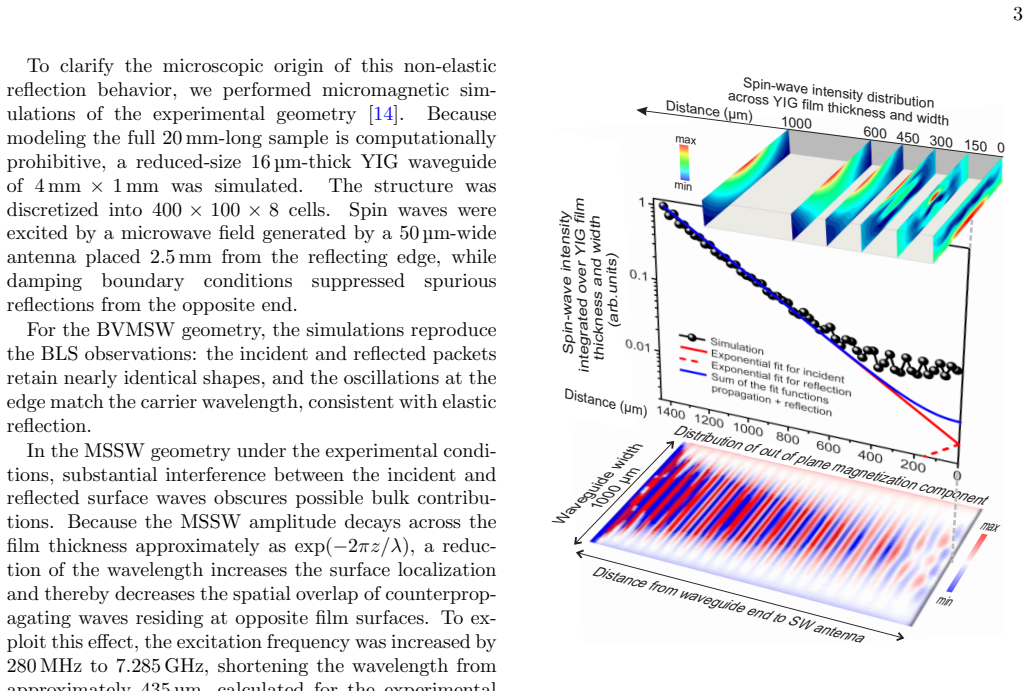
Reflection of the chiral Damon-Eshbach wave from the boundary of the magnetic medium is accompanied by excitation of spatially localized thickness-quantized bulk modes, whereas reciprocal backward-volume waves reflect nearly elastically. Brillouin light scattering spectroscopy, infrared thermography, and micromagnetic simulations reveal standing bulk excitations at the reflecting boundary and quantify the associated magnon energy accumulation and dissipation.
What carries the argument
Thickness-quantized bulk spin-wave modes that localize at the reflecting boundary and mediate the reversal of chirally localized surface waves.
If this is right
- Chirality-based suppression of direct backscattering holds only in frequency ranges free of bulk modes.
- In micrometer-thick films, bulk-mode excitations become the dominant reflection mechanism for surface waves.
- Energy dissipation and accumulation occur at boundaries through these standing bulk modes.
- This identifies the physical pathway for reversal of surface waves in three-dimensional magnetic media.
- Provides a general framework for understanding wave transport in nonreciprocal magnetic systems.
Where Pith is reading between the lines
- Adjusting film thickness could switch between elastic and bulk-mediated reflection regimes for tailored magnonic devices.
- Similar bulk-mediated mechanisms might appear in other chiral wave systems like acoustic or photonic waveguides with overlapping mode spectra.
- Boundary engineering to minimize bulk mode coupling could extend the frequency range of backscattering immunity.
Load-bearing premise
That the standing bulk excitations at the reflecting boundary are the main pathway allowing the chiral surface waves to reverse direction.
What would settle it
An experiment or simulation in which chiral surface waves reflect from the boundary without exciting any thickness-quantized bulk modes would falsify the claim.
Figures


read the original abstract
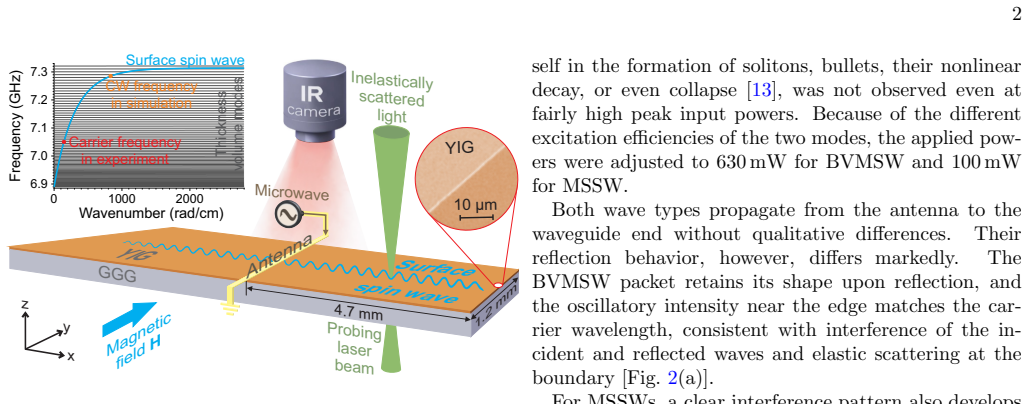
Surface spin waves of the Damon-Eshbach type exhibit intrinsically nonreciprocal transport properties with a chiral dynamical field structure that localizes counterpropagating waves at opposite film surfaces. Such chirality has been predicted to suppress direct backscattering in thin films within frequency ranges free of bulk modes. However, how chirality influences reflection in thicker three-dimensional magnetic media, where a dense spectrum of bulk excitations overlaps with surface waves, remains unclear. Here we demonstrate that, in micrometer-thick yttrium iron garnet films, reflection of the chiral Damon-Eshbach wave from the boundary of the magnetic medium is accompanied by excitation of spatially localized thickness-quantized bulk modes, whereas reciprocal backward-volume waves reflect nearly elastically. Brillouin light scattering spectroscopy, infrared thermography, and micromagnetic simulations reveal standing bulk excitations at the reflecting boundary and quantify the associated magnon energy accumulation and dissipation. These results identify bulk-mode excitations as the physical pathway enabling reversal of chirally localized surface waves in thick films, thereby defining the limits of chirality-based backscattering immunity and providing a general framework for wave transport in nonreciprocal magnetic media.
Editorial analysis
A structured set of objections, weighed in public.
Referee Report
Summary. The paper claims that in micrometer-thick YIG films, reflection of chirality-protected Damon-Eshbach (DE) surface spin waves at the magnetic boundary is accompanied by excitation of spatially localized thickness-quantized bulk modes, enabling reversal of the chiral localization, whereas reciprocal backward-volume (BV) waves reflect nearly elastically. This is demonstrated through Brillouin light scattering (BLS) spectroscopy revealing standing bulk excitations for DE incidence, infrared thermography quantifying associated magnon energy accumulation and dissipation, and micromagnetic simulations confirming the mode structures and localization.
Significance. If the central claim holds, the work identifies bulk-mode excitation as the physical mechanism limiting chirality-based backscattering immunity in thick nonreciprocal magnetic films and supplies a framework for magnon transport in media with overlapping surface and bulk spectra. The multi-technique approach (BLS + thermography + simulations) with explicit quantification of energy accumulation/dissipation is a strength that moves the argument beyond pure correlation.
major comments (2)
- [Abstract and Results (BLS/thermography analysis)] Abstract and Results on thermography/BLS quantification: the manuscript states that bulk modes 'quantify the associated magnon energy accumulation and dissipation' and identifies them as 'the physical pathway enabling reversal,' yet no explicit energy-balance closure or mode-conversion efficiency is reported (e.g., fraction of incident magnon energy transferred into the thickness-quantized bulk resonances versus dipolar radiation or continuum states). Without this accounting or a control suppressing the quantized resonances, the dominance inference remains correlative rather than demonstrated.
- [Micromagnetic simulations] Micromagnetic simulations section: while the simulations show standing bulk excitations for DE incidence and their absence/weakness for BV incidence, the reported mode amplitudes or power spectra are not compared quantitatively to the incident wave power to confirm that bulk-mode excitation accounts for the observed reflection behavior.
minor comments (2)
- [Figures] Figure captions and axis labels in the BLS spectra and thermography images should explicitly state the frequency range relative to the bulk-mode continuum to allow direct comparison with the claimed overlap.
- [Results on BV waves] The definition of 'nearly elastically' for BV reflection should be quantified (e.g., reflection coefficient or linewidth broadening) rather than left qualitative.
Simulated Author's Rebuttal
We thank the referee for the careful reading and constructive comments on our manuscript. The suggestions have prompted us to strengthen the quantitative links between bulk-mode excitation and the observed reflection behavior. We address each major comment point by point below and have revised the manuscript to incorporate additional analysis where feasible.
read point-by-point responses
-
Referee: [Abstract and Results (BLS/thermography analysis)] Abstract and Results on thermography/BLS quantification: the manuscript states that bulk modes 'quantify the associated magnon energy accumulation and dissipation' and identifies them as 'the physical pathway enabling reversal,' yet no explicit energy-balance closure or mode-conversion efficiency is reported (e.g., fraction of incident magnon energy transferred into the thickness-quantized bulk resonances versus dipolar radiation or continuum states). Without this accounting or a control suppressing the quantized resonances, the dominance inference remains correlative rather than demonstrated.
Authors: We acknowledge that the original manuscript presented the BLS spectra and thermographic maps as evidence for bulk-mode involvement and energy dissipation but did not include an explicit numerical energy-balance closure or conversion efficiency. The BLS data identify the discrete thickness-quantized resonances, while thermography quantifies the spatial accumulation and dissipation of magnon energy at the boundary for DE incidence. In the revised manuscript we have added a supplementary analysis that estimates the fraction of incident energy transferred to the bulk modes by comparing integrated BLS intensities (normalized to the incident wave) with the thermographic heat deposition rates. This supports that bulk resonances account for the dominant dissipation channel. A direct experimental control suppressing the quantized modes is not straightforward in the present geometry, as it would require altering film thickness or boundary conditions in a way that also changes the surface-wave dispersion; we now discuss this limitation explicitly. revision: yes
-
Referee: [Micromagnetic simulations] Micromagnetic simulations section: while the simulations show standing bulk excitations for DE incidence and their absence/weakness for BV incidence, the reported mode amplitudes or power spectra are not compared quantitatively to the incident wave power to confirm that bulk-mode excitation accounts for the observed reflection behavior.
Authors: The micromagnetic simulations were used to visualize the mode profiles, confirm the standing-wave character of the bulk excitations, and demonstrate the reversal of chiral localization for DE waves versus near-elastic reflection for BV waves. We agree that a quantitative power comparison strengthens the causal link. In the revised version we have added normalized power spectral densities extracted from the simulations, scaled to the incident wave amplitude. These show that the integrated power residing in the thickness-quantized bulk modes for DE incidence is comparable to the reflected-wave power, while remaining negligible for BV incidence, thereby corroborating the experimental observations. revision: yes
Circularity Check
No circularity: experimental demonstration via spectroscopy, thermography and standard simulations
full rationale
The paper reports direct experimental observations (BLS spectra, IR thermography) and micromagnetic simulations showing standing bulk modes at the boundary for DE-wave incidence but not for BV waves. No derivation chain, fitted-parameter prediction, or self-citation load-bearing step is present; the central claim rests on measured correlations and standard numerical modeling rather than any reduction of outputs to inputs by construction. Self-citations to prior magnon-transport literature are peripheral and do not substitute for the reported data.
Axiom & Free-Parameter Ledger
axioms (1)
- domain assumption Micromagnetic simulations accurately reproduce the spin-wave dynamics and mode localization in micrometer-thick YIG films under the experimental conditions.
Lean theorems connected to this paper
-
IndisputableMonolith/Foundation/RealityFromDistinction.leanreality_from_one_distinction unclear?
unclearRelation between the paper passage and the cited Recognition theorem.
reflection of the chiral Damon-Eshbach wave from the boundary of the magnetic medium is accompanied by excitation of spatially localized thickness-quantized bulk modes, whereas reciprocal backward-volume waves reflect nearly elastically
-
IndisputableMonolith/Cost/FunctionalEquation.leanwashburn_uniqueness_aczel unclear?
unclearRelation between the paper passage and the cited Recognition theorem.
bulk-mode excitations as the physical pathway enabling reversal of chirally localized surface waves
What do these tags mean?
- matches
- The paper's claim is directly supported by a theorem in the formal canon.
- supports
- The theorem supports part of the paper's argument, but the paper may add assumptions or extra steps.
- extends
- The paper goes beyond the formal theorem; the theorem is a base layer rather than the whole result.
- uses
- The paper appears to rely on the theorem as machinery.
- contradicts
- The paper's claim conflicts with a theorem or certificate in the canon.
- unclear
- Pith found a possible connection, but the passage is too broad, indirect, or ambiguous to say the theorem truly supports the claim.
Reference graph
Works this paper leans on
-
[1]
T. Yu, Z. Luo, and G. E. Bauer, Chirality as generalized spin-orbit interaction in spintronics, Phys. Rep.1009, 1–115 (2023)
work page 2023
-
[2]
C. Trevillian and V. Tyberkevych, Formation of chirality in propagating spin waves, npj Spintronics2, 23 (2024)
work page 2024
-
[3]
R. Shindou, R. Matsumoto, S. Murakami, and J.-i. Ohe, Topological chiral magnonic edge mode in a magnonic crystal, Phy. Rev. B87, 174427 (2013)
work page 2013
-
[4]
R. Damon and J. Eshbach, Magnetostatic modes of a fer- romagnet slab, J. Phys. Chem. Solids19, 308–320 (1961)
work page 1961
- [5]
-
[6]
K. Yamamoto, G. C. Thiang, P. Pirro, K.-W. Kim, K. Everschor-Sitte, and E. Saitoh, Topological charac- terization of classical waves: The topological origin of magnetostatic surface spin waves, Phys. Rev. Lett.122, 217201 (2019)
work page 2019
-
[7]
M. Mohseni, R. Verba, T. Br¨ acher, Q. Wang, D. A. Bozhko, B. Hillebrands, and P. Pirro, Backscattering immunity of dipole-exchange magnetostatic surface spin waves, Phys. Rev. Lett.122, 197201 (2019)
work page 2019
-
[8]
T. Schneider, A. A. Serga, T. Neumann, B. Hillebrands, and M. P. Kostylev, Phase reciprocity of spin-wave exci- tation by a microstrip antenna, Phys. Rev. B77, 214411 (2008)
work page 2008
-
[9]
Kostylev, Non-reciprocity of dipole-exchange spin waves in thin ferromagnetic films, J
M. Kostylev, Non-reciprocity of dipole-exchange spin waves in thin ferromagnetic films, J. Appl. Phys.113, 053907 (2013)
work page 2013
-
[10]
R. O. Serha, D. A. Bozhko, M. Agrawal, R. V. Verba, M. Kostylev, V. I. Vasyuchka, B. Hillebrands, and A. A. Serga, Low-damping spin-wave transmission in YIG/Pt- interfaced structures, Adv. Mater. Interfaces9, 2201323 (2022)
work page 2022
-
[11]
O. B¨ uttner, M. Bauer, S. O. Demokritov, B. Hillebrands, Y. S. Kivshar, V. Grimalsky, Y. Rapoport, and A. N. Slavin, Linear and nonlinear diffraction of dipolar spin waves in yttrium iron garnet films observed by space- and time-resolvedBrillouin light scattering, Phys. Rev. B 61, 11576–11587 (2000)
work page 2000
-
[12]
R. E. Dunagin, A. A. Serga, and D. A. Bozhko, Bril- louin light scattering spectroscopy of magnon–phonon thermal spectra of an in-plane magnetized yig film in two-dimensional wavevector space, J. Appl. Phys.137, 083901 (2025)
work page 2025
-
[13]
O. R. Sulymenko, O. V. Prokopenko, V. S. Tyberkevych, A. N. Slavin, and A. A. Serga, Bullets and droplets: Two-dimensional spin-wave solitons in modern magnon- ics (Review Article), Low Temp. Phys.44, 602–617 (2018)
work page 2018
-
[14]
M. J. Donahue and D. G. Porter,OOMMF User’s Guide, Version 1.0, Tech. Rep. NISTIR 6376 (National Insti- tute of Standards and Technology (NIST), Gaithersburg, MD, USA, 1999) available athttps://math.nist.gov/ oommf/
work page 1999
-
[15]
T. An, V. I. Vasyuchka, K. Uchida, A. V. Chumak, K. Yamaguchi, K. Harii, J. Ohe, M. B. Jungfleisch, Y. Kajiwara, H. Adachi, B. Hillebrands, S. Maekawa, and E. Saitoh, Unidirectional spin-wave heat conveyer, Nat. Mater.12, 549–553 (2013)
work page 2013
-
[16]
A. V. Chumak, A. A. Serga, S. Wolff, B. Hillebrands, and M. P. Kostylev, Scattering of surface and volume spin waves in a magnonic crystal, Appl. Phys. Lett.94, 172511 (2009)
work page 2009
- [17]
-
[18]
J. Holanda, D. S. Maior, A. Azevedo, and S. M. Rezende, Detecting the phonon spin in magnon–phonon conversion experiments, Nat. Phys.14, 500–506 (2018)
work page 2018
-
[19]
J. D. Costa, B. Figeys, X. Sun, N. Van Hoovels, H. A. C. Tilmans, F. Ciubotaru, and C. Adelmann, Compact tun- able YIG-based RF resonators, Appl. Phys. Lett.118, 162406 (2021)
work page 2021
-
[20]
A. G. Whitney, J. M. Lewis, J. Dickovick, V. Kalappattil, L. D. Carr, and M. Wu, Propagation of spin waves in doubly periodic magnonic crystals, Phys. Rev. Appl.23, 064012 (2025)
work page 2025
-
[21]
K. O. Levchenko, K. Dav´ ıdkov´ a, J. Mikkelsen, and A. V. Chumak, Review on spin-wave RF applications, IEEE Trans. Magn. , 1–45 (2026)
work page 2026
discussion (0)
Sign in with ORCID, Apple, or X to comment. Anyone can read and Pith papers without signing in.