Recognition: no theorem link
Diffusion Restore: Real-Time Markov Chain Monte Carlo Light Transport
Pith reviewed 2026-05-13 07:13 UTC · model grok-4.3
The pith
Diffusion Restore enables real-time MCMC light transport by using nonreversible diffusion-based dynamics without Metropolis adjustment.
A machine-rendered reading of the paper's core claim, the machinery that carries it, and where it could break.
Core claim
Diffusion Restore chooses diffusion-based local dynamics within the Restore framework, modeled as nonreversible to introduce momentum, and completely avoids Metropolis-adjustment while providing theoretical justification for validity and unbiasedness in light transport integrals. This leads to superior performance over existing MCMC methods and real-time frame rates on GPU implementations.
What carries the argument
Nonreversible diffusion-based local dynamics in the Restore framework for MCMC light transport sampling.
If this is right
- Outperforms all existing MCMC light transport methods across diverse scenes.
- Establishes a new state of the art in MCMC rendering.
- Achieves real-time frame rates with a GPU implementation in ray tracing and compute shaders.
- Outperforms traditional Path Tracing methods in real-time rendering settings like interactive applications and games.
Where Pith is reading between the lines
- Could extend to other high-dimensional integral approximations beyond light transport, such as in physics simulations.
- The momentum from nonreversible dynamics might reduce backtracking in other MCMC applications like optimization.
- Real-time capability suggests integration into game engines for more accurate global illumination without precomputation.
Load-bearing premise
The nonreversible diffusion-based local dynamics remain valid and produce unbiased estimates for light transport integrals even without any Metropolis adjustment.
What would settle it
A rendering scene where the output image shows visible bias or artifacts compared to ground truth path tracing, or fails to converge properly despite the theoretical claims.
Figures



read the original abstract
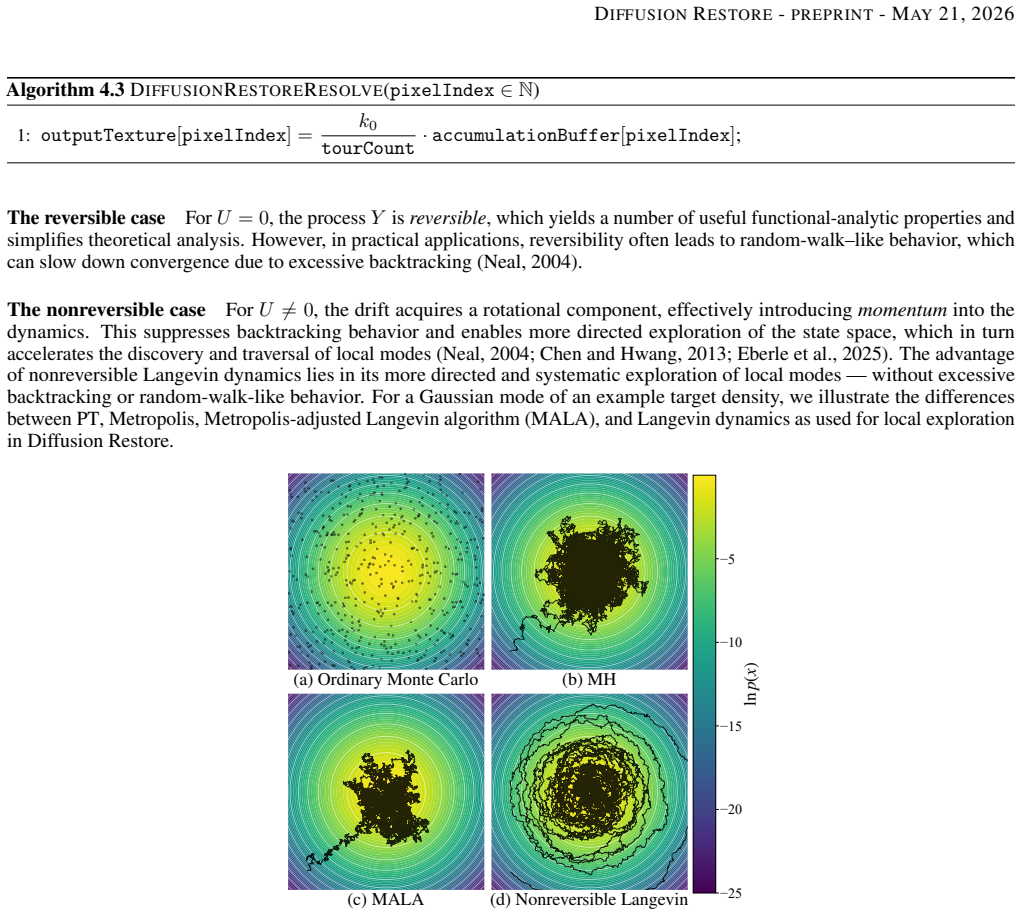
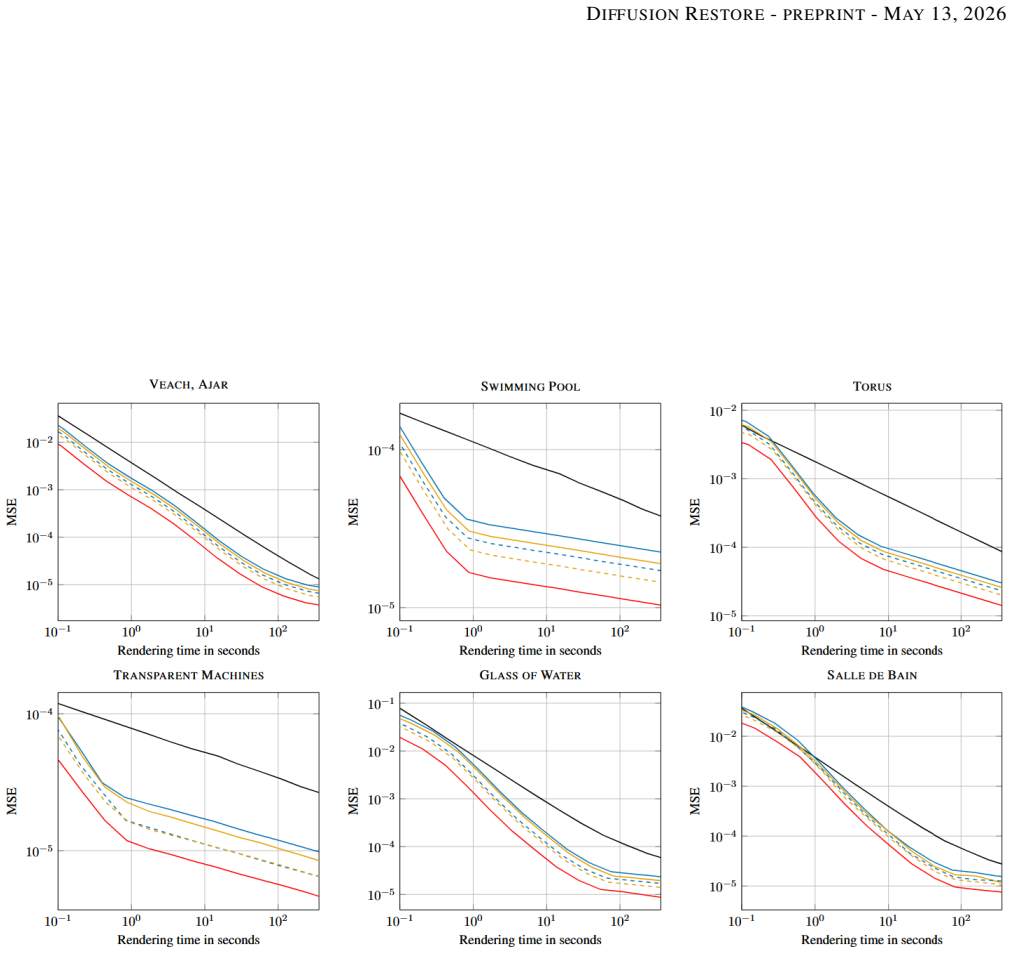
We present Diffusion Restore, a real-time framework for diffusion-based MCMC light transport. MCMC methods are highly suitable for sampling from complex high-dimensional distributions and for approximating integrals over them. In practice, they are often the only viable solution when direct sampling is not possible and alternative methods are either inefficient or cannot be applied due to the structure of the target distribution. However, controlling the exploration of the target distribution in MCMC methods remains challenging. Efficient exploration requires a balance between local exploration and global discovery, and local dynamics must rapidly explore individual modes without getting stuck or exhibiting excessive backtracking. The problem of global discovery has recently been addressed by the introduction of the Restore framework. In this work, we build on this framework and focus on improving local exploration. We show how to choose diffusion-based local dynamics within the Restore framework while completely avoiding Metropolis-adjustment, which is known to slow down convergence. Furthermore, we model these dynamics as nonreversible, introducing momentum in the drift and thereby enabling more directed exploration of the target distribution compared to reversible, random-walk-like dynamics. We provide a theoretical justification for the validity of our choice of local dynamics. Empirically, we demonstrate across diverse scenes that Diffusion Restore outperforms all existing MCMC light transport methods and establishes a new state of the art. In addition, we present a GPU implementation in ray tracing and compute shaders and achieve real-time frame rates. This demonstrates that Diffusion Restore is not only superior in offline rendering, but also outperforms traditional Path Tracing methods in real-time rendering settings, such as interactive applications and games.
Editorial analysis
A structured set of objections, weighed in public.
Referee Report
Summary. The paper introduces Diffusion Restore, an extension of the Restore framework for MCMC light transport that employs nonreversible diffusion-based local dynamics with momentum in the drift term. It claims to avoid Metropolis adjustment entirely while preserving unbiasedness, provides a theoretical justification for this choice, demonstrates empirical superiority over prior MCMC methods across diverse scenes, and reports a GPU implementation achieving real-time frame rates that also outperforms traditional path tracing in interactive settings.
Significance. If the theoretical justification for unbiased nonreversible diffusion dynamics holds in path space and the performance gains are reproducible, the work would represent a meaningful advance in MCMC rendering by improving local exploration efficiency and enabling real-time applications. The GPU implementation in ray tracing and compute shaders is a concrete strength that could broaden adoption beyond offline rendering.
major comments (2)
- [Abstract and §3] Abstract and §3 (Theoretical Justification): The claim that nonreversible diffusion dynamics remain valid and unbiased for light transport integrals without Metropolis adjustment rests on an extension of the Restore framework, but the provided justification does not explicitly verify that the target measure is preserved under the chosen drift term when the integrand exhibits discontinuities from visibility and BSDF boundaries; a concrete counterexample or invariance proof for the high-dimensional path-space case is needed to support the central unbiasedness assertion.
- [§4] §4 (Experiments): The assertion of outperforming all existing MCMC methods and establishing a new state of the art is load-bearing for the empirical contribution, yet the reported results lack error bars, variance estimates across independent runs, or controls for scene selection bias; without these, it is unclear whether the observed gains are statistically robust or sensitive to the chosen test scenes.
minor comments (2)
- [§5] §5 (GPU Implementation): The description of the ray tracing and compute shader pipeline would benefit from pseudocode or explicit parameter settings (e.g., step size schedules for the diffusion process) to aid reproducibility.
- [Method section] Notation throughout: The distinction between reversible and nonreversible dynamics is introduced clearly in the abstract but could be reinforced with a short comparison table of acceptance probabilities or drift terms in the method section.
Simulated Author's Rebuttal
We thank the referee for the constructive feedback. We address each major comment below and will revise the manuscript to strengthen the theoretical exposition and empirical reporting.
read point-by-point responses
-
Referee: [Abstract and §3] The claim that nonreversible diffusion dynamics remain valid and unbiased for light transport integrals without Metropolis adjustment rests on an extension of the Restore framework, but the provided justification does not explicitly verify that the target measure is preserved under the chosen drift term when the integrand exhibits discontinuities from visibility and BSDF boundaries; a concrete counterexample or invariance proof for the high-dimensional path-space case is needed to support the central unbiasedness assertion.
Authors: The justification in §3 extends the Restore framework by constructing drift terms that satisfy the Fokker-Planck equation for the target measure in path space. Because the diffusion process is defined via a continuous-time Markov chain whose generator annihilates the target density (including at visibility and BSDF discontinuities, which are handled by the underlying path measure), the stationary distribution remains invariant without Metropolis correction. We acknowledge that the current text does not spell out the measure-theoretic details for the discontinuous case; we will add a short invariance lemma and a brief discussion of boundary handling in the revised §3. revision: yes
-
Referee: [§4] The assertion of outperforming all existing MCMC methods and establishing a new state of the art is load-bearing for the empirical contribution, yet the reported results lack error bars, variance estimates across independent runs, or controls for scene selection bias; without these, it is unclear whether the observed gains are statistically robust or sensitive to the chosen test scenes.
Authors: We agree that statistical characterization would strengthen the claims. In the revised manuscript we will report mean and standard deviation over 10 independent runs per scene, include error bars on all convergence plots, and add a short paragraph explaining the scene-selection rationale (covering both simple and complex visibility/BSDF configurations). These additions will make the performance comparison more robust. revision: yes
Circularity Check
No significant circularity in derivation chain
full rationale
The paper extends the prior Restore framework by introducing new diffusion-based nonreversible local dynamics that avoid Metropolis adjustment, supplies an independent theoretical justification for validity and unbiasedness in the light transport setting, and supports the claims with empirical results across diverse scenes plus a GPU implementation. No load-bearing step reduces by construction to a fitted parameter, self-definition, or unverified self-citation chain; the central extension and performance claims rest on new content rather than tautological renaming or input-output equivalence.
Axiom & Free-Parameter Ledger
axioms (1)
- domain assumption Nonreversible diffusion dynamics preserve the target distribution and converge to the correct integral without Metropolis adjustment
Reference graph
Works this paper leans on
-
[1]
The Annals of Mathematical Statistics , volume =
Blackwell, David , title =. The Annals of Mathematical Statistics , volume =
-
[2]
Rao, C. Radhakrishna , title =. Bulletin of the Calcutta Mathematical Society , volume =
-
[3]
Bitterli, Benedikt , Year =
- [4]
- [5]
-
[6]
Çinlar, Erhan , title =
-
[7]
Randal Douc and Eric Moulines and Pierre Priouret and Philippe Soulier , title =
-
[8]
Engel, Klaus-Jochen and Nagel, Rainer , title =
-
[9]
Stewart N. Ethier and Thomas G. Kurtz , title =. 2009 , publisher=
work page 2009
-
[10]
Kajiya, James T. , title =. 1986 , issue_date =. doi:10.1145/15886.15902 , journal =
-
[11]
Pharr, Matt and Jakob, Wenzel and Humphreys, Greg , title =. 2021 , url =
work page 2021
-
[12]
Lafortune, Eric P. and Willems, Yves D. Rendering Participating Media with Bidirectional Path Tracing. Rendering Techniques '96. 1996
work page 1996
-
[13]
Bidirectional Estimators for Light Transport
Veach, Eric and Guibas, Leonidas. Bidirectional Estimators for Light Transport. Photorealistic Rendering Techniques. 1995
work page 1995
-
[14]
Foundations of Modern Probability , author =
-
[15]
Probability Theory: A Comprehensive Course , author =
-
[16]
Markov Chains and Stochastic Stability , author =
-
[17]
Durmus, Alain Oliviero and Eberle, Andreas , title =
-
[18]
Robert, Christian P. and Roberts, Gareth O. , year =. Rao-. 2101.01011 , archivePrefix =
-
[19]
Does waste-recycling really improve Metropolis-Hastings Monte Carlo algorithm? , author =. 2009 , eprint =
work page 2009
-
[20]
Monte Carlo simulation of a many-fermion study , author =. Phys. Rev. B , volume =. 1977 , month =. doi:10.1103/PhysRevB.16.3081 , url =
-
[21]
Douc, Randal and Robert, Christian P. , volume =. A vanilla. The Annals of Statistics , number =. 2011 , month =
work page 2011
-
[22]
The Journal of Chemical Physics , volume =
Equation of state calculations by fast computing machines , author =. The Journal of Chemical Physics , volume =. 1953 , month =
work page 1953
-
[23]
Hastings, W. K. , journal =. Monte. 1970 , month =
work page 1970
- [24]
-
[25]
Robust Monte Carlo Methods for Light Transport Simulation , author =
-
[26]
A simple and robust mutation strategy for the
Kelemen, Csaba and Szirmay-Kalos, László and Antal, György and Csonka, Ferenc , journal =. A simple and robust mutation strategy for the. 2002 , volume =
work page 2002
-
[27]
Exponential convergence of Langevin distributions and their discrete approximations , author =. Bernoulli , year =
- [28]
- [29]
-
[30]
Anisotropic gaussian mutations for
Li, Tzu-Mao and Lehtinen, Jaakko and Ramamoorthi, Ravi and Jakob, Wenzel and Durand, Fr\'. Anisotropic gaussian mutations for. ACM Transactions on Graphics , year =
-
[31]
Europhysics Letters (EPL) , publisher =
Simulated Tempering: A New Monte Carlo Scheme , author =. Europhysics Letters (EPL) , publisher =
- [32]
-
[33]
Liu, J. S. and Liang, F. and Wong, W. H. , title =. Journal of the American Statistical Association , year =
- [34]
-
[35]
ACM Transactions on Graphics , year =
Pantaleoni, Jacopo , title =. ACM Transactions on Graphics , year =
-
[36]
ACM Transactions on Graphics , year =
Rioux-Lavoie, Damien and Litalien, Joey and Gruson, Adrien and Hachisuka, Toshiya and Nowrouzezahrai, Derek , title =. ACM Transactions on Graphics , year =
- [37]
-
[38]
Bitterli, Benedikt and Jakob, Wenzel and Nov\'. Reversible jump. ACM Transactions on Graphics , year =
-
[39]
ACM Transactions on Graphics (TOG) , volume=
Gradient-domain metropolis light transport , author=. ACM Transactions on Graphics (TOG) , volume=. 2013 , publisher=
work page 2013
-
[40]
ACM Transactions on Graphics (TOG) , volume=
Ensemble Metropolis Light Transport , author=. ACM Transactions on Graphics (TOG) , volume=. 2021 , publisher=
work page 2021
-
[41]
and Hanika, Johannes and Dachsbacher, Carsten and Hachisuka, Toshiya , title =
Otsu, Hisanari and Kaplanyan, Anton S. and Hanika, Johannes and Dachsbacher, Carsten and Hachisuka, Toshiya , title =. ACM Transactions on Graphics , year =
-
[42]
ACM Transactions on Graphics , year =
Otsu, Hisanari and Hanika, Johannes and Hachisuka, Toshiya and Dachsbacher, Carsten , title =. ACM Transactions on Graphics , year =
-
[43]
Computer Graphics Forum , year =
Hanika, Johannes and Kaplanyan, Anton and Dachsbacher, Carsten , title =. Computer Graphics Forum , year =
-
[44]
ACM Transactions on Graphics , year =
Jakob, Wenzel and Marschner, Steve , title =. ACM Transactions on Graphics , year =
-
[45]
and Dachsbacher, Carsten , journal =
Hachisuka, Toshiya and Kaplanyan, Anton S. and Dachsbacher, Carsten , journal =. Multiplexed. 2014 , volume =
work page 2014
- [46]
-
[47]
Wang, Andi Q. , school =. Theory of killing and regeneration in continuous-time
-
[48]
and Pollock, Murray and Roberts, Gareth O
Wang, Andi Q. and Pollock, Murray and Roberts, Gareth O. and Steinsaltz, David , title =. The Annals of Applied Probability , year =
-
[49]
Sampling using Adaptive Regenerative Processes , author =. 2024 , eprint =
work page 2024
- [50]
-
[51]
Holl, Sascha and Singh, Gurprit and Seidel, Hans-Peter , title =. 2025 , issue_date =
work page 2025
-
[52]
Holl, Sascha and Singh, Gurprit and Seidel, Hans-Peter , title =. SIGGRAPH Conference Papers '26: Special Interest Group on Computer Graphics and Interactive Techniques Conference Papers , year =. doi:10.1145/3799902.3811041 , isbn =
-
[53]
Li, Tzu-Mao and Lehtinen, Jaakko and Ramamoorthi, Ravi and Jakob, Wenzel and Durand, Fr\'. dpt , url =
-
[54]
Pharr, Matt and Jakob, Wenzel and Humphreys, Greg , title =
-
[55]
Luan, Fujun and Zhao, Shuang and Bala, Kavita and Gkioulekas, Ioannis , title =
-
[56]
Forget Superresolution, Sample Adaptively (when Path Tracing) , author=. 2026 , eprint=
work page 2026
-
[57]
Denoising with Kernel Prediction and Asymmetric Loss Functions , journal =
Vogels, Thijs and Rousselle, Fabrice and McWilliams, Brian and R. Denoising with Kernel Prediction and Asymmetric Loss Functions , journal =. 2018 , month = jul, pages =
work page 2018
-
[58]
Computer Graphics Forum , volume =
Kuznetsov, Alexandr and Khademi Kalantari, Nima and Ramamoorthi, Ravi , title =. Computer Graphics Forum , volume =. 2018 , doi =
work page 2018
- [59]
-
[60]
Lee, M. E. and Redner, R. A. , title =. IEEE Computer Graphics and Applications , volume =. 1990 , doi =
work page 1990
-
[61]
Rushmeier, Holly E. and Ward, Gregory J. , title =. Proceedings of SIGGRAPH '94 , pages =. 1994 , publisher =
work page 1994
-
[62]
Xu, R. and Pattanaik, S. N. , title =. IEEE Computer Graphics and Applications , volume =. 2005 , doi =
work page 2005
-
[63]
and Donner, Craig and Ramamoorthi, Ravi , title =
Overbeck, Ryan S. and Donner, Craig and Ramamoorthi, Ravi , title =. ACM Transactions on Graphics (TOG) , volume =. 2009 , month = dec, doi =
work page 2009
-
[64]
Proceedings of the ACM on Computer Graphics and Interactive Techniques , volume =
Kazmierczyk, Pawel and Kim, Sungye and Uss, Wojciech and Kalinski, Wojciech and Galaj, Tomasz and Maciejewski, Mateusz and Harihara, Rama , title =. Proceedings of the ACM on Computer Graphics and Interactive Techniques , volume =. 2025 , month = may, pages =
work page 2025
- [65]
-
[66]
Non-reversible Metropolis-Hastings , volume =
Bierkens, Joris , year =. Non-reversible Metropolis-Hastings , volume =. Statistics and Computing , publisher =. doi:10.1007/s11222-015-9598-x , number =
-
[67]
Andrieu, Christophe and Livingstone, Samuel , title =
-
[68]
Eberle, Andreas and Lörler, Francis , title =
-
[69]
Nonreversible Langevin Samplers: Splitting Schemes, Analysis and Implementation , author =. 2017 , eprint =
work page 2017
-
[70]
Improving Asymptotic Variance of MCMC Estimators: Non-reversible Chains are Better , author=. 2004 , eprint=
work page 2004
-
[71]
Accelerating reversible Markov chains , journal =
Ting-Li Chen and Chii-Ruey Hwang , keywords =. Accelerating reversible Markov chains , journal =. 2013 , issn =. doi:https://doi.org/10.1016/j.spl.2013.05.002 , url =
-
[72]
Convergence of non-reversible Markov processes via lifting and flow Poincar
Eberle, Andreas and Guillin, Arnaud and Hahn, Leo and Lörler, Francis and Michel, Manon , year =. Convergence of non-reversible Markov processes via lifting and flow Poincar. 2503.04238 , archivePrefix =
-
[73]
Stochastic Analysis and Applications , volume =
Expansion of the global error for numerical schemes solving stochastic differential equations , author =. Stochastic Analysis and Applications , volume =
-
[74]
Convergence in total variation of the Euler-Maruyama scheme applied to diffusion processes with measurable drift coefficient and additive noise , author =. 2020 , eprint =
work page 2020
-
[75]
Numerical Solution of Stochastic Differential Equations , author =. 1992 , publisher =
work page 1992
-
[76]
Hutzenthaler, Martin and Jentzen, Arnulf , year =. Numerical approximations of stochastic differential equations with non-globally Lipschitz continuous coefficients , volume =. Memoirs of the American Mathematical Society , doi =
-
[77]
An Introduction to Partial Differential Equations , author =. 2004 , doi =
work page 2004
-
[78]
PDE and Martingale Methods in Option Pricing , author =. 2011 , edition =. doi:10.1007/978-88-470-1781-8 , isbn =
-
[79]
Pollock, Murray and Johansen, Adam M. and Roberts, Gareth O. , title =. Bernoulli , number =. 2016 , doi =
work page 2016
- [80]
discussion (0)
Sign in with ORCID, Apple, or X to comment. Anyone can read and Pith papers without signing in.