Recognition: 2 theorem links
· Lean TheoremRao-Blackwellized Markov chain Monte Carlo Light Transport
Pith reviewed 2026-05-12 01:49 UTC · model grok-4.3
The pith
A new Rao-Blackwellization technique for Metropolis-Hastings light transport delivers substantial variance reduction and faster convergence than waste-recycling.
A machine-rendered reading of the paper's core claim, the machinery that carries it, and where it could break.
Core claim
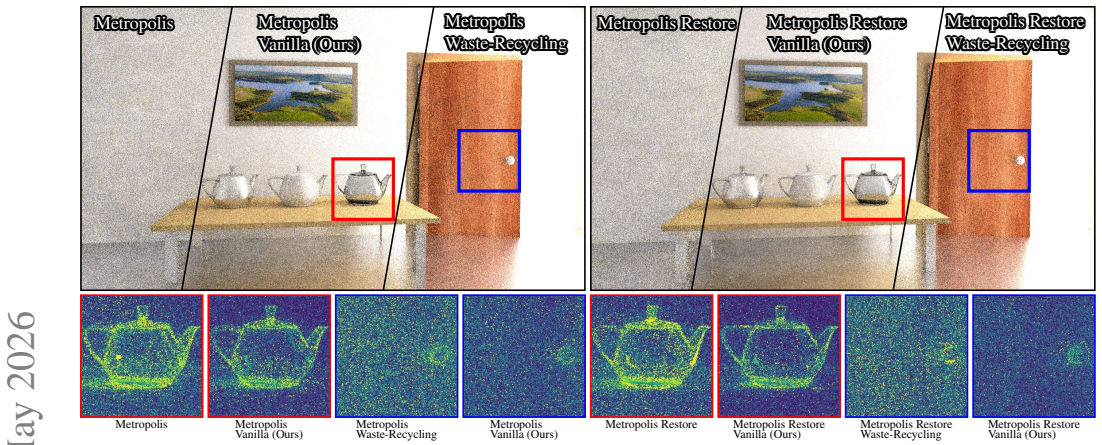
We introduce a novel Rao-Blackwellization technique for the general-purpose Metropolis-Hastings algorithm that is computationally efficient and achieves substantial variance reduction. We show that this method consistently outperforms waste-recycling in terms of both variance reduction and convergence speed. Building on this result, we adapt the proposed approach to the Jump Restore algorithm, where it similarly achieves substantial variance reduction and accelerated convergence, as demonstrated through extensive light transport experiments under equal-time and equal-sample comparisons.
What carries the argument
The novel Rao-Blackwellization technique for the Metropolis-Hastings algorithm, which uses conditional expectations on partial path information to lower variance without full recomputation of the estimator.
Load-bearing premise
The new Rao-Blackwellization technique can be applied to general light transport problems while remaining computationally efficient and delivering measurable variance reduction without hidden costs or scenario-specific limitations.
What would settle it
Implement the method on a complex lighting scene such as one containing caustics and measure whether variance or mean-squared error fails to drop below that of waste-recycling at equal wall-clock time or equal sample count.
Figures


read the original abstract
In light transport simulation, Markov chain Monte Carlo methods are particularly effective at exploring regions with complex lighting characteristics. However, estimator variance is a central concern across Monte Carlo methods in general. In light transport, high variance directly manifests as increased noise or, equivalently, longer rendering times at fixed image quality. Variance reduction techniques based on Rao-Blackwellization have proven particularly effective. In practice, however, the RB approach traditionally used in light transport, waste-recycling, can yield little to no measurable variance reduction, a fact we empirically confirm in this work. Motivated by this lack of effective variance reduction, we introduce a novel RB technique for the general-purpose Metropolis-Hastings algorithm that is computationally efficient and achieves substantial variance reduction. We show that this method consistently outperforms waste-recycling in terms of both variance reduction and convergence speed. Building on this result, we adapt the proposed RB approach to the recently introduced general-purpose Jump Restore algorithm, where it similarly achieves substantial variance reduction and accelerated convergence. Through extensive experiments in light transport simulation, we demonstrate that our \gls{rb} technique significantly outperforms the traditional approaches for both MH-based light transport algorithms and Jump Restore Light Transport, under both equal-time and equal-sample-count comparisons.
Editorial analysis
A structured set of objections, weighed in public.
Referee Report
Summary. The paper introduces a novel Rao-Blackwellized estimator for the general-purpose Metropolis-Hastings algorithm in light transport simulation. It derives the estimator, proves that it remains unbiased, and reports that the method is computationally efficient while delivering substantial variance reduction that consistently outperforms waste-recycling in both equal-time and equal-sample experiments. The same construction is applied to the Jump Restore algorithm, yielding analogous gains, with all claims supported by extensive experiments in light transport.
Significance. If the derivations and empirical results hold, the work provides a practical and effective variance-reduction tool for MCMC-based light transport that addresses the documented limitations of waste-recycling. The explicit proof of unbiasedness, the parameter-free construction, and the reproducible outperformance across multiple algorithms and comparison regimes constitute clear strengths that could improve convergence speed and image quality in complex lighting scenarios.
minor comments (2)
- [Abstract and §4 (Experiments)] The abstract states that waste-recycling 'can yield little to no measurable variance reduction' and that this is 'empirically confirm[ed]', yet the main text should include a dedicated subsection or table quantifying the observed reduction factors (or lack thereof) for the baseline across the tested scenes to make the motivation fully self-contained.
- [§3 (Derivation)] Notation for the Rao-Blackwellized estimator (e.g., the conditional expectation taken over the proposal or the auxiliary variables) should be introduced with a single, compact definition early in the derivation section rather than being re-stated in each algorithmic variant.
Simulated Author's Rebuttal
We thank the referee for the positive and accurate summary of our manuscript, including the novel Rao-Blackwellized estimator for Metropolis-Hastings, the unbiasedness proof, computational efficiency, and consistent outperformance of waste-recycling in both equal-time and equal-sample regimes. We also appreciate the extension to the Jump Restore algorithm and the overall recommendation for minor revision. No specific major comments were raised in the report.
Circularity Check
No significant circularity; derivation is mathematically self-contained
full rationale
The paper derives a Rao-Blackwellized estimator for general-purpose Metropolis-Hastings, proves unbiasedness from first principles, and validates variance reduction empirically against waste-recycling under equal-time and equal-sample protocols. The extension to Jump Restore applies the same construction without any step reducing the central claims to fitted parameters, self-definitions, or load-bearing self-citations. All load-bearing steps (estimator construction, unbiasedness proof, and comparative experiments) remain independent of the target results.
Axiom & Free-Parameter Ledger
Lean theorems connected to this paper
-
IndisputableMonolith/Cost/FunctionalEquation.leanwashburn_uniqueness_aczel unclear?
unclearRelation between the paper passage and the cited Recognition theorem.
We introduce a novel RB technique for the general-purpose Metropolis-Hastings algorithm that is computationally efficient and achieves substantial variance reduction (Abstract; Def. 5.4, Eq. 24-25).
-
IndisputableMonolith/Foundation/RealityFromDistinction.leanreality_from_one_distinction unclear?
unclearRelation between the paper passage and the cited Recognition theorem.
The vanilla RB principle... replace the waiting time τi ... by its conditional expectation given ζi (Section 5.4).
What do these tags mean?
- matches
- The paper's claim is directly supported by a theorem in the formal canon.
- supports
- The theorem supports part of the paper's argument, but the paper may add assumptions or extra steps.
- extends
- The paper goes beyond the formal theorem; the theorem is a base layer rather than the whole result.
- uses
- The paper appears to rely on the theorem as machinery.
- contradicts
- The paper's claim conflicts with a theorem or certificate in the canon.
- unclear
- Pith found a possible connection, but the passage is too broad, indirect, or ambiguous to say the theorem truly supports the claim.
Reference graph
Works this paper leans on
-
[1]
and target distribution π=N(0,1) . Table 2: Ratio of the empirical variances of our vanilla Rao–Blackwellization estimator Vtf and the standard estimator Atf of I at t= 100 for the Metropolis–Hastings algorithm with proposal kernel Q(x,·) =C(0, γ) (Cauchy distribution with mean 0 and scale γ >0 ) and initial state drawn from the target distribution π=N(0,...
work page 2026
-
[2]
The constant c in the definition in Equation (29) of the killing rate was chosen asc= 0.1
and target distribution π. The constant c in the definition in Equation (29) of the killing rate was chosen asc= 0.1. F Index of notation 24 RAO–BLACKWELLIZEDMARKOVCHAINMONTECARLOLIGHTTRANSPORT-PREPRINT- MAY12, 2026 0 200 400 600 800 1000 iterations 0.3 0.2 0.1 0.0 0.1 0.2 0.3 estimates Figure E.4: Overlay of 250 i.i.d. realizations of the standard estima...
work page 2026
-
[3]
The constant c in the definition in Equation (29) of the killing rate was chosen asc= 0.1
and target distribution π. The constant c in the definition in Equation (29) of the killing rate was chosen asc= 0.1. Table 6: Commonly used notation throughout the paper. Notation Description πTarget distribution (p. 17) λReference measure (p. 3) pDensity ofπwith respect toλ(p. 3) pλ Normalization constant ofp(p. 3) IIntegral offwith respect toπ(p. 17) Q...
discussion (0)
Sign in with ORCID, Apple, or X to comment. Anyone can read and Pith papers without signing in.