Recognition: no theorem link
Scaling Qubit Mapping and Routing With Position Graph Abstraction and Memoization
Pith reviewed 2026-05-12 04:21 UTC · model grok-4.3
The pith
Position graph abstraction with memoized heuristics scales SABRE for trapped-ion qubit mapping and routing.
A machine-rendered reading of the paper's core claim, the machinery that carries it, and where it could break.
Core claim
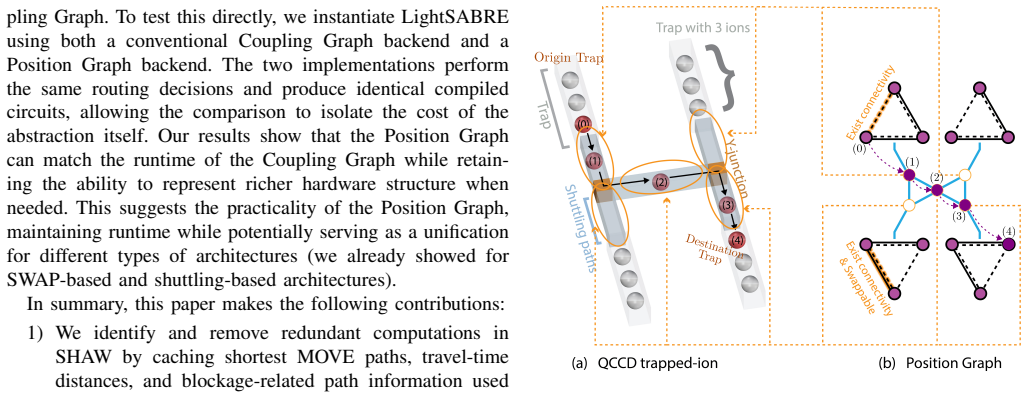
The position graph abstraction supplies a single structure that encodes all executable sites, allowable shuttling paths, and hardware constraints; applying it to SABRE permits relative move scoring and memoized congestion resolution to cache repeated evaluations and thereby accelerate compilation on TI-QCCD systems without any change to the produced routes.
What carries the argument
The position graph abstraction, a unified representation of executable locations, movement paths, and routing constraints that enables heuristic mappers to operate directly on shuttling hardware.
If this is right
- Compilation becomes feasible for larger TI-QCCD devices that were previously limited by repeated heuristic calculations.
- The same abstraction and caching approach applies to other heuristic mappers beyond SABRE.
- Redundant evaluations disappear in both single-run and repeated compilation workloads.
- The framework supports heterogeneous quantum architectures that share shuttling or routing constraints.
Where Pith is reading between the lines
- Similar caching patterns could be applied to other routing or placement heuristics that repeatedly score local moves.
- The abstraction might allow compilation to run incrementally when circuit subroutines are reused across jobs.
- Hardware vendors could embed the position graph directly in their control software to reduce offline compilation time.
Load-bearing premise
The position graph fully and accurately captures every valid movement path, congestion pattern, and trap-capacity limit, and the memoization steps reproduce the exact same decisions that the original SABRE algorithm would reach.
What would settle it
A test case in which the memoized implementation produces a different mapping or shuttling sequence than standard SABRE on the identical circuit and architecture would disprove that decisions are preserved.
Figures


read the original abstract
Scalable qubit mapping and routing remain major bottlenecks in quantum compilation, especially for Trapped-Ion Quantum Charge-Coupled device (TI-QCCD) architectures, where qubit interactions require physically shuttling ions under strict movement, congestion, and trap-capacity constraints. We present a compilation framework built around the position graph abstraction, a unified representation of executable locations, movement paths, and routing constraints that enables heuristic mappers to operate directly on shuttling-based hardware. Using this abstraction, we accelerate the SWAP-based BidiREctional heuristic search (SABRE) by implementing relative move scoring, which caches repeated heuristic move evaluations that arise during search, and memoized congestion resolution, which speeds up the resolution of repeated congestion. This optimization removes redundant computation without changing routing/shuttling decisions, improving the scalability of SABRE-based methods on TI-QCCD systems. Our results show that combining an architecture-aware abstraction with memoized heuristic evaluation yields a practical and effective path toward scalable qubit mapping and routing across heterogeneous quantum architectures.
Editorial analysis
A structured set of objections, weighed in public.
Referee Report
Summary. The paper introduces a position graph abstraction as a unified representation of executable locations, movement paths, and routing constraints for TI-QCCD architectures. It accelerates the SABRE bidirectional heuristic search algorithm via relative move scoring (caching repeated heuristic evaluations) and memoized congestion resolution, claiming these optimizations remove redundant computation without altering routing or shuttling decisions and thereby improve scalability for qubit mapping and routing on shuttling-based hardware.
Significance. If the position graph fully encodes all TI-QCCD constraints and the memoization techniques provably preserve SABRE's original decisions, the work would offer a practical engineering contribution toward scalable compilation for trapped-ion systems, extending existing heuristic mappers to heterogeneous architectures with movement and capacity limits.
major comments (2)
- [Abstract] Abstract: The central assertion that memoization of relative move scoring and congestion resolution 'removes redundant computation without changing routing/shuttling decisions' is load-bearing for the contribution but lacks any formal argument, invariant proof, or empirical verification. In bidirectional SABRE, state-dependent congestion can depend on evaluation order; if caching short-circuits a re-evaluation that would have altered a later tie-break or priority queue, the final mapping or shuttling schedule can diverge even when individual scores are identical.
- [Abstract] Abstract (results claim): The manuscript states that 'our results show' performance gains and a 'practical and effective path' toward scalability, yet provides no quantitative benchmarks, runtime comparisons, circuit fidelity metrics, or validation on concrete TI-QCCD instances. This absence prevents assessment of whether the claimed speedups are realized or whether the abstraction introduces hidden overheads.
minor comments (2)
- Clarify whether the position graph abstraction is intended to be architecture-specific to TI-QCCD or extensible to other shuttling models; the abstract's reference to 'heterogeneous quantum architectures' is not substantiated by any cross-architecture examples.
- The description of 'relative move scoring' and 'memoized congestion resolution' would benefit from pseudocode or a small worked example showing cache hits and how congestion state is keyed for memoization.
Simulated Author's Rebuttal
We thank the referee for the detailed review and constructive criticism of our manuscript. Below we respond to each major comment and describe the changes we will implement in the revision.
read point-by-point responses
-
Referee: [Abstract] Abstract: The central assertion that memoization of relative move scoring and congestion resolution 'removes redundant computation without changing routing/shuttling decisions' is load-bearing for the contribution but lacks any formal argument, invariant proof, or empirical verification. In bidirectional SABRE, state-dependent congestion can depend on evaluation order; if caching short-circuits a re-evaluation that would have altered a later tie-break or priority queue, the final mapping or shuttling schedule can diverge even when individual scores are identical.
Authors: We appreciate the referee highlighting the need for stronger justification of the invariance claim. The current manuscript asserts preservation based on the memoization design, which caches identical heuristic evaluations and congestion resolutions without modifying search logic or priority queues. To address the specific concern about potential divergence in bidirectional SABRE due to evaluation order, we will add empirical verification in the revised version by comparing outputs of the original and memoized implementations on benchmark circuits, confirming identical mappings and schedules. We will also clarify in the text how memoization keys are constructed to maintain consistency for state-dependent elements. revision: yes
-
Referee: [Abstract] Abstract (results claim): The manuscript states that 'our results show' performance gains and a 'practical and effective path' toward scalability, yet provides no quantitative benchmarks, runtime comparisons, circuit fidelity metrics, or validation on concrete TI-QCCD instances. This absence prevents assessment of whether the claimed speedups are realized or whether the abstraction introduces hidden overheads.
Authors: We agree that the abstract's performance claims require supporting quantitative data for proper evaluation. In the revised manuscript, we will expand the results section to include explicit runtime comparisons with baseline SABRE, scalability benchmarks across circuit sizes on representative TI-QCCD instances, and checks for any overhead introduced by the position graph abstraction. Where relevant, we will also report metrics related to compiled circuit quality to demonstrate that the optimizations preserve decision fidelity. revision: yes
Circularity Check
No circularity detected in position graph abstraction or memoized SABRE optimizations
full rationale
The paper introduces a new position graph abstraction as a unified representation for TI-QCCD constraints and applies standard memoization (relative move scoring and congestion resolution caching) to the pre-existing SABRE algorithm. The central claim—that these changes improve scalability without altering routing or shuttling decisions—is framed as an algorithmic engineering result resting on the abstraction's explicit design and the properties of caching, not on any self-referential definition, fitted parameters renamed as predictions, or load-bearing self-citations. No equations reduce to their inputs by construction, no uniqueness theorems are imported from the authors' prior work, and no known results are merely renamed. The derivation chain is self-contained against external benchmarks (SABRE) and does not exhibit any of the enumerated circularity patterns.
Axiom & Free-Parameter Ledger
axioms (1)
- domain assumption Graph representations can unify locations, paths, and constraints for ion shuttling.
invented entities (1)
-
Position graph abstraction
no independent evidence
Reference graph
Works this paper leans on
-
[1]
Chenghong Zhu, Xian Wu, Zhaohui Yang, Jingbo Wang, Anbang Wu, Shenggen Zheng, and Xin Wang. Quantum compiler design for qubit mapping and routing: A cross-architectural survey of superconducting, trapped-ion, and neutral atom systems.arXiv preprint arXiv:2505.16891, 2025
-
[2]
On the qubit routing problem.arXiv preprint arXiv:1902.08091, 2019
Alexander Cowtan, Silas Dilkes, Ross Duncan, Alexandre Krajenbrink, Will Simmons, and Seyon Sivarajah. On the qubit routing problem. arXiv preprint arXiv:1902.08091, 2019
-
[3]
Deterministic entanglement swapping in a superconducting circuit
Wen Ning, Xin-Jie Huang, Pei-Rong Han, Hekang Li, Hui Deng, Zhen- Biao Yang, Zhi-Rong Zhong, Yan Xia, Kai Xu, Dongning Zheng, et al. Deterministic entanglement swapping in a superconducting circuit. Physical review letters, 123(6):060502, 2019
work page 2019
-
[4]
How to wire a 1000- qubit trapped-ion quantum computer.PRX Quantum, 4(4):040313, 2023
M Malinowski, DTC Allcock, and CJ Ballance. How to wire a 1000- qubit trapped-ion quantum computer.PRX Quantum, 4(4):040313, 2023
work page 2023
-
[5]
Demonstration of the trapped-ion quantum ccd computer architecture.Nature, 592(7853):209–213, 2021
Juan M Pino, Jennifer M Dreiling, Caroline Figgatt, John P Gaebler, Steven A Moses, MS Allman, CH Baldwin, Michael Foss-Feig, David Hayes, Karl Mayer, et al. Demonstration of the trapped-ion quantum ccd computer architecture.Nature, 592(7853):209–213, 2021
work page 2021
-
[6]
Adam Siegel, Armands Strikis, and Michael Fogarty. Towards early fault tolerance on a 2×n array of qubits equipped with shuttling.PRX Quantum, 5(4):040328, 2024. TABLE III PROFILING OF_C A N_E X EIMPLEMENTATIONS INLIGHTSABRE. CGEVALUATES EXECUTABILITY USING REPEATED SUBGRAPH EXTRACTION, WHEREASPGUSES CACHEDPOSITIONGRAPH EXECUTE ADJACENCY. VALUES ARE AVERA...
work page 2024
-
[7]
High-fidelity single-spin shuttling in silicon.Nature Nanotechnology, 20(7):866–872, 2025
Maxim De Smet, Yuta Matsumoto, Anne-Marije J Zwerver, Larysa Tryputen, Sander L de Snoo, Sergey V Amitonov, Sam R Katiraee-Far, Amir Sammak, Nodar Samkharadze, ¨Onder G ¨ul, et al. High-fidelity single-spin shuttling in silicon.Nature Nanotechnology, 20(7):866–872, 2025
work page 2025
-
[8]
Bao Bach, Ilya Safro, and Ed Younis. Efficient compilation for shuttling trapped-ion machines via the position graph architectural abstraction. arXiv preprint arXiv:2501.12470, 2025
-
[9]
Tackling the qubit mapping problem for nisq-era quantum devices
Gushu Li, Yufei Ding, and Yuan Xie. Tackling the qubit mapping problem for nisq-era quantum devices. InProceedings of the twenty- fourth international conference on architectural support for program- ming languages and operating systems, pages 1001–1014, 2019
work page 2019
-
[10]
Berkeley quantum synthesis toolkit (bqskit) v1
Ed Younis, Costin C Iancu, Wim Lavrijsen, Marc Davis, and Ethan Smith. Berkeley quantum synthesis toolkit (bqskit) v1. Technical report, Lawrence Berkeley National Laboratory (LBNL), Berkeley, CA (United States), 2021
work page 2021
-
[11]
Jens Koch, Terri M Yu, Jay Gambetta, Andrew A Houck, David I Schuster, Johannes Majer, Alexandre Blais, Michel H Devoret, Steven M Girvin, and Robert J Schoelkopf. Charge-insensitive qubit design derived from the cooper pair box.Physical Review A—Atomic, Molecular, and Optical Physics, 76(4):042319, 2007
work page 2007
-
[12]
Architecture for a large-scale ion-trap quantum computer.Nature, 417(6890):709–711, 2002
David Kielpinski, Chris Monroe, and David J Wineland. Architecture for a large-scale ion-trap quantum computer.Nature, 417(6890):709–711, 2002
work page 2002
-
[13]
Quantum circuit optimization and transpi- lation via parameterized circuit instantiation
Ed Younis and Costin Iancu. Quantum circuit optimization and transpi- lation via parameterized circuit instantiation. In2022 IEEE International Conference on Quantum Computing and Engineering (QCE), pages 465–475. IEEE, 2022
work page 2022
-
[14]
Advantages and limitations of quantum routing.PRX quantum, 4(1):010313, 2023
Aniruddha Bapat, Andrew M Childs, Alexey V Gorshkov, and Eddie Schoute. Advantages and limitations of quantum routing.PRX quantum, 4(1):010313, 2023
work page 2023
-
[15]
Muqut: Multi-constraint quantum circuit mapping on nisq computers
Debjyoti Bhattacharjee, Abdullah Ash Saki, Mahabubul Alam, Anupam Chattopadhyay, and Swaroop Ghosh. Muqut: Multi-constraint quantum circuit mapping on nisq computers. In2019 IEEE/ACM international conference on computer-aided design (ICCAD), pages 1–7. IEEE, 2019
work page 2019
-
[16]
Tackling the qubit mapping problem with permutation- aware synthesis
Ji Liu, Ed Younis, Mathias Weiden, Paul Hovland, John Kubiatowicz, and Costin Iancu. Tackling the qubit mapping problem with permutation- aware synthesis. In2023 IEEE International Conference on Quantum Computing and Engineering (QCE), volume 1, pages 745–756. IEEE, 2023
work page 2023
- [17]
-
[18]
Ge Yan, Wenjie Wu, Yuheng Chen, Kaisen Pan, Xudong Lu, Zixiang Zhou, Yuhan Wang, Ruocheng Wang, and Junchi Yan. Quantum circuit synthesis and compilation optimization: Overview and prospects.arXiv preprint arXiv:2407.00736, 2024
-
[19]
Architecting noisy intermediate-scale trapped ion quantum computers
Prakash Murali, Dripto M Debroy, Kenneth R Brown, and Margaret Martonosi. Architecting noisy intermediate-scale trapped ion quantum computers. In2020 ACM/IEEE 47th Annual International Symposium on Computer Architecture (ISCA), pages 529–542. IEEE, 2020
work page 2020
-
[20]
Muzzle the shuttle: Efficient compilation for multi-trap trapped-ion quantum computers
Abdullah Ash Saki, Rasit Onur Topaloglu, and Swaroop Ghosh. Muzzle the shuttle: Efficient compilation for multi-trap trapped-ion quantum computers. In2022 Design, Automation & Test in Europe Conference & Exhibition (DATE), pages 322–327. IEEE, 2022
work page 2022
-
[21]
S-sync: Shuttle and swap co-optimization in quantum charge-coupled devices
Chenghong Zhu, Xian Wu, Jingbo Wang, and Xin Wang. S-sync: Shuttle and swap co-optimization in quantum charge-coupled devices. In Proceedings of the 52nd Annual International Symposium on Computer Architecture, pages 271–284, 2025
work page 2025
-
[22]
Jixuan Ruan, Hezi Zhang, Xiang Fang, Ang Li, Wesley C Campbell, Eric Hudson, David Hayes, Hartmut Haeffner, Travis Humble, Jens Palsberg, et al. Trapsimd: Simd-aware compiler optimization for 2d trapped-ion quantum machines.arXiv preprint arXiv:2504.17886, 2025
-
[23]
Marcos Yukio Siraichi, Vin ´ıcius Fernandes dos Santos, Caroline Col- lange, and Fernando Magno Quint ˜ao Pereira. Qubit allocation as a combination of subgraph isomorphism and token swapping.Proceedings of the ACM on Programming Languages, 3(OOPSLA):1–29, 2019
work page 2019
-
[24]
Pengcheng Zhu, Xueyun Cheng, and Zhijin Guan. An exact qubit alloca- tion approach for nisq architectures.Quantum Information Processing, 19(11):391, 2020
work page 2020
-
[25]
Optimal layout synthesis for quantum computing
Bochen Tan and Jason Cong. Optimal layout synthesis for quantum computing. InProceedings of the 39th International Conference on Computer-Aided Design, pages 1–9, 2020
work page 2020
-
[26]
Giacomo Nannicini, Lev S Bishop, Oktay G ¨unl¨uk, and Petar Jurcevic. Optimal qubit assignment and routing via integer programming.ACM Transactions on Quantum Computing, 4(1):1–31, 2022
work page 2022
-
[27]
Satis- fiability modulo theories-based qubit mapping for trapped-ion quantum computing systems
Wei-Hsiang Tseng, Yao-Wen Chang, and Jie-Hong Roland Jiang. Satis- fiability modulo theories-based qubit mapping for trapped-ion quantum computing systems. InProceedings of the 2024 International Symposium on Physical Design, pages 245–253, 2024
work page 2024
-
[28]
Using boolean satisfiability for exact shuttling in trapped-ion quantum computers
Daniel Schoenberger, Stefan Hillmich, Matthias Brandl, and Robert Wille. Using boolean satisfiability for exact shuttling in trapped-ion quantum computers. In2024 29th Asia and South Pacific Design Automation Conference (ASP-DAC), pages 127–133. IEEE, 2024
work page 2024
-
[29]
Chi Zhang, Ari B Hayes, Longfei Qiu, Yuwei Jin, Yanhao Chen, and Eddy Z Zhang. Time-optimal qubit mapping. InProceedings of the 26th ACM international conference on architectural support for programming languages and operating systems, pages 360–374, 2021
work page 2021
-
[30]
A Quantum Approximate Optimization Algorithm
Edward Farhi, Jeffrey Goldstone, and Sam Gutmann. A quantum approximate optimization algorithm.arXiv preprint arXiv:1411.4028, 2014
work page internal anchor Pith review Pith/arXiv arXiv 2014
-
[31]
Cambridge university press Cambridge, 2001
Michael A Nielsen and Isaac L Chuang.Quantum computation and quantum information, volume 2. Cambridge university press Cambridge, 2001
work page 2001
-
[32]
Quantum algorithm providing exponential speed increase for finding eigenvalues and eigenvectors
Daniel S Abrams and Seth Lloyd. Quantum algorithm providing exponential speed increase for finding eigenvalues and eigenvectors. Physical Review Letters, 83(24):5162, 1999
work page 1999
-
[33]
Peter W Shor. Polynomial-time algorithms for prime factorization and discrete logarithms on a quantum computer.SIAM review, 41(2):303– 332, 1999
work page 1999
-
[34]
Wood, Jake Lishman, Julien Gacon, Simon Martiel, Paul D
Ali Javadi-Abhari, Matthew Treinish, Kevin Krsulich, Christopher J. Wood, Jake Lishman, Julien Gacon, Simon Martiel, Paul D. Nation, Lev S. Bishop, Andrew W. Cross, Blake R. Johnson, and Jay M. Gambetta. Quantum computing with Qiskit, 2024
work page 2024
-
[35]
Algebraic compression of quantum circuits for hamiltonian evolution
Efekan K ¨okc¨u, Daan Camps, Lindsay Bassman Oftelie, James K Fre- ericks, Wibe A de Jong, Roel Van Beeumen, and Alexander F Kemper. Algebraic compression of quantum circuits for hamiltonian evolution. Physical Review A, 105(3):032420, 2022
work page 2022
discussion (0)
Sign in with ORCID, Apple, or X to comment. Anyone can read and Pith papers without signing in.