Recognition: 3 theorem links
· Lean TheoremAn Uncertainty-Aware Resilience Micro-Agent for Causal Observability in the Computing Continuum
Pith reviewed 2026-05-12 04:16 UTC · model grok-4.3
The pith
Micro-agents diagnose and repair grey failures at the edge using causal reasoning while avoiding destructive fixes through uncertainty gates.
A machine-rendered reading of the paper's core claim, the machinery that carries it, and where it could break.
Core claim
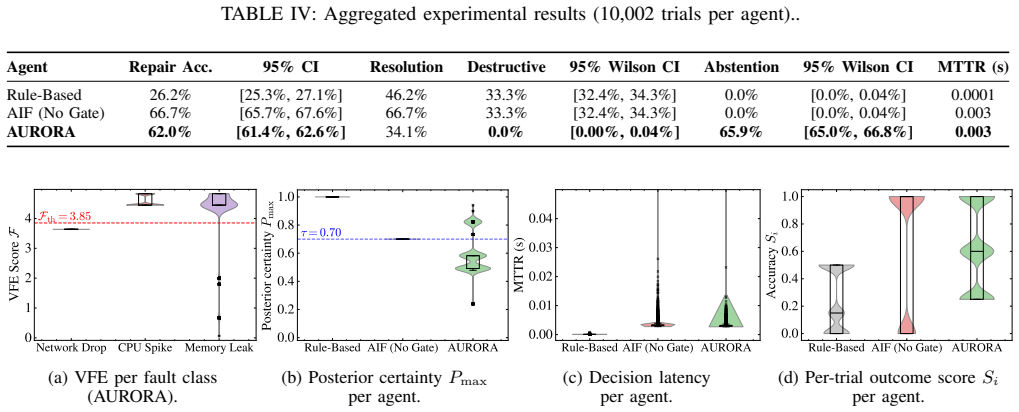
AURORA employs parallel micro-agents that integrate the free-energy principle, causal do-calculus, and localized causal state-graphs to support counterfactual root-cause analysis within each fault's Markov blanket. Restricting inference to causally relevant variables reduces computational overhead while preserving diagnostic fidelity. The dual-gated execution mechanism authorizes remediation only when causal confidence is high and predicted epistemic uncertainty is bounded; otherwise, it abstains from local intervention and escalates the diagnostic payload to the fog tier. Our experiments demonstrate that AURORA outperforms baselines, achieving a 0% destructive action rate, while maintaining
What carries the argument
Dual-gated execution mechanism based on causal confidence from free-energy principle and do-calculus applied to localized causal state-graphs within Markov blankets, authorizing local fixes only when uncertainty is bounded.
If this is right
- Local repairs can be performed safely without destructive actions in edge environments.
- Diagnostic accuracy reaches 62% with a mean time to repair of 3 milliseconds.
- Escalation to higher tiers handles cases of high uncertainty, maintaining overall system resilience.
- Computational overhead is reduced by limiting analysis to causally relevant variables.
Where Pith is reading between the lines
- The Markov blanket restriction could allow scaling the method to larger distributed systems by keeping each agent's scope small.
- Feedback from escalated cases might allow the fog tier to refine causal models over time.
- The same gated-causal pattern could apply to other domains with ambiguous faults, such as sensor networks or autonomous vehicle diagnostics.
Load-bearing premise
The integration of free-energy principle and do-calculus within localized causal state-graphs can reliably compute causal confidence and bound epistemic uncertainty such that the dual-gated mechanism correctly distinguishes safe local interventions from cases requiring escalation.
What would settle it
A controlled simulation of grey failures in which the agent authorizes a local intervention that damages the system or fails to repair a fault that a baseline method would handle correctly.
Figures



read the original abstract
Grey failures in the computing continuum produce ambiguous overlapping symptoms that existing approaches fail to diagnose reliably, either due to a lack of causal awareness or acting under high epistemic uncertainty, risking destructive interventions. This paper presents an uncertainty-aware resilience micro-agent for causal observability (AURORA), a lightweight framework for diagnosing and mitigating grey failures in edge-tier environments. The framework employs parallel micro-agents that integrate the free-energy principle, causal do-calculus, and localized causal state-graphs to support counterfactual root-cause analysis within each fault's Markov blanket. Restricting inference to causally relevant variables reduces computational overhead while preserving diagnostic fidelity. AURORA further introduces a dual-gated execution mechanism that authorizes remediation only when causal confidence is high and predicted epistemic uncertainty is bounded; otherwise, it abstains from local intervention and escalates the diagnostic payload to the fog tier. Our experiments demonstrate that AURORA outperforms baselines, achieving a 0% destructive action rate, while maintaining 62.0% repair accuracy and a 3ms mean time to repair.
Editorial analysis
A structured set of objections, weighed in public.
Referee Report
Summary. The manuscript presents AURORA, a lightweight micro-agent framework for resilience against grey failures in the computing continuum. It combines the free-energy principle with causal do-calculus on localized state-graphs to perform counterfactual root-cause analysis within Markov blankets. A dual-gated execution mechanism is introduced to authorize local interventions only under high causal confidence and bounded epistemic uncertainty, escalating otherwise. The authors claim that experiments show AURORA achieving 0% destructive actions, 62% repair accuracy, and 3 ms mean time to repair, outperforming baselines.
Significance. If the experimental claims are substantiated, this could advance resilience mechanisms in edge computing by offering a principled way to handle epistemic uncertainty in ambiguous fault diagnosis. The integration of active inference with causal reasoning in a micro-agent architecture addresses a practical gap, and the abstention policy when uncertainty is high is a positive design choice for safety-critical systems.
major comments (2)
- [Abstract and Experimental Results] Abstract and Experimental Results section: The headline claims of 0% destructive action rate, 62.0% repair accuracy, and 3 ms MTTR are stated without any description of the experimental setup, fault models, datasets, baseline implementations, number of trials, or statistical analysis. This is load-bearing for the central performance claim, as the 0% figure requires explicit evidence that the dual gate respected the epistemic uncertainty bounds on every trial.
- [Framework Design] Framework Design section: The dual-gated execution mechanism is defined to act only when causal confidence is high and epistemic uncertainty is bounded via free-energy minimization and do-calculus on the localized causal state-graph. No update equations for active inference, no procedure for deriving the numeric gate thresholds, and no validation against external benchmarks are supplied. Without these, the reported 0% destructive action rate cannot be distinguished from an internal definitional artifact.
minor comments (2)
- The manuscript would benefit from a dedicated table listing all free parameters (e.g., causal confidence threshold, epistemic uncertainty bound) and their default values or tuning procedures.
- The term 'Markov blanket' is invoked repeatedly but never given an explicit definition or diagram in the context of the localized causal state-graphs used by the micro-agents.
Simulated Author's Rebuttal
We thank the referee for the constructive feedback and the recommendation for major revision. We address each major comment point by point below and outline the specific revisions we will make to address the concerns.
read point-by-point responses
-
Referee: [Abstract and Experimental Results] Abstract and Experimental Results section: The headline claims of 0% destructive action rate, 62.0% repair accuracy, and 3 ms MTTR are stated without any description of the experimental setup, fault models, datasets, baseline implementations, number of trials, or statistical analysis. This is load-bearing for the central performance claim, as the 0% figure requires explicit evidence that the dual gate respected the epistemic uncertainty bounds on every trial.
Authors: We agree that the abstract and Experimental Results section currently present the headline metrics without adequate supporting detail on the experimental methodology. In the revised manuscript, we will substantially expand the Experimental Results section to include a full description of the experimental setup, fault models, datasets, baseline implementations, number of trials, and statistical analysis. We will also add explicit evidence showing that the dual gate respected the epistemic uncertainty bounds across all trials, thereby substantiating the 0% destructive action rate. The abstract will be updated to reference these expanded details. revision: yes
-
Referee: [Framework Design] Framework Design section: The dual-gated execution mechanism is defined to act only when causal confidence is high and epistemic uncertainty is bounded via free-energy minimization and do-calculus on the localized causal state-graph. No update equations for active inference, no procedure for deriving the numeric gate thresholds, and no validation against external benchmarks are supplied. Without these, the reported 0% destructive action rate cannot be distinguished from an internal definitional artifact.
Authors: We acknowledge that the Framework Design section lacks the requested mathematical and procedural details. In the revised manuscript, we will augment this section with the update equations for active inference, a step-by-step procedure for deriving the numeric thresholds on the causal confidence and epistemic uncertainty gates, and any validation performed against external benchmarks. These additions will provide the necessary rigor to support the performance claims and demonstrate that the 0% destructive action rate is experimentally grounded rather than definitional. revision: yes
Circularity Check
No circularity: claims rest on empirical results without self-referential reduction
full rationale
The abstract describes integration of free-energy principle, do-calculus and localized causal graphs into a dual-gated mechanism, then reports experimental outcomes (0% destructive actions, 62% repair accuracy, 3 ms MTTR). No equations, parameter-fitting steps, self-citations, or uniqueness theorems are supplied that would make any performance metric equivalent to its inputs by construction. The dual-gate is presented as an architectural choice whose correctness is asserted via experiment rather than derived tautologically from the same quantities it uses. Absent any quoted reduction (e.g., confidence score defined as a function that forces the gate to pass), the derivation chain does not exhibit circularity.
Axiom & Free-Parameter Ledger
free parameters (2)
- causal confidence threshold
- epistemic uncertainty bound
axioms (2)
- domain assumption Free-energy principle can quantify epistemic uncertainty for causal root-cause analysis in fault diagnosis
- standard math Do-calculus enables valid counterfactual reasoning within a fault's Markov blanket
invented entities (1)
-
Dual-gated execution mechanism
no independent evidence
Lean theorems connected to this paper
-
IndisputableMonolith/Cost/FunctionalEquation.leanwashburn_uniqueness_aczel echoes?
echoesECHOES: this paper passage has the same mathematical shape or conceptual pattern as the Recognition theorem, but is not a direct formal dependency.
dual-gated execution mechanism that authorizes remediation only when causal confidence is high and predicted epistemic uncertainty is bounded
-
IndisputableMonolith/Foundation/AlexanderDuality.leanalexander_duality_circle_linking unclear?
unclearRelation between the paper passage and the cited Recognition theorem.
Markov blanket-constrained inference ... do-calculus counterfactual
What do these tags mean?
- matches
- The paper's claim is directly supported by a theorem in the formal canon.
- supports
- The theorem supports part of the paper's argument, but the paper may add assumptions or extra steps.
- extends
- The paper goes beyond the formal theorem; the theorem is a base layer rather than the whole result.
- uses
- The paper appears to rely on the theorem as machinery.
- contradicts
- The paper's claim conflicts with a theorem or certificate in the canon.
- unclear
- Pith found a possible connection, but the passage is too broad, indirect, or ambiguous to say the theorem truly supports the claim.
Reference graph
Works this paper leans on
-
[1]
Governance at the edge: Agent-driven privacy mediation for mobile and iot data,
M. Khan, F. Sarhaddi, A. Zuniga, H. Flores, S. Tarkoma, and P. Nurmi, “Governance at the edge: Agent-driven privacy mediation for mobile and iot data,” inProceedings of the 27th International Workshop on Mobile Computing Systems and Applications, pp. 85–90, 2026
work page 2026
-
[2]
Resilient by design–active inference for distributed continuum intelligence,
P. K. Donta, A. Lapkovskis, E. Mingozzi, and S. Dustdar, “Resilient by design–active inference for distributed continuum intelligence,” arXiv preprint arXiv:2511.07202, 2025
-
[3]
Gover- nance and sustainability of distributed continuum systems: A big data approach,
P. K. Donta, B. Sedlak, V . Casamayor Pujol, and S. Dustdar, “Gover- nance and sustainability of distributed continuum systems: A big data approach,”Journal of Big Data, vol. 10, no. 1, p. 53, 2023
work page 2023
-
[4]
Equilibrium-driven antifragility in computing continuum systems,
N.-M. Rouska, V . Casamayor-Pujol, I. M. de Abril, and S. Dustdar, “Equilibrium-driven antifragility in computing continuum systems,” IEEE Internet Computing, vol. 29, no. 5, pp. 55–64, 2026
work page 2026
-
[5]
arXiv preprint arXiv:2508.20019 , year =
J. Wanget al., “Symphony: A decentralized multi-agent framework for scalable collective intelligence,”arXiv preprint arXiv:2508.20019, 2025
-
[6]
Bio-inspired agentic self-healing framework for resilient distributed computing continuum systems,
A. Saleh, P. K. Donta, R. Morabito, S. Tarkoma, A. Lindgren, Q. Zhang, S. Dustdar, S. Pirttikangas, and L. Lov ´en, “Bio-inspired agentic self-healing framework for resilient distributed computing continuum systems,”arXiv preprint arXiv:2601.00339, 2026
-
[7]
arXiv preprint arXiv:2603.21145 (2026)
P. Ye, A. Lapkovskis, A. Saleh, Q. Zhang, and P. K. Donta, “Nesy- edge: Neuro-symbolic trustworthy self-healing in the computing con- tinuum,”arXiv preprint arXiv:2603.21145, 2026
-
[8]
Resilience in the cloud-to-things continuum,
D. P. Abreu, K. Velasquez, B. Faria, M. Curado, and E. Monteiro, “Resilience in the cloud-to-things continuum,” inCyber Resilience: Applied Perspectives, pp. 159–179, Springer, 2025
work page 2025
-
[9]
Autonomic computing rebooted: Taming the computing continuum,
M. Parashar, “Autonomic computing rebooted: Taming the computing continuum,”ACM Transactions on Autonomous and Adaptive Systems, 2025
work page 2025
-
[10]
Equi- librium in the computing continuum through active inference,
B. Sedlak, P. K. Donta, V . Casamayor Pujol, and S. Dustdar, “Equi- librium in the computing continuum through active inference,”Future Generation Computer Systems, vol. 160, pp. 92–108, 2024
work page 2024
-
[11]
A. Darwiche, “Bayesian networks,”Foundations of Artificial Intelli- gence, vol. 3, pp. 467–509, 2008
work page 2008
-
[12]
M. Scutari, C. Vitolo, and A. Tucker, “Learning bayesian networks from big data with greedy search: computational complexity and ef- ficient implementation,”Statistics and Computing, vol. 29, pp. 1095– 1108, 2019
work page 2019
-
[13]
C. Aliferiset al., “Local causal and markov blanket induction for causal discovery and feature selection part i: Algorithms and empirical evaluation,”Journal of Machine Learning Research, vol. 11, 2010
work page 2010
-
[14]
Efficient markov blanket discovery and its appli- cation,
T. Gao and Q. Ji, “Efficient markov blanket discovery and its appli- cation,”IEEE transactions on Cybernetics, vol. 47, no. 5, pp. 1169– 1179, 2016
work page 2016
-
[15]
Pearl,Causality: Models, Reasoning, and Inference
J. Pearl,Causality: Models, Reasoning, and Inference. Cambridge University Press, 2nd ed., 2009
work page 2009
-
[16]
The free-energy principle: A unified brain theory?,
K. Friston, “The free-energy principle: A unified brain theory?,” Nature Reviews Neuroscience, vol. 11, no. 2, pp. 127–138, 2010
work page 2010
discussion (0)
Sign in with ORCID, Apple, or X to comment. Anyone can read and Pith papers without signing in.