Recognition: 2 theorem links
· Lean TheoremCharacterizing Pulsar Distances Using HI Kinematics
Pith reviewed 2026-05-12 03:56 UTC · model grok-4.3
The pith
HI kinematic distances for 66 pulsars match published parallaxes to within 1 sigma
A machine-rendered reading of the paper's core claim, the machinery that carries it, and where it could break.
Core claim
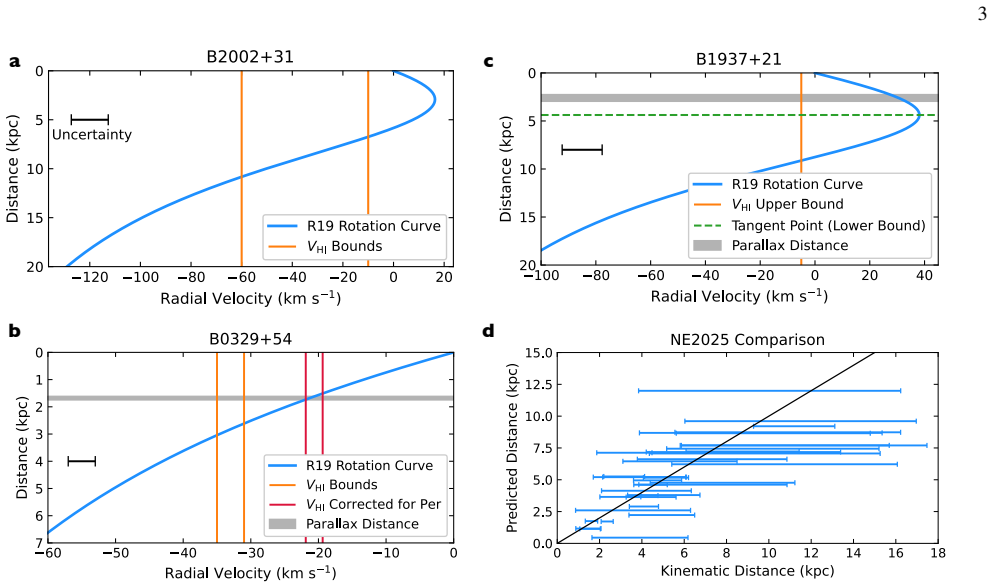
Using a state-of-the-art Galactic rotation curve, the authors calculate kinematic distances for 66 pulsars from HI radial velocity measurements and demonstrate that these distances differ by less than 1 sigma from published parallaxes for nearly all pulsars in the sample that have both types of distance measurement available, with general consistency to the NE2025 Galactic electron density model.
What carries the argument
HI kinematics, which determines distances by matching observed radial velocities of neutral hydrogen absorption and emission features along the line of sight to a Galactic rotation curve model.
If this is right
- An updated catalog of kinematic distances for 66 pulsars is now available.
- HI kinematics remains a reliable distance method when paired with current rotation curve models.
- The results and software are openly shared to support reproducibility and reuse.
- The distances show consistency with independent electron density model predictions.
Where Pith is reading between the lines
- Future HI surveys could apply the same approach to additional pulsars lacking parallax data.
- Further refinements to Galactic rotation models would likely tighten the uncertainties on these distances.
- The distances could be combined with other observables to improve estimates of pulsar velocities or luminosities.
Load-bearing premise
The distance calculation requires adopting a specific model for how the Galaxy rotates, whose accuracy and precision continue to improve.
What would settle it
A systematic comparison in which kinematic distances deviate by more than 1 sigma from parallaxes for a substantial fraction of pulsars that have both measurements would falsify the reported agreement.
Figures
read the original abstract
Distance measurements are fundamental to radio pulsars' use as astrophysical probes of General Relativity and the interstellar medium. One of the primary methods for determining pulsar distances is HI kinematics, which leverages the radial velocities of HI absorption and emission features detected along pulsar lines-of-sight. This method necessarily assumes a model for Galactic rotation, our knowledge of which continues to evolve in both accuracy and precision. In this research note, we derive kinematic distances for 66 pulsars with archival HI radial velocity measurements using a state-of-the-art Galactic rotation curve. The results and software are provided in an online repository. Our kinematic distances differ by $<1\sigma$ from published parallaxes for nearly all pulsars in the sample that have both types of distance measurement available. Comparison to the NE2025 Galactic electron density model shows general consistency between measured and predicted distances.
Editorial analysis
A structured set of objections, weighed in public.
Referee Report
Summary. The manuscript derives kinematic distances for 66 pulsars from archival HI absorption and emission radial-velocity measurements by applying a modern Galactic rotation curve. It reports that these distances agree with published parallax values to within 1σ for nearly all objects possessing both measurements and shows general consistency with distances predicted by the NE2025 electron-density model. The derived distances and the associated software are released in a public repository.
Significance. If the reported agreement holds, the work supplies a uniformly re-derived set of pulsar distances that incorporates the latest rotation-curve constraints and is externally validated against independent parallax and electron-density data. The public release of both the distance catalog and the analysis code is a clear strength, supporting reproducibility and future re-analysis as rotation models continue to improve.
minor comments (2)
- [Abstract] Abstract: the abstract states that distances differ by <1σ from parallaxes but provides no information on how uncertainties were propagated or on the data-selection criteria used to assemble the 66-pulsar sample; adding one sentence on each would improve the summary of the central result.
- [Methods] The manuscript would benefit from an explicit statement (perhaps in §2 or §3) of the precise rotation-curve parameters adopted and of any velocity-to-distance inversion algorithm details, even if the code repository contains the implementation.
Simulated Author's Rebuttal
We thank the referee for their positive assessment of the manuscript, including the recognition of its significance in providing a uniformly re-derived pulsar distance catalog based on the latest Galactic rotation curve, along with external validation against parallax and electron-density data. We also appreciate the emphasis placed on the public release of the distances and analysis code to support reproducibility.
Circularity Check
No significant circularity detected
full rationale
The paper applies an external state-of-the-art Galactic rotation curve to archival HI radial velocity measurements to derive kinematic distances for 66 pulsars. These distances are then directly compared to independent published parallax data (agreement within <1σ for nearly all overlapping objects) and to the NE2025 electron-density model. The rotation-curve assumption is explicitly noted as external and evolving; no equation, fit, or self-citation within the paper defines the output distances in terms of quantities fitted or derived from the same dataset. The central claim is therefore validated against external benchmarks rather than reducing to its own inputs by construction.
Axiom & Free-Parameter Ledger
axioms (1)
- domain assumption A model for Galactic rotation is assumed to convert observed radial velocities of HI features into distances.
Lean theorems connected to this paper
-
IndisputableMonolith/Foundation/RealityFromDistinction.leanreality_from_one_distinction unclear?
unclearRelation between the paper passage and the cited Recognition theorem.
We derive kinematic distances for 66 pulsars with archival HI radial velocity measurements using a state-of-the-art Galactic rotation curve... Our kinematic distances differ by <1σ from published parallaxes...
What do these tags mean?
- matches
- The paper's claim is directly supported by a theorem in the formal canon.
- supports
- The theorem supports part of the paper's argument, but the paper may add assumptions or extra steps.
- extends
- The paper goes beyond the formal theorem; the theorem is a base layer rather than the whole result.
- uses
- The paper appears to rely on the theorem as machinery.
- contradicts
- The paper's claim conflicts with a theorem or certificate in the canon.
- unclear
- Pith found a possible connection, but the passage is too broad, indirect, or ambiguous to say the theorem truly supports the claim.
Reference graph
Works this paper leans on
- [1]
- [2]
-
[3]
NE2001.I. A New Model for the Galactic Distribution of Free Electrons and its Fluctuations
Cordes, J. M., & Lazio, T. J. W. 2002, arXiv e-prints, astro. https://arxiv.org/abs/astro-ph/0207156
work page internal anchor Pith review Pith/arXiv arXiv 2002
-
[4]
Deller, A. T., Goss, W. M., Brisken, W. F., et al. 2019, ApJ, 875, 100, doi: 10.3847/1538-4357/ab11c7
-
[5]
Fich, M., Blitz, L., & Stark, A. A. 1989, ApJ, 342, 272, doi: 10.1086/167591
-
[6]
Frail, D. A., & Weisberg, J. M. 1990, AJ, 100, 743, doi: 10.1086/115556
-
[7]
Gaensler, B. M., Brazier, K. T. S., Manchester, R. N., Johnston, S., & Green, A. J. 1999, MNRAS, 305, 724, doi: 10.1046/j.1365-8711.1999.02500.x
-
[8]
Gaensler, B. M., & Wallace, B. J. 2003, ApJ, 594, 326, doi: 10.1086/376861
-
[9]
Hansen, B. M. S., & Phinney, E. S. 1997, MNRAS, 291, 569, doi: 10.1093/mnras/291.3.569
-
[10]
2025, arXiv e-prints, arXiv:2502.19934, doi: 10.48550/arXiv.2502.19934
Jiang, J., Cao, S., Lee, K., et al. 2025, arXiv e-prints, arXiv:2502.19934, doi: 10.48550/arXiv.2502.19934
-
[11]
Jing, W. C., Han, J. L., Hong, T., et al. 2023, MNRAS, 523, 4949, doi: 10.1093/mnras/stad1782
-
[12]
Johnston, S., Koribalski, B., Weisberg, J. M., & Wilson, W. 2001, MNRAS, 322, 715, doi: 10.1046/j.1365-8711.2001.04152.x
-
[13]
Koribalski, B., Johnston, S., Weisberg, J. M., & Wilson, W. 1995, ApJ, 441, 756, doi: 10.1086/175397
-
[14]
2018, ApJ, 852, 54, doi: 10.3847/1538-4357/aa9e89
Kothes, R., Sun, X., Gaensler, B., & Reich, W. 2018, ApJ, 852, 54, doi: 10.3847/1538-4357/aa9e89
-
[15]
Kramer, M., Stairs, I. H., Manchester, R. N., et al. 2006, Science, 314, 97, doi: 10.1126/science.1132305
-
[16]
Leahy, D. A., & Tian, W. W. 2008, A&A, 480, L25, doi: 10.1051/0004-6361:20079149
-
[17]
2021, ApJL, 911, L13, doi: 10.3847/2041-8213/abef6e
Liu, M., Krˇco, M., Li, D., et al. 2021, ApJL, 911, L13, doi: 10.3847/2041-8213/abef6e
-
[18]
Liu, M., Li, D., Dawson, J. R., et al. 2025, ApJS, 278, 13, doi: 10.3847/1538-4365/adbe66
-
[19]
Manchester, R. N., & Taylor, J. H. 1981, AJ, 86, 1953, doi: 10.1086/113078
-
[20]
2008, ApJ, 676, 1189, doi: 10.1086/529005 Mr´oz, P., Udalski, A., Skowron, D
Zimmerman, N. 2008, ApJ, 676, 1189, doi: 10.1086/529005 Mr´oz, P., Udalski, A., Skowron, D. M., et al. 2019, ApJL, 870, L10, doi: 10.3847/2041-8213/aaf73f
-
[21]
Ocker, S. K., & Cordes, J. M. 2026, The Astrophysical Journal, 1002, 3, doi: 10.3847/1538-4357/ae5825
-
[22]
2002, MNRAS, 335, 965, doi: 10.1046/j.1365-8711.2002.05532.x
Ord, S. M., Bailes, M., & van Straten, W. 2002, MNRAS, 337, 409, doi: 10.1046/j.1365-8711.2002.05810.x
-
[23]
2021, ApJL, 915, L28, doi: 10.3847/2041-8213/ac0bbd
Pan, Z., Qian, L., Ma, X., et al. 2021, ApJL, 915, L28, doi: 10.3847/2041-8213/ac0bbd
-
[24]
1996, MNRAS, 281, 27, doi: 10.1093/mnras/278.1.27
Persic, M., Salucci, P., & Stel, F. 1996, MNRAS, 281, 27, doi: 10.1093/mnras/278.1.27
-
[25]
Reid, M. J. 2022, AJ, 164, 133, doi: 10.3847/1538-3881/ac80bb
-
[26]
Reid, M. J., Menten, K. M., Brunthaler, A., et al. 2014, ApJ, 783, 130, doi: 10.1088/0004-637X/783/2/130 —. 2019, ApJ, 885, 131, doi: 10.3847/1538-4357/ab4a11
-
[27]
Rudnitskii, A. G., Safutdinov, E. R., Popov, M. V ., et al. 2014, Astronomy Reports, 58, 897, doi: 10.1134/S1063772914120087
-
[28]
Strom, R. G., & Stappers, B. W. 2000, in Astronomical Society of the Pacific Conference Series, V ol. 202, IAU Colloquium 177: Pulsar Astronomy - 2000 and Beyond, ed. M. Kramer, N. Wex, & R. Wielebinski, 509
work page 2000
-
[29]
Tian, W. W., & Leahy, D. A. 2008, MNRAS, 391, L54, doi: 10.1111/j.1745-3933.2008.00557.x van Leeuwen, J., Kasian, L., Stairs, I. H., et al. 2015, ApJ, 798, 118, doi: 10.1088/0004-637X/798/2/118
-
[30]
Lorimer, D. R. 2012, ApJ, 755, 39, doi: 10.1088/0004-637X/755/1/39
-
[31]
2017, A&A, 608, A57, doi: 10.1051/0004-6361/201731518
Verbunt, F., Igoshev, A., & Cator, E. 2017, A&A, 608, A57, doi: 10.1051/0004-6361/201731518
- [32]
-
[33]
Weisberg, J. M., Siegel, M. H., Frail, D. A., & Johnston, S. 1995, ApJ, 447, 204, doi: 10.1086/175866
-
[34]
M., Stanimirovi´c, S., Xilouris, K., et al
Weisberg, J. M., Stanimirovi´c, S., Xilouris, K., et al. 2008, ApJ, 674, 286, doi: 10.1086/523345
-
[35]
Wenger, T. V ., Balser, D. S., Anderson, L. D., & Bania, T. M. 2018, ApJ, 856, 52, doi: 10.3847/1538-4357/aaaec8
-
[36]
Yao, J. M., Manchester, R. N., & Wang, N. 2017, ApJ, 835, 29, doi: 10.3847/1538-4357/835/1/29
discussion (0)
Sign in with ORCID, Apple, or X to comment. Anyone can read and Pith papers without signing in.