Recognition: 2 theorem links
· Lean TheoremBlack Hole Binary Detection Landscape for the Laser Interferometer Lunar Antenna (LILA): Signal-to-Noise Calculations & Science Cases
Pith reviewed 2026-05-13 01:30 UTC · model grok-4.3
The pith
LILA can detect intermediate-mass black hole binaries from redshifts 20-30 with four years of observation.
A machine-rendered reading of the paper's core claim, the machinery that carries it, and where it could break.
Core claim
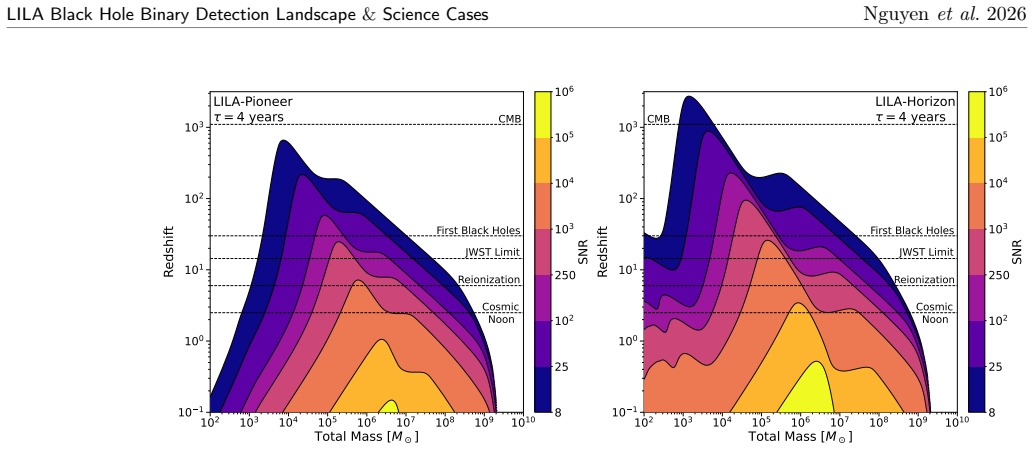
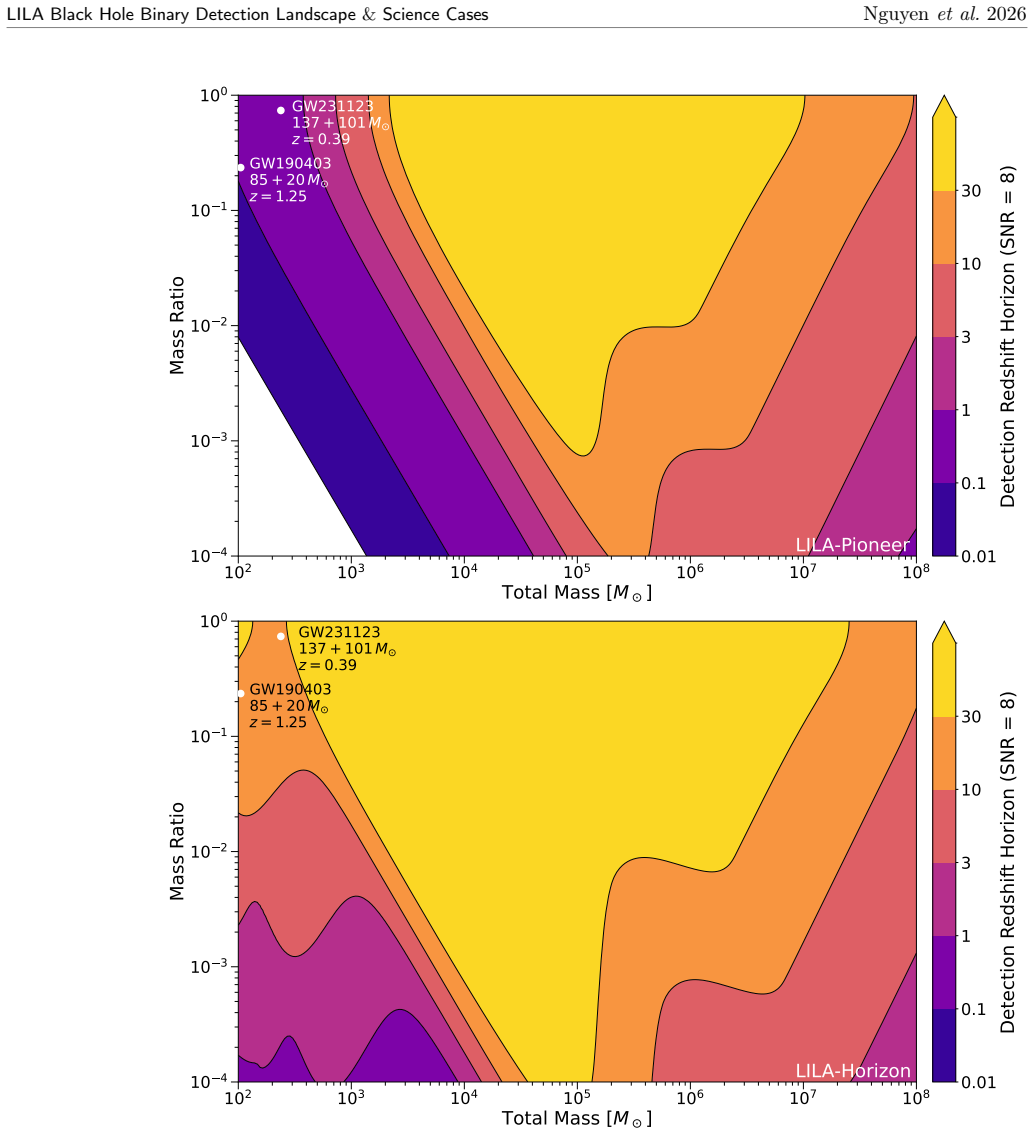
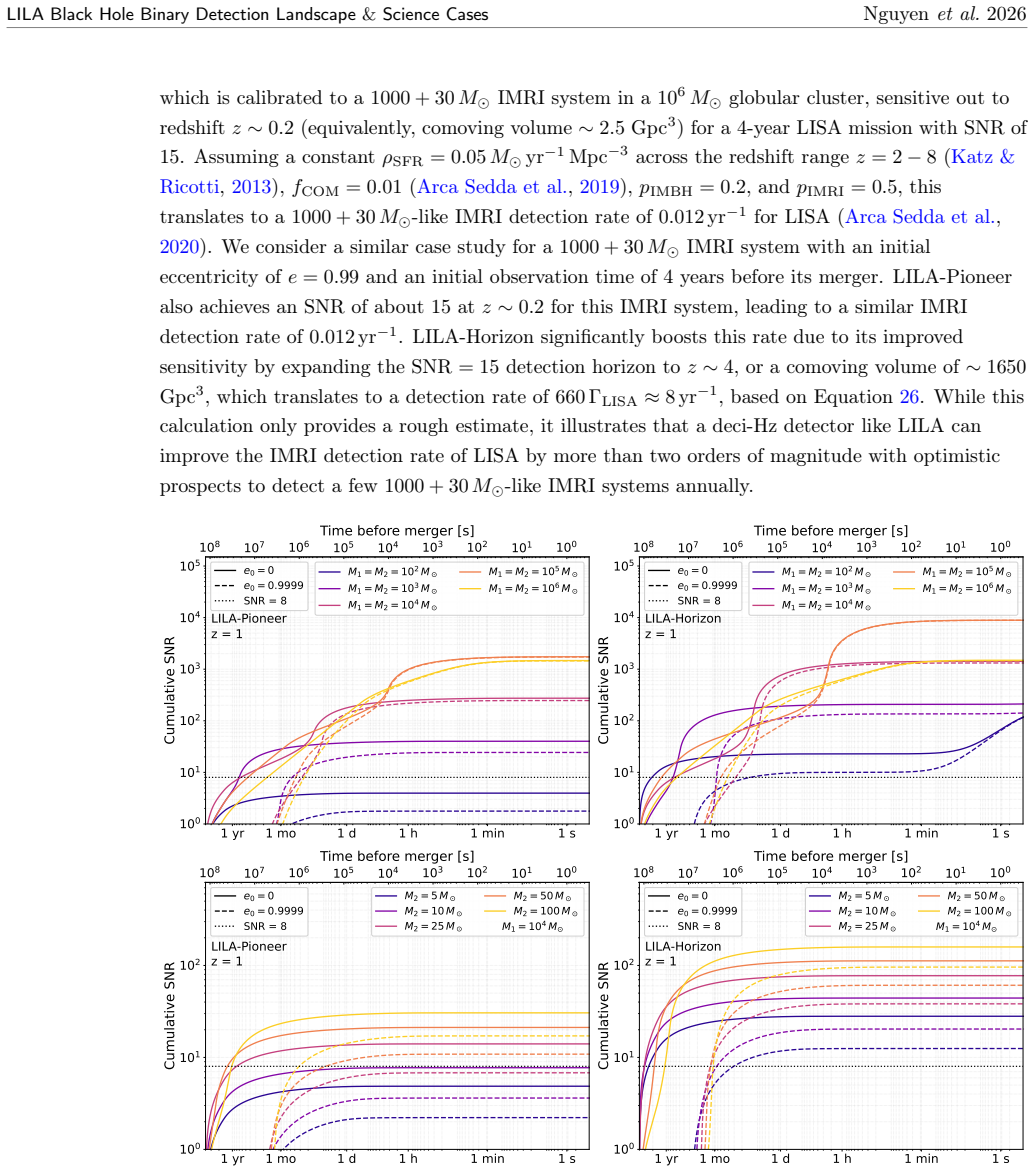
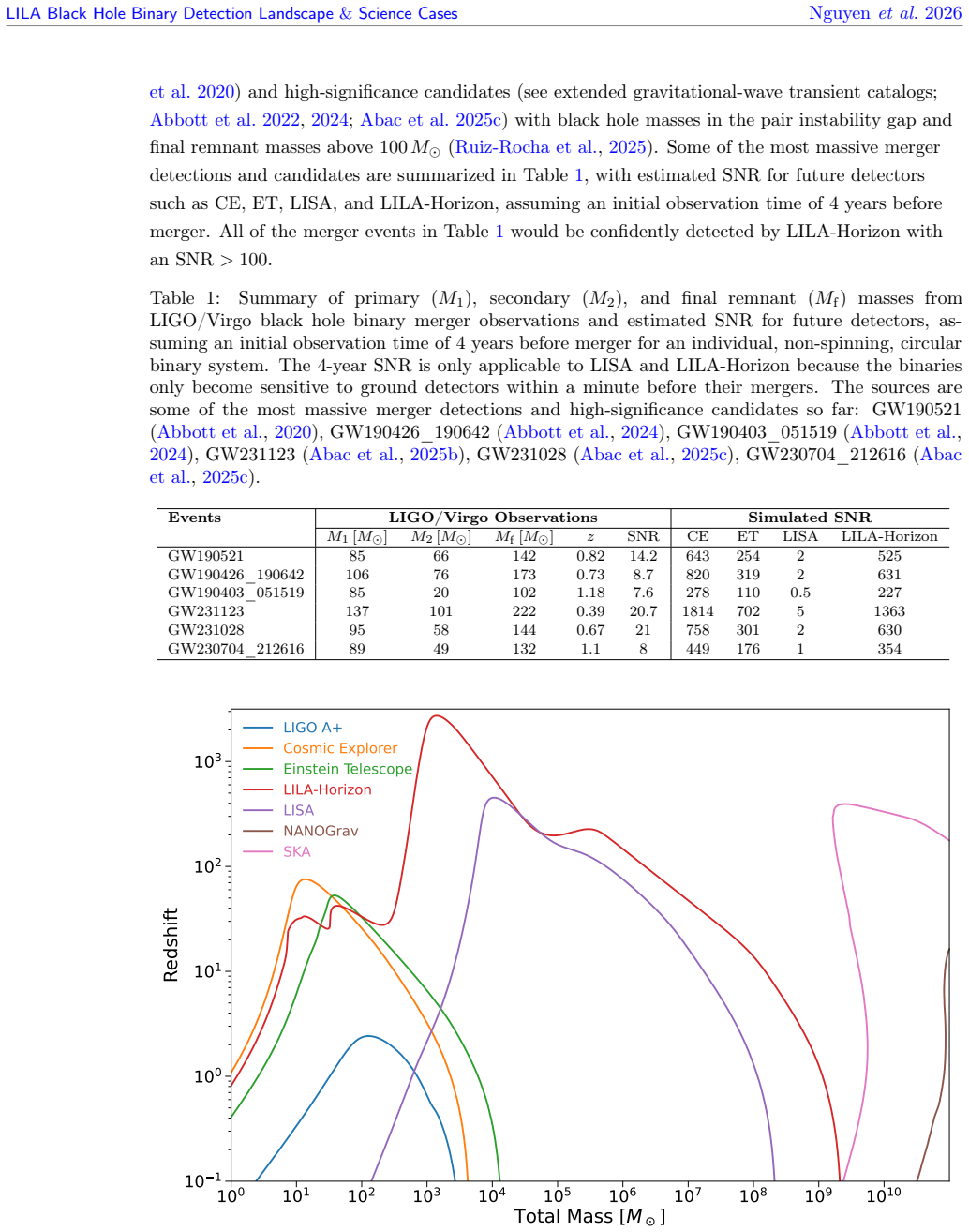
With an observational period of 4 years, LILA can extend its IMBH detection horizon to the very early Universe, directly probing the first population of massive black holes (z ∼ 20-30). LILA could also detect intermediate-mass-ratio inspiral systems with a total mass of ∼10^4−10^6 M⊙ and a mass ratio of ∼10−4−10−2, discover IMBH binaries months to years before merger with measurable eccentricity residuals, and observe high-SNR (≳100) events that enable strong-field tests of gravity while expanding the upper envelope of stellar-origin black holes to masses ≳250 M⊙.
What carries the argument
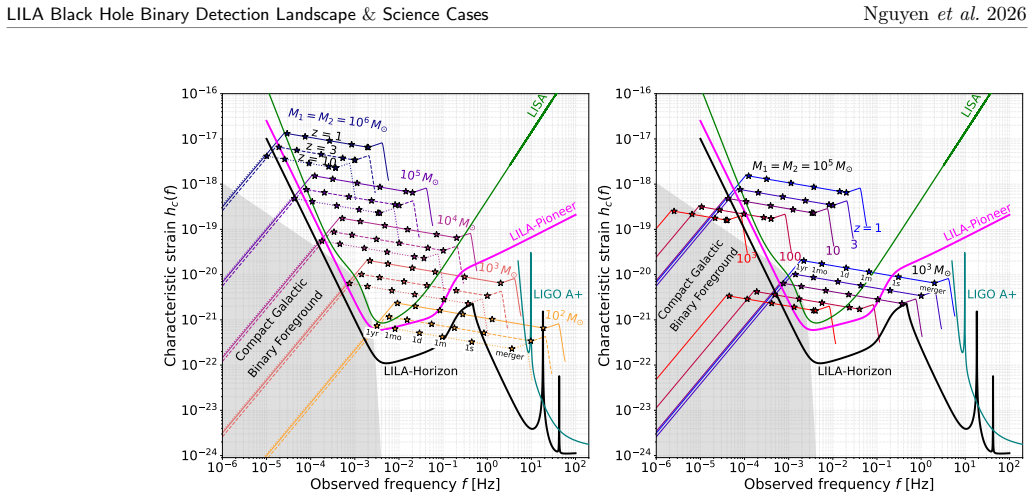
Signal-to-noise ratio calculations that fold the LILA sensitivity curve (taken from the prior proposal) with IMBH binary waveforms across a grid of masses, mass ratios, eccentricities, and redshifts up to z∼30.
If this is right
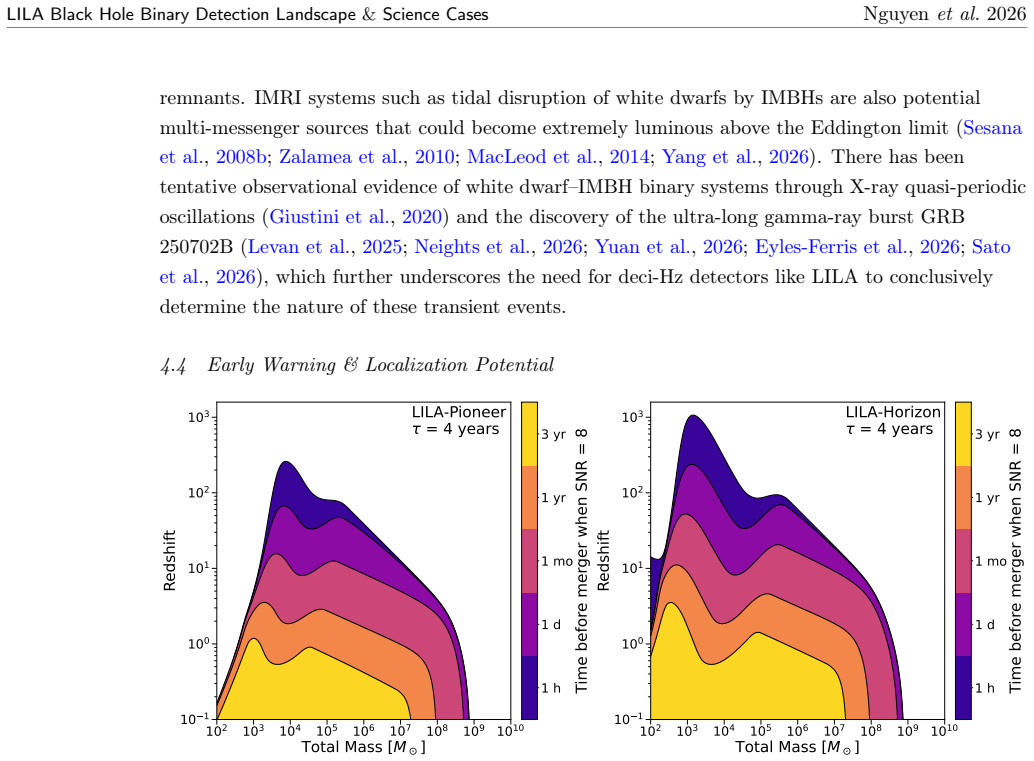
- LILA supplies months-to-years advance notice of IMBH mergers for multi-messenger and multi-band follow-up campaigns.
- High-SNR events enable direct strong-field tests of general relativity using the inspiral and ringdown phases.
- Eccentricity measurements distinguish formation channels that retain orbital eccentricity versus those that circularize.
- Detection of IMBHs at z∼20-30 constrains the seed population and early growth of supermassive black holes.
- LILA fills the gap between LIGO/Virgo stellar-mass detections and future space-based detectors by covering the pair-instability mass gap and light IMBH regime.
Where Pith is reading between the lines
- The ability to observe eccentric IMBH binaries at high redshift could test whether dynamical formation in dense early-universe clusters dominates over isolated binary evolution.
- If LILA detects events with masses above the pair-instability gap, it would tighten limits on the maximum mass of stellar-origin black holes produced by single-star evolution.
- Combining LILA's deci-Hz band with ground-based detectors would create a continuous multi-band gravitational-wave spectrum from stellar-mass to supermassive binaries.
- Non-detection of high-redshift IMBHs after four years would require downward revision of assumed merger rates or upward revision of LILA's noise floor.
Load-bearing premise
The noise model, sensitivity curve, and antenna response of LILA are taken as given from the prior proposal without independent verification in this work, and the existence and merger rates of the targeted IMBH populations are assumed rather than derived.
What would settle it
Actual on-Moon measurements of LILA's noise spectrum after deployment that deviate significantly from the modeled sensitivity curve, or a four-year data set that contains no IMBH merger events above z=10 despite the assumed rates.
Figures



read the original abstract
The Laser Interferometer Lunar Antenna (LILA) is a proposed gravitational-wave project aiming to take full advantage of the Moon's environment to access the deci-Hz band and detect intermediate-mass black hole (IMBH) binaries of mass $\sim 10^2-10^6 \, M_{\odot}$ (arXiv:2508.11631). With an observational period of 4 years, LILA can extend its IMBH detection horizon to the very early Universe, directly probing the first population of massive black holes ($z \sim 20-30$). LILA could also detect intermediate-mass-ratio inspiral systems with a total mass of $\sim 10^4 - 10^6 \, M_{\odot}$ and a mass ratio of $\sim 10^{-4} - 10^{-2}$. LILA can discover IMBH binaries months to years before merger with measurable eccentricity residuals retained from their formation, providing crucial early warning for multi-messenger and multi-band follow-up. The high SNR ($\gtrsim 100$) events detectable with LILA would enable strong-field tests of gravity. With these capabilities, LILA will provide important insights into the formation and evolution of massive black holes, as well as the astrophysical environments and evolutionary pathways of black hole binaries. LILA will also complement current LIGO/Virgo/KAGRA detections of pair-instability mass gap events, hierarchical merger candidates, and light IMBH mergers, while expanding the upper envelope of discovered black holes with stellar origin to masses of $\gtrsim 250 \, M_{\odot}$.
Editorial analysis
A structured set of objections, weighed in public.
Referee Report
Summary. The manuscript presents signal-to-noise ratio (SNR) calculations for the proposed Laser Interferometer Lunar Antenna (LILA) targeting intermediate-mass black hole (IMBH) binaries (∼10²–10⁶ M⊙) and intermediate-mass-ratio inspirals (IMRIs, total mass ∼10⁴–10⁶ M⊙, mass ratio ∼10^{-4}–10^{-2}). Using a 4-year observation period and sensitivity curves adopted from a prior LILA proposal, it claims detection horizons extending to z∼20–30, early warnings months to years before merger with retained eccentricity, high-SNR (≳100) events for strong-field gravity tests, and complementary science cases for black hole formation, evolution, and multi-messenger follow-up.
Significance. If the imported LILA noise model and antenna response hold, the results would meaningfully extend gravitational-wave reach into the deci-Hz band and the early universe, offering concrete, falsifiable predictions for IMBH detection rates and distances that complement LIGO/Virgo/KAGRA observations of pair-instability gap events. The forward-modeling approach provides specific science cases for multi-band early warnings and hierarchical merger studies.
major comments (2)
- [§2 (LILA Instrument and Noise Model)] §2 (LILA Instrument and Noise Model): The SNR calculations and z∼20–30 horizon claims import the complete noise PSD, lunar seismic/thermal environment, and response function directly from arXiv:2508.11631 with no independent re-derivation, error budget, or sensitivity analysis to variations in moonquake or thermal noise amplitudes. This assumption is load-bearing for the central detection-horizon result; an upward revision in the noise floor would shrink the reachable redshift below the quoted range.
- [§4 (Detection Horizons and Rates)] §4 (Detection Horizons and Rates): The quoted IMBH and IMRI detection rates and early-warning times rest on assumed merger-rate densities and eccentricity distributions that are stated but not derived or varied within the manuscript; while rates affect event counts rather than the horizon distance itself, the lack of justification or parameter ranges undermines the quantitative science-case claims.
minor comments (2)
- [Abstract] Abstract: The claim of 'high SNR (≳100)' events would be clearer with a parenthetical note on the specific mass, distance, and SNR threshold definitions used to arrive at this figure.
- [§3 (SNR Formulas)] Figure captions and §3 (SNR Formulas): Several waveform or integration expressions are referenced but not written explicitly; adding the exact functional forms or citing the precise equations employed would improve reproducibility.
Simulated Author's Rebuttal
We thank the referee for their careful and constructive review of our manuscript. We address each major comment point by point below, indicating the revisions we will make to strengthen the paper while remaining within its scope as an application of the established LILA noise model.
read point-by-point responses
-
Referee: [§2 (LILA Instrument and Noise Model)] §2 (LILA Instrument and Noise Model): The SNR calculations and z∼20–30 horizon claims import the complete noise PSD, lunar seismic/thermal environment, and response function directly from arXiv:2508.11631 with no independent re-derivation, error budget, or sensitivity analysis to variations in moonquake or thermal noise amplitudes. This assumption is load-bearing for the central detection-horizon result; an upward revision in the noise floor would shrink the reachable redshift below the quoted range.
Authors: We acknowledge that the noise PSD, lunar environment parameters, and response function are adopted directly from the companion LILA instrument proposal (arXiv:2508.11631), as the present work focuses on SNR calculations and science cases rather than instrument design. We agree that an explicit sensitivity analysis would improve robustness. In the revised manuscript we will add a dedicated subsection (or appendix) quantifying how detection horizons at z∼20–30 respond to plausible variations in seismic and thermal noise amplitudes (e.g., factors of 0.5–2 relative to the baseline model), thereby providing an error budget without performing a full independent re-derivation of the lunar noise environment. revision: partial
-
Referee: [§4 (Detection Horizons and Rates)] §4 (Detection Horizons and Rates): The quoted IMBH and IMRI detection rates and early-warning times rest on assumed merger-rate densities and eccentricity distributions that are stated but not derived or varied within the manuscript; while rates affect event counts rather than the horizon distance itself, the lack of justification or parameter ranges undermines the quantitative science-case claims.
Authors: We agree that the merger-rate densities and eccentricity distributions are taken from the literature and stated without additional derivation or variation in the current text. While these assumptions do not affect the quoted detection horizons (which depend only on SNR thresholds and the noise curve), they do influence the quantitative science-case statements regarding expected event numbers and early-warning statistics. In the revised §4 we will (i) cite the specific references and physical motivations for the adopted values, (ii) briefly justify the chosen ranges, and (iii) present results for a modest set of parameter variations (e.g., rate densities spanning an order of magnitude and eccentricity distributions consistent with formation channels) to illustrate the robustness of the multi-messenger and early-warning claims. revision: yes
Circularity Check
No significant circularity; detection horizons derived from forward SNR modeling on imported instrument parameters
full rationale
The paper conducts explicit signal-to-noise ratio calculations for IMBH binaries across mass and redshift ranges, integrating over a 4-year observation period to obtain detection horizons. The noise PSD, antenna response, and lunar environment model are adopted directly from the cited prior proposal (arXiv:2508.11631) without re-derivation here, but this is a standard use of external inputs rather than a reduction of the output to the input by construction. No self-definitional loops appear in the equations, no parameters are fitted to the target results and then relabeled as predictions, and the central claims about z~20-30 reach follow from the forward propagation of the adopted sensitivity under stated source assumptions. The self-citation is present and load-bearing for the instrument model but does not create a tautological chain, as the SNR computations and horizon estimates constitute independent content.
Axiom & Free-Parameter Ledger
free parameters (1)
- LILA noise curve and response
axioms (2)
- standard math Standard general-relativity inspiral-merger-ringdown waveforms for IMBH binaries
- domain assumption Astrophysical population of IMBHs exists at z~20-30 with merger rates sufficient for detection
Lean theorems connected to this paper
-
IndisputableMonolith/Cost/FunctionalEquation.leanwashburn_uniqueness_aczel unclearSNR = [∫ (hc(f)/hnoise(f))² d(ln f)]^{1/2} with hnoise = max(hLILA, hCGB) and piecewise hc(f) from Eq. 8 (inspiral-merger-ringdown + eccentricity)
-
IndisputableMonolith/Foundation/DimensionForcing.leanalexander_duality_circle_linking unclearDetection horizon to z∼20-30 for 10²-10⁶ M⊙ binaries using 4-year tobs and SNR threshold 8 (Fig. 4)
Reference graph
Works this paper leans on
-
[1]
The Science of the Einstein Telescope
Abac, A., Abramo, R., Albanesi, S., et al. 2025a, arXiv e-prints, arXiv:2503.12263, doi:10.48550/arXiv.2503.12263
work page internal anchor Pith review Pith/arXiv arXiv doi:10.48550/arxiv.2503.12263
-
[2]
Abac, A. G., Abbott, R., Abouelfettouh, I., et al. 2024a, ApJL, 970, L34, doi:10.3847/2041-8213/ad5beb
-
[3]
G., Abbott, R., Abe, H., et al
Abac, A. G., Abbott, R., Abe, H., et al. 2024b, ApJ, 973, 132, doi:10.3847/1538-4357/ad65ce
-
[4]
Abac, A. G., Abouelfettouh, I., Acernese, F., et al. 2025b, ApJL, 993, L25, doi:10.3847/2041-8213/ae0c9c —. 2025c, arXiv e-prints, arXiv:2508.18082, doi:10.48550/arXiv.2508.18082 —. 2025d, PhRvL, 135, 111403, doi:10.1103/kw5g-d732 —. 2026a, PhRvL, 136, 041403, doi:10.1103/6c61-fm1n —. 2026b, arXiv e-prints, arXiv:2603.19019, doi:10.48550/arXiv.2603.19019 ...
work page internal anchor Pith review Pith/arXiv arXiv doi:10.3847/2041-8213/ae0c9c 2041
-
[5]
Abbott, B. P., Abbott, R., Abbott, T. D., et al. 2016a, PhRvL, 116, 061102, doi:10.1103/PhysRevLett.116.061102 —. 2016b, PhRvL, 116, 221101, doi:10.1103/PhysRevLett.116.221101 —. 2016c, ApJL, 818, L22, doi:10.3847/2041-8205/818/2/L22 —. 2017, Classical and Quantum Gravity, 34, 044001, doi:10.1088/1361-6382/aa51f4
-
[6]
Abbottet al.[LIGO Scientific and Virgo], Phys
Abbott, R., Abbott, T. D., Abraham, S., et al. 2020, PhRvL, 125, 101102, doi:10.1103/PhysRevLett.125.101102
-
[7]
Abbott, R., Abbott, T. D., Acernese, F., et al. 2022, A&A, 659, A84, doi:10.1051/0004-6361/202141452 —. 2023, Physical Review X, 13, 011048, doi:10.1103/PhysRevX.13.011048 —. 2024, PhRvD, 109, 022001, doi:10.1103/PhysRevD.109.022001
-
[8]
2025, PhRvD, 112, 084080, doi:10.1103/PhysRevD.112.084080
Abbott, R., Abe, H., Acernese, F., et al. 2025, PhRvD, 112, 084080, doi:10.1103/PhysRevD.112.084080
-
[9]
The Astrophysical Journal Letters , author =
Agazie, G., Anumarlapudi, A., Archibald, A. M., et al. 2023a, ApJL, 951, L8, doi:10.3847/2041-8213/acdac6 —. 2023b, ApJL, 952, L37, doi:10.3847/2041-8213/ace18b —. 2023c, ApJL, 951, L10, doi:10.3847/2041-8213/acda88
-
[10]
Aghanim, N., Akrami, Y., Arroja, F., et al. 2020, Astronomy & Astrophysics, 641, A1, doi:10.1051/0004-6361/201833880 22 LILA Black Hole Binary Detection Landscape&Science CasesNguyenet al.2026
-
[11]
Ajith, P., Babak, S., Chen, Y., et al. 2008, PhRvD, 77, 104017, doi:10.1103/PhysRevD.77.104017 Akyüz, A., Correia, A., Garofalo, J., et al. 2025, arXiv e-prints, arXiv:2507.08789, doi:10.48550/arXiv.2507.08789
-
[12]
Alves, L. M. B., Sullivan, A. G., Ji, X., et al. 2024, arXiv e-prints, arXiv:2401.13668, doi:10.48550/arXiv.2401.13668
work page internal anchor Pith review Pith/arXiv arXiv doi:10.48550/arxiv.2401.13668 2024
-
[13]
Detecting Intermediate-Mass Ratio Inspirals From The Ground And Space
Amaro-Seoane, P. 2018, PhRvD, 98, 063018, doi:10.1103/PhysRevD.98.063018
-
[14]
Laser Interferometer Space Antenna
Amaro-Seoane, P., Audley, H., Babak, S., et al. 2017, ArXiv e-prints, arXiv:1702.00786. https://arxiv.org/abs/1702.00786
work page internal anchor Pith review Pith/arXiv arXiv 2017
-
[15]
Amaro-Seoane, P., Andrews, J., Arca Sedda, M., et al. 2023, Living Reviews in Relativity, 26, 2, doi:10.1007/s41114-022-00041-y Andrés-Carcasona, M., & Caneva Santoro, G. 2025, arXiv e-prints, arXiv:2512.01918, doi:10.48550/arXiv.2512.01918
-
[16]
Investigating the formation channel of GW231123: Population III stars or hierarchical mergers?
Angeloni, F., Kritos, K., Schneider, R., et al. 2026, arXiv e-prints, arXiv:2604.18709, doi:10.48550/arXiv.2604.18709
work page internal anchor Pith review Pith/arXiv arXiv doi:10.48550/arxiv.2604.18709 2026
-
[17]
Angus, C. R., Baldassare, V. F., Mockler, B., et al. 2022, Nature Astronomy, 6, 1452, doi:10.1038/s41550-022-01811-y
-
[18]
2019, MNRAS, 486, 5008, doi: 10.1093/mnras/stz1149
Antonini, F., Gieles, M., & Gualandris, A. 2019, MNRAS, 486, 5008, doi:10.1093/mnras/stz1149
-
[19]
Antonini, F., & Rasio, F. A. 2016, ApJ, 831, 187, doi:10.3847/0004-637X/831/2/187
-
[20]
Antonini, F., Toonen, S., & Hamers, A. S. 2017, ApJ, 841, 77, doi:10.3847/1538-4357/aa6f5e Arca Sedda, M., Amaro Seoane, P., & Chen, X. 2021a, A&A, 652, A54, doi:10.1051/0004-6361/202037785 Arca Sedda, M., Askar, A., & Giersz, M. 2018, MNRAS, 479, 4652, doi:10.1093/mnras/sty1859 —. 2019, arXiv e-prints, arXiv:1905.00902, doi:10.48550/arXiv.1905.00902 Arca...
-
[21]
Armitage, P. J., & Natarajan, P. 2005, ApJ, 634, 921, doi:10.1086/497108
-
[22]
2015, PhRvD, 91, 084011, doi:10.1103/PhysRevD.91.084011
Arvanitaki, A., Baryakhtar, M., & Huang, X. 2015, PhRvD, 91, 084011, doi:10.1103/PhysRevD.91.084011
-
[23]
2011, PhRvD, 83, 044026, doi:10.1103/PhysRevD.83.044026 Astropy Collaboration, Robitaille, T
Arvanitaki, A., & Dubovsky, S. 2011, PhRvD, 83, 044026, doi:10.1103/PhysRevD.83.044026 Astropy Collaboration, Robitaille, T. P., Tollerud, E. J., et al. 2013, A&A, 558, A33, doi:10.1051/0004-6361/201322068
-
[24]
Aswathi, P. S., East, W. E., Siemonsen, N., Sun, L., & Jones, D. 2025, PhRvD, 112, 123048, doi:10.1103/n5hr-zljn
-
[25]
Auclair, P., Blanco-Pillado, J. J., Figueroa, D. G., et al. 2020, JCAP, 2020, 034, doi:10.1088/1475-7516/2020/04/034 23 LILA Black Hole Binary Detection Landscape&Science CasesNguyenet al.2026
-
[26]
2025, Living Reviews in Relativity, 28, 1, doi:10.1007/s41114-024-00053-w
Bagui, E., Clesse, S., De Luca, V., et al. 2025, Living Reviews in Relativity, 28, 1, doi:10.1007/s41114-024-00053-w
-
[27]
2020, PhRvD, 101, 084053, doi:10.1103/PhysRevD.101.084053
Baibhav, V., Berti, E., & Cardoso, V. 2020, PhRvD, 101, 084053, doi:10.1103/PhysRevD.101.084053
-
[28]
Baldassare, V. F., Reines, A. E., Gallo, E., & Greene, J. E. 2015, ApJ, 809, doi:10.1088/2041-8205/809/1/L14
-
[29]
Barausse, E. 2012, MNRAS, 423, 2533, doi:10.1111/j.1365-2966.2012.21057.x
-
[30]
2000, ApJ, 531, 613, doi:10.1086/308503 —
Barkana, R., & Loeb, A. 2000, ApJ, 531, 613, doi:10.1086/308503 —. 2001, PhR, 349, 125, doi:10.1016/S0370-1573(01)00019-9
-
[31]
S., Mezcua, M., & Comerford, J
Barrows, R. S., Mezcua, M., & Comerford, J. M. 2019, ApJ, 882, 181, doi:10.3847/1538-4357/ab338a
-
[32]
2018, The A+ Design Curve, Tech
Barsotti, L., McCuller, L., Evans, M., & Fritschel, P. 2018, The A+ Design Curve, Tech. Rep. LIGO-T1800042-v5, LIGO Laboratory.https://dcc.ligo.org/LIGO-T1800042/public
work page 2018
-
[33]
2026, ApJL, 996, L44, doi:10.3847/2041-8213/ae2bff
Bartos, I., & Haiman, Z. 2026, ApJL, 996, L44, doi:10.3847/2041-8213/ae2bff
-
[34]
Belczynski, K., Klencki, J., Fields, C. E., et al. 2020, A&A, 636, A104, doi:10.1051/0004-6361/201936528
-
[35]
Berti, E., Buonanno, A., & Will, C. M. 2005, PhRvD, 71, 084025, doi:10.1103/PhysRevD.71.084025
-
[36]
2026, arXiv e-prints, arXiv:2602.05923, doi:10.48550/arXiv.2602.05923
Berti, E., Branchesi, M., Buonanno, A., et al. 2026, arXiv e-prints, arXiv:2602.05923, doi:10.48550/arXiv.2602.05923
-
[37]
2022, PhRvD, 105, 124063, doi:10.1103/PhysRevD.105.124063
Bhagwat, S., Pacilio, C., Barausse, E., & Pani, P. 2022, PhRvD, 105, 124063, doi:10.1103/PhysRevD.105.124063
-
[38]
K., Blecha, L., Torrey, P., et al
Bhowmick, A. K., Blecha, L., Torrey, P., et al. 2024, arXiv e-prints, arXiv:2402.03626, doi:10.48550/arXiv.2402.03626 —. 2026, ApJ, 997, 187, doi:10.3847/1538-4357/ae2607
-
[39]
Boekholt, T. C. N., Schleicher, D. R. G., Fellhauer, M., et al. 2018, MNRAS, 476, 366, doi:10.1093/mnras/sty208
-
[40]
2024, A&A, 690, A194, doi:10.1051/0004-6361/202348538
Bollati, F., Lupi, A., Dotti, M., & Haardt, F. 2024, A&A, 690, A194, doi:10.1051/0004-6361/202348538
-
[41]
2025, arXiv e-prints, arXiv:2509.12325, doi:10.48550/arXiv.2509.12325
Bonoli, S., Izquierdo-Villalba, D., Spinoso, D., et al. 2025, arXiv e-prints, arXiv:2509.12325, doi:10.48550/arXiv.2509.12325
-
[42]
Breivik, K., Rodriguez, C. L., Larson, S. L., Kalogera, V., & Rasio, F. A. 2016, ApJL, 830, L18, doi:10.3847/2041-8205/830/1/L18
-
[43]
Gravitational wave searches for ultralight bosons with LIGO and LISA
Brito, R., Ghosh, S., Barausse, E., et al. 2017, PhRvD, 96, 064050, doi:10.1103/PhysRevD.96.064050
-
[44]
2018, MNRAS, 478, 3199, doi:10.1093/mnras/sty1026
Britzen, S., Fendt, C., Witzel, G., et al. 2018, MNRAS, 478, 3199, doi:10.1093/mnras/sty1026
-
[45]
S., Berger, E., Stevenson, S., et al
Broekgaarden, F. S., Berger, E., Stevenson, S., et al. 2022, MNRAS, 516, 5737, doi:10.1093/mnras/stac1677
-
[46]
2003, ApJ, 596, 34, doi:10.1086/377529
Bromm, V., & Loeb, A. 2003, ApJ, 596, 34, doi:10.1086/377529
-
[47]
Bruce, J., Vesperini, E., Askar, A., et al. 2026, A&A, 707, A284, doi:10.1051/0004-6361/202557826 24 LILA Black Hole Binary Detection Landscape&Science CasesNguyenet al.2026
-
[48]
Burke, C. J., & Natarajan, P. 2026, Nature Astronomy, 10, 187, doi:10.1038/s41550-025-02759-5
-
[49]
Burke, O., Gair, J. R., Simón, J., & Edwards, M. C. 2020, PhRvD, 102, 124054, doi:10.1103/PhysRevD.102.124054
-
[50]
2019, MNRAS, 490, 4133, doi:10.1093/mnras/stz2836 Cáceres-Burgos, P
Bustamante, S., & Springel, V. 2019, MNRAS, 490, 4133, doi:10.1093/mnras/stz2836 Cáceres-Burgos, P. F. V., Dayal, P., Lira, P., et al. 2026, A&A, 707, A360, doi:10.1051/0004-6361/202556153 Cárdenas-Avendaño, A., & Sopuerta, C. F. 2024, arXiv e-prints, arXiv:2401.08085, doi:10.48550/arXiv.2401.08085
-
[51]
2020, PhRvD, 101, 044047, doi:10.1103/PhysRevD.101.044047
Carson, Z., & Yagi, K. 2020, PhRvD, 101, 044047, doi:10.1103/PhysRevD.101.044047
-
[52]
2025, arXiv e-prints, arXiv:2512.04593, doi:10.48550/arXiv.2512.04593
Chandra, K., Gamba, R., & Chiaramello, D. 2025, arXiv e-prints, arXiv:2512.04593, doi:10.48550/arXiv.2512.04593
-
[53]
Chang, J. N. Y., Dai, L., Pfister, H., Kar Chowdhury, R., & Natarajan, P. 2025, ApJL, 980, L22, doi:10.3847/2041-8213/adace7
-
[54]
2016, MNRAS, 463, 2145, doi:10.1093/mnras/stw1838
Charisi, M., Bartos, I., Haiman, Z., et al. 2016, MNRAS, 463, 2145, doi:10.1093/mnras/stw1838
-
[55]
R., Runnoe, J., Bogdanovic, T., & Trump, J
Charisi, M., Taylor, S. R., Runnoe, J., Bogdanovic, T., & Trump, J. R. 2022, MNRAS, 510, 5929, doi:10.1093/mnras/stab3713
-
[56]
2025, ApJL, 995, L6, doi:10.3847/2041-8213/ae1a5f
Chatterjee, C., McGowan, K., Deshmukh, S., Tyler-Howard, N., & Jani, K. 2025, ApJL, 995, L6, doi:10.3847/2041-8213/ae1a5f
-
[57]
Chen, S., Jani, K., & Kephart, T. W. 2026, arXiv e-prints, arXiv:2601.13621, doi:10.48550/arXiv.2601.13621
-
[58]
2017, ApJL, 842, L2, doi:10.3847/2041-8213/aa74ce
Chen, X., & Amaro-Seoane, P. 2017, ApJL, 842, L2, doi:10.3847/2041-8213/aa74ce
-
[59]
Chilingarian, I. V., Katkov, I. Y., Zolotukhin, I. Y., et al. 2018, ArXiv e-prints. https://arxiv.org/abs/1805.01467
-
[60]
S., Narayan, R., Su, K.-Y., & Natarajan, P
Cho, H., Prather, B. S., Narayan, R., Su, K.-Y., & Natarajan, P. 2025, arXiv e-prints, arXiv:2507.17818, doi:10.48550/arXiv.2507.17818
-
[61]
Cho, H., Prather, B. S., Narayan, R., et al. 2026, arXiv e-prints, arXiv:2602.15560, doi:10.48550/arXiv.2602.15560
-
[62]
2018, ApJL, 858, L8, doi:10.3847/2041-8213/aabf88
Christian, P., Mocz, P., & Loeb, A. 2018, ApJL, 858, L8, doi:10.3847/2041-8213/aabf88
- [63]
-
[64]
2026, MNRAS, 546, stag073, doi:10.1093/mnras/stag073
Croon, D., Gerosa, D., & Sakstein, J. 2026, MNRAS, 546, stag073, doi:10.1093/mnras/stag073
-
[65]
A., Christensen, N., & Sakellariadou, M
Cuceu, I., Bizouard, M. A., Christensen, N., & Sakellariadou, M. 2026, PhRvD, 113, L021302, doi:10.1103/zd8m-tzxd
-
[66]
2019, BAAS, 51, 109, doi:10.48550/arXiv.1903.04069
Cutler, C., Berti, E., Holley-Bockelmann, K., et al. 2019, BAAS, 51, 109, doi:10.48550/arXiv.1903.04069
-
[67]
Das, D., Shashank, S., & Bambi, C. 2024, European Physical Journal C, 84, 1237, doi:10.1140/epjc/s10052-024-13623-7 25 LILA Black Hole Binary Detection Landscape&Science CasesNguyenet al.2026
-
[68]
2026, arXiv e-prints, arXiv:2602.09124, doi:10.48550/arXiv.2602.09124
Das, M., Bulik, T., Roy, S., & Mukhopadhyay, B. 2026, arXiv e-prints, arXiv:2602.09124, doi:10.48550/arXiv.2602.09124
-
[69]
Datta, S., Gupta, A., Kastha, S., Arun, K. G., & Sathyaprakash, B. S. 2021, PhRvD, 103, 024036, doi:10.1103/PhysRevD.103.024036
-
[70]
2013, MNRAS, 430, 1694, doi: 10.1093/mnras/sts710
Dauser, T., Garcia, J., Wilms, J., et al. 2013, MNRAS, 430, 1694, doi:10.1093/mnras/sts710
-
[71]
Gravitational Waves from the Cosmic Dawn: Tracing Cosmic Black Hole Binaries with ET, LGWA and LISA
Davari, N., Valiante, R., Trinca, A., et al. 2026, arXiv e-prints, arXiv:2604.18173. https://arxiv.org/abs/2604.18173
work page internal anchor Pith review Pith/arXiv arXiv 2026
-
[72]
GW231123: A Possible Primordial Black Hole Origin
Dayal, P., Rossi, E. M., Shiralilou, B., et al. 2019, MNRAS, 486, 2336, doi:10.1093/mnras/stz897 De Luca, V., Franciolini, G., & Riotto, A. 2025, arXiv e-prints, arXiv:2508.09965, doi:10.48550/arXiv.2508.09965 De Rosa, A., Vignali, C., Bogdanović, T., et al. 2019, NewAR, 86, 101525, doi:10.1016/j.newar.2020.101525
work page internal anchor Pith review Pith/arXiv arXiv doi:10.1093/mnras/stz897 2019
-
[73]
Delfavero, V., Ray, S., Cook, H. E., et al. 2025, arXiv e-prints, arXiv:2508.13412, doi:10.48550/arXiv.2508.13412
-
[74]
Dewdney, P. E., Hall, P. J., Schilizzi, R. T., & Lazio, T. J. L. W. 2009, IEEE Proceedings, 97, 1482, doi:10.1109/JPROC.2009.2021005 Di Carlo, U. N., Mapelli, M., Pasquato, M., et al. 2021, MNRAS, 507, 5132, doi:10.1093/mnras/stab2390 Di Matteo, T., Khandai, N., DeGraf, C., et al. 2012, ApJL, 745, L29, doi:10.1088/2041-8205/745/2/L29 Di Matteo, T., Ni, Y....
-
[75]
2017, ApJ, 840, 31, doi: 10.3847/1538-4357/aa6b58
Dosopoulou, F., & Antonini, F. 2017, ApJ, 840, 31, doi:10.3847/1538-4357/aa6b58
-
[76]
2014, MNRAS, 440, 1590, doi:10.1093/mnras/stu373
Dubois, Y., Volonteri, M., & Silk, J. 2014, MNRAS, 440, 1590, doi:10.1093/mnras/stu373
-
[77]
C., D’Orazio, D., Derdzinski, A., et al
Duffell, P. C., D’Orazio, D., Derdzinski, A., et al. 2020, ApJ, 901, 25, doi:10.3847/1538-4357/abab95
-
[78]
2024a, PhRvD, 109, L021302, doi:10.1103/PhysRevD.109.L021302 —
Ellis, J., Fairbairn, M., Hütsi, G., et al. 2024a, PhRvD, 109, L021302, doi:10.1103/PhysRevD.109.L021302 —. 2024b, arXiv e-prints, arXiv:2403.19650, doi:10.48550/arXiv.2403.19650
-
[79]
2007, Progress of Theoretical Physics, 117, 241, doi:10.1143/PTP.117.241
Enoki, M., & Nagashima, M. 2007, Progress of Theoretical Physics, 117, 241, doi:10.1143/PTP.117.241
-
[80]
Evans, A. E., Blecha, L., & Bhowmick, A. K. 2025, MNRAS, 536, 2783, doi:10.1093/mnras/stae2735
discussion (0)
Sign in with ORCID, Apple, or X to comment. Anyone can read and Pith papers without signing in.