Recognition: unknown
Realtime-VLA FLASH: Speculative Inference Framework for Diffusion-based VLAs
Pith reviewed 2026-05-14 17:48 UTC · model grok-4.3
The pith
A lightweight draft model with parallel verification lets diffusion VLAs replan actions at 19.1 ms average latency instead of 58 ms.
A machine-rendered reading of the paper's core claim, the machinery that carries it, and where it could break.
Core claim
By generating candidate actions from a lightweight draft model and verifying them in parallel with the main model's Action Expert, most full diffusion inference rounds can be skipped. A phase-aware fallback restores the full pipeline when verification fails. The resulting system replaces many 58 ms full inferences with 7.8 ms speculative rounds, lowering average task latency to 19.1 ms on LIBERO while preserving task performance and demonstrating the same benefit on real-world conveyor sorting.
What carries the argument
Speculative inference pipeline: lightweight draft model plus parallel Action Expert verification and phase-aware fallback to full diffusion.
If this is right
- Average inference latency on LIBERO drops from 58 ms to 19.1 ms per replanning step.
- Task success rates remain essentially unchanged across the benchmark suites.
- Speculative rounds run as fast as 7.8 ms, enabling higher-frequency replanning.
- The same pipeline transfers to real-world conveyor-belt sorting without retraining.
- The method applies to any diffusion-based VLA that exposes an Action Expert for verification.
Where Pith is reading between the lines
- The same draft-plus-verification pattern could be applied to other slow generative policies in robotics, such as autoregressive transformers.
- Combining FLASH with model quantization or caching might push latency even lower on edge hardware.
- Frequent low-latency replanning could reduce the need for separate motion planners in dynamic scenes.
Load-bearing premise
The draft model produces outputs close enough to the main model that full inference is triggered infrequently enough to yield net speedup without hurting task success.
What would settle it
A test run in which the draft model disagrees with the Action Expert on more than half the steps, causing fallback frequency to rise and measured latency to stay near 58 ms or task success to drop.
Figures

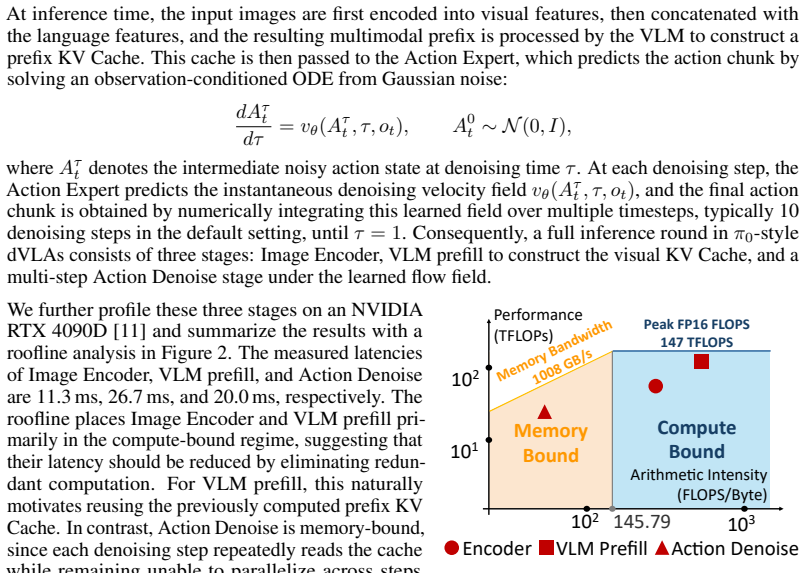


read the original abstract
Diffusion-based vision-language-action models (dVLAs) are promising for embodied intelligence but are fundamentally limited in real-time deployment by the high latency of full inference. We propose Realtime-VLA FLASH, a speculative inference framework that eliminates most full inference calls during replanning by introducing a lightweight draft model with parallel verification via the main model's Action Expert and a phase-aware fallback mechanism that reverts to the full inference pipeline when needed. This design enables low-latency, high-frequency replanning without sacrificing reliability. Experiments show that on LIBERO, FLASH largely preserves task performance by replacing many 58.0 ms full-inference rounds with speculative rounds as fast as 7.8 ms, lowering task-level average inference latency to 19.1 ms (3.04x speedup). We additionally demonstrate effectiveness on real-world conveyor-belt sorting, highlighting its practical impact for latency-critical embodied tasks.
Editorial analysis
A structured set of objections, weighed in public.
Circularity Check
No circularity: empirical latency claims rest on direct wall-clock measurements
full rationale
The paper proposes a speculative inference framework and validates it through direct experimental timing on LIBERO tasks. Reported figures (58.0 ms full inference, 7.8 ms speculative rounds, 19.1 ms average, 3.04x speedup) are obtained from wall-clock measurements of the implemented pipeline versus baseline, not from any equation that reduces a prediction to a fitted input or self-referential definition. No derivation chain, uniqueness theorem, or ansatz is invoked that collapses to prior self-citation or renaming of known results. The central performance claim is therefore independently falsifiable by re-running the timing experiments on the same benchmark.
Axiom & Free-Parameter Ledger
Reference graph
Works this paper leans on
-
[1]
$\pi_0$: A Vision-Language-Action Flow Model for General Robot Control
Kevin Black, Noah Brown, Danny Driess, Adnan Esmail, Michael Equi, Chelsea Finn, Niccolo Fusai, Lachy Groom, Karol Hausman, Brian Ichter, et al. π0: A vision-language-action flow model for general robot control.ArXiv, abs/2410.24164, 2024
work page internal anchor Pith review Pith/arXiv arXiv 2024
-
[2]
Real-time execution of action chunking flow policies.arXiv preprint arXiv:2506.07339, 2025
Kevin Black, Manuel Y Galliker, and Sergey Levine. Real-time execution of action chunking flow policies.arXiv preprint arXiv:2506.07339, 2025
-
[3]
Kevin Black, Allen Z Ren, Michael Equi, and Sergey Levine. Training-time action conditioning for efficient real-time chunking.arXiv preprint arXiv:2512.05964, 2025
-
[4]
Mean-flow based one-step vision-language-action
Yang Chen, Xiaoguang Ma, and Bin Zhao. Mean-flow based one-step vision-language-action. arXiv preprint arXiv:2603.01469, 2026
-
[5]
Diffusion policy: Visuomotor policy learning via action diffusion
Cheng Chi, Zhenjia Xu, Siyuan Feng, Eric Cousineau, Yilun Du, Benjamin Burchfiel, Russ Tedrake, and Shuran Song. Diffusion policy: Visuomotor policy learning via action diffusion. The International Journal of Robotics Research, page 02783649241273668, 2023
2023
-
[6]
Accelerated diffusion models via speculative sampling.arXiv preprint arXiv:2501.05370, 2025
Valentin De Bortoli, Alexandre Galashov, Arthur Gretton, and Arnaud Doucet. Accelerated diffusion models via speculative sampling.arXiv preprint arXiv:2501.05370, 2025
-
[7]
One step diffusion via shortcut models.arXiv preprint arXiv:2410.12557, 2024
Kevin Frans, Danijar Hafner, Sergey Levine, and Pieter Abbeel. One step diffusion via shortcut models.arXiv preprint arXiv:2410.12557, 2024
-
[8]
Mean Flows for One-step Generative Modeling
Zhengyang Geng, Mingyang Deng, Xingjian Bai, J Zico Kolter, and Kaiming He. Mean flows for one-step generative modeling.arXiv preprint arXiv:2505.13447, 2025
work page internal anchor Pith review Pith/arXiv arXiv 2025
-
[9]
Hengyuan Hu, Aniket Das, Dorsa Sadigh, and Nima Anari. Diffusion models are secretly exchangeable: Parallelizing ddpms via autospeculation.arXiv preprint arXiv:2505.03983, 2025
-
[10]
Physical Intelligence, Kevin Black, Noah Brown, James Darpinian, Karan Dhabalia, Danny Driess, Adnan Esmail, Michael Equi, Chelsea Finn, Niccolo Fusai, Manuel Y . Galliker, Dibya Ghosh, Lachy Groom, Karol Hausman, Brian Ichter, Szymon Jakubczak, Tim Jones, Liyiming Ke, Devin LeBlanc, Sergey Levine, Adrian Li-Bell, Mohith Mothukuri, Suraj Nair, Karl Pertsc...
work page internal anchor Pith review Pith/arXiv arXiv 2025
-
[11]
Wenqi Jiang, Jason Clemons, Karu Sankaralingam, and Christos Kozyrakis. How fast can i run my vla? demystifying vla inference performance with vla-perf.arXiv preprint arXiv:2602.18397, 2026
-
[12]
EAGLE: Speculative Sampling Requires Rethinking Feature Uncertainty
Yuhui Li, Fangyun Wei, Chao Zhang, and Hongyang Zhang. Eagle: Speculative sampling requires rethinking feature uncertainty.arXiv preprint arXiv:2401.15077, 2024
work page internal anchor Pith review arXiv 2024
-
[13]
Eagle-2: Faster inference of language models with dynamic draft trees
Yuhui Li, Fangyun Wei, Chao Zhang, and Hongyang Zhang. Eagle-2: Faster inference of language models with dynamic draft trees. InProceedings of the 2024 conference on empirical methods in natural language processing, pages 7421–7432, 2024
2024
-
[14]
arXiv preprint arXiv:2503.01840 (2025) 5 16 Z
Yuhui Li, Fangyun Wei, Chao Zhang, and Hongyang Zhang. Eagle-3: Scaling up inference acceleration of large language models via training-time test.arXiv preprint arXiv:2503.01840, 2025
-
[15]
Tao Lin, Yilei Zhong, Yuxin Du, Jingjing Zhang, Jiting Liu, Yinxinyu Chen, Encheng Gu, Ziyan Liu, Hongyi Cai, Yanwen Zou, et al. Evo-1: Lightweight vision-language-action model with preserved semantic alignment.arXiv preprint arXiv:2511.04555, 2025. 10
-
[16]
Flow Matching for Generative Modeling
Yaron Lipman, Ricky TQ Chen, Heli Ben-Hamu, Maximilian Nickel, and Matt Le. Flow matching for generative modeling.arXiv preprint arXiv:2210.02747, 2022
work page internal anchor Pith review Pith/arXiv arXiv 2022
-
[17]
Libero: Benchmarking knowledge transfer for lifelong robot learning.Advances in Neural Information Processing Systems, 36:44776–44791, 2023
Bo Liu, Yifeng Zhu, Chongkai Gao, Yihao Feng, Qiang Liu, Yuke Zhu, and Peter Stone. Libero: Benchmarking knowledge transfer for lifelong robot learning.Advances in Neural Information Processing Systems, 36:44776–44791, 2023
2023
-
[18]
Songming Liu, Bangguo Li, Kai Ma, Lingxuan Wu, Hengkai Tan, Xiao Ouyang, Hang Su, and Jun Zhu. Rdt2: Exploring the scaling limit of umi data towards zero-shot cross-embodiment generalization.arXiv preprint arXiv:2602.03310, 2026
-
[19]
Running vlas at real-time speed.arXiv preprint arXiv:2510.26742, 2025
Yunchao Ma, Yizhuang Zhou, Yunhuan Yang, Tiancai Wang, and Haoqiang Fan. Running vlas at real-time speed.arXiv preprint arXiv:2510.26742, 2025
-
[20]
GR00T N1: An open foundation model for generalist humanoid robots
NVIDIA, Johan Bjorck, Nikita Cherniadev Fernando Castañeda, Xingye Da, Runyu Ding, Linxi "Jim" Fan, Yu Fang, Dieter Fox, Fengyuan Hu, Spencer Huang, Joel Jang, Zhenyu Jiang, Jan Kautz, Kaushil Kundalia, Lawrence Lao, Zhiqi Li, Zongyu Lin, Kevin Lin, Guilin Liu, Edith Llontop, Loic Magne, Ajay Mandlekar, Avnish Narayan, Soroush Nasiriany, Scott Reed, You L...
2025
-
[21]
Gr00t n1.6: An im- proved open foundation model for generalist humanoid robots
NVIDIA GEAR Team, Allison Azzolini, Johan Bjorck, Valts Blukis, et al. Gr00t n1.6: An im- proved open foundation model for generalist humanoid robots. https://research.nvidia. com/labs/gear/gr00t-n1_6/, December 2025
2025
-
[22]
SmolVLA: A Vision-Language-Action Model for Affordable and Efficient Robotics
Mustafa Shukor, Dana Aubakirova, Francesco Capuano, Pepijn Kooijmans, Steven Palma, Adil Zouitine, Michel Aractingi, Caroline Pascal, Martino Russi, Andres Marafioti, et al. Smolvla: A vision-language-action model for affordable and efficient robotics.arXiv preprint arXiv:2506.01844, 2025
work page internal anchor Pith review Pith/arXiv arXiv 2025
-
[23]
Gemma: Open Models Based on Gemini Research and Technology
Gemma Team, Thomas Mesnard, Cassidy Hardin, Robert Dadashi, Surya Bhupatiraju, Shreya Pathak, Laurent Sifre, Morgane Rivière, Mihir Sanjay Kale, Juliette Love, et al. Gemma: Open models based on gemini research and technology.arXiv preprint arXiv:2403.08295, 2024
work page internal anchor Pith review Pith/arXiv arXiv 2024
-
[24]
Gemma 2: Improving Open Language Models at a Practical Size
Gemma Team, Morgane Riviere, Shreya Pathak, Pier Giuseppe Sessa, Cassidy Hardin, Surya Bhupatiraju, Léonard Hussenot, Thomas Mesnard, Bobak Shahriari, Alexandre Ramé, et al. Gemma 2: Improving open language models at a practical size.arXiv preprint arXiv:2408.00118, 2024
work page internal anchor Pith review Pith/arXiv arXiv 2024
-
[25]
Hanzhen Wang, Jiaming Xu, Yushun Xiang, Jiayi Pan, Yongkang Zhou, Yong-Lu Li, and Guohao Dai. Specprune-vla: Accelerating vision-language-action models via action-aware self-speculative pruning.arXiv preprint arXiv:2509.05614, 2025
-
[26]
Spec-vla: speculative decoding for vision-language-action models with relaxed accep- tance
Songsheng Wang, Rucheng Yu, Zhihang Yuan, Chao Yu, Feng Gao, Yu Wang, and Derek F Wong. Spec-vla: speculative decoding for vision-language-action models with relaxed accep- tance. InProceedings of the 2025 Conference on Empirical Methods in Natural Language Processing, pages 26916–26928, 2025
2025
-
[27]
Zhendong Wang, Zhaoshuo Li, Ajay Mandlekar, Zhenjia Xu, Jiaojiao Fan, Yashraj Narang, Linxi Fan, Yuke Zhu, Yogesh Balaji, Mingyuan Zhou, et al. One-step diffusion policy: Fast visuomotor policies via diffusion distillation.arXiv preprint arXiv:2410.21257, 2024
-
[28]
Tinyvla: Towards fast, data-efficient vision-language-action models for robotic manipulation.IEEE Robotics and Automation Letters, 2025
Junjie Wen, Yichen Zhu, Jinming Li, Minjie Zhu, Zhibin Tang, Kun Wu, Zhiyuan Xu, Ning Liu, Ran Cheng, Chaomin Shen, et al. Tinyvla: Towards fast, data-efficient vision-language-action models for robotic manipulation.IEEE Robotics and Automation Letters, 2025
2025
-
[29]
Justin Williams, Kishor Datta Gupta, Roy George, and Mrinmoy Sarkar. Lite vla: Efficient vision-language-action control on cpu-bound edge robots.arXiv preprint arXiv:2511.05642, 2025. 11
-
[30]
Chen Yang, Yucheng Hu, Yunchao Ma, Yunhuan Yang, Jing Tan, and Haoqiang Fan. Realtime- vla v2: Learning to run vlas fast, smooth, and accurate.arXiv preprint arXiv:2603.26360, 2026
-
[31]
Yantai Yang, Yuhao Wang, Zichen Wen, Luo Zhongwei, Chang Zou, Zhipeng Zhang, Chuan Wen, and Linfeng Zhang. Efficientvla: Training-free acceleration and compression for vision- language-action models.arXiv preprint arXiv:2506.10100, 2025
-
[32]
QuantVLA: Scale-Calibrated Post-Training Quantization for Vision-Language-Action Models
Jingxuan Zhang, Yunta Hsieh, Zhongwei Wang, Haokun Lin, Xin Wang, Ziqi Wang, Yingtie Lei, and Mi Zhang. Quantvla: Scale-calibrated post-training quantization for vision-language-action models.arXiv preprint arXiv:2602.20309, 2026
work page internal anchor Pith review Pith/arXiv arXiv 2026
-
[33]
Learning Fine-Grained Bimanual Manipulation with Low-Cost Hardware
Tony Z Zhao, Vikash Kumar, Sergey Levine, and Chelsea Finn. Learning fine-grained bimanual manipulation with low-cost hardware.arXiv preprint arXiv:2304.13705, 2023
work page internal anchor Pith review Pith/arXiv arXiv 2023
-
[34]
KERV: Kinematic-Rectified Speculative Decoding for Embodied VLA Models
Zihao Zheng, Zhihao Mao, Maoliang Li, Jiayu Chen, Xinhao Sun, Zhaobo Zhang, Donggang Cao, Hong Mei, and Xiang Chen. Kerv: Kinematic-rectified speculative decoding for embodied vla models.arXiv preprint arXiv:2603.01581, 2026
work page internal anchor Pith review Pith/arXiv arXiv 2026
-
[35]
Zihao Zheng, Zhihao Mao, Sicheng Tian, Maoliang Li, Jiayu Chen, Xinhao Sun, Zhaobo Zhang, Xuanzhe Liu, Donggang Cao, Hong Mei, et al. Heisd: Hybrid speculative decoding for embodied vision-language-action models with kinematic awareness.arXiv preprint arXiv:2603.17573, 2026. A Draft Model Details A.1 Architecture This section expands the draft architectur...
work page internal anchor Pith review Pith/arXiv arXiv 2026
discussion (0)
Sign in with ORCID, Apple, or X to comment. Anyone can read and Pith papers without signing in.