Recognition: 2 theorem links
· Lean TheoremThe Close Binary V486 Carinae
Pith reviewed 2026-05-15 02:52 UTC · model grok-4.3
The pith
V486 Car is a near-contact binary with masses 2.1 and 0.4 solar masses plus a possible 0.3 solar-mass companion a few AU away.
A machine-rendered reading of the paper's core claim, the machinery that carries it, and where it could break.
Core claim
Using combined satellite photometry, high-dispersion spectrometry, and ground-based observations, the study finds the primary component has mass 2.1 solar masses, radius 3.20 solar radii, and temperature 10000 K while the secondary has mass 0.4 solar masses, radius 1.48 solar radii, and temperature 6200 K at a distance of 162 parsecs. The O-C diagram of eclipse timings indicates an additional low-mass star of about 0.3 solar masses in an orbit separated by a few AU from the close binary.
What carries the argument
Simultaneous light-curve and radial-velocity modeling to extract stellar parameters, combined with O-C analysis of eclipse timing residuals to detect the third body.
If this is right
- The binary is interpreted as near-contact with conspicuous light asymmetries of about 0.036 mag attributed to the O'Connell effect.
- A low-amplitude jitter of about 0.005 mag with quasi-period near 10 days appears in the photometry, with a tendency for excursions at one maximum to precede those at the other.
- The third star may influence the long-term dynamical evolution of the close pair.
- More accurate and plentiful spectroscopic data are required to refine the solution and confirm the triple configuration.
Where Pith is reading between the lines
- This system could serve as an example for testing formation channels of hierarchical triples that contain a close binary.
- Similar timing analyses of other near-contact systems might reveal additional hidden companions.
- The derived distance places the binary in the solar neighborhood for comparison with population studies.
Load-bearing premise
That reliable physical parameters can be extracted despite only shallow eclipses and sinusoidal light variations that are merely suggestive of a near-contact configuration.
What would settle it
A radial-velocity curve that yields mass values inconsistent with the reported 2.1 and 0.4 solar masses would falsify the derived stellar parameters.
Figures





read the original abstract
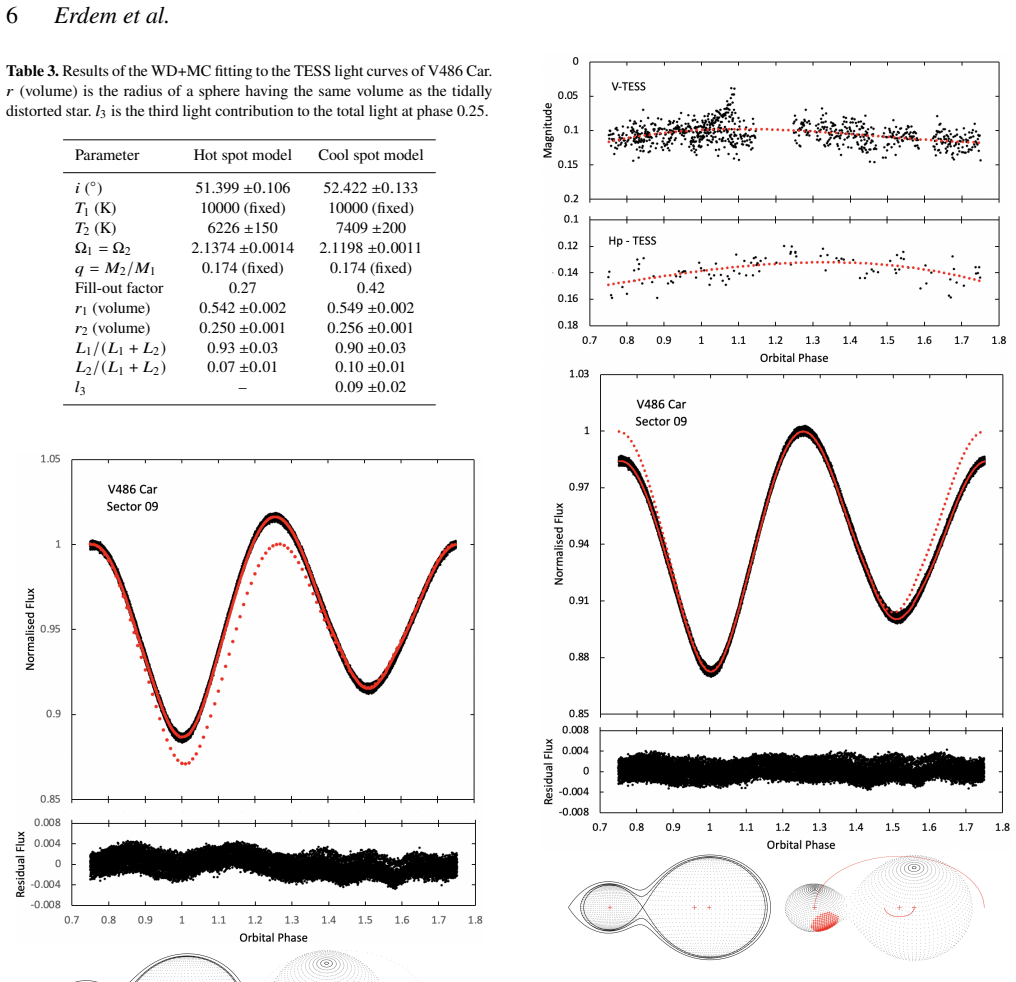
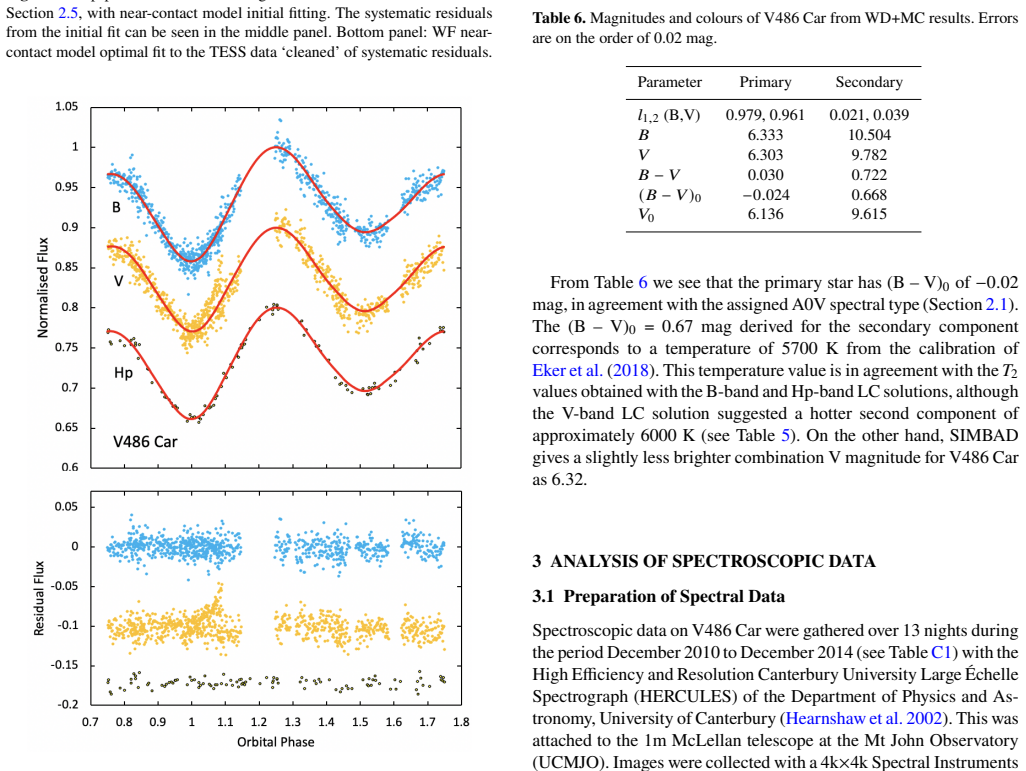
The hitherto neglected close binary V486 Car is studied with the aid of newly applied satellite photometry (HIPPARCOS and TESS), high dispersion spectrometry (HERCULES) and ground-based B and V photometry. While the sinusoidal light variations are suggestive of a near-contact system, the stars have only shallow eclipse, so highly confident parametrization becomes challenging. We find: $M_1 = 2.1 \pm 0.1$, $M_2 = 0.4 \pm 0.1$; $R_1 = 3.20 \pm 0.02$, $R_2 = 1.48 \pm 0.01$; (${\odot}$); $T_{e1} = 10000 \pm 500$, $T_{e2} = 6200 \pm 200$ (K); distance = 162 $\pm$ 12 (pc). New times of minima for V486 Car have been examined, including recent observations from TESS. The role of the relatively significant O'Connell effect is examined. As well as the conspicuous asymmetry from the main effect of about 0.036 mag (V), a jitter, with amplitude of about 0.005 V mag and quasi-period of order $\sim$ 10 d is noticed. There is a tendency for such photometric excursions at one maximum to precede those at the other. As well, the O -- C data indicate the presence of a low mass star $\sim$0.3 M$_{\odot}$ in an orbit separated by a few AU from the close binary. More accurate and plentiful spectroscopic data would be requisite for further investigations. A brief discussion reviews possible approaches to understanding the system in the context of near-contact binary scenarios.
Editorial analysis
A structured set of objections, weighed in public.
Referee Report
Summary. The paper analyzes the neglected close binary V486 Carinae using combined HIPPARCOS/TESS photometry, HERCULES high-dispersion spectroscopy, and ground-based B/V observations. Despite noting that shallow eclipses make highly confident parametrization challenging, it reports component masses M1=2.1±0.1 M⊙ and M2=0.4±0.1 M⊙, radii R1=3.20±0.02 R⊙ and R2=1.48±0.01 R⊙, effective temperatures Te1=10000±500 K and Te2=6200±200 K, and a distance of 162±12 pc. The work examines the O'Connell effect (0.036 mag asymmetry plus 0.005 mag jitter with ~10 d quasi-period) and interprets new times of minima, including TESS data, as evidence for a low-mass (~0.3 M⊙) third body in a wide orbit of a few AU; it calls for more spectroscopic data.
Significance. If the parameters prove reliable, the study adds a well-observed near-contact binary to the literature and supports hierarchical triple scenarios for such systems. The multi-dataset approach (photometry plus radial velocities) is a clear strength, and the explicit acknowledgment of modeling difficulties is commendable. The third-body interpretation, however, rests on timing trends that the authors themselves note require more data to confirm.
major comments (2)
- [Abstract and photometric modeling] Abstract and photometric/spectroscopic modeling sections: The headline parameters (M1=2.1±0.1 M⊙, R1=3.20±0.02 R⊙, etc.) are derived from HERCULES radial-velocity curves combined with light-curve modeling of shallow eclipses. Because eclipses are shallow, orbital inclination i is only weakly constrained near 90°. Spectroscopic masses scale as sin³i, so even a 1–2° uncertainty in i produces mass errors comparable to the quoted ±0.1 M⊙; the paper does not present degeneracy maps, Monte Carlo error budgets, or explicit tests showing that spot parameters (used to fit the 0.036 mag O'Connell effect) do not trade off against the binary potentials and fill-out factor.
- [O-C data analysis] O-C timing analysis: The inference of a ~0.3 M⊙ third body at a few AU separation is based on observed timing trends. With the limited number of minima (including recent TESS points), the orbital period and mass of the third body are not uniquely determined, and no quantitative assessment of alternative explanations (e.g., apsidal motion or spot-induced timing shifts) is provided to support the claim.
minor comments (2)
- [Photometric variations] The description of the photometric jitter (amplitude ~0.005 V mag, quasi-period ~10 d) and its tendency to precede excursions at the other maximum is interesting but would benefit from a quantitative periodogram or autocorrelation analysis to distinguish it from noise.
- [Notation] Notation for solar units (⊙) and temperature subscripts (Te1, Te2) is used inconsistently in places; ensure uniform formatting throughout tables and text.
Simulated Author's Rebuttal
We thank the referee for the careful and constructive review of our manuscript on V486 Carinae. We respond to the major comments point by point below.
read point-by-point responses
-
Referee: [Abstract and photometric modeling] Abstract and photometric/spectroscopic modeling sections: The headline parameters (M1=2.1±0.1 M⊙, R1=3.20±0.02 R⊙, etc.) are derived from HERCULES radial-velocity curves combined with light-curve modeling of shallow eclipses. Because eclipses are shallow, orbital inclination i is only weakly constrained near 90°. Spectroscopic masses scale as sin³i, so even a 1–2° uncertainty in i produces mass errors comparable to the quoted ±0.1 M⊙; the paper does not present degeneracy maps, Monte Carlo error budgets, or explicit tests showing that spot parameters (used to fit the 0.036 mag O'Connell effect) do not trade off against the binary potentials and fill-out factor.
Authors: We acknowledge the validity of this concern. The shallow eclipses do result in a weaker constraint on the inclination, and we recognize that the quoted uncertainties may not fully capture all degeneracies. In the revised manuscript, we will add a section detailing Monte Carlo error budgets and present degeneracy maps for key parameters. We will also include explicit tests demonstrating the impact of spot parameters on the derived potentials and fill-out factor. revision: yes
-
Referee: [O-C data analysis] O-C timing analysis: The inference of a ~0.3 M⊙ third body at a few AU separation is based on observed timing trends. With the limited number of minima (including recent TESS points), the orbital period and mass of the third body are not uniquely determined, and no quantitative assessment of alternative explanations (e.g., apsidal motion or spot-induced timing shifts) is provided to support the claim.
Authors: We agree that the third-body parameters cannot be uniquely determined from the current limited O-C data. We will revise the manuscript to include a quantitative discussion of alternative explanations, such as apsidal motion and spot-induced timing variations, to the extent possible with the available data. This will be accompanied by a stronger emphasis on the preliminary nature of the third-body claim and the need for more observations. revision: partial
- Unique determination of the third body parameters due to insufficient O-C data points.
Circularity Check
No significant circularity; parameters derived from independent external datasets via standard methods
full rationale
The reported masses, radii, temperatures and distance are obtained by fitting radial-velocity curves (HERCULES) and multi-band photometry (HIPPARCOS/TESS/ground-based) using conventional binary-star modeling codes. No equation in the paper equates a derived quantity to one of its own fitted inputs by construction, nor does any central claim rest on a self-citation chain that itself lacks independent verification. The O–C analysis for the putative third body uses observed times of minima, which are external data. The derivation chain therefore remains self-contained against external benchmarks.
Axiom & Free-Parameter Ledger
free parameters (1)
- component masses, radii and temperatures
axioms (1)
- domain assumption Standard assumptions of near-contact binary light-curve modeling (e.g., Roche geometry, limb darkening, gravity darkening)
invented entities (1)
-
low-mass third star ~0.3 solar masses
no independent evidence
Lean theorems connected to this paper
-
IndisputableMonolith/Cost/FunctionalEquation.leanwashburn_uniqueness_aczel unclear?
unclearRelation between the paper passage and the cited Recognition theorem.
We find: M1 = 2.1 ± 0.1, M2 = 0.4 ± 0.1; R1 = 3.20 ± 0.02, R2 = 1.48 ± 0.01; Te1 = 10000 ± 500, Te2 = 6200 ± 200 (K)
-
IndisputableMonolith/Foundation/BranchSelection.leanbranch_selection unclear?
unclearRelation between the paper passage and the cited Recognition theorem.
WD+MC fits to TESS LCs … hot spot model … fill-out factor 0.27
What do these tags mean?
- matches
- The paper's claim is directly supported by a theorem in the formal canon.
- supports
- The theorem supports part of the paper's argument, but the paper may add assumptions or extra steps.
- extends
- The paper goes beyond the formal theorem; the theorem is a base layer rather than the whole result.
- uses
- The paper appears to rely on the theorem as machinery.
- contradicts
- The paper's claim conflicts with a theorem or certificate in the canon.
- unclear
- Pith found a possible connection, but the passage is too broad, indirect, or ambiguous to say the theorem truly supports the claim.
Reference graph
Works this paper leans on
-
[3]
Data reduction and error analysis for the physical sciences
-
[4]
American Astronomical Society Meeting Abstracts , year = 2002, series =
Binary Maker 3.0 - An Interactive Graphics-Based Light Curve Synthesis Program Written in Java. American Astronomical Society Meeting Abstracts , year = 2002, series =
work page 2002
- [5]
-
[6]
Introduction to Astronomical Photometry , author=. 2007 , publisher=
work page 2007
-
[8]
Ellipsoidal figures of equilibrium
-
[9]
Limb and gravity-darkening coefficients for the TESS satellite at several metallicities, surface gravities, and microturbulent velocities. A&A , year = 2017, volume =
work page 2017
-
[10]
Bulletin d'Information du Centre de Donnees Stellaires , year = 1993, month = jul, volume =
A revised version of the ILLSS Catalogue. Bulletin d'Information du Centre de Donnees Stellaires , year = 1993, month = jul, volume =
work page 1993
-
[11]
VizieR Online Data Catalog: Revised version of the ILLSS Catalogue (Coluzzi 1993-1999)
work page 1993
-
[12]
VizieR Online Data Catalog: 2MASS All-Sky Catalog of Point Sources (Cutri+ 2003)
work page 2003
-
[14]
Another Unreal Paper , journal=
-
[15]
A Last Unreal Paper , journal=
- [22]
-
[25]
Physical parameters of close binary systems: VIII. , keywords =. doi:10.1093/mnras/staa3753 , archivePrefix =. 2101.10680 , primaryClass =
- [26]
-
[27]
Hadrava, Petr , title =. Publications of the Astronomical Institute of the Academy of Sciences of the Czech Republic , volume =
-
[29]
An Introduction to Close Binary Stars
- [30]
-
[31]
Southern Stars , year = 2013, month = sep, volume =
Southern Close Binaries Programme of the VSS. Southern Stars , year = 2013, month = sep, volume =
work page 2013
-
[34]
, year = 1973, month = may, volume =
The Evolution of a Contact Binary. , year = 1973, month = may, volume =
work page 1973
-
[36]
Close binary systems
-
[38]
, year = 1956, month = may, volume =
A method for computing accurately the epoch of minimum of an eclipsing variable. , year = 1956, month = may, volume =
work page 1956
-
[40]
, year = 1967, month = jan, volume =
Gravity-Darkening for Stars with Convective Envelopes. , year = 1967, month = jan, volume =
work page 1967
- [44]
-
[46]
Publications of the Riverview College Observatory , year = 1951, month = aug, volume =
The so-called periastron effect in close eclipsing binaries ; New variable stars (fifth list). Publications of the Riverview College Observatory , year = 1951, month = aug, volume =
work page 1951
-
[47]
A&A , year = 1997, month = jul, volume =
The HIPPARCOS Catalogue. A&A , year = 1997, month = jul, volume =
work page 1997
-
[51]
The Proximity Effects in Close Binary Systems. II. The Bolometric Reflection Effect for Stars with Deep Convective Envelopes. , year = 1969, month = jan, volume =
work page 1969
-
[55]
private communication , year = 2021, month = jun, volume =
HRSP Version 5. private communication , year = 2021, month = jun, volume =
work page 2021
-
[56]
HRSP - A dedicated echelle reduction software package for Hercules. IAU Colloq. 193: Variable Stars in the Local Group , year = 2004, editor =
work page 2004
-
[58]
An important paper , journal=
-
[59]
New Limb-Darkening Coefficients for Modeling Binary Star Light Curves. , keywords =. doi:10.1086/116788 , adsurl =
-
[63]
JAAVSO , year = 2006, month = jun, volume =
Unsolved Problems in the Evolution of Interacting Binary Stars. JAAVSO , year = 2006, month = jun, volume =
work page 2006
- [68]
-
[71]
Bak s V., Eker Z., 2022, @doi [ ] 10.32023/0001-5237/72.3.4 , https://ui.adsabs.harvard.edu/abs/2022AcA....72..195B 72, 195
-
[72]
Bak s V., et al., 2024, @doi [ ] 10.1017/pasa.2024.92 , https://ui.adsabs.harvard.edu/abs/2024PASA...41...83B 41, e083
-
[73]
Banks T., Budding E., 1990, @doi [ ] 10.1007/BF00659348 , https://ui.adsabs.harvard.edu/abs/1990Ap&SS.167..221B 167, 221
-
[74]
Bevington P., 1969, Data reduction and error analysis for the physical sciences . New York: McGraw-Hill
work page 1969
-
[75]
Bradstreet D. H., Steelman D. P., 2002, in American Astronomical Society Meeting Abstracts. p. 75.02
work page 2002
-
[76]
Budding E., Demircan O., 2007, Introduction to Astronomical Photometry. Cambridge Observing Handbooks for Research Astronomers, Cambridge University Press, www.cambridge.org/9780521847117
-
[77]
Astronomy and Astrophysics, CRC Press, https://books.google.com/books?id=sgGnzgEACAAJ
Budding E., Demircan O., 2022, A Guide to Close Binary Systems. Astronomy and Astrophysics, CRC Press, https://books.google.com/books?id=sgGnzgEACAAJ
work page 2022
-
[78]
Cardelli J. A., Clayton G. C., Mathis J. S., 1989, @doi [ ] 10.1086/167900 , https://ui.adsabs.harvard.edu/abs/1989ApJ...345..245C 345, 245
-
[79]
New Grids of ATLAS9 Model Atmospheres
Castelli F., Kurucz R. L., 2003, in Piskunov N., Weiss W. W., Gray D. F., eds, IAU Symposium Vol. 210, Modelling of Stellar Atmospheres. p. A20 ( @eprint arXiv astro-ph/0405087 ), @doi 10.48550/arXiv.astro-ph/0405087
work page internal anchor Pith review Pith/arXiv arXiv doi:10.48550/arxiv.astro-ph/0405087 2003
-
[80]
Chandrasekhar S., 1969, Ellipsoidal figures of equilibrium
work page 1969
-
[81]
Claret A., 2017, A&A, https://ui.adsabs.harvard.edu/abs/2017A
work page 2017
-
[82]
Coluzzi R., 1993, Bulletin d'Information du Centre de Donnees Stellaires, https://ui.adsabs.harvard.edu/abs/1993BICDS..43....7C 43, 7
work page 1993
-
[83]
Originally published in: 1993BICDS..43....7C
Coluzzi R., 1999, VizieR Online Data Catalog: Revised version of the ILLSS Catalogue (Coluzzi 1993-1999) , VizieR On-line Data Catalog: VI/71A. Originally published in: 1993BICDS..43....7C
work page 1999
-
[84]
Cutri R. M., et al., 2003, VizieR Online Data Catalog: 2MASS All-Sky Catalog of Point Sources (Cutri+ 2003) , VizieR On-line Data Catalog: II/246. Originally published in: University of Massachusetts and Infrared Processing and Analysis Center, (IPAC/California Institute of Technology) (2003)
work page 2003
-
[85]
Davidge T. J., Milone E. F., 1984, @doi [ ] 10.1086/190969 , https://ui.adsabs.harvard.edu/abs/1984ApJS...55..571D 55, 571
-
[86]
Eker Z., Bak s V., 2023, @doi [ ] 10.1093/mnras/stad1563 , https://ui.adsabs.harvard.edu/abs/2023MNRAS.523.2440E 523, 2440
-
[87]
Eker Z., et al., 2018, @doi [MNRAS] 10.1093/mnras/sty1834 , https://ui.adsabs.harvard.edu/abs/2018MNRAS.479.5491E 479, 5491
-
[88]
Erdem A., et al., 2022, @doi [Monthly Notices of the Royal Astronomical Society] 10.1093/mnras/stac2150 , https://ui.adsabs.harvard.edu/abs/2022MNRAS.515.6151E 515, 6151
-
[89]
Erdem A., et al., 2025, @doi [ ] 10.1017/pasa.2025.10080 , https://ui.adsabs.harvard.edu/abs/2025PASA...42..120E 42, e120
-
[90]
Fabry M., Pr s a A., 2025, @doi [ ] 10.3847/1538-4357/ae14ed , https://ui.adsabs.harvard.edu/abs/2025ApJ...994....7F 994, 7
-
[91]
P., 1976, @doi [ ] 10.1086/154266 , https://ui.adsabs.harvard.edu/abs/1976ApJ...205..217F 205, 217
Flannery B. P., 1976, @doi [ ] 10.1086/154266 , https://ui.adsabs.harvard.edu/abs/1976ApJ...205..217F 205, 217
-
[92]
Gaia Collaboration et al., 2016, @doi [A&A] 10.1051/0004-6361/201629272 , 595, A1
-
[93]
Gaia Collaboration et al., 2023, @doi [A&A] 10.1051/0004-6361/202243940 , https://ui.adsabs.harvard.edu/abs/2023A&A...674A...1G 674, A1
-
[94]
Hadrava P., 1995, , https://ui.adsabs.harvard.edu/abs/1995A&AS..114..393H 114, 393
work page 1995
-
[95]
Hadrava P., 2004, Publications of the Astronomical Institute of the Academy of Sciences of the Czech Republic, 92, 15
work page 2004
-
[96]
Hazlehurst J., Meyer-Hofmeister E., 1973, , https://ui.adsabs.harvard.edu/abs/1973A&A....24..379H 24, 379
work page 1973
-
[97]
Hearnshaw J. B., Barnes S. I., Kershaw G. M., Frost N., Graham G., Ritchie R., Nankivell G. R., 2002, @doi [Experimental Astronomy] 10.1023/A:1023770225275 , https://ui.adsabs.harvard.edu/abs/2002ExA....13...59H 13, 59
-
[98]
W., 2001, An Introduction to Close Binary Stars
Hilditch R. W., 2001, An Introduction to Close Binary Stars
work page 2001
-
[99]
P., 1975, University of Michigan Catalogue of two-dimensional spectral types for the HD stars
Houk N., Cowley A. P., 1975, University of Michigan Catalogue of two-dimensional spectral types for the HD stars. Volume I. Declinations -90\_ to -53\_ 0
work page 1975
-
[100]
Idaczyk R., Blackford M., Budding E., Butland R., 2013, Southern Stars, https://ui.adsabs.harvard.edu/abs/2013SouSt..52c..16R 52, 16
work page 2013
-
[101]
B., 1959, @doi [ ] 10.1086/107913 , https://ui.adsabs.harvard.edu/abs/1959AJ.....64..149I 64, 149
Irwin J. B., 1959, @doi [ ] 10.1086/107913 , https://ui.adsabs.harvard.edu/abs/1959AJ.....64..149I 64, 149
-
[102]
Jenkins J. M., et al., 2016, in Chiozzi G., Guzman J. C., eds, Society of Photo-Optical Instrumentation Engineers (SPIE) Conference Series Vol. 9913, Software and Cyberinfrastructure for Astronomy IV. p. 99133E, @doi 10.1117/12.2233418
-
[103]
Kirk B., et al., 2016, @doi [ ] 10.3847/0004-6256/151/3/68 , https://ui.adsabs.harvard.edu/abs/2016AJ....151...68K 151, 68
-
[104]
Kopal Z., 1959, Close binary systems . John Wiley & Sons, Inc, NY
work page 1959
-
[105]
P., 1941, @doi [ ] 10.1086/144252 , https://ui.adsabs.harvard.edu/abs/1941ApJ....93..133K 93, 133
Kuiper G. P., 1941, @doi [ ] 10.1086/144252 , https://ui.adsabs.harvard.edu/abs/1941ApJ....93..133K 93, 133
-
[106]
K., van Woerden H., 1956, , https://ui.adsabs.harvard.edu/abs/1956BAN....12..327K 12, 327
Kwee K. K., van Woerden H., 1956, , https://ui.adsabs.harvard.edu/abs/1956BAN....12..327K 12, 327
work page 1956
-
[107]
Liu Q.-Y., Yang Y.-L., 2003, @doi [ ] 10.1088/1009-9271/3/2/142 , https://ui.adsabs.harvard.edu/abs/2003ChJAA...3..142L 3, 142
-
[108]
B., 1967, , https://ui.adsabs.harvard.edu/abs/1967ZA.....65...89L 65, 89
Lucy L. B., 1967, , https://ui.adsabs.harvard.edu/abs/1967ZA.....65...89L 65, 89
work page 1967
-
[109]
Lucy L. B., 1968a, @doi [ApJ] 10.1086/149510 , https://ui.adsabs.harvard.edu/abs/1968ApJ...151.1123L 151, 1123
-
[110]
Lucy L. B., 1968b, @doi [ApJ] 10.1086/149712 , https://ui.adsabs.harvard.edu/abs/1968ApJ...153..877L 153, 877
-
[111]
Lucy L. B., Wilson R. E., 1979, @doi [ ] 10.1086/157212 , https://ui.adsabs.harvard.edu/abs/1979ApJ...231..502L 231, 502
-
[112]
Malkov O., Oblak E., 2006, , https://ui.adsabs.harvard.edu/abs/2006MmSAI..77.1175M 77, 1175
work page 2006
-
[113]
Malkov O. Y., Oblak E., Snegireva E. A., Torra J., 2006, @doi [ ] 10.1051/0004-6361:20053137 , https://ui.adsabs.harvard.edu/abs/2006A&A...446..785M 446, 785
-
[114]
O'Connell D. J. K., 1951, Publications of the Riverview College Observatory, https://ui.adsabs.harvard.edu/abs/1951PRCO....2...85O 2, 85
work page 1951
-
[115]
Perryman M. A. C., et al., 1997, A&A, https://ui.adsabs.harvard.edu/abs/1997A&A...323L..49P 323, L49
work page 1997
-
[116]
Pribulla T., Va n ko M., Chochol D., Hamb \'a lek L ., Parimucha S ., 2011, @doi [Astronomische Nachrichten] 10.1002/asna.201111569 , https://ui.adsabs.harvard.edu/abs/2011AN....332..607P 332, 607
-
[117]
Qian S., 2001, @doi [ ] 10.1046/j.1365-8711.2001.04921.x , https://ui.adsabs.harvard.edu/abs/2001MNRAS.328..914Q 328, 914
-
[118]
Ricker G. R., et al., 2015, @doi [Journal of Astronomical Telescopes, Instruments, and Systems] 10.1117/1.JATIS.1.1.014003 , https://ui.adsabs.harvard.edu/abs/2015JATIS...1a4003R 1, 014003
work page internal anchor Pith review doi:10.1117/1.jatis.1.1.014003 2015
discussion (0)
Sign in with ORCID, Apple, or X to comment. Anyone can read and Pith papers without signing in.