A universal framework to identify eccentric binary mergers: GW200105 case study
Pith reviewed 2026-05-20 08:47 UTC · model grok-4.3
pith:N7RWP6HU Add to your LaTeX paper
What is a Pith Number?\usepackage{pith}
\pithnumber{N7RWP6HU}
Prints a linked pith:N7RWP6HU badge after your title and writes the identifier into PDF metadata. Compiles on arXiv with no extra files. Learn more
The pith
A frequency-independent detection statistic finds only weak evidence for eccentricity in the neutron star-black hole merger GW200105.
A machine-rendered reading of the paper's core claim, the machinery that carries it, and where it could break.
Core claim
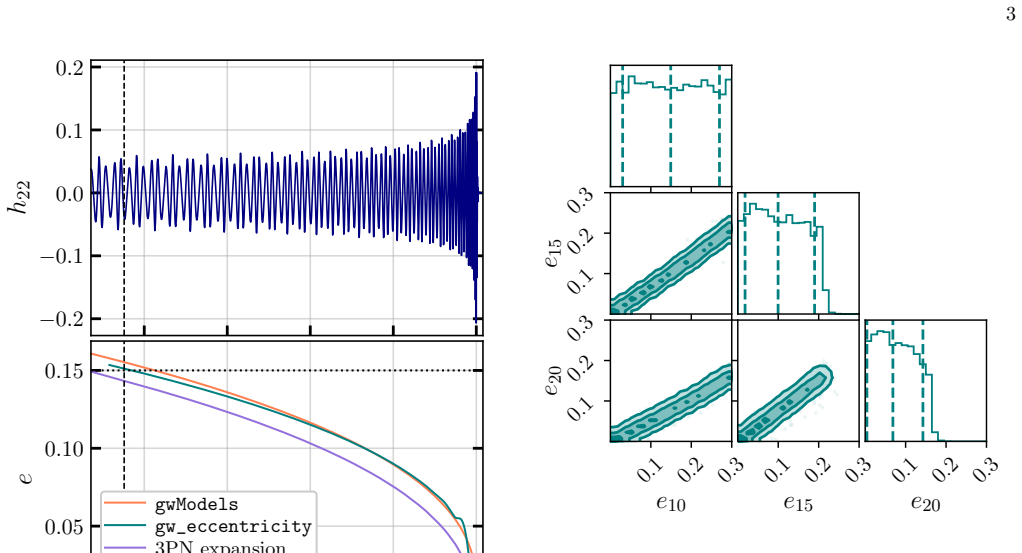
We show that the varied results reported across different studies can be partially reconciled by accounting for the evolution of eccentricity with reference frequency. In order to make conclusive statements about eccentricity, we propose a detection statistic that does not depend on reference frequency, and which marginalises over astrophysically-motivated distributions in eccentricity. Using this detection statistic, we find reduced support for the eccentric hypothesis for GW200105_162426: we obtain a natural log Bayes factor ln B ≤ 0.9 comparing the eccentric, aligned-spin hypothesis to the quasi-circular, precessing hypothesis.
What carries the argument
A reference-frequency-independent detection statistic that marginalizes over astrophysically-motivated eccentricity distributions.
If this is right
- The eccentric interpretation of GW200105_162426 receives only weak support.
- Discrepancies in eccentricity measurements between studies can be reconciled by accounting for frequency evolution.
- Future analyses of eccentricity must incorporate astrophysical distributions to reach conclusive results.
Where Pith is reading between the lines
- This approach could be applied to other candidate eccentric events to check if their eccentricity claims hold under the same conditions.
- The framework may help standardize eccentricity measurements across the full gravitational wave catalog.
- If the marginalization priors are updated with new population synthesis results, the Bayes factor for events like GW200105 could shift.
Load-bearing premise
The astrophysically-motivated distributions in eccentricity used for marginalization accurately represent the true population of merging binaries.
What would settle it
Reanalysis of GW200105 using alternative eccentricity population models that yields a Bayes factor significantly above 0.9 would falsify the reduced support for the eccentric hypothesis.
Figures

read the original abstract
Orbital eccentricity in gravitational-wave signals from merging compact object binaries is a powerful indicator of their formation channel. Several binary black hole mergers and a neutron star--black hole merger have been reported to exhibit signs of eccentricity, but which events are identified and the significance of the eccentricity differs between studies. Measurements of eccentricity can change depending on the choice of prior. The choice of prior is subtle: eccentricity is commonly measured at an arbitrary reference frequency, which varies from study to study. We use the candidate eccentric neutron star--black hole merger GW200105_162426 as a case study, employing a range of priors and reference frequencies, and find the results to be strongly prior-driven. We show that the varied results reported across different studies can be partially reconciled by accounting for the evolution of eccentricity with reference frequency. In order to make conclusive statements about eccentricity, we propose a detection statistic that does not depend on reference frequency, and which marginalises over astrophysically-motivated distributions in eccentricity. Using this detection statistic, we find reduced support for the eccentric hypothesis for GW200105_162426: we obtain a natural log Bayes factor ln B $\leq$ 0.9 comparing the eccentric, aligned-spin hypothesis to the quasi-circular, precessing hypothesis. Our results cast doubt on the eccentric interpretation of GW200105_162426 and underscore the importance of modelling the astrophysical distributions of eccentricity in nature.
Editorial analysis
A structured set of objections, weighed in public.
Referee Report
Summary. The manuscript proposes a reference-frequency-independent detection statistic for orbital eccentricity in compact binary mergers. This statistic marginalizes the likelihood over astrophysically motivated eccentricity distributions to compare an eccentric aligned-spin hypothesis against a quasi-circular precessing hypothesis. Using GW200105_162426 as a case study, the authors show that eccentricity inferences are strongly prior-dependent, reconcile literature discrepancies via eccentricity evolution, and report a natural log Bayes factor ln B ≤ 0.9 favoring the quasi-circular model, thereby casting doubt on the eccentric interpretation.
Significance. If robust, the framework offers a standardized approach to eccentricity detection that could reduce inconsistencies across studies and better constrain formation channels. The explicit treatment of reference-frequency dependence and the marginalization procedure represent a constructive advance, though the result's reliability hinges on the accuracy of the adopted population distributions.
major comments (2)
- [Detection statistic and marginalization procedure] The central detection statistic (described in the methods and results sections) is defined via marginalization over specific astrophysically motivated eccentricity distributions; the reported ln B ≤ 0.9 bound for GW200105_162426 therefore inherits any systematic bias if these distributions under-represent the high-eccentricity tail expected from dynamical channels. A sensitivity test varying the distribution parameters or formation-channel weights is needed to confirm that the reduced support for eccentricity is not an artifact of the marginalization choice.
- [Results for GW200105_162426] The abstract and results state that the Bayes factor is obtained after integrating against the eccentricity distributions, yet the manuscript provides limited verification of the marginalization implementation, waveform models employed, and data conditioning steps. Without these details, it is difficult to rule out post-hoc choices that could affect the quoted upper bound of ln B ≤ 0.9.
minor comments (2)
- [Abstract] The abstract's phrasing 'ln B ≤ 0.9 comparing the eccentric... to the quasi-circular...' would benefit from explicit clarification that this is an upper limit on the evidence for the eccentric hypothesis.
- [Case-study section] A concise table listing the range of priors, reference frequencies, and resulting Bayes factors tested in the case study would improve readability and allow direct comparison with prior literature.
Simulated Author's Rebuttal
We thank the referee for their thoughtful review and valuable feedback on our manuscript. We address each of the major comments below and describe the revisions we plan to implement.
read point-by-point responses
-
Referee: [Detection statistic and marginalization procedure] The central detection statistic (described in the methods and results sections) is defined via marginalization over specific astrophysically motivated eccentricity distributions; the reported ln B ≤ 0.9 bound for GW200105_162426 therefore inherits any systematic bias if these distributions under-represent the high-eccentricity tail expected from dynamical channels. A sensitivity test varying the distribution parameters or formation-channel weights is needed to confirm that the reduced support for eccentricity is not an artifact of the marginalization choice.
Authors: We agree that the marginalization over eccentricity distributions is central to our detection statistic and that the result could be sensitive to the specific forms chosen. The distributions used are drawn from astrophysical literature on binary formation channels, as described in the methods section of the manuscript. To strengthen the analysis, we will add a dedicated subsection performing sensitivity tests. These will include varying the shape parameters of the eccentricity distributions and adjusting the relative contributions from different formation channels (e.g., increasing the weight of dynamical channels with higher eccentricity tails). The outcomes of these tests will be reported in the revised manuscript to demonstrate the robustness of the ln B ≤ 0.9 finding. revision: yes
-
Referee: [Results for GW200105_162426] The abstract and results state that the Bayes factor is obtained after integrating against the eccentricity distributions, yet the manuscript provides limited verification of the marginalization implementation, waveform models employed, and data conditioning steps. Without these details, it is difficult to rule out post-hoc choices that could affect the quoted upper bound of ln B ≤ 0.9.
Authors: We recognize the importance of providing sufficient technical details for reproducibility and to allow readers to assess the reliability of the results. Although the current manuscript includes descriptions in the methods and results sections, we will expand these sections in the revision. Specifically, we will provide more detailed information on the implementation of the marginalization procedure, the exact waveform models and approximants used for both the eccentric and quasi-circular hypotheses, and the data preprocessing and conditioning steps applied to the LIGO/Virgo data for GW200105_162426. Additionally, we will include supplementary material or an appendix with verification tests, such as checks on the numerical integration and comparisons with alternative implementations, to address any concerns about post-hoc choices. revision: yes
Circularity Check
No significant circularity; derivation uses external priors
full rationale
The paper defines a reference-frequency-independent detection statistic by marginalizing the likelihood over astrophysically-motivated eccentricity distributions drawn from independent prior literature on formation channels. The reported ln B ≤ 0.9 is the direct numerical output of this marginalization applied to GW200105_162426 data. No parameters are fitted to the target event to produce the result, no self-citation chain justifies a uniqueness claim, and the eccentricity evolution model is applied as a physical mapping rather than a redefinition of the input. The central claim therefore remains a computation conditioned on external distributions and does not reduce to its own inputs by construction.
Axiom & Free-Parameter Ledger
axioms (2)
- domain assumption Eccentricity evolves with orbital frequency according to general relativity in a manner that allows reconciliation of measurements at different reference frequencies.
- domain assumption Astrophysically-motivated distributions of eccentricity exist and can be used for marginalization without introducing strong bias.
Reference graph
Works this paper leans on
-
[1]
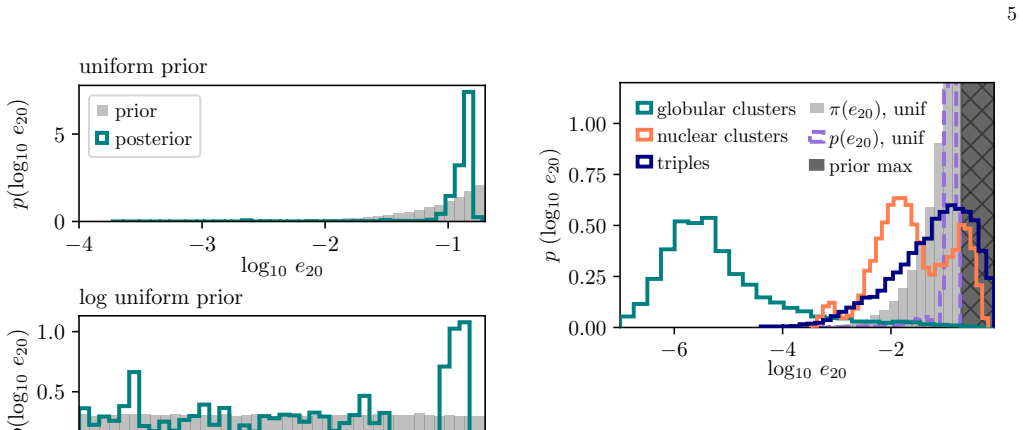
Uniform inebetween 0 and 0.2. Many authors adopt a uniform ineprior because the uniform dis- tribution seems uninformative [see, e.g., 48]
-
[2]
Log-uniform inebetweene= 10 −4 ande= 0.2. Some authors have argued that this distribution is more suitable than a uniform distribution since we do not know the order of magnitude of eccentric- ity; see, e.g., Ref. [8]. Arguably, this choice is more representative of at least some astrophysical distri- butions, where structure emerges when viewed on a log ...
-
[3]
A physically-motivated distribution derived from simulating NSBH mergers in triples [61], evolved to 20 Hz and truncated betweene= 0 ande= 0.2. 4 We perform an additional analysis at a reference fre- quency of 10 Hz using the NSBH triples prior evolved to 10 Hz and truncated betweene= 0 ande= 0.2. We choose this relatively conservative upper limit on ecce...
-
[4]
and withSEOBNRv5EHMwith the eccentricity fixed to zero. Taking these results at face value, we obtain natural log Bayes factors in support of the eccentric hypothesis over the quasi-circular precessing hypothesis of 2.4, 0.2 and 0.3 using a uniform, log-uniform and analytic NSBH triples prior respectively. We interpret this as weak, al- beit prior-depende...
-
[5]
J. Aasi, B. P. Abbott, R. Abbott, T. Abbott, M. R. Abernathy, K. Ackley, C. Adams, T. Adams, P. Ad- desso, and et al., Classical and Quantum Gravity32, 074001 (2015)
work page 2015
-
[6]
Advanced Virgo: a 2nd generation interferometric gravitational wave detector
F. Acerneseet al.(VIRGO), Class. Quant. Grav.32, 024001 (2015), arXiv:1408.3978 [gr-qc]
work page internal anchor Pith review Pith/arXiv arXiv 2015
-
[7]
T. Akutsu, M. Ando, K. Arai, Y. Arai, S. Araki, A. Araya, N. Aritomi, Y. Aso, S. Bae, Y. Bae, L. Baiotti, R. Bajpai, M. Barton, K. Cannon, E. Capocasa, M. Chan, C. Chen, K. Chen, and Y. Chen, Progress of Theoretical and Experimental Physics2021(2020), 10.1093/ptep/ptaa125
-
[8]
P. C. Peters, Phys. Rev.136, B1224 (1964)
work page 1964
-
[9]
R. M. O’Leary, B. Kocsis, and A. Loeb, MNRAS395, 2127 (2009), arXiv:0807.2638 [astro-ph]
work page internal anchor Pith review Pith/arXiv arXiv 2009
-
[10]
C. L. Rodriguez, P. Amaro-Seoane, S. Chatterjee, K. Kremer, F. A. Rasio, J. Samsing, C. S. Ye, and M. Zevin, Phys. Rev.D98, 123005 (2018), arXiv:1811.04926 [astro-ph.HE]
work page internal anchor Pith review Pith/arXiv arXiv 2018
- [11]
-
[12]
M. E. Lower, E. Thrane, P. D. Lasky, and R. Smith, Phys. Rev. D98, 083028 (2018), arXiv:1806.05350 8 [astro-ph.HE]
work page internal anchor Pith review Pith/arXiv arXiv 2018
- [13]
-
[14]
I. Romero-Shaw, P. D. Lasky, and E. Thrane, ApJ921, L31 (2021), arXiv:2108.01284 [astro-ph.HE]
-
[15]
E. O’Shea and P. Kumar, Phys. Rev. D108, 104018 (2023), arXiv:2107.07981 [astro-ph.HE]
-
[16]
I. Romero-Shaw, P. D. Lasky, and E. Thrane, ApJ940, 171 (2022), arXiv:2206.14695 [astro-ph.HE]
- [17]
-
[18]
Evidence for eccentricity in the population of binary black holes observed by LIGO-Virgo-KAGRA
N. Gupte, A. Ramos-Buades, A. Buonanno, J. Gair, M. Coleman Miller, M. Dax, S. R. Green, M. P¨ urrer, J. Wildberger, J. Macke, and et al., Physical Review D 112, 104045 (2025), arXiv:2404.14286 [gr-qc]
work page internal anchor Pith review Pith/arXiv arXiv 2025
- [19]
-
[20]
R. Abbott, T. D. Abbott, F. Acernese, K. Ackley, C. Adams, N. Adhikari, R. X. Adhikari, V. B. Adya, C. Affeldt, D. Agarwal, and et al., Physical Review X 13, 041039 (2023), arXiv:2111.03606 [gr-qc]
work page internal anchor Pith review Pith/arXiv arXiv 2023
- [21]
-
[22]
F. Antonini, I. M. Romero-Shaw, and T. Callister, Phys. Rev. Lett.134, 011401 (2025), arXiv:2406.19044 [astro-ph.HE]
-
[23]
J. Stegmann, F. Antonini, A. Olejak, S. Biscoveanu, V. Raymond, S. Rinaldi, and E. Flanagan, The As- trophysical Journal1000, L59 (2026), arXiv:2512.15873 [astro-ph.HE]
- [24]
-
[25]
von Zeipel, Astronomische Nachrichten183, 345 (1910)
H. von Zeipel, Astronomische Nachrichten183, 345 (1910)
work page 1910
-
[26]
M. L. Lidov, Planetary and Space Science9, 719 (1962)
work page 1962
- [27]
-
[28]
S. Naoz, W. M. Farr, Y. Lithwick, F. A. Rasio, and J. Teyssandier, Monthly Notices of the Royal Astronom- ical Society431, 2155 (2013), arXiv:1107.2414 [astro- ph.EP]
work page internal anchor Pith review Pith/arXiv arXiv 2013
-
[29]
Naoz, Annual Review of Astronomy and Astrophysics 54, 441–489 (2016)
S. Naoz, Annual Review of Astronomy and Astrophysics 54, 441–489 (2016)
work page 2016
-
[30]
C. L. Rodriguez and F. Antonini, ApJ863, 7 (2018), arXiv:1805.08212 [astro-ph.HE]
work page internal anchor Pith review Pith/arXiv arXiv 2018
-
[31]
A. Ramos-Buades, A. Buonanno, H. Estell´ es, M. Khalil, D. P. Mihaylov, S. Ossokine, L. Pompili, and M. Shiferaw, Phys. Rev. D108, 124037 (2023), arXiv:2303.18046 [gr-qc]
- [32]
- [33]
- [34]
- [35]
- [36]
-
[37]
T. A. Apostolatos, C. Cutler, G. J. Sussman, and K. S. Thorne, Physical Review D49, 6274 (1994)
work page 1994
- [38]
- [39]
-
[40]
V. Gayathri, J. Healy, J. Lange, B. O’Brien, M. Szczepa´ nczyk, I. Bartos, M. Campanelli, S. Kli- menko, C. O. Lousto, and R. O’Shaughnessy, Nature Astronomy6, 344 (2022)
work page 2022
-
[41]
A. Ramos-Buades, A. Buonanno, and J. Gair, Phys. Rev. D108, 124063 (2023), arXiv:2309.15528 [gr- qc]
- [42]
- [43]
- [44]
- [45]
-
[46]
Assessing the imprint of eccentricity in GW signatures using two independent waveform models
N. Malagon and R. O’Shaughnessy, arXiv e-prints , arXiv:2605.12818 (2026), arXiv:2605.12818 [astro- ph.HE]
work page internal anchor Pith review Pith/arXiv arXiv 2026
-
[47]
A. Jan, S. Nicolella, D. Shoemaker, and R. O’Shaughnessy, arXiv e-prints , arXiv:2512.20060 (2025), arXiv:2512.20060 [gr-qc]
work page internal anchor Pith review Pith/arXiv arXiv 2025
- [48]
- [49]
-
[50]
S. Tibrewal, A. Zimmerman, J. Lange, and D. Shoe- maker, arXiv e-prints , arXiv:2601.02260 (2026), arXiv:2601.02260 [gr-qc]
- [51]
- [52]
- [53]
- [54]
- [55]
-
[56]
K. Kacanja, K. Soni, and A. H. Nitz, Physical Review D112, 122007 (2025), arXiv:2508.00179 [gr-qc]. 9
-
[57]
K. S. Phukon, P. Schmidt, G. Morras, and G. Pratten, arXiv e-prints , arXiv:2512.10803 (2025), arXiv:2512.10803 [gr-qc]
work page internal anchor Pith review Pith/arXiv arXiv 2025
- [58]
- [59]
-
[60]
Black Hole-Neutron Star Mergers in Globular Clusters
D. Clausen, S. Sigurdsson, and D. F. Chernoff, Monthly Notices of the Royal Astronomical Society428, 3618 (2013), arXiv:1210.8153 [astro-ph.HE]
work page internal anchor Pith review Pith/arXiv arXiv 2013
-
[61]
Y.-B. Bae, C. Kim, and H. M. Lee, Monthly Notices of the Royal Astronomical Society440, 2714 (2014), arXiv:1308.1641 [astro-ph.HE]
work page internal anchor Pith review Pith/arXiv arXiv 2014
-
[62]
Greatly enhanced merger rates of compact-object binaries in non-spherical nuclear star clusters
C. Petrovich and F. Antonini, The Astrophysical Jour- nal846, 146 (2017), arXiv:1705.05848 [astro-ph.HE]
work page internal anchor Pith review Pith/arXiv arXiv 2017
- [63]
-
[64]
G. Fragione and S. Banerjee, The Astrophysical Journal 901, L16 (2020), arXiv:2006.06702 [astro-ph.GA]
-
[65]
J. Stegmann and J. Klencki, The Astrophysical Journal 991, L54 (2025), arXiv:2506.09121 [astro-ph.HE]
-
[66]
The LIGO Scientific Collaboration, the Virgo Col- laboration, the KAGRA Collaboration, A. G. Abac, I. Abouelfettouh, F. Acernese, K. Ackley, C. Adam- cewicz, S. Adhicary, D. Adhikari, and et al., arXiv e- prints , arXiv:2508.18082 (2025), arXiv:2508.18082 [gr- qc]
work page internal anchor Pith review Pith/arXiv arXiv 2025
-
[67]
P. C. Peters and J. Mathews, Physical Review131, 435 (1963)
work page 1963
- [68]
-
[69]
C. K¨ onigsd¨ orffer and A. Gopakumar, Physical Review D73, 124012 (2006), arXiv:gr-qc/0603056 [gr-qc]
work page internal anchor Pith review Pith/arXiv arXiv 2006
-
[70]
B. Moore, M. Favata, K. Arun, and C. K. Mishra, Phys- ical Review D93(2016), 10.1103/physrevd.93.124061
-
[71]
Non-adiabatic dynamics of eccentric black-hole binaries in post-Newtonian theory
G. Fumagalli, N. Loutrel, D. Gerosa, and M. Boschini, Phys. Rev. D112, 024012 (2025), arXiv:2502.06952 [gr- qc]
work page internal anchor Pith review Pith/arXiv arXiv 2025
- [72]
- [73]
-
[74]
T. Islam and T. Venumadhav, Physical Review D112, 104039 (2025), arXiv:2502.02739 [gr-qc]
-
[75]
Bilby: A user-friendly Bayesian inference library for gravitational-wave astronomy
G. Ashtonet al., Astrophys. J. Suppl.241, 27 (2019), arXiv:1811.02042 [astro-ph.IM]
work page internal anchor Pith review Pith/arXiv arXiv 2019
-
[76]
I. M. Romero-Shawet al., Mon. Not. Roy. Astron. Soc. 499, 3295 (2020), arXiv:2006.00714 [astro-ph.IM]
work page internal anchor Pith review Pith/arXiv arXiv 2020
- [77]
- [78]
-
[79]
The LIGO Scientific Collaboration, the Virgo Col- laboration, the KAGRA Collaboration, A. G. Abac, I. Abouelfettouh, F. Acernese, K. Ackley, S. Adhicary, D. Adhikari, N. Adhikari, and et al., arXiv e-prints , arXiv:2508.18081 (2025), arXiv:2508.18081 [gr-qc]
work page internal anchor Pith review Pith/arXiv arXiv 2025
-
[80]
J. S. Speagle, Monthly Notices of the Royal Astronom- ical Society493, 3132 (2020), arXiv:1904.02180 [astro- ph.IM]
work page internal anchor Pith review Pith/arXiv arXiv 2020
discussion (0)
Sign in with ORCID, Apple, or X to comment. Anyone can read and Pith papers without signing in.