Block-Sphere Vector Quantization
Pith reviewed 2026-05-20 07:24 UTC · model grok-4.3
The pith
Block-Sphere Quantization improves reconstruction MSE and expected inner-product distortion by quantizing blocks on the sphere after random rotation.
A machine-rendered reading of the paper's core claim, the machinery that carries it, and where it could break.
Core claim
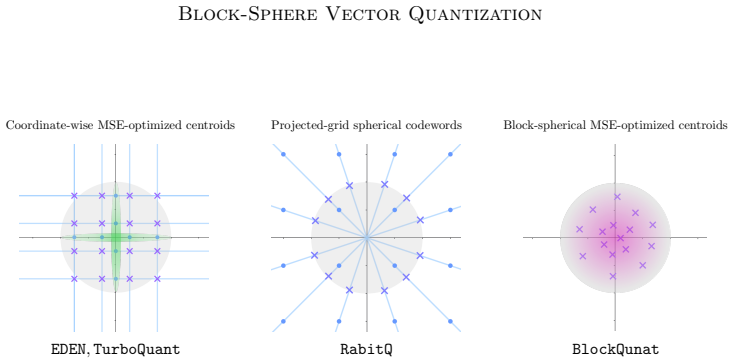
Block-Sphere Quantization (BlockQuant) is a rotation-based vector quantizer that quantizes blocks of randomly rotated vectors directly on the sphere. Unlike coordinate-wise methods, this design preserves the geometry of the rotated embeddings more faithfully. The paper proves that BlockQuant improves over EDEN, RabitQ, and TurboQuant on both reconstruction MSE and expected inner-product distortion, with experiments confirming consistent gains in storage and inference settings.
What carries the argument
The block-spherical quantization step, which maps blocks of randomly rotated vectors onto the sphere before applying quantization.
If this is right
- BlockQuant supplies stronger guarantees than the baselines for MSE distortion.
- It also delivers lower expected inner-product distortion, aiding similarity search.
- The unified comparison shows prior methods trade off strengths by distortion type.
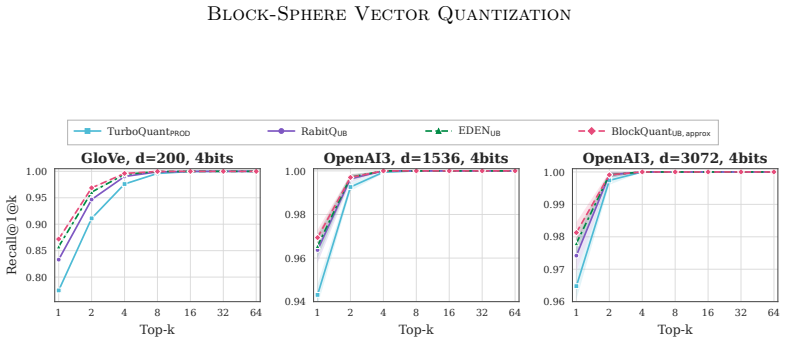
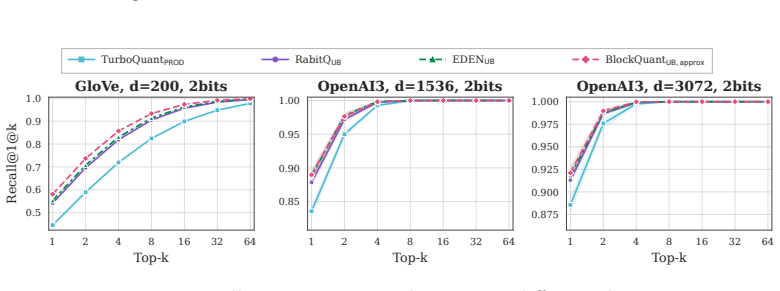
- Practical gains appear in real embedding datasets and long-context LLM inference.
Where Pith is reading between the lines
- The spherical block approach might extend to product quantization or other structured compressors.
- Performance differences could be largest in very high-dimensional or anisotropic data.
- Integration into vector databases could trade modest overhead for reduced retrieval distortion.
Load-bearing premise
That quantizing blocks on the sphere after random rotation preserves vector geometry more faithfully than coordinate-wise quantization.
What would settle it
A head-to-head evaluation on a standard embedding dataset in which BlockQuant produces higher average MSE or expected inner-product error than EDEN or TurboQuant.
Figures

read the original abstract
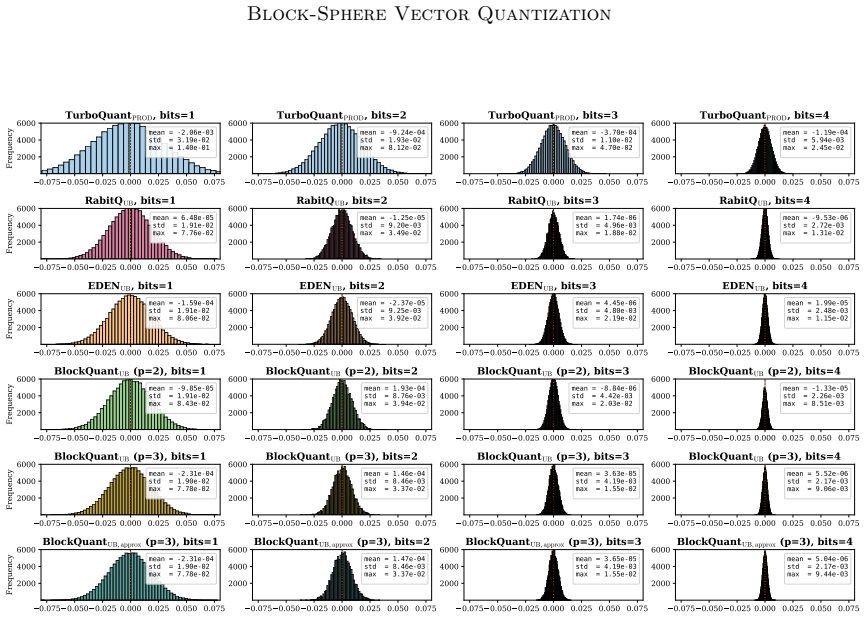
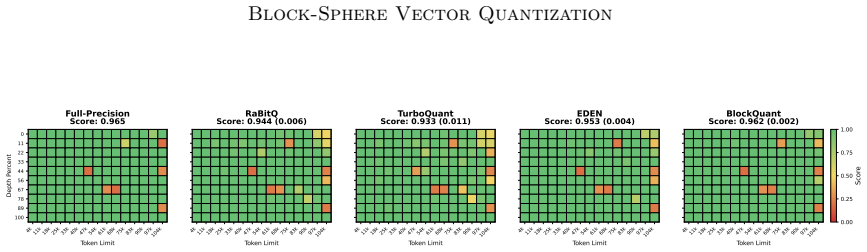
Vector quantization is a fundamental primitive for scalable machine learning systems, enabling memory-efficient storage, fast retrieval, and compressed inference. Recent rotation-based quantizers such as EDEN, RabitQ, and TurboQuant have introduced strong guarantees and empirical performance, but the surrounding comparisons have been difficult to interpret because they rely on different distortion criteria, probability regimes, and implementation assumptions. As our first contribution, we provide a unified theoretical comparison of these methods and show that their relative advantages are criterion-dependent rather than absolute: EDEN and TurboQuant are favorable for MSE distortion, EDEN is also effective for expected inner-product distortion, and RabitQ provides strong high-probability control. This comparison further clarifies that EDEN provides particularly strong guarantees for expected distortion measures. As our second contribution, we introduce Block-Sphere Quantization (BlockQuant), a new rotation-based block quantization algorithm designed around the spherical geometry of randomly rotated vectors. Unlike coordinate-wise quantizers, BlockQuant quantizes blocks on the sphere, preserving the geometry of rotated embeddings more faithfully. We prove that this block-spherical design theoretically improves over the baselines considered in this paper for both reconstruction MSE and expected inner-product distortion. Our experiments on real embedding datasets and long-context LLM inference tasks show practical gains that are consistent with our theoretical improvements.
Editorial analysis
A structured set of objections, weighed in public.
Referee Report
Summary. The manuscript provides a unified theoretical comparison of rotation-based vector quantizers (EDEN, RabitQ, TurboQuant), showing that their relative advantages are criterion-dependent (e.g., EDEN and TurboQuant favorable for MSE, EDEN for expected inner-product distortion, RabitQ for high-probability control). It introduces Block-Sphere Quantization (BlockQuant), which performs quantization on blocks lying on the sphere after a random rotation, and proves that this design yields strict improvements over the considered baselines in both reconstruction MSE and expected inner-product distortion. Experiments on embedding datasets and long-context LLM inference tasks report consistent practical gains aligned with the theory.
Significance. If the proofs hold under the stated assumptions, the work would be significant for scalable ML systems by offering a quantization primitive with simultaneous theoretical guarantees on multiple distortion measures, which is valuable for compressed storage and inference. The unified comparison clarifies trade-offs among recent methods and is a useful service to the community. The manuscript ships explicit theoretical proofs of improvement and reproducible experimental validation on real tasks, which are strengths.
major comments (2)
- [§4] §4 (BlockQuant Theoretical Analysis): The proof that the block-spherical design after random rotation strictly dominates coordinate-wise baselines in both MSE and expected inner-product distortion invokes per-block independence and isotropy on the sphere. The manuscript does not bound or analyze residual cross-block correlations induced by the shared rotation matrix or cases where block size does not evenly divide the embedding dimension; without this, the claimed strict improvement does not necessarily follow for structured or low-rank embeddings.
- [Theorem 1] Theorem 1 and surrounding derivation: The unified comparison correctly notes criterion dependence, but the dominance claims for BlockQuant reduce to per-block spherical quantization error bounds only under the additional premise that overall inner-product distortion is exactly the sum of block distortions; an explicit expansion showing the cross terms vanish would be required to make the argument load-bearing.
minor comments (2)
- [Algorithm 1] The definition of the random rotation matrix and its interaction with block partitioning could be stated more explicitly in the algorithm description to aid reproducibility.
- [Figure 3] Figure 3 (distortion vs. bit-rate curves) would benefit from error bars or multiple random seeds to visually support the consistency of gains.
Simulated Author's Rebuttal
We thank the referee for their thorough review and valuable suggestions. We address the major comments below and plan to incorporate revisions to strengthen the theoretical analysis.
read point-by-point responses
-
Referee: [§4] §4 (BlockQuant Theoretical Analysis): The proof that the block-spherical design after random rotation strictly dominates coordinate-wise baselines in both MSE and expected inner-product distortion invokes per-block independence and isotropy on the sphere. The manuscript does not bound or analyze residual cross-block correlations induced by the shared rotation matrix or cases where block size does not evenly divide the embedding dimension; without this, the claimed strict improvement does not necessarily follow for structured or low-rank embeddings.
Authors: We appreciate this observation. While the random orthogonal rotation ensures that each block is isotropically distributed on the sphere, we acknowledge that residual correlations between blocks due to the shared rotation are not explicitly bounded in the current manuscript. For the expected distortion measures, these correlations average to zero over the randomness of the rotation. To address concerns for structured embeddings, we will add an analysis bounding the cross-block terms and discuss handling of dimensions that are not multiples of the block size (e.g., via padding). This will be included in a revised §4. revision: yes
-
Referee: [Theorem 1] Theorem 1 and surrounding derivation: The unified comparison correctly notes criterion dependence, but the dominance claims for BlockQuant reduce to per-block spherical quantization error bounds only under the additional premise that overall inner-product distortion is exactly the sum of block distortions; an explicit expansion showing the cross terms vanish would be required to make the argument load-bearing.
Authors: We agree that making the cross terms explicit would improve clarity. The squared inner-product distortion for the full vector expands to the sum of per-block distortions plus twice the sum of cross-block inner products. Under the random rotation, the expectation of these cross terms is zero due to the isotropy and orthogonality. We will provide this explicit expansion in the text surrounding Theorem 1 to confirm that the overall expected distortion is the sum of block distortions. revision: yes
Circularity Check
Derivation chain is self-contained with no circular reductions identified.
full rationale
The abstract describes a unified theoretical comparison of existing methods (EDEN, RabitQ, TurboQuant) against external baselines and introduces BlockQuant with a claimed proof of improvement for MSE and expected inner-product distortion. The new design is motivated by spherical geometry after random rotation, with comparisons framed as criterion-dependent rather than absolute. No equations, fitted parameters renamed as predictions, self-citations, or ansatzes are visible that would reduce the claimed strict improvements to inputs by construction. The derivation appears independent and self-contained against the stated external benchmarks and probability regimes.
Axiom & Free-Parameter Ledger
axioms (1)
- domain assumption Randomly rotated vectors exhibit spherical geometry that block quantization can preserve more faithfully than coordinate-wise approaches.
Lean theorems connected to this paper
-
IndisputableMonolith/Foundation/AlexanderDuality.leanalexander_duality_circle_linking echoes?
echoesECHOES: this paper passage has the same mathematical shape or conceptual pattern as the Recognition theorem, but is not a direct formal dependency.
Lemma 1 (Block marginal distribution... fp,d(zj)=Γ(d/2)/[π^{p/2}Γ((d-p)/2)](1-∥zj∥₂²)^{(d-p-2)/2}
-
IndisputableMonolith/Cost/FunctionalEquation.leanwashburn_uniqueness_aczel unclear?
unclearRelation between the paper passage and the cited Recognition theorem.
Theorem 3 ... DMSE(Q(p=2)) ≤ 2.015·4^{-b}(1+o(1))
What do these tags mean?
- matches
- The paper's claim is directly supported by a theorem in the formal canon.
- supports
- The theorem supports part of the paper's argument, but the paper may add assumptions or extra steps.
- extends
- The paper goes beyond the formal theorem; the theorem is a base layer rather than the whole result.
- uses
- The paper appears to rely on the theorem as machinery.
- contradicts
- The paper's claim conflicts with a theorem or certificate in the canon.
- unclear
- Pith found a possible connection, but the passage is too broad, indirect, or ambiguous to say the theorem truly supports the claim.
Reference graph
Works this paper leans on
-
[1]
Advances in Neural Information Processing Systems , volume=
Combinatorial multi-armed bandit with general reward functions , author=. Advances in Neural Information Processing Systems , volume=
-
[2]
International conference on machine learning , pages=
Contextual combinatorial cascading bandits , author=. International conference on machine learning , pages=. 2016 , organization=
work page 2016
- [3]
-
[4]
TurboQuant: Online Vector Quantization with Near-optimal Distortion Rate
Turboquant: Online vector quantization with near-optimal distortion rate , author=. arXiv preprint arXiv:2504.19874 , year=
work page internal anchor Pith review arXiv
-
[5]
Revisiting RaBitQ and TurboQuant: A Symmetric Comparison of Methods, Theory, and Experiments
Revisiting RaBitQ and TurboQuant: A Symmetric Comparison of Methods, Theory, and Experiments , author=. arXiv preprint arXiv:2604.19528 , year=
work page internal anchor Pith review Pith/arXiv arXiv
-
[6]
2017 IEEE 58th Annual Symposium on Foundations of Computer Science (FOCS) , pages=
Optimal compression of approximate inner products and dimension reduction , author=. 2017 IEEE 58th Annual Symposium on Foundations of Computer Science (FOCS) , pages=. 2017 , organization=
work page 2017
-
[7]
Proceedings of the ACM on Management of Data , volume=
Practical and asymptotically optimal quantization of high-dimensional vectors in euclidean space for approximate nearest neighbor search , author=. Proceedings of the ACM on Management of Data , volume=. 2025 , publisher=
work page 2025
-
[8]
Proceedings of the ACM on Management of Data , volume=
Rabitq: Quantizing high-dimensional vectors with a theoretical error bound for approximate nearest neighbor search , author=. Proceedings of the ACM on Management of Data , volume=. 2024 , publisher=
work page 2024
-
[9]
Proceedings of the AAAI Conference on Artificial Intelligence , volume=
Qjl: 1-bit quantized jl transform for kv cache quantization with zero overhead , author=. Proceedings of the AAAI Conference on Artificial Intelligence , volume=
-
[11]
Advances in Neural Information Processing Systems , volume=
Drive: One-bit distributed mean estimation , author=. Advances in Neural Information Processing Systems , volume=
-
[12]
International Conference on Machine Learning , pages=
Eden: Communication-efficient and robust distributed mean estimation for federated learning , author=. International Conference on Machine Learning , pages=. 2022 , organization=
work page 2022
-
[13]
IRE Transactions on Information Theory , volume =
Max, Joel , title =. IRE Transactions on Information Theory , volume =. 1960 , doi =
work page 1960
- [14]
- [15]
-
[16]
IEEE Transactions on Information Theory , volume =
Gersho, Allen , title =. IEEE Transactions on Information Theory , volume =. 1979 , doi =
work page 1979
- [17]
- [18]
-
[19]
Product Quantization for Nearest Neighbor Search , journal =
J. Product Quantization for Nearest Neighbor Search , journal =. 2011 , doi =
work page 2011
-
[20]
Proceedings of the IEEE Conference on Computer Vision and Pattern Recognition (CVPR) , pages =
Ge, Tiezheng and He, Kaiming and Ke, Qifa and Sun, Jian , title =. Proceedings of the IEEE Conference on Computer Vision and Pattern Recognition (CVPR) , pages =. 2013 , doi =
work page 2013
- [21]
-
[22]
IEEE Transactions on Knowledge and Data Engineering , volume =
Wang, Jianfeng and Wang, Jingdong and Song, Jingkuan and Xu, Xin-Shun and Shen, Heng Tao and Li, Shipeng , title =. IEEE Transactions on Knowledge and Data Engineering , volume =. 2015 , doi =
work page 2015
- [23]
-
[24]
Gibson, Jerry D. and Sayood, Khalid , title =. Advances in Electronics and Electron Physics , volume =
- [25]
-
[26]
Proceedings of the IEEE/CVF Conference on Computer Vision and Pattern Recognition (CVPR) , pages =
Eghbali, Sepehr and Tahvildari, Ladan , title =. Proceedings of the IEEE/CVF Conference on Computer Vision and Pattern Recognition (CVPR) , pages =
- [27]
-
[28]
Image and Video Tokenization with Binary Spherical Quantization , booktitle =
Zhao, Yue and Xiong, Yuanjun and Kr. Image and Video Tokenization with Binary Spherical Quantization , booktitle =. 2025 , url =
work page 2025
- [29]
-
[30]
A Note on TurboQuant and the Earlier DRIVE/EDEN Line of Work
Ben-Basat, Ran and Ben-Itzhak, Yaniv and Mendelson, Gal and Mitzenmacher, Michael and Portnoy, Amit and Vargaftik, Shay , title =. arXiv preprint arXiv:2604.18555 , year =
work page internal anchor Pith review Pith/arXiv arXiv
-
[31]
arXiv preprint arXiv:1909.10766 , year =
Pagh, Rasmus and Sivertsen, Johan , title =. arXiv preprint arXiv:1909.10766 , year =
-
[32]
IEEE transactions on big data , volume=
Billion-scale similarity search with GPUs , author=. IEEE transactions on big data , volume=. 2019 , publisher=
work page 2019
-
[33]
KIVI: A Tuning-Free Asymmetric 2bit Quantization for KV Cache
Kivi: A tuning-free asymmetric 2bit quantization for kv cache , author=. arXiv preprint arXiv:2402.02750 , year=
work page internal anchor Pith review Pith/arXiv arXiv
-
[34]
arXiv preprint arXiv:2504.03717 , year=
Raana: A fast, flexible, and data-efficient post-training quantization algorithm , author=. arXiv preprint arXiv:2504.03717 , year=
-
[35]
Proceedings of the IRE , volume=
Quantization distortion in pulse-count modulation with nonuniform spacing of levels , author=. Proceedings of the IRE , volume=. 2006 , publisher=
work page 2006
-
[36]
BEIR: A Heterogenous Benchmark for Zero-shot Evaluation of Information Retrieval Models
Beir: A heterogenous benchmark for zero-shot evaluation of information retrieval models , author=. arXiv preprint arXiv:2104.08663 , year=
work page internal anchor Pith review Pith/arXiv arXiv
-
[37]
Needle in a haystack-pressure testing llms, 2023 , author=. URL https://github. com/gkamradt/LLMTest\_NeedleInAHaystack , year=
work page 2023
-
[38]
Longbench: A bilingual, multitask benchmark for long context understanding , author=. Proceedings of the 62nd annual meeting of the association for computational linguistics (volume 1: Long papers) , pages=
discussion (0)
Sign in with ORCID, Apple, or X to comment. Anyone can read and Pith papers without signing in.