Neutron Star Bounds on Muonic Fifth Forces from Picometer to Kilometer Scales
Pith reviewed 2026-06-30 15:53 UTC · model grok-4.3
The pith
Neutron stars with abundant muons impose coupling limits on fifth forces three orders of magnitude stronger than supernova data across picometer-to-kilometer ranges.
A machine-rendered reading of the paper's core claim, the machinery that carries it, and where it could break.
Core claim
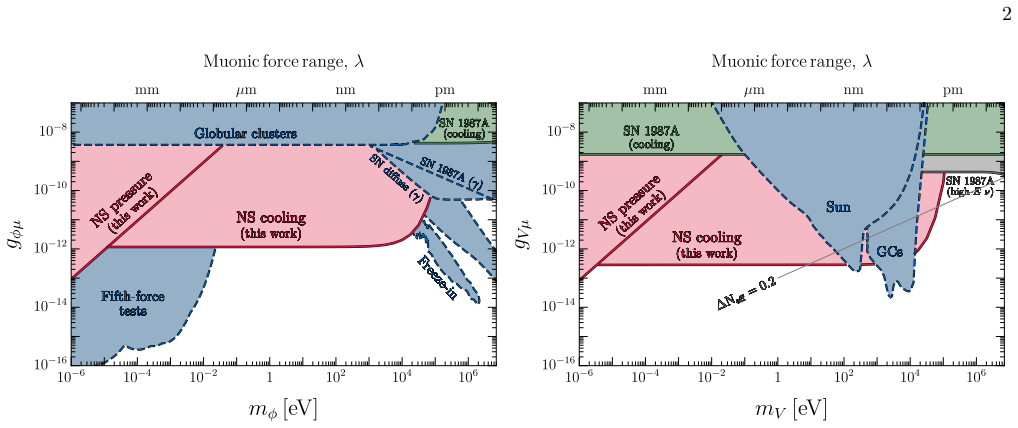
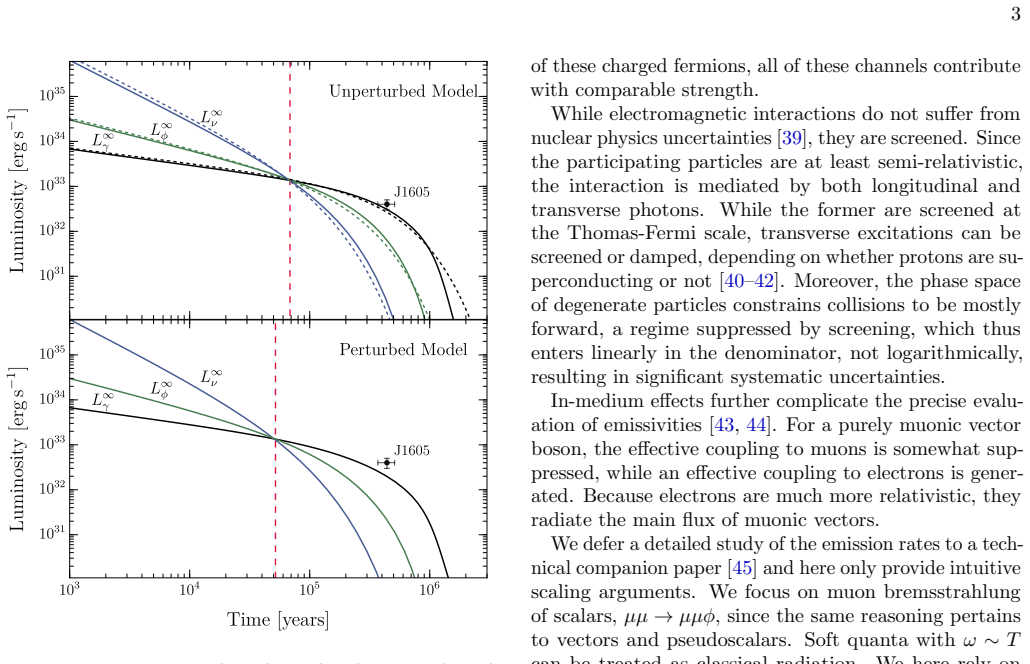
Neutron-star cooling implies limits of g_φμ ≲ 10^{-12} and g_Vμ ≲ 3×10^{-13} on scalar and vector bosons with masses m_X ≲ 100 keV, whereas SN 1987A cooling implies only g ≲ 3×10^{-9}. Moreover, hydrostatic equilibrium requires any long-range muonic force to be sufficiently weak, surpassing cooling bounds for m_X ≲ 10^{-5} eV. Together, these observables provide the most stringent probes of muonic interactions over distance scales ranging from picometers to kilometers.
What carries the argument
The muon population inside a neutron star and the way an additional muonic force would change its cooling luminosity and hydrostatic structure.
If this is right
- The cooling bounds already exceed SN 1987A limits by three orders of magnitude for m_X up to 100 keV.
- Hydrostatic equilibrium supplies the dominant constraint for m_X below 10^{-5} eV.
- The combined limits cover mediator masses whose Compton wavelengths span picometers to kilometers.
- Neutron stars thereby become the leading laboratory for muonic fifth forces in this mass window.
Where Pith is reading between the lines
- Laboratory experiments searching for muonic forces would need to reach couplings below 10^{-12} to compete with these astrophysical bounds.
- The same logic could be applied to other compact objects if they contain significant muon populations, though the paper focuses on neutron stars.
- Future precise measurements of neutron-star cooling curves could directly test or tighten the reported limits.
Load-bearing premise
Standard neutron-star cooling and hydrostatic models remain valid when a muonic fifth force is added, so that any mismatch with observed temperatures or radii can be attributed only to the new force.
What would settle it
Observation of a neutron star whose surface temperature or radius requires a muonic scalar or vector coupling larger than the stated limits for a mediator in the relevant mass window.
Figures
read the original abstract
Experimental searches for fifth forces coupled to muons are fundamentally limited by the scarcity of muons in ordinary matter, whereas neutron stars contain abundant muon populations. We show that these compact objects therefore provide superior sensitivity across a broad range of mediator masses. Neutron-star cooling implies limits of $g_{\phi\mu}\lesssim10^{-12}$ and $g_{V\!\mu}\lesssim3\times10^{-13}$ on scalar and vector bosons with masses $m_X\lesssim100$ keV, whereas SN 1987A cooling implies only $g\lesssim3\times10^{-9}$. Moreover, hydrostatic equilibrium requires any long-range muonic force to be sufficiently weak, surpassing cooling bounds for $m_X\lesssim10^{-5}$ eV. Together, these observables provide the most stringent probes of muonic interactions over distance scales ranging from picometers to kilometers.
Editorial analysis
A structured set of objections, weighed in public.
Referee Report
Summary. The paper claims that neutron stars, owing to their abundant muon populations, yield stronger constraints on muonic fifth forces than SN 1987A. Neutron-star cooling is used to bound scalar and vector mediators with g_φμ ≲ 10^{-12} and g_Vμ ≲ 3×10^{-13} for m_X ≲ 100 keV, while hydrostatic equilibrium supplies tighter limits for m_X ≲ 10^{-5} eV, together probing muonic interactions from picometer to kilometer scales.
Significance. If the modeling assumptions hold after robustness checks, the result would meaningfully extend fifth-force searches into muon-coupled sectors that are hard to access terrestrially, leveraging standard astrophysical observables without introducing new free parameters. The approach of applying existing NS cooling and structure frameworks to a new interaction is a clear strength.
major comments (2)
- [Cooling bounds section] Cooling analysis (section deriving the g_φμ and g_Vμ limits): the quoted bounds assume that any additional emissivity or energy transport from the muonic force produces an observable deviation from standard cooling curves that cannot be offset by plausible variations in the EOS, muon fraction, or superfluid gaps. No explicit scan or marginalization over these uncertain inputs is described, which directly affects whether the numerical limits follow.
- [Hydrostatic equilibrium section] Hydrostatic equilibrium analysis (section on long-range forces): the claim that hydrostatic equilibrium supplies bounds surpassing cooling for m_X ≲ 10^{-5} eV likewise presupposes that observed NS masses and radii cannot be reproduced once the new long-range potential is included by adjusting other model parameters. This assumption is load-bearing for the statement that hydrostatic limits are stronger in that mass window.
minor comments (2)
- [Abstract] Abstract: the notation g_Vμ employs nonstandard spacing; standard subscript formatting g_{Vμ} would improve readability.
- [Abstract] Abstract: numerical results are stated without cross-references to the specific equations or figures that contain the derivations, which would help readers trace the steps.
Simulated Author's Rebuttal
We thank the referee for the constructive comments and for recognizing the potential of neutron-star observables to constrain muonic fifth forces. We respond point-by-point to the major comments below.
read point-by-point responses
-
Referee: [Cooling bounds section] Cooling analysis (section deriving the g_φμ and g_Vμ limits): the quoted bounds assume that any additional emissivity or energy transport from the muonic force produces an observable deviation from standard cooling curves that cannot be offset by plausible variations in the EOS, muon fraction, or superfluid gaps. No explicit scan or marginalization over these uncertain inputs is described, which directly affects whether the numerical limits follow.
Authors: We agree that an explicit marginalization would further strengthen the presentation. Our bounds are derived using representative EOS and cooling models (e.g., APR and BSk families with standard muon fractions and superfluid gaps) that already reproduce observed NS temperatures. The additional muonic emissivity scales directly with muon density and is large enough that even order-of-magnitude variations in the uncertain parameters shift the quoted limits by at most a factor of a few while remaining stronger than the SN 1987A bound. In the revised manuscript we will add a dedicated paragraph quantifying this sensitivity and stating the conservative nature of the limits. revision: partial
-
Referee: [Hydrostatic equilibrium section] Hydrostatic equilibrium analysis (section on long-range forces): the claim that hydrostatic equilibrium supplies bounds surpassing cooling for m_X ≲ 10^{-5} eV likewise presupposes that observed NS masses and radii cannot be reproduced once the new long-range potential is included by adjusting other model parameters. This assumption is load-bearing for the statement that hydrostatic limits are stronger in that mass window.
Authors: For the long-range regime the additional potential is effectively a constant shift to the gravitational potential inside the star. We show that reproducing the observed 2 M_⊙ maximum mass while satisfying causality and the measured radius range requires the effective coupling to remain below the quoted threshold; larger values force the EOS into unphysical regimes (negative pressure or superluminal sound speed) that are already excluded by nuclear-physics constraints independent of the fifth force. We will expand the text with an explicit statement of this argument and a brief illustration that EOS adjustments cannot compensate without violating these independent bounds. revision: partial
Circularity Check
No circularity: bounds derived from external NS observables and standard models
full rationale
The derivation applies standard neutron-star cooling theory and hydrostatic equilibrium to observed temperatures, radii, and SN1987A data to extract upper limits on g_φμ and g_Vμ. No step reduces a claimed prediction to a fitted parameter by construction, invokes a self-citation as the sole justification for a uniqueness theorem, or renames an input as an output. The central results remain independent of any internal fit or self-referential definition.
Axiom & Free-Parameter Ledger
axioms (2)
- domain assumption Neutron stars contain abundant muon populations that can mediate new forces
- domain assumption Observed neutron-star cooling and hydrostatic equilibrium can be used to bound additional interactions
invented entities (1)
-
Light scalar or vector boson mediating muonic fifth force
no independent evidence
Forward citations
Cited by 2 Pith papers
-
Minimal Proton-Mass Dark Matter
A minimal dark matter model with one complex scalar carrying B and L numbers, stabilized by proton stability, with mass near the proton mass and relic density from UV freeze-in.
-
New Gauge Forces, Neutron Stars and Schwinger Neutrino Production
For Lμ-Lτ gauge forces with g ≳ 10^{-18}, Schwinger neutrino production in neutron stars alters composition, invalidates merger constraints at g ≳ 10^{-17}, and could yield detectable ~100 MeV neutrino fluxes from you...
Reference graph
Works this paper leans on
-
[1]
A. O. Sushkov, W. J. Kim, D. A. R. Dalvit and S. K. Lamoreaux,New Experimental Limits on Non-Newtonian Forces in the Micrometer Range,Phys. Rev. Lett.107(2011) 171101 [1108.2547]
work page internal anchor Pith review Pith/arXiv arXiv 2011
-
[2]
Y. J. Chen, W. K. Tham, D. E. Krause, D. Lopez, E. Fischbach and R. S. Decca,Stronger Limits on Hypothetical Yukawa Interactions in the 30–8000 nm Range,Phys. Rev. Lett.116(2016) 221102 [1410.7267]
work page internal anchor Pith review Pith/arXiv arXiv 2016
-
[3]
A. A. Geraci, S. J. Smullin, D. M. Weld, J. Chiaverini and A. Kapitulnik,Improved constraints on non-Newtonian forces at 10 microns,Phys. Rev. D78 (2008) 022002 [0802.2350]
work page internal anchor Pith review Pith/arXiv arXiv 2008
-
[4]
D. J. Kapner, T. S. Cook, E. G. Adelberger, J. H. Gundlach, B. R. Heckel, C. D. Hoyle and H. E. Swanson, Tests of the gravitational inverse-square law below the dark-energy length scale,Phys. Rev. Lett.98(2007) 021101 [hep-ph/0611184]
work page internal anchor Pith review Pith/arXiv arXiv 2007
- [5]
- [6]
-
[7]
Yang, B.-F
S.-Q. Yang, B.-F. Zhan, Q.-L. Wang, C.-G. Shao, L.-C. Tu, W.-H. Tan and J. Luo,Test of the Gravitational Inverse Square Law at Millimeter Ranges,Phys. Rev. Lett.108(2012) 081101
2012
-
[8]
Tan et al.,Improvement for Testing the Gravitational Inverse-Square Law at the Submillimeter Range,Phys
W.-H. Tan et al.,Improvement for Testing the Gravitational Inverse-Square Law at the Submillimeter Range,Phys. Rev. Lett.124(2020) 051301
2020
-
[9]
J. K. Hoskins, R. D. Newman, R. Spero and J. Schultz, Experimental tests of the gravitational inverse square law for mass separations from 2-cm to 105-cm,Phys. Rev. D 32(1985) 3084
1985
-
[10]
J. Berg´ e, P. Brax, G. M´ etris, M. Pernot-Borr` as, P. Touboul and J.-P. Uzan,MICROSCOPE Mission: First Constraints on the Violation of the Weak 6 Equivalence Principle by a Light Scalar Dilaton,Phys. Rev. Lett.120(2018) 141101 [1712.00483]
work page internal anchor Pith review Pith/arXiv arXiv 2018
-
[11]
Foot,New Physics From Electric Charge Quantization?,Mod
R. Foot,New Physics From Electric Charge Quantization?,Mod. Phys. Lett. A6(1991) 527
1991
-
[12]
X. G. He, G. C. Joshi, H. Lew and R. R. Volkas,New- Z ′ phenomenology,Phys. Rev. D43(1991) 22
1991
-
[13]
X.-G. He, G. C. Joshi, H. Lew and R. R. Volkas, SimplestZ ′ model,Phys. Rev. D44(1991) 2118
1991
-
[14]
R. Foot, X. G. He, H. Lew and R. R. Volkas,Model for a lightZ ′ boson,Phys. Rev. D50(1994) 4571 [hep-ph/9401250]
work page internal anchor Pith review Pith/arXiv arXiv 1994
-
[15]
Flavor-specific scalar mediators
B. Batell, A. Freitas, A. Ismail and D. Mckeen, Flavor-specific scalar mediators,Phys. Rev. D98(2018) 055026 [1712.10022]
work page internal anchor Pith review Pith/arXiv arXiv 2018
- [16]
-
[17]
The landscape of QCD axion models
L. Di Luzio, M. Giannotti, E. Nardi and L. Visinelli,The landscape of QCD axion models,Phys. Rept.870(2020) 1 [2003.01100]
work page internal anchor Pith review Pith/arXiv arXiv 2020
-
[18]
T. Kumar Poddar, S. Mohanty and S. Jana,Vector gauge boson radiation from compact binary systems in a gaugedL µ −L τ scenario,Phys. Rev. D100(2019) 123023 [1908.09732]
- [19]
- [20]
- [21]
-
[22]
Muonic Boson Limits: Supernova Redux
A. Caputo, G. Raffelt and E. Vitagliano,Muonic boson limits: Supernova redux,Phys. Rev. D105(2022) 035022 [2109.03244]
work page internal anchor Pith review Pith/arXiv arXiv 2022
- [23]
-
[24]
$L_\mu-L_\tau$ gauge bosons in beam dumps and supernovae
N. Blinov, P. J. Fox, K. J. Kelly, R. Plestid and T. Zhou, Lµ −L τ gauge bosons in beam dumps and supernovae, 2511.09619
work page internal anchor Pith review Pith/arXiv arXiv
-
[25]
B. L. Friman and O. V. Maxwell,Neutron Star Neutrino Emissivities,Astrophys. J.232(1979) 541
1979
-
[26]
S. Bottaro, A. Caputo and D. F. G. Fiorillo,Neutrino emission in cold neutron stars: Bremsstrahlung and modified urca rates reexamined,JCAP11(2024) 015 [2406.18640]
-
[27]
Iwamoto,Axion Emission from Neutron Stars,Phys
N. Iwamoto,Axion Emission from Neutron Stars,Phys. Rev. Lett.53(1984) 1198
1984
-
[28]
Ishizuka and M
N. Ishizuka and M. Yoshimura,Axion and Dilaton Emissivity from Nascent Neutron Stars,Prog. Theor. Phys.84(1990) 233
1990
-
[29]
M. Buschmann, C. Dessert, J. W. Foster, A. J. Long and B. R. Safdi,Upper Limit on the QCD Axion Mass from Isolated Neutron Star Cooling,Phys. Rev. Lett.128 (2022) 091102 [2111.09892]
-
[30]
Astrophysical Axion Bounds: The 2024 Edition,
A. Caputo and G. Raffelt,Astrophysical Axion Bounds: The 2024 Edition,PoSCOSMICWISPers(2024) 041 [2401.13728]
- [31]
- [32]
-
[33]
K. Langhoff, N. J. Outmezguine and N. L. Rodd, Irreducible Axion Background,Phys. Rev. Lett.129 (2022) 241101 [2209.06216]
-
[34]
S.-P. Li and X.-J. Xu,Production rates of dark photons and Z’ in the Sun and stellar cooling bounds,JCAP09 (2023) 009 [2304.12907]
- [35]
-
[36]
Cosmology With a Very Light $L_\mu - L_\tau$ Gauge Boson
M. Escudero, D. Hooper, G. Krnjaic and M. Pierre, Cosmology with A Very Light L µ −L τ Gauge Boson, JHEP03(2019) 071 [1901.02010]
work page internal anchor Pith review Pith/arXiv arXiv 2019
-
[37]
Page,NSCool: Neutron star cooling code, Astrophysics Source Code Library, record ascl:1609.009, Sept., 2016
D. Page,NSCool: Neutron star cooling code, Astrophysics Source Code Library, record ascl:1609.009, Sept., 2016
2016
-
[38]
The equation of state for nucleon matter and neutron star structure
A. Akmal, V. R. Pandharipande and D. G. Ravenhall, The Equation of state of nucleon matter and neutron star structure,Phys. Rev. C58(1998) 1804 [nucl-th/9804027]
work page internal anchor Pith review Pith/arXiv arXiv 1998
-
[39]
D. F. G. Fiorillo, T. Pitik and E. Vitagliano,Supernova production of axionlike particles coupling to electrons, reloaded,Phys. Rev. D112(2025) 083008 [2503.15630]. Erratum:Phys. Rev. D113(2026) 089902
work page internal anchor Pith review Pith/arXiv arXiv 2025
-
[40]
P. S. Shternin and D. G. Yakovlev,Electron-muon heat conduction in neutron star cores via the exchange of transverse plasmons,Phys. Rev. D75(2007) 103004 [0705.1963]
work page internal anchor Pith review Pith/arXiv arXiv 2007
-
[41]
P. S. Shternin and D. G. Yakovlev,Electron thermal conductivity owing to collisions between degenerate electrons,Phys. Rev. D74(2006) 043004 [astro-ph/0608371]
work page internal anchor Pith review Pith/arXiv arXiv 2006
- [42]
-
[43]
L. B. Leinson and A. Perez,Collective effects in neutrino anti-neutrino synchrotron radiation from neutron stars, Phys. Rev. D59(1999) 043002 [astro-ph/9710257]
work page internal anchor Pith review Pith/arXiv arXiv 1999
-
[44]
L. B. Leinson,Neutrino pair emission due to electron phonon scattering in a neutron star crust: A reappraisal, Phys. Lett. B469(1999) 166 [hep-ph/0009049]
work page internal anchor Pith review Pith/arXiv arXiv 1999
-
[45]
D. F. G. Fiorillo, A. Lella, G. G. Raffelt, N. Selimovi´ c and E. Vitagliano,Production of Leptophilic Bosons in Ultradegenerate Relativistic Matter, 2026. Work in Progress
2026
-
[46]
Black Hole Superradiance Signatures of Ultralight Vectors
M. Baryakhtar, R. Lasenby and M. Teo,Black Hole Superradiance Signatures of Ultralight Vectors,Phys. Rev. D96(2017) 035019 [1704.05081]
work page internal anchor Pith review Pith/arXiv arXiv 2017
-
[47]
D. F. G. Fiorillo, M. Heinlein, H.-T. Janka, G. Raffelt, E. Vitagliano and R. Bollig,Supernova simulations confront SN 1987A neutrinos,Phys. Rev. D108(2023) 083040 [2308.01403]. [48]https:// . See Supplemental Material for a discussion of possible constraints from scalar decays in photon pairs and details on our calculation for the loop-induced scalar cou...
-
[48]
R. S. Decca, D. Lopez, E. Fischbach, G. L. Klimchitskaya, D. E. Krause and V. M. Mostepanenko, 7 Tests of new physics from precise measurements of the Casimir pressure between two gold-coated plates,Phys. Rev. D75(2007) 077101 [hep-ph/0703290]
work page internal anchor Pith review Pith/arXiv arXiv 2007
- [49]
-
[50]
Optomechanical vector sensing of new forces at 6 micron separation
G. Venugopalan et al.,Optomechanical vector sensing of new forces at 6 micron separation,Sci. Rep.16(2026) 5180 [2412.13167]
work page internal anchor Pith review Pith/arXiv arXiv 2026
-
[51]
H. C. Chiu, G. L. Klimchitskaya, V. N. Marachevsky, V. M. Mostepanenko and U. Mohideen,Demonstration of the asymmetric lateral Casimir force between corrugated surfaces in the nonadditive regime,Phys. Rev. B80(2009) 121402 [0909.2161]
work page internal anchor Pith review Pith/arXiv arXiv 2009
-
[52]
V. B. Bezerra, G. L. Klimchitskaya, V. M. Mostepanenko and C. Romero,Advance and prospects in constraining the Yukawa-type corrections to Newtonian gravity from the Casimir effect,Phys. Rev. D81(2010) 055003 [1002.2141]
work page internal anchor Pith review Pith/arXiv arXiv 2010
-
[53]
A. A. Banishev, J. Wagner, T. Emig, R. Zandi and U. Mohideen,Demonstration of Angle Dependent Casimir Force Between Corrugations,Phys. Rev. Lett. 110(2013) 250403 [1212.6271]
work page internal anchor Pith review Pith/arXiv arXiv 2013
-
[54]
A. A. Banishev, J. Wagner, T. Emig, R. Zandi and U. Mohideen,Experimental and theoretical investigation of the angular dependence of the Casimir force between sinusoidally corrugated surfaces,Phys. Rev. B89(2014) 235436 [1402.2716]
work page internal anchor Pith review Pith/arXiv arXiv 2014
- [55]
-
[56]
Probing short-range gravity using quantum reflection
J. Boynewicz and C. A. Sackett,Probing short-range gravity using quantum reflection,2511.08770
work page internal anchor Pith review Pith/arXiv arXiv
- [57]
-
[58]
D. F. Bartlett and S. Loegl,Limits on an Electromagnetic Fifth Force,Phys. Rev. Lett.61(1988) 2285
1988
-
[59]
D. Kroff and P. C. Malta,Constraining hidden photons via atomic force microscope measurements and the Plimpton-Lawton experiment,Phys. Rev. D102(2020) 095015 [2008.02209]
-
[60]
D. F. G. Fiorillo, G. G. Raffelt and E. Vitagliano,Strong Supernova 1987A Constraints on Bosons Decaying to Neutrinos,Phys. Rev. Lett.131(2023) 021001 [2209.11773]. [62]KATRINCollaboration, M. Aker et al.,Direct neutrino-mass measurement based on 259 days of KATRIN data,Science388(2025) adq9592 [2406.13516]. [63]LIGO Scientific, Virgo, Fermi GBM, INTEGRAL...
- [61]
-
[62]
M. C. Miller et al.,PSR J0030+0451 Mass and Radius fromN ICERData and Implications for the Properties of Neutron Star Matter,Astrophys. J. Lett.887(2019) L24 [1912.05705]
work page internal anchor Pith review Pith/arXiv arXiv 2019
-
[63]
Burns,Neutron Star Mergers and How to Study Them,Living Rev
E. Burns,Neutron Star Mergers and How to Study Them,Living Rev. Rel.23(2020) 4 [1909.06085]
- [64]
-
[65]
Hyperon stars in the Brueckner-Bethe-Goldstone theory
M. Baldo, G. F. Burgio and H. J. Schulze,Hyperon stars in the Brueckner-Bethe-Goldstone theory,Phys. Rev. C 61(2000) 055801 [nucl-th/9912066]
work page internal anchor Pith review Pith/arXiv arXiv 2000
-
[66]
B. Bhat, A. Dohi, T. Muto and T. Noda,Cooling of Isolated Neutron Stars with Hyperon-mixed Kaon-Condensation Matter,2605.09723
work page internal anchor Pith review Pith/arXiv arXiv
-
[67]
Light Dark Matter: Models and Constraints
S. Knapen, T. Lin and K. M. Zurek,Light Dark Matter: Models and Constraints,Phys. Rev. D96(2017) 115021 [1709.07882]
work page internal anchor Pith review Pith/arXiv arXiv 2017
-
[68]
E. Vitagliano, I. Tamborra and G. Raffelt,Grand Unified Neutrino Spectrum at Earth: Sources and Spectral Components,Rev. Mod. Phys.92(2020) 45006 [1910.11878]
-
[69]
D. E. Gruber, J. L. Matteson, L. E. Peterson and G. V. Jung,The spectrum of diffuse cosmic hard x-rays measured with HEAO-1,Astrophys. J.520(1999) 124 [astro-ph/9903492]
work page internal anchor Pith review Pith/arXiv arXiv 1999
-
[70]
R. Krivonos, D. Wik, B. Grefenstette, K. Madsen, K. Perez, S. Rossland, S. Sazonov and A. Zoglauer, N uST ARmeasurement of the cosmic X-ray background in the 3–20 keV energy band,Mon. Not. Roy. Astron. Soc.502(2021) 3966 [2011.11469]
-
[71]
Neutron stars from young nearby associations the origin of RXJ1605.3+3249
N. Tetzlaff, J. G. Schmidt, M. M. Hohle and R. Neuhaeuser,Neutron stars from young nearby associations the origin of RXJ1605.3+3249,Publ. Astron. 8 Soc. Austral.29(2012) 98 [1202.1388]
work page internal anchor Pith review Pith/arXiv arXiv 2012
-
[72]
Jansen, D
F. Jansen, D. Lumb, B. Altieri, J. Clavel, M. Ehle, C. Erd, C. Gabriel, M. Guainazzi, P. Gondoin, R. Much, R. Munoz, M. Santos, N. Schartel, D. Texier and G. Vacanti,XMM-Newton observatory. I. The spacecraft and operations,A&A365(2001) L1
2001
-
[73]
European Space Agency, XMM-Newton Users Handbook, Section 3.3.8; accessed 21 May 2026
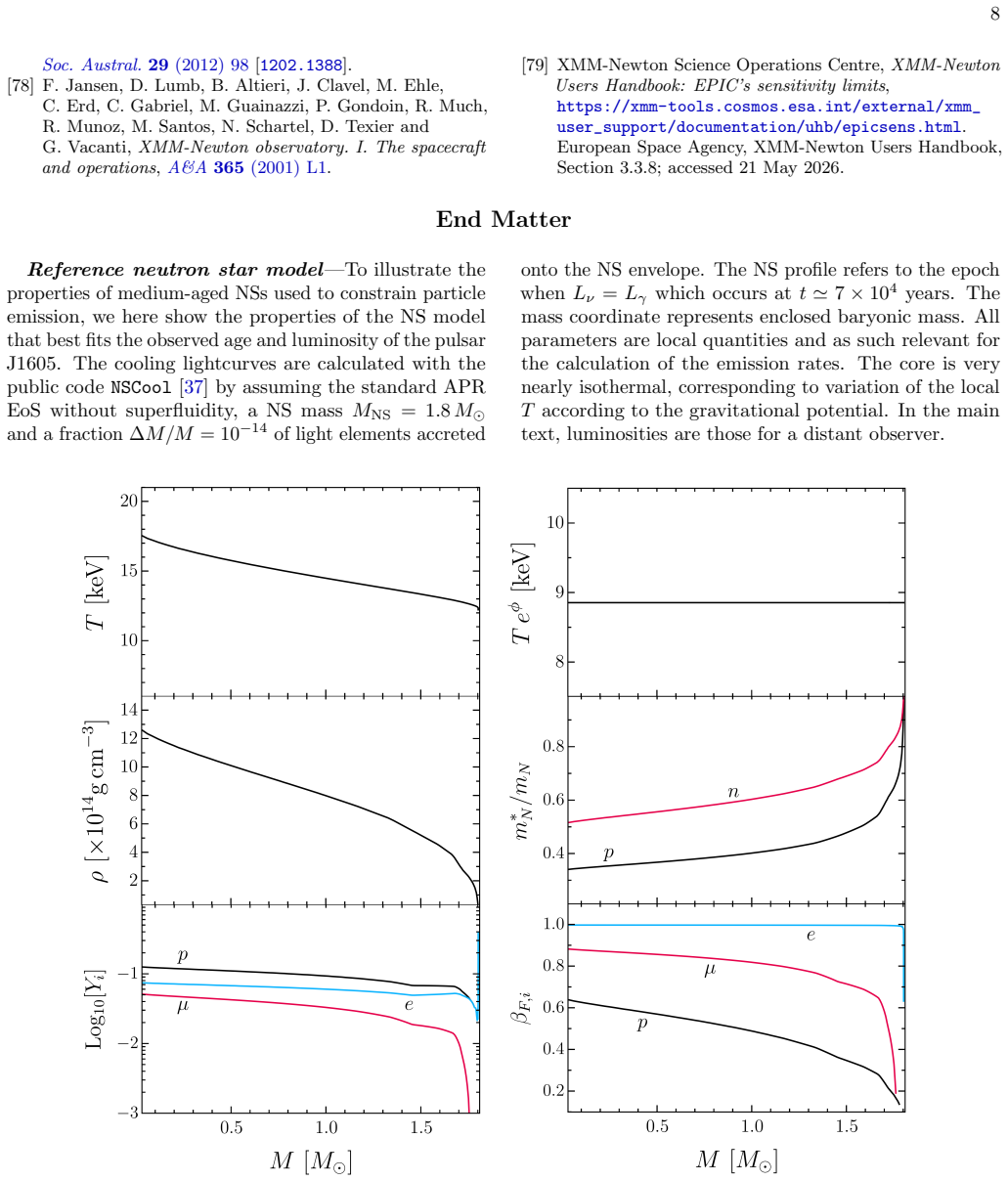
XMM-Newton Science Operations Centre,XMM-Newton Users Handbook: EPIC’s sensitivity limits, https://xmm-tools.cosmos.esa.int/external/xmm_ user_support/documentation/uhb/epicsens.html. European Space Agency, XMM-Newton Users Handbook, Section 3.3.8; accessed 21 May 2026. End Matter Reference neutron star model—To illustrate the properties of medium-aged NS...
2026
discussion (0)
Sign in with ORCID, Apple, or X to comment. Anyone can read and Pith papers without signing in.