Prime Certificates for Exact Vertex-Coprime Ramsey Numbers
Pith reviewed 2026-06-29 17:23 UTC · model grok-4.3
The pith
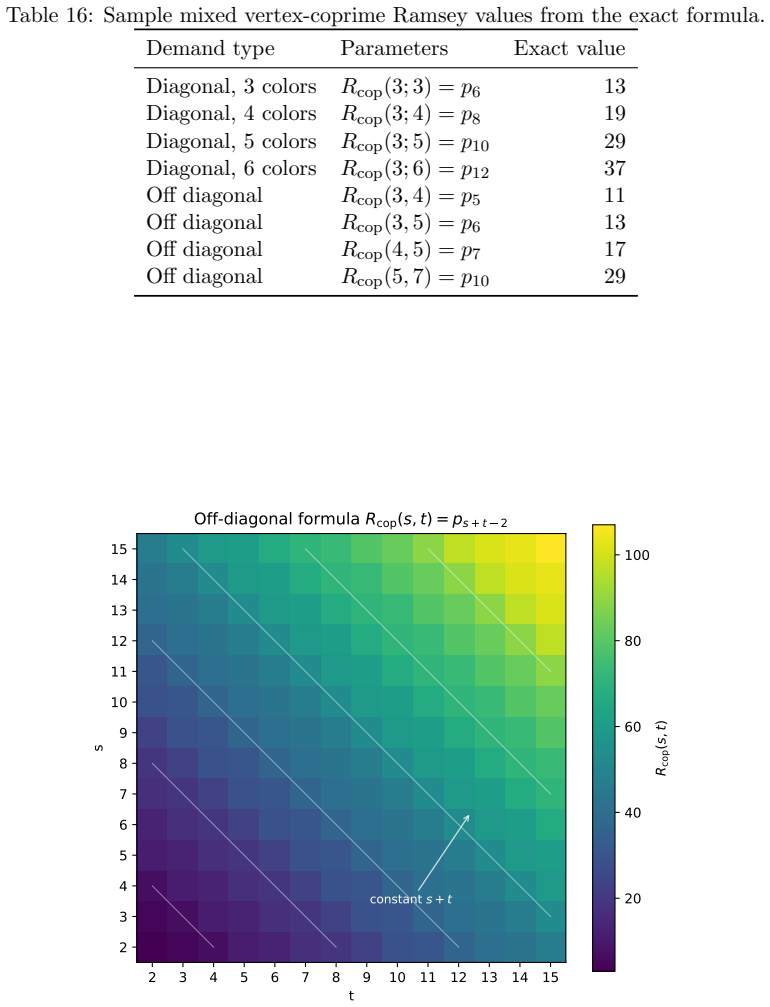
The mixed vertex-coloring coprime Ramsey number R_cop(k_1,…,k_c) equals the prime whose index is the sum of (k_i-1).
A machine-rendered reading of the paper's core claim, the machinery that carries it, and where it could break.
Core claim
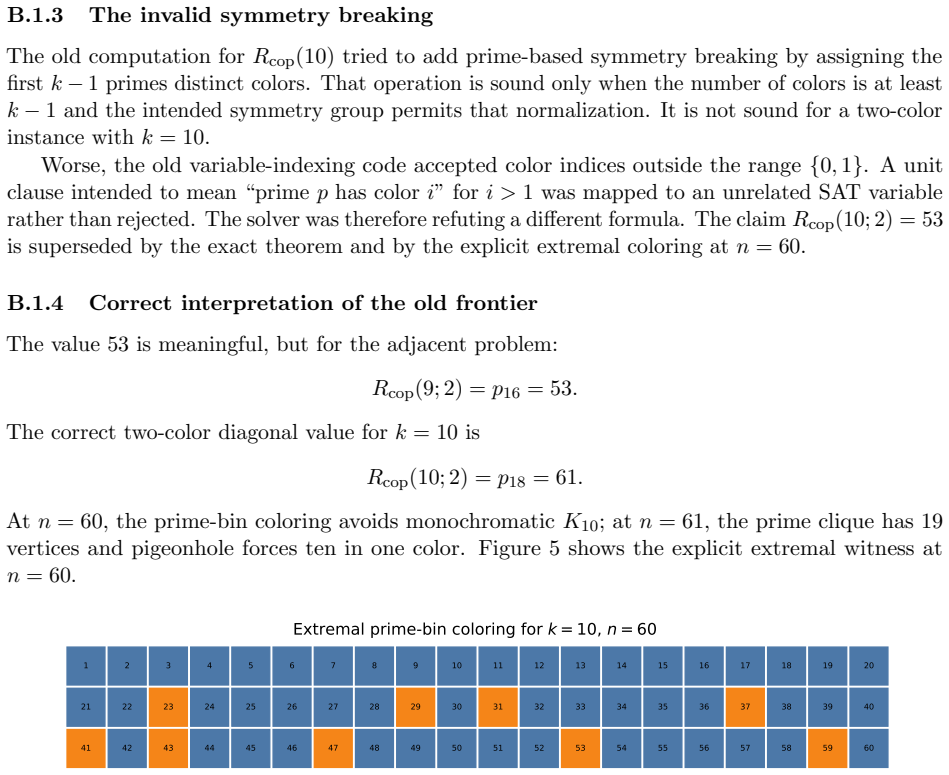
We prove that the mixed vertex-coloring coprime Ramsey number satisfies R_cop(k_1,…,k_c)=p_{∑_{i=1}^c(k_i-1)}, where p_m is the m-th prime. The proof is elementary: the prime clique {1}∪{p≤n:p prime} gives the upper bound by pigeonhole, while a prime-bin partition gives the matching lower bound by coloring each composite with a bin containing one of its prime divisors. The same certificate viewpoint yields an exact reduction of the edge-coloring variant to classical Ramsey numbers: R_edge(k_1,…,k_c)=p_{R_cl(k_1,…,k_c)-1}.
What carries the argument
The clique formed by 1 together with all primes up to n in the coprime graph G_n, which supplies the pigeonhole upper bound, together with the prime-bin partition that supplies the matching lower bound.
If this is right
- The edge-coloring parameter satisfies the exact reduction R_edge(k_1,…,k_c)=p_{R_cl(k_1,…,k_c)-1}.
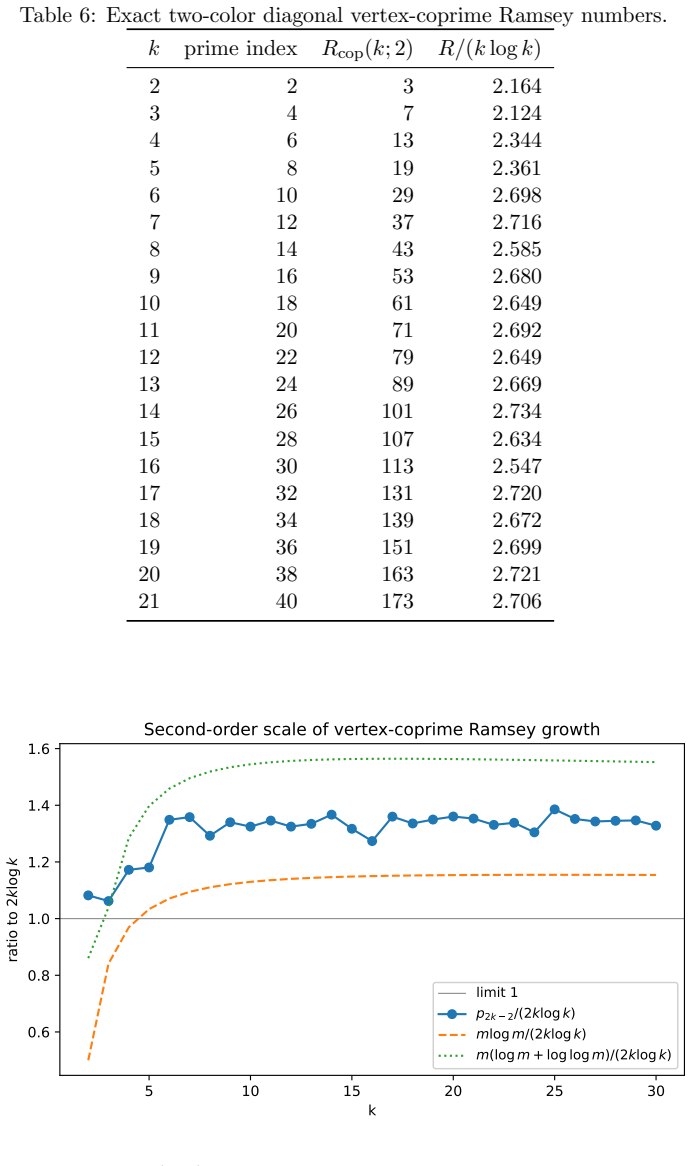
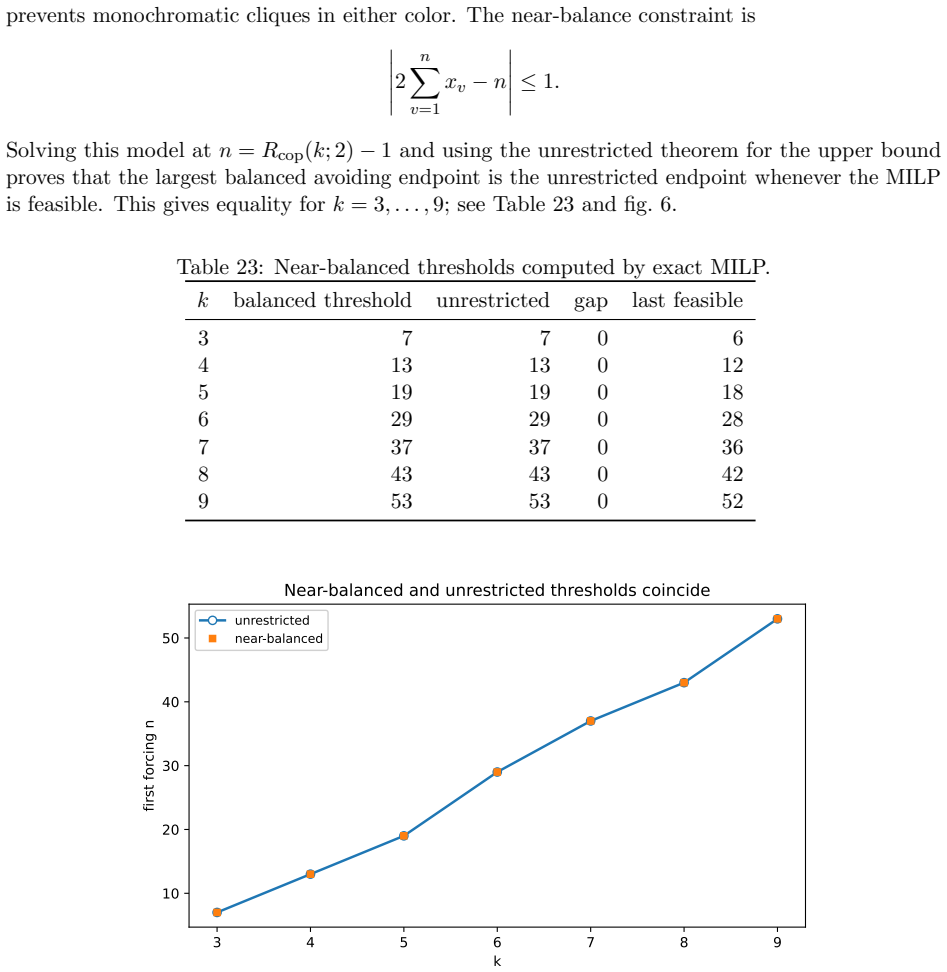
- The balanced two-color diagonal threshold equals the unrestricted threshold p_{2k-2} for every k at least 2.
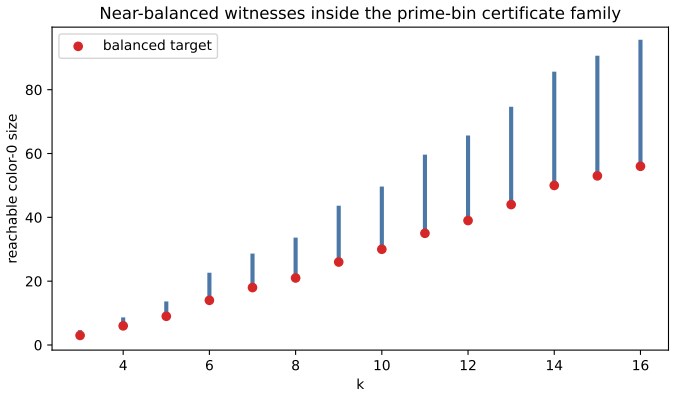
- For any fixed number of colors c, multicolor balanced certificates exist for all sufficiently large parameters via a Hall argument combined with the Selberg-Delange estimate.
- A polynomial-time primitive exists for extracting the certificates from the same clique-label construction.
Where Pith is reading between the lines
- The formula directly ties the growth of these Ramsey numbers to the distribution of primes.
- The certificate method may transfer to other Ramsey parameters defined on graphs whose edges or vertices are governed by divisibility or coprimality conditions.
Load-bearing premise
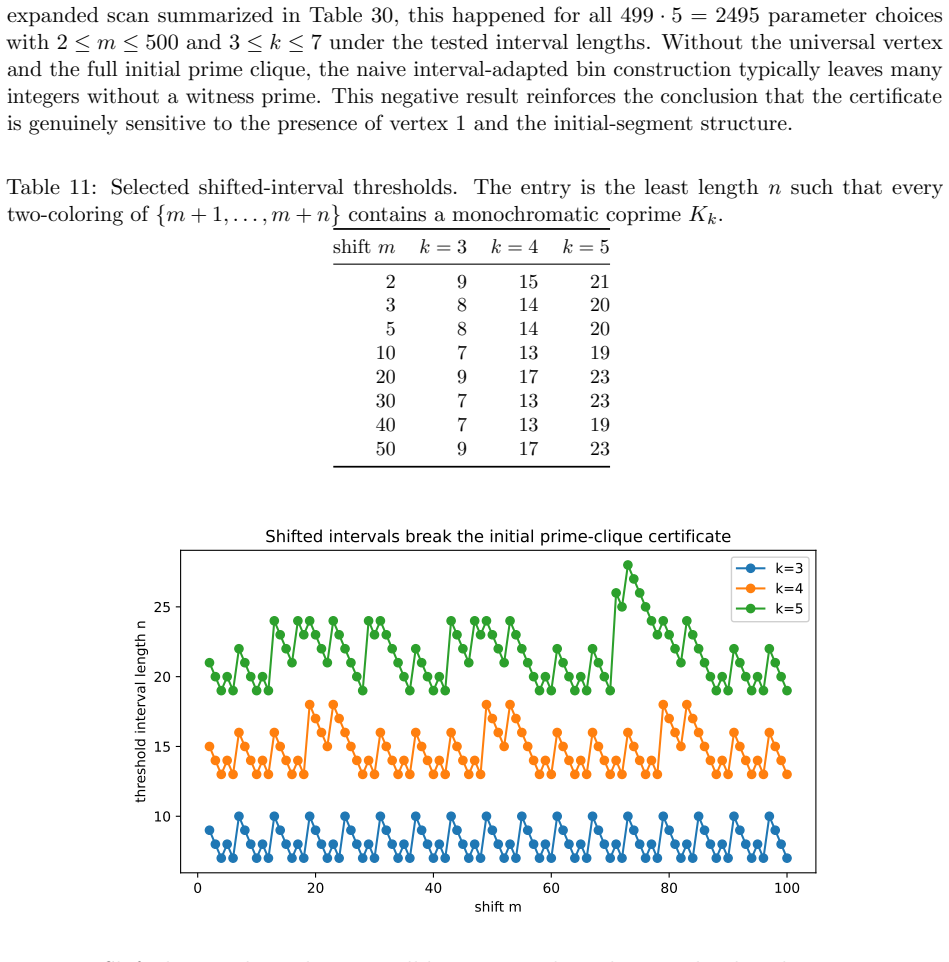
The set consisting of 1 together with the primes up to the relevant prime forms a clique in the coprime graph G_n.
What would settle it
An explicit c-coloring of the coprime graph on the integers from 1 to p_m minus 1, where m equals the sum of (k_i minus 1), that avoids a monochromatic coprime clique of size k_i in color i for each i.
Figures



read the original abstract
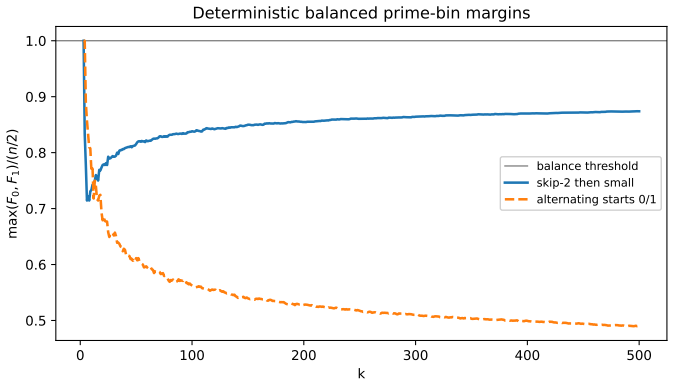
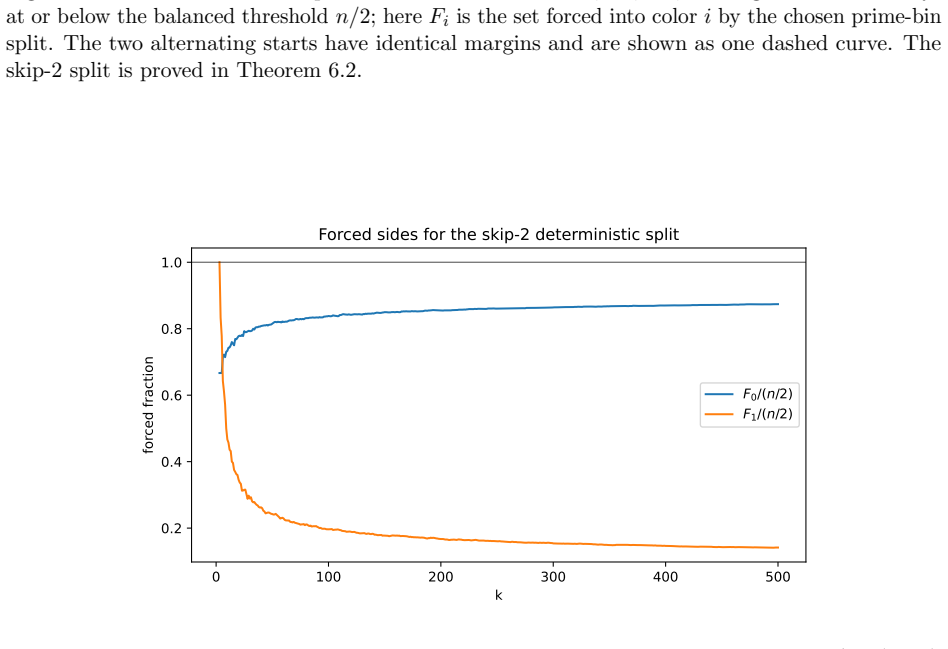
Let $G_n$ be the coprime graph on $\{1,\ldots,n\}$. We prove that the mixed vertex-coloring coprime Ramsey number satisfies \[ \Rcop(k_1,\ldots,k_c)=p_{\sum_{i=1}^c(k_i-1)}, \] where $p_m$ is the $m$-th prime. The proof is elementary: the prime clique $\{1\}\cup\{p\le n:p\text{ prime}\}$ gives the upper bound by pigeonhole, while a prime-bin partition gives the matching lower bound by coloring each composite with a bin containing one of its prime divisors. We reserve $\Rcop$ for this vertex-coloring parameter; the edge-coloring parameter on the same host graph is denoted $\Redge$. The same certificate viewpoint yields several extensions, including a support-disjointness generalization, a polynomial-time certificate-extraction primitive, and an exact reduction of the edge-coloring variant to classical Ramsey numbers: $\Redge(k_1,\ldots,k_c)=p_{\Rcl(k_1,\ldots,k_c)-1}$. These two formulas are rank transfers from the same clique-label certificate. We also prove that the balanced two-color diagonal threshold equals the unrestricted threshold $p_{2k-2}$ for all $k\ge2$, via a deterministic prime-bin split requiring only the weak inequality $2p_m<p_{2m}<3p_m$; for fixed $c$, a Hall argument plus a standard Selberg--Delange estimate gives eventual multicolor balanced certificates.
Editorial analysis
A structured set of objections, weighed in public.
Referee Report
Summary. The manuscript proves that the mixed vertex-coloring coprime Ramsey number satisfies R_cop(k_1,…,k_c)=p_{∑(k_i−1)}, where p_m is the m-th prime. The upper bound follows from the clique {1}∪{primes ≤ n} in the coprime graph G_n together with the pigeonhole principle on color classes; the matching lower bound is obtained from a prime-bin partition in which each composite is colored according to one of its prime factors. The same certificate framework yields an exact reduction Redge(k_1,…,k_c)=p_{R_cl(k_1,…,k_c)−1} for the edge-coloring variant, a support-disjointness generalization, and exact balanced two-color thresholds p_{2k−2} for all k≥2 via a deterministic prime-bin split that uses only the inequality 2p_m < p_{2m} < 3p_m.
Significance. If the derivations hold, the result supplies a closed-form expression for an entire family of Ramsey-type numbers on the coprime graph, a rare occurrence in Ramsey theory. The elementary certificate construction, the direct reduction of the edge-coloring parameter to classical Ramsey numbers, and the provision of polynomial-time certificate extraction constitute concrete strengths that would be noted in any assessment of the work.
minor comments (2)
- The abstract states that the balanced two-color result holds for all k≥2 via the inequality 2p_m < p_{2m} < 3p_m; a short explicit verification of this inequality (or a reference to a standard bound) would make the deterministic split fully self-contained.
- Notation: the symbols Rcop and Redge are introduced in the abstract but the manuscript should confirm that they are used consistently in all subsequent statements of the main theorems.
Simulated Author's Rebuttal
We thank the referee for the positive assessment of the manuscript and the recommendation to accept.
Circularity Check
No significant circularity identified
full rationale
The paper's central claim is established by an elementary direct argument: the set {1} union primes forms a clique in G_n by the definition of coprimality, so the pigeonhole principle on color classes immediately yields the upper bound R_cop(k1,...,kc) <= p_{sum(ki-1)}; the matching lower bound follows from an explicit prime-bin coloring in which each composite is assigned to a bin sharing one of its prime factors, ensuring each color class has no ki pairwise-coprime vertices. Neither bound reduces to a fitted parameter, a self-citation chain, or an imported ansatz; the argument is self-contained against the standard definitions of the coprime graph and Ramsey numbers, with no load-bearing reliance on prior work by the authors.
Axiom & Free-Parameter Ledger
axioms (2)
- standard math Pigeonhole principle
- standard math Every composite integer greater than 1 has at least one prime divisor
Reference graph
Works this paper leans on
-
[1]
F. P. Ramsey. On a problem of formal logic.Proceedings of the London Mathematical Society, 30:264–286, 1930
1930
-
[2]
A combinatorial problem in geometry.Compositio Mathematica, 2:463–470, 1935
Paul Erd˝ os and George Szekeres. A combinatorial problem in geometry.Compositio Mathematica, 2:463–470, 1935
1935
-
[3]
Some remarks on the theory of graphs.Bulletin of the American Mathematical Society, 53:292–294, 1947
Paul Erd˝ os. Some remarks on the theory of graphs.Bulletin of the American Mathematical Society, 53:292–294, 1947
1947
-
[4]
R. E. Greenwood and A. M. Gleason. Combinatorial relations and chromatic graphs.Canadian Journal of Mathematics, 7:1–7, 1955
1955
-
[5]
A note on Ramsey numbers.Journal of Combinatorial Theory, Series A, 29(3):354–360, 1980
Mikl´ os Ajtai, J´ anos Koml´ os, and Endre Szemer´ edi. A note on Ramsey numbers.Journal of Combinatorial Theory, Series A, 29(3):354–360, 1980
1980
-
[6]
The Ramsey number R(3, t) has order of magnitude t2/logt .Random Structures & Algorithms, 7(3):173–207, 1995
Jeong Han Kim. The Ramsey number R(3, t) has order of magnitude t2/logt .Random Structures & Algorithms, 7(3):173–207, 1995
1995
-
[7]
Burr, Paul Erd˝ os, and L´ aszl´ o Lov´ asz
Stefan A. Burr, Paul Erd˝ os, and L´ aszl´ o Lov´ asz. On graphs of Ramsey type.Ars Combinatoria, 1:167–190, 1976
1976
-
[8]
Stanis law P. Radziszowski. Small Ramsey numbers.Electronic Journal of Combinatorics, Dynamic Surveys DS1, revision 18, April 24, 2026. doi:10.37236/21
work page doi:10.37236/21 2026
-
[9]
Vigleik Angeltveit and Brendan D. McKay. R(5, 5) ≤ 46.Journal of Graph Theory, online
- [10]
-
[11]
An expo- nential improvement for diagonal Ramsey.Annals of Mathematics, 203(3):869–932, 2026
Marcelo Campos, Simon Griffiths, Robert Morris, and Julian Sahasrabudhe. An expo- nential improvement for diagonal Ramsey.Annals of Mathematics, 203(3):869–932, 2026. doi:10.4007/annals.2026.203.3.4. arXiv:2303.09521
- [12]
-
[13]
An exponential improvement for Ramsey lower bounds
Jie Ma, Wujie Shen, and Shengjie Xie. An exponential improvement for Ramsey lower bounds. Inventiones Mathematicae, online 2026. doi:10.1007/s00222-026-01421-9. arXiv:2507.12926
work page internal anchor Pith review Pith/arXiv arXiv doi:10.1007/s00222-026-01421-9 2026
-
[14]
Gaussian random graphs and Ramsey numbers
Zach Hunter, Aleksa Milojevi´ c, and Benny Sudakov. Gaussian random graphs and Ramsey numbers. arXiv:2512.17718, revised May 2026
work page internal anchor Pith review Pith/arXiv arXiv 2026
-
[15]
An update on multicolor Ramsey lower bounds
Marcelo Campos and Cosmin Pohoata. An update on multicolor Ramsey lower bounds. arXiv:2601.15183, 2026
-
[16]
A note on multicolour Ramsey numbers and random sphere graphs
Yamaan Attwa, Albert L´ opez Vidal, and Patrick Morris. A note on multicolour Ramsey numbers and random sphere graphs. arXiv:2602.02155, 2026
-
[17]
Reinforced Generation of Combinatorial Structures: Ramsey Numbers
Ansh Nagda, Prabhakar Raghavan, and Abhradeep Thakurta. Reinforced generation of combinatorial structures: Ramsey numbers. arXiv:2603.09172, revised April 2026
work page internal anchor Pith review Pith/arXiv arXiv 2026
-
[18]
Benjamin Przybocki, John Mackey, Marijn J. H. Heule, and Bernardo Subercaseaux. Dou- bly saturated Ramsey graphs: A case study in computer-assisted mathematical discovery. arXiv:2604.21187, 2026. 41
work page internal anchor Pith review Pith/arXiv arXiv 2026
-
[19]
Subarsha Banerjee. On structural properties and adjacency spectrum of coprime graph of integers.Asian-European Journal of Mathematics, 19(1):2550069, 2026. doi:10.1142/s179355712550069x. arXiv:2506.10583
-
[20]
On finite groups whose coprime graph is a divisor graph
Xuanlong Ma, Liangliang Zhai, Nan Gao, and Junyao Pan. On finite groups whose coprime graph is a divisor graph. arXiv:2501.14339, revised February 2026
- [21]
-
[22]
What Happens When You Let an AI Loose on 1,000 Erd˝ os Problems
Alex Towell. What Happens When You Let an AI Loose on 1,000 Erd˝ os Problems. Blog post, updated April 26, 2026. https://metafunctor.com/post/2026-03-16-computational-exp lorations/
2026
-
[23]
Computational explorations in number theory, combinatorics, and beyond
Alex Towell. Computational explorations in number theory, combinatorics, and beyond. GitHub repository, 2026.https://github.com/queelius/computational-explorations
2026
-
[24]
Chromatic number of coprime graph
Misha Lavrov. Answer to “Chromatic number of coprime graph”. Mathematics Stack Exchange,
- [25]
-
[26]
Paul Erd˝ os and Gabor N. S´ ark¨ ozy. On cycles in the coprime graph of integers.Electronic Journal of Combinatorics, 4(2):R8, 1997. doi:10.37236/1323
-
[27]
Subgraphs of coprime graphs on sets of consecutive integers.Integers, 22:A47, 2022
Ethan Berkove and Michael Brilleslyper. Subgraphs of coprime graphs on sets of consecutive integers.Integers, 22:A47, 2022. doi:10.5281/zenodo.10987344
-
[28]
G. Batta and L. Hajdu. Minimal common factor graphs containing all graphs of order k. Discrete Mathematics, 349(5):114974, 2026. doi:10.1016/j.disc.2025.114974
-
[29]
Mohamed Jorf, Brahim Boudine, and Lahcen Oukhtite. Coprime divisors graphs and their col- oring parameters.Discrete Mathematics Letters, 13:128–134, 2024. doi:10.47443/dml.2024.045
-
[30]
Remarks in number theory IV
Paul Erd˝ os. Remarks in number theory IV. Extremal problems in number theory I.Matematikai Lapok, 13:228–255, 1962
1962
-
[31]
S. L. G. Choi. On sequences containing at most 3 pairwise coprime integers.Transactions of the American Mathematical Society, 183:437–440, 1973. doi:10.1090/s0002-9947-1973-0327710-7
-
[32]
Rudolf Ahlswede and Levon H. Khachatrian. On extremal sets without coprimes.Acta Arithmetica, 66(1):89–99, 1994. doi:10.4064/aa-66-1-89-99
-
[33]
On Sequences Containing at Most 4 Pairwise Coprime Integers
Yong-Gao Chen and Xiao-Feng Zhou. On sequences containing at most 4 pairwise coprime inte- gers.Discrete Mathematics, 313:357–365, 2013. doi:10.1016/j.disc.2012.11.008. arXiv:1101.0050
work page internal anchor Pith review Pith/arXiv arXiv doi:10.1016/j.disc.2012.11.008 2013
-
[34]
Kiss, Csaba S´ andor, and Quan-Hui Yang
S´ andor Z. Kiss, Csaba S´ andor, and Quan-Hui Yang. On a conjecture of Erd˝ os about sets without k pairwise coprime integers.SIAM Journal on Discrete Mathematics, 32(4):2453–2466,
-
[35]
On a conjecture of Erd\H{o}s about sets without $k$ pairwise coprime integers
doi:10.1137/17m1130630. arXiv:1705.05730
work page internal anchor Pith review Pith/arXiv arXiv doi:10.1137/17m1130630
-
[36]
Third edition, Graduate Studies in Mathematics 163, American Mathematical Society, 2015
G´ erald Tenenbaum.Introduction to Analytic and Probabilistic Number Theory. Third edition, Graduate Studies in Mathematics 163, American Mathematical Society, 2015
2015
-
[37]
Estimates of Some Functions Over Primes without R.H.
Pierre Dusart. Estimates of some functions over primes without R.H. arXiv:1002.0442, 2010. Published version:The Ramanujan Journal, 45(1):227–251, 2018, doi:10.1007/s11139-016-9839- 4. 42
work page internal anchor Pith review Pith/arXiv arXiv doi:10.1007/s11139-016-9839- 2010
discussion (0)
Sign in with ORCID, Apple, or X to comment. Anyone can read and Pith papers without signing in.