GWTC-5.0: Constraints on the Cosmic Expansion Rate and Modified Gravitational-wave Propagation
Pith reviewed 2026-06-29 15:42 UTC · model grok-4.3
The pith
236 gravitational-wave sources yield H0 of 71 km s^{-1} Mpc^{-1} with no detected departures from general relativity in wave propagation.
A machine-rendered reading of the paper's core claim, the machinery that carries it, and where it could break.
Core claim
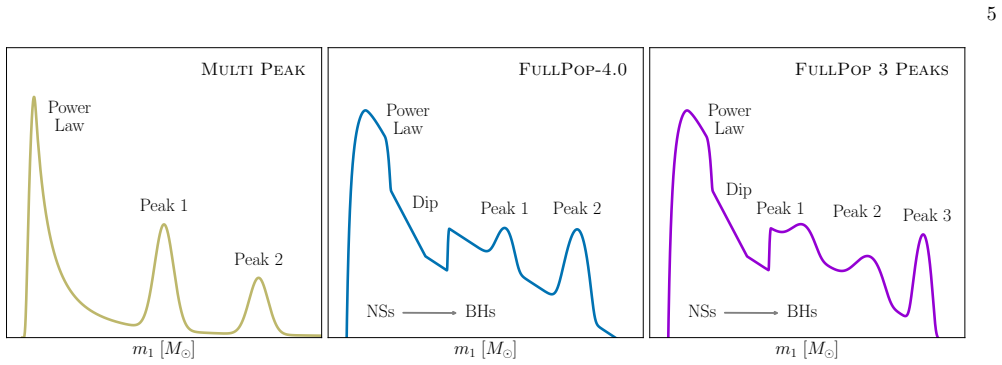
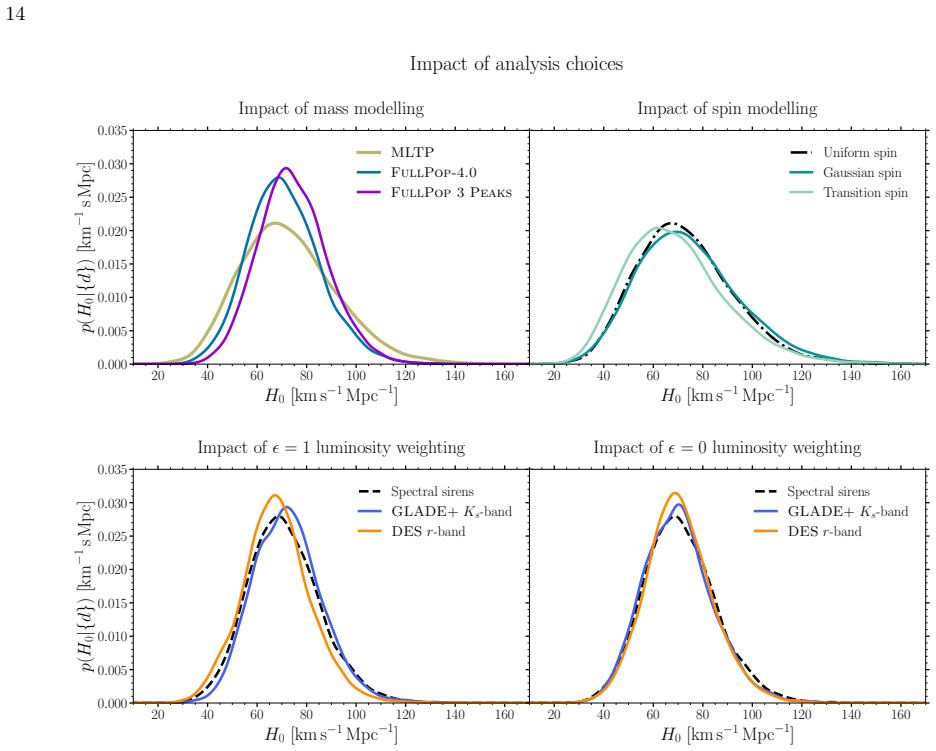
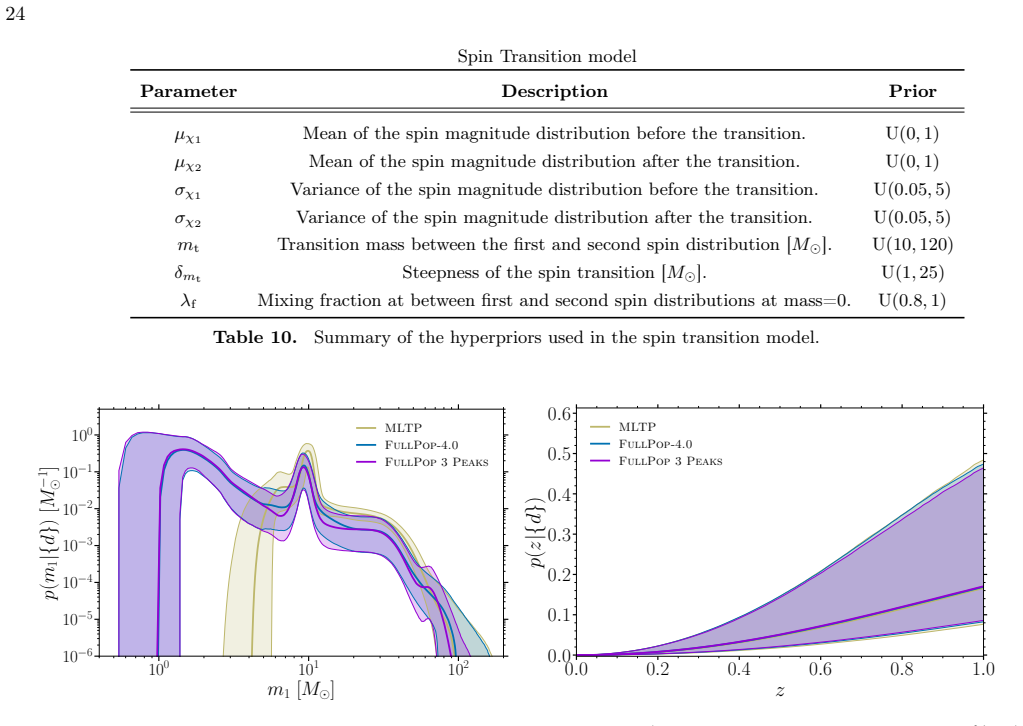
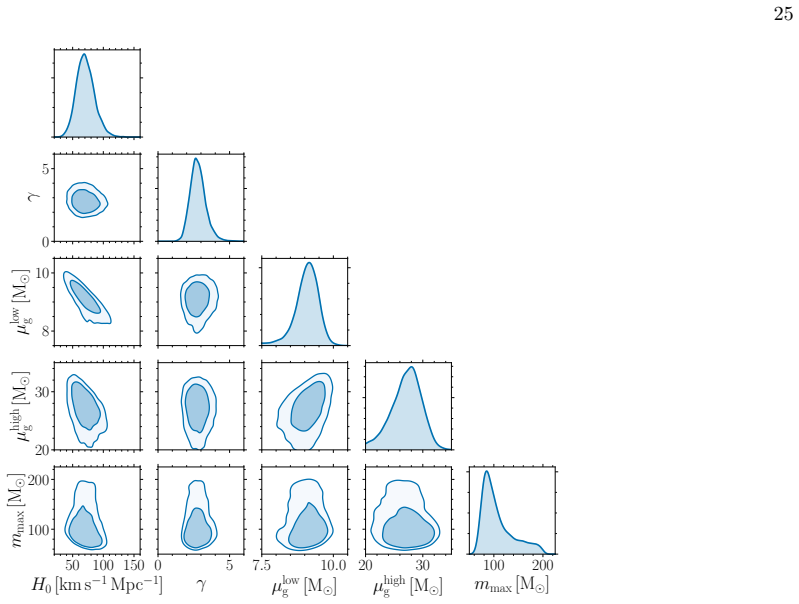
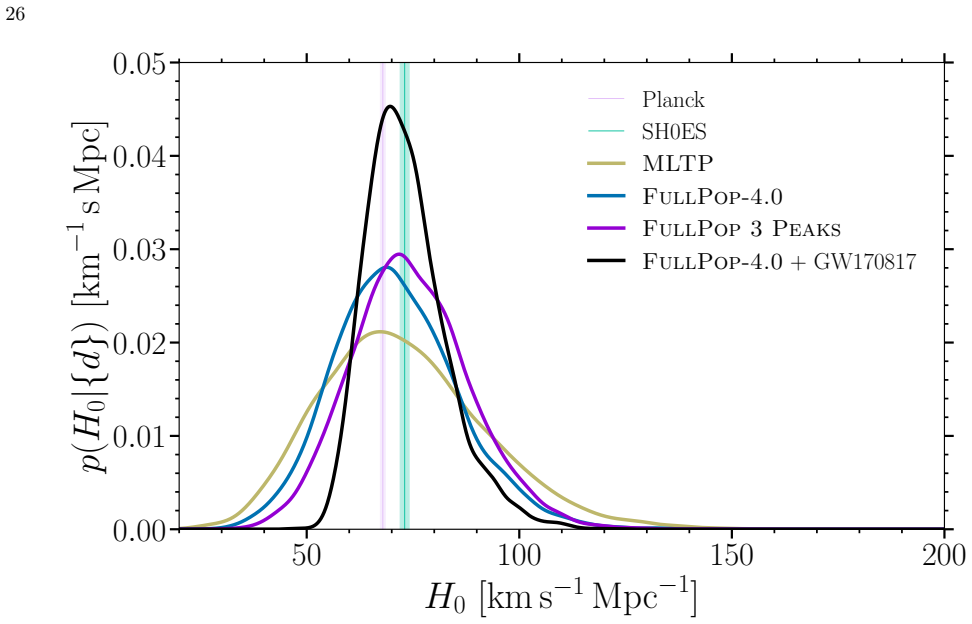
Using 236 GW sources, the luminosity distances measured from the waves are compared to redshifts obtained from source-frame mass distribution features and statistical host-galaxy associations, yielding H0 = 71.0_{-7.1}^{+9.0} km s^{-1} Mpc^{-1} (median with 68 percent symmetric credible interval) while finding no departures from GR in parameterized tests of GW propagation; the result incorporates the prior H0 measurement from GW170817 and DES-Y6 information and improves the reconstructed mass distribution uncertainties.
What carries the argument
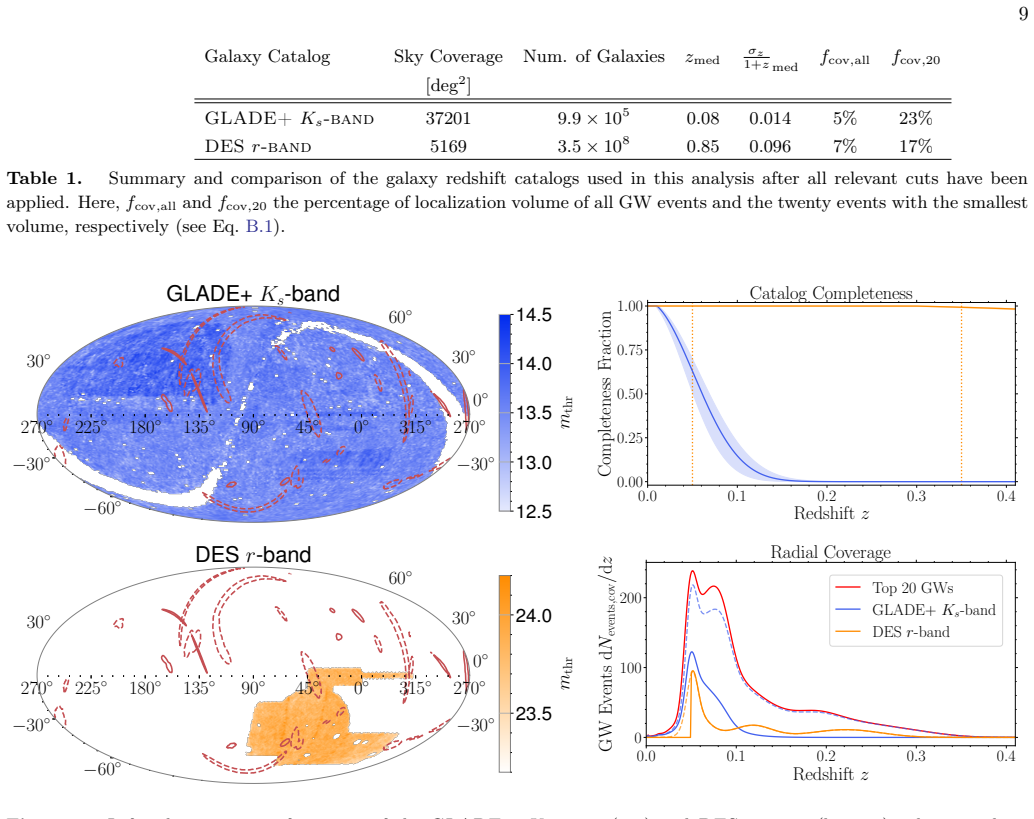
Statistical matching of GW luminosity distances to redshifts inferred from black-hole mass-spectrum features and host-galaxy catalogs, combined with prior H0 and galaxy-catalog data.
If this is right
- Larger future GW catalogs with improved sky localizations will further tighten the H0 measurement.
- The mass-distribution reconstruction can be used to refine source-frame population models for subsequent cosmological analyses.
- Parameterized tests set limits on classes of modified-gravity models that alter GW propagation distance.
- The result provides an independent cross-check on electromagnetic determinations of the expansion rate.
Where Pith is reading between the lines
- If the mass-spectrum features used for redshift inference prove stable across detector networks, the method could be applied to next-generation ground-based observatories without requiring electromagnetic counterparts.
- Combining this statistical H0 with distance-ladder and CMB measurements could quantify the contribution of any systematic bias in the GW channel.
- Absence of propagation deviations at current precision suggests that any modified-gravity effects, if present, must be smaller than the statistical uncertainty on the distance-redshift relation for stellar-mass binaries.
Load-bearing premise
Redshifts inferred from source-frame mass-spectrum features and statistical host-galaxy associations are unbiased and sufficiently precise to yield cosmological constraints when combined with prior H0 and galaxy-catalog data.
What would settle it
A single gravitational-wave event with a precisely measured electromagnetic redshift whose luminosity distance lies well outside the 68 percent credible interval predicted by H0 = 71 km s^{-1} Mpc^{-1} would directly contradict the reported constraint.
Figures




read the original abstract
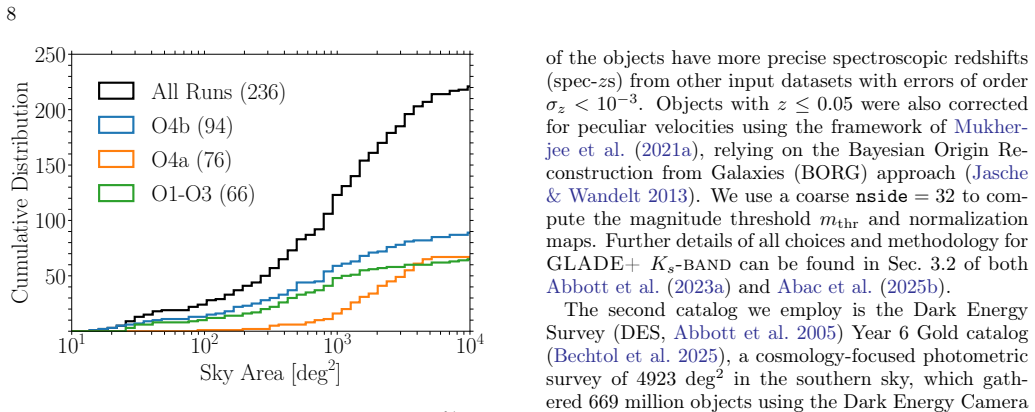
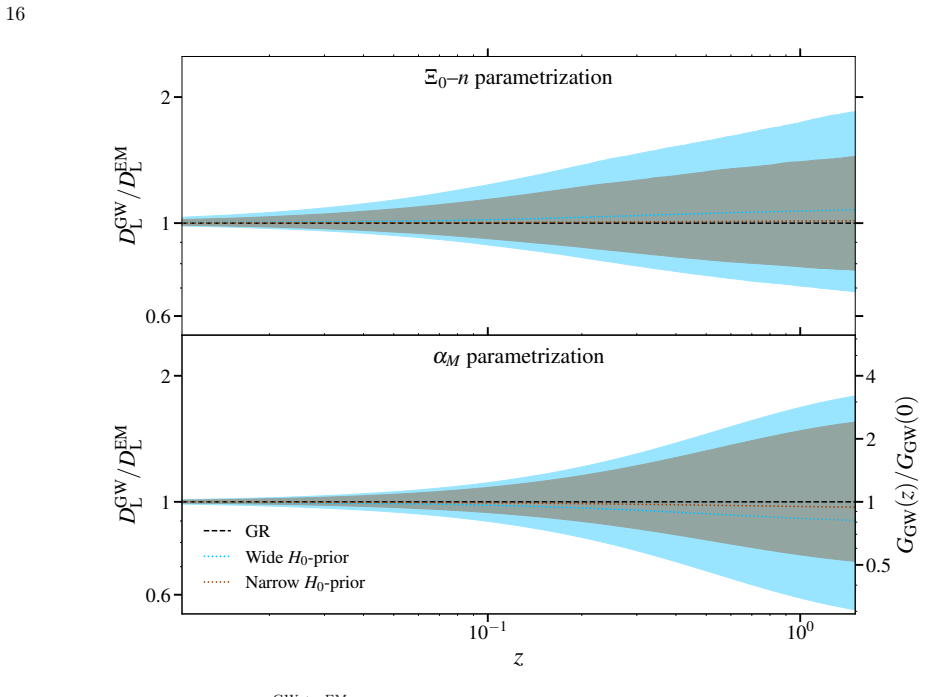
We employ 236 gravitational-wave (GW) sources in the fifth LIGO--Virgo--KAGRA Collaboration (LVK) Gravitational-Wave Transient Catalog (GWTC-5.0) to estimate the Hubble constant $H_0$. We compare the luminosity distance measured from GWs to the redshift inferred i) using features in the mass spectrum, and ii) using statistical host galaxy association. Probing the relationship between source luminosity distances and redshifts obtained in this way yields constraints on cosmological parameters. We estimate $H_0 = {71.0}_{-7.1}^{+9.0}\,{\text{km}\,\text{s}^{-1}\,\text{Mpc}^{-1}}$ (median with $68\%$ symmetric credible interval). This combines information from the source-frame mass distribution with the $H_0$ measurement from GW170817 and its electromagnetic counterpart as well as galaxy catalog information from Dark Energy Survey Year 6 (DES-Y6). We improve over the GWTC-4.0 measurement by using more GW sources, some with significantly smaller sky localization volumes, which leads to a reduction by $25.7\%$ of the $H_0$ uncertainty and a reconstructed mass distribution with lower uncertainties. We also constrain deviations from general relativity (GR) which affect GW propagation, specifically that modify the luminosity distance inferred from the GW signal. We find no departures from GR in parameterized tests of GW propagation.
Editorial analysis
A structured set of objections, weighed in public.
Referee Report
Summary. The manuscript analyzes 236 GW events from GWTC-5.0 to constrain H0 by comparing GW luminosity distances to redshifts inferred from features in the source-frame mass spectrum and from statistical host-galaxy associations. It reports H0 = 71.0_{-7.1}^{+9.0} km s^{-1} Mpc^{-1} (68% credible interval), obtained by combining the new events with the GW170817 electromagnetic counterpart and DES-Y6 galaxy catalog information. The work also performs parameterized tests of modified GW propagation and reports consistency with GR. It claims a 25.7% reduction in H0 uncertainty relative to GWTC-4.0 due to the larger sample and improved localizations.
Significance. If the mass-spectrum redshift inferences prove unbiased, the result supplies a valuable independent cosmological probe that enlarges the GW sample size and tightens the H0 constraint while testing GR propagation. The use of 236 events with some having smaller localization volumes is a clear strength, as is the explicit combination of multiple channels; however, the dependence on the earlier GW170817 anchor limits full independence.
major comments (2)
- [§3.2] §3.2 (mass-spectrum redshift channel): the central H0 posterior relies on redshifts inferred from a parametric source-frame mass model whose form (power-law indices, gap locations, possible peaks) is either fixed or jointly fit; the manuscript provides no dedicated validation on simulated catalogs with known input cosmology to demonstrate that mismatches or unmodeled redshift evolution do not systematically shift the reported H0, which is load-bearing because this channel dominates the 236-event sample.
- [Results section] Results section and abstract: the claimed 25.7% reduction in H0 uncertainty is presented without a quantitative error-budget breakdown separating the contribution of the new GW events (including their smaller localization volumes) from the fixed GW170817 and DES-Y6 priors, preventing assessment of whether the improvement is driven by the GWTC-5.0 data as asserted.
minor comments (2)
- [Abstract] Abstract: the phrase 'some with significantly smaller sky localization volumes' is used without quantifying how many events or which subset drives the improvement.
- [§2] §2: the notation and definitions for the parameterized modified-propagation models would benefit from an explicit table listing each parameter and its physical meaning.
Simulated Author's Rebuttal
We thank the referee for their careful reading and constructive feedback. We address each major comment below and will revise the manuscript accordingly.
read point-by-point responses
-
Referee: [§3.2] §3.2 (mass-spectrum redshift channel): the central H0 posterior relies on redshifts inferred from a parametric source-frame mass model whose form (power-law indices, gap locations, possible peaks) is either fixed or jointly fit; the manuscript provides no dedicated validation on simulated catalogs with known input cosmology to demonstrate that mismatches or unmodeled redshift evolution do not systematically shift the reported H0, which is load-bearing because this channel dominates the 236-event sample.
Authors: We agree that dedicated end-to-end validation on simulated catalogs with known input cosmology would strengthen confidence in the mass-spectrum channel. Although the joint fit of mass-model hyperparameters with cosmological parameters provides some protection against model mismatch, and the parametric form follows the same framework used in prior GWTC analyses, we will add a simulation study in the revised manuscript to quantify any residual bias in the H0 posterior arising from unmodeled redshift evolution or model misspecification. revision: yes
-
Referee: [Results section] Results section and abstract: the claimed 25.7% reduction in H0 uncertainty is presented without a quantitative error-budget breakdown separating the contribution of the new GW events (including their smaller localization volumes) from the fixed GW170817 and DES-Y6 priors, preventing assessment of whether the improvement is driven by the GWTC-5.0 data as asserted.
Authors: We acknowledge that an explicit error-budget decomposition would allow readers to isolate the contribution of the additional 236 events and their improved localizations from the fixed GW170817 and DES-Y6 components. The quoted 25.7% reduction is computed from the full posterior width relative to the GWTC-4.0 result with the same anchor priors, but we will include a quantitative breakdown (e.g., via successive addition of event subsets or variance decomposition) in the revised Results section and abstract to clarify the source of the improvement. revision: yes
Circularity Check
No significant circularity in the H0 estimation chain
full rationale
The paper performs a joint hierarchical inference on 236 GW events from GWTC-5.0, using features in the source-frame mass spectrum and statistical host-galaxy associations to infer redshifts while simultaneously reconstructing the mass distribution (with reported lower uncertainties than prior catalogs). This is combined with independent external anchors (GW170817 EM counterpart and DES-Y6 galaxy catalog). No equations or steps reduce the reported H0 posterior to a fitted parameter renamed as a prediction, a self-definitional loop, or a load-bearing self-citation chain; the central result incorporates new data and external benchmarks rather than being forced by construction from its own inputs.
Axiom & Free-Parameter Ledger
Forward citations
Cited by 4 Pith papers
-
Rapid Hubble constant inference from GW170817 using GPU-accelerated nested sampling: prior sensitivity and the limits of post-hoc reweighting
GPU-accelerated nested sampling on GW170817 demonstrates that switching to a uniform-in-dL prior shifts the H0 tail and median far more than post-hoc reweighting captures, due to an under-sampled (dL, iota) bimodality.
-
Population-level correlations in Bayesian statistics: an illustrative model for gravitational-wave astronomy
An idealized Gaussian model demonstrates that single-event correlations inflate uncertainties in population correlations and that catalog-wide correlated biases can be misread as population correlations.
-
Intrinsic handedness in O1-O4a black-hole mergers: probing orbital precession, remnant retention in dense environments and cosmological mirror asymmetry
92% of 91 LIGO black hole mergers favor non-zero V_GW, constraining bound remnants to at most 8% and finding no cosmological handedness preference with average near zero.
-
The first decade of gravitational-wave measurements of black hole spins
A review summarizing formation-channel predictions, waveform effects, and population-level constraints on stellar-mass black hole spins from the first decade of gravitational-wave observations.
Reference graph
Works this paper leans on
-
[1]
The Science of the Einstein Telescope
Aasi, J., et al. 2015, Class. Quant. Grav., 32, 074001, doi: 10.1088/0264-9381/32/7/074001 Abac, A., et al. 2025a. https://arxiv.org/abs/2503.12263 Abac, A. G., Abouelfettouh, I., Acernese, F., et al. 2026a, To be published in this issue. https://dcc.ligo.org/LIGO-P2500701/public —. 2026b, To be published in this issue. https://dcc.ligo.org/LIGO-P2600166/...
work page internal anchor Pith review Pith/arXiv arXiv doi:10.1088/0264-9381/32/7/074001 2015
-
[2]
https://arxiv.org/abs/astro-ph/0510346 Abdalla, E., et al. 2022, JHEAp, 34, 49, doi: 10.1016/j.jheap.2022.04.002 Acernese, F., et al. 2015, Class. Quant. Grav., 32, 024001, doi: 10.1088/0264-9381/32/2/024001 Adams, T., Buskulic, D., Germain, V., et al. 2016, Class. Quant. Grav., 33, 175012, doi: 10.1088/0264-9381/33/17/175012 Ade, P. A. R., et al. 2016, A...
work page internal anchor Pith review Pith/arXiv arXiv doi:10.1016/j.jheap.2022.04.002 2022
-
[3]
The DESI Experiment Part I: Science,Targeting, and Survey Design
https://arxiv.org/abs/1611.00036 Aghanim, N., et al. 2020, Astron. Astrophys., 641, A6, doi: 10.1051/0004-6361/201833910 Akutsu, T., et al. 2021, PTEP, 2021, 05A101, doi: 10.1093/ptep/ptaa125 Alfradique, V., Bom, C. R., Teixeira, G., & Santos, A. 2026, Improved constraint on the Hubble constant from dark sirens with LIGO/Virgo/KAGRA O4a. https://arxiv.org...
work page internal anchor Pith review Pith/arXiv arXiv doi:10.1051/0004-6361/201833910 2020
- [4]
-
[5]
High Mass X-ray Binaries: Future Evolution and Fate
https://arxiv.org/abs/1208.2422 Belgacem, E., Dirian, Y., Foffa, S., et al. 2019a, JCAP, 08, 015, doi: 10.1088/1475-7516/2019/08/015 Belgacem, E., Dirian, Y., Foffa, S., & Maggiore, M. 2018a, Phys. Rev. D, 98, 023510, doi: 10.1103/PhysRevD.98.023510 —. 2018b, Phys. Rev. D, 97, 104066, doi: 10.1103/PhysRevD.97.104066 Belgacem, E., et al. 2019b, JCAP, 07, 0...
work page internal anchor Pith review Pith/arXiv arXiv doi:10.1088/1475-7516/2019/08/015 2019
-
[6]
https://arxiv.org/abs/2010.05082 Chatterjee, D., Hegade K R, A., Holder, G., et al. 2021, Phys. Rev. D, 104, 083528, doi: 10.1103/PhysRevD.104.083528 Chen, A., Gray, R., & Baker, T. 2024a, JCAP, 02, 035, doi: 10.1088/1475-7516/2024/02/035 Chen, H.-Y. 2020, Phys. Rev. Lett., 125, 201301, doi: 10.1103/PhysRevLett.125.201301 Chen, H.-Y., Ezquiaga, J. M., & G...
-
[7]
https://arxiv.org/abs/2410.03275 Dálya, G., Galgóczi, G., Dobos, L., et al. 2018, Mon. Not. Roy. Astron. Soc., 479, 2374, doi: 10.1093/mnras/sty1703 Dálya, G., et al. 2022, Mon. Not. Roy. Astron. Soc., 514, 1403, doi: 10.1093/mnras/stac1443 Davies, G. S., Dent, T., Tápai, M., et al. 2020, Phys. Rev. D, 102, 022004, doi: 10.1103/PhysRevD.102.022004 Deffaye...
-
[8]
2021a, JCAP, 08, 026, doi: 10.1088/1475-7516/2021/08/026 —
https://arxiv.org/abs/2412.00202 Finke, A., Foffa, S., Iacovelli, F., Maggiore, M., & Mancarella, M. 2021a, JCAP, 08, 026, doi: 10.1088/1475-7516/2021/08/026 —. 2021b, Phys. Rev. D, 104, 084057, doi: 10.1103/PhysRevD.104.084057 —. 2022, Phys. Dark Univ., 36, 100994, doi: 10.1016/j.dark.2022.100994 Fishbach, M., Essick, R., & Holz, D. E. 2020, Astrophys. J...
-
[9]
2023, JCAP, 08, 050, doi: 10.1088/1475-7516/2023/08/050 Fryer, C
https://arxiv.org/abs/2008.11316 Fonseca, J., Zazzera, S., Baker, T., & Clarkson, C. 2023, JCAP, 08, 050, doi: 10.1088/1475-7516/2023/08/050 Fryer, C. L., Belczynski, K., Wiktorowicz, G., et al. 2012, Astrophys. J., 749, 91, doi: 10.1088/0004-637X/749/1/91 Gair, J. R., et al. 2023, Astron. J., 166, 22, doi: 10.3847/1538-3881/acca78 Gennari, V., Mastrogiov...
-
[10]
https://arxiv.org/abs/2502.20445 Gleyzes, J., Langlois, D., & Vernizzi, F. 2015, Int. J. Mod. Phys. D, 23, 1443010, doi: 10.1142/S021827181443010X Górski, K. M., Hivon, E., Banday, A. J., et al. 2005, Astrophys. J., 622, 759, doi: 10.1086/427976 Gray, R., Messenger, C., & Veitch, J. 2022, Mon. Not. Roy. Astron. Soc., 512, 1127, doi: 10.1093/mnras/stac366 ...
-
[11]
https://arxiv.org/abs/2411.12026 Ivezić, v., et al. 2019, Astrophys. J., 873, 111, doi: 10.3847/1538-4357/ab042c Jasche, J., & Wandelt, B. D. 2013, Mon. Not. Roy. Astron. Soc., 432, 894, doi: 10.1093/mnras/stt449 40 John Zweizig. 2006, The Data Monitor Tool Project, labcit.ligo.caltech.edu/˜jzweizig/DMT-Project.html Joshi, P., et al
-
[12]
https://arxiv.org/abs/2506.06497 Kalogera, V., et al
work page internal anchor Pith review Pith/arXiv arXiv
-
[13]
https://arxiv.org/abs/2111.06990 Kapil, V., Reali, L., Cotesta, R., & Berti, E. 2024, Phys. Rev. D, 109, 104043, doi: 10.1103/PhysRevD.109.104043 Karathanasis, C., Mukherjee, S., & Mastrogiovanni, S. 2023, Mon. Not. Roy. Astron. Soc., 523, 4539, doi: 10.1093/mnras/stad1373 Klimenko, S., & Mitselmakher, G. 2004, Class. Quant. Grav., 21, S1819, doi: 10.1088...
- [14]
-
[15]
Euclid Definition Study Report
https://arxiv.org/abs/1110.3193 Leyde, K., Baker, T., & Enzi, W. 2024, JCAP, 12, 013, doi: 10.1088/1475-7516/2024/12/013 —
work page internal anchor Pith review Pith/arXiv arXiv doi:10.1088/1475-7516/2024/12/013 2024
-
[16]
A., Chassande-Mottin, E., & Karathanasis, C
https://arxiv.org/abs/2507.12171 Leyde, K., Mastrogiovanni, S., Steer, D. A., Chassande-Mottin, E., & Karathanasis, C. 2022, JCAP, 09, 012, doi: 10.1088/1475-7516/2022/09/012 Li, Y.-J., Tang, S.-P., Wang, Y.-Z., & Fan, Y.-Z. 2024a, Astrophys. J., 976, 153, doi: 10.3847/1538-4357/ad888b Li, Y.-J., Wang, Y.-Z., Tang, S.-P., Chen, T., & Fan, Y.-Z. 2025a, Ast...
-
[17]
Determining the Hubble constant from gravitational wave observations of merging compact binaries
https://arxiv.org/abs/1307.2638 Nissanke, S., Holz, D. E., Hughes, S. A., Dalal, N., & Sievers, J. L. 2010, Astrophys. J., 725, 496, doi: 10.1088/0004-637X/725/1/496 Nitz, A. H., Dent, T., Dal Canton, T., Fairhurst, S., & Brown, D. A. 2017, Astrophys. J., 849, 118, doi: 10.3847/1538-4357/aa8f50 Noller, J., & Nicola, A. 2019, Phys. Rev. D, 99, 103502, doi:...
work page internal anchor Pith review Pith/arXiv arXiv doi:10.1088/0004-637x/725/1/496 2010
-
[18]
https://arxiv.org/abs/2605.23538 Pedrotti, A., Mancarella, M., Bel, J., & Gerosa, D
work page internal anchor Pith review Pith/arXiv arXiv
-
[19]
https://arxiv.org/abs/2504.10482 Perenon, L., Piazza, F., Marinoni, C., & Hui, L. 2015, JCAP, 11, 029, doi: 10.1088/1475-7516/2015/11/029 Perivolaropoulos, L., & Skara, F. 2022, New Astron. Rev., 95, 101659, doi: 10.1016/j.newar.2022.101659 Perna, G., Mastrogiovanni, S., & Ricciardone, A
work page internal anchor Pith review Pith/arXiv arXiv doi:10.1088/1475-7516/2015/11/029 2015
-
[20]
https://arxiv.org/abs/2405.07904 Pettorino, V., & Amendola, L. 2015, Phys. Lett. B, 742, 353, doi: 10.1016/j.physletb.2015.02.007 Pierra, G., Mastrogiovanni, S., & Perriès, S. 2024a, Astron. Astrophys., 692, A80, doi: 10.1051/0004-6361/202452545 Pierra, G., Mastrogiovanni, S., Perriès, S., & Mapelli, M. 2024b, Phys. Rev. D, 109, 083504, doi: 10.1103/PhysR...
-
[21]
https://arxiv.org/abs/1901.08580 Sakon, S., et al. 2024, Phys. Rev. D, 109, 044066, doi: 10.1103/PhysRevD.109.044066 Saltas, I. D., Sawicki, I., Amendola, L., & Kunz, M. 2014, Phys. Rev. Lett., 113, 191101, doi: 10.1103/PhysRevLett.113.191101 Salvarese, A., & Chen, H.-Y. 2024, Astrophys. J. Lett., 974, L16, doi: 10.3847/2041-8213/ad7bbc Santoliquido, F., ...
work page internal anchor Pith review Pith/arXiv arXiv doi:10.1103/physrevd.109.044066 1901
-
[22]
https://arxiv.org/abs/2502.10780 Tsukada, L., et al. 2023, Phys. Rev. D, 108, 043004, doi: 10.1103/PhysRevD.108.043004 Turski, C., Bilicki, M., Dálya, G., Gray, R., & Ghosh, A. 2023, Mon. Not. Roy. Astron. Soc., 526, 6224, doi: 10.1093/mnras/stad3110 Urban, A. L., et al. 2021, gwdetchar/gwdetchar, doi.org/10.5281/zenodo.2575786, Zenodo, doi: 10.5281/zenod...
discussion (0)
Sign in with ORCID, Apple, or X to comment. Anyone can read and Pith papers without signing in.