Sub-luminous Type IIP SN 2024abfl as a result of a significantly low energy Fe-core collapse
Pith reviewed 2026-06-29 06:26 UTC · model grok-4.3
The pith
SN 2024abfl exploded from a compact progenitor of at most 10 solar masses with energy of 0.05 foe or less and 0.003 solar masses of nickel.
A machine-rendered reading of the paper's core claim, the machinery that carries it, and where it could break.
Core claim
Detailed 1-D hydrodynamical modeling suggests a compact progenitor with an upper limit of 10 Msun. It exploded with very low-energy 0.05 foe or less with a very low nickel mass of 0.003 Msun, consistent with the observed parameters. These parameters provide important constraints on the nature of low-energy core-collapse explosions.
What carries the argument
1-D hydrodynamical modeling of the multi-band light curve, colors, and low-resolution spectra to derive progenitor mass and radius, explosion energy, and ejected nickel mass.
If this is right
- Core-collapse explosions can release as little as 0.05 foe while still producing a Type IIP light curve.
- Nickel-56 yields in the weakest explosions can be limited to 0.003 solar masses.
- Compact progenitors at or below 10 solar masses are viable sources of faint Type IIP events.
- Low-luminosity Type IIP supernovae help map the lower boundary of successful core-collapse explosions.
Where Pith is reading between the lines
- A population of even fainter or undetected events may exist if similar low-energy collapses are common.
- The event may mark the low-energy end of a continuous distribution rather than a distinct subclass of explosions.
- Future high-resolution spectroscopy or late-time imaging could test whether the 1-D modeling assumptions hold for this parameter regime.
Load-bearing premise
The 1-D hydrodynamical models correctly recover the true explosion energy and nickel mass for a compact progenitor at this extremely low energy extreme.
What would settle it
Pre-explosion images or post-fade imaging that reveal a progenitor star more massive than 10 solar masses at the exact site of SN 2024abfl.
Figures





read the original abstract
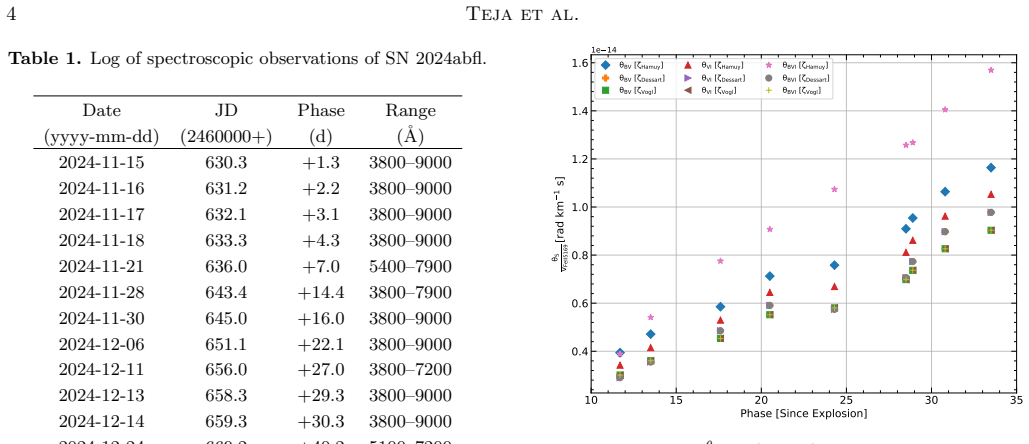
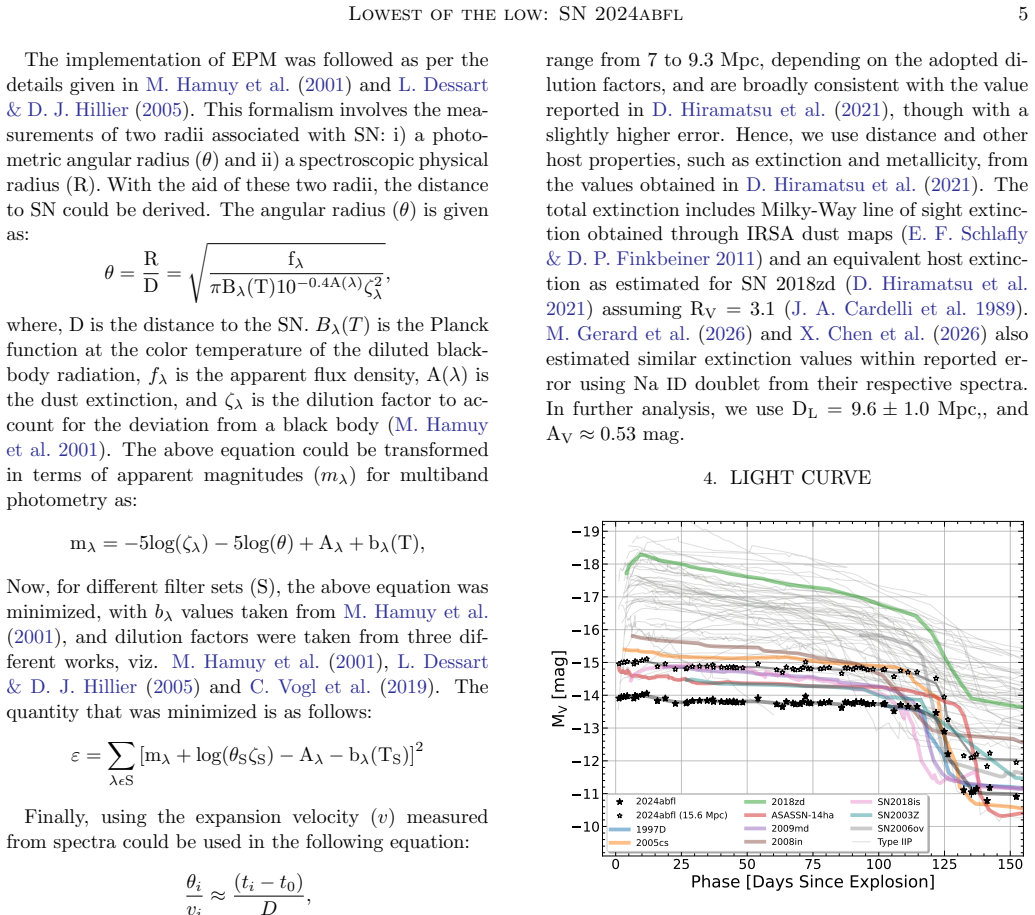
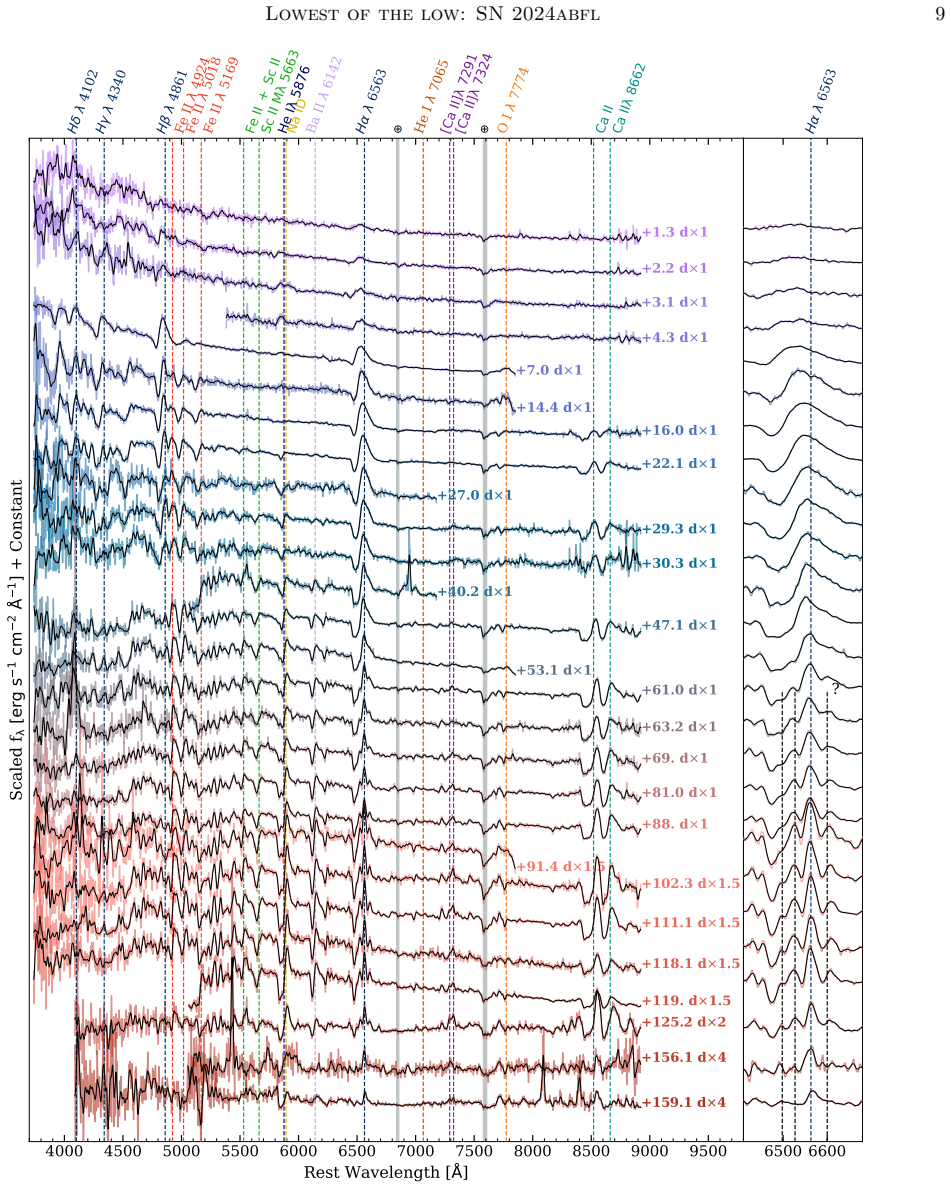
We present extensive, well-sampled multiwavelength photometric and low-resolution optical spectroscopic observations of the low-luminosity Type IIP supernova SN 2024abfl. SN 2024abfl is found to be at the faintest end of Type IIP supernovae with unprecedented flat (0.1 mag/ 100 day) plateau evolution and a mid-plateau absolute magnitude of Mv~-13.8 mag, placing it among one of the faintest Type IIP supernovae discovered to date. SN 2024abfl is adjacent to SN 2018zd in the same host NGC~2146. Using various SN distance measurement probes, we provide independent estimates of the debated distance to the host NGC 2146 (7-9 Mpc). Spectral evolution of SN 2024abfl is found to be similar to other SNe spectra of this subclass but with very narrow line profiles, indicating moderately low expansion velocities of the ejecta. Detailed 1-D hydrodynamical modeling suggests a compact progenitor with an upper limit of 10 Msun, fairly consistent with the directly detected progenitor estimates. It exploded with very low-energy 0.05 foe or less with a very low nickel mass of 0.003 Msun, consistent with the observed parameters. These parameters provide important constraints on the nature of low-energy core-collapse explosions. We discuss possible progenitor scenarios and compare SN 2024abfl with other low-luminosity Type IIP supernovae.
Editorial analysis
A structured set of objections, weighed in public.
Referee Report
Summary. The paper presents extensive multiwavelength photometry and low-resolution optical spectroscopy of the sub-luminous Type IIP supernova SN 2024abfl in NGC 2146. It reports an unusually flat plateau (0.1 mag/100 d) and mid-plateau M_V ≈ -13.8 mag, places the event among the faintest known IIP supernovae, and uses 1-D hydrodynamical modeling to infer a compact progenitor (upper mass limit 10 M_⊙), explosion energy ≤0.05 foe, and nickel mass 0.003 M_⊙. Independent distance estimates to the host (7-9 Mpc) are also provided, and the parameters are compared with other low-luminosity IIP events.
Significance. If the modeling framework is shown to be reliable at these extremes, the result would supply one of the lowest-energy core-collapse events with direct observational constraints, helping to delineate the lower boundary of successful explosions and the role of fallback or electron-capture mechanisms. The well-sampled light curve, narrow-line spectra, and host-distance analysis constitute a useful addition to the sparse sample of sub-luminous IIP supernovae. The work explicitly credits the multi-probe distance determination and the consistency with directly detected progenitor limits.
major comments (2)
- [Hydrodynamical modeling] Hydrodynamical modeling section: the abstract and modeling text state that the 1-D code recovers E ≤ 0.05 foe and M_Ni = 0.003 M_⊙ as the values that reproduce the plateau, velocities, and luminosity, yet no validation runs, recovery tests, or sensitivity analysis are shown for the compact-progenitor, low-energy corner of parameter space; without such tests the derived parameters remain fitted quantities rather than independent predictions.
- [Distance estimates] Distance and luminosity section: the absolute magnitude (and therefore the inferred nickel mass and energy) scales directly with the adopted distance to NGC 2146; although independent probes are presented, the text does not propagate the 7-9 Mpc range into formal uncertainties on the best-fit E and M_Ni or demonstrate that the modeling conclusions remain unchanged across that interval.
minor comments (2)
- [Abstract and modeling] The abstract and modeling text use “or less” for the explosion energy without specifying the lower bound explored or the χ² surface; a brief statement of the explored grid and goodness-of-fit metric would clarify uniqueness.
- [Figures] Figure captions for the light-curve and velocity comparisons should explicitly state the adopted distance and reddening values used to convert observed to absolute quantities.
Simulated Author's Rebuttal
We thank the referee for the constructive comments. We respond point-by-point to the major comments below, indicating revisions that will be made to strengthen the manuscript.
read point-by-point responses
-
Referee: [Hydrodynamical modeling] Hydrodynamical modeling section: the abstract and modeling text state that the 1-D code recovers E ≤ 0.05 foe and M_Ni = 0.003 M_⊙ as the values that reproduce the plateau, velocities, and luminosity, yet no validation runs, recovery tests, or sensitivity analysis are shown for the compact-progenitor, low-energy corner of parameter space; without such tests the derived parameters remain fitted quantities rather than independent predictions.
Authors: We agree that the current manuscript lacks explicit validation runs or sensitivity analysis in the low-energy, compact-progenitor regime. Although the 1-D hydrodynamical code is the same framework used in prior studies of sub-luminous Type IIP events, dedicated recovery tests for this extreme corner of parameter space are not presented. In the revised manuscript we will add a subsection with sensitivity analyses and recovery experiments on synthetic light curves to demonstrate that the code reliably recovers input parameters in this regime. revision: yes
-
Referee: [Distance estimates] Distance and luminosity section: the absolute magnitude (and therefore the inferred nickel mass and energy) scales directly with the adopted distance to NGC 2146; although independent probes are presented, the text does not propagate the 7-9 Mpc range into formal uncertainties on the best-fit E and M_Ni or demonstrate that the modeling conclusions remain unchanged across that interval.
Authors: The referee is correct that the manuscript does not propagate the 7-9 Mpc distance range into formal uncertainties on E and M_Ni. We will revise the distance and modeling sections to include explicit error propagation from this distance interval. We will also present modeling results at the bounding distances (7 Mpc and 9 Mpc) to show that the conclusions on progenitor mass, explosion energy, and nickel mass remain unchanged. revision: yes
Circularity Check
No significant circularity; modeling reports fitted parameters
full rationale
The abstract states that 'Detailed 1-D hydrodynamical modeling suggests a compact progenitor with an upper limit of 10 Msun... It exploded with very low-energy 0.05 foe or less with a very low nickel mass of 0.003 Msun, consistent with the observed parameters.' This is standard inference by fitting model parameters to data rather than any self-definitional loop, fitted input renamed as prediction, or self-citation that bears the central load. No equations or sections are quoted that reduce the claimed values to the inputs by construction. The derivation chain is self-contained as an application of an external hydro code to observations.
Axiom & Free-Parameter Ledger
free parameters (3)
- explosion energy
- nickel mass
- progenitor mass upper limit
axioms (2)
- domain assumption One-dimensional hydrodynamical models accurately capture the light-curve and spectral evolution of low-energy core-collapse events.
- domain assumption The distance to NGC 2146 lies between 7 and 9 Mpc.
Reference graph
Works this paper leans on
-
[2]
P., Gonz´ alez-Gait´ an, S., Hamuy, M., et al
Anderson, J. P., Gonz´ alez-Gait´ an, S., Hamuy, M., et al. 2014, ApJ, 786, 67, doi: 10.1088/0004-637X/786/1/67
-
[3]
Andrews, J. E., Krafton, K. M., Clayton, G. C., et al. 2016, MNRAS, 457, 3241, doi: 10.1093/mnras/stw164
-
[4]
Arcavi, I., Gal-Yam, A., Cenko, S. B., et al. 2012, ApJL, 756, L30, doi: 10.1088/2041-8205/756/2/L30
-
[5]
Arnett, W. D., & Fu, A. 1989, ApJ, 340, 396, doi: 10.1086/167402 Astropy Collaboration, Robitaille, T. P., Tollerud, E. J., et al. 2013, A&A, 558, A33, doi: 10.1051/0004-6361/201322068 Astropy Collaboration, Price-Whelan, A. M., Sip˝ ocz, B. M., et al. 2018, AJ, 156, 123, doi: 10.3847/1538-3881/aabc4f Astropy Collaboration, Price-Whelan, A. M., Lim, P. L....
-
[6]
Baklanov, P. V., Blinnikov, S. I., & Pavlyuk, N. N. 2005, Astronomy Letters, 31, 429, doi: 10.1134/1.1958107 Lowest of the low: SN 2024abfl19
-
[7]
1979, A&A, 72, 287
Barbon, R., Ciatti, F., & Rosino, L. 1979, A&A, 72, 287
1979
-
[8]
Barker, B. L., Harris, C. E., Warren, M. L., O’Connor, E. P., & Couch, S. M. 2022, ApJ, 934, 67, doi: 10.3847/1538-4357/ac77f3
-
[9]
Bellm, E. C., Kulkarni, S. R., Graham, M. J., et al. 2019, PASP, 131, 018002, doi: 10.1088/1538-3873/aaecbe
-
[10]
2001, MNRAS, 322, 231, doi: 10.1046/j.1365-8711.2001.04022.x
Benetti, S., Turatto, M., Balberg, S., et al. 2001, MNRAS, 322, 361, doi: 10.1046/j.1365-8711.2001.04122.x
-
[11]
2004, Ap&SS, 290, 13, doi: 10.1023/B:ASTR.0000022161.03559.42
Blinnikov, S., & Sorokina, E. 2004, Ap&SS, 290, 13, doi: 10.1023/B:ASTR.0000022161.03559.42
-
[12]
Blinnikov, S. I., R¨ opke, F. K., Sorokina, E. I., et al. 2006, A&A, 453, 229, doi: 10.1051/0004-6361:20054594
-
[13]
2014, ApJ, 782, 98, doi: 10.1088/0004-637X/782/2/98
Bose, S., & Kumar, B. 2014, ApJ, 782, 98, doi: 10.1088/0004-637X/782/2/98
-
[14]
Bostroem, K. A., Dessart, L., Hillier, D. J., et al. 2023, ApJL, 953, L18, doi: 10.3847/2041-8213/ace31c
-
[15]
Core-collapse supernova explosion theory
Burrows, A., & Vartanyan, D. 2021, Nature, 589, 29, doi: 10.1038/s41586-020-03059-w
-
[16]
2021, arXiv e-prints, arXiv:2109.12943, doi: 10.48550/arXiv.2109.12943
Callis, E., Fraser, M., Pastorello, A., et al. 2021, arXiv e-prints, arXiv:2109.12943, doi: 10.48550/arXiv.2109.12943
-
[17]
Cardelli, J. A., Clayton, G. C., & Mathis, J. S. 1989, ApJ, 345, 245, doi: 10.1086/167900
-
[18]
2026, arXiv e-prints, arXiv:2602.04309, doi: 10.48550/arXiv.2602.04309
Chen, X., Sun, N.-C., Xi, Q., et al. 2026, arXiv e-prints, arXiv:2602.04309, doi: 10.48550/arXiv.2602.04309
-
[19]
The nature of SN 1997D: low-mass progenitor and weak explosion
Chugai, N. N., & Utrobin, V. P. 2000, A&A, 354, 557, doi: 10.48550/arXiv.astro-ph/9906190 Cs¨ ornyei, G., & Guti´ errez, C. P. 2026, arXiv e-prints, arXiv:2602.15788, doi: 10.48550/arXiv.2602.15788
work page internal anchor Pith review Pith/arXiv arXiv doi:10.48550/arxiv.astro-ph/9906190 2000
-
[20]
K., Singh, A., Kawabata, K., & Teja, R
Das, H., Sahu, D. K., Singh, A., Kawabata, K., & Teja, R. 2024, Transient Name Server Classification Report, 2024-4515, 1
2024
-
[21]
Das, K. K., Kasliwal, M. M., Sollerman, J., et al. 2026, PASP, 138, 024204, doi: 10.1088/1538-3873/ae33f5
-
[22]
2025, A&A, 694, A260, doi: 10.1051/0004-6361/202452507
Dastidar, R., Misra, K., Valenti, S., et al. 2025, A&A, 694, A260, doi: 10.1051/0004-6361/202452507
-
[23]
Dessart, L., & Hillier, D. J. 2005, A&A, 439, 671, doi: 10.1051/0004-6361:20053217
-
[24]
2025, A&A, 698, A293, doi: 10.1051/0004-6361/202555161
Dessart, L., John Hillier, D., & Sarangi, A. 2025, A&A, 698, A293, doi: 10.1051/0004-6361/202555161
-
[25]
Duffell, P. C. 2016, ApJ, 821, 76, doi: 10.3847/0004-637X/821/2/76
-
[26]
2024, arXiv e-prints, arXiv:2404.01776, doi: 10.48550/arXiv.2404.01776
Fang, Q., Maeda, K., Ye, H., Moriya, T., & Matsumoto, T. 2024, arXiv e-prints, arXiv:2404.01776, doi: 10.48550/arXiv.2404.01776
-
[27]
Faran, T., Poznanski, D., Filippenko, A. V., et al. 2014a, MNRAS, 445, 554, doi: 10.1093/mnras/stu1760
-
[28]
Faran, T., Poznanski, D., Filippenko, A. V., et al. 2014b, MNRAS, 442, 844, doi: 10.1093/mnras/stu955
-
[29]
Farmer, R., Fields, C. E., Petermann, I., et al. 2016, ApJS, 227, 22, doi: 10.3847/1538-4365/227/2/22
-
[30]
Filippenko, A. V. 1997, ARA&A, 35, 309, doi: 10.1146/annurev.astro.35.1.309
-
[31]
Foreman-Mackey, D., Hogg, D. W., Lang, D., & Goodman, J. 2013, PASP, 125, 306, doi: 10.1086/670067 F¨ orster, F., Cabrera-Vives, G., Castillo-Navarrete, E., et al. 2021, AJ, 161, 242, doi: 10.3847/1538-3881/abe9bc
-
[32]
Fraser, M., Ergon, M., Eldridge, J. J., et al. 2011, MNRAS, 417, 1417, doi: 10.1111/j.1365-2966.2011.19370.x
-
[33]
2004, ApJ, 611, 1005, doi: 10.1086/422091
Gehrels, N., Chincarini, G., Giommi, P., et al. 2004, ApJ, 611, 1005, doi: 10.1086/422091
-
[34]
Gerard, M., Andrews, J. E., Clayton, G. C., et al. 2026, arXiv e-prints, arXiv:2601.02638, doi: 10.48550/arXiv.2601.02638
-
[35]
Goldberg, J. A., Bildsten, L., & Paxton, B. 2019, ApJ, 879, 3, doi: 10.3847/1538-4357/ab22b6 Guti´ errez, C. P., Anderson, J. P., Hamuy, M., et al. 2017, ApJ, 850, 89, doi: 10.3847/1538-4357/aa8f52
-
[36]
The Standard Candle Method for Type II Supernovae and the Hubble Constant
Hamuy, M. 2003, arXiv e-prints, astro, doi: 10.48550/arXiv.astro-ph/0309122
work page internal anchor Pith review Pith/arXiv arXiv doi:10.48550/arxiv.astro-ph/0309122 2003
-
[37]
Hamuy, M., & Pinto, P. A. 2002, ApJL, 566, L63, doi: 10.1086/339676
-
[38]
Hamuy, M., Pinto, P. A., Maza, J., et al. 2001, ApJ, 558, 615, doi: 10.1086/322450
-
[39]
Harris, C. R., Millman, K. J., van der Walt, S. J., et al. 2020, Nature, 585, 357, doi: 10.1038/s41586-020-2649-2
-
[40]
Hiramatsu, D., Howell, D. A., Van Dyk, S. D., et al. 2021, Nature Astronomy, 5, 903, doi: 10.1038/s41550-021-01384-2
-
[41]
Hunter, J. D. 2007, Computing in Science & Engineering, 9, 90, doi: 10.1109/MCSE.2007.55
-
[42]
2024, Transient Name Server Discovery Report, 2024-4506, 1
Itagaki, K. 2024, Transient Name Server Discovery Report, 2024-4506, 1
2024
-
[43]
Jermyn, A. S., Bauer, E. B., Schwab, J., et al. 2023, ApJS, 265, 15, doi: 10.3847/1538-4365/acae8d
-
[44]
K., & Ammon, K
Jordi, K., Grebel, E. K., & Ammon, K. 2005, Astronomische Nachrichten, 326, 657
2005
-
[45]
2016, in Positioning and Power in Academic Publishing: Players, Agents and Agendas, ed
Kluyver, T., Ragan-Kelley, B., P´ erez, F., et al. 2016, in Positioning and Power in Academic Publishing: Players, Agents and Agendas, ed. F. Loizides & B. Scmidt (Netherlands: IOS Press), 87–90. https://eprints.soton.ac.uk/403913/
2016
-
[46]
2021, MNRAS, 503, 797, doi: 10.1093/mnras/stab350 20Teja et al
Janka, H.-T. 2021, MNRAS, 503, 797, doi: 10.1093/mnras/stab350 20Teja et al
-
[47]
Ralchenko, Reader, J., & and NIST ASD Team
Kramida, A., Yu. Ralchenko, Reader, J., & and NIST ASD Team. 2024, NIST Atomic Spectra Database (ver. 5.12), [Online]. Available:https://physics.nist.gov/asd [2026, March 9]. National Institute of Standards and
2024
-
[48]
Kumar, H., Bhalerao, V., Anupama, G. C., et al. 2022, AJ, 164, 90, doi: 10.3847/1538-3881/ac7bea
-
[49]
2026, ApJ, 1002, 68, doi: 10.3847/1538-4357/ae5a9e
Li, L., Zhang, J., Zhao, Z., et al. 2026, ApJ, 1002, 68, doi: 10.3847/1538-4357/ae5a9e
-
[50]
Li, W., Van Dyk, S. D., Filippenko, A. V., et al. 2006, ApJ, 641, 1060, doi: 10.1086/499916
-
[51]
2025, ApJL, 982, L55, doi: 10.3847/2041-8213/adbf0b mnicholl
Luo, J., Zhang, L., Chen, B.-Q., et al. 2025, ApJL, 982, L55, doi: 10.3847/2041-8213/adbf0b mnicholl. 2018, mnicholl/superbol: superbol v1.0, v1.0 Zenodo, doi: 10.5281/zenodo.2155821
-
[52]
Blinnikov, S. I. 2023, PASJ, 75, 634, doi: 10.1093/pasj/psad024
-
[53]
Morozova, V., Piro, A. L., Renzo, M., et al. 2015b, ApJ, 814, 63, doi: 10.1088/0004-637X/814/1/63
-
[54]
2023, A&A, 678, A43, doi: 10.1051/0004-6361/202346713
Nagao, T., Mattila, S., Kotak, R., & Kuncarayakti, H. 2023, A&A, 678, A43, doi: 10.1051/0004-6361/202346713
-
[55]
2006, ApJ, 645, 841, doi: 10.1086/504413 Olivares E., F., Hamuy, M., Pignata, G., et al
Nugent, P., Sullivan, M., Ellis, R., et al. 2006, ApJ, 645, 841, doi: 10.1086/504413 Olivares E., F., Hamuy, M., Pignata, G., et al. 2010, ApJ, 715, 833, doi: 10.1088/0004-637X/715/2/833 pandas development team, T. 2020, pandas-dev/pandas: Pandas, latest Zenodo, doi: 10.5281/zenodo.3509134
-
[56]
Pastorello, A., Zampieri, L., Turatto, M., et al. 2004, MNRAS, 347, 74, doi: 10.1111/j.1365-2966.2004.07173.x
-
[57]
Pastorello, A., Sauer, D., Taubenberger, S., et al. 2006, MNRAS, 370, 1752, doi: 10.1111/j.1365-2966.2006.10587.x
-
[58]
Pastorello, A., Valenti, S., Zampieri, L., et al. 2009, MNRAS, 394, 2266, doi: 10.1111/j.1365-2966.2009.14505.x
-
[59]
2011, ApJS, 192, 3, doi: 10.1088/0067-0049/192/1/3
Paxton, B., Bildsten, L., Dotter, A., et al. 2011, ApJS, 192, 3, doi: 10.1088/0067-0049/192/1/3
-
[60]
2013, ApJS, 208, 4, doi: 10.1088/0067-0049/208/1/4
Paxton, B., Cantiello, M., Arras, P., et al. 2013, ApJS, 208, 4, doi: 10.1088/0067-0049/208/1/4
work page internal anchor Pith review doi:10.1088/0067-0049/208/1/4 2013
-
[61]
2015, ApJS, 220, 15, doi: 10.1088/0067-0049/220/1/15
Paxton, B., Marchant, P., Schwab, J., et al. 2015, ApJS, 220, 15, doi: 10.1088/0067-0049/220/1/15
work page internal anchor Pith review doi:10.1088/0067-0049/220/1/15 2015
-
[62]
Paxton, B., Schwab, J., Bauer, E. B., et al. 2018, ApJS, 234, 34, doi: 10.3847/1538-4365/aaa5a8
work page internal anchor Pith review doi:10.3847/1538-4365/aaa5a8 2018
-
[63]
2019, ApJS, 243, 10, doi: 10.3847/1538-4365/ab2241
Paxton, B., Smolec, R., Schwab, J., et al. 2019, ApJS, 243, 10, doi: 10.3847/1538-4365/ab2241
-
[64]
J., Folatelli, G., Anderson, J
Pessi, P. J., Folatelli, G., Anderson, J. P., et al. 2019, MNRAS, 488, 4239, doi: 10.1093/mnras/stz1855
-
[65]
Prabhu, T. P. 2014, Proceedings of the Indian National Science Academy Part A, 80, 887, doi: 10.16943/ptinsa/2014/v80i4/55174
-
[66]
L., Zampieri, L., Spiro, S., et al
Pumo, M. L., Zampieri, L., Spiro, S., et al. 2017, MNRAS, 464, 3013, doi: 10.1093/mnras/stw2625
-
[67]
Reguitti, A., Pumo, M. L., Mazzali, P. A., et al. 2021, MNRAS, 501, 1059, doi: 10.1093/mnras/staa3730 Rodr´ ıguez,´O., Clocchiatti, A., & Hamuy, M. 2014, AJ, 148, 107, doi: 10.1088/0004-6256/148/6/107
-
[68]
Roming, P. W. A., Kennedy, T. E., Mason, K. O., et al. 2005, Space Science Reviews, 120, 95, doi: 10.1007/s11214-005-5095-4
work page internal anchor Pith review doi:10.1007/s11214-005-5095-4 2005
-
[69]
Sato, M., Tominaga, N., Blinnikov, S. I., et al. 2024, ApJ, 970, 163, doi: 10.3847/1538-4357/ad50cb
-
[70]
Schlafly, E. F., & Finkbeiner, D. P. 2011, ApJ, 737, 103, doi: 10.1088/0004-637X/737/2/103
work page internal anchor Pith review doi:10.1088/0004-637x/737/2/103 2011
-
[71]
W., Young, D
Shingles, L., Smith, K. W., Young, D. R., et al. 2021, Transient Name Server AstroNote, 7, 1
2021
-
[72]
Sim, S. A. 2017, in Handbook of Supernovae, ed. A. W. Alsabti & P. Murdin, 769, doi: 10.1007/978-3-319-21846-5 28
-
[73]
Sahu, D. K. 2018, MNRAS, 480, 2475, doi: 10.1093/mnras/sty1957
-
[74]
2026, arXiv e-prints, arXiv:2603.14137, doi: 10.48550/arXiv.2603.14137
Singh, A., Goto, S., Sarangi, A., et al. 2026, arXiv e-prints, arXiv:2603.14137, doi: 10.48550/arXiv.2603.14137
-
[75]
Smartt, S. J. 2009, ARA&A, 47, 63, doi: 10.1146/annurev-astro-082708-101737
-
[76]
Smith, K. W., Smartt, S. J., Young, D. R., et al. 2020, PASP, 132, 085002, doi: 10.1088/1538-3873/ab936e Smithsonian Astrophysical Observatory. 2000, SAOImage DS9: A utility for displaying astronomical images in the X11 window environment,, Astrophysics Source Code Library, record ascl:0003.002
-
[77]
Spiro, S., Pastorello, A., Pumo, M. L., et al. 2014, MNRAS, 439, 2873, doi: 10.1093/mnras/stu156
-
[78]
Janka, H. T. 2016, ApJ, 821, 38, doi: 10.3847/0004-637X/821/1/38
work page internal anchor Pith review doi:10.3847/0004-637x/821/1/38 2016
-
[79]
361, Massive Stars Near and Far, ed
Symposium, Vol. 361, Massive Stars Near and Far, ed. J. Mackey, J. S. Vink, & N. St-Louis, 610–611, doi: 10.1017/S1743921322002034
-
[80]
Teja, R. S., Goldberg, J. A., Sahu, D. K., et al. 2024b, ApJ, 974, 44, doi: 10.3847/1538-4357/ad67d9
-
[81]
Teja, R. S., Singh, A., Sahu, D. K., et al. 2022, ApJ, 930, 34, doi: 10.3847/1538-4357/ac610b Lowest of the low: SN 2024abfl21
discussion (0)
Sign in with ORCID, Apple, or X to comment. Anyone can read and Pith papers without signing in.