RUBIES: The Evolution of the Ionization Parameter from 0 < z < 9
Pith reviewed 2026-06-29 06:33 UTC · model grok-4.3
The pith
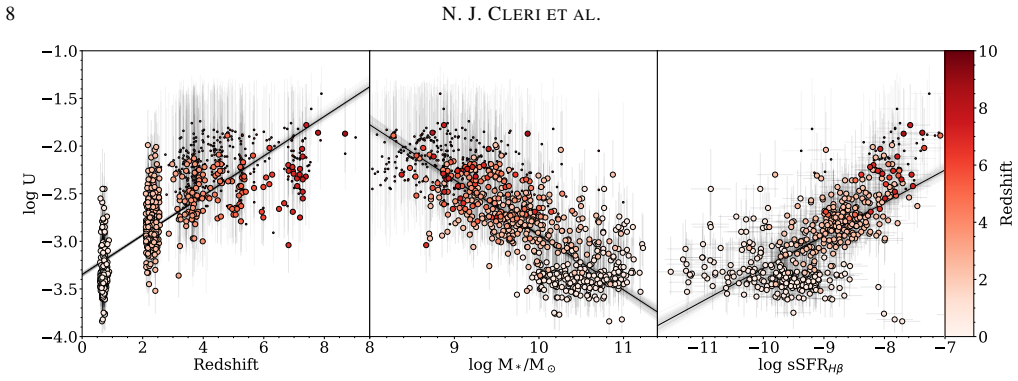
The ionization parameter U in galaxies rises by a factor of about 4 from redshift 2 to 6 even at fixed stellar mass and specific star formation rate.
A machine-rendered reading of the paper's core claim, the machinery that carries it, and where it could break.
Core claim
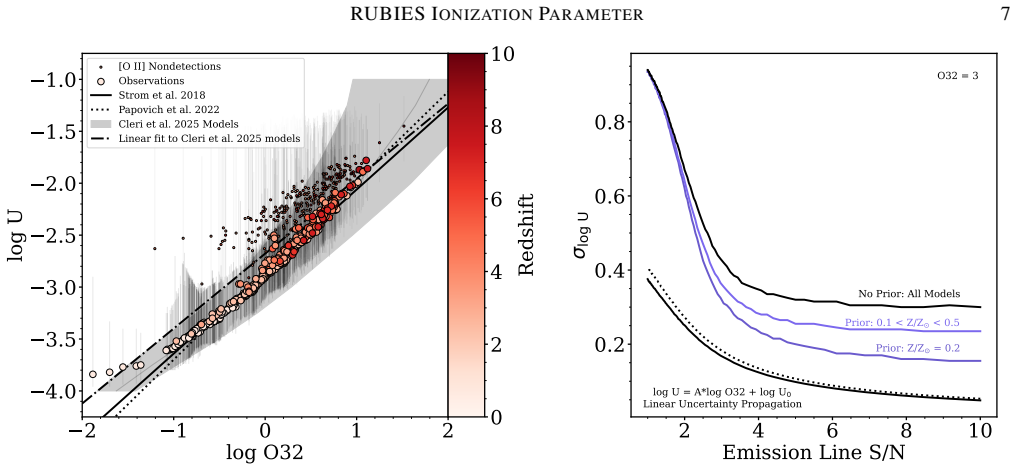
Using Cloudy photoionization models applied to O32 ratios, we infer U for 434 galaxies at 3<z<9 and find that U increases with redshift and sSFR while decreasing with stellar mass. We show that U increases with redshift even at fixed stellar mass and sSFR by a factor of ~4 from z=2 to z=6. Our results carry a systematic uncertainty of ~0.3 dex in log U arising from the range of models that reproduce the same O32 ratio without additional priors.
What carries the argument
The dimensionless ionization parameter U, inferred from the observed O32=[O III]/[O II] emission line ratio via Cloudy photoionization models.
If this is right
- U can be estimated from redshift, stellar mass, and sSFR alone when O32 spectroscopy is unavailable.
- Nebular conditions in galaxies change systematically with cosmic time even after accounting for mass and star formation rate.
- Future modeling that ingests many emission lines simultaneously can tighten constraints on gas density, abundances, and ionizing sources for individual objects.
Where Pith is reading between the lines
- If the O32-to-U mapping holds, the evolution implies that the typical ionizing spectrum or gas density changes with redshift at fixed galaxy properties.
- Emission-line-based estimates of star formation rate or metallicity at high redshift may need systematic corrections that grow with lookback time.
- Extending the same O32 analysis to z>9 with future facilities could test whether the rise in U continues or saturates.
Load-bearing premise
Cloudy photoionization models supply a reliable and sufficiently unique mapping from the observed O32 ratio to U for the high-redshift galaxy population without extra priors from other lines.
What would settle it
A measurement of U in the same high-redshift galaxies using additional emission lines that removes the model degeneracy and shows no residual increase with redshift at fixed stellar mass and sSFR.
Figures


read the original abstract
High-redshift galaxies have smaller radii, harder ionizing continua, and higher ionizing photon production efficiencies than lower redshift systems, which implies a corresponding evolution in nebular conditions. A key metric to quantify gas properties is the ionization parameter, q, the ratio of the local ionizing photon flux to the local hydrogen density. The ionization parameter is often inferred from observed emission line ratios, e.g., O32=[O III]/[O II]. Prior to JWST, statistical samples of ionization parameter-sensitive emission lines in the rest-frame optical remained inaccessible at high-z. We investigate the dimensionless ionization parameter, U=q/c at 3<z<9, inferred using Cloudy photoionization models from the O32 ratios for 434 galaxies in the RUBIES survey with JWST/NIRSpec PRISM and G395M spectroscopy, constituting the largest high-z population study of U to date. We compare to lower-redshift samples from SDSS, LEGA-C, and KBSS to probe the evolution of U from 0<z<9. We find that U increases with redshift and specific star formation rate (sSFR), and decreases with stellar mass. We combine the predictive power with multivariate relations to estimate U from redshift, stellar mass, and sSFR for use in cases where O32 is not available from spectroscopy, and show that U increases with redshift even at fixed stellar mass and sSFR by a factor of ~4 from z=2 to z=6. Crucially, and in contrast to previous linear best-fit calibrations, our inference results in a systematic uncertainty in log U of ~0.3 dex at zero measurement uncertainty due to the wide range of photoionization models that predict the same O32 ratio without informative priors. Finally, we discuss future modeling frameworks to accept many observed emission lines to simultaneously constrain gas-phase abundances, densities, ionizing sources, and ionization parameters to high accuracies for individual galaxies.
Editorial analysis
A structured set of objections, weighed in public.
Referee Report
Summary. The paper measures the dimensionless ionization parameter U in 434 galaxies at 3<z<9 from the RUBIES JWST/NIRSpec survey by converting observed O32=[O III]/[O II] ratios using Cloudy photoionization models. It compares these to lower-redshift samples (SDSS, LEGA-C, KBSS) and reports that U increases with redshift and sSFR while decreasing with stellar mass. The authors fit multivariate relations in z, M*, and sSFR to predict U when O32 is unavailable and claim that U rises by a factor of ~4 from z=2 to z=6 even at fixed stellar mass and sSFR. The abstract explicitly notes a ~0.3 dex systematic uncertainty in log U arising from the range of models that reproduce the same O32 without additional priors.
Significance. If the reported trend survives model variations, the work supplies the largest high-redshift statistical sample of U measurements to date and supplies practical multivariate predictive relations. The explicit discussion of the 0.3 dex model-driven floor is a positive feature that correctly flags the dominant uncertainty.
major comments (2)
- [Abstract] Abstract and results section on the fixed-M*/sSFR evolution: the central claim that U increases by a factor of ~4 from z=2 to z=6 at fixed stellar mass and sSFR is obtained by mapping O32 to U and then fitting the multivariate relation. Because the paper itself states that the same O32 can be produced by models differing by 0.3 dex in log U (with no measurement error), it is not shown whether the reported redshift trend exceeds or is comparable to this systematic floor when the model grid is varied.
- [Methods] Methods describing the Cloudy grid and O32-to-U conversion: the mapping assumes a single set of Cloudy models without reporting tests that vary density, metallicity, ionizing spectrum hardness, or geometry across the redshift range, even though the abstract acknowledges these parameters evolve with redshift and shift O32 at fixed U. An explicit robustness check (e.g., repeating the multivariate fit on alternate grids or with additional line constraints) is needed to establish that the fixed-M*/sSFR trend is not an artifact of the chosen model assumptions.
minor comments (1)
- [Abstract] Notation: the abstract defines U = q/c as the 'dimensionless ionization parameter' but then refers to 'ionization parameter, q'; a brief clarification of the q vs. U convention would avoid reader confusion.
Simulated Author's Rebuttal
We thank the referee for their careful reading and constructive comments. We address each major comment below and agree that additional clarification on model robustness is needed. We will revise the manuscript accordingly.
read point-by-point responses
-
Referee: [Abstract] Abstract and results section on the fixed-M*/sSFR evolution: the central claim that U increases by a factor of ~4 from z=2 to z=6 at fixed stellar mass and sSFR is obtained by mapping O32 to U and then fitting the multivariate relation. Because the paper itself states that the same O32 can be produced by models differing by 0.3 dex in log U (with no measurement error), it is not shown whether the reported redshift trend exceeds or is comparable to this systematic floor when the model grid is varied.
Authors: The 0.3 dex systematic uncertainty arising from the range of models that reproduce a given O32 is already stated explicitly in the abstract as the dominant uncertainty at zero measurement error. The reported factor of ~4 corresponds to ~0.6 dex, which exceeds this floor. However, we acknowledge that the manuscript does not explicitly demonstrate the trend's persistence when the underlying model grid is varied. In revision we will add a dedicated paragraph in the results section comparing the amplitude of the fixed-M*/sSFR redshift trend to the quoted 0.3 dex floor and will include a limited robustness test that repeats the multivariate fit on an alternate Cloudy grid. revision: partial
-
Referee: [Methods] Methods describing the Cloudy grid and O32-to-U conversion: the mapping assumes a single set of Cloudy models without reporting tests that vary density, metallicity, ionizing spectrum hardness, or geometry across the redshift range, even though the abstract acknowledges these parameters evolve with redshift and shift O32 at fixed U. An explicit robustness check (e.g., repeating the multivariate fit on alternate grids or with additional line constraints) is needed to establish that the fixed-M*/sSFR trend is not an artifact of the chosen model assumptions.
Authors: We agree that an explicit robustness check is required. The present analysis adopts a single standard Cloudy grid, with the 0.3 dex uncertainty intended to capture the range of models consistent with the observed O32. We did not, however, perform redshift-dependent variations of density, metallicity, or ionizing spectrum in the conversion step. In the revised manuscript we will expand the methods section with an appendix that (i) varies these parameters across plausible high-z ranges and (ii) repeats the multivariate fit on the alternate grids to confirm that the reported fixed-M*/sSFR redshift evolution is not an artifact of the fiducial assumptions. revision: yes
Circularity Check
No significant circularity detected in derivation chain
full rationale
The paper infers the ionization parameter U from observed O32 line ratios via Cloudy photoionization model grids on new JWST data for 434 galaxies, then directly measures trends in the resulting U values versus redshift, stellar mass, and sSFR (including at fixed M* and sSFR). The multivariate relations are explicitly fitted to these inferred values and presented only as a secondary predictive tool for cases lacking O32 spectroscopy; they are not used to generate the core evolution claim. No self-citations, self-definitional mappings, or renamings of inputs as predictions appear in the abstract or described chain. The derivation relies on external model grids and lower-z comparison samples (SDSS, LEGA-C, KBSS) and remains independent of its own fitted outputs. The acknowledged 0.3 dex systematic floor from model degeneracies is a limitation on precision, not a circularity in the logic.
Axiom & Free-Parameter Ledger
free parameters (1)
- coefficients of multivariate U(z, M*, sSFR) relations
axioms (1)
- domain assumption Cloudy photoionization models accurately map O32 line ratios to U across the relevant parameter space
Forward citations
Cited by 2 Pith papers
-
A Population of Little Red Dot-like Quasars in SDSS
Defines a sample of ~1300 SDSS quasars as Local Red Dots matching LRD photometric colors at z~0.4-0.8, with a V-shaped subset showing Balmer absorption and [NeV] emission, and SEDs modeled as reddened AGN plus host ga...
-
LEGGOS I: The JWST LEGGOS Survey -- LEnsing and Galaxy Growth: Observing Substructures -- Unpacks the Nature of Clumpy Star Formation and Quenching in Gravitationally Lensed Galaxies beyond Cosmic Noon
LEGGOS presents a uniform framework that jointly models lensing, photometry, and integral-field spectroscopy to disentangle stellar populations in clumps of high-redshift lensed galaxies.
Reference graph
Works this paper leans on
-
[1]
Abdurro’uf, Larson, R. L., Coe, D., et al. 2024, ApJ, 973, 47, doi: 10.3847/1538-4357/ad6001
-
[2]
Arnaud, K. A. 1996, in Astronomical Society of the Pacific Conference Series, V ol. 101, Astronomical Data Analysis Software and Systems V , ed. G. H. Jacoby & J. Barnes, 17 Astropy Collaboration, Robitaille, T. P., Tollerud, E. J., et al. 2013, A&A, 558, A33, doi: 10.1051/0004-6361/201322068
-
[3]
Baldwin, J. A., Phillips, M. M., & Terlevich, R. 1981, PASP, 93, 5, doi: 10.1086/130766
-
[4]
Berg, D. A., Chisholm, J., Erb, D. K., et al. 2021, ApJ, 922, 170, doi: 10.3847/1538-4357/ac141b
-
[5]
Blanc, G. A., Kewley, L., V ogt, F. P. A., & Dopita, M. A. 2015, ApJ, 798, 99, doi: 10.1088/0004-637X/798/2/99
-
[6]
Brinchmann, J., Charlot, S., White, S. D. M., et al. 2004, MNRAS, 351, 1151, doi: 10.1111/j.1365-2966.2004.07881.x
-
[7]
Bruzual, G., & Charlot, S. 2003, MNRAS, 344, 1000, doi: 10.1046/j.1365-8711.2003.06897.x
-
[8]
Byler, N., Dalcanton, J. J., Conroy, C., & Johnson, B. D. 2017, ApJ, 840, 44, doi: 10.3847/1538-4357/aa6c66
-
[9]
The Dust Content and Opacity of Actively Star-Forming Galaxies
Calzetti, D., Armus, L., Bohlin, R. C., et al. 2000, ApJ, 533, 682, doi: 10.1086/308692
work page internal anchor Pith review doi:10.1086/308692 2000
-
[10]
Calzetti, D., Kinney, A. L., & Storchi-Bergmann, T. 1994, ApJ, 429, 582, doi: 10.1086/174346 14 See https://hprc.tamu.edu/kb/User-Guides/Grace, where the namesake of the cluster is Grace Hopper
-
[11]
Cann, J. M., Satyapal, S., Abel, N. P., et al. 2018, ApJ, 861, 142, doi: 10.3847/1538-4357/aac64a
-
[12]
2003, Publications of the Astronomical Society of the Pacific, 115, 763, doi: 10.1086/376392
Chabrier, G. 2003, Publications of the Astronomical Society of the Pacific, 115, 763, doi: 10.1086/376392
work page internal anchor Pith review doi:10.1086/376392 2003
-
[13]
2016, ApJ, 823, 102, doi: 10.3847/0004-637X/823/2/102 de Laverny, P., Recio-Blanco, A., Worley, C
Choi, J., Dotter, A., Conroy, C., et al. 2016, ApJ, 823, 102, doi: 10.3847/0004-637X/823/2/102
work page internal anchor Pith review doi:10.3847/0004-637x/823/2/102 2016
-
[14]
Choustikov, N., Katz, H., Cameron, A. J., et al. 2026, The Open Journal of Astrophysics, 9, 58199, doi: 10.33232/001c.158199
-
[15]
Cleri, N. J., Olivier, G. M., Backhaus, B. E., et al. 2025, ApJ, 994, 146, doi: 10.3847/1538-4357/ae0f17
-
[16]
Conroy, C., & Gunn, J. E. 2010, ApJ, 712, 833, doi: 10.1088/0004-637X/712/2/833
work page internal anchor Pith review doi:10.1088/0004-637x/712/2/833 2010
-
[17]
Cullen, F., Shapley, A. E., McLure, R. J., et al. 2021, MNRAS, 505, 903, doi: 10.1093/mnras/stab1340 de Graaff, A., Rix, H.-W., Carniani, S., et al. 2024, A&A, 684, A87, doi: 10.1051/0004-6361/202347755 de Graaff, A., Brammer, G., Weibel, A., et al. 2025, A&A, 697, A189, doi: 10.1051/0004-6361/202452186
-
[18]
Done, C., Davis, S. W., Jin, C., Blaes, O., & Ward, M. 2012, MNRAS, 420, 1848, doi: 10.1111/j.1365-2966.2011.19779.x
-
[19]
2016, ApJS, 222, 8, doi: 10.3847/0067-0049/222/1/8
Dotter, A. 2016, ApJS, 222, 8, doi: 10.3847/0067-0049/222/1/8
work page internal anchor Pith review doi:10.3847/0067-0049/222/1/8 2016
-
[20]
Eldridge, J. J., Stanway, E. R., Xiao, L., et al. 2017, PASA, 34, e058, doi: 10.1017/pasa.2017.51
work page internal anchor Pith review doi:10.1017/pasa.2017.51 2017
-
[21]
Erb, D. K., Shapley, A. E., Pettini, M., et al. 2006, ApJ, 644, 813, doi: 10.1086/503623 12 N. J. CLERI ET AL
-
[22]
Ferland, G. J., Porter, R. L., van Hoof, P. A. M., et al. 2013, RMxAA, 49, 137, doi: 10.48550/arXiv.1302.4485 Fernández, V ., Amorín, R., Firpo, V ., & Morisset, C. 2024, A&A, 688, A69, doi: 10.1051/0004-6361/202449224
work page internal anchor Pith review Pith/arXiv arXiv doi:10.48550/arxiv.1302.4485 2013
-
[23]
2024, ApJ, 964, 146, doi: 10.3847/1538-4357/ad235c
Fujimoto, S., Ouchi, M., Nakajima, K., et al. 2024, ApJ, 964, 146, doi: 10.3847/1538-4357/ad235c
-
[24]
Greene, J. E., Labbe, I., Goulding, A. D., et al. 2024, ApJ, 964, 39, doi: 10.3847/1538-4357/ad1e5f
-
[25]
Gunasekera, C. M., van Hoof, P. A. M., Chatzikos, M., & Ferland, G. J. 2023, Research Notes of the American Astronomical Society, 7, 246, doi: 10.3847/2515-5172/ad0e75
-
[26]
Harikane, Y ., Sanders, R. L., Ellis, R., et al. 2025, arXiv e-prints, arXiv:2505.09186, doi: 10.48550/arXiv.2505.09186
-
[27]
Harris, C. R., Millman, K. J., van der Walt, S. J., et al. 2020, Nature, 585, 357, doi: 10.1038/s41586-020-2649-2
-
[28]
E., Watson, D., Brammer, G., et al
Heintz, K. E., Watson, D., Brammer, G., et al. 2024, Science, 384, 890, doi: 10.1126/science.adj0343
-
[29]
2023, MNRAS, 526, 3610, doi: 10.1093/mnras/stad2955
Hirschmann, M., Charlot, S., Feltre, A., et al. 2023, MNRAS, 526, 3610, doi: 10.1093/mnras/stad2955
-
[30]
Hunter, J. D. 2007, Computing in Science and Engineering, 9, 90, doi: 10.1109/MCSE.2007.55
-
[31]
Hviding, R. E., de Graaff, A., Miller, T. B., et al. 2025, A&A, 702, A57, doi: 10.1051/0004-6361/202555816
-
[32]
2023, ApJ, 956, 139, doi: 10.3847/1538-4357/acf376
Isobe, Y ., Ouchi, M., Nakajima, K., et al. 2023, ApJ, 956, 139, doi: 10.3847/1538-4357/acf376
-
[33]
D., Leja, J., Conroy, C., & Speagle, J
Johnson, B. D., Leja, J., Conroy, C., & Speagle, J. S. 2021, ApJS, 254, 22, doi: 10.3847/1538-4365/abef67
work page internal anchor Pith review doi:10.3847/1538-4365/abef67 2021
-
[34]
2018, MNRAS, 477, 5568, doi: 10.1093/mnras/sty1012
Kaasinen, M., Kewley, L., Bian, F., et al. 2018, MNRAS, 477, 5568, doi: 10.1093/mnras/sty1012
-
[35]
2023, The Open Journal of Astrophysics, 6, 44, doi: 10.21105/astro.2309.03269
Katz, H., Rosdahl, J., Kimm, T., et al. 2023, The Open Journal of Astrophysics, 6, 44, doi: 10.21105/astro.2309.03269
-
[36]
Kauffmann, G., Heckman, T. M., White, S. D. M., et al. 2003, MNRAS, 341, 33, doi: 10.1046/j.1365-8711.2003.06291.x
-
[37]
Kelly, B. C. 2007, ApJ, 665, 1489, doi: 10.1086/519947
-
[38]
Kennicutt, R. C. 1998a, ARA&A, 36, 189, doi: 10.1146/annurev.astro.36.1.189
work page internal anchor Pith review doi:10.1146/annurev.astro.36.1.189
-
[39]
Kennicutt, R. C. 1998b, ApJ, 498, 541, doi: 10.1086/305588
work page internal anchor Pith review doi:10.1086/305588
-
[40]
Kennicutt, R. C., & Evans, N. J. 2012, ARA&A, 50, 531, doi: 10.1146/annurev-astro-081811-125610
work page internal anchor Pith review doi:10.1146/annurev-astro-081811-125610 2012
-
[41]
Kewley, L. J., & Dopita, M. A. 2002, ApJS, 142, 35, doi: 10.1086/341326
-
[42]
Kewley, L. J., & Ellison, S. L. 2008, ApJ, 681, 1183, doi: 10.1086/587500
-
[43]
Kewley, L. J., Geller, M. J., & Jansen, R. A. 2004, AJ, 127, 2002, doi: 10.1086/382723
-
[44]
Kewley, L. J., Groves, B., Kauffmann, G., & Heckman, T. 2006, MNRAS, 372, 961, doi: 10.1111/j.1365-2966.2006.10859.x
-
[45]
Kewley, L. J., Nicholls, D. C., Sutherland, R., et al. 2019a, ApJ, 880, 16, doi: 10.3847/1538-4357/ab16ed
-
[46]
Kewley, L. J., Nicholls, D. C., & Sutherland, R. S. 2019b, ARA&A, 57, 511, doi: 10.1146/annurev-astro-081817-051832
-
[47]
D., Onoue, M., Inayoshi, K., et al
Kocevski, D. D., Onoue, M., Inayoshi, K., et al. 2023, ApJL, 954, L4, doi: 10.3847/2041-8213/ace5a0
-
[48]
2013, ApJL, 775, L16, doi: 10.1088/2041-8205/775/1/L16
Kriek, M., & Conroy, C. 2013, ApJL, 775, L16, doi: 10.1088/2041-8205/775/1/L16
-
[49]
2001, MNRAS, 322, 231, doi: 10.1046/j.1365-8711.2001.04022.x
Kroupa, P. 2001, MNRAS, 322, 231, doi: 10.1046/j.1365-8711.2001.04022.x
-
[50]
Laseter, I. H., Maseda, M. V ., Curti, M., et al. 2024, A&A, 681, A70, doi: 10.1051/0004-6361/202347133 Le Fèvre, O., Saisse, M., Mancini, D., et al. 2003, in Society of Photo-Optical Instrumentation Engineers (SPIE) Conference
-
[51]
4841, Instrument Design and Performance for Optical/Infrared Ground-based Telescopes, ed
Series, V ol. 4841, Instrument Design and Performance for Optical/Infrared Ground-based Telescopes, ed. M. Iye & A. F. M. Moorwood, 1670–1681, doi: 10.1117/12.460959
-
[52]
2022, A&A, 667, A34, doi: 10.1051/0004-6361/202243865
Lebouteiller, V ., & Ramambason, L. 2022, A&A, 667, A34, doi: 10.1051/0004-6361/202243865
-
[53]
2023, ApJS, 264, 23, doi: 10.3847/1538-4365/ac9d99
Leistedt, B., Alsing, J., Peiris, H., Mortlock, D., & Leja, J. 2023, ApJS, 264, 23, doi: 10.3847/1538-4365/ac9d99
-
[54]
Leja, J., Carnall, A. C., Johnson, B. D., Conroy, C., & Speagle, J. S. 2019, ApJ, 876, 3, doi: 10.3847/1538-4357/ab133c
work page internal anchor Pith review doi:10.3847/1538-4357/ab133c 2019
-
[55]
Leja, J., Johnson, B. D., Conroy, C., van Dokkum, P. G., & Byler, N. 2017, ApJ, 837, 170, doi: 10.3847/1538-4357/aa5ffe
-
[56]
Lewis, Z., Maseda, M. V ., de Graaff, A., et al. 2025, arXiv e-prints, arXiv:2512.03134, doi: 10.48550/arXiv.2512.03134
-
[57]
Li, Y ., Leja, J., Johnson, B. D., et al. 2025, ApJ, 986, 9, doi: 10.3847/1538-4357/adcab4
-
[58]
2022, A&A, 661, A140, doi: 10.1051/0004-6361/202142971
Magg, E., Bergemann, M., Serenelli, A., et al. 2022, A&A, 661, A140, doi: 10.1051/0004-6361/202142971
-
[59]
2019, A&A Rv, 27, 3, doi: 10.1007/s00159-018-0112-2
Maiolino, R., & Mannucci, F. 2019, A&A Rv, 27, 3, doi: 10.1007/s00159-018-0112-2
-
[60]
Mannucci, F., Cresci, G., Maiolino, R., Marconi, A., & Gnerucci, A. 2010, MNRAS, 408, 2115, doi: 10.1111/j.1365-2966.2010.17291.x
-
[61]
2024, A&A, 689, A78, doi: 10.1051/0004-6361/202449240
Marconi, A., Amiri, A., Feltre, A., et al. 2024, A&A, 689, A78, doi: 10.1051/0004-6361/202449240
-
[62]
Matthee, J., Naidu, R. P., Brammer, G., et al. 2024, ApJ, 963, 129, doi: 10.3847/1538-4357/ad2345
-
[63]
S., Steidel, C
McLean, I. S., Steidel, C. C., Epps, H., et al. 2010, in Society of Photo-Optical Instrumentation Engineers (SPIE) Conference
2010
-
[64]
7735, Ground-based and Airborne Instrumentation for Astronomy III, ed
Series, V ol. 7735, Ground-based and Airborne Instrumentation for Astronomy III, ed. I. S. McLean, S. K. Ramsay, & H. Takami, 77351E, doi: 10.1117/12.856715
-
[65]
S., Steidel, C
McLean, I. S., Steidel, C. C., Epps, H. W., et al. 2012, in Society of Photo-Optical Instrumentation Engineers (SPIE) Conference
2012
-
[66]
8446, Ground-based and Airborne Instrumentation for Astronomy IV , ed
Series, V ol. 8446, Ground-based and Airborne Instrumentation for Astronomy IV , ed. I. S. McLean, S. K. Ramsay, & H. Takami, 84460J, doi: 10.1117/12.924794
-
[67]
2026, arXiv e-prints, arXiv:2601.08939, doi: 10.48550/arXiv.2601.08939 RUBIES IONIZATIONPARAMETER13
Moreschini, B., Belfiore, F., Marconi, A., et al. 2026, arXiv e-prints, arXiv:2601.08939, doi: 10.48550/arXiv.2601.08939 RUBIES IONIZATIONPARAMETER13
-
[68]
Nersesian, A., van der Wel, A., Gallazzi, A. R., et al. 2025, A&A, 695, A86, doi: 10.1051/0004-6361/202452662
-
[69]
Newville, M., Stensitzki, T., Allen, D. B., & Ingargiola, A. 2014, LMFIT: Non-Linear Least-Square Minimization and Curve-Fitting for Python, 0.8.0 Zenodo, doi: 10.5281/zenodo.11813
-
[70]
2025, ApJ, 991, 222, doi: 10.3847/1538-4357/adfc4d
Ono, Y ., Ouchi, M., Harikane, Y ., et al. 2025, ApJ, 991, 222, doi: 10.3847/1538-4357/adfc4d
-
[71]
2013, ApJ, 777, 155, doi: 10.1088/0004-637X/777/2/155
Ono, Y ., Ouchi, M., Curtis-Lake, E., et al. 2013, ApJ, 777, 155, doi: 10.1088/0004-637X/777/2/155
-
[72]
2023, ApJ, 951, 72, doi: 10.3847/1538-4357/acd44a
Ono, Y ., Harikane, Y ., Ouchi, M., et al. 2023, ApJ, 951, 72, doi: 10.3847/1538-4357/acd44a
-
[73]
Osterbrock, D. E. 1989, Astrophysics of gaseous nebulae and active galactic nuclei
1989
-
[74]
E., & Ferland, G
Osterbrock, D. E., & Ferland, G. J. 2006, Astrophysics of gaseous nebulae and active galactic nuclei
2006
-
[75]
1979, MNRAS, 189, 95, doi: 10.1093/mnras/189.1.95
Smith, G. 1979, MNRAS, 189, 95, doi: 10.1093/mnras/189.1.95
-
[76]
C., Estrada-Carpenter, V ., et al
Papovich, C., Simons, R. C., Estrada-Carpenter, V ., et al. 2022, ApJ, 937, 22, doi: 10.3847/1538-4357/ac8058
-
[77]
2018, MNRAS, 473, 4077, doi: 10.1093/mnras/stx2656
Pillepich, A., Springel, V ., Nelson, D., et al. 2018, MNRAS, 473, 4077, doi: 10.1093/mnras/stx2656
work page internal anchor Pith review doi:10.1093/mnras/stx2656 2018
-
[78]
2019, MNRAS, 490, 3196, doi: 10.1093/mnras/stz2338
Pillepich, A., Nelson, D., Springel, V ., et al. 2019, MNRAS, 490, 3196, doi: 10.1093/mnras/stz2338
-
[79]
Reback, J., jbrockmendel, McKinney, W., et al. 2022, pandas-dev/pandas: Pandas 1.4.2, v1.4.2, Zenodo Zenodo, doi: 10.5281/zenodo.3509134
-
[80]
Reddy, N. A., Pettini, M., Steidel, C. C., et al. 2012, ApJ, 754, 25, doi: 10.1088/0004-637X/754/1/25
discussion (0)
Sign in with ORCID, Apple, or X to comment. Anyone can read and Pith papers without signing in.