Generative AI and Digital Ecosystem Resilience: A Proactive Lifecycle-Based Survey
Pith reviewed 2026-06-29 08:31 UTC · model grok-4.3
The pith
The C5 Interaction Model enables a unified lifecycle taxonomy for proactive detection of GenAI-generated inauthentic narratives.
A machine-rendered reading of the paper's core claim, the machinery that carries it, and where it could break.
Core claim
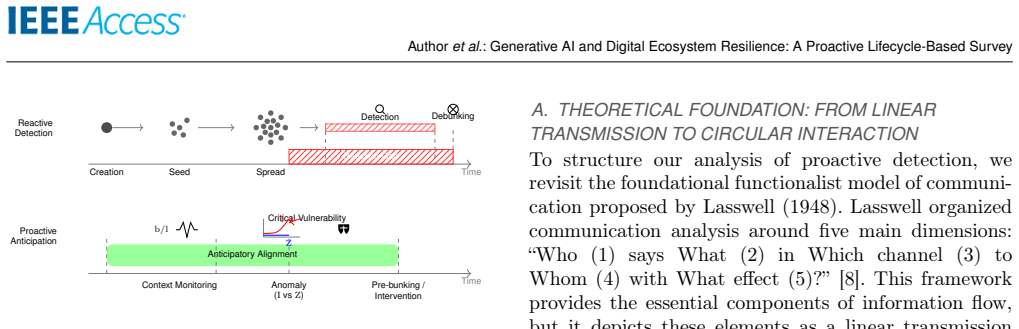
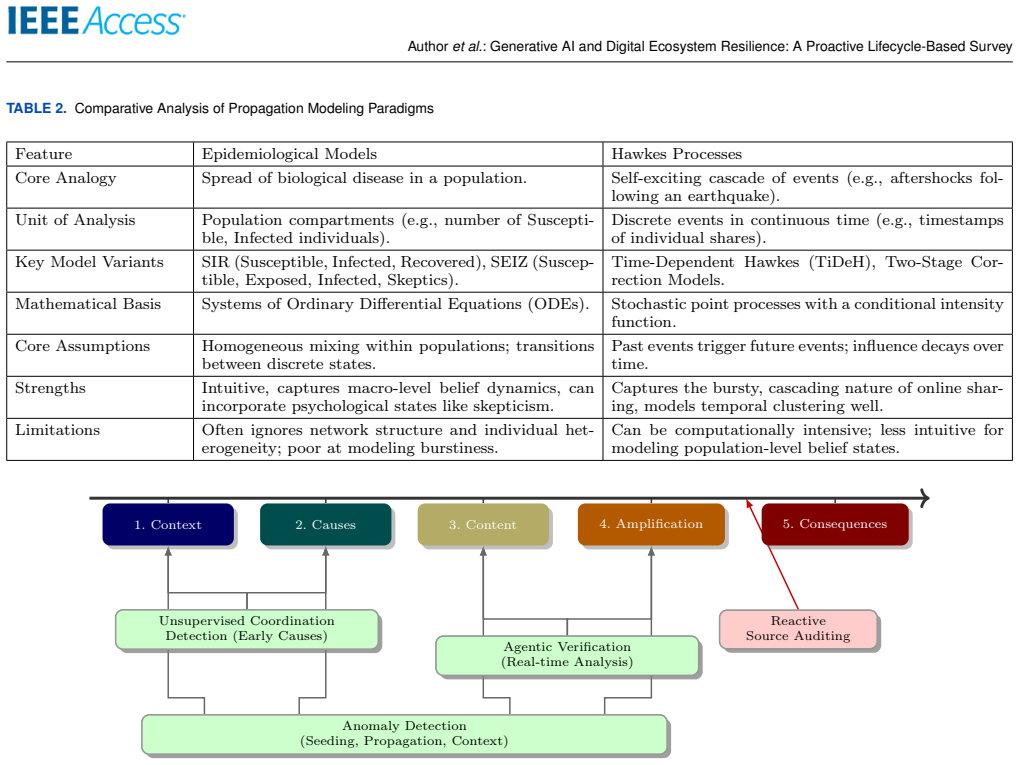
The paper claims that structuring analysis around the C5 Interaction Model (Context, Causes, Content, Cycle of Amplification, Consequences) integrates socio-technical lifecycle models of adversarial campaigns with computational methods, allowing proactive detection of emerging inauthentic narratives at multiple stages through techniques including Hawkes processes, anomaly detection in high-dimensional spaces, unsupervised coordination detection on multi-layer graphs, and agentic AI systems, while outlining a research agenda to address GenAI-driven challenges like rapid threat evolution and multi-level distributional drift.
What carries the argument
The C5 Interaction Model (Context, Causes, Content, Cycle of Amplification, Consequences), which provides the organizing taxonomy that combines social science lifecycle views of narrative campaigns with machine learning detection methods across creation, seeding, and propagation stages.
If this is right
- Analysis of Coordinated Inauthentic Behavior, epidemiological modeling, and Hawkes processes can separate synthetic amplification patterns from authentic baseline traffic.
- Proactive techniques such as anomaly detection in embedding spaces, graph-based coordination detection, and agentic AI systems can intervene at specific points in the C5 stages.
- Future systems must account for multi-level distributional drift to maintain detection performance as GenAI threats evolve.
- Building anticipatory and resilient information ecosystems requires focusing on anomalous cluster detection rather than post-spread identification.
Where Pith is reading between the lines
- The taxonomy could be tested by mapping historical non-GenAI misinformation campaigns onto the same five stages to check consistency.
- Adding quantitative measures of how completely the C5 stages cover observed threat data would help evaluate the model's claimed integration value.
- Extending the model to incorporate platform-specific incentives in the Causes stage might reveal new intervention points not addressed in the survey.
Load-bearing premise
The C5 Interaction Model supplies a comprehensive and non-redundant structure that can integrate machine learning and social science research streams on adversarial campaigns without leaving significant gaps or creating overlaps.
What would settle it
A test applying the C5 categories to a fresh set of documented GenAI campaigns and finding either a major threat type that fits none of the five stages or two stages that capture the same phenomenon in practice would show the model fails as a unifying taxonomy.
Figures
read the original abstract
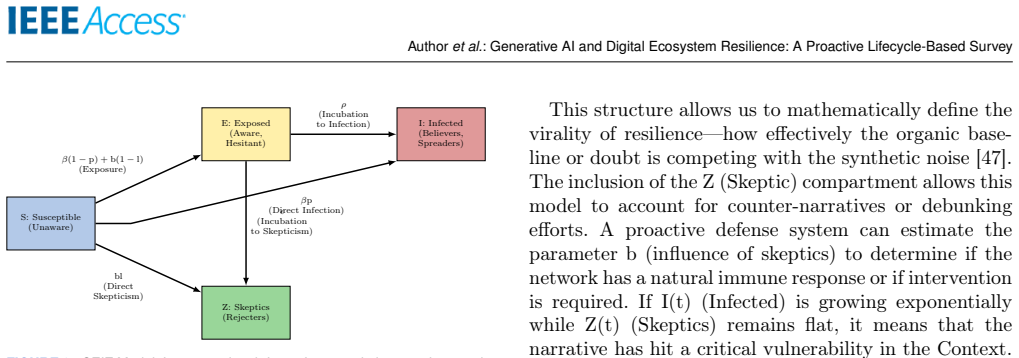
The proliferation of adversarial synthetic content, accelerated by Generative AI (GenAI) is rendering traditional reactive detection methods ineffective. This survey synthesizes emerging research to demonstrate a paradigm shift toward the proactive detection of emerging inauthentic narratives. In this survey, we adopt a unified, lifecycle-based taxonomy to combine socio-technical lifecycle models of adversarial campaigns with advanced computational methodologies for emerging inauthentic narrative detection. By structuring the analysis around the C5 Interaction Model (Context, Causes, Content, Cycle of Amplification, Consequences), we integrate different research streams from machine learning and social science. To differentiate spread patterns of synthetic amplification from authentic baseline traffic, this paper surveys state-of-the-art techniques for modeling the creation, seeding, and propagation of fresh narratives, including the analysis of Coordinated Inauthentic Behavior (CIB), epidemiological modeling, and Hawkes process. This survey also provides a systematic review of proactive detection methods for adversarial threats at different stages in the C5 interaction model, specifically, anomaly detection in high-dimensional embedding spaces, unsupervised coordination detection on multi-layer graphs, and agentic AI systems. Finally, this survey addresses challenges posed by GenAI, including the difficulty of tracking rapidly changing threats and multi-level distributional drift, and it outlines a future research agenda focused on detecting anomalous clusters and building anticipatory and resilient systems. This survey provides a comprehensive, lifecycle-based review of methods for the proactive detection of emerging synthetic threats for more resilient information ecosystems.
Editorial analysis
A structured set of objections, weighed in public.
Referee Report
Summary. This survey synthesizes research on Generative AI-enabled adversarial synthetic content, arguing for a paradigm shift from reactive to proactive detection of emerging inauthentic narratives. It introduces the C5 Interaction Model (Context, Causes, Content, Cycle of Amplification, Consequences) as a unified lifecycle-based taxonomy that integrates machine learning techniques (e.g., Hawkes processes, embedding anomaly detection, multi-layer graph coordination detection) with social science concepts (e.g., Coordinated Inauthentic Behavior analysis) to model narrative creation, seeding, propagation, and consequences. The paper reviews state-of-the-art methods at each C5 stage and outlines challenges such as distributional drift along with a future research agenda for anticipatory resilient systems.
Significance. If the C5 taxonomy is shown to be both comprehensive and non-redundant, the survey could consolidate disparate ML and social-science streams into a practical framework for proactive threat detection, aiding the design of anticipatory systems against GenAI-driven misinformation. The explicit coverage of techniques such as Hawkes processes for amplification modeling and unsupervised coordination detection on multi-layer graphs provides a useful consolidation of current methods. However, without demonstrated validation of the taxonomy, the claimed unification and paradigm shift remain assertions rather than evidenced contributions.
major comments (3)
- [section introducing and applying the C5 Interaction Model] The central claim that the C5 Interaction Model supplies a comprehensive, non-redundant structure capable of integrating distinct ML and social-science research streams is asserted through categorization (e.g., placing Hawkes processes and CIB analysis under Cycle of Amplification) but is not supported by any explicit overlap/gap analysis or audit demonstrating that the five categories are disjoint and exhaustive. This validation is load-bearing for the unification and paradigm-shift argument.
- [introductory description of the survey approach] No description is provided of the literature search methodology, selection criteria, database sources, or process for resolving conflicts among cited works. Without these, the survey's coverage, balance, and representativeness of the synthesized research streams cannot be assessed, undermining the claim of a systematic review.
- [sections on proactive detection methods and challenges] The demonstration of a 'paradigm shift toward the proactive detection' rests on structuring existing techniques under C5 headings, yet the manuscript supplies no comparative analysis or evidence quantifying how reactive methods fail relative to the proactive approaches surveyed (e.g., anomaly detection in high-dimensional embeddings).
minor comments (2)
- [abstract and introduction] The initial presentation of the C5 acronym would benefit from an immediate parenthetical expansion of all five components rather than deferring the full definition.
- [review of state-of-the-art techniques] Several technique descriptions (e.g., multi-layer graph coordination detection) would be clearer with explicit pointers to the primary references rather than general citations.
Simulated Author's Rebuttal
We thank the referee for their constructive and detailed feedback. We address each major comment below and outline revisions to strengthen the manuscript's claims regarding the C5 model, survey methodology, and evidence for the paradigm shift.
read point-by-point responses
-
Referee: [section introducing and applying the C5 Interaction Model] The central claim that the C5 Interaction Model supplies a comprehensive, non-redundant structure capable of integrating distinct ML and social-science research streams is asserted through categorization (e.g., placing Hawkes processes and CIB analysis under Cycle of Amplification) but is not supported by any explicit overlap/gap analysis or audit demonstrating that the five categories are disjoint and exhaustive. This validation is load-bearing for the unification and paradigm-shift argument.
Authors: We agree that an explicit overlap/gap analysis would provide stronger support for the C5 model's claimed comprehensiveness and non-redundancy. The current manuscript derives the taxonomy from established socio-technical lifecycle models and maps computational methods onto its stages, but does not include a dedicated audit. In revision, we will add a new subsection following the C5 model introduction that systematically maps representative papers to each category, discusses potential boundary overlaps (e.g., between Content and Cycle of Amplification), and justifies the five categories as disjoint and exhaustive based on distinct phases of narrative emergence and impact. revision: yes
-
Referee: [introductory description of the survey approach] No description is provided of the literature search methodology, selection criteria, database sources, or process for resolving conflicts among cited works. Without these, the survey's coverage, balance, and representativeness of the synthesized research streams cannot be assessed, undermining the claim of a systematic review.
Authors: This is a valid observation; the manuscript does not detail the literature review process. We will add a new 'Survey Methodology' subsection in the introduction that specifies the databases (arXiv, Google Scholar, ACM Digital Library), search keywords and time range, inclusion/exclusion criteria focused on GenAI-enabled adversarial content, and the process for resolving citation conflicts via author discussion and cross-validation against recent surveys. revision: yes
-
Referee: [sections on proactive detection methods and challenges] The demonstration of a 'paradigm shift toward the proactive detection' rests on structuring existing techniques under C5 headings, yet the manuscript supplies no comparative analysis or evidence quantifying how reactive methods fail relative to the proactive approaches surveyed (e.g., anomaly detection in high-dimensional embeddings).
Authors: We acknowledge that the paradigm-shift argument is primarily demonstrated through synthesis and structuring rather than direct quantitative comparison. The introduction and challenges sections note limitations of reactive methods (e.g., inability to handle distributional drift), but do not provide side-by-side metrics. In revision, we will expand the challenges section with a concise comparative discussion, drawing on cited works to illustrate specific failure modes of reactive detection (such as delayed response to novel embeddings) versus the anticipatory capabilities of the surveyed proactive techniques, while noting that a full empirical benchmark lies outside the survey's scope. revision: yes
Circularity Check
No circularity: survey organizes external literature without self-referential derivation
full rationale
This is a survey paper whose central contribution is an organizational taxonomy (C5 Interaction Model) used to categorize existing research streams from machine learning and social science. No mathematical derivations, equations, fitted parameters, or predictions appear in the abstract or described structure. The C5 headings simply group cited external methods (Hawkes processes, embedding anomaly detection, CIB analysis, etc.) rather than deriving new results from prior definitions within the paper itself. No self-citation chains, ansatzes, or uniqueness theorems are invoked as load-bearing premises. The work is therefore self-contained against external benchmarks and receives the default non-circularity finding for survey syntheses.
Axiom & Free-Parameter Ledger
axioms (1)
- domain assumption The C5 Interaction Model captures the essential stages of adversarial synthetic content campaigns without significant omission or overlap.
invented entities (1)
-
C5 Interaction Model
no independent evidence
Reference graph
Works this paper leans on
-
[1]
A Survey of Fake News: Fundamental Theories, Detection Methods, and Opportunities,
K. Shu, A. Sliva, S. Wang, J. Tang, and H. Liu, “A Survey of Fake News: Fundamental Theories, Detection Methods, and Opportunities,” ACM Computing Surveys, vol. 53, no. 5, pp. 1–40, Sep. 2021
2021
-
[2]
A Survey on Proactive De- fense Strategies Against Misinformation in Large Language Models,
S. Liu, H. Liu, A. Liu, B. Duan, Q. Zheng, Y. Yan, H. Geng, P. Jiang, J. Liu, and X. Hu, “A Survey on Proactive De- fense Strategies Against Misinformation in Large Language Models,” in Findings of the Association for Computational Linguistics: ACL 2025, 2025, pp. 18144–18155
2025
-
[3]
Fact- checking information from large language models can de- crease headline discernment,
M. DeVerna, H. Yan, K. Yang, and F. Menczer, “Fact- checking information from large language models can de- crease headline discernment,” Proc. Nat. Acad. Sci., vol. 121, no. 50, Dec. 2024
2024
-
[4]
AI-Powered Fact-Checking: Combating Misinforma- tion in the Digital Age,
Q. Li, “AI-Powered Fact-Checking: Combating Misinforma- tion in the Digital Age,” Front. Humanit. Soc. Sci., vol. 5, no. 4, Apr. 2025
2025
-
[5]
Fake News Detection Revisited: An Extensive Review of Theoret- ical Frameworks, Dataset Assessments, Model Constraints, and Forward-Looking Research Agendas,
S. Harris, H. J. Hadi, N. Ahmad, and M. A. Alshara, “Fake News Detection Revisited: An Extensive Review of Theoret- ical Frameworks, Dataset Assessments, Model Constraints, and Forward-Looking Research Agendas,” Computers, vol. 12, no. 11, p. 222, 2024
2024
-
[6]
Dis- information as process: modeling the lifecycle of deceit,
V. Tolz, S. Hutchings, V. Kazakov, and S. Tipaldou, “Dis- information as process: modeling the lifecycle of deceit,” Communication Theory, vol. 35, no. 4, pp. 214, 2025
2025
-
[7]
Misinformation, disinformation, and fake news: Lessons from an interdisciplinary, systematic literature review,
E. Broda and J. Strömbäck, “Misinformation, disinformation, and fake news: Lessons from an interdisciplinary, systematic literature review,” Ann. Int. Commun. Assoc., vol. 48, no. 2, pp. 139–166, 2024
2024
-
[8]
Thestructureandfunctionofcommunication in society,
H.D.Lasswell,“Thestructureandfunctionofcommunication in society,” in The Communication of Ideas, L. Bryson, Ed. New York, NY, USA: Harper and Row, 1948, pp. 37–51
1948
-
[9]
The disinformation lifecycle: an integrated understanding of its creation, spread and effects,
K. Krujiver, N. Finlayson, B. Cadet, and S. Meer , “The disinformation lifecycle: an integrated understanding of its creation, spread and effects,” AI & Soc., 2025
2025
-
[10]
Examining the Role of Distrust in Science and Social Media Use: Effects on Susceptibility to COVID Misperceptions with Panel Data,
S. Lee, S. Jones-Jang, M. Chung, E. Lee, and T. Diehl, “Examining the Role of Distrust in Science and Social Media Use: Effects on Susceptibility to COVID Misperceptions with Panel Data,” Mass Commun. Soc., vol. 27, no. 2, Oct. 2023
2023
-
[11]
Determinants of Gullibility to Misinformation: A Study of Climate Change, COVID-19 and Artificial Intel- ligence,
S. Gruener, “Determinants of Gullibility to Misinformation: A Study of Climate Change, COVID-19 and Artificial Intel- ligence,” J. Interdisc. Econ., 2022
2022
-
[12]
Epidemiological modeling of news and rumors on Twitter,
F. Jin, E. Dougherty, P. Saraf, Y. Cao, and N. Ramakrishnan, “Epidemiological modeling of news and rumors on Twitter,” in Proc. 7th Workshop on Social Network Mining and Anal- ysis, 2013
2013
-
[13]
Are Narratives Contagious? Modeling Narrative Diffusion Using Epidemiological Theo- ries,
M. Gurung and N. Agarwal, “Are Narratives Contagious? Modeling Narrative Diffusion Using Epidemiological Theo- ries,” in Advances in Social Networks Analysis and Mining, Springer, 2024
2024
-
[14]
Analysing Deception in Witness Memory Though Linguistic Styles,
S. Sola-Sales, C. Alzetta, C. Moret-Tatay, and F. Dell’Orietta, “Analysing Deception in Witness Memory Though Linguistic Styles,” MDPI Brain Sciences, vol. 13, no. 2, p. 317, 2023
2023
-
[15]
Understanding the Contribution of Recommendation Algorithms on Misinforma- tion Recommendation and Misinformation Dissemination on Social Networks,
R. Pathak, F. Spezzano, and M. S. Pera, “Understanding the Contribution of Recommendation Algorithms on Misinforma- tion Recommendation and Misinformation Dissemination on Social Networks,” ACM Trans. Web, vol. 17, 2023
2023
-
[16]
The Spread Mechanism of Misinformation on Social Media,
P. Chen, “The Spread Mechanism of Misinformation on Social Media,” J. Comp. Theor. Educ. Res., Feb. 2025
2025
-
[17]
A Model of Online Misinformation,
D. Acemoglu, A. Ozdaglar, and J. Siderius, “A Model of Online Misinformation,” NBER, Working Paper 28884, 2021
2021
-
[18]
The Role of Cognitive Bias and Emotional Drive in the Dissemination of Fake News: A Review and Prospectus,
Y. Luo, “The Role of Cognitive Bias and Emotional Drive in the Dissemination of Fake News: A Review and Prospectus,” Int. J. Fine Arts Creat. Innov., vol. 2, no. 2, Sep. 2025
2025
-
[19]
Cascading falsehoods: mapping the diffusion of misinformation in algorithmic environments,
D. Shin, and E. Y. Shin, “Cascading falsehoods: mapping the diffusion of misinformation in algorithmic environments,” AI & Soc., 2025, pp. 8770–8780
2025
-
[20]
Countering AI-generated misinformation with pre-emptive source discreditation and debunking,
E. R. Spearing, C. I. Gile, A. L. Fogwill, T. Prike, B. S. Thompson, and S. Lewandowsky, “Countering AI-generated misinformation with pre-emptive source discreditation and debunking,” R. Soc. Open Sci., vol. 12, no. 6, Jun. 2025
2025
-
[21]
The Power of a Good Idea: Quantitative Modeling of the Spread of Ideas from Epidemiological Mod- els,
L. M. A. Bettencourt, A. Cintrón-Arias, D. I. Kaiser, and C. Castillo-Chávez“The Power of a Good Idea: Quantitative Modeling of the Spread of Ideas from Epidemiological Mod- els,” Physica A, 2011
2011
-
[22]
A Survey on Generative AI and LLM for Video Generation, Understanding, and Streaming,
P. Zhou, L. Wang, Z. Liu, Y. Hao, P. Hui, S. Tarkoma, and J. Kangasharju, “A Survey on Generative AI and LLM for Video Generation, Understanding, and Streaming,” arXiv preprint arXiv:2404.16038, 2024
-
[23]
Transforming Content Creation: The Influence of Generative AI on a New Frontier,
V. Divya1 and A. U. Mirza, “Transforming Content Creation: The Influence of Generative AI on a New Frontier,” in Exploring the Frontiers of Artificial Intelligence, 2024
2024
-
[24]
Blessing or curse? A survey on the Impact of Generative AI on Fake News,
A. Loth, M. Kappes, and M.-O. Pahl, “Blessing or curse? A survey on the Impact of Generative AI on Fake News,” arXiv preprint arXiv:2404.03021, 2024
-
[25]
Malicious Use of Artificial Intelligence,
C. Easttom, “Malicious Use of Artificial Intelligence,” in 2025 IEEE 15th Annual Computing and Communication Workshop and Conference (CCWC), 2025, pp. 00499–00507
2025
-
[26]
Hallu- cinations in Large Language Models (LLMs),
G. P. Reddy, Y. V. Pavan Kumar, and K. P. Prakash, “Hallu- cinations in Large Language Models (LLMs),” in 2024 IEEE Open Conference of Electrical, Electronic and Information Sciences (eStream), 2024, pp. 1–6
2024
-
[27]
ChildGAN: Face aging and rejuvenation to find missing children,
P. K. Chandaliya and N. Nain, “ChildGAN: Face aging and rejuvenation to find missing children,” Pattern Recognit., vol. 129, p. 108761, Sep. 2022, doi: 10.1016/j.patcog.2022.108761
-
[28]
Chinese propaganda network on Facebook used AI-generated faces,
T. Hatmaker. “Chinese propaganda network on Facebook used AI-generated faces,” TechCrunch. https://techcrunch .com/2020/09/22/facebook-gans-takes-down-networks-o f-fake-accounts-originating-in-china-and-the-philippines (accessed Jan. 9, 2026)
2020
-
[29]
AI Hyperrealism: Why AI Faces Are Perceived as More Real Than Human Ones,
E. J. Miller, B. A. Steward, and A. Dawel, “AI Hyperrealism: Why AI Faces Are Perceived as More Real Than Human Ones,” Psychological Science, vol. 34, no. 12, pp. 1390–1403, 2023
2023
-
[30]
Leveraging generative AI for personalized recommendation system,
P. Bedi, S. Das, S. B. Goyal, R. Nath Shaw, and A. Ghosh “Leveraging generative AI for personalized recommendation system,” in Advanced Computing and Intelligent Technolo- gies, vol. 958. Singapore: Springer, 2024, pp. 433–450
2024
-
[31]
Integrating Research on AI-Driven Hyper-Personalization: A Review and Framework for Scalable Social Media Campaigns,
S. Patil, A. Bhat, N. Jain, and V. Javalkar, “Integrating Research on AI-Driven Hyper-Personalization: A Review and Framework for Scalable Social Media Campaigns,” in 2025 International Conference on Pervasive Computational Technologies (ICPCT), 2025, pp. 766–771
2025
-
[32]
Generative AI in Content Creation: Opportunities and Ethical Challenges,
C. S. Suri, S. S. Shukla, R. Pal, V. Srivastava, G. Talele, and M. K. B, “Generative AI in Content Creation: Opportunities and Ethical Challenges,” in 2024 IEEE 11th Uttar Pradesh Section International Conference on Electrical, Electronics and Computer Engineering (UPCON), 2024, pp. 1–6
2024
-
[33]
A Comprehensive Survey on AI Content Generator,
P. P. Jacob, A. A J, A. Vimal, A. A, and A. K. G, “A Comprehensive Survey on AI Content Generator,” 2023
2023
-
[34]
Analysis of Tools forGenerationofEducationalContentUsingArtificialIntelli- gence,
I. Blagoev, G. Vassileva, and V. Monov, “Analysis of Tools forGenerationofEducationalContentUsingArtificialIntelli- gence,” in EDULEARN23 Proceedings, 2023, pp. 5078–5086
2023
-
[35]
Advancements and Challenges of Generative AI inHigherEducationalContentCreationATechnicalPerspec- tive,
A. Faccia, M. Ridon, Z. Beebeejaun, and N. M. Roxana Mosteanu, “Advancements and Challenges of Generative AI inHigherEducationalContentCreationATechnicalPerspec- tive,” in ACM Proc. 2023 8th Int. Conf. Inf. Syst. Eng., 2024, pp. 48–54
2023
-
[36]
How generative AI Is shaping the future of marketing,
D. Grewal, C. B. Satornino, T. Davenport, and A. Guha, “How generative AI Is shaping the future of marketing,” J. Acad. Mark. Sci., vol. 53, no. 3, pp. 702–722, 2025. 12 VOLUME 1, 2026 Authoret al.: Generative AI and Digital Ecosystem Resilience: A Proactive Lifecycle-Based Survey
2025
-
[37]
Using ChatGPT in content marketing: enhancing users’ social media engagement in cross-platform content creation through generative AI,
K. Aldous, J. Salminen, A. Farooq, S. Jung, and B. Jansen “Using ChatGPT in content marketing: enhancing users’ social media engagement in cross-platform content creation through generative AI,” in Proc. 35th ACM Conf. Hypertext and Social Media, 2024, pp. 376–383
2024
-
[38]
Use of artificial intelligence for the generation of media content,
B. Sančanin and A. Penjišević, “Use of artificial intelligence for the generation of media content,” Social informatics journal, vol. 1, no. 1, pp. 1–7, 2022
2022
-
[39]
Coordinated inauthentic behavior: An innova- tive manipulation tactic to amplify COVID-19 anti-vaccine communicationoutreachviasocialmedia,
M. Murero, “Coordinated inauthentic behavior: An innova- tive manipulation tactic to amplify COVID-19 anti-vaccine communicationoutreachviasocialmedia,” Front.Sociol.,vol. 8, 2023
2023
-
[40]
Detection and characterization of coordinated online behavior: A survey,
L. Mannocci, M. Mazza, A. Monreale, M. Tesconi, and S. Cresci, “Detection and characterization of coordinated online behavior: A survey,” arXiv preprint arXiv:2505.10867, 2025
-
[41]
Unsupervised detection of coordinated information operations in the wild,
D. H. Smith, C. Ehrett, and P. L. Warren, “Unsupervised detection of coordinated information operations in the wild,” J. Online Trust Saf., vol. 1, no. 2, 2024
2024
-
[42]
Lost in transformation: Rediscovering llm- generated campaigns in social media,
B. Grimme J. Pohl, H. Winkelmann, L. Stampe and C. Grimme, “Lost in transformation: Rediscovering llm- generated campaigns in social media,” in Multidisciplinary Int. Symp. Disinformation in Open Online Media, Springer, 2023, pp. 72–87
2023
-
[43]
Recom- mender systems and the amplification of extremist content,
J. Whittaker, S. Looney, A. Reed, and F. Votta, “Recom- mender systems and the amplification of extremist content,” Internet Policy Review, 2023
2023
-
[44]
Preference Amplification in Recommender Systems,
D. Kalimeris, S. Bhagat, S. Kalyanaraman, U. Weinsberg, “Preference Amplification in Recommender Systems,” Proc. Nat. Acad. Sci., 2021
2021
-
[45]
Bigseiz Test Outcomes: Applying Ml Techniques for Fake News Identification and Comparing Sir and Seiz Epidemic Models on Twitter’s Temporal Network,
K. Bozhiqi, “Bigseiz Test Outcomes: Applying Ml Techniques for Fake News Identification and Comparing Sir and Seiz Epidemic Models on Twitter’s Temporal Network,” IEEE Access, 2023
2023
-
[46]
Modeling polarized information diffusion with SEI(A)I(D)Z: a stance-based epi- demiological approach,
M. I. Gurung, N. Agarwal, and E. Addai, “Modeling polarized information diffusion with SEI(A)I(D)Z: a stance-based epi- demiological approach,” Social Network Analysis and Mining, Springer, 2018
2018
-
[47]
Probabilistic Contagion and Models of Influ- ence,
A. Karaka, “Probabilistic Contagion and Models of Influ- ence,” Weights & Biases, 2023
2023
-
[48]
Hawkes processes for understanding heterogeneity in information propagation on Twitter,
L. Wang, and L. Zhang, “Hawkes processes for understanding heterogeneity in information propagation on Twitter,” Front. Phys., 2022
2022
-
[49]
Hawkes Processes for Continuous Time Sequence Classification: an Application to Rumour Stance Classification in Twitter,
K. Erk, and N. A. Smith, “Hawkes Processes for Continuous Time Sequence Classification: an Application to Rumour Stance Classification in Twitter,” in Proc. 54th ACL 2016 Vol. 2, 2016, pp. 393–398
2016
-
[50]
Network-informed Prompt Engineering against Organized Astroturf Campaigns under Extreme Class Imbalance,
N. Kanakaris, H. Ping, X. Xiao, N. K. Ahmed, L. Luceri, E. Ferrara, P. Bogdan, “Network-informed Prompt Engineering against Organized Astroturf Campaigns under Extreme Class Imbalance,” ACM on Web, 2025, pp. 2651–2660
2025
-
[51]
Modeling the spread of fake news on Twitter,
T. Murayama, S. Wakamiya, E. Aramaki, and R. Kobayashi, “Modeling the spread of fake news on Twitter,” PLOS ONE, 2021
2021
-
[52]
Hawkes Process for Under- standing the Influence of Pathogenic Social Media Accounts,
H. Alvari and P. Shakarian, "Hawkes Process for Under- standing the Influence of Pathogenic Social Media Accounts," 2019 2nd International Conference on Data Intelligence and Security (ICDIS), 2019, pp. 36-42
2019
-
[53]
Hawkes process model with a time-dependent background rate and its application to high-frequency financial data,
T. Omi, Y. Hirata, and K. Aihara, “Hawkes process model with a time-dependent background rate and its application to high-frequency financial data,” Phys. Rev. E, 2017
2017
-
[54]
Location and Language Independent Fake Rumor Detection Through Epi- demiological and Structural Graph Analysis of Social Con- nections.,
D. Serpanos, G. Xenos, and B. Tsouvalas, “Location and Language Independent Fake Rumor Detection Through Epi- demiological and Structural Graph Analysis of Social Con- nections.,” Front Artif Intell, 2022
2022
-
[55]
Digital media and misinformation: An outlook on multidisciplinary strategies against manipula- tion,
D. Caled and M. J. Silva, “Digital media and misinformation: An outlook on multidisciplinary strategies against manipula- tion,” PubMed Central, 2021, pp. 123-159
2021
-
[56]
Unsupervised fake news detection on social media using hybrid Gaussian Mixture Model,
S. Perveen, M. Shahbaz, S. S. Albouq, K. Shinan, H. E. Alhazmi, F. Alanazi, “Unsupervised fake news detection on social media using hybrid Gaussian Mixture Model,” PLOS ONE, 2025
2025
-
[57]
A BERT-Based Multimodal Framework for Enhanced Fake News Detection Using Text and Image Data Fusion,
M. Al-alshaqi, D. B. Rawat, and C. Liu, “A BERT-Based Multimodal Framework for Enhanced Fake News Detection Using Text and Image Data Fusion,” MDPI Computers, 2025
2025
-
[58]
Modeling Misinformation Diffusion in Social Media: Beyond Network Properties ,
F. Spezzano, “Modeling Misinformation Diffusion in Social Media: Beyond Network Properties ,” 2021 IEEE Third International Conference on Cognitive Machine Intelligence (CogMI), 2021, pp. 168-171
2021
-
[59]
Enhancing fake news detection with transformer-based deep learning: A multidisciplinary approach,
N. Raza, S. J. Abdulkadir, Y. A. Abid, S. S. Albouq, A. Alwadain, A. U. Rehman, E. H. Sumiea, and M. Farhan, “Enhancing fake news detection with transformer-based deep learning: A multidisciplinary approach,” PLOS ONE, 2025
2025
-
[60]
Temporal and Social ContextbasedBurstDetectionfromFolksonomies,
J. Yao, B. Cui, Y. Huang, and X. Jin, “Temporal and Social ContextbasedBurstDetectionfromFolksonomies,” inAAAI, 2020, pp. 1474–1479
2020
-
[61]
Bursty and hierarchical structure in streams ,
J. Kleinberg, “Bursty and hierarchical structure in streams ,” ACM KDD, 2002, pp. 91-101
2002
-
[62]
Propagation Structure-Aware Graph Transformer for Robust and Inter- pretable Fake News Detection,
J. Zhu, C. Gao, Z. Yin, X. Li, and J. Kurths, “Propagation Structure-Aware Graph Transformer for Robust and Inter- pretable Fake News Detection,” ACM KDD, 2024, pp. 4652- 4663
2024
-
[63]
Coordinated inauthentic behavior: An innova- tive manipulation tactic to amplify COVID-19 anti-vaccine communication outreach via social media,
M. Murero, “Coordinated inauthentic behavior: An innova- tive manipulation tactic to amplify COVID-19 anti-vaccine communication outreach via social media,” Frontiers in soci- ology vol. 8, 2023
2023
-
[64]
Unsupervised detection of coordinated information operations in the wild,
D. H. Smith, C. Ehrett, and P. Warren, “Unsupervised detection of coordinated information operations in the wild,” EPJ Data Science, 2025
2025
-
[65]
Beyond Interaction Patterns: Assessing Claims of Coordinated Inter-StateInformation Operations on Twitter/X,
V. Pantè, D. Axelrod, A. Flammini, F. Menczer, E. Ferrara, and Luca Luceri, “Beyond Interaction Patterns: Assessing Claims of Coordinated Inter-StateInformation Operations on Twitter/X,” ACM on Web Conferences, 2025, pp. 1234-1238
2025
-
[66]
Exploring Agentic Artificial Intelligence Systems: Towards a Typological Framework,
C. Wissuchek, and P. Zschech, “Exploring Agentic Artificial Intelligence Systems: Towards a Typological Framework,” (Pacific Asia Conference on Information Systems (PACIS), 2025
2025
-
[67]
Advancing Agentic Systems: Dynamic Task Decomposition, Tool Inte- gration and Evaluation using Novel Metrics and Dataset ,
S. K. Jeyakumar, A. Ahmad, and A. Gabriel, “Advancing Agentic Systems: Dynamic Task Decomposition, Tool Inte- gration and Evaluation using Novel Metrics and Dataset ,” NeurIPS Workshop on Open-world Agents, 2024
2024
-
[68]
Multi-agent Systems for Misinformation Life- cycle : Detection, Correction And Source Identification,
A. Gautam, “Multi-agent Systems for Misinformation Life- cycle : Detection, Correction And Source Identification,” ICWSM, 2025
2025
-
[69]
MultiAgent Collaboration Attack: In- vestigating Adversarial Attacks in Large Language Model Collaborations via Debate,
A. Amayuelas, X. Yang, A. Antoniades, W. Hua, L. Pan, and W. Y. Wang, “MultiAgent Collaboration Attack: In- vestigating Adversarial Attacks in Large Language Model Collaborations via Debate,” EMNLP, 2024
2024
-
[70]
Improving Multi-Agent Debate with Sparse Communication Topology ,
Y.Li,Y.Du,J.Zhang,L.Hou,P.Grabowski,Y.Li,andE.Ie, “Improving Multi-Agent Debate with Sparse Communication Topology ,” EMNLP, 2024, pp. 7281-7294
2024
-
[71]
The Truth Becomes Clearer Through Debate! Multi-Agent Systems with Large Language Models Unmask Fake News,
Y. Liu, Y. Liu, X. Zhang, X. Chen, and R. Yan, “The Truth Becomes Clearer Through Debate! Multi-Agent Systems with Large Language Models Unmask Fake News,” ACM, 2025, pp. 504-514
2025
-
[72]
From Generation to Judgment: Opportunities and Challenges of LLM-as-a-judge,
D. Li, B. Jiang, L. Huang, A. Beigi, C. Zhao, Z. Tan, A. Bhattacharjee, Y. Jiang, C Chen, and T. Wu, “From Generation to Judgment: Opportunities and Challenges of LLM-as-a-judge,” EMNLP, 2025
2025
-
[73]
Large Language Models are not Fair Evaluators,
P. Wang, L. Li, L. Chen, Z. Cai, D. Zhu, B. Lin, Y. Cao, L. Kong, Q. Liu, T. Liu, and Z. Sui., “Large Language Models are not Fair Evaluators,” ACL, 2024, pp. 9440-9450
2024
-
[74]
LLM-as- a-Judge: Rapid Evaluation of Legal Document Recommenda- tion via Retrieval-Augmented Generation,
A. Pradhan, A. Ortan, A. Verma, and M. Seshadri, “LLM-as- a-Judge: Rapid Evaluation of Legal Document Recommenda- tion via Retrieval-Augmented Generation,” RecSys, 2025
2025
-
[75]
Limitations of the LLM-as-a- Judge Approach for Evaluating LLM Outputs in Expert Knowledge Tasks,
A. Szymanski, N. Ziems, H. A. Eicher-Miller, T. J. Li, M. Jiang, and R. A. Metoyer, “Limitations of the LLM-as-a- Judge Approach for Evaluating LLM Outputs in Expert Knowledge Tasks,” ACM, 2025, pp. 952 - 966
2025
-
[76]
Agent-as-a-Judge: Evaluate Agents with Agents,
M. Zhuge, C. Zhao, D. Ashley, W. Wang, D. Khizbullin, Y. Xiong, Z. Liu, E. Chang, R. Krishnamoorthi, Y. Tian, Y. Shi, V. Chandra, and J Schmidhuber, “Agent-as-a-Judge: Evaluate Agents with Agents,” ICML Poster, 2025
2025
-
[77]
Paraphrase diversification using counterfactual debiasing,
S. Park, S. Hwang, F. Chen, J. Choo, J. Ha, S. Kim, and J. Yim, “Paraphrase diversification using counterfactual debiasing,” AAAI, 2019, pp. 6883-6891
2019
-
[78]
Acharya, A
T. Acharya, A. Annamalai and M. F. Chouikha, “Addressing the Class Imbalance Problem in Network-Based Anomaly VOLUME 1, 2026 13 Authoret al.: Generative AI and Digital Ecosystem Resilience: A Proactive Lifecycle-Based Survey Detection,” IEEE Symposium on Computer Applications and Industrial Electronics (ISCAIE), 2024, pp. 1-6
2026
-
[79]
Attacking Misinfor- mation Detection Using Adversarial Examples Generated by Language Models,
P. Przybyła, E. McGill, and H. Saggion, “Attacking Misinfor- mation Detection Using Adversarial Examples Generated by Language Models,” EMNLP, 2025, pp. 27614–27630
2025
-
[80]
Blockchain-Aided Secure Semantic Communication for AI- Generated Content in Metaverse,
Y. Lin, H. Du, D. Niyato, J. Nie, J. Zhang, and Y. Cheng, “Blockchain-Aided Secure Semantic Communication for AI- Generated Content in Metaverse,” IEEE Open Journal of the Computer Society, 2023, pp. 72-83
2023
discussion (0)
Sign in with ORCID, Apple, or X to comment. Anyone can read and Pith papers without signing in.