DataShield: Safety-degrading Data Filtering for LLM Benign Instruction Fine-Tuning
Pith reviewed 2026-06-28 22:07 UTC · model grok-4.3
The pith
Benign fine-tuning degrades LLM safety by increasing response compliance, which DataShield measures per sample to filter the riskiest data.
A machine-rendered reading of the paper's core claim, the machinery that carries it, and where it could break.
Core claim
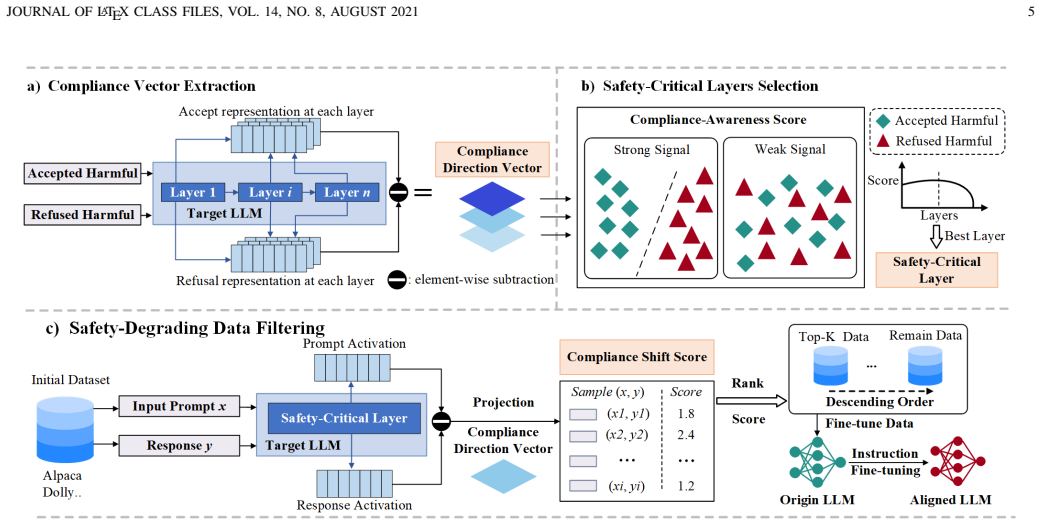
DataShield identifies potential safety-degrading samples in benign datasets by quantifying each sample's contribution to the model's overall compliance behavior. It does so through three components: Compliance Vector Extraction to capture compliance tendency, Compliance-Aware Score to find the optimal safety-critical layer, and Safety-degrading Sample Filtering based on projection shifts along the compliance direction. This allows efficient identification of high-risk samples without the high costs or noise of previous methods.
What carries the argument
The compliance vector, which represents the direction of increased response compliance in the model's activations, combined with Compliance-Aware Score selection of the optimal layer and projection-shift scoring of each sample.
Load-bearing premise
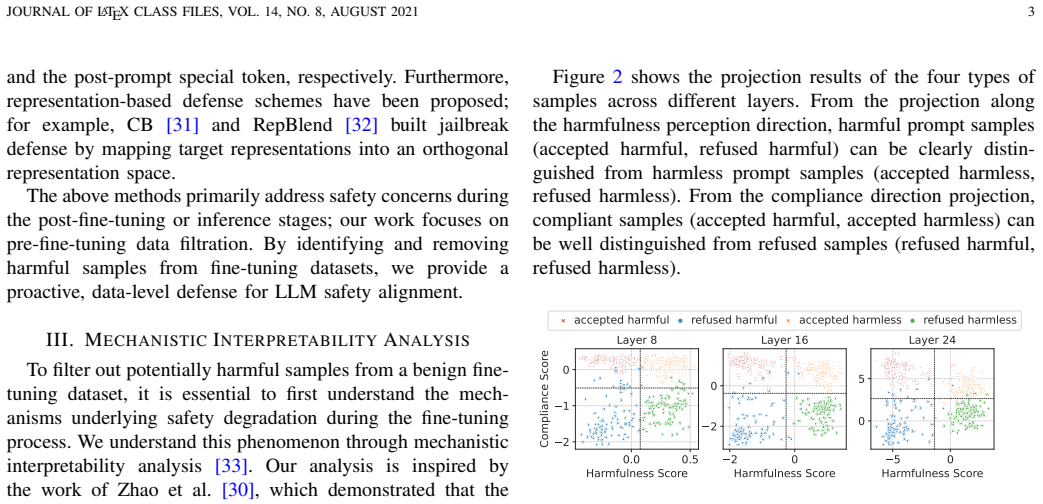
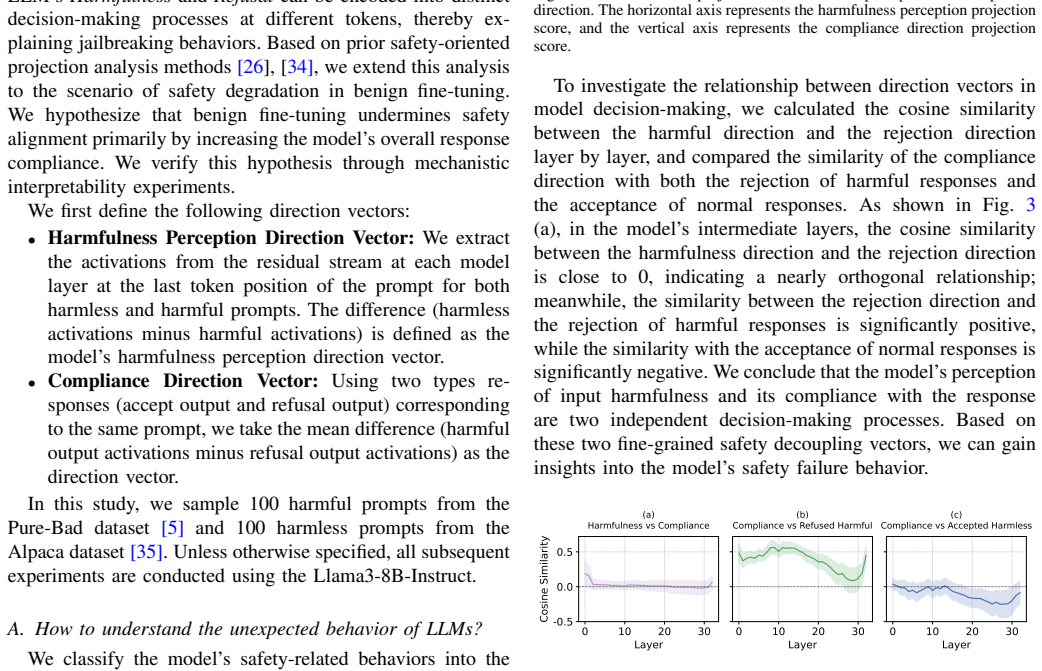
The rise in response compliance during benign fine-tuning is the main measurable driver of safety degradation and can be isolated to a single vector in one optimal layer.
What would settle it
An experiment in which models fine-tuned on the high-score subset show no greater safety degradation than models fine-tuned on a random subset of equal size.
Figures





read the original abstract
Large language models (LLMs) suffer from degraded safety capabilities even when fine-tuned with benign datasets. However, existing methods for identifying safety-degrading samples in benign datasets suffer from high computational costs and significant noise issues. In this paper, we propose DataShield to efficiently and effectively identify potential safety-degrading samples. Our key intuition is based on the observation that benign fine-tuning increases the overall response compliance of LLMs. DataShield's key technical insight is to quantify each sample's contribution to the model's compliance behavior as its safety degradation score. DataShield consists of three core components: (1) Compliance Vector Extraction, which captures the LLM's compliance behavior tendency; (2) a novel Compliance-Aware Score (CAS), which automatically identifies the optimal safety-critical layer; and (3) Safety-degrading Sample Filtering, which quantifies the projection shift of training data along the compliance direction. Extensive experimental evaluation on Llama3-8B, Llama3.1-8B, and Qwen2.5-7B using the Alpaca and Dolly benign datasets validates our method's effectiveness in identifying high-risk and low-risk data subsets. We also observe that open-ended question answering is more likely to trigger safety degradation, and corresponding responses tend to be longer. We hope this work can provide new insights into data-centric defense methods. The source code is available at: https://github.com/ZJunBo/DataShield.
Editorial analysis
A structured set of objections, weighed in public.
Referee Report
Summary. The paper proposes DataShield for identifying safety-degrading samples in benign instruction-tuning datasets for LLMs. It observes that benign fine-tuning increases overall response compliance and quantifies each sample's contribution via a safety degradation score computed from Compliance Vector Extraction, a Compliance-Aware Score (CAS) that selects the optimal safety-critical layer, and projection-shift filtering along the compliance direction. Experiments on Llama-3-8B, Llama-3.1-8B and Qwen2.5-7B using Alpaca and Dolly datasets are said to show effective separation into high-risk and low-risk subsets; additional observations note that open-ended questions are more likely to trigger degradation and produce longer responses.
Significance. If the central claim holds and the compliance-vector approach reliably isolates safety degradation, the method would offer a computationally lighter data-centric defense compared with existing approaches, with potential to improve safety preservation during benign fine-tuning. The public release of source code strengthens reproducibility.
major comments (2)
- [Abstract / Method description] The core assumption that safety degradation is primarily captured by monotonic projection shift along a single compliance vector extracted from one CAS-selected layer is load-bearing but untested against alternative mechanisms. If refusal circuitry, harm-detection heads, or multi-layer interactions contribute orthogonally, samples that shift the compliance projection while leaving those directions intact would receive incorrect scores, undermining the filtering claim. No ablation is described that removes the compliance component and verifies loss of predictive power for post-fine-tuning safety metrics.
- [Abstract / Compliance Vector Extraction and Safety-degrading Sample Filtering] The safety degradation score is defined directly from observed compliance shifts during fine-tuning, creating a potential circularity: the metric used to filter data is itself derived from the compliance behavior the method seeks to mitigate. Without an independent safety evaluation (e.g., harmfulness benchmarks on held-out prompts before and after filtering) that is not reducible to the same compliance vector, it is unclear whether the identified subsets actually predict safety outcomes rather than merely re-expressing the compliance signal.
minor comments (2)
- [Abstract] The abstract states that open-ended question answering is more likely to trigger degradation and yields longer responses; this observation should be supported by quantitative statistics (e.g., length distributions or trigger rates per category) in the results section.
- [Method] Notation for the compliance vector, CAS computation, and projection shift should be introduced with explicit equations or pseudocode to allow readers to verify the claimed parameter-free or low-cost properties.
Simulated Author's Rebuttal
We thank the referee for the detailed and constructive feedback. Below we respond point-by-point to the major comments, indicating where revisions will be made.
read point-by-point responses
-
Referee: [Abstract / Method description] The core assumption that safety degradation is primarily captured by monotonic projection shift along a single compliance vector extracted from one CAS-selected layer is load-bearing but untested against alternative mechanisms. If refusal circuitry, harm-detection heads, or multi-layer interactions contribute orthogonally, samples that shift the compliance projection while leaving those directions intact would receive incorrect scores, undermining the filtering claim. No ablation is described that removes the compliance component and verifies loss of predictive power for post-fine-tuning safety metrics.
Authors: The method is motivated by the consistent empirical observation that benign fine-tuning increases overall response compliance, which in turn correlates with measured safety degradation across the evaluated models. The CAS procedure selects the layer whose compliance direction best predicts these shifts, providing a data-driven rather than arbitrary choice of representation. We agree that an explicit ablation comparing the full pipeline against a version that omits the compliance-projection component would strengthen the claim; we will add this experiment (and the corresponding analysis of predictive power on post-fine-tuning safety metrics) in the revision. revision: yes
-
Referee: [Abstract / Compliance Vector Extraction and Safety-degrading Sample Filtering] The safety degradation score is defined directly from observed compliance shifts during fine-tuning, creating a potential circularity: the metric used to filter data is itself derived from the compliance behavior the method seeks to mitigate. Without an independent safety evaluation (e.g., harmfulness benchmarks on held-out prompts before and after filtering) that is not reducible to the same compliance vector, it is unclear whether the identified subsets actually predict safety outcomes rather than merely re-expressing the compliance signal.
Authors: The degradation score is intentionally derived from compliance shifts because that is the observable mechanism the method targets. Nevertheless, the filtering decision is validated by independent downstream safety evaluations: after fine-tuning on the filtered versus unfiltered subsets, we measure harmfulness on held-out prompt sets using standard benchmarks that are not identical to the compliance-vector construction. These results show that high-risk subsets produce measurably larger safety degradation. We will expand the manuscript to explicitly separate the scoring procedure from the final safety metrics and to discuss the extent to which the two remain distinguishable. revision: partial
Circularity Check
No significant circularity in derivation chain
full rationale
The paper's core method defines a safety degradation score via compliance vector extraction and projection shift, motivated by the stated observation that benign fine-tuning increases compliance. No equations, self-citations, or steps are quoted that reduce the claimed identification of safety-degrading samples to a tautology or fitted input by construction. Experimental validation across models and datasets supplies independent content, and the derivation remains self-contained against external benchmarks rather than reducing to its own inputs.
Axiom & Free-Parameter Ledger
Reference graph
Works this paper leans on
-
[1]
Removing rlhf protections in gpt-4 via fine-tuning,
Q. Zhan, R. Fang, R. Bindu, A. Gupta, T. B. Hashimoto, and D. Kang, “Removing rlhf protections in gpt-4 via fine-tuning,” inProceedings of the 2024 Conference of the North American Chapter of the Association for Computational Linguistics: Human Language Technologies (Volume 2: Short Papers), 2024, pp. 681–687
2024
-
[2]
Badllama: cheaply removing safety fine-tuning from llama 2-chat 13b,
P. Gade, S. Lermen, C. Rogers-Smith, and J. Ladish, “Badllama: cheaply removing safety fine-tuning from llama 2-chat 13b,”arXiv preprint arXiv:2311.00117, 2023
- [3]
-
[4]
S. Lermen, C. Rogers-Smith, and J. Ladish, “Lora fine-tuning effi- ciently undoes safety training in llama 2-chat 70b,”arXiv preprint arXiv:2310.20624, 2023
-
[5]
Fine-tuning aligned language models compromises safety, even when users do not intend to!
X. Qi, Y . Zeng, T. Xie, P.-Y . Chen, R. Jia, P. Mittal, and P. Henderson, “Fine-tuning aligned language models compromises safety, even when users do not intend to!” inInternational Conference on Learning Representations, vol. 2024, 2024, pp. 30 988–31 043
2024
-
[6]
arXiv preprint arXiv:2305.06972 , year=
J. Hazell, “Large language models can be used to effectively scale spear phishing campaigns,”arXiv preprint arXiv:2305.06972, p. 50, 2023
-
[7]
Ai model gpt-3 (dis) informs us better than humans,
G. Spitale, N. Biller-Andorno, and F. Germani, “Ai model gpt-3 (dis) informs us better than humans,”Science Advances, vol. 9, no. 26, p. eadh1850, 2023
2023
-
[8]
E. H. Soice, R. Rocha, K. Cordova, M. Specter, and K. M. Esvelt, “Can JOURNAL OF LATEX CLASS FILES, VOL. 14, NO. 8, AUGUST 2021 13 large language models democratize access to dual-use biotechnology?” arXiv preprint arXiv:2306.03809, 2023
-
[9]
A. Grattafiori, A. Dubey, A. Jauhri, A. Pandey, A. Kadian, A. Al-Dahle, A. Letman, A. Mathur, A. Schelten, A. Vaughanet al., “The llama 3 herd of models,”arXiv preprint arXiv:2407.21783, 2024
work page internal anchor Pith review Pith/arXiv arXiv 2024
-
[10]
arXiv preprint arXiv:2402.05044 , year=
L. Li, B. Dong, R. Wang, X. Hu, W. Zuo, D. Lin, Y . Qiao, and J. Shao, “Salad-bench: A hierarchical and comprehensive safety benchmark for large language models,”arXiv preprint arXiv:2402.05044, 2024
-
[11]
A holistic approach to undesired content detection in the real world,
T. Markov, C. Zhang, S. Agarwal, F. E. Nekoul, T. Lee, S. Adler, A. Jiang, and L. Weng, “A holistic approach to undesired content detection in the real world,” inProceedings of the AAAI conference on artificial intelligence, vol. 37, no. 12, 2023, pp. 15 009–15 018
2023
-
[12]
What is in your safe data? identifying benign data that breaks safety,
L. He, M. Xia, and P. Henderson, “What is in your safe data? identifying benign data that breaks safety,”arXiv preprint arXiv:2404.01099, 2024
-
[13]
Seal: Safety-enhanced aligned llm fine-tuning via bilevel data selection,
H. Shen, P.-Y . Chen, P. Das, and T. Chen, “Seal: Safety-enhanced aligned llm fine-tuning via bilevel data selection,” inInternational Conference on Learning Representations, vol. 2025, 2025, pp. 31 243–31 264
2025
-
[14]
Layer- aware representation filtering: Purifying finetuning data to preserve llm safety alignment,
H. Li, L. Li, Z. Lu, X. Wei, R. Li, J. Shao, and L. Sha, “Layer- aware representation filtering: Purifying finetuning data to preserve llm safety alignment,” inProceedings of the 2025 Conference on Empirical Methods in Natural Language Processing, 2025, pp. 8041–8061
2025
-
[15]
Gradsafe: Detecting jailbreak prompts for llms via safety-critical gradient analysis,
Y . Xie, M. Fang, R. Pi, and N. Gong, “Gradsafe: Detecting jailbreak prompts for llms via safety-critical gradient analysis,” inProceedings of the 62nd annual meeting of the association for computational linguistics (volume 1: Long papers), 2024, pp. 507–518
2024
-
[16]
Assessing the brittleness of safety alignment via pruning and low-rank modifications,
B. Wei, K. Huang, Y . Huang, T. Xie, X. Qi, M. Xia, P. Mittal, M. Wang, and P. Henderson, “Assessing the brittleness of safety alignment via pruning and low-rank modifications,” inInternational Conference on Machine Learning. PMLR, 2024, pp. 52 588–52 610
2024
-
[17]
Harmful Fine-tuning Attacks and Defenses for Large Language Models: A Survey
T. Huang, S. Hu, F. Ilhan, S. F. Tekin, and L. Liu, “Harmful fine- tuning attacks and defenses for large language models: A survey,”arXiv preprint arXiv:2409.18169, 2024
work page internal anchor Pith review Pith/arXiv arXiv 2024
-
[18]
Targeted vaccine: Safety alignment for large language models against harmful fine-tuning via layer-wise perturbation,
G. Liu, W. Lin, Q. Mu, T. Huang, R. Mo, Y . Tao, and L. Shen, “Targeted vaccine: Safety alignment for large language models against harmful fine-tuning via layer-wise perturbation,”IEEE Transactions on Information Forensics and Security, 2025
2025
-
[19]
Safety layers in aligned large language models: The key to llm security,
S. Li, L. Yao, L. Zhang, and Y . Li, “Safety layers in aligned large language models: The key to llm security,” inInternational Conference on Learning Representations, vol. 2025, 2025, pp. 98 163–98 189
2025
-
[20]
Safe lora: The silver lining of reducing safety risks when finetuning large language models,
C.-Y . Hsu, Y .-L. Tsai, C.-H. Lin, P.-Y . Chen, C.-M. Yu, and C.-Y . Huang, “Safe lora: The silver lining of reducing safety risks when finetuning large language models,”Advances in Neural Information Processing Systems, vol. 37, pp. 65 072–65 094, 2024
2024
-
[21]
Vaccine: Perturbation-aware alignment for large language models against harmful fine-tuning attack,
T. Huang, S. Hu, and L. Liu, “Vaccine: Perturbation-aware alignment for large language models against harmful fine-tuning attack,”Advances in Neural Information Processing Systems, vol. 37, pp. 74 058–74 088, 2024
2024
-
[22]
Sa- lora: Safety-alignment preserved low-rank adaptation,
M. Li, W. M. Si, M. Backes, Y . Zhang, and Y . Wang, “Sa- lora: Safety-alignment preserved low-rank adaptation,”arXiv preprint arXiv:2501.01765, 2025
-
[23]
Refining positive and toxic samples for dual safety self-alignment of llms with minimal human interventions,
J. Xu, G. Nan, S. Guan, S. Leng, Y . Liu, Z. Wang, Y . Ma, Z. Zhou, Y . Hou, and X. Tao, “Refining positive and toxic samples for dual safety self-alignment of llms with minimal human interventions,”IEEE Transactions on Information Forensics and Security, 2026
2026
-
[24]
Dia- logue injection attack: Jailbreaking llms through context manipulation,
W. Meng, F. Zhang, W. Yao, Z. Guo, Y . Li, C. Wei, and W. Chen, “Dia- logue injection attack: Jailbreaking llms through context manipulation,” IEEE Transactions on Information Forensics and Security, 2026
2026
-
[25]
Jailbroken: How does llm safety training fail?
A. Wei, N. Haghtalab, and J. Steinhardt, “Jailbroken: How does llm safety training fail?”Advances in neural information processing systems, vol. 36, pp. 80 079–80 110, 2023
2023
-
[26]
Representation Engineering: A Top-Down Approach to AI Transparency
A. Zou, L. Phan, S. Chen, J. Campbell, P. Guo, R. Ren, A. Pan, X. Yin, M. Mazeika, A.-K. Dombrowskiet al., “Representation en- gineering: A top-down approach to ai transparency,”arXiv preprint arXiv:2310.01405, 2023
work page internal anchor Pith review Pith/arXiv arXiv 2023
-
[27]
Programming refusal with con- ditional activation steering,
B. W. Lee, I. Padhi, K. Natesan Ramamurthy, E. Miehling, P. Dognin, M. Nagireddy, and A. Dhurandhar, “Programming refusal with con- ditional activation steering,” inInternational conference on learning representations, vol. 2025, 2025, pp. 90 960–90 985
2025
-
[28]
Refusal in language models is mediated by a single direction,
A. Arditi, O. Obeso, A. Syed, D. Paleka, N. Panickssery, W. Gurnee, and N. Nanda, “Refusal in language models is mediated by a single direction,”Advances in Neural Information Processing Systems, vol. 37, pp. 136 037–136 083, 2024
2024
-
[29]
Understanding and mitigating over-refusal for large language models via safety repre- sentation,
J. Zhang, R. Chen, Q. Zhou, X. Deng, and W. Jiang, “Understanding and mitigating over-refusal for large language models via safety repre- sentation,”arXiv preprint arXiv:2511.19009, 2025
-
[30]
Llms encode harmfulness and refusal separately,
J. Zhao, J. Huang, Z. Wu, D. Bau, and W. Shi, “Llms encode harmfulness and refusal separately,”Advances in Neural Information Processing Systems, vol. 38, pp. 140 283–140 318, 2026
2026
-
[31]
Improving alignment and robustness with circuit breakers,
A. Zou, L. Phan, J. Wang, D. Duenas, M. Lin, M. Andriushchenko, R. Wang, Z. Kolter, M. Fredrikson, and D. Hendrycks, “Improving alignment and robustness with circuit breakers,”Advances in Neural Information Processing Systems, vol. 37, pp. 83 345–83 373, 2024
2024
-
[32]
Representation bending for large language model safety,
A. Yousefpour, T. Kim, R. S. Kwon, S. Lee, W. Jeung, S. Han, A. Wan, H. Ngan, Y . Yu, and J. Choi, “Representation bending for large language model safety,” inProceedings of the 63rd Annual Meeting of the Association for Computational Linguistics (Volume 1: Long Papers), 2025, pp. 24 073–24 098
2025
-
[33]
H. Zhang, Z. Zhang, M. Wang, Z. Su, Y . Wang, Q. Wang, S. Yuan, E. Nie, X. Duan, F. Hanet al., “Locate, steer, and improve: A practi- cal survey of actionable mechanistic interpretability in large language models,”arXiv preprint arXiv:2601.14004, 2026
work page internal anchor Pith review Pith/arXiv arXiv 2026
-
[34]
Persona Vectors: Monitoring and Controlling Character Traits in Language Models
R. Chen, A. Arditi, H. Sleight, O. Evans, and J. Lindsey, “Persona vectors: Monitoring and controlling character traits in language models,” arXiv preprint arXiv:2507.21509, 2025
work page internal anchor Pith review Pith/arXiv arXiv 2025
-
[35]
Stanford alpaca: An instruction-following llama model,
R. Taori, I. Gulrajani, T. Zhang, Y . Dubois, X. Li, C. Guestrin, P. Liang, and T. B. Hashimoto, “Stanford alpaca: An instruction-following llama model,” 2023
2023
-
[36]
Metadefense: Defending fine-tuning based jailbreak attack before and during generation,
W. Jiang and S. Pan, “Metadefense: Defending fine-tuning based jailbreak attack before and during generation,”Advances in neural information processing systems, vol. 38, pp. 99 167–99 197, 2026
2026
-
[37]
Robust estimation of a location parameter,
P. J. Huber, “Robust estimation of a location parameter,” inBreak- throughs in statistics: Methodology and distribution. Springer, 1992, pp. 492–518
1992
-
[38]
Steering Llama 2 via Contrastive Activation Addition
N. Panickssery, N. Gabrieli, J. Schulz, M. Tong, E. Hubinger, and A. M. Turner, “Steering llama 2 via contrastive activation addition,”arXiv preprint arXiv:2312.06681, 2023
work page internal anchor Pith review Pith/arXiv arXiv 2023
-
[39]
Qwen2.5 technical report,
Qwen, :, A. Yang, B. Yang, B. Zhang, B. Hui, B. Zheng, B. Yu, C. Li, D. Liu, F. Huang, H. Wei, H. Lin, J. Yang, J. Tu, J. Zhang, J. Yang, J. Yang, J. Zhou, J. Lin, K. Dang, K. Lu, K. Bao, K. Yang, L. Yu, M. Li, M. Xue, P. Zhang, Q. Zhu, R. Men, R. Lin, T. Li, T. Tang, T. Xia, X. Ren, X. Ren, Y . Fan, Y . Su, Y . Zhang, Y . Wan, Y . Liu, Z. Cui, Z. Zhang, ...
-
[40]
[Online]. Available: https://arxiv.org/abs/2412.15115
work page internal anchor Pith review Pith/arXiv arXiv
-
[41]
Keeping llms aligned after fine-tuning: The crucial role of prompt templates,
K. Lyu, H. Zhao, X. Gu, D. Yu, A. Goyal, and S. Arora, “Keeping llms aligned after fine-tuning: The crucial role of prompt templates,”Ad- vances in Neural Information Processing Systems, vol. 37, pp. 118 603– 118 631, 2024
2024
-
[42]
HarmBench: A Standardized Evaluation Framework for Automated Red Teaming and Robust Refusal
M. Mazeika, L. Phan, X. Yin, A. Zou, Z. Wang, N. Mu, E. Sakhaee, N. Li, S. Basart, B. Liet al., “Harmbench: A standardized evaluation framework for automated red teaming and robust refusal,”arXiv preprint arXiv:2402.04249, 2024
work page internal anchor Pith review Pith/arXiv arXiv 2024
-
[43]
Free dolly: Introducing the world’s first truly open instructiontuned llm,
M. Conover, M. Hayes, A. Mathur, J. Xie, J. Wan, S. Shah, A. Ghodsi, P. Wendell, M. Zaharia, and R. Xin, “Free dolly: Introducing the world’s first truly open instructiontuned llm,” 2023
2023
-
[44]
Safety alignment should be made more than just a few tokens deep,
X. Qi, A. Panda, K. Lyu, X. Ma, S. Roy, A. Beirami, P. Mittal, and P. Henderson, “Safety alignment should be made more than just a few tokens deep,” inInternational Conference on Learning Representations, vol. 2025, 2025, pp. 54 911–54 941
2025
-
[45]
Xstest: A test suite for identifying exaggerated safety behaviours in large language models,
P. R ¨ottger, H. Kirk, B. Vidgen, G. Attanasio, F. Bianchi, and D. Hovy, “Xstest: A test suite for identifying exaggerated safety behaviours in large language models,” inProceedings of the 2024 Conference of the North American Chapter of the Association for Computational Linguistics: Human Language Technologies (Volume 1: Long Papers), 2024, pp. 5377–5400
2024
-
[46]
Wildteaming at scale: From in-the-wild jailbreaks to (adversarially) safer language models,
L. Jiang, K. Rao, S. Han, A. Ettinger, F. Brahman, S. Kumar, N. Mireshghallah, X. Lu, M. Sap, Y . Choiet al., “Wildteaming at scale: From in-the-wild jailbreaks to (adversarially) safer language models,”Advances in Neural Information Processing Systems, vol. 37, pp. 47 094–47 165, 2024
2024
discussion (0)
Sign in with ORCID, Apple, or X to comment. Anyone can read and Pith papers without signing in.