Mass and Spin Growth of Very Massive Stars in Star Clusters Potentially Associated with Little Red Dots
Pith reviewed 2026-06-28 13:29 UTC · model grok-4.3
The pith
Very massive stars in dense star clusters can grow to 10^3-10^4 solar masses while achieving normalized spins above 10.
A machine-rendered reading of the paper's core claim, the machinery that carries it, and where it could break.
Core claim
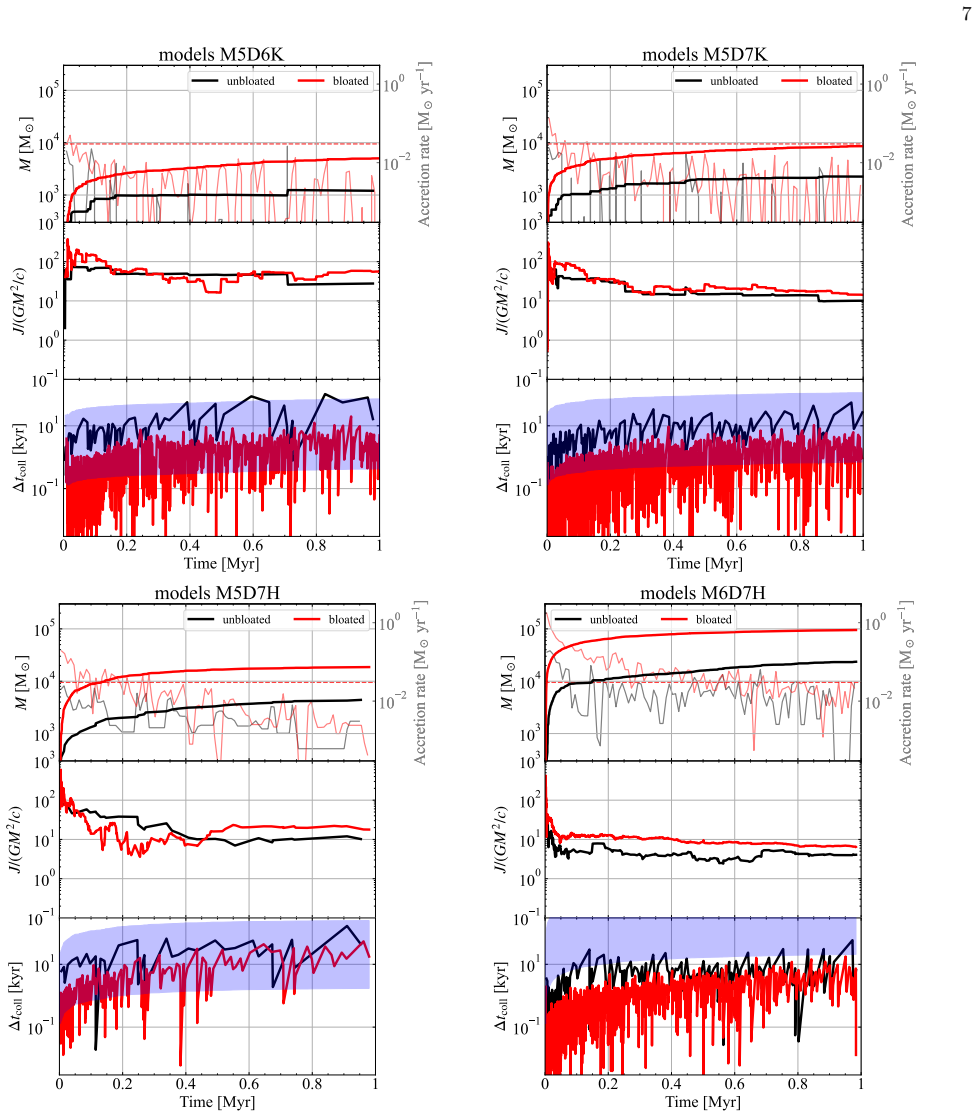
Using gravitational N-body simulations the authors find that very massive stars in dense star clusters reach masses of 10^3 to 10^4 solar masses depending on initial cluster conditions. The mass grows by up to a factor of three when the bloated state at the Hayashi track from collisions is maintained at accretion rates above 3 times 10 to the minus 2 solar masses per year. The normalized spin exceeds 10 in all cases. Collapse of such a star produces an intermediate-mass black hole with a massive accretion disk that can trigger powerful explosions and emit burst gravitational waves similar to GW190521 and GW231123 with remnant masses above 100 solar masses.
What carries the argument
Gravitational N-body simulations that follow stellar mass growth through collisions and accretion while evolving the stellar spin parameter in dense clusters.
If this is right
- VMS masses reach 10^3 to 10^4 solar masses depending on the initial conditions of the host clusters.
- Inclusion of the bloated Hayashi track state increases VMS masses by up to a factor of three at accretion rates above 0.03 solar masses per year.
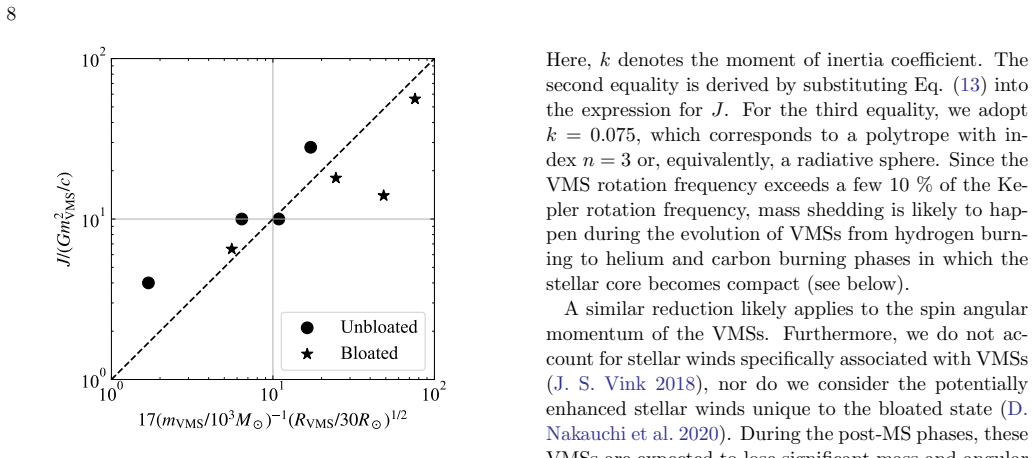
- The normalized spin of the VMS exceeds 10 in every simulated case.
- Collapse produces an intermediate-mass black hole with a massive accretion disk that triggers powerful explosions and burst gravitational waves like GW190521.
Where Pith is reading between the lines
- If Little Red Dots are powered by clusters containing these objects the post-collapse disk activity could contribute to their observed emission properties.
- Accounting for angular momentum loss in collisions might lower final masses yet leave the spin high enough for the black hole formation channel to remain viable.
- This formation route for intermediate-mass black holes could be tested by searching for burst gravitational wave signals with remnant masses above 100 solar masses in future detector data.
Load-bearing premise
The bloated state at the Hayashi track induced by stellar collisions is maintained at accretion rates exceeding 3 times 10 to the minus 2 solar masses per year.
What would settle it
A calculation or observation demonstrating that the bloated state collapses or that post-main-sequence evolution and collision losses keep masses below 1000 solar masses would falsify the predicted growth range and high-spin outcome.
Figures

read the original abstract
Using gravitational $N$-body simulations, we investigate the evolution of mass and spin for very massive stars (VMSs) in dense star clusters, which may be potentially associated with Little Red Dots (LRDs). Our results show that VMS masses can reach $10^3$--$10^4\,M_\odot$, depending on the initial conditions of the host clusters. Notably, the VMS mass increases by up to a factor of three when accounting for the bloated state at the Hayashi track induced by stellar collisions, provided that this state is maintained at accretion rates exceeding $3 \times 10^{-2}\,M_\odot\,{\rm yr}^{-1}$. In all cases, the spin of the VMS, when normalized to the dimensionless black hole (BH) spin parameter, exceeds $10$. While our model may overestimate VMS masses and spins due to the omission of post-main-sequence evolution and the loss of mass and angular momentum during collisions, we nonetheless demonstrate that VMSs formed in dense star clusters can be highly spinning. Such a rapidly spinning VMS is expected to collapse into an intermediate-mass BH surrounded by a massive accretion disk. This BH-disk system could trigger powerful explosions and emit burst gravitational waves, similar to those observed in GW190521 and GW231123, for which the remnant BH masses are estimated to be $\gtrsim 100\,M_\odot$.
Editorial analysis
A structured set of objections, weighed in public.
Referee Report
Summary. The manuscript uses gravitational N-body simulations to study the mass and spin evolution of very massive stars (VMSs) in dense star clusters that may be associated with Little Red Dots. It reports that VMS masses can reach 10^3--10^4 M_⊙, increasing by up to a factor of three when the collision-induced bloated state on the Hayashi track is maintained at accretion rates > 3×10^{-2} M_⊙ yr^{-1}. The VMS spin, normalized to the dimensionless BH spin parameter, exceeds 10 in all cases, suggesting formation of IMBHs with massive disks capable of producing powerful explosions and burst gravitational waves akin to GW190521 and GW231123.
Significance. If the modeling assumptions hold, the work provides a dynamical formation channel for very massive, rapidly spinning stars in clusters, with implications for intermediate-mass black hole seeds, the interpretation of Little Red Dots, and the origin of high-mass gravitational wave events. The conditional mass enhancement and high-spin results offer a mechanism linking stellar collisions and accretion to observable transients.
major comments (2)
- [Abstract] Abstract: The factor-of-three mass increase and the upper mass range of 10^3--10^4 M_⊙ depend on the assumption that the bloated Hayashi-track state persists at accretion rates exceeding 3 × 10^{-2} M_⊙ yr^{-1}. The text does not report whether the simulated accretion rates in the N-body runs satisfy this threshold throughout the growth phase, making this a load-bearing condition for the central quantitative claims.
- [Abstract] Abstract: The claim that the normalized spin exceeds 10 relies on the same bloated-state assumption plus the idealization of no mass or angular-momentum loss in collisions. While the manuscript notes possible overestimation due to omitted post-main-sequence evolution, it does not provide sensitivity tests or bounds on how these omissions affect the reported spin values or the resulting BH-disk system predictions.
minor comments (1)
- [Abstract] Abstract: The phrasing 'normalized to the dimensionless black hole (BH) spin parameter' for the VMS spin could be clarified, as the dimensionless spin parameter a is typically ≤1 for black holes; specifying the exact normalization (e.g., J c / G M^2) would improve precision.
Simulated Author's Rebuttal
We thank the referee for their thorough review and constructive feedback on our manuscript. We address each major comment below and outline the revisions we will make.
read point-by-point responses
-
Referee: [Abstract] Abstract: The factor-of-three mass increase and the upper mass range of 10^3--10^4 M_⊙ depend on the assumption that the bloated Hayashi-track state persists at accretion rates exceeding 3 × 10^{-2} M_⊙ yr^{-1}. The text does not report whether the simulated accretion rates in the N-body runs satisfy this threshold throughout the growth phase, making this a load-bearing condition for the central quantitative claims.
Authors: We agree that the mass-enhancement claim is conditional on the accretion-rate threshold. The abstract already qualifies the result with the phrase 'provided that this state is maintained at accretion rates exceeding 3×10^{-2} M_⊙ yr^{-1}'. Inspection of the simulation outputs shows that, during the phase of repeated stellar collisions that builds the VMS, the instantaneous accretion rates onto the central object remain above this threshold for the duration of the growth episode in all runs that reach the reported masses. To eliminate any ambiguity we will add a short clarifying sentence to the abstract and a supporting statement in Section 3 referencing the relevant time-series data. revision: yes
-
Referee: [Abstract] Abstract: The claim that the normalized spin exceeds 10 relies on the same bloated-state assumption plus the idealization of no mass or angular-momentum loss in collisions. While the manuscript notes possible overestimation due to omitted post-main-sequence evolution, it does not provide sensitivity tests or bounds on how these omissions affect the reported spin values or the resulting BH-disk system predictions.
Authors: The referee correctly identifies that the normalized-spin values rest on the idealization of perfect angular-momentum retention. The manuscript already states that the reported spins 'may overestimate' the true values. Because performing new suites of simulations that include explicit mass and angular-momentum loss is beyond the scope of the present study, we cannot supply quantitative sensitivity tests. However, we will expand the discussion section to provide order-of-magnitude bounds: even if 30–50 % of the angular momentum is lost per collision, the final normalized spin remains ≳ 3–5, still sufficient to produce a massive remnant disk capable of powering the transients discussed. This qualitative bound will be added to the revised text. revision: partial
Circularity Check
No significant circularity; results are direct numerical outputs from N-body simulations under stated assumptions.
full rationale
The paper reports outcomes of gravitational N-body simulations tracking stellar collisions and accretion in dense clusters. Mass and spin values are computed directly from the simulation trajectories with explicit initial conditions and modeling choices (e.g., the bloated Hayashi-track state maintained above a stated accretion-rate threshold). No parameter is fitted to a data subset and then re-predicted, no quantity is defined in terms of itself, and no load-bearing premise reduces to a self-citation chain. The factor-of-three mass boost is an output conditional on an explicit modeling assumption rather than a definitional identity. The spin result likewise follows from the same simulation outputs. The derivation chain is therefore self-contained against external benchmarks and receives the default non-circularity finding.
Axiom & Free-Parameter Ledger
free parameters (2)
- Initial cluster conditions
- Accretion-rate threshold for bloated state
axioms (2)
- domain assumption Stellar collisions produce a persistent bloated state on the Hayashi track that can be sustained during high-rate accretion
- domain assumption N-body integration without post-main-sequence evolution or collision mass/angular-momentum loss still yields representative VMS properties
Reference graph
Works this paper leans on
-
[1]
G., Abouelfettouh, I., Acernese, F., et al
Abac, A. G., Abouelfettouh, I., Acernese, F., et al. 2025, ApJL, 993, L25, doi: 10.3847/2041-8213/ae0c9c
-
[2]
Abbott, R., Abbott, T. D., Abraham, S., et al. 2020a, PhRvL, 125, 101102, doi: 10.1103/PhysRevLett.125.101102 10
-
[3]
Abbott, R., Abbott, T. D., Abraham, S., et al. 2020b, ApJL, 900, L13, doi: 10.3847/2041-8213/aba493
-
[4]
Akins, H. B., Casey, C. M., Lambrides, E., et al. 2025, ApJ, 991, 37, doi: 10.3847/1538-4357/ade984
-
[5]
Ananna, T. T., Bogd´ an,´A., Kov´ acs, O. E., Natarajan, P., & Hickox, R. C. 2024, ApJL, 969, L18, doi: 10.3847/2041-8213/ad5669
-
[6]
Baggen, J. F. W., van Dokkum, P., Brammer, G., et al. 2024, ApJL, 977, L13, doi: 10.3847/2041-8213/ad90b8
-
[7]
Banerjee, S., Belczynski, K., Fryer, C. L., et al. 2020, A&A, 639, A41, doi: 10.1051/0004-6361/201935332
-
[8]
Begelman, M. C., & Rees, M. J. 1978, MNRAS, 185, 847, doi: 10.1093/mnras/185.4.847
-
[9]
Belczynski, K., Bulik, T., Fryer, C. L., et al. 2010, ApJ, 714, 1217, doi: 10.1088/0004-637X/714/2/1217
-
[10]
J., Stone, Z., Shen, Y., & Jiang, Y.-F
Burke, C. J., Stone, Z., Shen, Y., & Jiang, Y.-F. 2025, arXiv e-prints, arXiv:2511.16082, doi: 10.48550/arXiv.2511.16082
-
[11]
, year = 1964, month = aug, volume =
Chandrasekhar, S. 1964, ApJ, 140, 417, doi: 10.1086/147938
-
[12]
2014, ApJ, 790, 162, doi: 10.1088/0004-637X/790/2/162
Chen, K.-J., Heger, A., Woosley, S., et al. 2014, ApJ, 790, 162, doi: 10.1088/0004-637X/790/2/162
-
[13]
2021, MNRAS, 508, 4175, doi: 10.1093/mnras/stab2497
Chon, S., Omukai, K., & Schneider, R. 2021, MNRAS, 508, 4175, doi: 10.1093/mnras/stab2497
-
[14]
2022, MNRAS, 514, 4639, doi: 10.1093/mnras/stac1549 de Graaff, A., Rix, H.-W., Naidu, R
Chon, S., Ono, H., Omukai, K., & Schneider, R. 2022, MNRAS, 514, 4639, doi: 10.1093/mnras/stac1549 de Graaff, A., Rix, H.-W., Naidu, R. P., et al. 2025, A&A, 701, A168, doi: 10.1051/0004-6361/202554681 D’Eugenio, F., Juodˇ zbalis, I., Ji, X., et al. 2026, MNRAS, 545, staf2117, doi: 10.1093/mnras/staf2117 Di Carlo, U. N., Mapelli, M., Pasquato, M., et al. ...
-
[15]
2025, ApJ, 995, 44, doi: 10.3847/1538-4357/ae200e
Escala, A., Zimmermann, L., Valdebenito, S., et al. 2025, ApJ, 995, 44, doi: 10.3847/1538-4357/ae200e
-
[16]
Timmes, F. X. 2022, ApJ, 937, 112, doi: 10.3847/1538-4357/ac8b83
-
[17]
2020, ApJL, 902, L36, doi: 10.3847/2041-8213/abbadd
Justham, S. 2020, ApJL, 902, L36, doi: 10.3847/2041-8213/abbadd
-
[18]
Rodrigues, J. M. 2009, Nature, 460, 73, doi: 10.1038/nature08083
-
[19]
Freitag, M., & Benz, W. 2005, MNRAS, 358, 1133, doi: 10.1111/j.1365-2966.2005.08770.x
-
[20]
Fricke, K. J. 1973, ApJ, 183, 941, doi: 10.1086/152280
-
[21]
Fryer, C. L., Woosley, S. E., & Heger, A. 2001, ApJ, 550, 372, doi: 10.1086/319719
-
[22]
2025, ApJ, 981, 119, doi: 10.3847/1538-4357/adb0b8
Shibata, M. 2025, ApJ, 981, 119, doi: 10.3847/1538-4357/adb0b8
-
[23]
2009, ApJ, 695, 1421, doi: 10.1088/0004-637X/695/2/1421
Fujii, M., Iwasawa, M., Funato, Y., & Makino, J. 2009, ApJ, 695, 1421, doi: 10.1088/0004-637X/695/2/1421
-
[24]
S., Wang, L., Tanikawa, A., Hirai, Y., & Saitoh, T
Fujii, M. S., Wang, L., Tanikawa, A., Hirai, Y., & Saitoh, T. R. 2024, Science, 384, 1488, doi: 10.1126/science.adi4211
-
[25]
Fuller, G. M., Woosley, S. E., & Weaver, T. A. 1986, ApJ, 307, 675, doi: 10.1086/164452
-
[26]
Furtak, L. J., Secunda, A. R., Greene, J. E., et al. 2025, A&A, 698, A227, doi: 10.1051/0004-6361/202554110
-
[27]
2015, MNRAS, 454, 3150, doi: 10.1093/mnras/stv2162
Giersz, M., Leigh, N., Hypki, A., L¨ utzgendorf, N., & Askar, A. 2015, MNRAS, 454, 3150, doi: 10.1093/mnras/stv2162
-
[28]
Gloudemans, A. J., Duncan, K. J., Eilers, A.-C., et al. 2025, ApJ, 986, 130, doi: 10.3847/1538-4357/adddb9 Gonz´ alez Prieto, E., Kremer, K., Fragione, G., et al. 2022, ApJ, 940, 131, doi: 10.3847/1538-4357/ac9b0f
-
[29]
Greene, J. E., Labbe, I., Goulding, A. D., et al. 2024, ApJ, 964, 39, doi: 10.3847/1538-4357/ad1e5f
-
[30]
A., Pacucci, F., & Kocevski, D
Guia, C. A., Pacucci, F., & Kocevski, D. D. 2024, Research Notes of the American Astronomical Society, 8, 207, doi: 10.3847/2515-5172/ad7262 H¨ aberle, M., Neumayer, N., Seth, A., et al. 2024, Nature, 631, 285, doi: 10.1038/s41586-024-07511-z
-
[31]
2023, ApJ, 959, 39, doi: 10.3847/1538-4357/ad029e
Harikane, Y., Zhang, Y., Nakajima, K., et al. 2023, ApJ, 959, 39, doi: 10.3847/1538-4357/ad029e
-
[32]
Heger, A., & Woosley, S. E. 2002, ApJ, 567, 532, doi: 10.1086/338487
-
[33]
Hosokawa, T., Omukai, K., & Yorke, H. W. 2012, ApJ, 756, 93, doi: 10.1088/0004-637X/756/1/93
-
[34]
2013, ApJ, 778, 178, doi: 10.1088/0004-637X/778/2/178
Yoshida, N. 2013, ApJ, 778, 178, doi: 10.1088/0004-637X/778/2/178
-
[35]
Humphreys, R. M., & Davidson, K. 1994, PASP, 106, 1025, doi: 10.1086/133478
-
[36]
Hurley, J. R., Pols, O. R., & Tout, C. A. 2000, MNRAS, 315, 543, doi: 10.1046/j.1365-8711.2000.03426.x
-
[37]
Hurley, J. R., Tout, C. A., & Pols, O. R. 2002, MNRAS, 329, 897, doi: 10.1046/j.1365-8711.2002.05038.x
-
[38]
1963, ApJ, 138, 1090, doi: 10.1086/147708
Iben, Jr., I. 1963, ApJ, 138, 1090, doi: 10.1086/147708
-
[39]
2026, ApJ, 1000, 90, doi: 10.3847/1538-4357/ae42ce
Inayoshi, K., Murase, K., & Kashiyama, K. 2026, ApJ, 1000, 90, doi: 10.3847/1538-4357/ae42ce
-
[40]
1999, PASJ, 51, 417, doi: 10.1093/pasj/51.4.417
Ishii, M., Ueno, M., & Kato, M. 1999, PASJ, 51, 417, doi: 10.1093/pasj/51.4.417
-
[41]
The Cliff: A Metal-Poor Little Red Dot Hosting an Overmassive Black Hole at $z = 3.55$
Ivey, L. R., D’Eugenio, F., Maiolino, R., et al. 2026, arXiv e-prints, arXiv:2604.09177, doi: 10.48550/arXiv.2604.09177
work page internal anchor Pith review Pith/arXiv arXiv doi:10.48550/arxiv.2604.09177 2026
-
[42]
2020, PASJ, 72, 13, doi: 10.1093/pasj/psz133
Iwasawa, M., Namekata, D., Nitadori, K., et al. 2020, PASJ, 72, 13, doi: 10.1093/pasj/psz133
-
[43]
2016, PASJ, 68, 54, doi: 10.1093/pasj/psw053 11
Iwasawa, M., Tanikawa, A., Hosono, N., et al. 2016, PASJ, 68, 54, doi: 10.1093/pasj/psw053 11
-
[44]
2025, MNRAS, 544, 3900, doi: 10.1093/mnras/staf1867
Ji, X., Maiolino, R., ¨Ubler, H., et al. 2025, MNRAS, 544, 3900, doi: 10.1093/mnras/staf1867
-
[45]
Jockel, C., Kawaguchi, K., Fujibayashi, S., & Shibata, M. 2025, Mon. Not. Roy. Astron. Soc., 545, staf1949, doi: 10.1093/mnras/staf1949 Juodˇ zbalis, I., Ji, X., Maiolino, R., et al. 2024, MNRAS, 535, 853, doi: 10.1093/mnras/stae2367
-
[46]
Kido, D., Ioka, K., Hotokezaka, K., Inayoshi, K., & Irwin, C. M. 2025, MNRAS, 544, 3407, doi: 10.1093/mnras/staf1898
-
[47]
King, I. R. 1966, AJ, 71, 64, doi: 10.1086/109857
-
[48]
D., Onoue, M., Inayoshi, K., et al
Kocevski, D. D., Onoue, M., Inayoshi, K., et al. 2023, ApJL, 954, L4, doi: 10.3847/2041-8213/ace5a0
-
[49]
Kocevski, D. D., Finkelstein, S. L., Barro, G., et al. 2025, ApJ, 986, 126, doi: 10.3847/1538-4357/adbc7d
-
[50]
Kokorev, V., Caputi, K. I., Greene, J. E., et al. 2024, ApJ, 968, 38, doi: 10.3847/1538-4357/ad4265
-
[51]
2025, ApJ, 995, 24, doi: 10.3847/1538-4357/ae119e
Kokubo, M., & Harikane, Y. 2025, ApJ, 995, 24, doi: 10.3847/1538-4357/ae119e
-
[52]
2026, ApJL, 1000, L21, doi: 10.3847/2041-8213/ae4c52
Kritos, K., & Silk, J. 2026, ApJL, 1000, L21, doi: 10.3847/2041-8213/ae4c52
-
[53]
Kroupa, P. 2001, MNRAS, 322, 231, doi: 10.1046/j.1365-8711.2001.04022.x
-
[54]
Krumholz, M. R., McKee, C. F., & Bland -Hawthorn, J. 2019, ARA&A, 57, 227, doi: 10.1146/annurev-astro-091918-104430
-
[55]
Labbe, I., Greene, J. E., Bezanson, R., et al. 2025, ApJ, 978, 92, doi: 10.3847/1538-4357/ad3551
-
[56]
Lee, W. H., & Ramirez-Ruiz, E. 2006, ApJ, 641, 961, doi: 10.1086/500533
-
[57]
Liu, Y. T., Shapiro, S. L., & Stephens, B. C. 2007, PhRvD, 76, 084017, doi: 10.1103/PhysRevD.76.084017
-
[58]
How I Wonder What You Are -- JWST's Little Red Dots do not TWINKLE
Liu, Z., Naidu, R. P., Secunda, A., et al. 2026, arXiv e-prints, arXiv:2604.13000, doi: 10.48550/arXiv.2604.13000
work page internal anchor Pith review Pith/arXiv arXiv doi:10.48550/arxiv.2604.13000 2026
-
[59]
2024, Research Notes of the American Astronomical Society, 8, 182, doi: 10.3847/2515-5172/ad614c
Loeb, A. 2024, Research Notes of the American Astronomical Society, 8, 182, doi: 10.3847/2515-5172/ad614c
-
[60]
2025, MNRAS, 538, 1921, doi: 10.1093/mnras/staf359
Maiolino, R., Risaliti, G., Signorini, M., et al. 2025, MNRAS, 538, 1921, doi: 10.1093/mnras/staf359
-
[61]
Matsumoto, H., Tsuru, T. G., Koyama, K., et al. 2001, ApJ, 547, L25, doi: 10.1086/318878
-
[62]
2015, ApJ, 810, 64, doi: 10.1088/0004-637X/810/1/64
Nakamura, T. 2015, ApJ, 810, 64, doi: 10.1088/0004-637X/810/1/64
-
[63]
Matthee, J., Naidu, R. P., Brammer, G., et al. 2024, ApJ, 963, 129, doi: 10.3847/1538-4357/ad2345
-
[64]
2026, A&A, 706, A372, doi: 10.1051/0004-6361/202453317
Mazzolari, G., Gilli, R., Maiolino, R., et al. 2026, A&A, 706, A372, doi: 10.1051/0004-6361/202453317
-
[65]
K., Buonanno, A., Gair, J., et al
Mehta, A. K., Buonanno, A., Gair, J., et al. 2022, ApJ, 924, 39, doi: 10.3847/1538-4357/ac3130
-
[66]
J., Janka, H.-T., & M¨ uller, E
Montero, P. J., Janka, H.-T., & M¨ uller, E. 2012, ApJ, 749, 37, doi: 10.1088/0004-637X/749/1/37
-
[67]
2024, PhRvD, 110, L061301, doi: 10.1103/PhysRevD.110.L061301
Nagele, C., & Umeda, H. 2024, PhRvD, 110, L061301, doi: 10.1103/PhysRevD.110.L061301
-
[68]
2023, MNRAS, 523, 1629, doi: 10.1093/mnras/stad1522
Nagele, C., Umeda, H., & Takahashi, K. 2023, MNRAS, 523, 1629, doi: 10.1093/mnras/stad1522
-
[69]
2020, MNRAS, 496, 1224, doi: 10.1093/mnras/staa1636
Sumiyoshi, K. 2020, MNRAS, 496, 1224, doi: 10.1093/mnras/staa1636
-
[70]
2022, MNRAS, 517, 1584, doi: 10.1093/mnras/stac2495
Sumiyoshi, K. 2022, MNRAS, 517, 1584, doi: 10.1093/mnras/stac2495
-
[71]
A "Black Hole Star" Reveals the Remarkable Gas-Enshrouded Hearts of the Little Red Dots
Naidu, R. P., Matthee, J., Katz, H., et al. 2025, arXiv e-prints, arXiv:2503.16596, doi: 10.48550/arXiv.2503.16596
work page internal anchor Pith review Pith/arXiv arXiv doi:10.48550/arxiv.2503.16596 2025
-
[72]
2020, ApJ, 902, 81, doi: 10.3847/1538-4357/abb463
Nakauchi, D., Inayoshi, K., & Omukai, K. 2020, ApJ, 902, 81, doi: 10.3847/1538-4357/abb463
-
[73]
Ohlmann, S. T., Schneider, F. R. N., Roepke, F. K., et al. 2025, arXiv e-prints, arXiv:2512.13424, doi: 10.48550/arXiv.2512.13424
-
[74]
2025, ApJ, 994, 40, doi: 10.3847/1538-4357/ae1619
Pacucci, F., Hernquist, L., & Fujii, M. 2025, ApJ, 994, 40, doi: 10.3847/1538-4357/ae1619
-
[75]
2025, A&A, 693, L2, doi: 10.1051/0004-6361/202452422 Portegies Zwart, S
Perger, K., Fogasy, J., Frey, S., & Gab´ anyi, K.´E. 2025, A&A, 693, L2, doi: 10.1051/0004-6361/202452422 Portegies Zwart, S. F., Baumgardt, H., Hut, P., Makino, J., & McMillan, S. L. W. 2004, Nature, 428, 724, doi: 10.1038/nature02448 Portegies Zwart, S. F., McMillan, S. L. W., & Gieles, M. 2010, ARA&A, 48, 431, doi: 10.1146/annurev-astro-081309-130834
-
[76]
Quinlan, G. D., & Shapiro, S. L. 1990, ApJ, 356, 483, doi: 10.1086/168856
-
[77]
P., Naab, T., Spurzem, R., et al
Rizzuto, F. P., Naab, T., Spurzem, R., et al. 2021, MNRAS, 501, 5257, doi: 10.1093/mnras/staa3634
-
[78]
Rusakov, V., Watson, D., Nikopoulos, G. P., et al. 2026, Nature, 649, 574, doi: 10.1038/s41586-025-09900-4
-
[79]
2025, ApJL, 980, L38, doi: 10.3847/2041-8213/adaf94
Ryu, T., Sills, A., Pakmor, R., de Mink, S., & Mathieu, R. 2025, ApJL, 980, L38, doi: 10.3847/2041-8213/adaf94
-
[80]
Sanders, R. H. 1970, ApJ, 162, 791, doi: 10.1086/150711
discussion (0)
Sign in with ORCID, Apple, or X to comment. Anyone can read and Pith papers without signing in.