Systematic Error in Approximate Models of the GRB Early Afterglow
Pith reviewed 2026-06-28 12:53 UTC · model grok-4.3
The pith
Newtonian reverse shocks leave hours where two-zone models mispredict GRB afterglow emission.
A machine-rendered reading of the paper's core claim, the machinery that carries it, and where it could break.
Core claim
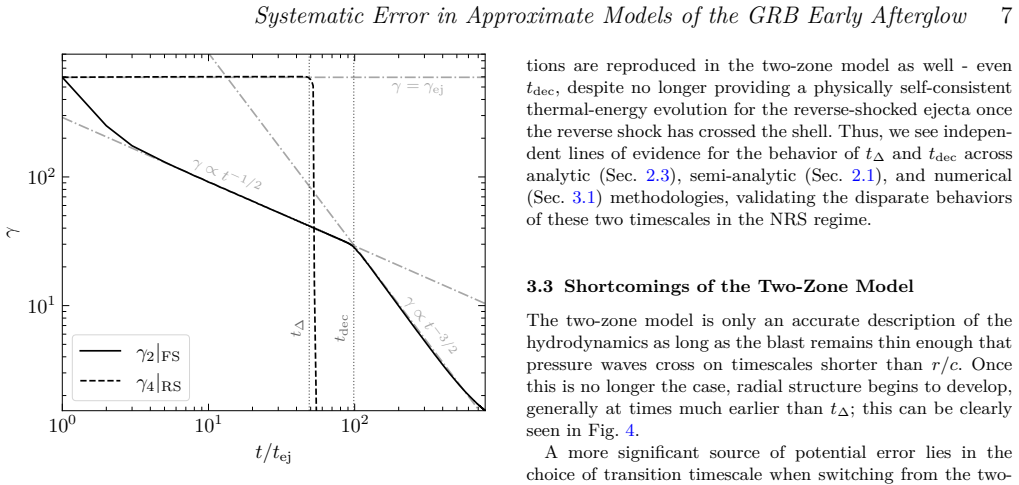
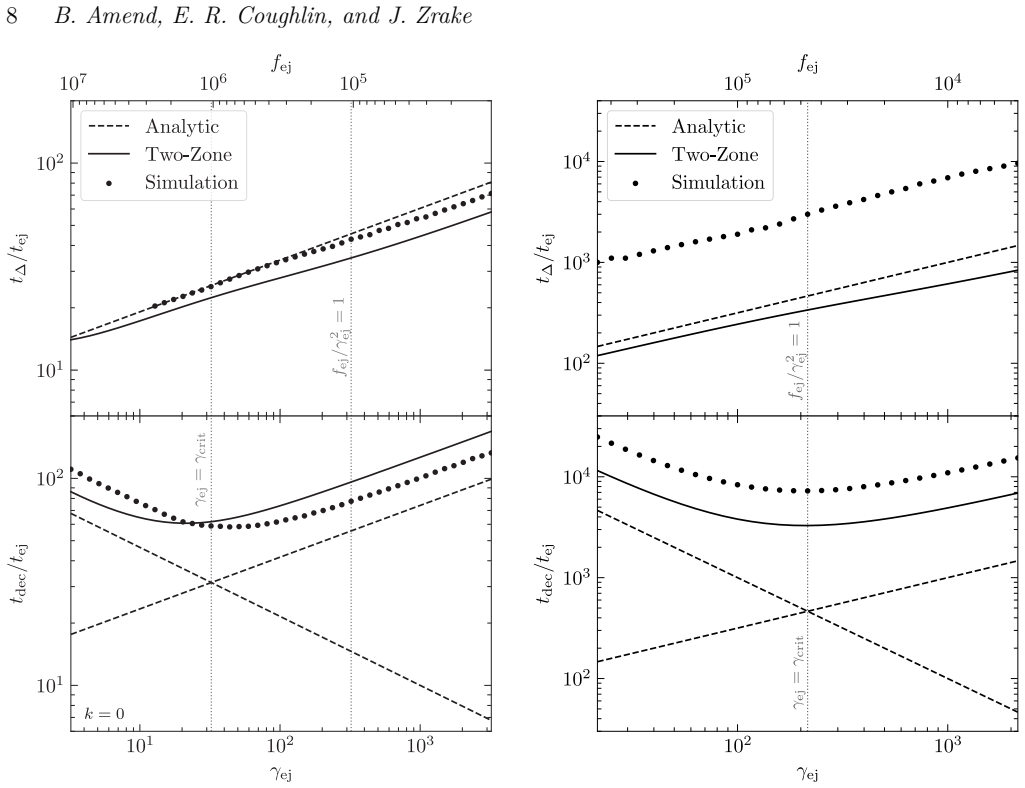
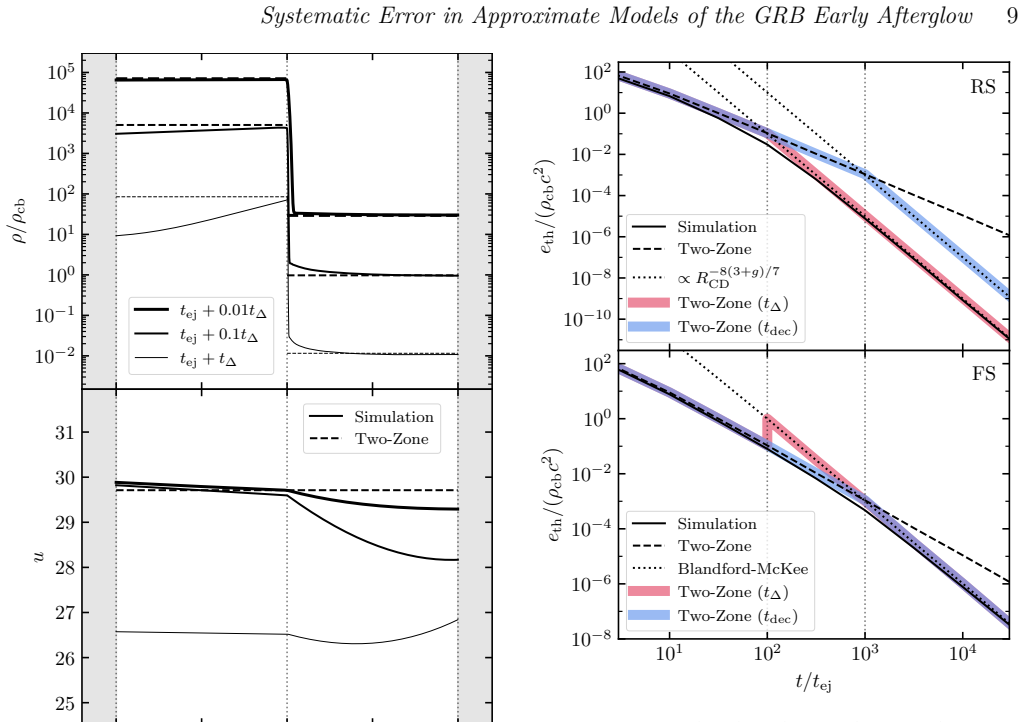
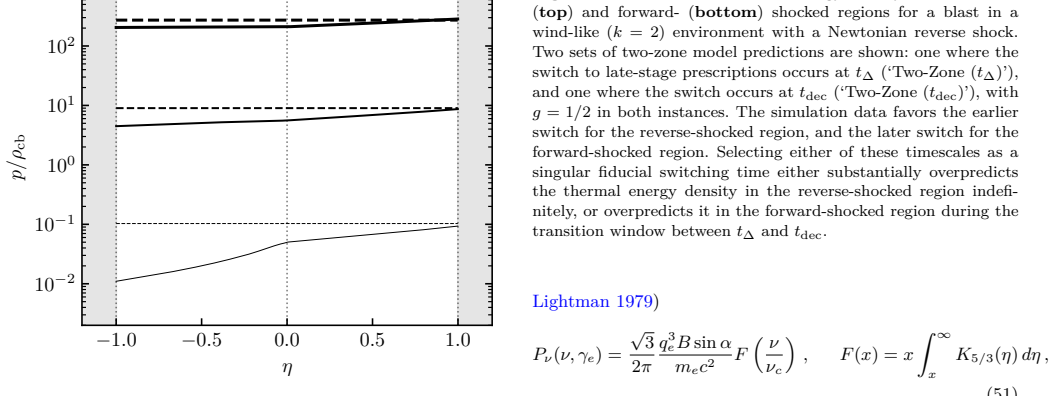
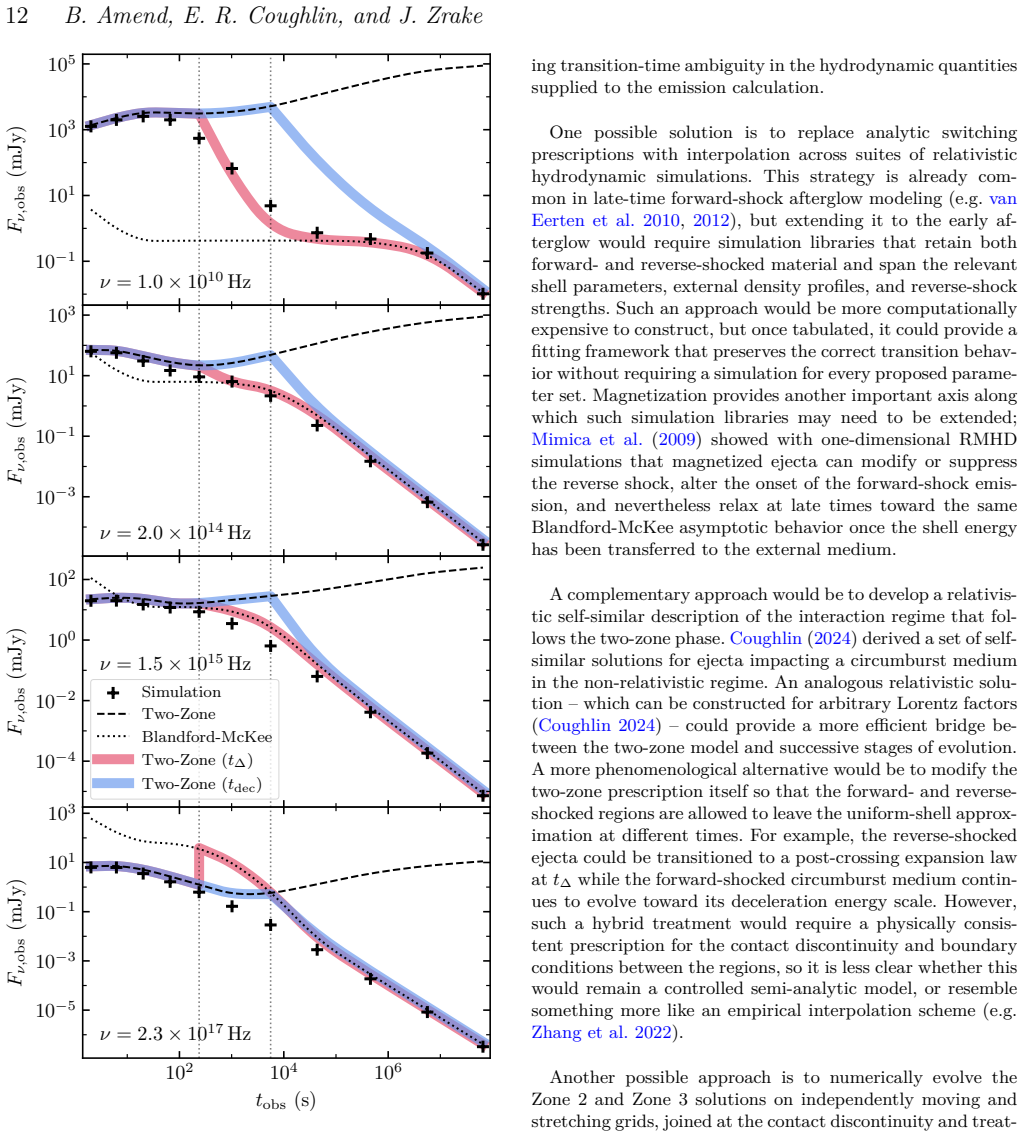
When the reverse shock is Newtonian, it crosses the ejecta shell long before Blandford-McKee self-similarity is established, leaving a prolonged interval that can span hours in observer time in which the true hydrodynamic evolution is not captured by standard semi-analytic prescriptions. This mismatch can substantially overpredict the reverse-shock emission from radio through ultraviolet frequencies, or overpredict the forward-shock emission at X-ray frequencies, depending on how the transition away from the two-zone model is prescribed.
What carries the argument
The two-zone model, which divides the outflow into forward-shocked circumburst medium and reverse-shocked ejecta until the Blandford-McKee self-similar phase begins.
If this is right
- The Newtonian reverse shock finishes crossing the ejecta long before self-similarity, creating an hours-long gap in model validity.
- Reverse-shock emission from radio through ultraviolet can be substantially overpredicted during this gap.
- Forward-shock emission at X-ray frequencies can be substantially overpredicted, depending on the transition prescription used.
- Standard semi-analytic prescriptions therefore fail to describe the true evolution in the pre-self-similar phase for Newtonian reverse shocks.
Where Pith is reading between the lines
- Observers fitting early afterglow data with two-zone models may need to restrict those fits to later times or switch to full hydrodynamic calculations when the reverse shock is expected to be Newtonian.
- The duration of the mismatch interval offers a new observable diagnostic for the initial Lorentz factor and shell thickness of the ejecta.
- The choice of transition prescription from the two-zone model to the self-similar phase becomes a source of systematic uncertainty that should be quantified in population studies.
Load-bearing premise
High-resolution special relativistic hydrodynamics simulations accurately capture the true physical evolution of the outflow before Blandford-McKee self-similarity begins.
What would settle it
A side-by-side comparison of two-zone model light curves against full hydrodynamic simulation outputs or early afterglow observations that shows whether the reported overpredictions occur at the stated frequencies during the identified interval.
Figures

read the original abstract
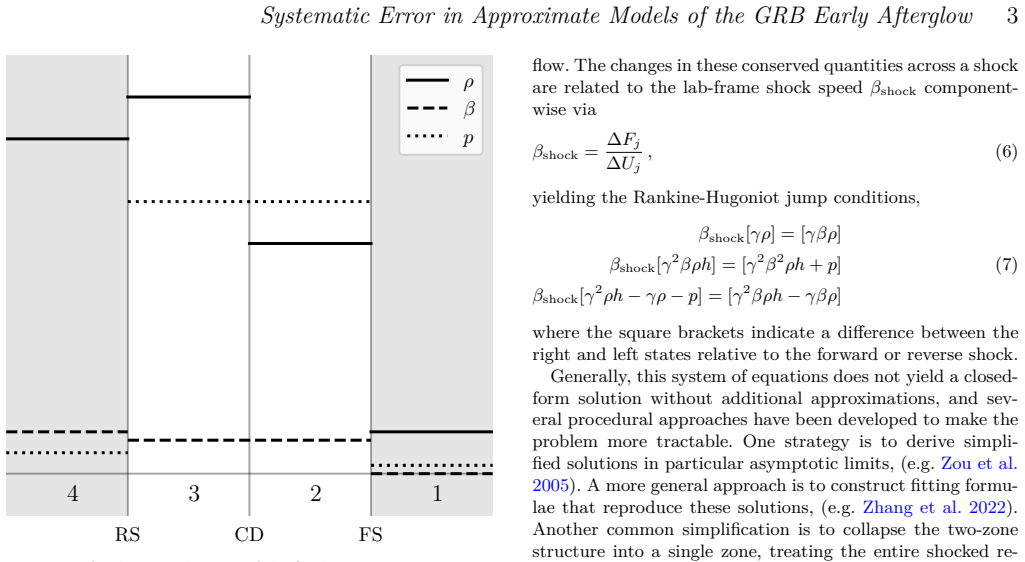
Gamma-ray burst (GRB) afterglows are thought to arise when relativistic ejecta launched by a compact central engine drive a blast wave into the surrounding circumburst medium, producing broadband synchrotron emission. We present a rigorous assessment, based on high-resolution special relativistic hydrodynamics simulations, of a widely adopted `two-zone model' for approximating the dynamics of the early afterglow phase. Before the onset of the Blandford-McKee (BMK) self-similar solution, the outflow generally produces two emission components, associated with the forward-shocked circumburst medium and the reverse-shocked ejecta. The subsequent evolution depends on whether the reverse shock significantly decelerates the ejecta as it crosses the shell, separating the so-called relativistic and Newtonian reverse shock regimes. We show that when the reverse shock is Newtonian, it crosses the ejecta shell long before BMK self-similarity is established, leaving a prolonged interval that can span $\sim$ hours in observer time in which the true hydrodynamic evolution is not captured by standard semi-analytic prescriptions. We demonstrate that this mismatch can substantially overpredict the reverse-shock emission from radio through ultraviolet frequencies, or overpredict the forward-shock emission at X-ray frequencies, depending on how the transition away from the two-zone model is prescribed.
Editorial analysis
A structured set of objections, weighed in public.
Referee Report
Summary. The paper presents high-resolution special relativistic hydrodynamics (SRHD) simulations to evaluate the standard two-zone model for the early afterglow phase of gamma-ray bursts. It claims that, in the Newtonian reverse-shock regime, the reverse shock crosses the ejecta shell well before the onset of Blandford-McKee self-similarity, leaving an extended hydrodynamic phase (potentially hours in observer time) that is not captured by common semi-analytic prescriptions; this mismatch can lead to substantial overpredictions of reverse-shock emission (radio to UV) or forward-shock emission (X-rays) depending on the transition prescription adopted.
Significance. If the central hydrodynamic result holds, the work identifies a concrete, previously under-appreciated limitation in widely used approximations for GRB afterglow modeling, with direct implications for broadband light-curve and spectral interpretations across radio through X-ray bands. The reliance on high-resolution SRHD simulations rather than analytic fitting provides a falsifiable, simulation-grounded test of the two-zone model's domain of validity.
major comments (2)
- [Methods] Methods section: the abstract and strongest claim rest on high-resolution SRHD simulations demonstrating that the Newtonian reverse shock crosses before BMK self-similarity, yet no resolution study, convergence test, or quantitative error analysis is described; without these, the load-bearing assertion that the true evolution lies outside the two-zone model for an extended interval cannot be verified at the reported level of rigor.
- [Results] Results/figures: the demonstration that the mismatch 'substantially overpredicts' emission requires explicit quantitative comparison (e.g., factor by which flux is overpredicted at specific frequencies and times); the current description leaves the magnitude of the systematic error as a qualitative statement rather than a measured discrepancy.
minor comments (2)
- Provide the specific ejecta Lorentz factor, shell thickness, and circumburst density values used to obtain the ~hours observer-time interval; this would allow readers to assess how generic the prolonged non-self-similar phase is.
- Clarify the precise criterion used to identify the 'onset of BMK self-similarity' in the simulations (e.g., radial profile matching, energy conservation, or Lorentz-factor evolution threshold).
Simulated Author's Rebuttal
We thank the referee for their positive assessment of the work's significance and for the constructive major comments. We address each point below and will make the requested revisions to strengthen the rigor of the presentation.
read point-by-point responses
-
Referee: [Methods] Methods section: the abstract and strongest claim rest on high-resolution SRHD simulations demonstrating that the Newtonian reverse shock crosses before BMK self-similarity, yet no resolution study, convergence test, or quantitative error analysis is described; without these, the load-bearing assertion that the true evolution lies outside the two-zone model for an extended interval cannot be verified at the reported level of rigor.
Authors: We agree that a resolution study and convergence tests are necessary to support the central claims at the required level of rigor. In the revised manuscript we will add a new subsection to the Methods section that specifies the grid resolutions employed, reports the numerical scheme and Courant factor, and presents explicit convergence tests. These will include side-by-side comparisons of the reverse-shock crossing time, post-shock Lorentz-factor profiles, and density structure at three successively doubled resolutions, demonstrating that the key hydrodynamic result (crossing well before Blandford-McKee self-similarity) is stable to within a few percent. revision: yes
-
Referee: [Results] Results/figures: the demonstration that the mismatch 'substantially overpredicts' emission requires explicit quantitative comparison (e.g., factor by which flux is overpredicted at specific frequencies and times); the current description leaves the magnitude of the systematic error as a qualitative statement rather than a measured discrepancy.
Authors: We accept that the magnitude of the systematic error must be quantified rather than stated qualitatively. In the revised Results section we will add a new figure and accompanying table that post-process the simulation snapshots with a synchrotron emission code and directly compare the resulting light curves to those generated by the standard two-zone prescriptions. The comparison will report numerical factors (e.g., flux overprediction by a factor of X at 1 GHz at observer time t_obs = Y hours, and similarly for optical and X-ray bands) for both the Newtonian-reverse-shock and transition-prescription cases, making the size of the discrepancy explicit and falsifiable. revision: yes
Circularity Check
No significant circularity identified
full rationale
The paper's central claim rests on direct comparison of high-resolution SRHD simulations against existing two-zone semi-analytic prescriptions. The finding that Newtonian reverse shocks cross the ejecta before BMK self-similarity, and the resulting emission mismatch, is obtained from the numerical evolution itself rather than any parameter fit, self-definition, or load-bearing self-citation chain. No derivation step reduces to its inputs by construction, and the work remains self-contained against external simulation benchmarks.
Axiom & Free-Parameter Ledger
axioms (2)
- domain assumption Synchrotron radiation is the dominant emission mechanism from forward and reverse shocks in GRB afterglows.
- domain assumption The Blandford-McKee self-similar solution describes the late-time outflow dynamics.
Reference graph
Works this paper leans on
-
[1]
Hydrodynamic Time Scales and Temporal Structure of GRBs
Hydrodynamic Timescales and Temporal Structure of Gamma-Ray Bursts. , keywords =. doi:10.1086/309835 , archivePrefix =. astro-ph/9508081 , primaryClass =
work page internal anchor Pith review Pith/arXiv arXiv doi:10.1086/309835
-
[2]
Physics of Fluids , keywords =
Fluid dynamics of relativistic blast waves. Physics of Fluids , keywords =. doi:10.1063/1.861619 , adsurl =
-
[3]
Relativistic fireballs - Energy conversion and time-scales. , keywords =. doi:10.1093/mnras/258.1.41P , adsurl =
-
[4]
Mechanical Model for Relativistic Blast Waves
Mechanical Model for Relativistic Blast Waves. , keywords =. doi:10.1086/508807 , archivePrefix =. astro-ph/0607641 , primaryClass =
work page internal anchor Pith review Pith/arXiv arXiv doi:10.1086/508807
-
[5]
jetsimpy: A Highly Efficient Hydrodynamic Code for Gamma-Ray Burst Afterglow. , keywords =. doi:10.3847/1538-4365/ad4d9d , archivePrefix =. 2402.19359 , primaryClass =
-
[6]
Precise measurements of self-absorbed rising reverse shock emission from gamma-ray burst 221009A. Nature Astronomy , keywords =. doi:10.1038/s41550-023-01997-9 , archivePrefix =. 2303.13583 , primaryClass =
-
[7]
A Reverse Shock and Unusual Radio Properties in GRB 160625B
A Reverse Shock and Unusual Radio Properties in GRB 160625B. , keywords =. doi:10.3847/1538-4357/aa8a76 , archivePrefix =. 1705.08455 , primaryClass =
work page internal anchor Pith review Pith/arXiv arXiv doi:10.3847/1538-4357/aa8a76
-
[8]
A Reverse Shock in GRB 160509A
A Reverse Shock in GRB 160509A. , keywords =. doi:10.3847/1538-4357/833/1/88 , archivePrefix =. 1606.08873 , primaryClass =
work page internal anchor Pith review Pith/arXiv arXiv doi:10.3847/1538-4357/833/1/88
-
[9]
A Reverse Shock in GRB 130427A
A Reverse Shock in GRB 130427A. , keywords =. doi:10.1088/0004-637X/776/2/119 , archivePrefix =. 1305.2453 , primaryClass =
work page internal anchor Pith review Pith/arXiv arXiv doi:10.1088/0004-637x/776/2/119
-
[10]
Analysis of two scenarios for the early optical emission of the gamma-ray burst afterglows 990123 and 021211. , keywords =. doi:10.1111/j.1365-2966.2004.08083.x , archivePrefix =. astro-ph/0406027 , primaryClass =
-
[11]
Light Curves of GRB Optical Flashes
Light Curves of Gamma-Ray Burst Optical Flashes. , keywords =. doi:10.1086/317869 , archivePrefix =. astro-ph/0009319 , primaryClass =
work page internal anchor Pith review Pith/arXiv arXiv doi:10.1086/317869
-
[12]
GRB990123, The Optical Flash and The Fireball Model
GRB 990123: The Optical Flash and the Fireball Model. , keywords =. doi:10.1086/312039 , archivePrefix =. astro-ph/9902009 , primaryClass =
work page internal anchor Pith review Pith/arXiv arXiv doi:10.1086/312039
-
[13]
GRB 990123: reverse and internal shock flashes and late afterglow behaviour. , keywords =. doi:10.1046/j.1365-8711.1999.02800.x , archivePrefix =. astro-ph/9902367 , primaryClass =
-
[14]
Intrinsic parameters of GRB 990123 from its prompt optical flash and afterglow. , keywords =. doi:10.1046/j.1365-8711.2000.03922.x , archivePrefix =. astro-ph/9906062 , primaryClass =
-
[15]
Optical Flash of GRB 990123: constraints on the physical parameter of the reverse shock
Optical Flash of GRB 990123: Constraints on the Physical Parameters of the Reverse Shock. , keywords =. doi:10.1088/1009-9271/2/5/449 , archivePrefix =. astro-ph/0306024 , primaryClass =
work page internal anchor Pith review Pith/arXiv arXiv doi:10.1088/1009-9271/2/5/449
-
[16]
GRB 021004: Reverse Shock Emission
GRB 021004: Reverse Shock Emission. , keywords =. doi:10.1086/367691 , archivePrefix =. astro-ph/0210584 , primaryClass =
work page internal anchor Pith review Pith/arXiv arXiv doi:10.1086/367691
-
[17]
The afterglow of GRB021211: Another case of reverse shock emission
The afterglow of GRB 021211: Another case of reverse shock emission. , keywords =. doi:10.1051/0004-6361:20030371 , archivePrefix =. astro-ph/0301345 , primaryClass =
work page internal anchor Pith review Pith/arXiv arXiv doi:10.1051/0004-6361:20030371
-
[18]
A unified treatment of the gamma-ray burst 021211 and its afterglow. , keywords =. doi:10.1111/j.1365-2966.2003.07138.x , archivePrefix =. astro-ph/0305446 , primaryClass =
-
[19]
The Afterglow, Energetics and Host Galaxy of the Short-Hard Gamma-Ray Burst 051221a
The Afterglow, Energetics, and Host Galaxy of the Short-Hard Gamma-Ray Burst 051221a. , keywords =. doi:10.1086/506429 , archivePrefix =. astro-ph/0601455 , primaryClass =
work page internal anchor Pith review Pith/arXiv arXiv doi:10.1086/506429
-
[20]
The Afterglow of GRB 130427A from 1 to 10^16 GHz
The Afterglow of GRB 130427A from 1 to 10 ^ 16 GHz. , keywords =. doi:10.1088/0004-637X/781/1/37 , archivePrefix =. 1307.4401 , primaryClass =
work page internal anchor Pith review Pith/arXiv arXiv doi:10.1088/0004-637x/781/1/37
-
[21]
The Early Light Curve of the Optical Afterglow of GRB 021211
The Early Light Curve of the Optical Afterglow of GRB 021211. , keywords =. doi:10.1086/374684 , archivePrefix =. astro-ph/0302136 , primaryClass =
work page internal anchor Pith review Pith/arXiv arXiv doi:10.1086/374684
-
[22]
Short GRB 160821B: A Reverse Shock, a Refreshed Shock, and a Well-sampled Kilonova. , keywords =. doi:10.3847/1538-4357/ab38bb , archivePrefix =. 1905.02159 , primaryClass =
-
[23]
Early afterglows in wind environments revisited. , keywords =. doi:10.1111/j.1365-2966.2005.09411.x , archivePrefix =. astro-ph/0508602 , primaryClass =
-
[24]
Spectra and Light Curves of Gamma-Ray Burst Afterglows
Spectra and Light Curves of Gamma-Ray Burst Afterglows. , keywords =. doi:10.1086/311269 , archivePrefix =. astro-ph/9712005 , primaryClass =
work page internal anchor Pith review Pith/arXiv arXiv doi:10.1086/311269
-
[25]
Radio Transients from Gamma-Ray Bursters
Radio Transients from Gamma-Ray Bursters. , keywords =. doi:10.1086/187102 , archivePrefix =. astro-ph/9307024 , primaryClass =
work page internal anchor Pith review Pith/arXiv arXiv doi:10.1086/187102
-
[26]
Optical and Long Wavelength Afterglow from Gamma-Ray Bursts
Optical and Long-Wavelength Afterglow from Gamma-Ray Bursts. , keywords =. doi:10.1086/303625 , archivePrefix =. astro-ph/9606043 , primaryClass =
work page internal anchor Pith review Pith/arXiv arXiv doi:10.1086/303625
-
[27]
Gamma-Ray--Burst Afterglow: Supporting the Cosmological Fireball Model, Constraining Parameters, and Making Predictions. , keywords =. doi:10.1086/310809 , archivePrefix =. astro-ph/9704116 , primaryClass =
work page internal anchor Pith review Pith/arXiv arXiv doi:10.1086/310809
-
[28]
Shocked by GRB 970228: the afterglow of a cosmological fireball
Shocked by GRB 970228: the afterglow of a cosmological fireball. , keywords =. doi:10.1093/mnras/288.4.L51 , archivePrefix =. astro-ph/9704153 , primaryClass =
work page internal anchor Pith review Pith/arXiv arXiv doi:10.1093/mnras/288.4.l51
-
[29]
Discovery of the X-Ray Afterglow of the Gamma-Ray Burst of February 28 1997
Discovery of an X-ray afterglow associated with the -ray burst of 28 February 1997. , keywords =. doi:10.1038/42885 , archivePrefix =. astro-ph/9706065 , primaryClass =
work page internal anchor Pith review Pith/arXiv arXiv doi:10.1038/42885 1997
-
[30]
, year = 1997, month = apr, volume =
Transient optical emission from the error box of the -ray burst of 28 February 1997. , year = 1997, month = apr, volume =. doi:10.1038/386686a0 , adsurl =
-
[31]
, year = 1997, month = sep, volume =
The radio afterglow from the -ray burst of 8 May 1997. , year = 1997, month = sep, volume =. doi:10.1038/38451 , adsurl =
-
[32]
Predictions for The Very Early Afterglow and The Optical Flash
Predictions for the Very Early Afterglow and the Optical Flash. , keywords =. doi:10.1086/307508 , archivePrefix =. astro-ph/9901338 , primaryClass =
work page internal anchor Pith review Pith/arXiv arXiv doi:10.1086/307508
-
[33]
Observation of contemporaneous optical radiation from a gamma-ray burst
Observation of contemporaneous optical radiation from a -ray burst. , keywords =. doi:10.1038/18837 , archivePrefix =. astro-ph/9903271 , primaryClass =
work page internal anchor Pith review Pith/arXiv arXiv doi:10.1038/18837
-
[34]
Discovery of a Radio Flare from GRB 990123
Discovery of a Radio Flare from GRB 990123. , keywords =. doi:10.1086/312227 , archivePrefix =. astro-ph/9903441 , primaryClass =
work page internal anchor Pith review Pith/arXiv arXiv doi:10.1086/312227
-
[35]
Off-axis Gamma-ray Burst Afterglow Modeling Based on a Two-dimensional Axisymmetric Hydrodynamics Simulation. , keywords =. doi:10.1088/0004-637X/722/1/235 , archivePrefix =. 1006.5125 , primaryClass =
work page internal anchor Pith review Pith/arXiv arXiv doi:10.1088/0004-637x/722/1/235
-
[36]
Gamma-ray burst afterglow broadband fitting based directly on hydrodynamics simulations
Gamma-Ray Burst Afterglow Broadband Fitting Based Directly on Hydrodynamics Simulations. , keywords =. doi:10.1088/0004-637X/749/1/44 , archivePrefix =. 1110.5089 , primaryClass =
work page internal anchor Pith review Pith/arXiv arXiv doi:10.1088/0004-637x/749/1/44
-
[37]
Gamma-Ray Burst Afterglows in the Multimessenger Era: Numerical Models and Closure Relations. , keywords =. doi:10.3847/1538-4357/ab93cf , archivePrefix =. 1909.11691 , primaryClass =
-
[38]
Early afterglow emission from a reverse shock as a diagnostic tool for gamma-ray burst outflows. , keywords =. doi:10.1111/j.1365-2966.2004.08099.x , archivePrefix =. astro-ph/0403461 , primaryClass =
-
[39]
Optical Flashes and Radio Flares in GRBs afterglow: Numerical Study
Optical Flashes and Radio Flares in Gamma-Ray Burst Afterglow: Numerical Study. , keywords =. doi:10.1086/317021 , archivePrefix =. astro-ph/9910241 , primaryClass =
work page internal anchor Pith review Pith/arXiv arXiv doi:10.1086/317021
-
[40]
Modeling GRB 050904: Autopsy of a Massive Stellar Explosion at z=6.29
Modeling GRB 050904: Autopsy of a Massive Stellar Explosion at z=6.29. , keywords =. doi:10.1086/520699 , archivePrefix =. astro-ph/0612256 , primaryClass =
work page internal anchor Pith review Pith/arXiv arXiv doi:10.1086/520699
-
[41]
The Physics of Gamma-Ray Bursts
The physics of gamma-ray bursts. Reviews of Modern Physics , keywords =. doi:10.1103/RevModPhys.76.1143 , archivePrefix =. astro-ph/0405503 , primaryClass =
work page internal anchor Pith review Pith/arXiv arXiv doi:10.1103/revmodphys.76.1143
-
[42]
A semi-analytical solution to the forward-reverse shock hydrodynamics of the gamma-ray burst afterglow. , keywords =. doi:10.1093/mnras/stac1198 , archivePrefix =. 2204.13014 , primaryClass =
-
[43]
Hydrodynamics of a Relativistic Fireball: the Complete Evolution
Hydrodynamics of a Relativistic Fireball: The Complete Evolution. , keywords =. doi:10.1086/306868 , archivePrefix =. astro-ph/9803217 , primaryClass =
work page internal anchor Pith review Pith/arXiv arXiv doi:10.1086/306868
-
[44]
The Dynamics and Afterglow Radiation of Gamma-Ray Bursts. I. Constant Density Medium. , keywords =. doi:10.1088/0004-637X/698/2/1261 , archivePrefix =. 0902.2396 , primaryClass =
work page internal anchor Pith review Pith/arXiv arXiv doi:10.1088/0004-637x/698/2/1261
-
[45]
Radiative processes in astrophysics
-
[46]
Synchrotron Self-Absorption in Radio Supernovae. , keywords =. doi:10.1086/305676 , adsurl =
-
[47]
Afterglow emission in Gamma-Ray Bursts: I. Pair-enriched ambient medium and radiative blast waves
Afterglow emission in gamma-ray bursts - I. Pair-enriched ambient medium and radiative blast waves. , keywords =. doi:10.1093/mnras/stt872 , archivePrefix =. 1211.2806 , primaryClass =
work page internal anchor Pith review Pith/arXiv arXiv doi:10.1093/mnras/stt872
-
[48]
The Radio to GeV Afterglow of GRB 221009A. , keywords =. doi:10.3847/2041-8213/acbfad , archivePrefix =. 2302.04388 , primaryClass =
-
[49]
From Coasting to Energy-conserving: New Self-similar Solutions to the Interaction Phase of Strong Explosions. , keywords =. doi:10.3847/2041-8213/ad87cc , archivePrefix =. 2409.10600 , primaryClass =
-
[50]
Deceleration of arbitrarily magnetized GRB ejecta: the complete evolution
Deceleration of arbitrarily magnetized GRB ejecta: the complete evolution. , keywords =. doi:10.1051/0004-6361:200810756 , archivePrefix =. 0810.2961 , primaryClass =
work page internal anchor Pith review Pith/arXiv arXiv doi:10.1051/0004-6361:200810756
-
[51]
Living Reviews in Relativity , keywords =
Numerical Hydrodynamics in Special Relativity. Living Reviews in Relativity , keywords =. doi:10.12942/lrr-2003-7 , adsurl =
-
[52]
The interaction phase of engine-driven explosions and high-energy winds
The interaction phase of engine-driven explosions and high-energy winds. arXiv e-prints , keywords =. doi:10.48550/arXiv.2605.16490 , archivePrefix =. 2605.16490 , primaryClass =
work page internal anchor Pith review Pith/arXiv arXiv doi:10.48550/arxiv.2605.16490
discussion (0)
Sign in with ORCID, Apple, or X to comment. Anyone can read and Pith papers without signing in.