A New Record Census of Dwarf AGN and a Bimodal M_(rm BH)-M_(star) Scaling Relation with DESI DR1
Pith reviewed 2026-06-28 13:42 UTC · model grok-4.3
The pith
Dwarf galaxies host AGN at low rates and follow a separate black hole scaling relation from massive galaxies.
A machine-rendered reading of the paper's core claim, the machinery that carries it, and where it could break.
Core claim
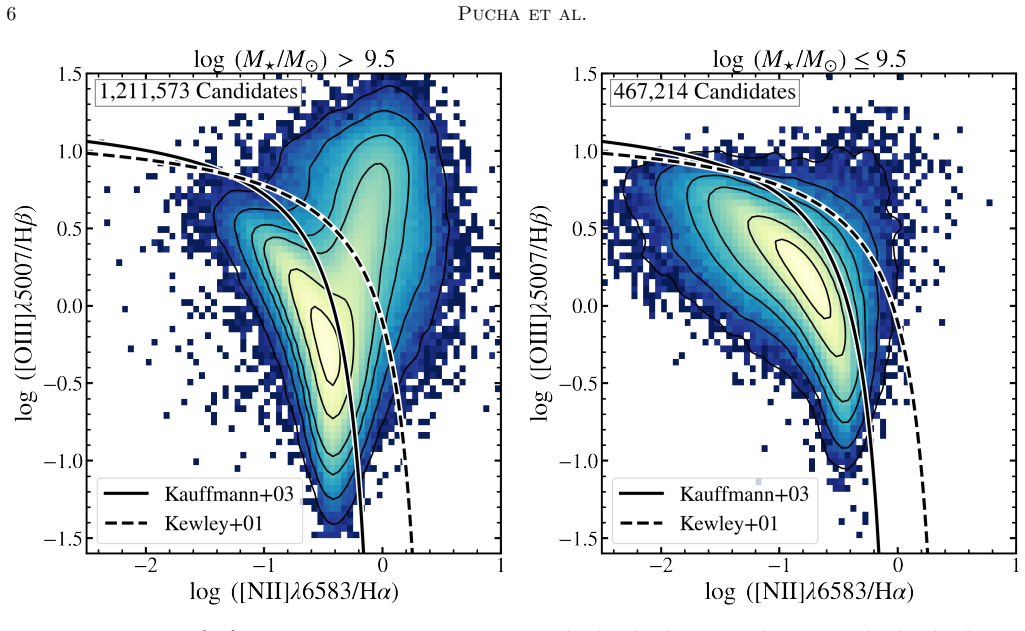
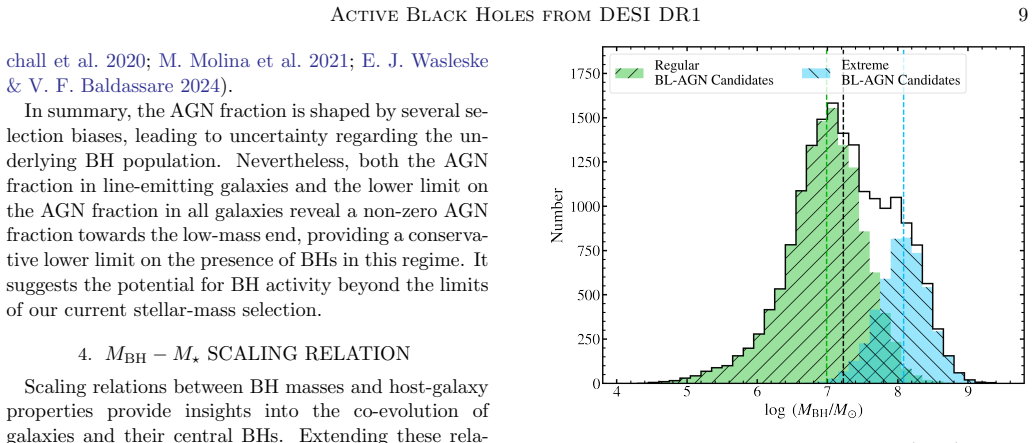
The [NII]-BPT diagnostic applied to DESI DR1 data identifies AGN in 314245 high-mass and 9648 dwarf line-emitting galaxies. The 17949 broad-line AGN yield black hole masses that extend the scaling relation to lower masses, revealing a bimodal M_BH-M_star distribution consistent with two separate evolutionary pathways for galaxies and their black holes.
What carries the argument
The [NII]-BPT emission-line ratio diagnostic combined with single-epoch virial black hole mass estimates from broad H-alpha lines.
If this is right
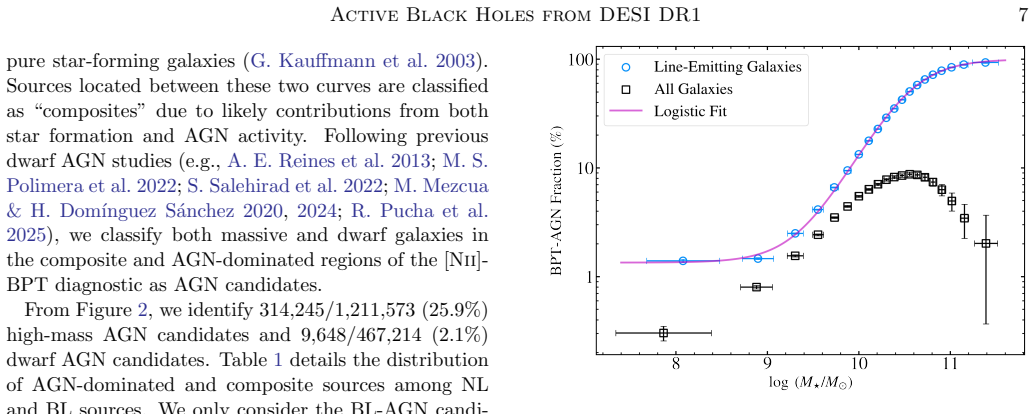
- AGN fraction among line-emitting galaxies increases monotonically from 1.4 percent at the low-mass end to 93.3 percent at the high-mass end.
- The M_BH-M_star scaling relation extends to log M_star approximately 7.8 and log M_BH approximately 4.4.
- Black holes in dwarf galaxies lie offset from the relation followed by more massive systems.
- Galaxies and their central black holes may follow two distinct evolutionary pathways across cosmic time.
- The EmFit catalog provides emission-line measurements for approximately 7.4 million galaxies.
Where Pith is reading between the lines
- If the bimodality persists at higher redshift, it could account for the overmassive black holes observed in early galaxies as members of one pathway.
- Repeating the analysis with multi-wavelength AGN indicators would test whether optical diagnostics miss a population of low-mass AGN.
- The released catalog enables direct comparison of narrow-line versus broad-line AGN demographics across the full mass range.
Load-bearing premise
The [NII]-BPT diagnostic and single-epoch virial BH-mass method remain reliable when applied to the lowest-mass line-emitting galaxies where star-formation contamination and line-width calibration uncertainties are largest.
What would settle it
A measurement showing that the AGN fraction among dwarf galaxies rises above a few percent when using X-ray or mid-infrared selection instead of optical line ratios would falsify the reported low rates and the implied bimodality.
Figures






read the original abstract
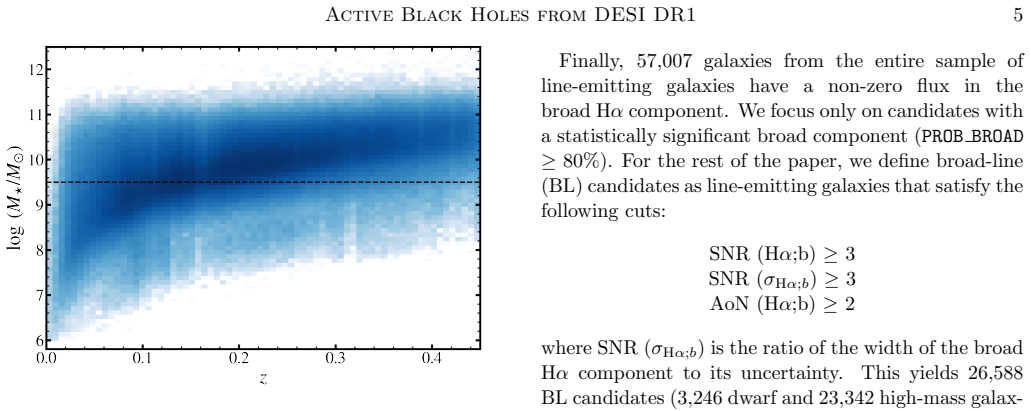
Using the first spectroscopic data release from the Dark Energy Spectroscopic Instrument (DESI DR1), we search for AGN signatures in 1,678,787 low-redshift ($0.001 \le z \le 0.45$) line-emitting galaxies. Based on the [NII]-BPT emission-line ratio diagnostic, we identify AGN in 314,245/1,211,573 (25.9%) high-mass ($\log (M_{\star}/M_{\odot}) > 9.5$) and 9648/467,214 (2.1%) dwarf ($\log (M_{\star}/M_{\odot}) \le 9.5$) galaxies. Among these AGN, 17,949 are broad-line candidates (BL-AGN) with broad H$\alpha$ emission, enabling black hole (BH) mass estimates using single-epoch virial methods. We find that the AGN fraction in line-emitting galaxies increases monotonically with stellar mass, rising from $\sim$1.4% at the low-mass end to $\sim$93.3% at the high-mass end. Using the large BL-AGN sample, we extend the $M_{\rm BH} - M_{\star}$ scaling relation down to $\log (M_{\star}/M_{\odot}) \approx 7.8$ and $\log (M_{\rm BH}/M_{\odot}) \approx 4.4$. In the context of high-redshift overmassive BHs, our results suggest that galaxies and their central BHs may follow two distinct evolutionary pathways across cosmic time. With this paper, we release the EmFit value-added catalog, containing emission-line flux and width measurements for $\sim$7.4 million galaxies, the largest catalog with emission-line decomposition into narrow, broad, and outflow components to date. This work significantly expands upon the early DESI results and provides a statistical sample for probing the galaxy$-$BH connection in the low-mass galaxy regime.
Editorial analysis
A structured set of objections, weighed in public.
Referee Report
Summary. Using DESI DR1 spectra of 1,678,787 low-redshift line-emitting galaxies, the authors apply the [NII]-BPT diagnostic to identify AGN in 25.9% of high-mass (log M_star > 9.5) and 2.1% of dwarf (log M_star <= 9.5) systems. Among 17,949 broad-line AGN candidates they derive single-epoch virial BH masses and extend the M_BH-M_star relation to log M_star ~7.8 and log M_BH ~4.4. They report a monotonic rise in AGN fraction with stellar mass and interpret the low-mass extension, in the context of high-z overmassive BHs, as evidence for two distinct galaxy-BH evolutionary pathways. The paper also releases the EmFit catalog of emission-line measurements for ~7.4 million galaxies.
Significance. If the low-mass diagnostics prove reliable, the work supplies the largest statistical census of dwarf AGN and the first robust extension of the scaling relation below log M_star = 9, together with a public catalog that will enable community follow-up. The monotonic AGN-fraction trend is a direct, reproducible count that strengthens demographic constraints on BH seeding and growth. The bimodal-pathway interpretation, however, rests on the unquantified performance of BPT and virial methods at the lowest masses.
major comments (2)
- [§4.1 and §4.2] §4.1 and §4.2: The [NII]-BPT demarcation is applied to the dwarf subsample without quantitative robustness tests (e.g., WHAN diagram, [SII]-BPT, or mock spectra with SF contamination) that would bound the fraction of misclassified objects at the 10-20% level needed to preserve the reported 2.1% AGN fraction and the claimed bimodality.
- [§5.2] §5.2: Single-epoch virial BH masses for the log M_star <=9.5 BL-AGN sample rely on the standard f-factor and line-width calibration derived from higher-mass reverberation-mapped AGN; no validation or systematic-error budget is provided for the regime log M_BH ~4.4 where narrow/broad decomposition and possible shock contributions are most uncertain, directly affecting the low-mass anchor of the bimodal relation.
minor comments (3)
- [Abstract] Abstract: the total line-emitting sample (1,678,787) and the high-mass/dwarf split numbers are internally consistent, but the text should explicitly state the number of line-emitting dwarfs used in the denominator of the 2.1% fraction.
- [Figure 5] Figure 5 (scaling-relation panel): error bars on the binned low-mass points and a direct overlay of the high-z overmassive-BH locus are needed to allow readers to assess the claimed offset.
- [§6] §6: the EmFit catalog description should include a column-by-column definition and a note on the S/N threshold applied to the broad-Hα component.
Simulated Author's Rebuttal
We thank the referee for their careful reading of our manuscript and for the constructive comments. We address the major comments point by point below.
read point-by-point responses
-
Referee: [§4.1 and §4.2] The [NII]-BPT demarcation is applied to the dwarf subsample without quantitative robustness tests (e.g., WHAN diagram, [SII]-BPT, or mock spectra with SF contamination) that would bound the fraction of misclassified objects at the 10-20% level needed to preserve the reported 2.1% AGN fraction and the claimed bimodality.
Authors: We agree that quantitative robustness tests would strengthen the dwarf AGN classification. The [NII]-BPT is the standard diagnostic applied consistently with prior literature on both high- and low-mass systems, but we acknowledge the value of bounding misclassification. In the revised manuscript we will add WHAN diagram comparisons, [SII]-BPT checks where S/N permits, and mock spectra with SF contamination to quantify the misclassification fraction and its effect on the 2.1% AGN fraction. revision: yes
-
Referee: [§5.2] Single-epoch virial BH masses for the log M_star <=9.5 BL-AGN sample rely on the standard f-factor and line-width calibration derived from higher-mass reverberation-mapped AGN; no validation or systematic-error budget is provided for the regime log M_BH ~4.4 where narrow/broad decomposition and possible shock contributions are most uncertain, directly affecting the low-mass anchor of the bimodal relation.
Authors: We recognize that the low-mass regime (log M_BH ~4.4) introduces additional uncertainties in narrow/broad decomposition and possible shock contributions not captured by the standard high-mass calibration. While the single-epoch method follows the established literature calibration, we agree an explicit systematic error budget is warranted. In the revision we will expand §5.2 with a dedicated error budget discussion and any available low-mass validation checks. revision: yes
Circularity Check
No significant circularity; results are direct observational counts and empirical extensions from new spectra
full rationale
The paper's core outputs—AGN fractions (2.1% in dwarfs, 25.9% in high-mass), the extension of the M_BH-M_star relation to log M_star ~7.8, and the bimodal interpretation—are obtained by applying standard [NII]-BPT classification and single-epoch virial estimators to the new DESI DR1 spectra. No equation or step reduces these quantities to a quantity defined by the authors' own prior fit or self-citation chain; the EmFit catalog and reported scaling points are constructed from the fresh line measurements. Minor references to earlier DESI work exist but are not load-bearing for the central counts or the low-mass extension. The derivation chain therefore remains self-contained against external benchmarks.
Axiom & Free-Parameter Ledger
axioms (2)
- domain assumption The [NII]-BPT line-ratio demarcation separates AGN from star-forming galaxies even at log M_star <= 9.5
- domain assumption Single-epoch virial BH masses derived from broad H-alpha are unbiased at log M_BH ~4.4
Reference graph
Works this paper leans on
-
[1]
Overview of the DESI Milky Way Survey. , keywords =. doi:10.3847/1538-4357/acb3c0 , archivePrefix =. 2208.08514 , primaryClass =
-
[2]
Research Notes of the American Astronomical Society , keywords =
Preliminary Target Selection for the DESI Bright Galaxy Survey (BGS). Research Notes of the American Astronomical Society , keywords =. doi:10.3847/2515-5172/abc25a , adsurl =
-
[3]
The DESI Bright Galaxy Survey: Final Target Selection, Design, and Validation. , keywords =. doi:10.3847/1538-3881/accff8 , adsurl =
-
[4]
Identifying Missing Quasars from the DESI Bright Galaxy Survey. , keywords =. doi:10.3847/1538-3881/adabc9 , archivePrefix =. 2404.03621 , primaryClass =
-
[5]
Research Notes of the American Astronomical Society , keywords =
Preliminary Target Selection for the DESI Luminous Red Galaxy (LRG) Sample. Research Notes of the American Astronomical Society , keywords =. doi:10.3847/2515-5172/abc0f4 , adsurl =
-
[6]
Target Selection and Validation of DESI Luminous Red Galaxies. , keywords =. doi:10.3847/1538-3881/aca5fb , adsurl =
-
[7]
Research Notes of the American Astronomical Society , keywords =
Preliminary Target Selection for the DESI Emission Line Galaxy (ELG) Sample. Research Notes of the American Astronomical Society , keywords =. doi:10.3847/2515-5172/abc078 , adsurl =
-
[8]
Target Selection and Validation of DESI Emission Line Galaxies. , keywords =. doi:10.3847/1538-3881/acb213 , adsurl =
-
[9]
Research Notes of the American Astronomical Society , keywords =
Preliminary Target Selection for the DESI Quasar (QSO) Sample. Research Notes of the American Astronomical Society , keywords =. doi:10.3847/2515-5172/abc01a , adsurl =
-
[10]
Target Selection and Validation of DESI Quasars. , keywords =. doi:10.3847/1538-4357/acb3c2 , adsurl =
-
[11]
The Target-selection Pipeline for the Dark Energy Spectroscopic Instrument. , keywords =. doi:10.3847/1538-3881/aca5f9 , adsurl =
-
[12]
The Early Data Release of the Dark Energy Spectroscopic Instrument. , keywords =. doi:10.3847/1538-3881/ad3217 , archivePrefix =. 2306.06308 , primaryClass =
-
[13]
Validation of the Scientific Program for the Dark Energy Spectroscopic Instrument. , keywords =. doi:10.3847/1538-3881/ad0b08 , archivePrefix =. 2306.06307 , primaryClass =
-
[14]
Data Release 1 of the Dark Energy Spectroscopic Instrument
Data Release 1 of the Dark Energy Spectroscopic Instrument. , keywords =. doi:10.3847/1538-3881/ae4c43 , archivePrefix =. 2503.14745 , primaryClass =
work page internal anchor Pith review Pith/arXiv arXiv doi:10.3847/1538-3881/ae4c43
-
[15]
The DESI Experiment, a whitepaper for Snowmass 2013
The DESI Experiment, a whitepaper for Snowmass 2013. arXiv e-prints , keywords =. doi:10.48550/arXiv.1308.0847 , archivePrefix =. 1308.0847 , primaryClass =
work page internal anchor Pith review Pith/arXiv arXiv doi:10.48550/arxiv.1308.0847 2013
-
[16]
arXiv e-prints , keywords =
The DESI Experiment Part I: Science,Targeting, and Survey Design. arXiv e-prints , keywords =
-
[17]
arXiv e-prints , keywords =
The DESI Experiment Part II: Instrument Design. arXiv e-prints , keywords =
-
[18]
Overview of the Instrumentation for the Dark Energy Spectroscopic Instrument
Overview of the Instrumentation for the Dark Energy Spectroscopic Instrument. , keywords =. doi:10.3847/1538-3881/ac882b , archivePrefix =. 2205.10939 , primaryClass =
work page internal anchor Pith review Pith/arXiv arXiv doi:10.3847/1538-3881/ac882b
-
[19]
Overview of the Fiber System for the Dark Energy Spectroscopic Instrument. , keywords =. doi:10.3847/1538-3881/ad76a4 , adsurl =
-
[20]
The Robotic Multiobject Focal Plane System of the Dark Energy Spectroscopic Instrument (DESI). , keywords =. doi:10.3847/1538-3881/ac9ab1 , archivePrefix =. 2205.09014 , primaryClass =
-
[21]
The Optical Corrector for the Dark Energy Spectroscopic Instrument. , keywords =. doi:10.3847/1538-3881/ad45fe , archivePrefix =. 2306.06310 , primaryClass =
-
[22]
Overview of the DESI Legacy Imaging Surveys
Overview of the DESI Legacy Imaging Surveys. , keywords =. doi:10.3847/1538-3881/ab089d , archivePrefix =. 1804.08657 , primaryClass =
work page internal anchor Pith review Pith/arXiv arXiv doi:10.3847/1538-3881/ab089d
-
[23]
The construction of large-scale structure catalogs for the Dark Energy Spectroscopic Instrument. , keywords =. doi:10.1088/1475-7516/2025/01/125 , archivePrefix =. 2405.16593 , primaryClass =
-
[24]
DESI 2024 II: sample definitions, characteristics, and two-point clustering statistics. , keywords =. doi:10.1088/1475-7516/2025/07/017 , archivePrefix =. 2411.12020 , primaryClass =
-
[25]
Survey Operations for the Dark Energy Spectroscopic Instrument. , keywords =. doi:10.3847/1538-3881/ad0832 , archivePrefix =. 2306.06309 , primaryClass =
-
[26]
The Spectroscopic Data Processing Pipeline for the Dark Energy Spectroscopic Instrument. , keywords =. doi:10.3847/1538-3881/acb212 , archivePrefix =. 2209.14482 , primaryClass =
-
[27]
Correcting for the Effects of Interstellar Extinction
Correcting for the Effects of Interstellar Extinction. , keywords =. doi:10.1086/316293 , archivePrefix =. astro-ph/9809387 , primaryClass =
work page internal anchor Pith review Pith/arXiv arXiv doi:10.1086/316293
-
[28]
Maps of Dust Infrared Emission for Use in Estimation of Reddening and Cosmic Microwave Background Radiation Foregrounds. , keywords =. doi:10.1086/305772 , archivePrefix =. astro-ph/9710327 , primaryClass =
work page internal anchor Pith review Pith/arXiv arXiv doi:10.1086/305772
-
[29]
Measuring Reddening with SDSS Stellar Spectra and Recalibrating SFD
Measuring Reddening with Sloan Digital Sky Survey Stellar Spectra and Recalibrating SFD. , keywords =. doi:10.1088/0004-637X/737/2/103 , archivePrefix =. 1012.4804 , primaryClass =
work page internal anchor Pith review Pith/arXiv arXiv doi:10.1088/0004-637x/737/2/103
-
[30]
FastSpecFit: Fast spectral synthesis and emission-line fitting of DESI spectra
-
[31]
QuasarNET: Human-level spectral classification and redshifting with Deep Neural Networks
QuasarNET: Human-level spectral classification and redshifting with Deep Neural Networks. arXiv e-prints , keywords =. doi:10.48550/arXiv.1808.09955 , archivePrefix =. 1808.09955 , primaryClass =
work page internal anchor Pith review Pith/arXiv arXiv doi:10.48550/arxiv.1808.09955
-
[32]
Optimal strategies for identifying quasars in DESI. , keywords =. doi:10.1088/1475-7516/2020/11/015 , archivePrefix =. 2007.10348 , primaryClass =
-
[33]
2021, A&A, 647, A1, doi: 10.1051/0004-6361/202039313
The eROSITA X-ray telescope on SRG. , keywords =. doi:10.1051/0004-6361/202039313 , archivePrefix =. 2010.03477 , primaryClass =
-
[34]
Performance of the Quasar Spectral Templates for the Dark Energy Spectroscopic Instrument. , keywords =. doi:10.3847/1538-3881/ace35d , archivePrefix =. 2305.10426 , primaryClass =
-
[35]
Astropy: A Community Python Package for Astronomy
doi:10.1051/0004-6361/201322068 , Eid =. arXiv , Author =:1307.6212 , Journal =
work page internal anchor Pith review Pith/arXiv arXiv doi:10.1051/0004-6361/201322068
-
[36]
The Astropy Project: Building an inclusive, open-science project and status of the v2.0 core package
The Astropy Project: Building an Open-science Project and Status of the v2.0 Core Package. , keywords =. doi:10.3847/1538-3881/aabc4f , archivePrefix =. 1801.02634 , primaryClass =
work page internal anchor Pith review Pith/arXiv arXiv doi:10.3847/1538-3881/aabc4f
-
[37]
The Astropy Project: Sustaining and Growing a Community-oriented Open-source Project and the Latest Major Release (v5.0) of the Core Package. , keywords =. doi:10.3847/1538-4357/ac7c74 , archivePrefix =. 2206.14220 , primaryClass =
work page internal anchor Pith review Pith/arXiv arXiv doi:10.3847/1538-4357/ac7c74
-
[38]
Hunter, J. D. , Title =. Computing in Science & Engineering , Volume =
-
[39]
Charles R. Harris and K. Jarrod Millman and St. Array programming with. 2020 , month = sep, journal =. doi:10.1038/s41586-020-2649-2 , publisher =
-
[40]
Secondary standard stars for absolute spectrophotometry. , keywords =. doi:10.1086/160817 , adsurl =
-
[41]
Project Overview of the Beijing-Arizona Sky Survey
Project Overview of the Beijing-Arizona Sky Survey. , keywords =. doi:10.1088/1538-3873/aa65ba , archivePrefix =. 1702.03653 , primaryClass =
work page internal anchor Pith review Pith/arXiv arXiv doi:10.1088/1538-3873/aa65ba
-
[42]
2003, MNRAS, 344, 1000, doi: 10.1046/j.1365-8711.2003.06897.x
Stellar population synthesis at the resolution of 2003. , keywords =. doi:10.1046/j.1365-8711.2003.06897.x , archivePrefix =. astro-ph/0309134 , primaryClass =
-
[43]
Classification parameters for the emission-line spectra of extragalactic objects. , keywords =. doi:10.1086/130766 , adsurl =
-
[44]
Spectral Classification of Emission-Line Galaxies. , keywords =. doi:10.1086/191166 , adsurl =
-
[45]
A comprehensive classification of galaxies in the Sloan Digital Sky Survey: how to tell true from fake AGN?. , keywords =. doi:10.1111/j.1365-2966.2011.18244.x , archivePrefix =. 1012.4426 , primaryClass =
-
[46]
2019, A&A, 622, A103, doi: 10.1051/0004-6361/201834156 24
CIGALE: a python Code Investigating GALaxy Emission. , keywords =. doi:10.1051/0004-6361/201834156 , archivePrefix =. 1811.03094 , primaryClass =
work page internal anchor Pith review Pith/arXiv arXiv doi:10.1051/0004-6361/201834156
-
[47]
The Dust Content and Opacity of Actively Star-Forming Galaxies
The Dust Content and Opacity of Actively Star-forming Galaxies. , keywords =. doi:10.1086/308692 , archivePrefix =. astro-ph/9911459 , primaryClass =
work page internal anchor Pith review Pith/arXiv arXiv doi:10.1086/308692
-
[48]
The Galactic disk mass function: reconciliation of the HST and nearby determinations
The Galactic Disk Mass Function: Reconciliation of the Hubble Space Telescope and Nearby Determinations. , keywords =. doi:10.1086/374879 , archivePrefix =. astro-ph/0302511 , primaryClass =
work page internal anchor Pith review Pith/arXiv arXiv doi:10.1086/374879
-
[49]
Astronomy & Geophysics , keywords =
GAMA: towards a physical understanding of galaxy formation. Astronomy and Geophysics , keywords =. doi:10.1111/j.1468-4004.2009.50512.x , archivePrefix =. 0910.5123 , primaryClass =
-
[50]
Galaxy And Mass Assembly (GAMA): Data Release 4 and the z < 0.1 total and z < 0.08 morphological galaxy stellar mass functions. , keywords =. doi:10.1093/mnras/stac472 , archivePrefix =. 2203.08539 , primaryClass =
-
[51]
Society of Photo-Optical Instrumentation Engineers (SPIE) Conference Series , year = 2020, series =
Performance of Kitt Peak's Mayall 4-meter telescope during DESI commissioning. Society of Photo-Optical Instrumentation Engineers (SPIE) Conference Series , year = 2020, series =. doi:10.1117/12.2574776 , archivePrefix =. 2101.08816 , primaryClass =
-
[52]
Planck 2018 results. VI. Cosmological parameters. , keywords =. doi:10.1051/0004-6361/201833910 , adsurl =
-
[53]
The Sloan Digital Sky Survey: Technical Summary
The Sloan Digital Sky Survey: Technical Summary. , keywords =. doi:10.1086/301513 , archivePrefix =. astro-ph/0006396 , primaryClass =
work page internal anchor Pith review Pith/arXiv arXiv doi:10.1086/301513
-
[54]
The Eighth Data Release of the Sloan Digital Sky Survey: First Data from SDSS-III
The Eighth Data Release of the Sloan Digital Sky Survey: First Data from SDSS-III. , keywords =. doi:10.1088/0067-0049/193/2/29 , archivePrefix =. 1101.1559 , primaryClass =
work page internal anchor Pith review Pith/arXiv arXiv doi:10.1088/0067-0049/193/2/29
-
[55]
Astronomical Data Analysis Software and Systems XXXIII , year = 2025, editor =
SPARCL: SPectra Analysis and Retrievable Catalog Lab. Astronomical Data Analysis Software and Systems XXXIII , year = 2025, editor =. doi:10.26624/FMJS9195 , archivePrefix =. 2401.05576 , primaryClass =
-
[56]
The Wide-field Infrared Survey Explorer (WISE): Mission Description and Initial On-orbit Performance
The Wide-field Infrared Survey Explorer (WISE): Mission Description and Initial On-orbit Performance. , keywords =. doi:10.1088/0004-6256/140/6/1868 , archivePrefix =. 1008.0031 , primaryClass =
work page internal anchor Pith review Pith/arXiv arXiv doi:10.1088/0004-6256/140/6/1868
-
[57]
The Messenger , keywords =
On the theoretical ratio of some nebular lines. The Messenger , keywords =
-
[58]
Classifying the full SDSS-IV MaNGA Survey using optical diagnostic diagrams: Presentation of AGN catalogs in flexible apertures. , keywords =. doi:10.1051/0004-6361/202245437 , archivePrefix =. 2302.08519 , primaryClass =
-
[59]
The DESI Survey Validation: Results from Visual Inspection of the Quasar Survey Spectra. , keywords =. doi:10.3847/1538-3881/acacfc , archivePrefix =. 2208.08517 , primaryClass =
-
[60]
What drives the growth of black holes: A decade of progress. , keywords =. doi:10.1016/j.newar.2025.101733 , archivePrefix =. 2506.19166 , primaryClass =
-
[61]
Archetype-based Redshift Estimation for the Dark Energy Spectroscopic Instrument Survey. , keywords =. doi:10.3847/1538-3881/ad60c2 , archivePrefix =. 2405.19288 , primaryClass =
-
[62]
A ~50,000 solar mass black hole in the nucleus of RGG 118
A 50,000 M _ Solar Mass Black Hole in the Nucleus of RGG 118. , keywords =. doi:10.1088/2041-8205/809/1/L14 , archivePrefix =. 1506.07531 , primaryClass =
work page internal anchor Pith review Pith/arXiv arXiv doi:10.1088/2041-8205/809/1/l14 2041
-
[63]
Multi-epoch Spectroscopy of Dwarf Galaxies with AGN Signatures: Identifying Sources with Persistent Broad H Emission. , keywords =. doi:10.3847/0004-637X/829/1/57 , archivePrefix =. 1605.05731 , primaryClass =
work page internal anchor Pith review Pith/arXiv arXiv doi:10.3847/0004-637x/829/1/57
-
[64]
A Search for Optical AGN Variability in 35,000 Low-mass Galaxies with the Palomar Transient Factory. , keywords =. doi:10.3847/1538-4357/ab8936 , archivePrefix =. 1910.06342 , primaryClass =
-
[65]
Low-mass Active Galaxies in the SAMI Galaxy Survey with Spatially-resolved Spectroscopy
Low-mass Active Galaxies in the SAMI Galaxy Survey with Spatially-resolved Spectroscopy. arXiv e-prints , keywords =. doi:10.48550/arXiv.2604.01297 , archivePrefix =. 2604.01297 , primaryClass =
work page internal anchor Pith review Pith/arXiv arXiv doi:10.48550/arxiv.2604.01297
-
[66]
Population statistics of intermediate-mass black holes in dwarf galaxies using the NEWHORIZON simulation. , keywords =. doi:10.1093/mnras/stad1544 , archivePrefix =. 2211.13301 , primaryClass =
-
[67]
Introducing the BRAHMA simulation suite: Signatures of low mass black hole seeding models in cosmological simulations. , keywords =. doi:10.1093/mnras/stae1386 , archivePrefix =. 2402.03626 , primaryClass =
-
[68]
Growth of high-redshift supermassive black holes from heavy seeds in the BRAHMA cosmological simulations: implications of overmassive black holes. , keywords =. doi:10.1093/mnras/stae1819 , archivePrefix =. 2406.14658 , primaryClass =
-
[69]
Signatures of black hole seeding in the local Universe: predictions from the BRAHMA cosmological simulations. , keywords =. doi:10.1093/mnras/staf269 , archivePrefix =. 2411.19332 , primaryClass =
-
[70]
X-ray detected AGN in SDSS dwarf galaxies. , keywords =. doi:10.1093/mnras/staa040 , archivePrefix =. 2001.03135 , primaryClass =
-
[71]
The incidence of X-ray selected AGN in nearby galaxies. , keywords =. doi:10.1093/mnras/stab3573 , archivePrefix =. 2112.03142 , primaryClass =
-
[72]
The relationship between the incidence of X-ray selected AGN in nearby galaxies & star-formation rate. , keywords =. doi:10.1093/mnras/stad1723 , archivePrefix =. 2306.10868 , primaryClass =
-
[73]
The Low-Luminosity End of the Radius-Luminosity Relationship for Active Galactic Nuclei
The Low-luminosity End of the Radius-Luminosity Relationship for Active Galactic Nuclei. , keywords =. doi:10.1088/0004-637X/767/2/149 , archivePrefix =. 1303.1742 , primaryClass =
work page internal anchor Pith review Pith/arXiv arXiv doi:10.1088/0004-637x/767/2/149
-
[74]
The AGN Black Hole Mass Database
The AGN Black Hole Mass Database. , keywords =. doi:10.1086/679601 , archivePrefix =. 1411.2596 , primaryClass =
work page internal anchor Pith review Pith/arXiv arXiv doi:10.1086/679601
-
[75]
The success of optical variability in uncovering active galactic nuclei in low stellar mass galaxies. , keywords =. doi:10.1051/0004-6361/202451870 , archivePrefix =. 2412.14298 , primaryClass =
-
[76]
The Eddington Ratio Distribution of Narrow Line Active Galactic Nuclei
The Eddington Ratio Distribution of Narrow-line Active Galactic Nuclei. , keywords =. doi:10.3847/1538-3881/ae5a1e , archivePrefix =. 2511.14575 , primaryClass =
work page internal anchor Pith review Pith/arXiv arXiv doi:10.3847/1538-3881/ae5a1e
-
[77]
Stellar feedback-regulated black hole growth: driving factors from nuclear to halo scales. , keywords =. doi:10.1093/mnras/stad171 , archivePrefix =. 2210.09320 , primaryClass =
-
[78]
A large population of over-massive black hole quasars at z=0.3-0.8 revealed by eROSITA. arXiv e-prints , keywords =. doi:10.48550/arXiv.2603.22425 , archivePrefix =. 2603.22425 , primaryClass =
-
[79]
Dwarf AGNs from Optical Variability for the Origins of Seeds (DAVOS): insights from the dark energy survey deep fields. , keywords =. doi:10.1093/mnras/stac2262 , archivePrefix =. 2111.03079 , primaryClass =
-
[80]
DAVOS: Dwarf Active Galactic Nuclei from Variability for the Origins of Seeds: Properties of Variability-selected Active Galactic Nuclei in the COSMOS Field and Expectations for the Rubin Observatory. , keywords =. doi:10.3847/1538-4357/ad54ca , archivePrefix =. 2402.06882 , primaryClass =
discussion (0)
Sign in with ORCID, Apple, or X to comment. Anyone can read and Pith papers without signing in.