EvoGS: Constructing Continuous-Layered Gaussian Splatting with Evolution Tree for Scalable 3D Streaming
Pith reviewed 2026-06-27 21:59 UTC · model grok-4.3
The pith
EvoGS organizes 3D Gaussian splats into a continuous Evolution Tree so child nodes can correct errors in parent layers and cut redundancy for streaming.
A machine-rendered reading of the paper's core claim, the machinery that carries it, and where it could break.
Core claim
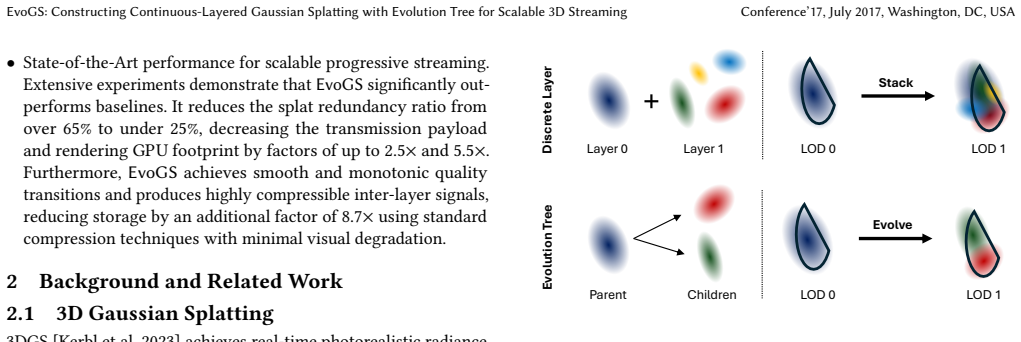
EvoGS is the first continuous-layering representation for 3D Gaussian Splatting. Organized as an Evolution Tree, EvoGS generates finer details via an explicit, wavelet-inspired parent-child refinement. This empowers child nodes to structurally correct ancestral errors, yield inherently sparse and highly compressible inter-layer signals.
What carries the argument
The Evolution Tree, a hierarchical parent-child structure that uses wavelet-inspired refinement signals so each child can correct errors from its ancestors and add detail without duplicating prior splats.
If this is right
- Splat redundancy falls from over 65 percent to under 25 percent.
- Transmission payload shrinks by up to 2.4 times compared with state-of-the-art baselines.
- GPU VRAM footprint drops by up to 5.5 times.
- Quality transitions remain smooth and suitable for real-time adaptive streaming.
Where Pith is reading between the lines
- The tree could let a streaming client fetch only the branches needed for the current viewpoint, further trimming bandwidth.
- If the refinement truly removes rather than hides error, the same tree might support higher final quality at the same data budget.
- Similar hierarchical correction could be tried in other splat or point-cloud streaming systems that currently rely on independent layers.
Load-bearing premise
The parent-child refinement actually corrects ancestral errors and can be built and decoded fast enough for real-time streaming rather than merely reorganizing the same splats.
What would settle it
A side-by-side measurement of redundancy percentage, transmitted bytes, and VRAM use when streaming the same scene with EvoGS versus a discrete-layer baseline, checking whether the claimed drops to under 25 percent redundancy and 2.4×/5.5× savings appear.
Figures




read the original abstract
Streaming 3D Gaussian Splatting requires highly scalable, progressive representations. Existing progressive methods rely on \textit{discrete layering}, accumulating separate splat sets for each level of detail. This structural independence between layers inherently leads to error accumulation, severe splat redundancy, and uncontrolled quality transitions. We propose EvoGS, the first \textit{continuous-layering} representation. Organized as an Evolution Tree, EvoGS generates finer details via an explicit, wavelet-inspired parent-child refinement. This empowers child nodes to structurally correct ancestral errors, yield inherently sparse and highly compressible inter-layer signals. Extensive experiments show EvoGS eliminates splat redundancy from over 65\% to under 25\%. Compared to state-of-the-art baselines, it reduces transmission payload and GPU VRAM footprint by up to 2.4$\times$ and 5.5$\times$, respectively, and achieves smooth quality transitions optimal for real-time adaptive streaming. Project page: https://yuang-ian.github.io/evogs/
Editorial analysis
A structured set of objections, weighed in public.
Referee Report
Summary. The manuscript introduces EvoGS as the first continuous-layering representation for streaming 3D Gaussian Splatting. It organizes splats into an Evolution Tree that employs wavelet-inspired parent-child refinement, allowing child nodes to structurally correct ancestral errors and produce sparse, compressible inter-layer signals. The work claims this eliminates splat redundancy (from over 65% to under 25%), reduces transmission payload and GPU VRAM by up to 2.4× and 5.5× versus state-of-the-art baselines, and yields smooth quality transitions suitable for real-time adaptive streaming.
Significance. If the Evolution Tree mechanism genuinely enables error-correcting refinement rather than simple reorganization, the approach could meaningfully advance progressive 3D representations by addressing redundancy and quality-transition problems inherent to discrete layering. The reported resource reductions would be practically relevant for bandwidth-constrained streaming scenarios.
major comments (1)
- The central claim that parent-child refinement 'structurally corrects ancestral errors' (rather than reorganizing the same splats) is load-bearing for the redundancy-reduction and sparsity arguments, yet the provided manuscript text supplies neither the explicit refinement equations nor the decoding procedure that would allow verification of this distinction.
minor comments (1)
- The abstract references 'extensive experiments' and specific quantitative gains but does not identify the datasets, baseline methods, or error metrics used; these details are required to assess whether the reported 2.4×/5.5× improvements are comparable.
Simulated Author's Rebuttal
We thank the referee for the constructive comment highlighting the need for explicit formalization of the core mechanism. We address the point below and will update the manuscript accordingly.
read point-by-point responses
-
Referee: The central claim that parent-child refinement 'structurally corrects ancestral errors' (rather than reorganizing the same splats) is load-bearing for the redundancy-reduction and sparsity arguments, yet the provided manuscript text supplies neither the explicit refinement equations nor the decoding procedure that would allow verification of this distinction.
Authors: We agree that explicit refinement equations and the decoding procedure are required to substantiate the distinction between structural error correction and reorganization. The manuscript describes the Evolution Tree and wavelet-inspired parent-child refinement conceptually (Section 3), but does not present closed-form equations for the residual correction applied by child nodes or the layer-by-layer decoding steps. In the revised manuscript we will add these in a new subsection, including the mathematical update rules for child splat attributes based on parent residuals and pseudocode for the decoding process. This will enable verification that inter-layer signals represent corrections rather than redundant splats. revision: yes
Circularity Check
No significant circularity detected
full rationale
The paper introduces EvoGS as a novel continuous-layering Gaussian Splatting representation organized via an Evolution Tree with wavelet-inspired parent-child refinement. No equations, derivations, or first-principles predictions appear in the provided abstract or description that reduce by construction to fitted inputs, self-definitions, or self-citation chains. Claims of reduced redundancy and improved streaming are presented as empirical outcomes from experiments, not as tautological outputs of the method definition itself. The central mechanism is described as an independent structural choice evaluated against external baselines, making the derivation self-contained without circular reduction.
Axiom & Free-Parameter Ledger
Reference graph
Works this paper leans on
-
[1]
3D Gaussian Splatting for Real -Time Radiance Field Rendering,
Bernhard Kerbl and Georgios Kopanas and Thomas Leimk. 2023 , url =. doi:10.1145/3592433 , timestamp =
-
[2]
Zhiwen Fan and Kevin Wang and Kairun Wen and Zehao Zhu and Dejia Xu and Zhangyang Wang , title =. CoRR , volume =. 2023 , url =. doi:10.48550/ARXIV.2311.17245 , eprinttype =. 2311.17245 , timestamp =
-
[3]
Vbench: Comprehensive benchmark suite for video generative models
Tao Lu and Mulin Yu and Linning Xu and Yuanbo Xiangli and Limin Wang and Dahua Lin and Bo Dai , title =. 2024 , url =. doi:10.1109/CVPR52733.2024.01952 , timestamp =
-
[4]
Vbench: Comprehensive benchmark suite for video generative models
Yiwen Chen and Zilong Chen and Chi Zhang and Feng Wang and Xiaofeng Yang and Yikai Wang and Zhongang Cai and Lei Yang and Huaping Liu and Guosheng Lin , title =. 2024 , url =. doi:10.1109/CVPR52733.2024.02029 , timestamp =
-
[5]
Yang Liu and Chuanchen Luo and Lue Fan and Naiyan Wang and Junran Peng and Zhaoxiang Zhang , editor =. Computer Vision -. 2024 , url =. doi:10.1007/978-3-031-72640-8\_15 , timestamp =
-
[6]
Vbench: Comprehensive benchmark suite for video generative models
Zhiwen Yan and Weng Fei Low and Yu Chen and Gim Hee Lee , title =. 2024 , url =. doi:10.1109/CVPR52733.2024.01977 , timestamp =
-
[7]
Bernhard Kerbl and Andreas Meuleman and Georgios Kopanas and Michael Wimmer and Alexandre Lanvin and George Drettakis , title =. 2024 , url =. doi:10.1145/3658160 , timestamp =
-
[8]
Kerui Ren and Lihan Jiang and Tao Lu and Mulin Yu and Linning Xu and Zhangkai Ni and Bo Dai , title =. CoRR , volume =. 2024 , url =. doi:10.48550/ARXIV.2403.17898 , eprinttype =. 2403.17898 , timestamp =
-
[9]
Matthias Zwicker and Hanspeter Pfister and Jeroen van Baar and Markus H. Gross , editor =. 12th. 2001 , url =. doi:10.1109/VISUAL.2001.964490 , timestamp =
-
[10]
Proceedings of the 15th
Yuang Shi and Bennett Clement and Wei Tsang Ooi , title =. Proceedings of the 15th
-
[11]
International Conference on 3D Vision, 3DV 2025, Singapore, March 25-28, 2025 , pages =
Yuang Shi and G. International Conference on 3D Vision, 3DV 2025, Singapore, March 25-28, 2025 , pages =
2025
-
[12]
Proceedings of the 16th
Yuan. Proceedings of the 16th
-
[13]
Proceedings of the 3rd Workshop on Emerging Multimedia Systems,
Nehal Baganal Krishna and Yuang Shi and Wei Tsang Ooi and Amr Rizk , title =. Proceedings of the 3rd Workshop on Emerging Multimedia Systems,. 2025 , XXcrossref =. doi:10.1145/3746441.3748225 , timestamp =
-
[14]
Proceedings of the 31st Annual International Conference on Mobile Computing and Networking,
Yi. Proceedings of the 31st Annual International Conference on Mobile Computing and Networking,
-
[15]
Sketch and Patch: Efficient 3D Gaussian Representation for Man-Made Scenes , booktitle =
Yuang Shi and Simone Gasparini and G. Sketch and Patch: Efficient 3D Gaussian Representation for Man-Made Scenes , booktitle =
-
[16]
Proceedings of the 16th
Yuang Shi , title =. Proceedings of the 16th
-
[17]
Taubman and Michael W
David S. Taubman and Michael W. Marcellin , title =. Proc
-
[18]
1996 , issn =
The Lifting Scheme: A Custom-Design Construction of Biorthogonal Wavelets , journal =. 1996 , issn =
1996
-
[19]
Yuang Shi and G. Sketch. CoRR , volume =
-
[20]
Jianxiong Shen and Yue Qian and Xiaohang Zhan , title =
-
[21]
CoRR , volume =
Guanghao Li and Kerui Ren and Linning Xu and Zhewen Zheng and Changjian Jiang and Xin Gao and Bo Dai and Jian Pu and Mulin Yu and Jiangmiao Pang , title =. CoRR , volume =
-
[22]
Yihang Chen and Qianyi Wu and Weiyao Lin and Mehrtash Harandi and Jianfei Cai , title =
-
[23]
Jiongming Qin and Kaixuan Zhou and Yu Jiang and Huizhi Zhu and Fei Luo and Chunxia Xiao , title =
-
[24]
Yifan Wang and Mufan Liu and Qi Yang and He Huang and Le Yang and Yiling Xu , title =
-
[25]
Adaptive
Gong, Han and Li, Qiyue and Liu, Zhi and Zhou, Hao and Zhou, Peng Yuan and Li, Zhu and Li, Jie , journal=. Adaptive. 2025 , publisher=
2025
-
[26]
Proceedings of the 31st Annual International Conference on Mobile Computing and Networking,
Gunjoong Kim and Seonghoon Park and Jeho Lee and Chanyoung Jung and Hyungchol Jun and Hojung Cha , title =. Proceedings of the 31st Annual International Conference on Mobile Computing and Networking,
-
[27]
MobiCom '20: The 26th Annual International Conference on Mobile Computing and Networking, London, United Kingdom, September 21-25, 2020 , pages =
Bo Han and Yu Liu and Feng Qian , title =. MobiCom '20: The 26th Annual International Conference on Mobile Computing and Networking, London, United Kingdom, September 21-25, 2020 , pages =
2020
-
[28]
Immersive Video Technologies , publisher =
Chapter 15 - Volumetric video streaming: Current approaches and implementations , editor =. Immersive Video Technologies , publisher =. 2023 , isbn =
2023
-
[29]
Immersive Video Technologies , publisher =
Chapter 11 - Volumetric video – acquisition, interaction, streaming and rendering , editor =. Immersive Video Technologies , publisher =. 2023 , isbn =
2023
-
[30]
Srinivasan and Matthew Tancik and Jonathan T
Ben Mildenhall and Pratul P. Srinivasan and Matthew Tancik and Jonathan T. Barron and Ravi Ramamoorthi and Ren Ng , editor =. Computer Vision -
-
[31]
Barron and Ben Mildenhall and Dor Verbin and Pratul P
Jonathan T. Barron and Ben Mildenhall and Dor Verbin and Pratul P. Srinivasan and Peter Hedman , title =
-
[32]
Tanks and temples: benchmarking large-scale scene reconstruction , journal =
Arno Knapitsch and Jaesik Park and Qian. Tanks and temples: benchmarking large-scale scene reconstruction , journal =
-
[33]
Deep blending for free-viewpoint image-based rendering , journal =
Peter Hedman and Julien Philip and True Price and Jan. Deep blending for free-viewpoint image-based rendering , journal =
-
[34]
Zstandard compression and the application/zstd media type , author=
discussion (0)
Sign in with ORCID, Apple, or X to comment. Anyone can read and Pith papers without signing in.