The Manticore Project II: Bayesian digital twins of cosmic structure across the SDSS and BOSS volumes
Pith reviewed 2026-06-27 15:23 UTC · model grok-4.3
The pith
Bayesian reconstruction of cosmic structure over a (4 Gpc/h)^3 volume from five galaxy surveys produces LCDM-consistent initial conditions and density fields.
A machine-rendered reading of the paper's core claim, the machinery that carries it, and where it could break.
Core claim
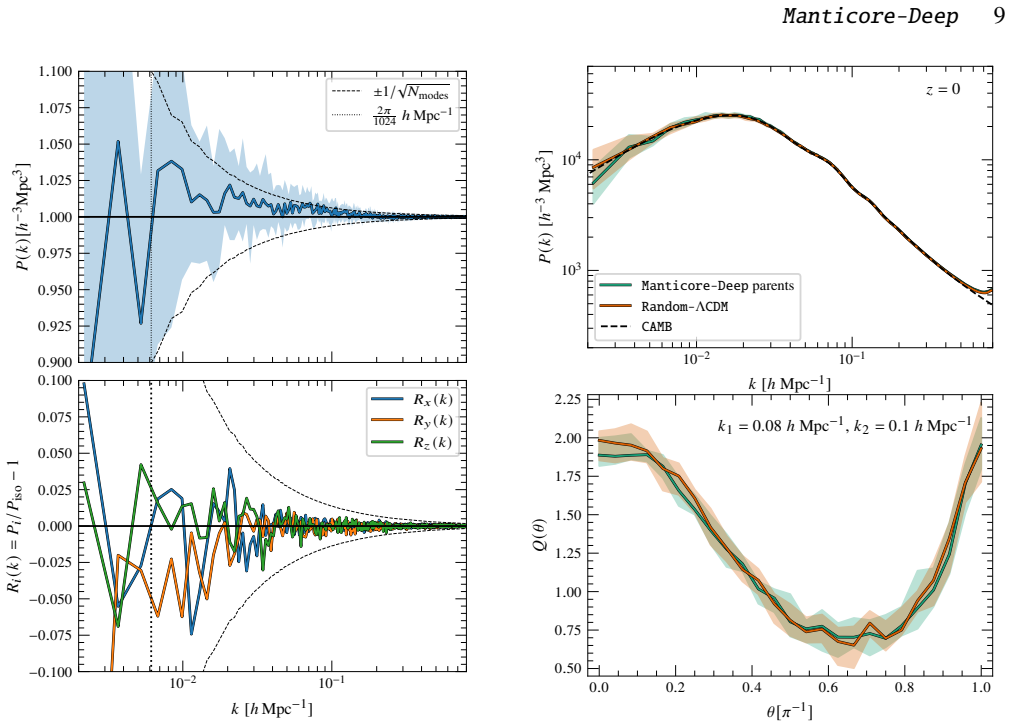
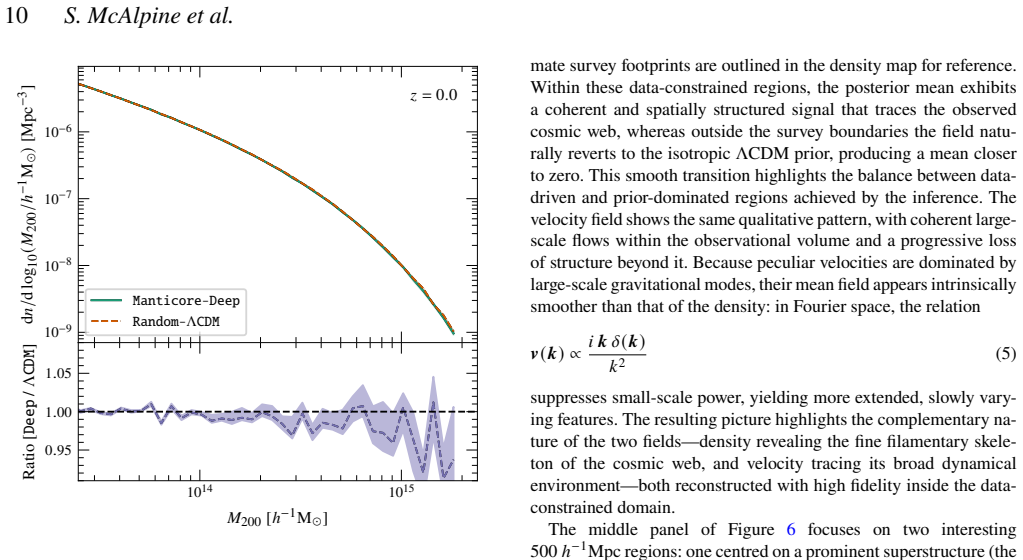
The posterior realisations are statistically consistent with LCDM, exhibiting Gaussian, isotropic initial conditions and evolving into late-time structures that reproduce the expected z=0 matter power spectrum, bispectrum, and halo mass function across the resolved scales tested, with the BOSS Great Wall recovered as a ~3σ overdensity in all realisations.
What carries the argument
The BORG algorithm combined with a novel tiled inference strategy that jointly constrains five distinct galaxy surveys while preserving long-range gravitational correlations across the full volume.
If this is right
- The reconstructed fields can be used to predict and test higher-order statistics of large-scale structure without additional assumptions.
- The same posterior ensemble supplies velocity fields that align with observed cluster motions as confirmed by the recession-split kSZ test.
- The method enables consistent inclusion of additional surveys or higher-resolution data within the existing hierarchical framework.
- Recovery of individual structures like the BOSS Great Wall at ~3σ in every realisation provides a direct test of whether observed overdensities are typical under LCDM.
Where Pith is reading between the lines
- The volume increase could allow tighter constraints on primordial non-Gaussianity if the initial-condition statistics are examined at larger scales.
- Combining the density and velocity posteriors with future spectroscopic or intensity-mapping surveys would test consistency of growth rate measurements across independent tracers.
- The approach supplies a ready-made ensemble of initial conditions for resimulations that could quantify the impact of cosmic variance on small-scale observables.
Load-bearing premise
The tiled inference strategy preserves long-range gravitational correlations and avoids boundary artifacts while jointly modeling selection functions and biases across the five surveys.
What would settle it
A direct comparison showing that the reconstructed matter power spectrum, bispectrum, or halo mass function deviates from LCDM predictions on resolved scales, or that the cross-correlation with Planck CMB lensing falls below the reported 7.4σ significance.
Figures

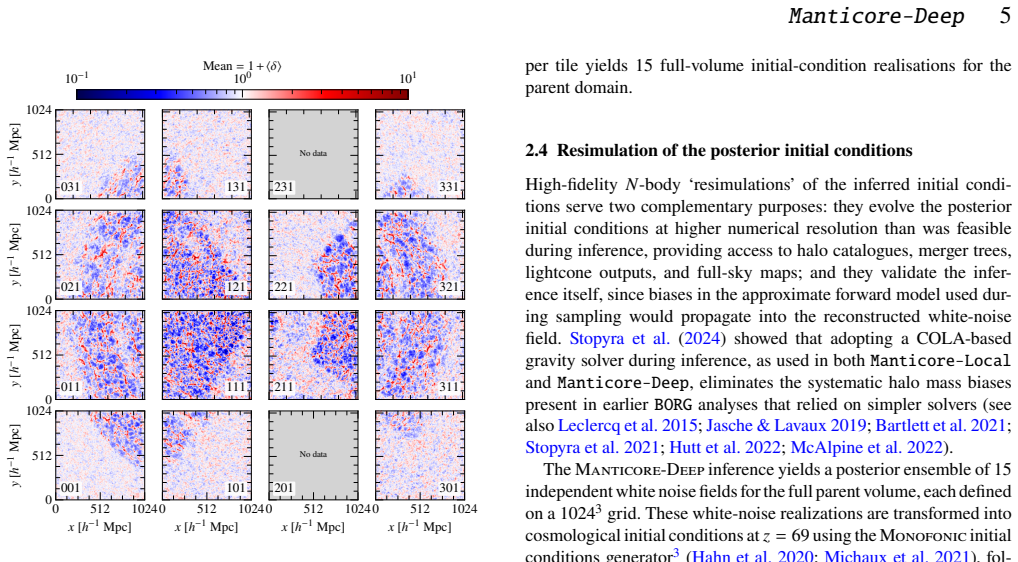

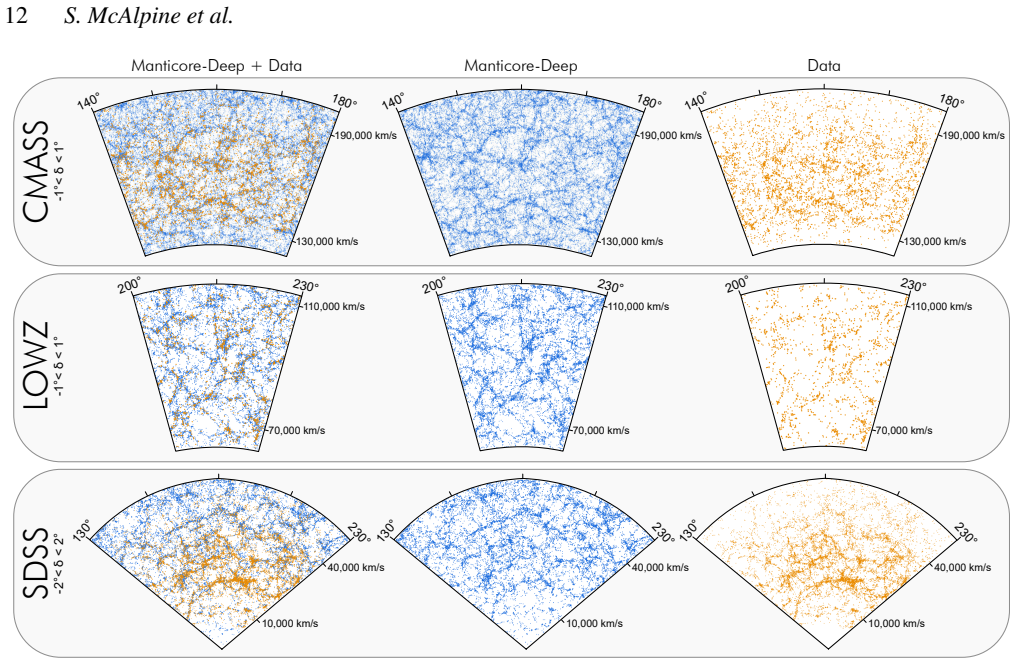


read the original abstract
We present Manticore-Deep, a high-resolution Bayesian field-level inference of cosmic large-scale structure spanning a comoving volume of $(4~h^{-1}\mathrm{Gpc})^{3}$ out to $z \approx 0.7$, at ${\sim}4$~Mpc/h resolution. Building on the inference framework established in the companion Manticore-Local analysis (P1), Manticore-Deep jointly constrains five galaxy redshift surveys (2M++, 6dFGS, 2dFGRS, SDSS, and BOSS) within a single hierarchical Bayesian framework using the BORG algorithm. The method infers initial conditions that are evolved forward under gravitational dynamics, delivering a full posterior ensemble of three-dimensional density and velocity fields that causally reproduce the observed large-scale structure. A novel tiled inference strategy makes this computation feasible, extending the reconstructed volume by more than an order of magnitude beyond P1. The posterior realisations are statistically consistent with LCDM, exhibiting Gaussian, isotropic initial conditions and evolving into late-time structures that reproduce the expected $z=0$ matter power spectrum, bispectrum, and halo mass function across the resolved scales tested. We validate the physical fidelity of the reconstruction through two independent, template-free posterior-predictive tests against observations not used in the inference. Cross-correlation of the reconstructed matter field with the Planck PR3 CMB lensing map yields a conservative cumulative detection significance of 7.4$\sigma$, while velocity-weighted stacking of $64750$ galaxy clusters on the Planck 217~GHz map produces a kSZ detection at $3.5\sigma$, with a model-independent approach--recession split confirming that the inferred velocities are statistically aligned with the true cluster motions. As a case study, we show that the BOSS Great Wall is recovered as a ${\sim}3\sigma$ overdensity consistent with LCDM across all posterior realisations.
Editorial analysis
A structured set of objections, weighed in public.
Referee Report
Summary. The paper presents Manticore-Deep, a Bayesian field-level inference using the BORG algorithm on five galaxy redshift surveys (2M++, 6dFGS, 2dFGRS, SDSS, BOSS) over a (4 h^{-1} Gpc)^3 comoving volume to z≈0.7 at ~4 Mpc/h resolution. It introduces a novel tiled inference strategy to jointly model selection functions and biases, producing posterior ensembles of initial conditions, density, and velocity fields. The reconstructions are reported to be statistically consistent with LCDM (Gaussian isotropic ICs, matching z=0 power spectrum, bispectrum, and halo mass function), with external validations via 7.4σ cross-correlation with Planck PR3 CMB lensing and 3.5σ kSZ detection from velocity-weighted stacking on the 217 GHz map, plus recovery of the BOSS Great Wall as a ~3σ overdensity.
Significance. If the central claims hold, this represents a substantial advance by extending Bayesian LSS reconstruction over an order-of-magnitude larger volume than prior work while delivering falsifiable posterior-predictive tests against independent Planck data (CMB lensing and kSZ). The external grounding of the velocity and density fields strengthens the consistency-with-LCDM result beyond internal statistics alone.
major comments (1)
- [Abstract] Abstract (and the description of the tiled inference strategy): the central LCDM-consistency claims (matching z=0 power spectrum, bispectrum, halo mass function, plus 7.4σ lensing and 3.5σ kSZ significances) rest on the assumption that the novel tiled strategy preserves long-range gravitational correlations without boundary artifacts. No quantitative test is described (e.g., cross-tile power-spectrum continuity, correlation-function recovery on scales exceeding tile size, or suppression of largest-scale modes), which is load-bearing for the claim that the posterior realisations are data-driven rather than prior-driven.
minor comments (1)
- [Abstract] Abstract: the reported 7.4σ and 3.5σ significances are presented without accompanying details on data cuts, error modeling, or the precise posterior-predictive procedure; these should be expanded for reproducibility.
Simulated Author's Rebuttal
We thank the referee for their careful reading of the manuscript and for their positive assessment of its significance. We address the single major comment below.
read point-by-point responses
-
Referee: [Abstract] Abstract (and the description of the tiled inference strategy): the central LCDM-consistency claims (matching z=0 power spectrum, bispectrum, halo mass function, plus 7.4σ lensing and 3.5σ kSZ significances) rest on the assumption that the novel tiled strategy preserves long-range gravitational correlations without boundary artifacts. No quantitative test is described (e.g., cross-tile power-spectrum continuity, correlation-function recovery on scales exceeding tile size, or suppression of largest-scale modes), which is load-bearing for the claim that the posterior realisations are data-driven rather than prior-driven.
Authors: We agree that explicit quantitative validation of the tiled strategy's impact on long-range modes is important for supporting the LCDM-consistency claims. The manuscript describes the overlapping-tile construction in Section 3.2 as a means to maintain gravitational correlations across boundaries, but we acknowledge that dedicated tests (such as cross-tile power-spectrum continuity or correlation-function recovery on scales larger than individual tiles) are not presented. In the revised manuscript we will add a new subsection (or appendix) containing these tests on both mock catalogues and the real data, including measurements of the largest-scale modes and a direct comparison of the recovered power spectrum and bispectrum with and without the tiling. This addition will directly address the load-bearing assumption identified by the referee. revision: yes
Circularity Check
No circularity: external Planck validations and forward-model consistency checks are independent of the tiled inference inputs.
full rationale
The derivation chain infers initial conditions via BORG from five galaxy surveys, then forward-evolves under gravity to produce density/velocity fields. The LCDM-consistency claims (power spectrum, bispectrum, halo mass function) and the 7.4σ lensing / 3.5σ kSZ detections are tested against Planck PR3 maps and 217 GHz data explicitly not used in the inference. The novel tiled strategy is a computational extension of the P1 framework; no equation or result reduces by construction to a fitted parameter or self-citation. The posterior ensemble is compared to external observations, satisfying the independence criterion for a score of 0.
Axiom & Free-Parameter Ledger
free parameters (2)
- grid resolution =
~4 Mpc/h
- reconstructed volume =
(4 h^{-1} Gpc)^3
axioms (2)
- domain assumption Gravitational evolution follows LCDM dynamics
- domain assumption Galaxy surveys can be jointly modeled in one hierarchical Bayesian framework
Reference graph
Works this paper leans on
-
[1]
Planck 2015 results. XXII. A map of the thermal Sunyaev-Zeldovich effect. , keywords =. doi:10.1051/0004-6361/201525826 , archivePrefix =. 1502.01596 , primaryClass =
work page internal anchor Pith review Pith/arXiv arXiv doi:10.1051/0004-6361/201525826 2015
-
[2]
The DESI Experiment Part I: Science,Targeting, and Survey Design
The DESI Experiment Part I: Science, Targeting, and Survey Design. arXiv e-prints , keywords =. doi:10.48550/arXiv.1611.00036 , archivePrefix =. 1611.00036 , primaryClass =
work page internal anchor Pith review Pith/arXiv arXiv doi:10.48550/arxiv.1611.00036
-
[3]
The Atacama Cosmology Telescope: A Measurement of the DR6 kSZ Power Spectrum. arXiv e-prints , keywords =. doi:10.48550/arXiv.2405.07883 , archivePrefix =. 2405.07883 , primaryClass =
-
[4]
On the connectivity of the cosmic web: theory and implications for cosmology and galaxy formation
On the connectivity of the cosmic web: theory and implications for cosmology and galaxy formation. , keywords =. doi:10.1093/mnras/sty1643 , archivePrefix =. 1803.11477 , primaryClass =
work page internal anchor Pith review Pith/arXiv arXiv doi:10.1093/mnras/sty1643
-
[5]
ELUCID. VIII. Simulating the Coma Galaxy Cluster to Calibrate Model and Understand Feedback. , keywords =. doi:10.3847/1538-4357/ad392e , archivePrefix =. 2401.14730 , primaryClass =
-
[6]
Velocity fields and turbulence from cosmic filaments to galaxy clusters. arXiv e-prints , keywords =. doi:10.48550/arXiv.2501.09573 , archivePrefix =. 2501.09573 , primaryClass =
-
[7]
ELUCID. VII. Using Constrained Hydro Simulations to Explore the Gas Component of the Cosmic Web. , keywords =. doi:10.3847/1538-4357/ac8359 , archivePrefix =. 2206.08384 , primaryClass =
-
[8]
Multiscale phenomenology of the cosmic web. , keywords =. doi:10.1111/j.1365-2966.2010.17263.x , archivePrefix =. 1007.0742 , primaryClass =
-
[9]
Intercluster filaments in a CDM Universe. , keywords =. doi:10.1111/j.1365-2966.2005.08897.x , archivePrefix =. astro-ph/0406665 , primaryClass =
-
[10]
Intercluster filaments of galaxies programme: abundance and distribution of filaments in the 2dFGRS catalogue. , keywords =. doi:10.1111/j.1365-2966.2004.08425.x , archivePrefix =. astro-ph/0409576 , primaryClass =
-
[11]
Yves-Henri Sanejouand , keywords =. A robust assessment of the local anisotropy of the Hubble constant in the Pantheon+ sample , journal =. 2025 , issn =. doi:https://doi.org/10.1016/j.newast.2024.102331 , url =
-
[12]
A 5.7 detection confirming the existence of a possibly dark matter related CMB foreground in nearby cosmic filaments. arXiv e-prints , keywords =. doi:10.48550/arXiv.2411.15307 , archivePrefix =. 2411.15307 , primaryClass =
-
[13]
A possible common explanation for several cosmic microwave background (CMB) anomalies: A strong impact of nearby galaxies on observed large-scale CMB fluctuations. , keywords =. doi:10.1051/0004-6361/202346779 , archivePrefix =. 2305.00268 , primaryClass =
-
[14]
The DES view of the Eridanus supervoid and the CMB cold spot. , keywords =. doi:10.1093/mnras/stab3309 , archivePrefix =. 2112.07699 , primaryClass =
-
[15]
The Hubble Tension in our own Backyard: DESI and the Nearness of the Coma Cluster. arXiv e-prints , keywords =. doi:10.48550/arXiv.2409.14546 , archivePrefix =. 2409.14546 , primaryClass =
-
[16]
Simulations of the merging galaxy cluster Abell 2034: what determines the level of separation between gas and dark matter. , keywords =. doi:10.1093/mnras/staa3399 , archivePrefix =. 2010.14906 , primaryClass =
-
[17]
An N-body/hydrodynamical simulation study of the merging cluster El Gordo: A compelling case for self-interacting dark matter?. , keywords =. doi:10.1051/0004-6361/202348000 , archivePrefix =. 2309.10374 , primaryClass =
-
[18]
Multi-phenomena Modeling of the New Bullet-like Cluster ZwCl 008.8+52 Using N-body/Hydrodynamical Simulations. , keywords =. doi:10.3847/1538-4357/aad04c , archivePrefix =. 1712.06887 , primaryClass =
work page internal anchor Pith review Pith/arXiv arXiv doi:10.3847/1538-4357/aad04c
-
[19]
Constrained Simulation of the Bullet Cluster
Constrained Simulation of the Bullet Cluster. , keywords =. doi:10.1088/0004-637X/787/2/144 , archivePrefix =. 1312.0959 , primaryClass =
work page internal anchor Pith review Pith/arXiv arXiv doi:10.1088/0004-637x/787/2/144
-
[20]
Optimal machine-driven acquisition of future cosmological data. , keywords =. doi:10.1051/0004-6361/202141706 , archivePrefix =. 2107.00657 , primaryClass =
-
[21]
Revisiting the CMB large-scale anomalies: The impact of the Sunyaev-Zeldovich signal from the Local Universe. , keywords =. doi:10.1051/0004-6361/202451238 , archivePrefix =. 2406.11543 , primaryClass =
-
[22]
The local hole: a galaxy underdensity covering 90 per cent of sky to 200 Mpc. , keywords =. doi:10.1093/mnras/stac396 , archivePrefix =. 2107.08505 , primaryClass =
-
[24]
On the least action principle in cosmology. , keywords =. doi:10.1046/j.1365-8711.2000.03261.x , archivePrefix =. astro-ph/9908167 , primaryClass =
-
[25]
Dynamics of the Local Universe: cosmic velocity flows and voids
Dynamics of the Local Universe: cosmic velocity flows and voids. Invisible Universe , year = 2010, editor =. doi:10.1063/1.3462593 , archivePrefix =. 0912.0516 , primaryClass =
work page internal anchor Pith review Pith/arXiv arXiv doi:10.1063/1.3462593 2010
-
[26]
Reconstruction of cosmological initial conditions from galaxy redshift catalogues. , keywords =. doi:10.1046/j.1365-8711.1999.02747.x , archivePrefix =. astro-ph/9902119 , primaryClass =
-
[27]
Posterior sampling of the initial conditions of the universe from non-linear large scale structures using score-based generative models. , keywords =. doi:10.1093/mnrasl/slad152 , archivePrefix =. 2304.03788 , primaryClass =
-
[29]
Supernovae evidence for foundational change to cosmological models. , keywords =. doi:10.1093/mnrasl/slae112 , archivePrefix =. 2412.15143 , primaryClass =
-
[30]
First investigation of void statistics in numerical relativity simulations. , keywords =. doi:10.1093/mnras/stae2737 , archivePrefix =. 2403.15134 , primaryClass =
-
[31]
Classical and Quantum Gravity , keywords =
Is the observable Universe consistent with the cosmological principle?. Classical and Quantum Gravity , keywords =. doi:10.1088/1361-6382/acbefc , archivePrefix =. 2207.05765 , primaryClass =
-
[32]
Larger H _ 0 values in the CMB dipole direction. , keywords =. doi:10.1103/PhysRevD.105.103510 , archivePrefix =. 2108.13228 , primaryClass =
-
[33]
Like a spider in its web: a study of the large-scale structure around the Coma cluster. , keywords =. doi:10.1051/0004-6361/201936629 , archivePrefix =. 1910.11879 , primaryClass =
-
[34]
Pre-processing of galaxies in cosmic filaments around AMASCFI clusters in the CFHTLS. , keywords =. doi:10.1051/0004-6361/201935394 , archivePrefix =. 1903.02879 , primaryClass =
-
[35]
Tree structure of the percolating Universe
Tree Structure of a Percolating Universe. , keywords =. doi:10.1103/PhysRevLett.85.5515 , archivePrefix =. astro-ph/0011293 , primaryClass =
work page internal anchor Pith review Pith/arXiv arXiv doi:10.1103/physrevlett.85.5515
-
[36]
Path Integral Methods for Primordial Density Perturbations: Sampling of Constrained Gaussian Random Fields. , keywords =. doi:10.1086/185066 , adsurl =
-
[37]
Constrained Realizations of Gaussian Fields: A Simple Algorithm. , keywords =. doi:10.1086/186160 , adsurl =
-
[38]
Simulating the formation of the local galaxy population. , keywords =. doi:10.1046/j.1365-8711.2002.05447.x , archivePrefix =. astro-ph/0111099 , primaryClass =
-
[39]
ELUCID Exploring the Local Universe with the Reconstructed Initial Density Field. I. Hamiltonian Markov Chain Monte Carlo Method with Particle Mesh Dynamics. , keywords =. doi:10.1088/0004-637X/794/1/94 , archivePrefix =. 1407.3451 , primaryClass =
work page internal anchor Pith review Pith/arXiv arXiv doi:10.1088/0004-637x/794/1/94
-
[40]
ELUCID - Exploring the Local Universe with ReConstructed Initial Density Field III: Constrained Simulation in the SDSS Volume. , keywords =. doi:10.3847/0004-637X/831/2/164 , archivePrefix =. 1608.01763 , primaryClass =
work page internal anchor Pith review Pith/arXiv arXiv doi:10.3847/0004-637x/831/2/164
-
[41]
Galaxy Clusters and the Amplitude of Primordial Fluctuations. , keywords =. doi:10.1086/168439 , adsurl =
-
[42]
The observed infall of galaxies towards the Virgo cluster. , keywords =. doi:10.1111/j.1365-2966.2010.16501.x , archivePrefix =. 1002.2085 , primaryClass =
-
[43]
The rapid growth phase of supermassive black holes
The rapid growth phase of supermassive black holes. , keywords =. doi:10.1093/mnras/sty2489 , archivePrefix =. 1805.08293 , primaryClass =
work page internal anchor Pith review Pith/arXiv arXiv doi:10.1093/mnras/sty2489
-
[44]
The Velocity Dispersion Function of Very Massive Galaxy Clusters: Abell 2029 and Coma
The Velocity Dispersion Function of Very Massive Galaxy Clusters: Abell 2029 and Coma. , keywords =. doi:10.3847/1538-4365/aa653e , archivePrefix =. 1612.06428 , primaryClass =
work page internal anchor Pith review Pith/arXiv arXiv doi:10.3847/1538-4365/aa653e 2029
-
[45]
Infall Regions of Galaxy Clusters
Infall Regions of Galaxy Clusters. , keywords =. doi:10.1086/304075 , archivePrefix =. astro-ph/9701034 , primaryClass =
work page internal anchor Pith review Pith/arXiv arXiv doi:10.1086/304075
-
[46]
The Next Generation Virgo Cluster Survey (NGVS). I. Introduction to the Survey. , keywords =. doi:10.1088/0067-0049/200/1/4 , adsurl =
-
[47]
Virgo Dwarfs: New Light on Faint Galaxies. , keywords =. doi:10.1086/166500 , adsurl =
-
[48]
Spectroscopic Determination of the Luminosity Function in the Galaxy Clusters A2199 and Virgo. , keywords =. doi:10.1088/0004-6256/135/5/1837 , archivePrefix =. 0710.1082 , primaryClass =
work page internal anchor Pith review Pith/arXiv arXiv doi:10.1088/0004-6256/135/5/1837
-
[49]
The ACS Fornax Cluster Survey. V. Measurement and Recalibration of Surface Brightness Fluctuations and a Precise Value of the Fornax-Virgo Relative Distance. , keywords =. doi:10.1088/0004-637X/694/1/556 , archivePrefix =. 0901.1138 , primaryClass =
work page internal anchor Pith review Pith/arXiv arXiv doi:10.1088/0004-637x/694/1/556
-
[50]
Astronomy Letters , keywords =
Investigation of properties of galaxy clusters in the Hercules supercluster region. Astronomy Letters , keywords =. doi:10.1134/S1063773712120043 , adsurl =
-
[51]
Planck 2018 results. I. Overview and the cosmological legacy of Planck. , keywords =. doi:10.1051/0004-6361/201833880 , archivePrefix =. 1807.06205 , primaryClass =
work page internal anchor Pith review Pith/arXiv arXiv doi:10.1051/0004-6361/201833880 2018
-
[52]
Dark Halos of M31 and the Milky Way
Dark halos of M 31 and the Milky Way. , keywords =. doi:10.1093/pasj/psv042 , archivePrefix =. 1504.05368 , primaryClass =
work page internal anchor Pith review Pith/arXiv arXiv doi:10.1093/pasj/psv042
-
[53]
The Transverse velocity of the Andromeda system, derived from the M31 satellite population
The transverse velocity of the Andromeda system, derived from the M31 satellite population. , keywords =. doi:10.1093/mnras/stv2865 , archivePrefix =. 1512.02245 , primaryClass =
work page internal anchor Pith review Pith/arXiv arXiv doi:10.1093/mnras/stv2865
-
[54]
First Gaia Dynamics of the Andromeda System: DR2 Proper Motions, Orbits, and Rotation of M31 and M33
First Gaia Dynamics of the Andromeda System: DR2 Proper Motions, Orbits, and Rotation of M31 and M33. , keywords =. doi:10.3847/1538-4357/ab001b , archivePrefix =. 1805.04079 , primaryClass =
work page internal anchor Pith review Pith/arXiv arXiv doi:10.3847/1538-4357/ab001b
-
[55]
Cepheid Period-Luminosity Relations in the Near-infrared and the Distance to M31 from the Hubble Space Telescope Wide Field Camera 3. , keywords =. doi:10.1088/0004-637X/745/2/156 , archivePrefix =. 1110.3769 , primaryClass =
work page internal anchor Pith review Pith/arXiv arXiv doi:10.1088/0004-637x/745/2/156
-
[56]
Galaxy formation in WMAP1 and WMAP7 cosmologies
Galaxy formation in WMAP1 and WMAP7 cosmologies. , keywords =. doi:10.1093/mnras/sts115 , archivePrefix =. 1206.0052 , primaryClass =
work page internal anchor Pith review Pith/arXiv arXiv doi:10.1093/mnras/sts115
-
[57]
Horizon Run 4 Simulation: Coupled Evolution of Galaxies and Large-scale Structures of the Universe
Horizon Run 4 Simulation: Coupled Evolution of Galaxies and Large-Scale Structures of the Universe. Journal of Korean Astronomical Society , keywords =. doi:10.5303/JKAS.2015.48.4.213 , archivePrefix =. 1508.05107 , primaryClass =
work page internal anchor Pith review Pith/arXiv arXiv doi:10.5303/jkas.2015.48.4.213 2015
-
[58]
Sample variance in the local measurements of the Hubble constant
Sample variance in the local measurements of the Hubble constant. , keywords =. doi:10.1093/mnras/stx1967 , archivePrefix =. 1706.09723 , primaryClass =
work page internal anchor Pith review Pith/arXiv arXiv doi:10.1093/mnras/stx1967
-
[59]
The KBC Void: Consistency with Supernovae Type Ia and the Kinematic SZ Effect in a LTB Model. , keywords =. doi:10.3847/1538-4357/aaa59b , archivePrefix =. 1801.01890 , primaryClass =
work page internal anchor Pith review Pith/arXiv arXiv doi:10.3847/1538-4357/aaa59b
-
[60]
Observational evidence for a local underdensity in the Universe and its effect on the measurement of the Hubble constant. , keywords =. doi:10.1051/0004-6361/201936400 , archivePrefix =. 1907.12402 , primaryClass =
-
[61]
The Local Hole revealed by galaxy counts and redshifts
The local hole revealed by galaxy counts and redshifts. , keywords =. doi:10.1093/mnras/stt2024 , archivePrefix =. 1307.4405 , primaryClass =
work page internal anchor Pith review Pith/arXiv arXiv doi:10.1093/mnras/stt2024
-
[62]
The galaxy luminosity function and the Local Hole
The galaxy luminosity function and the Local Hole. , keywords =. doi:10.1093/mnras/stw555 , archivePrefix =. 1603.02322 , primaryClass =
work page internal anchor Pith review Pith/arXiv arXiv doi:10.1093/mnras/stw555
-
[63]
A 2.4% Determination of the Local Value of the Hubble Constant
A 2.4\. , keywords =. doi:10.3847/0004-637X/826/1/56 , archivePrefix =. 1604.01424 , primaryClass =
work page internal anchor Pith review Pith/arXiv arXiv doi:10.3847/0004-637x/826/1/56
-
[64]
Planck 2015 results. XIII. Cosmological parameters. , keywords =. doi:10.1051/0004-6361/201525830 , archivePrefix =. 1502.01589 , primaryClass =
-
[65]
arXiv e-prints , keywords =
Halo and Galaxy Formation Histories from the Millennium Simulation: Public release of a VO-oriented and SQL-queryable database for studying the evolution of galaxies in the LambdaCDM cosmogony. arXiv e-prints , keywords =
-
[66]
The Next Generation Virgo Cluster Survey (NGVS). XIII. The Luminosity and Mass Function of Galaxies in the Core of the Virgo Cluster and the Contribution from Disrupted Satellites. , keywords =. doi:10.3847/0004-637X/824/1/10 , archivePrefix =. 1604.06462 , primaryClass =
work page internal anchor Pith review Pith/arXiv arXiv doi:10.3847/0004-637x/824/1/10
-
[67]
The Galaxy Luminosity Function and Luminosity Density at Redshift z=0.1
The Galaxy Luminosity Function and Luminosity Density at Redshift z = 0.1. , keywords =. doi:10.1086/375776 , archivePrefix =. astro-ph/0210215 , primaryClass =
work page internal anchor Pith review Pith/arXiv arXiv doi:10.1086/375776
-
[68]
The diversity and similarity of simulated cold dark matter haloes. , keywords =. doi:10.1111/j.1365-2966.2009.15878.x , archivePrefix =. 0810.1522 , primaryClass =
-
[69]
Bayesian reconstruction of the cosmological large-scale structure: methodology, inverse algorithms and numerical optimization. , keywords =. doi:10.1111/j.1365-2966.2008.13341.x , archivePrefix =. 0705.0429 , primaryClass =
-
[70]
Information field theory for cosmological perturbation reconstruction and non-linear signal analysis
Information field theory for cosmological perturbation reconstruction and nonlinear signal analysis. , keywords =. doi:10.1103/PhysRevD.80.105005 , archivePrefix =. 0806.3474 , primaryClass =
work page internal anchor Pith review Pith/arXiv arXiv doi:10.1103/physrevd.80.105005
-
[71]
Trudy Astrofizicheskogo Instituta Alma-Ata , year = 1965, month = jan, volume =
On the Construction of a Composite Model for the Galaxy and on the Determination of the System of Galactic Parameters. Trudy Astrofizicheskogo Instituta Alma-Ata , year = 1965, month = jan, volume =
1965
-
[72]
A Universal Density Profile from Hierarchical Clustering
A Universal Density Profile from Hierarchical Clustering. , keywords =. doi:10.1086/304888 , archivePrefix =. astro-ph/9611107 , primaryClass =
work page internal anchor Pith review Pith/arXiv arXiv doi:10.1086/304888
-
[73]
The Structure of Cold Dark Matter Halos. , keywords =. doi:10.1086/177173 , archivePrefix =. astro-ph/9508025 , primaryClass =
-
[74]
A new gas cooling model for semi-analytical galaxy formation models
A new gas cooling model for semi-analytic galaxy formation models. , keywords =. doi:10.1093/mnras/stx3218 , archivePrefix =. 1708.02950 , primaryClass =
work page internal anchor Pith review Pith/arXiv arXiv doi:10.1093/mnras/stx3218
-
[75]
A comparison between semi-analytical gas cooling models and cosmological hydrodynamical simulations
A comparison between semi-analytical gas cooling models and cosmological hydrodynamical simulations. , keywords =. doi:10.1093/mnras/stz730 , archivePrefix =. 1803.01923 , primaryClass =
work page internal anchor Pith review Pith/arXiv arXiv doi:10.1093/mnras/stz730
-
[76]
Dark Matter in the Local Universe
Dark matter in the Local Universe. , keywords =. doi:10.1016/j.newar.2013.11.001 , archivePrefix =. 1312.0105 , primaryClass =
work page internal anchor Pith review Pith/arXiv arXiv doi:10.1016/j.newar.2013.11.001 2013
-
[77]
A survey of galaxy redshifts. IV - The data. , keywords =. doi:10.1086/190860 , adsurl =
-
[78]
2012, MNRAS, 421, 2002, doi: 10.1111/j.1365-2966.2012.20431.x
Galaxy And Mass Assembly (GAMA): the 0.013 < z < 0.1 cosmic spectral energy distribution from 0.1 m to 1 mm. , keywords =. doi:10.1111/j.1365-2966.2012.22036.x , archivePrefix =. 1209.0259 , primaryClass =
-
[79]
The K-Band Galaxy Luminosity Function
The K-Band Galaxy Luminosity Function. , keywords =. doi:10.1086/322488 , archivePrefix =. astro-ph/0011456 , primaryClass =
work page internal anchor Pith review Pith/arXiv arXiv doi:10.1086/322488
-
[80]
Action Dynamics of the Local Supercluster
Action Dynamics of the Local Supercluster. , keywords =. doi:10.3847/1538-4357/aa9525 , archivePrefix =. 1710.08935 , primaryClass =
work page internal anchor Pith review Pith/arXiv arXiv doi:10.3847/1538-4357/aa9525
-
[81]
Structure and kinematics of the Virgo cluster of galaxies. , keywords =. doi:10.1051/0004-6361/201936172 , archivePrefix =. 2002.12820 , primaryClass =
-
[82]
The distribution of galaxies in the direction of the 'Great Attractor'. , keywords =. doi:10.1038/342251a0 , adsurl =
discussion (0)
Sign in with ORCID, Apple, or X to comment. Anyone can read and Pith papers without signing in.