Identifiability of g mode Resonances in Eccentric Binary Neutron Stars with Multidetector Observations
Pith reviewed 2026-06-27 08:51 UTC · model grok-4.3
The pith
Deep learning classifiers identify weak g-mode resonant phase shifts in eccentric binary neutron star signals from third-generation detectors, outperforming matched filtering.
A machine-rendered reading of the paper's core claim, the machinery that carries it, and where it could break.
Core claim
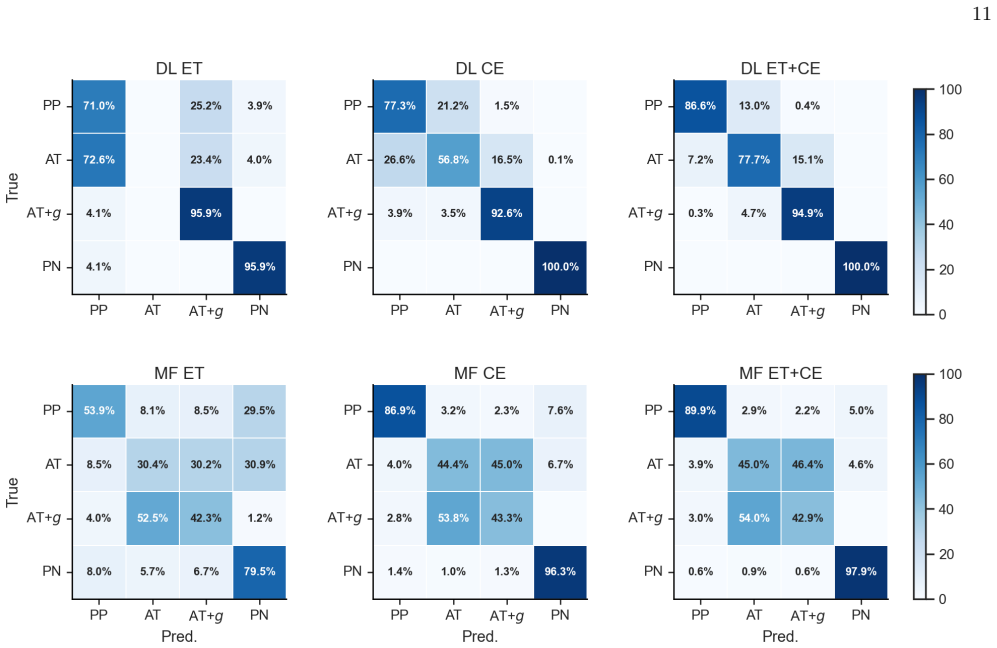
The resonant correction manifests as a weak phase morphology difference superimposed on the adiabatic tidal background that neural classifiers can learn from the complete time-domain strain segment, whereas matched filtering, which responds only to overall similarity, performs worse. On the simulated four-class dataset the deep-learning accuracies are 0.655 (ET), 0.815 (CE), and 0.897 (ET+CE), compared with 0.514, 0.677, and 0.689 for matched filtering; joint observations therefore improve identifiability of the weak internal-mode phase information.
What carries the argument
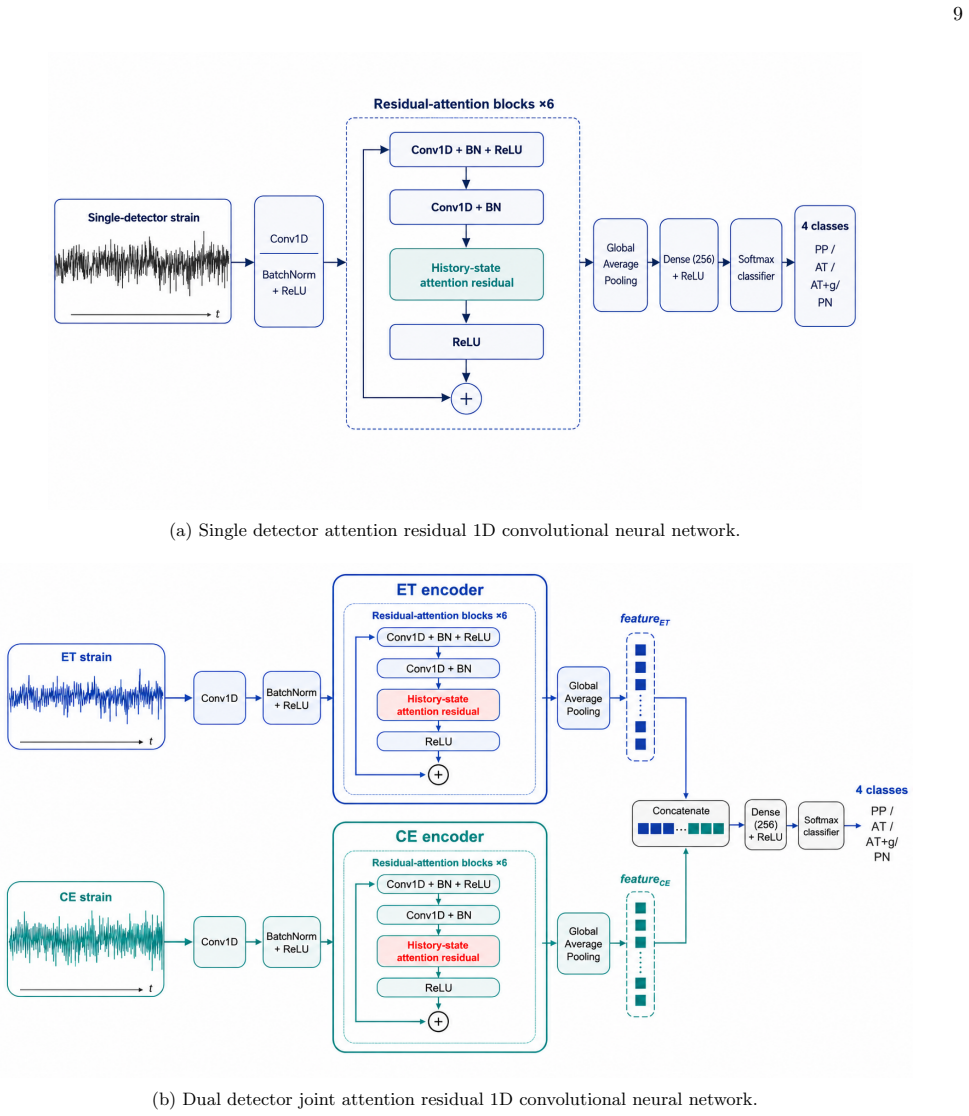
A four-class dataset built in an eccentric harmonic framework, with deep-learning classifiers trained on time-domain strain segments from ET and CE detectors to distinguish resonant g-mode phase morphology from adiabatic tides and noise.
Load-bearing premise
The resonant correction appears as a weak phase morphology difference on the adiabatic tidal background that a neural network can learn from the full strain segment while matched filtering cannot.
What would settle it
If classification accuracy on resonant g-mode samples remains statistically indistinguishable from accuracy on adiabatic-tide-only samples when the same networks are retrained and tested on independent realizations of ET/CE noise, the claim that the phase signature is learnable would be falsified.
Figures





read the original abstract
$g$ mode resonances in eccentric binary neutron star systems are potential probes of internal stratification, superfluidity, composition gradients, and the equation of state. Although such weak dynamical tidal signatures are unlikely to be resolved with current detector sensitivities, third generation observations may make them accessible, in which case identifying the weak resonant phase shift would provide information beyond the bulk adiabatic tidal deformability. We build a four class dataset in an eccentric harmonic framework, containing point particle, adiabatic tide, resonant $g$ mode, and pure noise samples, and use Einstein Telescope (ET) and Cosmic Explorer (CE) detector data to test whether this weak resonant phase signature can be identified from noisy time domain strain. The ET, CE, and ET+CE deep learning models reach accuracies of $0.655$, $0.815$, and $0.897$, respectively. On the same simulated samples, the matched filtering method reaches lower accuracies of $0.514$, $0.677$, and $0.689$. This result arises from the fact that the resonant correction manifests as a weak phase morphology difference superimposed on the adiabatic tidal background, whereas matched filtering is sensitive only to the overall similarity. Hence, in the presence of weak phase differences, the neural classifier employed in deep learning is better able to learn these local phase and morphology features from the complete time domain strain segment. The results indicate that joint third generation observations improve the identifiability of weak internal mode phase information.
Editorial analysis
A structured set of objections, weighed in public.
Referee Report
Summary. The manuscript constructs a four-class dataset of simulated eccentric binary neutron star waveforms (point-particle, adiabatic tide, resonant g-mode, pure noise) and trains deep learning classifiers on Einstein Telescope (ET), Cosmic Explorer (CE), and combined ET+CE time-domain strain data. It reports overall accuracies of 0.655 (ET), 0.815 (CE), and 0.897 (ET+CE) for the neural networks versus 0.514, 0.677, and 0.689 for matched filtering on the same samples, attributing the improvement to the networks' ability to learn weak resonant phase morphology differences superimposed on the adiabatic tidal background.
Significance. If the performance gap is shown to arise specifically from the resonant versus adiabatic distinction rather than easier class separations, the result would indicate that deep learning can extract subtle dynamical tidal phase information inaccessible to matched filtering in third-generation detector data, offering a route to probe neutron-star internal stratification and equation of state via g-mode resonances.
major comments (1)
- [Abstract and dataset/results description] The reported overall accuracies do not establish that the networks are learning the weak resonant phase morphology rather than coarser distinctions. The four-class dataset explicitly includes pure noise and point-particle samples that differ strongly in amplitude or signal presence; without per-class precision/recall, confusion matrices, or metrics isolating the adiabatic-tide versus resonant-g-mode contrast, the headline numbers (abstract) cannot support the claim that the resonant correction is identifiable while remaining invisible to matched filtering.
minor comments (1)
- [Methods] Training details, hyperparameter choices, cross-validation procedure, and error bars on the quoted accuracies are not mentioned in the abstract and should be supplied in the methods section for reproducibility.
Simulated Author's Rebuttal
We thank the referee for their careful reading of the manuscript and for highlighting this important point regarding the interpretation of the reported accuracies. We address the comment below and will revise the manuscript to incorporate the requested metrics.
read point-by-point responses
-
Referee: The reported overall accuracies do not establish that the networks are learning the weak resonant phase morphology rather than coarser distinctions. The four-class dataset explicitly includes pure noise and point-particle samples that differ strongly in amplitude or signal presence; without per-class precision/recall, confusion matrices, or metrics isolating the adiabatic-tide versus resonant-g-mode contrast, the headline numbers (abstract) cannot support the claim that the resonant correction is identifiable while remaining invisible to matched filtering.
Authors: We agree that overall accuracy on the four-class problem does not by itself isolate performance on the adiabatic-tide versus resonant-g-mode distinction. The matched-filtering baseline was evaluated on exactly the same samples and yields lower accuracy, which is consistent with the networks extracting additional phase-morphology information, but this remains an indirect argument. To directly resolve the concern we will add, in the revised manuscript, full confusion matrices for the ET, CE and ET+CE classifiers together with per-class precision, recall and F1 scores. These will be presented both for the full four-class task and for the two-class sub-problem of adiabatic tide versus resonant g-mode, allowing readers to assess whether the performance gain is driven by the subtle resonant signature. revision: yes
Circularity Check
No circularity; empirical accuracies from independent simulations
full rationale
The paper constructs a four-class simulated dataset (point-particle, adiabatic tide, resonant g-mode, noise) and reports classification accuracies from trained neural networks versus matched filtering on the same samples. No equations, parameters, or derivations reduce the reported accuracies (0.655/0.815/0.897) to quantities defined inside the paper by construction. The central claim rests on numerical experiments whose inputs (waveform generation, noise realization, network training) are external to the output metrics. No self-citations, ansatzes, or uniqueness theorems are invoked as load-bearing steps. The derivation chain is self-contained against external benchmarks.
Axiom & Free-Parameter Ledger
Reference graph
Works this paper leans on
-
[1]
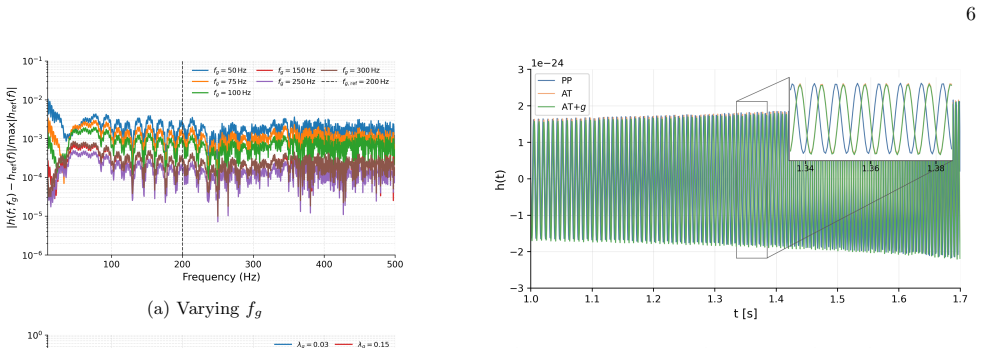
For the first ordergmode con- sidered here, we denote the corresponding coupling by Λg, whose typical scale can lie between 10 −2 and 1. In the simulations below, we focus on a weak coupling por- tion of this range, taking Λg from 0.03 to 0.30 to examine how the resonant phase amplitude affects identification performance [25]. The external tidal tensor is...
-
[2]
In the simulations, the correspondingF I +, F I ×, andS n,I(f) enter the detector projection and col- ored noise generation
and the CE next generation ground based detector design [41]. In the simulations, the correspondingF I +, F I ×, andS n,I(f) enter the detector projection and col- ored noise generation. B. Noise modeling and strain construction For each detector, a colored Gaussian noise realization nI(t) is generated with PyCBC from the one sided de- tector power spectr...
2048
-
[3]
LIGO Scientific Collaboration and Virgo Collaboration, Gw170817: Observation of gravitational waves from a bi- nary neutron star inspiral, Physical Review Letters119, 161101 (2017), arXiv:1710.05832 [gr-qc]
Pith/arXiv arXiv 2017
-
[4]
LIGO Scientific Collaboration and Virgo Collaboration, GW170817: Measurements of neutron star radii and equation of state, Physical Review Letters121, 161101 (2018)
2018
-
[5]
S. De, D. Finstad, J. M. Lattimer, D. A. Brown, E. Berger, and C. M. Biwer, Tidal deformabilities and radii of neutron stars from the observation of GW170817, Physical Review Letters121, 091102 (2018)
2018
-
[6]
Annala, T
E. Annala, T. Gorda, A. Kurkela, and A. Vuori- nen, Gravitational-wave constraints on the neutron-star- matter equation of state, Physical Review Letters120, 172703 (2018)
2018
-
[7]
LIGO Scientific Collaboration, Virgo Collaboration, and KAGRA Collaboration, Gwtc-3: Compact bi- nary coalescences observed by ligo and virgo during the second part of the third observing run, arXiv preprint arXiv:2111.03606 10.48550/arXiv.2111.03606 (2021), arXiv:2111.03606 [gr-qc]
work page internal anchor Pith review Pith/arXiv arXiv doi:10.48550/arxiv.2111.03606 2021
-
[8]
Annala, T
E. Annala, T. Gorda, E. Katerini, A. Kurkela, J. N¨ attil¨ a, V. Paschalidis, and A. Vuorinen, Multimessenger con- straints for ultradense matter, Physical Review X12, 011058 (2022)
2022
-
[9]
Hinderer, Tidal love numbers of neutron stars, The Astrophysical Journal677, 1216 (2008)
T. Hinderer, Tidal love numbers of neutron stars, The Astrophysical Journal677, 1216 (2008)
2008
-
[10]
Damour and A
T. Damour and A. Nagar, Relativistic tidal properties of neutron stars, Physical Review D80, 084035 (2009)
2009
-
[11]
Hinderer, B
T. Hinderer, B. D. Lackey, R. N. Lang, and J. S. Read, Tidal deformability of neutron stars with realistic equa- tions of state and their gravitational wave signatures in binary inspiral, Physical Review D81, 123016 (2010)
2010
-
[12]
Yagi and N
K. Yagi and N. Yunes, I-Love-Q: Unexpected universal relations for neutron stars and quark stars, Science341, 365 (2013)
2013
-
[13]
Hinderer, A
T. Hinderer, A. Taracchini, F. Foucart, A. Buonanno, J. Steinhoff, M. Duez, L. E. Kidder, H. P. Pfeiffer, M. A. Scheel, B. Szilagyi, K. Hotokezaka, K. Kyutoku, M. Shibata, and C. W. Carpenter, Effects of neutron- star dynamic tides on gravitational waveforms within the effective-one-body approach, Physical Review Letters 116, 181101 (2016)
2016
-
[14]
Steinhoff, T
J. Steinhoff, T. Hinderer, A. Buonanno, and A. Tarac- chini, Dynamical tides in general relativity: Effective action and effective-one-body hamiltonian, Physical Re- view D94, 104028 (2016)
2016
-
[15]
Pratten, P
G. Pratten, P. Schmidt, and N. Williams, Impact of dy- namical tides on the reconstruction of the neutron star equation of state, Physical Review Letters129, 081102 (2022)
2022
-
[16]
E. M. Kantor and M. E. Gusakov, Composition temperature-dependent g modes in superfluid neutron stars, Monthly Notices of the Royal Astronomical Soci- ety: Letters442, L90 (2014)
2014
-
[17]
Passamonti, N
A. Passamonti, N. Andersson, and W. C. G. Ho, Buoy- ancy and g-modes in young superfluid neutron stars, Monthly Notices of the Royal Astronomical Society455, 1489 (2016)
2016
-
[18]
Constantinou, S
C. Constantinou, S. Han, P. Jaikumar, and M. Prakash, g-modes of neutron stars with hadron-to-quark crossover transitions, Physical Review D104, 123032 (2021)
2021
-
[19]
Jaikumar, A
P. Jaikumar, A. Semposki, M. Prakash, and C. Con- stantinou, g-mode oscillations in hybrid stars: A tale of two sounds, Physical Review D103, 123009 (2021)
2021
-
[20]
A. R. Counsell, F. Gittins, N. Andersson, and I. Tews, Interface modes in inspiralling neutron stars: A gravitational-wave probe of first-order phase transitions, Physical Review Letters135, 081402 (2025)
2025
-
[21]
A. Passamonti, N. Andersson, and P. Pnigouras, Dy- namical tides in neutron stars: The impact of the crust, Monthly Notices of the Royal Astronomical Society504, 1273 (2021), arXiv:2012.09637 [astro-ph.HE]
arXiv 2021
-
[22]
Lai, Resonant oscillations and tidal heating in coalesc- ing binary neutron stars, Monthly Notices of the Royal Astronomical Society270, 611 (1994)
D. Lai, Resonant oscillations and tidal heating in coalesc- ing binary neutron stars, Monthly Notices of the Royal Astronomical Society270, 611 (1994)
1994
-
[23]
Reisenegger and P
A. Reisenegger and P. Goldreich, Excitation of neutron star normal modes during binary inspiral, The Astro- physical Journal426, 688 (1994)
1994
-
[24]
K. D. Kokkotas and G. Sch¨ afer, Tidal and tidal-resonant effects in coalescing binaries, Monthly Notices of the Royal Astronomical Society275, 301 (1995)
1995
-
[25]
Vick and D
M. Vick and D. Lai, Tidal effects in eccentric coalescing neutron star binaries, Physical Review D100, 063001 (2019)
2019
-
[26]
J. Tak´ atsy, L. Zwick, P. Saini, and J. Samsing, Orbital eccentricity can make neutron star g-mode resonances ob- servable with current gravitational-wave detectors, arXiv e-prints , arXiv:2402.15111 (2024), arXiv:2402.15111 [gr- qc]
arXiv 2024
-
[27]
J. Tak´ atsy, L. Zwick, P. Saini, and J. Samsing, Or- bital eccentricity can make neutron star g-mode reso- nances observable with current gravitational-wave detec- tors, Phys. Rev. D113, 103047 (2026), arXiv:2602.15111 [astro-ph.HE]
arXiv 2026
-
[28]
P. C. Peters and J. Mathews, Gravitational radiation from point masses in a keplerian orbit, Physical Review 131, 435 (1963)
1963
-
[29]
P. C. Peters, Gravitational radiation and the motion of two point masses, Physical Review136, B1224 (1964)
1964
-
[30]
R. Gold, S. Bernuzzi, M. Thierfelder, B. Br¨ ugmann, and F. Pretorius, Eccentric binary neutron star mergers, Physical Review D86, 121501 (2012)
2012
-
[31]
W. E. East, F. Pretorius, and B. C. Stephens, Dynamical capture binary neutron star mergers, The Astrophysical Journal Letters760, L4 (2012)
2012
-
[32]
Paschalidis, W
V. Paschalidis, W. E. East, F. Pretorius, and S. L. Shapiro, One-arm spiral instability in hypermassive neu- tron stars formed by dynamical-capture binary neutron star mergers, Physical Review D92, 121502 (2015)
2015
-
[33]
A. H. Nitz, A. Lenon, and D. A. Brown, Search for eccen- tric binary neutron star mergers in the first and second observing runs of advanced ligo, The Astrophysical Jour- nal890, 1 (2020), arXiv:1912.05464 [astro-ph.HE]
arXiv 2020
-
[34]
A. K. Lenon, A. H. Nitz, and D. A. Brown, Measuring the eccentricity of gw170817 and gw190425, Monthly No- tices of the Royal Astronomical Society497, 1966 (2020), arXiv:2005.14146 [astro-ph.HE]
arXiv 1966
-
[35]
A. K. Lenon, D. A. Brown, and A. H. Nitz, Eccentric bi- nary neutron star search prospects for Cosmic Explorer, 15 Physical Review D104, 063011 (2021)
2021
-
[36]
Dutta Roy and P
P. Dutta Roy and P. Saini, Impact of unmodeled eccen- tricity on the tidal deformability measurement and impli- cations for gravitational wave physics inference, Physical Review D110, 024002 (2024)
2024
-
[37]
K. Kacanja, K. Soni, and A. H. Nitz, Eccentricity signa- tures in ligo-virgo-kagra’s bns and nsbh binaries, arXiv e-prints , arXiv:2508.00179 (2025), arXiv:2508.00179 [gr- qc]
arXiv 2025
-
[38]
Punturo, M
M. Punturo, M. Abernathy, F. Acernese, B. Allen,et al., The einstein telescope: A third-generation gravitational wave observatory, Classical and Quantum Gravity27, 194002 (2010)
2010
-
[39]
S. Hild, M. Abernathy, F. Acernese, P. Amaro-Seoane, et al., Sensitivity studies for third-generation gravita- tional wave observatories, Classical and Quantum Grav- ity28, 094013 (2011)
2011
-
[40]
Science Case for the Einstein Telescope
M. Maggiore, C. van den Broeck, N. Bartolo, E. Bel- gacem, D. Bertacca,et al., Science case for the einstein telescope, arXiv preprint arXiv:1912.02622 10.48550/arXiv.1912.02622 (2019), arXiv:1912.02622 [astro-ph.CO]
work page internal anchor Pith review Pith/arXiv arXiv doi:10.48550/arxiv.1912.02622 1912
-
[41]
Reitzeet al., Cosmic explorer: The u.s
D. Reitzeet al., Cosmic explorer: The u.s. contribu- tion to gravitational-wave astronomy beyond ligo, Bul- letin of the American Astronomical Society51, 35 (2019), arXiv:1907.04833 [astro-ph.IM]
Pith/arXiv arXiv 2019
-
[42]
A Horizon Study for Cosmic Explorer: Science, Observatories, and Community
M. Evans, R. X. Adhikari, C. Afle, S. Ballmer,et al., A horizon study for cosmic explorer: Science, observato- ries, and community, arXiv preprint arXiv:2109.09882 10.48550/arXiv.2109.09882 (2021), arXiv:2109.09882 [astro-ph.IM]
work page internal anchor Pith review Pith/arXiv arXiv doi:10.48550/arxiv.2109.09882 2021
-
[43]
E. D. Hall, Cosmic explorer: A next-generation ground- based gravitational-wave observatory, Galaxies10, 90 (2022)
2022
-
[44]
Allen, W
B. Allen, W. G. Anderson, P. R. Brady, D. A. Brown, and J. D. E. Creighton, FINDCHIRP: An algorithm for detection of gravitational waves from inspiraling compact binaries, Physical Review D85, 122006 (2012)
2012
-
[45]
Veitch, V
J. Veitch, V. Raymond, B. Farr, W. Farr, P. Graff, S. Vitale, B. Aylott, K. Blackburn, N. Christensen, M. Coughlin, W. Del Pozzo, F. Feroz, J. Gair, C.- J. Haster, V. Kalogera, T. Littenberg, I. Mandel, R. O’Shaughnessy, M. Pitkin, C. Rodriguez, C. R¨ over, T. Sidery, R. Smith, M. Van Der Sluys, A. Vecchio, W. Vousden, and L. Wade, Parameter estimation fo...
2015
-
[46]
Ashton, M
G. Ashton, M. H¨ ubner, P. D. Lasky, C. Talbot, K. Ack- ley, S. Biscoveanu, Q. Chu, A. Divakarla, P. J. Easter, B. Goncharov, F. Hernandez Vivanco, J. Harms, M. E. Lower, G. D. Meadors, D. Melchor, E. Payne, M. D. Pitkin, J. Powell, N. Sarin, R. J. E. Smith, and E. Thrane, Bilby: A user-friendly bayesian inference li- brary for gravitational-wave astronom...
2019
-
[47]
D. George and E. A. Huerta, Deep learning for real-time gravitational wave detection and parameter estimation: Results with advanced ligo data, Physics Letters B778, 64 (2018), arXiv:1711.03121 [gr-qc]
Pith/arXiv arXiv 2018
-
[48]
M. Sun, J. Li, S. Cao, and X. Liu, Deep learning forecasts of cosmic acceleration parameters from DECi-hertz inter- ferometer gravitational-wave observatory, Astronomy & Astrophysics682, A177 (2024)
2024
-
[49]
Gabbard, M
H. Gabbard, M. Williams, F. Hayes, and C. Messen- ger, Matching matched filtering with deep networks for gravitational-wave astronomy, Physical Review Letters 120, 141103 (2018)
2018
-
[50]
M. Sun, J. Wu, J. Li, B. McCane, N. Yang, X. Ma, B. Wang, and M. Zhang, Conditional autoencoder for generating binary neutron star waveforms with tidal and precession effects, Physical Review D112, 084016 (2025)
2025
-
[51]
Cuoco, J
E. Cuoco, J. Powell, M. Cavagli` a, K. Ackley,et al., En- hancing gravitational-wave science with machine learn- ing, Machine Learning: Science and Technology2, 011002 (2020)
2020
- [52]
-
[53]
A. J. K. Chua and M. Vallisneri, Learning bayesian pos- teriors with neural networks for gravitational-wave infer- ence, Physical Review Letters124, 041102 (2020)
2020
-
[54]
M. Sun, J. Wu, Q. Hu, J. Li, N. Yang, X. Ma, B. Wang, M. Zhang, and Y. Zhong, Detection of multi- band lensed gravitational waves from dark matter ha- los with deep learning, Physical Review D113, 103004 (2026), arXiv:2511.09107 [astro-ph.IM]
Pith/arXiv arXiv 2026
-
[55]
M. Dax, S. R. Green, J. Gair, J. H. Macke, A. Buonanno, and B. Sch¨ olkopf, Real-time gravitational wave science with neural posterior estimation, Physical Review Letters 127, 241103 (2021)
2021
-
[56]
A. Nitz, I. Harry, D. Brown, C. M. Biwer, J. Willis, T. D. Canton, C. Capano, T. Dent, L. Pekowsky, G. S. C. Davies, S. De, M. Cabero, S. Wu, A. R. Williamson, B. Machenschalk, D. Macleod, F. Pannarale, P. Kumar, S. Reyes, dfinstad, S. Kumar, M. T´ apai, L. Singer, P. Ku- mar, veronica villa, maxtrevor, B. U. V. Gadre, S. Khan, S. Fairhurst, and A. Tolley...
2024
-
[57]
W. Zhao, C. Van Den Broeck, D. Baskaran, and T. G. F. Li, Determination of dark energy by the Einstein Tele- scope: Comparing with CMB, BAO, and SNIa observa- tions, Physical Review D83, 023005 (2011)
2011
-
[58]
Schneider, V
R. Schneider, V. Ferrari, S. Matarrese, and S. F. Porte- gies Zwart, Low-frequency gravitational waves from cos- mological compact binaries, Monthly Notices of the Royal Astronomical Society324, 797 (2001)
2001
-
[59]
Cutler and D
C. Cutler and D. E. Holz, Ultrahigh precision cosmology from gravitational waves, Physical Review D80, 104009 (2009)
2009
-
[60]
Cai and T
R.-G. Cai and T. Yang, Estimating cosmological param- eters by the simulated data of gravitational waves from the Einstein Telescope, Physical Review D95, 044024 (2017)
2017
-
[61]
Albanesi, R
S. Albanesi, R. Gamba, S. Bernuzzi, J. Fontbut´ e, A. Gon- zalez, and A. Nagar, Effective-one-body modeling for generic compact binaries with arbitrary orbits, Physical Review D112, L121503 (2025)
2025
discussion (0)
Sign in with ORCID, Apple, or X to comment. Anyone can read and Pith papers without signing in.