A Delayed Multi-channel Progenitor for Apparently Nonrepeating Fast Radio Bursts
Pith reviewed 2026-06-27 06:09 UTC · model grok-4.3
The pith
One-off fast radio bursts arise from progenitors with a mean delay of 1.4 billion years after star formation.
A machine-rendered reading of the paper's core claim, the machinery that carries it, and where it could break.
Core claim
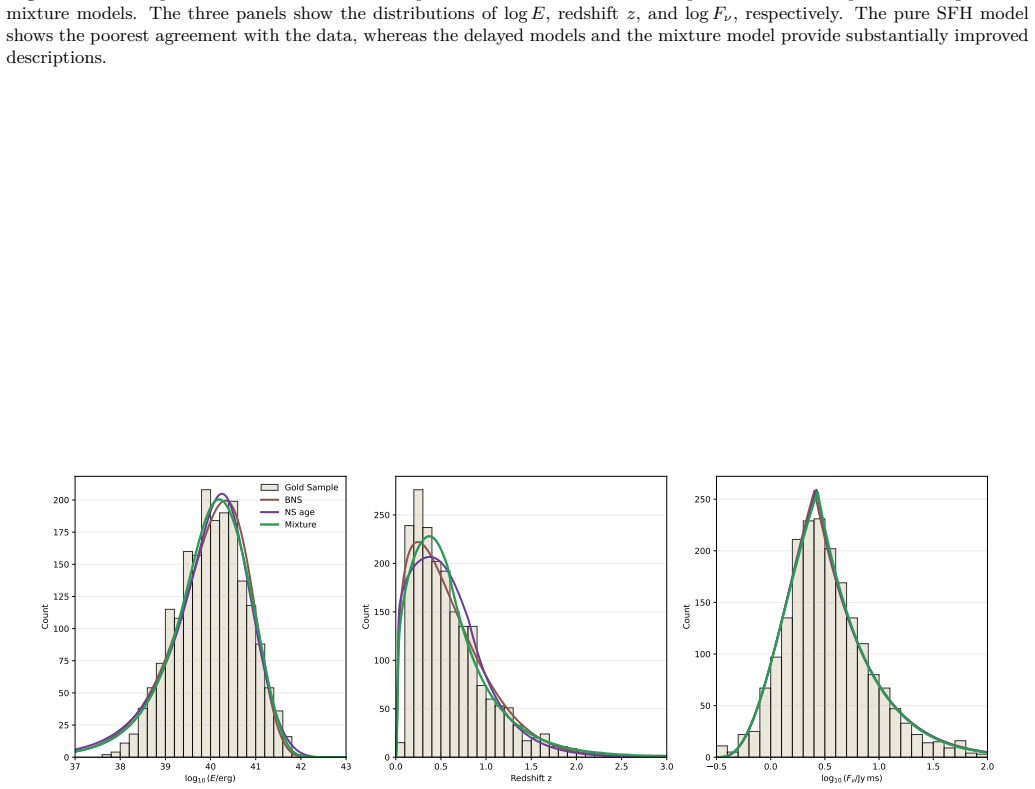
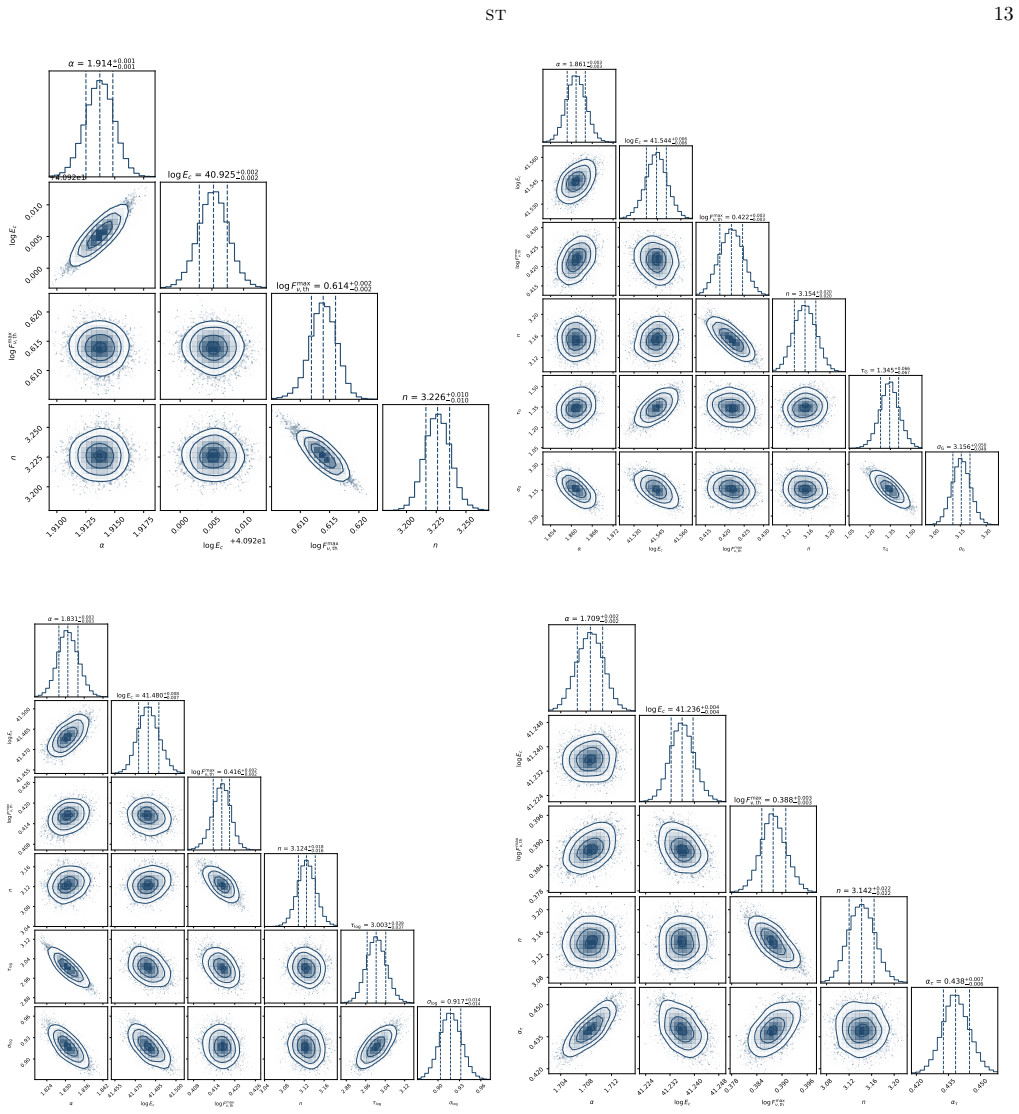
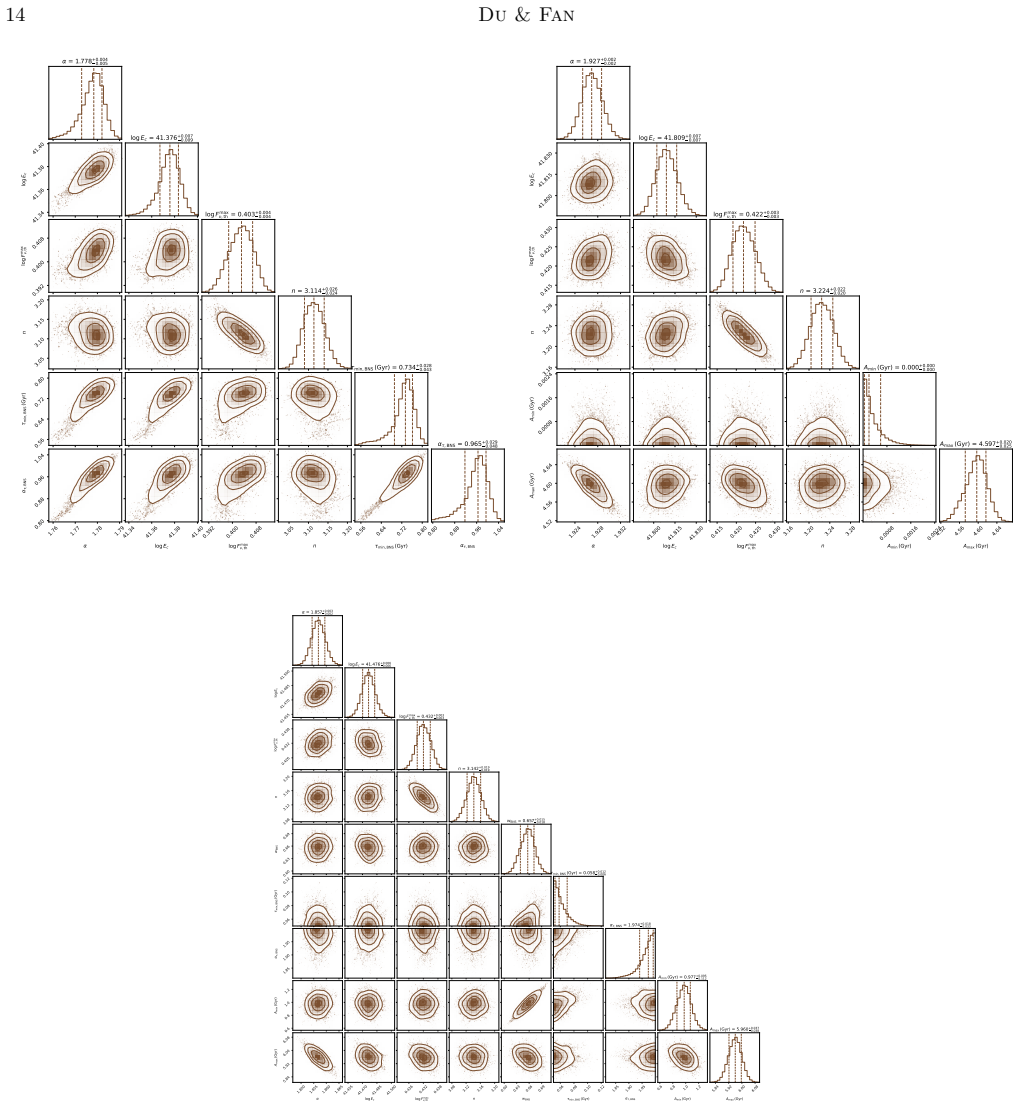
The samples in CHIME/FRB Catalog do not support an intrinsic event rate density that directly follows the SFH. The preferred model is a mixture model that corresponds to an effective mean delay time of 1.426 Gyr. These results suggest that the current data may naturally be explained by delayed, possibly multi-channel progenitor evolution for the one-off FRBs.
What carries the argument
Mixture model obtained by normalizing two physically motivated delayed channels (binary neutron star related and neutron star age-window) separately and combining them as a weighted mixture.
If this is right
- Pure star formation history tracing is disfavored for the intrinsic rate density of one-off FRBs.
- The effective mean delay time for the preferred mixture is 1.426 Gyr.
- Binary neutron star and neutron star age-window channels are viable when combined in a mixture.
- The observed redshift distribution is better explained by delayed progenitor evolution than by direct tracing of star formation.
Where Pith is reading between the lines
- The mixture approach could be used to estimate the relative contributions of different progenitor channels with future larger catalogs.
- A confirmed delay would imply that one-off FRBs occur in older host galaxies than would be expected from young stellar populations.
- This statistical method for testing delay times might extend to other astrophysical transients with uncertain progenitors.
Load-bearing premise
The CHIME/FRB Catalog redshift distribution accurately reflects the intrinsic event rate density after correction for selection effects.
What would settle it
A larger sample or reanalysis of the CHIME/FRB Catalog redshift distribution that fits a pure star formation history model better than the delayed mixture model.
Figures

read the original abstract
Fast radio bursts (FRBs) are millisecond-duration radio flashes of unknown origin, observationally classified into repeating and apparently nonrepeating (one-off) populations. In this work, we use a statistical population approach to investigate the redshift evolution of one-off FRBs. We compare a pure star formation history (SFH) tracing model, phenomenological delayed models, physically motivated delayed models that correspond to binary neutron star related and neutron star age-window channels, and mixture models which is obtained when two physically motivated models are normalized separately and then combined as a weighted mixture. The samples in CHIME/FRB Catalog do not support an intrinsic event rate density that directly follows the SFH. The preferred model is mixture model corresponds to an effective mean delay time of $\bar{\tau}=1.426^{+0.032}_{-0.035}~\mathrm{Gyr}$. These results suggest that the current data may naturally explained by delayed, possibly multi-channel progenitor evolution for the one-off FRBs.
Editorial analysis
A structured set of objections, weighed in public.
Referee Report
Summary. The manuscript uses a statistical population synthesis approach to model the redshift distribution of apparently non-repeating (one-off) FRBs drawn from the CHIME/FRB Catalog. It compares a pure star-formation-history (SFH) tracing model against phenomenological delayed models, physically motivated delayed models (BNS and NS age-window channels), and normalized mixture models. The central claim is that the catalog data reject a direct SFH tracing model and instead favor a mixture model whose effective mean delay time is 1.426^{+0.032}_{-0.035} Gyr, implying delayed, possibly multi-channel progenitors.
Significance. If the selection-function corrections and likelihood construction are shown to be robust, the result would provide quantitative evidence that one-off FRB progenitors involve significant delay times relative to star formation and may operate through multiple channels. The explicit consideration of physically motivated BNS/NS channels and their normalized mixtures is a constructive element of the analysis.
major comments (3)
- [Abstract] Abstract and methods: The abstract reports a clear model preference and a specific mean delay time with uncertainties, yet supplies no explicit form for the selection function, the likelihood construction, or the data cuts applied to the CHIME/FRB Catalog redshift distribution. This omission leaves the rejection of the pure SFH model and the quoted delay value without visible derivation steps.
- [Model comparison] Model comparison: The load-bearing assumption that the observed redshift distribution, once corrected, faithfully traces the intrinsic event rate density is stated but not accompanied by a quantitative validation or sensitivity test of the CHIME selection function (sensitivity, beam response, or completeness versus redshift/DM). Any unaccounted systematics would directly affect the likelihood ratios and the posterior on the mixture weight.
- [Results] Results: The reported effective mean delay time of 1.426 Gyr is obtained by fitting the mixture model directly to the catalog; the parameter is therefore defined by the fit rather than serving as an independent, falsifiable prediction of the progenitor channels.
minor comments (1)
- [Abstract] The sentence in the abstract beginning 'The preferred model is mixture model corresponds to' is grammatically incomplete and should be rephrased for clarity.
Simulated Author's Rebuttal
We thank the referee for the constructive report and recommendation for major revision. We address each major comment point-by-point below, providing clarifications from the manuscript and indicating where revisions will be made to improve transparency on methods and assumptions.
read point-by-point responses
-
Referee: [Abstract] Abstract and methods: The abstract reports a clear model preference and a specific mean delay time with uncertainties, yet supplies no explicit form for the selection function, the likelihood construction, or the data cuts applied to the CHIME/FRB Catalog redshift distribution. This omission leaves the rejection of the pure SFH model and the quoted delay value without visible derivation steps.
Authors: The abstract is written to be concise and highlight the primary results. The full manuscript provides the data cuts in Section 2 (redshift and DM selections from the CHIME/FRB Catalog), the selection function form in Section 3.1 (a redshift- and DM-dependent completeness model based on published CHIME sensitivity), and the likelihood in Section 3.2 (Poisson likelihood on binned redshift distributions). We will revise the abstract to reference these elements briefly and expand the methods section to make the derivation steps for model rejection and the delay posterior more explicit. revision: partial
-
Referee: [Model comparison] Model comparison: The load-bearing assumption that the observed redshift distribution, once corrected, faithfully traces the intrinsic event rate density is stated but not accompanied by a quantitative validation or sensitivity test of the CHIME selection function (sensitivity, beam response, or completeness versus redshift/DM). Any unaccounted systematics would directly affect the likelihood ratios and the posterior on the mixture weight.
Authors: The analysis adopts the CHIME selection function as described in the catalog release papers and assumes the corrected distribution traces the intrinsic rate density after correction. No dedicated quantitative sensitivity tests for beam response or completeness variations versus redshift/DM are included in the current manuscript. We agree this is a limitation that could impact the results. We will add a dedicated discussion of potential systematics and perform a basic sensitivity analysis by varying selection function parameters within published uncertainties to assess effects on the mixture posterior. revision: yes
-
Referee: [Results] Results: The reported effective mean delay time of 1.426 Gyr is obtained by fitting the mixture model directly to the catalog; the parameter is therefore defined by the fit rather than serving as an independent, falsifiable prediction of the progenitor channels.
Authors: The effective mean delay is computed directly from the posterior of the fitted mixture model (normalized combination of the BNS and NS age-window channels) and functions as a summary statistic characterizing the data-preferred delay distribution. It is not presented as an a priori prediction from the physical channels but as an inferred quantity. We will revise the results and discussion sections to clarify this distinction explicitly, emphasizing its role as a fitted effective parameter while retaining its utility for interpreting progenitor implications. revision: partial
Circularity Check
No circularity: standard model fitting to catalog data
full rationale
The paper performs explicit statistical model comparison and parameter fitting of SFH, delayed, and mixture models directly to the CHIME/FRB Catalog redshift distribution (after selection corrections). The quoted mean delay time is reported as the posterior from the preferred mixture model fit, not as an independent prediction or first-principles result. No self-definitional equations, fitted inputs relabeled as predictions, load-bearing self-citations, or uniqueness theorems imported from prior work appear in the derivation chain. The analysis is a conventional data-driven inference exercise whose central claim rests on the external catalog and the stated selection corrections rather than reducing to its own inputs by construction.
Axiom & Free-Parameter Ledger
free parameters (1)
- effective mean delay time =
1.426 Gyr
axioms (1)
- domain assumption CHIME/FRB Catalog redshift distribution can be directly compared to intrinsic rate-density models after standard selection corrections.
Reference graph
Works this paper leans on
-
[1]
X., McQuinn, M., et al.\ 2020, , 581, 7809, 391
Macquart, J.-P., Prochaska, J. X., McQuinn, M., et al.\ 2020, , 581, 7809, 391. doi:10.1038/s41586-020-2300-2
-
[2]
Tang, L., Lin, H.-N., & Li, X.\ 2023, Chinese Physics C, 47, 8, 085105. doi:10.1088/1674-1137/acda1c
-
[3]
Chen, H.-H., Xu, W.-T., Liang, X.-Y., et al.\ 2026, arXiv:2603.18487. doi:10.48550/arXiv.2603.18487
-
[4]
Deng, W. & Zhang, B.\ 2014, , 783, 2, L35. doi:10.1088/2041-8205/783/2/L35
-
[5]
doi:10.1088/0004-637X/788/2/189
Gao, H., Li, Z., & Zhang, B.\ 2014, , 788, 2, 189. doi:10.1088/0004-637X/788/2/189
-
[6]
Zhang, G. Q., Yu, H., He, J. H., et al.\ 2020, , 900, 2, 170. doi:10.3847/1538-4357/abaa4a
-
[7]
Zhang, Z. J., Yan, K., Li, C. M., et al.\ 2021, , 906, 1, 49. doi:10.3847/1538-4357/abceb9
-
[8]
Lin, H.-N. & Zou, R.\ 2024, , 962, 1, 73. doi:10.3847/1538-4357/ad1b4f
-
[9]
R., et al.\ 2018, , 481, 2, 2320
Luo, R., Lee, K., Lorimer, D. R., et al.\ 2018, , 481, 2, 2320. doi:10.1093/mnras/sty2364
-
[10]
Luo, R., Men, Y., Lee, K., et al.\ 2020, , 494, 1, 665. doi:10.1093/mnras/staa704
-
[11]
Zhang, R. C., Zhang, B., Li, Y., et al.\ 2021, , 501, 1, 157. doi:10.1093/mnras/staa3537
-
[12]
Zhang, R. C. & Zhang, B.\ 2022, , 924, 1, L14. doi:10.3847/2041-8213/ac46ad
-
[13]
& Ekers, R.\ 2018, , 480, 3, 4211
Macquart, J.-P. & Ekers, R.\ 2018, , 480, 3, 4211. doi:10.1093/mnras/sty2083
-
[14]
James, C. W., Prochaska, J. X., Macquart, J.-P., et al.\ 2022, , 509, 4, 4775. doi:10.1093/mnras/stab3051
-
[15]
Macquart, J.-P., Shannon, R. M., Bannister, K. W., et al.\ 2019, , 872, 2, L19. doi:10.3847/2041-8213/ab03d6
-
[16]
doi:10.1103/PhysRevD.89.107303
Zhou, B., Li, X., Wang, T., et al.\ 2014, , 89, 10, 107303. doi:10.1103/PhysRevD.89.107303
-
[17]
CHIME/FRB Collaboration, Amiri, M., Andersen, B. C., et al.\ 2021, , 257, 2, 59. doi:10.3847/1538-4365/ac33ab
-
[18]
C., et al.\ 2026, , 283, 1, 34
Chime/Frb Collaboration, Abbott, T., Andersen, B. C., et al.\ 2026, , 283, 1, 34. doi:10.3847/1538-4365/ae3828
-
[19]
Cordes, J. M. & Lazio, T. J. W.\ 2002, astro-ph/0207156. doi:10.48550/arXiv.astro-ph/0207156
work page internal anchor Pith review Pith/arXiv arXiv doi:10.48550/arxiv.astro-ph/0207156 2002
-
[20]
Yao, J. M., Manchester, R. N., & Wang, N.\ 2017, , 835, 1, 29. doi:10.3847/1538-4357/835/1/29
-
[21]
Prochaska, J. X. & Zheng, Y.\ 2019, , 485, 1, 648. doi:10.1093/mnras/stz261
-
[22]
Lin, H.-N., Li, X.-Y., & Zou, R.\ 2024, , 969, 2, 123. doi:10.3847/1538-4357/ad5310
-
[23]
Radiation Backgrounds at Cosmic Dawn: X-Rays from Compact Binaries , volume=
Madau, P. & Fragos, T.\ 2017, , 840, 1, 39. doi:10.3847/1538-4357/aa6af9
-
[24]
& Deng, C.-M.\ 2025, , 698, A127
Meng, M. & Deng, C.-M.\ 2025, , 698, A127. doi:10.1051/0004-6361/202451250
-
[25]
Chen, H.-Y., Gu, W.-M., Sun, M., et al.\ 2022, , 939, 1, 27. doi:10.3847/1538-4357/ac958a
-
[26]
W., Bhardwaj, M., et al.\ 2023, , 944, 1, 105
Shin, K., Masui, K. W., Bhardwaj, M., et al.\ 2023, , 944, 1, 105. doi:10.3847/1538-4357/acaf06
-
[27]
Gordon, A. C., Fong, W.-. fai ., Kilpatrick, C. D., et al.\ 2023, , 954, 1, 80. doi:10.3847/1538-4357/ace5aa
-
[28]
CHIME/FRB Collaboration, Andersen, B. C., Bandura, K. M., et al.\ 2020, , 587, 7832, 54. doi:10.1038/s41586-020-2863-y
-
[29]
L., Esposito, P., Rea, N., et al.\ 2016, , 457, 4, 3448
Israel, G. L., Esposito, P., Rea, N., et al.\ 2016, , 457, 4, 3448. doi:10.1093/mnras/stw008
-
[30]
ApJ , year = 1955, month = jan, volume =
Salpeter, E. E.\ 1955, , 121, 161. doi:10.1086/145971
-
[31]
& van Leeuwen, J.\ 2024, , 690, A377
Wang, Y. & van Leeuwen, J.\ 2024, , 690, A377. doi:10.1051/0004-6361/202450673
-
[32]
Gupta, O., Beniamini, P., Kumar, P., et al.\ 2025, , 986, 1, 100. doi:10.3847/1538-4357/add14c
-
[33]
Thornton, D., Stappers, B., Bailes, M., et al.\ 2013, Science, 341, 6141, 53. doi:10.1126/science.1236789
-
[34]
Petroff, E., Hessels, J. W. T., & Lorimer, D. R.\ 2019, , 27, 1, 4. doi:10.1007/s00159-019-0116-6
-
[35]
doi:10.1103/RevModPhys.95.035005
Zhang, B.\ 2023, Reviews of Modern Physics, 95, 3, 035005. doi:10.1103/RevModPhys.95.035005
-
[36]
W.LuandP.Kumar.MonthlyNoticesoftheRoyalAstronomicalSociety,477(2):2470–2493,2018
Lorimer, D. R., Bailes, M., McLaughlin, M. A., et al.\ 2007, Science, 318, 5851, 777. doi:10.1126/science.1147532
-
[37]
Spitler, L. G., Scholz, P., Hessels, J. W. T., et al.\ 2016, , 531, 7593, 202. doi:10.1038/nature17168
-
[38]
Bochenek, C. D., Ravi, V., Belov, K. V., et al.\ 2020, , 587, 7832, 59. doi:10.1038/s41586-020-2872-x
-
[39]
Mereghetti, S., Savchenko, V., Ferrigno, C., et al.\ 2020, , 898, 2, L29. doi:10.3847/2041-8213/aba2cf
-
[40]
& Rezzolla, L.\ 2014, , 562, A137
Falcke, H. & Rezzolla, L.\ 2014, , 562, A137. doi:10.1051/0004-6361/201321996
-
[41]
W., et al.\ 2021, , 598, 7880, 267
Li, D., Wang, P., Zhu, W. W., et al.\ 2021, , 598, 7880, 267. doi:10.1038/s41586-021-03878-5
-
[42]
14 Astrophysics of FRBs Coordinator: Alice P
Chatterjee, S., Law, C. J., Wharton, R. S., et al.\ 2017, , 541, 7635, 58. doi:10.1038/nature20797
-
[43]
Pleunis, Z., Good, D. C., Kaspi, V. M., et al.\ 2021, , 923, 1, 1. doi:10.3847/1538-4357/ac33ac
-
[44]
C., Bandura, K., et al.\ 2019, , 885, 1, L24
CHIME/FRB Collaboration, Andersen, B. C., Bandura, K., et al.\ 2019, , 885, 1, L24. doi:10.3847/2041-8213/ab4a80
-
[45]
Xu, H., Niu, J. R., Chen, P., et al.\ 2022, , 609, 7928, 685. doi:10.1038/s41586-022-05071-8
-
[46]
Curtin, A. P., Sand, K. R., Pleunis, Z., et al.\ 2025, , 992, 2, 206. doi:10.3847/1538-4357/adf844
-
[47]
Ridnaia, A., Svinkin, D., Frederiks, D., et al.\ 2021, Nature Astronomy, 5, 372. doi:10.1038/s41550-020-01265-0
-
[48]
Li, C. K., Lin, L., Xiong, S. L., et al.\ 2021, Nature Astronomy, 5, 378. doi:10.1038/s41550-021-01302-6
-
[49]
R., Nathanail, A., & Rezzolla, L.\ 2018, , 864, 2, 117
Most, E. R., Nathanail, A., & Rezzolla, L.\ 2018, , 864, 2, 117. doi:10.3847/1538-4357/aad6ef
-
[50]
Hansen, B. M. S. & Lyutikov, M.\ 2001, , 322, 4, 695. doi:10.1046/j.1365-8711.2001.04103.x
-
[51]
Totani, T.\ 2013, , 65, 5, L12. doi:10.1093/pasj/65.5.L12
-
[52]
doi:10.3847/2041-8205/822/1/L7
Wang, J.-S., Yang, Y.-P., Wu, X.-F., et al.\ 2016, , 822, 1, L7. doi:10.3847/2041-8205/822/1/L7
-
[53]
Mingarelli, C. M. F., Levin, J., & Lazio, T. J. W.\ 2015, , 814, 2, L20. doi:10.1088/2041-8205/814/2/L20
-
[54]
doi:10.1038/s41586-022-04755-5
Niu, C.-H., Aggarwal, K., Li, D., et al.\ 2022, , 606, 7916, 873. doi:10.1038/s41586-022-04755-5
-
[55]
Zhang, B.\ 2019, , 873, 2, L9. doi:10.3847/2041-8213/ab0ae8
-
[56]
doi:10.1088/2041-8205/776/2/L39
Kashiyama, K., Ioka, K., & M \'e sz \'a ros, P.\ 2013, , 776, 2, L39. doi:10.1088/2041-8205/776/2/L39
-
[57]
Rice, J. R. & Zhang, B.\ 2017, Journal of High Energy Astrophysics, 13, 22. doi:10.1016/j.jheap.2017.02.002
-
[58]
doi:10.1103/PhysRevD.90.127503
Barrau, A., Rovelli, C., & Vidotto, F.\ 2014, , 90, 12, 127503. doi:10.1103/PhysRevD.90.127503
-
[59]
Spitler, L. G., Cordes, J. M., Hessels, J. W. T., et al.\ 2014, , 790, 2, 101. doi:10.1088/0004-637X/790/2/101
-
[60]
Bannister, K. W., Deller, A. T., Phillips, C., et al.\ 2019, Science, 365, 6453, 565. doi:10.1126/science.aaw5903
-
[61]
15 Astrophysics of FRBs Coordinator: Alice P
Law, C. J., Sharma, K., Ravi, V., et al.\ 2024, , 967, 1, 29. doi:10.3847/1538-4357/ad3736
-
[62]
The Einstein Telescope: a third-generation gravitational wave observatory
Punturo, M., Abernathy, M., Acernese, F., et al.\ 2010, Classical and Quantum Gravity, 27, 19, 194002. doi:10.1088/0264-9381/27/19/194002
-
[63]
A Horizon Study for Cosmic Explorer: Science, Observatories, and Community
Evans, M., Adhikari, R. X., Afle, C., et al.\ 2021, arXiv:2109.09882. doi:10.48550/arXiv.2109.09882
work page internal anchor Pith review Pith/arXiv arXiv doi:10.48550/arxiv.2109.09882 2021
-
[64]
2023, JCAP, 2023, 068, doi: 10.1088/1475-7516/2023/07/068
Branchesi, M., Maggiore, M., Alonso, D., et al.\ 2023, , 2023, 7, 068. doi:10.1088/1475-7516/2023/07/068
discussion (0)
Sign in with ORCID, Apple, or X to comment. Anyone can read and Pith papers without signing in.