Correct Yourself, Keep My Trust: How Self-Correction and Social Connection Shape Credibility in Social Chatbots
Pith reviewed 2026-06-26 19:12 UTC · model grok-4.3
The pith
Self-correction by social chatbots preserves trustworthiness and expertise ratings after errors, while social connection drives belief change only in self-correction cases.
A machine-rendered reading of the paper's core claim, the machinery that carries it, and where it could break.
Core claim
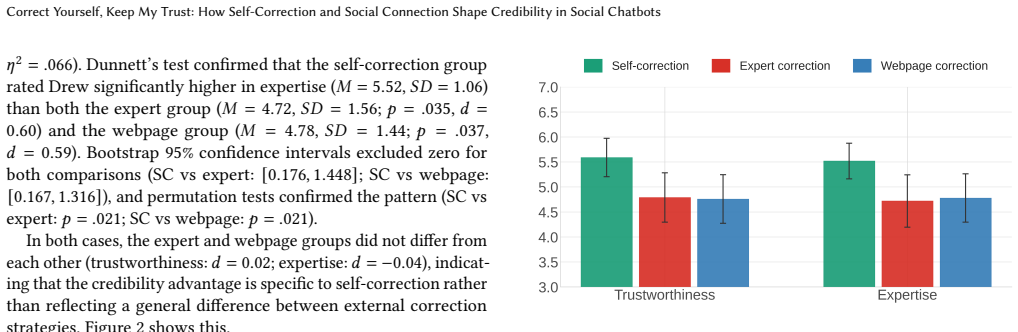
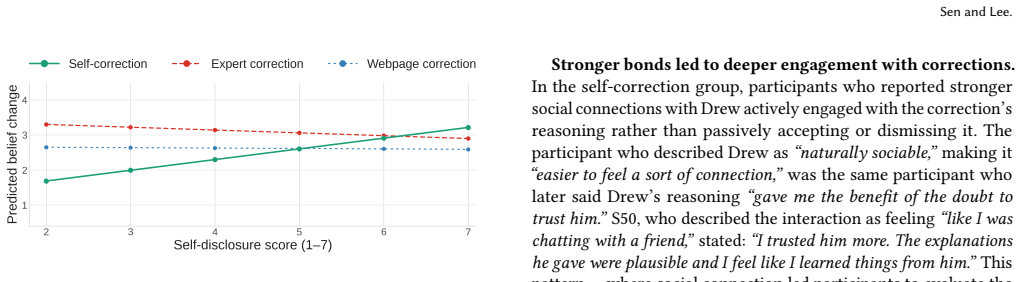
Self-correction by the social chatbot corrects errors as effectively as external sources but without reducing credibility ratings, whereas external corrections lower trustworthiness and perceived expertise. Social connection strength predicts the magnitude of belief change only under self-correction; outsourcing the correction removes this relationship entirely.
What carries the argument
Between-subjects experiment with three error-correction conditions (webpage retraction, self-correction by the social chatbot, expert-chatbot correction) and social connection (social attraction plus self-disclosure) as a moderator of belief change.
If this is right
- Social chatbots should implement self-correction mechanisms to correct errors while retaining user trust.
- Building social attraction and encouraging self-disclosure amplifies the effectiveness of corrections on belief updating.
- Relying on external sources for corrections eliminates the benefit that social connection provides for belief change.
Where Pith is reading between the lines
- The pattern may apply to other persistent conversational agents where repeated interactions matter more than one-off accuracy fixes.
- Designers could test whether repeated self-corrections over multiple sessions compound into higher long-term retention than external corrections.
- The moderator effect suggests relational factors interact with error-handling strategies in ways that purely informational fixes do not capture.
Load-bearing premise
The three correction conditions presented equivalent chatbot behavior, error content, and user exposure so that differences can be attributed to the correction strategy and its interaction with social connection rather than unmeasured factors like prior attitudes or consistency perceptions.
What would settle it
A follow-up study that equalizes perceived chatbot consistency across conditions and still finds no trustworthiness advantage for self-correction, or that finds social connection predicts belief change even under external correction, would undermine the central results.
Figures

read the original abstract
When social chatbots make mistakes, and they do, how they recover determines whether users trust them again. Social chatbots are increasingly integrated into everyday life, yet they remain prone to generating convincing but inaccurate information. The social connection they build with users makes such errors particularly consequential. We conducted a between-subjects experiment (N=120) comparing three error correction strategies: a webpage retraction, self-correction by the same social chatbot, and correction by an expert chatbot. Our results reveal two key findings. First, all three strategies corrected the error equally well, but only self-correction did so without damaging the chatbot's credibility: participants rated self-correcting chatbots significantly higher in both trustworthiness and perceived expertise than chatbots whose errors were corrected by external sources. Second, the strength of the user's social connection with the chatbot, measured through social attraction and self-disclosure, significantly predicted the magnitude of belief change, but only when the chatbot corrected itself. Outsourcing corrections to an external source severed this link entirely. These findings suggest that social chatbots should correct their own mistakes rather than outsource corrections, and that investing in social connection is a functional mechanism that amplifies correction effectiveness, not merely a design feature. We discuss implications for designing chatbots that maintain long-term credibility while effectively addressing their own errors.
Editorial analysis
A structured set of objections, weighed in public.
Referee Report
Summary. The manuscript reports a between-subjects experiment (N=120) comparing three error-correction strategies for social chatbots (webpage retraction, self-correction by the same chatbot, and correction by an expert chatbot). It claims that all three strategies correct factual errors equally well, but only self-correction preserves the chatbot's trustworthiness and perceived expertise; additionally, measures of social connection (social attraction and self-disclosure) predict the magnitude of belief change only in the self-correction condition.
Significance. If the results hold after addressing methodological gaps, the work offers a clear, actionable design recommendation for social chatbots and contributes empirical evidence on how social connection functions as a moderator rather than a mere feature. The between-subjects design and focus on belief change provide a falsifiable test of the self-correction hypothesis.
major comments (2)
- [Methods] The central claim that differences in trustworthiness, expertise, and the social-connection moderator are attributable to correction source requires that the three between-subjects conditions were equivalent in initial erroneous response wording and timing, subsequent interaction length and style, and absence of differential persona or consistency cues. The manuscript provides no scripts, logs, or manipulation-check data confirming this equivalence (Methods section).
- [Abstract] The abstract states directional results (self-correction rated significantly higher; social connection predicts belief change only for self-correction) but supplies no statistical details, effect sizes, participant demographics, or analysis methods. These details are required to evaluate whether the reported differences are load-bearing for the claims.
minor comments (1)
- [Abstract] The abstract could be expanded to include a brief statement of the statistical approach and key effect sizes to allow readers to assess the strength of the reported differences without immediately consulting the full results section.
Simulated Author's Rebuttal
We thank the referee for their thoughtful review and constructive suggestions. We address each major comment below and outline the revisions we will make to strengthen the manuscript.
read point-by-point responses
-
Referee: [Methods] The central claim that differences in trustworthiness, expertise, and the social-connection moderator are attributable to correction source requires that the three between-subjects conditions were equivalent in initial erroneous response wording and timing, subsequent interaction length and style, and absence of differential persona or consistency cues. The manuscript provides no scripts, logs, or manipulation-check data confirming this equivalence (Methods section).
Authors: We agree that ensuring and demonstrating equivalence across the three conditions is essential to support our claims. The manuscript's Methods section described the procedure at a high level but did not include the full scripts or manipulation check data, which were collected during the study. In the revision, we will add the exact wording of the initial erroneous responses, the correction messages for each condition, details on interaction timing and length, and results from manipulation checks confirming no differential perceptions of persona or consistency. These will be incorporated into the main text or provided as supplementary materials. revision: yes
-
Referee: [Abstract] The abstract states directional results (self-correction rated significantly higher; social connection predicts belief change only for self-correction) but supplies no statistical details, effect sizes, participant demographics, or analysis methods. These details are required to evaluate whether the reported differences are load-bearing for the claims.
Authors: We acknowledge that the current abstract lacks the statistical details necessary for full evaluation. We will revise the abstract to include key information such as the statistical tests used, significance levels, effect sizes where appropriate, participant demographics (e.g., age, gender distribution), and a brief description of the analysis methods, while adhering to the word limit. revision: yes
Circularity Check
No circularity: empirical experiment with no derivation chain
full rationale
The paper reports results from a between-subjects experiment (N=120) comparing error-correction strategies via participant ratings and regression on social-connection measures. No equations, first-principles derivations, parameter fitting, or predictions are present. Claims rest on statistical outcomes from collected data rather than any self-referential reduction, self-citation load-bearing premise, or ansatz. The study is self-contained as an empirical report; external benchmarks (participant responses) are independent of the analysis itself.
Axiom & Free-Parameter Ledger
axioms (2)
- domain assumption Self-report measures of trustworthiness, expertise, social attraction, and self-disclosure validly capture the intended psychological constructs.
- domain assumption The between-subjects assignment isolates the effects of correction strategy without systematic differences in participant characteristics or chatbot presentation across conditions.
Reference graph
Works this paper leans on
-
[1]
Marlene Sophie Altenmüller, Stephan Nuding, and Mario Gollwitzer. 2021. No harm in being self-corrective: Self-criticism and reform intentions increase re- searchers’ epistemic trustworthiness and credibility in the eyes of the public. Public understanding of science30, 8 (2021), 962–976
2021
-
[2]
Altman and D
I. Altman and D. A. Taylor. 1973. Social Penetration: The Development of Interpersonal Relationships. (1973). 8 Correct Yourself, Keep My Trust: How Self-Correction and Social Connection Shape Credibility in Social Chatbots
1973
-
[3]
L. De Angelis, F. Baglivo, G. Arzilli, G. P. Privitera, P. Ferragina, A. Tozzi, and C. Rizzo. 2023. ChatGPT and the rise of large language models: the new AI- driven infodemic threat in public health.Frontiers in Public Health11 (2023). doi:10.3389/fpubh.2023.1166120
-
[4]
2017.Facts and fictions in mental health
Hal Arkowitz and Scott O Lilienfeld. 2017.Facts and fictions in mental health. John Wiley & Sons
2017
-
[5]
Aronson, B
E. Aronson, B. Willerman, and J. Floyd. 1966. The Effect of a Pratfall on Increasing Interpersonal Attractiveness.Psychonomic Science4, 6 (1966), 227–228. doi:10. 3758/BF03342263
1966
-
[6]
Christa SC Asterhan and Miriam Babichenko. 2015. The social dimension of learning through argumentation: Effects of human presence and discourse style. Journal of Educational Psychology107, 3 (2015), 740
2015
-
[7]
Timothy W Bickmore and Rosalind W Picard. 2005. Establishing and maintaining long-term human-computer relationships.ACM Transactions on Computer- Human Interaction (TOCHI)12, 2 (2005), 293–327
2005
-
[8]
Bluvstein, X
S. Bluvstein, X. Zhao, A. Barasch, and J. Schroeder. 2024. Imperfectly Human: The Humanizing Potential of (Corrected) Errors in Text-Based Communication. Journal of the Association for Consumer Research9, 3 (2024), 332–343. doi:10. 1086/728412
2024
-
[9]
Shelly Chaiken. 1980. Heuristic versus systematic information processing and the use of source versus message cues in persuasion.Journal of personality and social psychology39, 5 (1980), 752
1980
-
[10]
Rijul Chaturvedi, Sanjeev Verma, Ronnie Das, and Yogesh K Dwivedi. 2023. Social companionship with artificial intelligence: Recent trends and future avenues. Technological Forecasting and Social Change193 (2023), 122634
2023
-
[11]
Lara Christoforakos, Nina Feicht, Simone Hinkofer, A. Löscher, Sonja F. Schlegl, and S. Diefenbach. 2021. Connect With Me. Exploring Influencing Factors in a Human-Technology Relationship Based on Regular Chatbot Use.Frontiers in Digital Health3 (2021). doi:10.3389/fdgth.2021.689999
-
[12]
Nancy L Collins and Lynn Carol Miller. 1994. Self-disclosure and liking: a meta- analytic review.Psychological bulletin116, 3 (1994), 457
1994
-
[13]
John Cook, Ullrich Ecker, and Stephan Lewandowsky. 2015. Misinformation and how to correct it.Emerging trends in the social and behavioral sciences: An interdisciplinary, searchable, and linkable resource(2015), 1–17
2015
-
[14]
Thomas H Costello, Gordon Pennycook, and David G Rand. 2024. Durably reducing conspiracy beliefs through dialogues with AI.Science385, 6714 (2024), eadq1814
2024
-
[15]
S. R. Cox, Y.-C. Lee, and W. T. Ooi. 2023. Comparing How a Chatbot References User Utterances from Previous Chatting Sessions: An Investigation of Users’ Pri- vacy Concerns and Perceptions. InProceedings of the 11th International Conference on Human-Agent Interaction (HAI ’23). 105–114. doi:10.1145/3623809.3623875
-
[16]
Emmelyn AJ Croes and Marjolijn L Antheunis. 2021. Can we be friends with Mitsuku? A longitudinal study on the process of relationship formation between humans and a social chatbot.Journal of Social and Personal Relationships38, 1 (2021), 279–300
2021
-
[17]
Valdemar Danry, Pat Pataranutaporn, Matthew Groh, and Ziv Epstein. 2025. Deceptive explanations by large language models lead people to change their beliefs about misinformation more often than honest explanations. InProceedings of the 2025 CHI conference on human factors in computing systems. 1–31
2025
-
[18]
Sunny Dawar, Savita Panwar, Sunishtha Dhaka, and Pallavi Kudal. 2022. An- tecedents and role of trust in chatbot use intentions: an Indian perspective. Marketing i menedžment innovacij13, 4 (2022), 198–206
2022
-
[19]
Nora Denner, Benno Viererbl, and Thomas Koch. 2023. Effects of Repeated Corrections of Misinformation on Organizational Trust: More is Not Always Better.International Journal of Strategic Communication17, 1 (2023), 39–53
2023
-
[20]
Israel Junior Borges Do Nascimento, Ana Beatriz Pizarro, Jussara M Almeida, Natasha Azzopardi-Muscat, Marcos André Gonçalves, Maria Björklund, and David Novillo-Ortiz. 2022. Infodemics and health misinformation: a systematic review of reviews.Bulletin of the World Health Organization100, 9 (2022), 544
2022
-
[21]
C. Esterwood and L. P. Robert. 2023. Three Strikes and You Are Out!: The Impacts of Multiple Human–Robot Trust Violations and Repairs on Robot Trustworthi- ness.Computers in Human Behavior142 (2023), 107658. doi:10.1016/j.chb.2023. 107658
-
[22]
Folk, Stephanie Yu, and Elizabeth W
D. Folk, Stephanie Yu, and Elizabeth W. Dunn. 2022. Is a good bot better than a mediocre human?: Chatbots as alternative sources of social connection. (2022). doi:10.31234/osf.io/xunsy
-
[23]
Freitag, M
J. Freitag, M. Gochee, B. Nyhan, M. Ransden, K. Roschke, and D. Gillmor. 2024. The Corrections Dilemma: Media Retractions Increase Belief Accuracy But Decrease Trust.Journal of Experimental Political Science11, 1 (2024), 90–101. doi:10.1017/ XPS.2023.4
2024
-
[24]
doi: 10.1080/10447318.2025.2530058
Z. Gong and L. Y.-F. Su. 2025. Designing Chatbots for Misinformation Correction: Examining the Roles of Chatbot Expertise and Anthropomorphism.Interna- tional Journal of Human–Computer Interaction(2025). doi:10.1080/10447318.2025. 2490703
-
[25]
C. Gu, Y. Zhang, and L. Zeng. 2024. Exploring the Mechanism of Sustained Consumer Trust in AI Chatbots After Service Failures: A Perspective Based on Attribution and CASA Theories.Humanities and Social Sciences Communications 11 (2024), 1400. doi:10.1057/s41599-024-03879-5
-
[26]
An er- ror occurred!
Kasper Hald, Katharina Weitz, Elisabeth André, and Matthias Rehm. 2021. “An er- ror occurred!”-trust repair with virtual robot using levels of mistake explanation. InProceedings of the 9th International Conference on Human-Agent Interaction. 218–226
2021
-
[27]
Jamie Hale. [n. d.]. Myths about Health That Should Die. ([n. d.])
-
[28]
I. Iancu and B. Iancu. 2023. Interacting with Chatbots Later in Life: A Technology Acceptance Perspective in COVID-19 Pandemic Situation.Frontiers in Psychology 13 (2023), 1111003. doi:10.3389/fpsyg.2022.1111003
-
[29]
M. Jain, P. Kumar, R. Kota, and S. N. Patel. 2018. Evaluating and Informing the Design of Chatbots. InProceedings of the 2018 Designing Interactive Systems Conference (DIS ’18). 895–906. doi:10.1145/3196709.3196735
-
[30]
E. Jo, Y. Jeong, S. Park, D. A. Epstein, and Y.-H. Kim. 2024. Understanding the Impact of Long-Term Memory on Self-Disclosure with Large Language Model- Driven Chatbots for Public Health Intervention. InProceedings of the 2024 CHI Conference on Human Factors in Computing Systems (CHI ’24). doi:10.1145/ 3613904.3642420
arXiv 2024
-
[31]
S. M. Jones-Jang and Y. J. Park. 2023. How Do People React to AI Failure? Automation Bias, Algorithmic Aversion, and Perceived Controllability.Journal of Computer-Mediated Communication28, 1 (2023), zmac029. doi:10.1093/jcmc/ zmac029
-
[32]
P. K. Kahr, G. Rooks, C. C. P. Snijders, and M. C. Willemsen. 2024. The Trust Recovery Journey: The Effect of Timing of Errors on the Willingness to Follow AI Advice. InProceedings of the 29th International Conference on Intelligent User Interfaces (IUI ’24). doi:10.1145/3640543.3645167
-
[33]
P. H. Kim, D. L. Ferrin, C. D. Cooper, and K. T. Dirks. 2004. Removing the Shadow of Suspicion: The Effects of Apology Versus Denial for Repairing Competence- Versus Integrity-Based Trust Violations.Journal of Applied Psychology89, 1 (2004), 104–118. doi:10.1037/0021-9010.89.1.104
-
[34]
J. J. Koehler and A. D. Gershoff. 2003. Betrayal Aversion: When Agents of Protection Become Agents of Harm.Organizational Behavior and Human Decision Processes90, 2 (2003), 244–261. doi:10.1016/S0749-5978(02)00518-6
-
[35]
Laura M König. 2023. Debunking nutrition myths: An experimental test of the ‘truth sandwich’text format.British Journal of Health Psychology(2023)
2023
-
[36]
Jean-Philippe Laurenceau, Luis M Rivera, Amy R Schaffer, and Paula R Pietromonaco. 2004. Intimacy as an interpersonal process: Current status and future directions.Handbook of closeness and intimacy(2004), 71–88
2004
-
[37]
J. Lee, D. Lee, and J.-G. Lee. 2024. Influence of Rapport and Social Presence with an AI Psychotherapy Chatbot on Users’ Self-Disclosure.International Journal of Human–Computer Interaction40, 7 (2024), 1620–1631. doi:10.1080/10447318. 2023.2240000
-
[38]
Y.-C. Lee, N. Yamashita, Y. Huang, and W. Fu. 2020. “I Hear You, I Feel You”: Encouraging Deep Self-Disclosure Through a Chatbot. InProceedings of the 2020 CHI Conference on Human Factors in Computing Systems (CHI ’20). 1–12. doi:10.1145/3313831.3376175
-
[39]
S. Lewandowsky, J. Cook, U. K. H. Ecker, D. Albarracín, M. A. Amazeen, P. Kendeou, D. Lombardi, E. J. Newman, G. Pennycook, E. Porter, et al. 2020. The Debunking Handbook 2020. (2020). doi:10.17910/b7.1182
-
[40]
Stephan Lewandowsky, John Cook, Philipp Schmid, Dawn Liu Holford, Adam Finn, Julie Leask, Angus Thomson, Doug Lombardi, Ahmed K Al-Rawi, Michelle A Amazeen, et al. 2021. The COVID-19 vaccine communication hand- book. A practical guide for improving vaccine communication and fighting misinformation
2021
-
[41]
S. Lewandowsky, U. K. H. Ecker, C. M. Seifert, N. Schwarz, and J. Cook. 2012. Misinformation and Its Correction: Continued Influence and Successful De- biasing.Psychological Science in the Public Interest13, 3 (2012), 106–131. doi:10.1177/1529100612451018
-
[42]
Joon Soo Lim. 2019. The effectiveness of refutation with logic vs. indignation in restoring the credibility of and trust in a government organization: A heuristic- systematic model of crisis communication processing.Journal of Contingencies and Crisis Management27, 2 (2019), 157–167
2019
-
[43]
Robert B Lount Jr, Chen-Bo Zhong, Niro Sivanathan, and J Keith Murnighan
-
[44]
Getting off on the wrong foot: The timing of a breach and the restoration of trust.Personality and Social Psychology Bulletin34, 12 (2008), 1601–1612
2008
-
[45]
Gale M Lucas, Jill Boberg, David Traum, Ron Artstein, Jonathan Gratch, Alesia Gainer, Emmanuel Johnson, Anton Leuski, and Mikio Nakano. 2018. Getting to know each other: The role of social dialogue in recovery from errors in social robots. InProceedings of the 2018 acm/ieee international conference on human-robot interaction. 344–351
2018
-
[46]
D. B. Margolin, A. Hannak, and I. Weber. 2018. Political Fact-Checking on Twitter: When Do Corrections Have an Effect?Political Communication35, 2 (2018), 196–219. doi:10.1080/10584609.2017.1334018
-
[47]
Linda L McCroskey, James C McCroskey, and Virginia P Richmond. 2006. Anal- ysis and improvement of the measurement of interpersonal attraction and ho- mophily.Communication Quarterly54, 1 (2006), 1–31
2006
-
[48]
Y. Moon. 2000. Intimate Exchanges: Using Computers to Elicit Self-Disclosure from Consumers.Journal of Consumer Research26, 4 (2000), 323–339. doi:10. 1086/209566 9 Sen and Lee
2000
-
[49]
G. Na, J. Choi, and H. Kang. 2023. It’s Not My Fault, but I’m to Blame: The Effect of a Home Robot’s Attribution and Approach Movement on Trust and Emotion of Users.International Journal of Human-Computer Interaction(2023). doi:10.1080/10447318.2023.2209977
-
[50]
C. Nass, J. Steuer, and E. R. Tauber. 1994. Computers Are Social Actors. In Proceedings of the SIGCHI Conference on Human Factors in Computing Systems (CHI ’94). 72–78. doi:10.1145/191666.191703
-
[51]
Bradley S O’hara, Richard G Netemeyer, and Scot Burton. 1991. AN EXAMINA- TION OF THE RELATIVE EFFECTS OF SOURCE EXPERTISE, TRUSTWORTHI- NESS, AND LIKABILITY.Social Behavior & Personality: an international journal 19, 4 (1991)
1991
-
[52]
S. Pareek, E. Velloso, and J. Goncalves. 2024. Trust Development and Repair in AI-Assisted Decision-Making during Complementary Expertise. InProceedings of the 2024 ACM Conference on Fairness, Accountability, and Transparency (FAccT ’24). 546–561. doi:10.1145/3630106.3658924
-
[53]
Pat Pataranutaporn, Chayapatr Archiwaranguprok, Samantha WT Chan, Eliz- abeth Loftus, and Pattie Maes. 2025. Slip through the chat: Subtle injection of false information in llm chatbot conversations increases false memory formation. InProceedings of the 30th International Conference on Intelligent User Interfaces. 1297–1313
2025
-
[54]
R. E. Petty and J. T. Cacioppo. 1986. The Elaboration Likelihood Model of Persuasion.Advances in Experimental Social Psychology19 (1986), 123–205. doi:10.1016/S0065-2601(08)60214-2
-
[55]
Portela and C
M. Portela and C. Granell-Canut. 2017. A New Friend in Our Smartphone? Observing Interactions with Chatbots in the Search of Emotional Engagement. In Proceedings of the XVIII International Conference on Human Computer Interaction. 1–7
2017
-
[56]
Anku Rani, Valdemar Danry, Paul Pu Liang, Andrew Lippman, and Pattie Maes
-
[57]
InProceedings of the 2026 CHI Conference on Human Factors in Computing Systems
Dialogues with AI Reduce Beliefs in Misinformation but Build No Lasting Discernment Skills. InProceedings of the 2026 CHI Conference on Human Factors in Computing Systems. 1–26
2026
-
[58]
Rebecca Robbins, Michael A Grandner, Orfeu M Buxton, Lauren Hale, Daniel J Buysse, Kristen L Knutson, Sanjay R Patel, Wendy M Troxel, Shawn D Youngstedt, Charles A Czeisler, et al. 2019. Sleep myths: an expert-led study to identify false beliefs about sleep that impinge upon population sleep health practices.Sleep health5, 4 (2019), 409–417
2019
-
[59]
Maria A Ruani and M. Reiss. 2023. Susceptibility to COVID-19 Nutrition Mis- information and Eating Behavior Change during Lockdowns: An International Web-Based Survey.Nutrients15 (2023). doi:10.3390/nu15020451
-
[60]
Saffarizadeh, M
K. Saffarizadeh, M. Boodraj, and T. M. Alashoor. 2017. Conversational Assis- tants: Investigating Privacy Concerns, Trust, and Self-Disclosure. InICIS 2017 Proceedings
2017
-
[61]
Salvi, M
F. Salvi, M. Horta Ribeiro, R. Gallotti, and R. West. 2025. On the Conversational Persuasiveness of GPT-4.Nature Human Behaviour9 (2025), 1645–1653. doi:10. 1038/s41562-025-02194-6
2025
-
[62]
Ciampaglia, Onur Varol, Kai-Cheng Yang, A
Chengcheng Shao, G. Ciampaglia, Onur Varol, Kai-Cheng Yang, A. Flammini, and F. Menczer. 2017. The spread of low-credibility content by social bots.Nature Communications9 (2017). doi:10.1038/s41467-018-06930-7
-
[63]
M. Skjuve, A. Følstad, and P. B. Brandtzæg. 2023. A Longitudinal Study of Human– Chatbot Relationships.International Journal of Human-Computer Studies168 (2023), 102903. doi:10.1016/j.ijhcs.2022.102903
-
[64]
M. Skjuve, A. Følstad, and P. B. Brandtzæg. 2023. A Longitudinal Study of Self- Disclosure in Human–Chatbot Relationships.Interacting with Computers35, 1 (2023), 24–39. doi:10.1093/iwc/iwad022
-
[65]
M. Skjuve, A. Følstad, P. B. Brandtzæg, and K. Kvale. 2021. My Chatbot Com- panion – A Study of Human-Chatbot Relationships.International Journal of Human-Computer Studies149 (2021), 102601. doi:10.1016/j.ijhcs.2021.102601
-
[66]
Spitale, N
G. Spitale, N. Biller-Andorno, and F. Germani. 2023. AI Model GPT-3 (Dis)informs Us Better Than Humans.Science Advances9, 26 (2023), eadh1850. doi:10.1126/ sciadv.adh1850
2023
-
[67]
Briony Swire-Thompson, David Lazer, et al . 2020. Public health and online misinformation: challenges and recommendations.Annu Rev Public Health41, 1 (2020), 433–451
2020
-
[68]
D.-C. Toader, G. Boca, R. Toader, M. Măcelaru, C. Toader, D. Ighian, and A. T. Rădulescu. 2019. The Effect of Social Presence and Chatbot Errors on Trust. Sustainability12, 1 (2019), 256. doi:10.3390/su12010256
-
[69]
Nathan Walter and Riva Tukachinsky. 2020. A meta-analytic examination of the continued influence of misinformation in the face of correction: How powerful is it, why does it happen, and how to stop it?Communication research47, 2 (2020), 155–177
2020
-
[70]
Jinping Wang and Zeynep Tanes-Ehle. 2023. Examining the Effects of Conversa- tional Chatbots on Changing Conspiracy Beliefs about Science: The Paradox of Interactivity.Journal of Broadcasting & Electronic Media67, 1 (2023), 68–89
2023
-
[71]
Jinping Wang, Hyun Yang, Ruosi Shao, Saeed Abdullah, and S Shyam Sundar
-
[72]
InProceedings of the 2020 CHI conference on human factors in computing systems
Alexa as coach: Leveraging smart speakers to build social agents that reduce public speaking anxiety. InProceedings of the 2020 CHI conference on human factors in computing systems. 1–13
2020
-
[73]
Weirui Wang and Nicole Kashian. 2025. The story my friend told me: examining the interplay of message format and relational closeness in misinformation correction.Media Psychology28, 3 (2025), 412–438
2025
-
[74]
Yuxi Wang, M. Mckee, A. Torbica, and D. Stuckler. 2019. Systematic Literature Review on the Spread of Health-related Misinformation on Social Media.Social Science & Medicine (1982)240 (2019), 112552 – 112552. doi:10.1016/j.socscimed. 2019.112552
-
[75]
B. Weiner. 1985. An Attributional Theory of Achievement Motivation and Emotion.Psychological Review92, 4 (1985), 548–573. doi:10.1037/0033-295X.92.4. 548
-
[76]
V. Westbrook, D. T. Wegener, and M. W. Susmann. 2023. Mechanisms in Contin- ued Influence: The Impact of Misinformation Corrections on Source Perceptions. Memory & Cognition51 (2023), 1317–1330. doi:10.3758/s13421-023-01402-w
-
[77]
Ying Xu, Nora Bradford, Radhika Garg, et al. 2023. Transparency Enhances Posi- tive Perceptions of Social Artificial Intelligence.Human Behavior and Emerging Technologies2023 (2023)
2023
-
[78]
Q. Yu, T. Nguyen, S. Prakkamakul, and N. Salehi. 2018. Silent Abandonment in Contact Centers: Estimating Customer Patience from Uncertain Data
2018
-
[79]
E. S. Zhan, M. D. Molina, M. Rheu, and W. Peng. 2023. Deceptive AI Systems That Generate Disinformation: A Science Mapping Approach.Telematics and Informatics83 (2023), 102026. doi:10.1016/j.tele.2023.102026
-
[80]
X. Zhang, S. K. Lee, W. Kim, and S. Hahn. 2023. “Sorry, It Was My Fault”: Repairing Trust in Human–Robot Interactions.International Journal of Human-Computer Studies175 (2023), 103031. doi:10.1016/j.ijhcs.2023.103031
discussion (0)
Sign in with ORCID, Apple, or X to comment. Anyone can read and Pith papers without signing in.