Detecting AI Coding Agents in Open Source: A Validated Multi-Method Census of 180 Million Repositories
Pith reviewed 2026-06-25 22:56 UTC · model grok-4.3
The pith
Multi-method detection identifies 30 times more AI coding agent commits than bot-account lookup alone.
A machine-rendered reading of the paper's core claim, the machinery that carries it, and where it could break.
Core claim
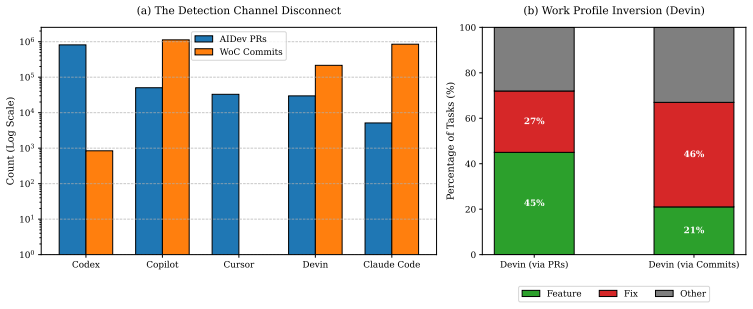
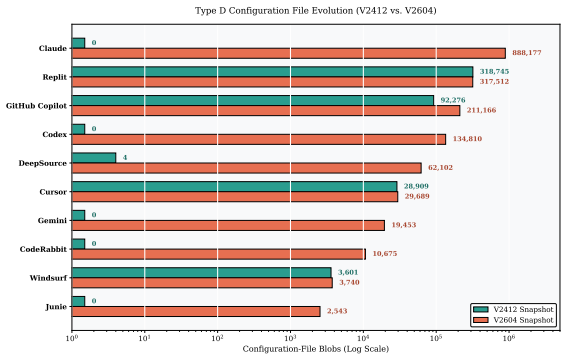
Multi-method detection identifies 850,157 Claude Code commits in one snapshot, of which bot-account lookup recovers only 28,154 (3.3 percent), establishing a 30x relative-recall gap. Across snapshots from December 2024 to April 2026, commit-attributed agents generate over 320,000 commits per month, with Claude Code leading (886,122 commits across 17,295 projects) and dominating silent configuration-file-only adoption. Compared with an independent pull-request census, the two channels capture nearly disjoint populations: a PR census misses 79 percent of commit-detected Claude Code adopters and essentially all Codex adopters, and the observed work profile follows deployment and detection mode
What carries the argument
multi-layered detection framework integrating configuration-file scanning, commit-message analysis, author-identity matching, and bot-signature lookup, classifying traces into four behavioral types
If this is right
- Single-signal prevalence estimates for AI coding agents are biased low by at least a factor of 30.
- Commit-deployed in-editor agents surface as maintenance work while PR-deployed cloud agents surface as feature work.
- Silent configuration-file-only adoption accounts for thousands of projects and is invisible to bot or PR methods.
- Different detection channels capture disjoint agent populations, so no single channel represents overall adoption.
Where Pith is reading between the lines
- Future prevalence studies should combine multiple signals rather than rely on any one channel.
- The work profile observed depends more on deployment mode than on the specific agent tool.
- Extending the four-pattern framework to additional agent types could test whether the 30x gap is general across tools.
Load-bearing premise
The 495 hand-validated labels with per-cell precision and Wilson intervals are representative of the true positive and false positive rates of the four detection patterns across the full 180 million repository corpus and across time snapshots.
What would settle it
Re-running the full multi-method pipeline on a later snapshot and finding that bot-account lookup recovers substantially more than 3.3 percent of the total Claude Code commits would indicate the reported recall gap does not hold.
Figures


read the original abstract
Generative AI coding agents are entering the open-source supply chain, yet their diverse and often invisible traces leave their prevalence poorly understood. We introduce a multi-layered detection framework that integrates configuration-file scanning, commit-message analysis, author-identity matching, and bot-signature lookup across World of Code (180M+ Git repositories), classifying agent traces into four behavioral types. No single method captures more than a fraction of activity: multi-method detection identifies 850,157 Claude Code commits in one snapshot, of which bot-account lookup_the signal most adoption studies rely on_recovers only 28,154 (3.3%), a 30x relative-recall gap, so single-signal prevalence estimates are biased low by at least this factor. Every detection pattern is hand-validated (495 labels) with per-cell precision and Wilson confidence intervals. Across snapshots from December 2024 to April 2026, commit-attributed agents generate over 320,000 commits per month; Claude Code leads (886,122 commits across 17,295 projects) and dominates silent, configuration-file-only adoption (21,078 projects). Compared against an independent pull-request census (AIDev), the two channels capture nearly disjoint agent populations_a PR census misses 79% of commit-detected Claude Code adopters and essentially all Codex adopters_and different kinds of work: PR-deployed cloud agents (Codex, Cursor) surface as feature work, while commit-deployed in-editor agents (Claude Code, OpenHands, Aider) surface as maintenance. The observed work profile follows deployment and detection mode rather than the tool itself, so no single channel is representative.
Editorial analysis
A structured set of objections, weighed in public.
Referee Report
Summary. The manuscript presents a multi-method detection framework integrating configuration-file scanning, commit-message analysis, author-identity matching, and bot-signature lookup across 180M+ Git repositories in World of Code. It classifies AI coding agent traces into four behavioral types and reports that multi-method detection identifies 850,157 Claude Code commits in one snapshot, while bot-account lookup recovers only 28,154 (3.3%), yielding a 30x relative-recall gap. Every detection pattern is hand-validated on 495 labels with per-cell precision and Wilson confidence intervals. Comparisons to an independent PR census (AIDev) show nearly disjoint populations (PR misses 79% of commit-detected Claude Code adopters) and work profiles tied to deployment mode rather than tool.
Significance. If the validation generalizes, the work demonstrates that single-signal prevalence estimates for generative AI coding agents are biased low by at least an order of magnitude and that commit versus PR channels capture distinct populations and work types. The scale of the census and the explicit multi-method plus hand-validation approach provide a concrete empirical basis for revising adoption studies in software supply chains.
major comments (2)
- [Validation / Methods] Validation / Methods section: The sampling frame for the 495 hand-validated labels (stratified random vs. convenience sampling, stratification by detection pattern, repository size, or temporal coverage) is not described. This is load-bearing for the per-cell precision estimates and Wilson intervals that underwrite the 30x recall-gap claim across the full 180M-repository corpus.
- [Results] Results, disjoint-population paragraph: The statement that a PR census misses 79% of commit-detected Claude Code adopters requires an explicit description of the overlap calculation, including whether the two datasets cover identical time windows and repositories; without this the disjoint-population claim cannot be evaluated.
minor comments (1)
- [Abstract] Abstract: The four behavioral types are referenced but not named or briefly defined; adding one-sentence characterizations would improve standalone readability.
Simulated Author's Rebuttal
We thank the referee for the constructive feedback on the validation sampling and overlap calculation. These points improve the transparency of the manuscript. We address each major comment below.
read point-by-point responses
-
Referee: [Validation / Methods] Validation / Methods section: The sampling frame for the 495 hand-validated labels (stratified random vs. convenience sampling, stratification by detection pattern, repository size, or temporal coverage) is not described. This is load-bearing for the per-cell precision estimates and Wilson intervals that underwrite the 30x recall-gap claim across the full 180M-repository corpus.
Authors: The referee is correct that the manuscript does not describe the sampling frame for the 495 hand-validated labels. We will revise the Validation / Methods section to provide a complete description of the sampling procedure, including the sampling method (stratified random or otherwise), the stratification variables used (detection pattern, repository size, temporal coverage), and the selection process from the larger set of detected instances. This addition will support evaluation of the per-cell precision estimates and Wilson intervals. revision: yes
-
Referee: [Results] Results, disjoint-population paragraph: The statement that a PR census misses 79% of commit-detected Claude Code adopters requires an explicit description of the overlap calculation, including whether the two datasets cover identical time windows and repositories; without this the disjoint-population claim cannot be evaluated.
Authors: We agree that the overlap calculation requires explicit description. We will revise the Results section to detail the overlap computation, including the matching criteria on repositories and agent identifiers, confirmation that both the commit detection and AIDev PR census cover identical time windows (December 2024 to April 2026), and the exact formula yielding the 79% figure (proportion of commit-detected Claude Code adopters without a match in the PR census). revision: yes
Circularity Check
No circularity: empirical counts and hand validation are independent of any self-referential derivation
full rationale
The paper performs a multi-method census on an external corpus (World of Code) and reports raw detection counts plus hand-labeled precision on 495 samples with Wilson intervals. No equations, fitted parameters, predictions derived from fits, or load-bearing self-citations appear in the derivation chain. The 30x recall gap is a direct ratio of observed counts (850157 vs 28154), not a constructed quantity. Validation labels are produced by human inspection external to the detection rules, and the AIDev comparison is an independent external census. The representativeness concern raised by the skeptic is a question of sampling validity, not circularity by construction.
Axiom & Free-Parameter Ledger
axioms (1)
- domain assumption The four detection signals (config files, commit messages, author identity, bot signatures) are reliable indicators of AI agent activity with acceptably low false-positive rates.
Reference graph
Works this paper leans on
-
[1]
The Impact of AI on Developer Productivity: Evidence from GitHub Copilot
Sida Peng, Eirini Kalliamvakou, Peter Cihon, and Mert Demirer. The impact of ai on developer pro- ductivity: Evidence from github copilot.arXiv preprint arXiv:2302.06590, 2023
work page internal anchor Pith review Pith/arXiv arXiv 2023
-
[2]
Composer 2 technical report.arXiv preprint arXiv:2603.24477, 2026
Cursor Research Team, Aaron Chan, Ahmed Shalaby, Alexander Wettig, Aman Sanger, Andrew Zhai, Anurag Ajay, Ashvin Nair, Charlie Snell, Chen Lu, et al. Composer 2 technical report.arXiv preprint arXiv:2603.24477, 2026
-
[3]
Replit agent.https://docs.replit.com/replitai/agent, 2024
Replit. Replit agent.https://docs.replit.com/replitai/agent, 2024. Autonomous app-building agent; announced September 2024. Accessed June 2026
2024
-
[4]
OpenHands: An Open Platform for AI Software Developers as Generalist Agents
Xingyao Wang, Boxuan Li, Yufan Song, Frank F. Xu, Xiangru Tang, Mingchen Zhuge, Jiayi Pan, Yueqi Song, Bowen Li, Jaskirat Singh, et al. OpenHands: An open platform for AI software developers as generalist agents, 2024. arXiv:2407.16741
work page internal anchor Pith review Pith/arXiv arXiv 2024
-
[5]
Hao He, Courtney Miller, Shyam Agarwal, Christian K¨ astner, and Bogdan Vasilescu. Speed at the cost of quality: How cursor ai increases short-term velocity and long-term complexity in open-source projects. InProceedings of the 23rd International Conference on Mining Software Repositories (MSR ’26), 2026. arXiv:2511.04427
-
[6]
Cybersecurity risks of ai-generated code.Center for Security and Emerging Technology, November 2024
Jessica Ji, Jenny Jun, Maggie Wu, and Rebecca Gelles. Cybersecurity risks of ai-generated code.Center for Security and Emerging Technology, November 2024. Issue Brief
2024
-
[7]
Agentic Much? Adoption of Coding Agents on GitHub
Romain Robbes, Th´ eo Matricon, Thomas Degueule, Andre Hora, and Stefano Zacchiroli. Agentic much? adoption of coding agents on github.arXiv preprint arXiv:2601.18341, 2026. 18 Project Pre-adoption (months) Post-adoption (months) −6−5−4−3−2−1 +1 +2 +3 +4 +5 all-hands-ai oh-aci 0 0 0 0 0 41 84 61 125 39 7 jisaf location-map 0 0 0 0 0 20 129 0 0 0 0 runtime...
work page internal anchor Pith review Pith/arXiv arXiv 2026
-
[8]
World of code: Enabling a research workflow for mining and analyzing the universe of open source vcs data.Empirical Software Engineering, 26(2):1–42, 2021
Yuxing Ma, Tapajit Dey, Chris Bogart, Sadika Amreen, Marat Valiev, Adam Tutko, David Kennard, Russell Zaretzki, and Audris Mockus. World of code: Enabling a research workflow for mining and analyzing the universe of open source vcs data.Empirical Software Engineering, 26(2):1–42, 2021
2021
- [9]
-
[10]
Survey reveals AI’s impact on the developer experience.https://github.blog/ news-insights/research/survey-reveals-ais-impact-on-the-developer-experience/, 2023
GitHub. Survey reveals AI’s impact on the developer experience.https://github.blog/ news-insights/research/survey-reveals-ais-impact-on-the-developer-experience/, 2023. Wakefield Research survey of 500 U.S. developers; reports 92% AI-tool usage. Accessed June 2026
2023
-
[11]
Detecting and characterizing bots that commit code
Tapajit Dey, Sara Mousavi, Eduardo Ponce, Tanner Fry, Bogdan Vasilescu, Anna Filippova, and Au- dris Mockus. Detecting and characterizing bots that commit code. InIEEE/ACM 17th International Conference on Mining Software Repositories (MSR), pages 209–219, 2020
2020
-
[12]
A ground-truth dataset and clas- sification model for detecting bots in github issue and pr comments.Journal of Systems and Software, 175:110911, 2021
Mehdi Golzadeh, Alexandre Decan, Damien Legay, and Tom Mens. A ground-truth dataset and clas- sification model for detecting bots in github issue and pr comments.Journal of Systems and Software, 175:110911, 2021
2021
-
[13]
Wiese, Ivanilton Polato, Ana Paula Chaves, and Marco A
Mairieli Wessel, Bruno Mendes de Souza, Igor Steinmacher, Igor S. Wiese, Ivanilton Polato, Ana Paula Chaves, and Marco A. Gerosa. The power of bots: Characterizing and understanding bots in OSS projects.Proceedings of the ACM on Human-Computer Interaction, 2(CSCW):182:1–182:19, 2018
2018
-
[14]
Identifying auto-generated code by using machine learning techniques
Kento Shimonaka, Soichi Sumi, Yoshiki Higo, and Shinji Kusumoto. Identifying auto-generated code by using machine learning techniques. InInternational Workshop on Empirical Software Engineering in Practice (IWESEP), 2016
2016
-
[15]
Zero- shot detection of machine-generated codes.arXiv preprint arXiv:2310.05103, 2023
Xianjun Yang, Kexun Zhang, Haifeng Chen, Linda Petzold, William Yang Wang, and Wei Cheng. Zero- shot detection of machine-generated codes.arXiv preprint arXiv:2310.05103, 2023
-
[16]
Xin Yin, Xinrui Li, Chao Ni, Xiaodan Xu, and Xiaohu Yang. Detecting LLM-generated code with subtle modification by adversarial training.arXiv preprint arXiv:2507.13123, 2025
-
[17]
An empirical evaluation of GitHub Copilot’s code suggestions
Nhan Nguyen and Sarah Nadi. An empirical evaluation of GitHub Copilot’s code suggestions. In IEEE/ACM 19th International Conference on Mining Software Repositories (MSR), pages 1–5, 2022
2022
-
[18]
A dataset and an approach for identity resolution of 38 million author IDs extracted from 2b git commits
Tanner Fry, Tapajit Dey, Andrey Karnauch, and Audris Mockus. A dataset and an approach for identity resolution of 38 million author IDs extracted from 2b git commits. InIEEE/ACM 17th International Conference on Mining Software Repositories (MSR), pages 518–522, 2020
2020
-
[19]
A complete set of related git repositories identified via community detection approaches based on shared commits
Audris Mockus, Diomidis Spinellis, Zoe Kotti, and Gabriel John Dusing. A complete set of related git repositories identified via community detection approaches based on shared commits. InIEEE/ACM 17th International Conference on Mining Software Repositories (MSR), pages 513–517, 2020. 19
2020
-
[20]
CodeRabbit: AI code reviews.https://www.coderabbit.ai/, 2024
CodeRabbit. CodeRabbit: AI code reviews.https://www.coderabbit.ai/, 2024. AI code-review agent. Accessed June 2026
2024
-
[21]
Aider: AI pair programming in your terminal.https://github.com/Aider-AI/aider,
Paul Gauthier. Aider: AI pair programming in your terminal.https://github.com/Aider-AI/aider,
-
[22]
Accessed June 2026
Open-source terminal coding tool. Accessed June 2026
2026
-
[23]
Ecosyste.ms: An open api service for software ecosystems.https://ecosyste.ms/
Ecosyste.ms. Ecosyste.ms: An open api service for software ecosystems.https://ecosyste.ms/. Repository-metadata index across software forges. Accessed June 2026
2026
-
[24]
Windsurf: The agentic IDE.https://windsurf.com/, 2024
Codeium. Windsurf: The agentic IDE.https://windsurf.com/, 2024. Agentic IDE, originally released by Codeium. Accessed June 2026
2024
-
[25]
Claude code.https://www.anthropic.com/claude-code, 2025
Anthropic. Claude code.https://www.anthropic.com/claude-code, 2025. Agentic command-line coding tool; research preview announced February 2025 alongside Claude 3.7 Sonnet. Accessed June 2026
2025
-
[26]
Introducing Codex: A cloud-based software engineering agent.https://openai.com/index/ introducing-codex/, 2025
OpenAI. Introducing Codex: A cloud-based software engineering agent.https://openai.com/index/ introducing-codex/, 2025. Research preview announced May 16, 2025; powered by codex-1. Accessed June 2026
2025
-
[27]
Gemini cli.https://github.com/google-gemini/gemini-cli, 2025
Google. Gemini cli.https://github.com/google-gemini/gemini-cli, 2025. Computer software
2025
-
[28]
Dependabot.https://github.com/dependabot, 2019
GitHub. Dependabot.https://github.com/dependabot, 2019. Automated dependency-update bot. Accessed June 2026
2019
-
[29]
Github copilot coding agent.https://github.blog/changelog/ 2025-09-25-copilot-coding-agent-is-now-generally-available/, 2025
GitHub. Github copilot coding agent.https://github.blog/changelog/ 2025-09-25-copilot-coding-agent-is-now-generally-available/, 2025. Autonomous SWE agent; announced May 2025, generally available September 2025. Accessed June 2026
2025
-
[30]
Jules: An autonomous coding agent.https://jules.google/, 2025
Google. Jules: An autonomous coding agent.https://jules.google/, 2025. Asynchronous coding agent from Google Labs; public beta May 2025. Accessed June 2026
2025
-
[31]
Introducing devin, the first AI software engineer.https://cognition.ai/blog/ introducing-devin, 2024
Cognition. Introducing devin, the first AI software engineer.https://cognition.ai/blog/ introducing-devin, 2024. Autonomous software-engineering agent; announced March 2024. Accessed June 2026
2024
-
[32]
Conventional commits 1.0.0.https://www.conventionalcommits.org/en/v1
Conventional Commits. Conventional commits 1.0.0.https://www.conventionalcommits.org/en/v1. 0.0/, 2023. Specification for structured commit messages. Accessed June 2026
2023
-
[33]
Audris Mockus and Lawrence G. Votta. Identifying reasons for software changes using historic databases. InProceedings of the International Conference on Software Maintenance (ICSM), pages 120–130, 2000
2000
-
[34]
When do changes induce fixes? InProceed- ings of the 2005 International Workshop on Mining Software Repositories (MSR), pages 1–5, 2005
Jacek ´Sliwerski, Thomas Zimmermann, and Andreas Zeller. When do changes induce fixes? InProceed- ings of the 2005 International Workshop on Mining Software Repositories (MSR), pages 1–5, 2005
2005
-
[35]
Edwin B. Wilson. Probable inference, the law of succession, and statistical inference.Journal of the American Statistical Association, 22(158):209–212, 1927
1927
-
[36]
Developer certificate of origin, version 1.1.https://developercertificate.org/,
Linux Foundation. Developer certificate of origin, version 1.1.https://developercertificate.org/,
-
[37]
Accessed June 2026. 20
2026
discussion (0)
Sign in with ORCID, Apple, or X to comment. Anyone can read and Pith papers without signing in.