Discrete Event Population Updates: finding game theoretic emergent behaviour in queueing systems with simulation
Pith reviewed 2026-06-29 01:58 UTC · model grok-4.3
The pith
A single long discrete event simulation can be coupled directly to evolutionary update rules to analyze strategic behavior in queueing systems without closed-form payoffs.
A machine-rendered reading of the paper's core claim, the machinery that carries it, and where it could break.
Core claim
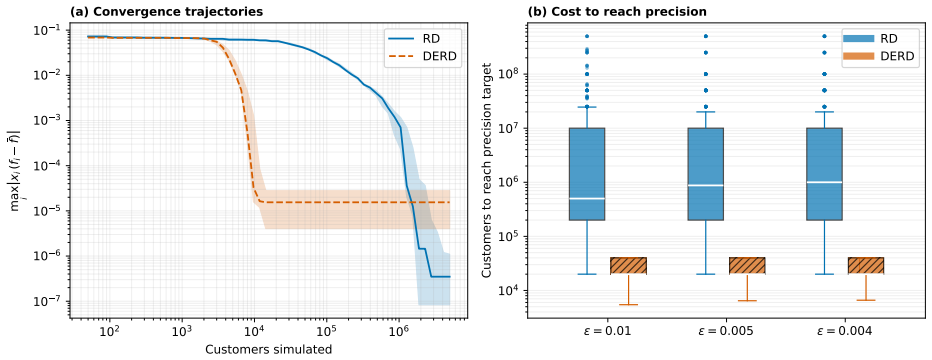
The central claim is that Discrete Event Population Updates (DEPU) couple a single long run of a discrete event simulation directly to an evolutionary population update rule, removing the closed-form constraint that previously limited evolutionary game theory in queueing systems. Implementations via Discrete Event Replicator Dynamics and Discrete Event Moran Replacement applied to a multi-server jockeying model reach comparable precision tens of times faster than nesting short simulations inside an outer evolutionary loop, and make systematic parameter sweeps tractable because each operating point costs only one simulation run.
What carries the argument
Discrete Event Population Updates (DEPU), which integrate one long discrete event simulation run directly with evolutionary population update rules such as replicator dynamics or Moran replacement.
If this is right
- Evolutionary game theory applies to any queueing system that can be built in a discrete event simulator.
- Each operating point in parameter space requires only a single simulation run.
- Systematic parameter sweeps over model parameters become computationally tractable.
- Comparable precision is reached tens of times faster than the standard practice of nesting short simulations inside an evolutionary loop.
Where Pith is reading between the lines
- The approach could extend to other simulation-based models in operations research that involve population-level strategic interactions.
- It opens the possibility of hybrid methods that combine discrete event simulation with agent-based evolutionary dynamics for real-time queue management.
- Direct comparison against additional models with known analytical solutions would test the robustness of the single-run payoff coupling.
Load-bearing premise
That the payoffs obtained from a single long discrete event simulation run can be fed directly into standard evolutionary update rules to produce accurate population dynamics without requiring closed-form expressions or additional validation of the simulation-to-evolution coupling.
What would settle it
Applying the method to a queueing model that admits known closed-form payoffs and observing that the resulting population dynamics diverge from those computed using the closed forms.
Figures





read the original abstract
Strategic behaviour in queueing systems has been studied extensively in the behavioural queueing literature, but almost exclusively for systems that admit closed-form expressions for the cost or utility experienced by a strategic user. Evolutionary game theory offers a mature framework for analysing populations whose individual payoffs depend on the composition of the population itself, and would in principle apply to a much wider class of queueing systems; its application has, however, been constrained by the same closed-form requirement. We introduce Discrete Event Population Updates (DEPU), a general algorithmic framework that couples a single long run of a discrete event simulation (DES) directly to an evolutionary population update rule, removing that constraint. We present two implementations: Discrete Event Replicator Dynamics (DERD), which follows an Euler discretisation of the replicator dynamics equation, and Discrete Event Moran Replacement (DEMR), which maintains a finite population updated via Moran-style copying events. Both are applied to a multi-server jockeying model for which no closed-form fitness expressions are available. On the jockeying model considered, DEPU reaches comparable precision tens of times faster than the standard practice of nesting short simulations inside an outer evolutionary loop, and because each operating point then costs only a single simulation run it also makes systematic parameter sweeps tractable. This brings the toolkit of evolutionary dynamics within reach of any system a modeller can build in a discrete event simulator.
Editorial analysis
A structured set of objections, weighed in public.
Referee Report
Summary. The paper introduces Discrete Event Population Updates (DEPU) as an algorithmic framework coupling a single long discrete event simulation (DES) run directly to evolutionary population update rules, with two implementations: Discrete Event Replicator Dynamics (DERD) following an Euler discretisation of the replicator equation and Discrete Event Moran Replacement (DEMR) using Moran-style copying in a finite population. It applies the method to a multi-server jockeying queueing model without closed-form fitnesses and claims that DEPU achieves comparable precision to nested short simulations inside an outer evolutionary loop but tens of times faster, while also enabling tractable parameter sweeps.
Significance. If the DEPU coupling is shown to be accurate, the work would extend evolutionary game theory to queueing systems that admit simulation but not analytic solution, removing a key barrier in behavioural queueing research. The approach is algorithmic, introduces no free parameters, and avoids circularity or fitted quantities.
major comments (2)
- [Abstract and results on the jockeying model] The central claim that payoffs from one long DES run can be fed directly into replicator or Moran updates to produce accurate population dynamics (abstract; results on jockeying model) is load-bearing but rests on an unvalidated assumption. No benchmark against any closed-form model is provided to test for systematic bias from on-the-fly payoff estimation, event interleaving, or time-scale choices, leaving the accuracy of the simulation-to-evolution coupling untested relative to the nested-simulation baseline.
- [Methods descriptions of DERD and DEMR] Implementation details, error analysis, and validation data for simulation fidelity are absent (abstract; methods descriptions of DERD/DEMR), so the performance and precision claims cannot be assessed for soundness.
minor comments (1)
- [Abstract] Notation for the two implementations (DERD vs. DEMR) could be introduced more explicitly when first mentioned to aid readability.
Simulated Author's Rebuttal
We thank the referee for their constructive comments, which highlight important aspects of validation and methodological detail. We respond to each major comment below and agree that revisions are warranted to strengthen the manuscript.
read point-by-point responses
-
Referee: [Abstract and results on the jockeying model] The central claim that payoffs from one long DES run can be fed directly into replicator or Moran updates to produce accurate population dynamics (abstract; results on jockeying model) is load-bearing but rests on an unvalidated assumption. No benchmark against any closed-form model is provided to test for systematic bias from on-the-fly payoff estimation, event interleaving, or time-scale choices, leaving the accuracy of the simulation-to-evolution coupling untested relative to the nested-simulation baseline.
Authors: We agree that the absence of a benchmark against a closed-form model leaves the coupling unvalidated with respect to potential systematic biases. Although the framework targets systems without closed-form fitnesses, we will add a dedicated validation subsection in the revised manuscript. This will apply DEPU to a simple queueing game (e.g., an M/M/1 pricing game) that admits closed-form fitness expressions, allowing direct comparison of the resulting population dynamics against both the known analytic replicator/Moran trajectories and the nested-simulation baseline. revision: yes
-
Referee: [Methods descriptions of DERD and DEMR] Implementation details, error analysis, and validation data for simulation fidelity are absent (abstract; methods descriptions of DERD/DEMR), so the performance and precision claims cannot be assessed for soundness.
Authors: We accept that the current Methods section lacks sufficient implementation detail, error analysis, and fidelity validation to allow full assessment of the performance claims. In the revision we will expand the descriptions of DERD and DEMR to include pseudocode, explicit discussion of time-scale separation assumptions, potential biases from event interleaving and on-the-fly payoff estimation, and additional quantitative comparisons (error metrics and runtime ratios) against the nested-simulation baseline on the jockeying model. revision: yes
Circularity Check
No circularity: algorithmic coupling is independent of inputs
full rationale
The paper introduces DEPU as a direct algorithmic coupling of a single long DES run to standard replicator or Moran update rules. No equations, fitted parameters, or derivations reduce the claimed speed or population dynamics to self-referential definitions or renamed inputs. The method is presented as a general framework applicable to any simulatable system, with performance claims based on empirical timing comparisons rather than constructed equivalences. Lack of closed-form validation is a separate empirical concern, not a circularity reduction.
Axiom & Free-Parameter Ledger
axioms (1)
- domain assumption Simulation outputs from a single long DES run provide reliable fitness values that can be inserted directly into replicator dynamics or Moran replacement rules.
Reference graph
Works this paper leans on
-
[1]
Individual versus social optimization in the allocation of customers to alternative servers.Management Science, 29(7):831–839, 1983
Colin E Bell and Shaler Stidham Jr. Individual versus social optimization in the allocation of customers to alternative servers.Management Science, 29(7):831–839, 1983
1983
-
[2]
A solution for queues with instantaneous jockeying and other customer selection rules.Naval Research Logistics Quarterly, 17(3):315–325, 1970
Ralph L Disney and William E Mitchell. A solution for queues with instantaneous jockeying and other customer selection rules.Naval Research Logistics Quarterly, 17(3):315–325, 1970
1970
-
[3]
Congestion tolls for Poisson queueing processes.Economet- rica, 43(1):81–92, 1975
Noel M Edelson and David K Hildebrand. Congestion tolls for Poisson queueing processes.Economet- rica, 43(1):81–92, 1975. 25
1975
-
[4]
Springer Science & Business Media, 2011
Walter Gautschi.Numerical analysis. Springer Science & Business Media, 2011
2011
-
[5]
Social stability and equilibrium.Econometrica, 59(3):859–867, 1991
Itzhak Gilboa and Akihiko Matsui. Social stability and equilibrium.Econometrica, 59(3):859–867, 1991
1991
-
[6]
Two queues before a single server.Biometrika, 45(1/2):1–11, 1958
Frank A Haight. Two queues before a single server.Biometrika, 45(1/2):1–11, 1958
1958
-
[7]
CRC press, 2016
Refael Hassin.Rational queueing. CRC press, 2016
2016
-
[8]
Springer, New York, 2003
Refael Hassin and Moshe Haviv.To Queue or Not to Queue: Equilibrium Behavior in Queueing Systems. Springer, New York, 2003
2003
-
[9]
The price of anarchy in an exponential multi-server.Operations Research Letters, 35(4):421–426, 2007
Moshe Haviv and Tim Roughgarden. The price of anarchy in an exponential multi-server.Operations Research Letters, 35(4):421–426, 2007
2007
-
[10]
Simulating dynamical features of escape panic.Nature, 407(6803):487–490, 2000
Dirk Helbing, Ill´ es Farkas, and Tam´ as Vicsek. Simulating dynamical features of escape panic.Nature, 407(6803):487–490, 2000
2000
-
[11]
Computation and simulation of evolution- ary game dynamics in finite populations.Scientific reports, 9(1):6946, 2019
Laura Hindersin, Bin Wu, Arne Traulsen, and Julian Garc´ ıa. Computation and simulation of evolution- ary game dynamics in finite populations.Scientific reports, 9(1):6946, 2019
2019
-
[12]
Cambridge Univer- sity Press, Cambridge, 1998
Josef Hofbauer and Karl Sigmund.Evolutionary Games and Population Dynamics. Cambridge Univer- sity Press, Cambridge, 1998
1998
-
[13]
Measuring the price of anarchy in critical care unit interactions.Journal of the Operational Research Society, 68(6):630–642, 2017
Vincent Knight, Izabela Komenda, and Jeff Griffiths. Measuring the price of anarchy in critical care unit interactions.Journal of the Operational Research Society, 68(6):630–642, 2017
2017
-
[14]
Selfish routing in public services.European Journal of Operational Research, 230(1):122–132, 2013
Vincent A Knight and Paul R Harper. Selfish routing in public services.European Journal of Operational Research, 230(1):122–132, 2013
2013
-
[15]
On jockeying in queues.Management Science, 12(5):412–436, 1966
Ernest Koenigsberg. On jockeying in queues.Management Science, 12(5):412–436, 1966
1966
-
[16]
A review of the discrete choice models applied to evacuation modelling.Transportation Research Part C: Emerging Technologies, 70:83–97, 2016
Ruggiero Lovreglio, Achille Fonzone, and Luigi Dell’Olio. A review of the discrete choice models applied to evacuation modelling.Transportation Research Part C: Emerging Technologies, 70:83–97, 2016
2016
-
[17]
A model for rational abandonments from invisible queues
Avishai Mandelbaum and Nahum Shimkin. A model for rational abandonments from invisible queues. Queueing Systems, 36:141–173, 2000
2000
-
[18]
Cambridge University Press, Cambridge, 1982
John Maynard Smith.Evolution and the Theory of Games. Cambridge University Press, Cambridge, 1982
1982
-
[19]
Random processes in genetics
Patrick Alfred Pierce Moran. Random processes in genetics. InMathematical proceedings of the cam- bridge philosophical society, volume 54, pages 60–71. Cambridge University Press, 1958
1958
-
[20]
The regulation of queue size by levying tolls.Econometrica: journal of the Econometric Society, pages 15–24, 1969
Pinhas Naor. The regulation of queue size by levying tolls.Econometrica: journal of the Econometric Society, pages 15–24, 1969
1969
-
[21]
Harvard university press, 2006
Martin A Nowak.Evolutionary dynamics: exploring the equations of life. Harvard university press, 2006
2006
-
[22]
Palmer, Vincent A
Geraint I. Palmer, Vincent A. Knight, Paul R. Harper, and Asyl L. Hawa. Ciw: An open-source discrete event simulation library.Journal of Simulation, 13(1):68–82, 2019
2019
-
[23]
A game theoretic model of the behavioural gaming that takes place at the ems-ed interface.European Journal of Operational Research, 305(3):1236–1258, 2023
Michalis Panayides, Vince Knight, and Paul Harper. A game theoretic model of the behavioural gaming that takes place at the ems-ed interface.European Journal of Operational Research, 305(3):1236–1258, 2023
2023
-
[24]
John Wiley & Sons, Inc., 1998
Michael Pidd.Computer simulation in management science. John Wiley & Sons, Inc., 1998
1998
-
[25]
Bloomsbury Publishing, 2014
Stewart Robinson.Simulation: the practice of model development and use. Bloomsbury Publishing, 2014. 26
2014
-
[26]
How bad is selfish routing?Journal of the ACM, 49(2):236–259, 2002
Tim Roughgarden and ´Eva Tardos. How bad is selfish routing?Journal of the ACM, 49(2):236–259, 2002
2002
-
[27]
MIT Press, Cambridge, MA, 2010
William H Sandholm.Population Games and Evolutionary Dynamics. MIT Press, Cambridge, MA, 2010
2010
-
[28]
Ten simple rules for repro- ducible computational research.PLOS Computational Biology, 9(10):e1003285, 2013
Geir Kjetil Sandve, Anton Nekrutenko, James Taylor, and Eivind Hovig. Ten simple rules for repro- ducible computational research.PLOS Computational Biology, 9(10):e1003285, 2013
2013
-
[29]
Why imitate, and if so, how? A boundedly rational approach to multi-armed bandits
Karl H Schlag. Why imitate, and if so, how? A boundedly rational approach to multi-armed bandits. Journal of Economic Theory, 78(1):130–156, 1998
1998
-
[30]
A conservative index heuristic for routing problems with multiple heterogeneous service facilities.Mathematical Methods of Operations Research, 92:511– 543, 2020
Rob Shone, Vincent A Knight, and Paul R Harper. A conservative index heuristic for routing problems with multiple heterogeneous service facilities.Mathematical Methods of Operations Research, 92:511– 543, 2020
2020
-
[31]
Containment of socially optimal policies in multiple-facility markovian queueing systems.Journal of the Operational Research Society, 67(4):629–643, 2016
Rob Shone, Vincent A Knight, Paul R Harper, Janet E Williams, and John Minty. Containment of socially optimal policies in multiple-facility markovian queueing systems.Journal of the Operational Research Society, 67(4):629–643, 2016
2016
-
[32]
Comparisons between observable and unobservable m/m/1 queues with respect to optimal customer behavior.European Journal of Operational Research, 227(1):133–141, 2013
Rob Shone, Vincent A Knight, and Janet E Williams. Comparisons between observable and unobservable m/m/1 queues with respect to optimal customer behavior.European Journal of Operational Research, 227(1):133–141, 2013
2013
-
[33]
Reinforcement learning: An introduction.A Bradford Book, 2018
Richard S Sutton. Reinforcement learning: An introduction.A Bradford Book, 2018
2018
-
[34]
Evolutionary stable strategies and game dynamics.Mathematical Biosciences, 40(1–2):145–156, 1978
Peter D Taylor and Leo B Jonker. Evolutionary stable strategies and game dynamics.Mathematical Biosciences, 40(1–2):145–156, 1978
1978
-
[35]
Ciw: 3.2.4
The Ciw library developers. Ciw: 3.2.4
-
[36]
Coevolutionary dynamics: from finite to infinite populations.Physical review letters, 95(23):238701, 2005
Arne Traulsen, Jens Christian Claussen, and Christoph Hauert. Coevolutionary dynamics: from finite to infinite populations.Physical review letters, 95(23):238701, 2005
2005
-
[37]
Deciding which queue to join: Some counterexamples.Operations Research, 34(1):55–62, 1986
Ward Whitt. Deciding which queue to join: Some counterexamples.Operations Research, 34(1):55–62, 1986
1986
-
[38]
Wilkinson, Michel Dumontier, IJsbrand Jan Aalbersberg, Gabrielle Appleton, Myles Axton, Arie Baak, Niklas Blomberg, Jan-Willem Boiten, Luiz Bonino da Silva Santos, Philip E
Mark D. Wilkinson, Michel Dumontier, IJsbrand Jan Aalbersberg, Gabrielle Appleton, Myles Axton, Arie Baak, Niklas Blomberg, Jan-Willem Boiten, Luiz Bonino da Silva Santos, Philip E. Bourne, et al. The FAIR guiding principles for scientific data management and stewardship.Scientific Data, 3:160018, 2016. 27
2016
discussion (0)
Sign in with ORCID, Apple, or X to comment. Anyone can read and Pith papers without signing in.