Symbolon: Symbolic Execution by Learning Code Transformation
Pith reviewed 2026-06-30 09:04 UTC · model grok-4.3
The pith
Symbolon learns code transformations on small programs and applies them via an agent to raise symbolic execution coverage on large targets.
A machine-rendered reading of the paper's core claim, the machinery that carries it, and where it could break.
Core claim
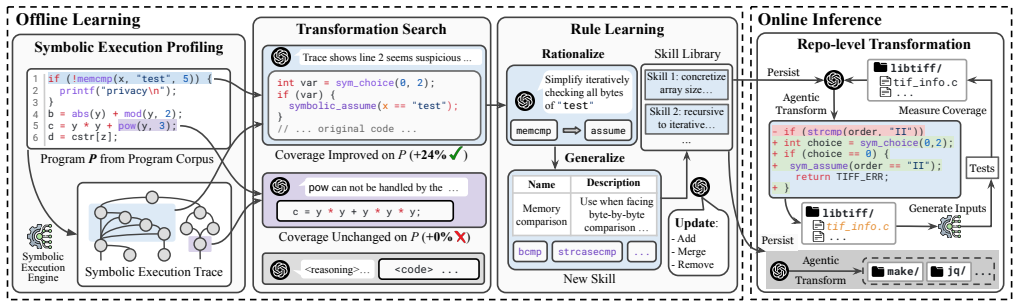
Symbolon formulates transformation discovery as search on small programs, distills the outcomes into a library of agent skills, and uses an agent to apply the skills context-sensitively on repo-level targets, thereby improving symbolic execution engines such as KLEE.
What carries the argument
a reusable library of agent skills distilled from offline search-based transformation discovery on small programs and instantiated context-sensitively by an agent
If this is right
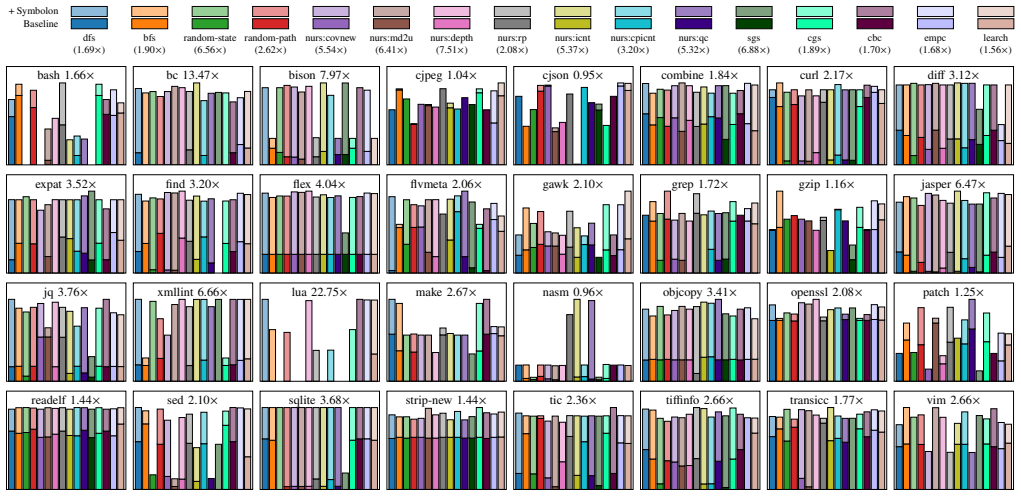
- KLEE with Symbolon raises average line coverage 3.69 times across 32 real-world programs and 16 search strategies.
- Peak memory usage falls by a factor of 29.2 and per-query solver time by a factor of 123.
- The framework identifies 21 previously unknown bugs in the latest Linux kernel, all reported to maintainers.
Where Pith is reading between the lines
- The same distilled-skill approach could be tried on other symbolic execution engines to check whether the coverage and resource gains transfer.
- If the skills generalize, they might be tested as a preprocessing step for related techniques such as concolic execution.
- Collecting a broader set of small programs for the initial search phase could increase the range of programs that benefit from the skill library.
Load-bearing premise
Transformations found through search on small programs can be turned into skills that an agent applies to much larger programs while preserving their effectiveness and semantic correctness.
What would settle it
An experiment on the same 32 programs showing that Symbolon produces no measurable gain in line coverage, peak memory, or solver time over unmodified KLEE across the 16 search strategies.
Figures


read the original abstract
Symbolic execution is a powerful program analysis technique with broad applications, such as vulnerability detection, security testing, and malware analysis. However, this technique is known to suffer from scalability issues, e.g., path explosion, complex constraints, due to certain structural and semantic patterns commonly presented in real-world programs. Existing approaches attempt to escape these patterns by transforming programs into new representations to reduce the execution cost. Unfortunately, these transformations are often too rigid to exploit diverse local program semantics and sometimes rely on compiler optimizations designed for concrete execution that may misalign with the goals of symbolic execution. We present Symbolon, a framework that automatically learns diverse code transformations and applies them context-sensitively to improve symbolic execution. Our key insight is to formulate transformation discovery as a search problem over program representations. To make the search practical, Symbolon learns transformations cheaply offline on small programs, distills them into a reusable library of agent skills, and uses an agent to instantiate these skills on repo-level targets. Our evaluation shows that Symbolon substantially improves the symbolic execution engine KLEE across 16 search strategies on 32 real-world programs, increasing line coverage by 3.69x on average while reducing peak memory and per-query solver time by 29.2x and 123x, respectively. When applied to the latest Linux kernel, Symbolon uncovers 21 previously unknown bugs, all of which have been reported to the kernel maintainers.
Editorial analysis
A structured set of objections, weighed in public.
Referee Report
Summary. The paper presents Symbolon, a framework for improving symbolic execution by automatically learning code transformations. It formulates transformation discovery as a search problem over program representations, performs cheap offline search on small programs, distills the results into a reusable library of agent skills, and deploys an agent to apply the skills context-sensitively on large repo-scale targets. The central empirical claim is that Symbolon improves the KLEE engine across 16 search strategies on 32 real-world programs (3.69× average line coverage, 29.2× peak memory reduction, 123× per-query solver time reduction) and, when applied to the latest Linux kernel, discovers 21 previously unknown bugs that were reported to maintainers.
Significance. If the results hold, the work would constitute a meaningful advance in symbolic execution by replacing rigid, hand-crafted or compiler-oriented transformations with an automated, learnable pipeline that adapts to local program semantics. The evaluation on a diverse set of 32 programs, multiple search strategies, and a production-scale target (Linux kernel) with concrete bug reports supplies falsifiable, practical evidence. The offline-learning-plus-online-instantiation design is a clear strength that could be reused in other program-analysis settings.
major comments (1)
- [Abstract and pipeline description (Section 3)] The performance and bug-finding claims rest on the assumption that the learned transformations preserve semantics. The abstract and the description of the distillation/instantiation pipeline supply no mechanism (e.g., equivalence checking, differential testing, or constraint-structure preservation) that would guarantee the transformed program is observationally equivalent to the original. Because every reported metric (coverage, memory, solver time, and new bugs) is only interpretable under semantic preservation, this omission is load-bearing for the central claim.
minor comments (2)
- [Abstract] The abstract states gains “across 16 search strategies” but does not enumerate the strategies or the selection criteria; adding this list (or a pointer to the experimental-setup subsection) would improve reproducibility.
- [Evaluation section] Table or figure captions that report the 3.69× / 29.2× / 123× figures should explicitly state the baseline (vanilla KLEE) and whether the numbers are arithmetic means, geometric means, or medians.
Simulated Author's Rebuttal
We thank the referee for the constructive feedback and the opportunity to address this important point regarding semantic preservation. We respond to the major comment below.
read point-by-point responses
-
Referee: [Abstract and pipeline description (Section 3)] The performance and bug-finding claims rest on the assumption that the learned transformations preserve semantics. The abstract and the description of the distillation/instantiation pipeline supply no mechanism (e.g., equivalence checking, differential testing, or constraint-structure preservation) that would guarantee the transformed program is observationally equivalent to the original. Because every reported metric (coverage, memory, solver time, and new bugs) is only interpretable under semantic preservation, this omission is load-bearing for the central claim.
Authors: We agree that semantic preservation is foundational to interpreting all reported metrics and that the current abstract and Section 3 description do not make the verification mechanism explicit. The search process operates exclusively on small programs for which we perform differential testing (comparing concrete and symbolic outputs before and after each candidate transformation) to retain only semantics-preserving rewrites; these verified transformations are then distilled into the skill library. However, we acknowledge that this verification step is not described in the pipeline overview. In the revised manuscript we will add a dedicated subsection to Section 3 that details the differential-testing procedure used during offline search, including the concrete test harness, the equivalence criterion, and how it carries over to the online instantiation phase. This addition will make the preservation guarantee explicit without altering any experimental results. revision: yes
Circularity Check
No circularity: empirical claims rest on external measurements, not self-referential definitions or fitted predictions.
full rationale
The paper's core results are direct empirical measurements (line coverage, memory usage, solver time on 32 programs; 21 new bugs in the Linux kernel) obtained by running the transformed programs through KLEE. No equations, parameters, or uniqueness theorems are defined in terms of the target metrics; the learning step is presented as offline search whose outputs are then applied and measured externally. The generalization assumption (no semantic loss) is a methodological claim whose validity is tested by the reported outcomes rather than presupposed by construction. No self-citation chains or ansatzes reduce the reported gains to tautologies.
Axiom & Free-Parameter Ledger
axioms (1)
- domain assumption Program transformations discovered on small programs preserve the semantics needed for symbolic execution while reducing path and constraint cost.
invented entities (1)
-
distilled agent skills library
no independent evidence
Reference graph
Works this paper leans on
-
[1]
Symbolic execution and program testing,
J. C. King, “Symbolic execution and program testing,”Commun. ACM, vol. 19, no. 7, p. 385–394, 1976
1976
-
[2]
Symbolic execution for software testing in practice: preliminary assessment,
C. Cadar, P. Godefroid, S. Khurshid, C. S. Păsăreanu, K. Sen, N. Till- mann, and W. Visser, “Symbolic execution for software testing in practice: preliminary assessment,” inProceedings of the 33rd Inter- national Conference on Software Engineering, 2011, pp. 1066–1071
2011
-
[3]
KLEE: Unassisted and automatic generation of high-coverage tests for complex systems programs,
C. Cadar, D. Dunbar, and D. R. Engler, “KLEE: Unassisted and automatic generation of high-coverage tests for complex systems programs,” inProceedings of the 8th USENIX Symposium on Op- erating Systems Design and Implementation (OSDI’08). USENIX Association, 2008, pp. 209–224
2008
-
[4]
S2e: A platform for in-vivo multi-path analysis of software systems,
V. Chipounov, V. Kuznetsov, and G. Candea, “S2e: A platform for in-vivo multi-path analysis of software systems,” inProceedings of the sixteenth international conference on Architectural support for programming languages and operating systems. ACM, 2011
2011
-
[5]
Symbolic execution with SYMCC: don’t interpret, compile!
S. Poeplau and A. Francillon, “Symbolic execution with SYMCC: don’t interpret, compile!” inProceedings of the 29th USENIX Con- ference on Security Symposium. USENIX Association, 2020, pp. 181–198
2020
-
[6]
Rethinking pointer rea- soning in symbolic execution,
E. Coppa, D. C. D’Elia, and C. Demetrescu, “Rethinking pointer rea- soning in symbolic execution,” inProceedings of the 32nd IEEE/ACM International Conference on Automated Software Engineering (ASE). IEEE, 2017, pp. 613–618
2017
-
[7]
Advancing automated, permission-based pro- gram verification using symbolic execution,
M. H. Schwerhoff, “Advancing automated, permission-based pro- gram verification using symbolic execution,” Ph.D. dissertation, ETH Zurich, 2016
2016
-
[8]
Automated reasoning and detection of specious configuration in large systems with symbolic execution,
Y. Hu, G. Huang, and P. Huang, “Automated reasoning and detection of specious configuration in large systems with symbolic execution,” inProceedings of the 14th USENIX Symposium on Operating Systems Design and Implementation (OSDI 20), 2020, pp. 719–734
2020
-
[9]
Towards symbolic pointers reasoning in dynamic symbolic execution,
D. Kuts, “Towards symbolic pointers reasoning in dynamic symbolic execution,” in2021 Ivannikov Memorial Workshop (IVMEM). IEEE, 2021, pp. 42–49
2021
-
[10]
Droidreach++: Exploring the reachability of native code in android applications,
L. Borzacchiello, M. Cornacchia, D. Maiorca, G. Giacinto, and E. Coppa, “Droidreach++: Exploring the reachability of native code in android applications,”Computers & Security, p. 104657, 2025
2025
-
[11]
Dart: Directed automated random testing,
P. Godefroid, N. Klarlund, and K. Sen, “Dart: Directed automated random testing,” inProceedings of the 2005 ACM SIGPLAN confer- ence on Programming language design and implementation, 2005, pp. 213–223
2005
-
[12]
Directedincremental symbolic execution,
S. Person,G. Yang,N. Rungta,andS. Khurshid,“Directedincremental symbolic execution,” inProceedings of the 32nd ACM SIGPLAN Conference on Programming Language Design and Implementation, 2011, pp. 504–515
2011
-
[13]
Analyzing semantic correctness with symbolic execution: A case study on pkcs# 1 v1. 5 signature verification,
S. Y. Chau, M. Yahyazadeh, O. Chowdhury, A. Kate, and N. Li, “Analyzing semantic correctness with symbolic execution: A case study on pkcs# 1 v1. 5 signature verification,” inNetwork and Distributed Systems Security (NDSS) Symposium 2019, 2019
2019
-
[14]
Efficient state merging in symbolic execution,
V. Kuznetsov, J. Kinder, S. Bucur, and G. Candea, “Efficient state merging in symbolic execution,” inProceedings of the 33rd ACM SIGPLAN Conference on Programming Language Design and Im- plementation, 2012, pp. 193–204
2012
-
[15]
Symbolic execution for randomized programs,
Z. Susag, S. Lahiri, J. Hsu, and S. Roy, “Symbolic execution for randomized programs,”Proceedings of the ACM on Programming Languages, vol. 6, no. OOPSLA2, pp. 1583–1612, 2022
2022
-
[16]
Assisting malware analysis with symbolic execution: A case study,
R. Baldoni, E. Coppa, D. C. D’Elia, and C. Demetrescu, “Assisting malware analysis with symbolic execution: A case study,” inInter- national conference on cyber security cryptography and machine learning. Springer, 2017, pp. 171–188
2017
-
[17]
Driller: Augmenting fuzzing through selective symbolic execution
N. Stephens, J. Grosen, C. Salls, A. Dutcher, R. Wang, J. Corbetta, Y. Shoshitaishvili, C. Kruegel, and G. Vigna, “Driller: Augmenting fuzzing through selective symbolic execution.” inNDSS, vol. 16, no. 2016, 2016, pp. 1–16
2016
-
[18]
Savior: Towardsbug-driven hybridtesting,
Y. Chen, P. Li, J. Xu, S. Guo, R. Zhou, Y. Zhang, T. Wei, and L. Lu, “Savior: Towardsbug-driven hybridtesting,”in2020IEEESymposium on Security and Privacy (SP). IEEE, 2020, pp. 1580–1596
2020
-
[19]
Pangolin: Incre- mental hybrid fuzzing with polyhedral path abstraction,
H. Huang, P. Yao, R. Wu, Q. Shi, and C. Zhang, “Pangolin: Incre- mental hybrid fuzzing with polyhedral path abstraction,” in2020 IEEE Symposium on Security and Privacy (SP). IEEE, 2020, pp. 1613–1627
2020
-
[20]
SyzSpec: specification generation for linux kernel fuzzing via under-constrained symbolic execution,
Y. Hao, J. Pu, X. Li, Z. Qian, and A. A. Sani, “SyzSpec: specification generation for linux kernel fuzzing via under-constrained symbolic execution,” inProceedings of the 2025 ACM SIGSAC Conference on Computer and Communications Security. Association for Computing Machinery, 2025, pp. 813–826
2025
-
[21]
Sound and effi- cient generation of data-oriented exploits via programming language synthesis,
Y. Ling, G. Rajiv, K. Gopinathan, and I. Sergey, “Sound and effi- cient generation of data-oriented exploits via programming language synthesis,” in34th USENIX Security Symposium (USENIX Security 25), 2025, pp. 413–429
2025
-
[22]
Syml: Guiding symbolic execution toward vulnerable states through pattern learning,
N. Ruaro, K. Zeng, L. Dresel, M. Polino, T. Bao, A. Continella, S. Zanero, C. Kruegel, and G. Vigna, “Syml: Guiding symbolic execution toward vulnerable states through pattern learning,” inPro- ceedings of the 24th International Symposium on Research in Attacks, Intrusions and Defenses, 2021, pp. 456–468. 14
2021
-
[23]
Guiding Symbolic Execution with Static Analysis and LLMs for Vulnerability Discovery
M. Shafiuzzaman, A. Desai, W. Guo, and T. Bultan, “Guiding sym- bolic execution with static analysis and llms for vulnerability discov- ery,”arXiv preprint arXiv:2604.06506, 2026
work page internal anchor Pith review Pith/arXiv arXiv 2026
-
[24]
Under-constrained symbolic execu- tion: Correctness checking for real code,
D. A. Ramos and D. Engler, “Under-constrained symbolic execu- tion: Correctness checking for real code,” in24th USENIX Security Symposium (USENIX Security 15), 2015, pp. 49–64
2015
-
[25]
Sys: A static/symbolic tool for finding good bugs in good (browser) code,
F. Brown, D. Stefan, and D. Engler, “Sys: A static/symbolic tool for finding good bugs in good (browser) code,” in29th USENIX Security Symposium (USENIX Security 20), 2020, pp. 199–216
2020
-
[26]
Maze: Towards automated heap feng shui,
Y. Wang, C. Zhang, Z. Zhao, B. Zhang, X. Gong, and W. Zou, “Maze: Towards automated heap feng shui,” in30th USENIX security symposium (USENIX security 21), 2021, pp. 1647–1664
2021
-
[27]
The taming of the stack: Isolating stack data from memory errors,
K. Huang, Y. Huang, M. Payer, Z. Qian, J. Sampson, G. Tan, and T. Jaeger, “The taming of the stack: Isolating stack data from memory errors,” inNDSS, 2022
2022
-
[28]
Symbisect: Accurate bisection for fuzzer-exposed vulnerabilities,
Z. Zhang, Y. Hao, W. Chen, X. Zou, X. Li, H. Li, Y. Zhai, and B. Lau, “Symbisect: Accurate bisection for fuzzer-exposed vulnerabilities,” in 33rd USENIX Security Symposium (USENIX Security 24), 2024, pp. 2493–2510
2024
-
[29]
The cost of performance: Breaking threadx with kernel object masquerading attacks,
X. Shao, Z. Ling, Y. Zhang, H. Yan, Y. Wei, L. Luo, Z. Liu, J. Luo, and X. Fu, “The cost of performance: Breaking threadx with kernel object masquerading attacks,” in34th USENIX Security Symposium (USENIX Security 25), 2025, pp. 7507–7524
2025
-
[30]
Rakis: Secure fast i/o primitives across trust boundaries on intel sgx,
M. Alharthi, F. Sang, D. Kuvaiskii, M. Vij, and T. Kim, “Rakis: Secure fast i/o primitives across trust boundaries on intel sgx,” in Proceedings of the Twentieth European Conference on Computer Systems, 2025, pp. 1177–1193
2025
-
[31]
Scad: Towards a universal and automated network side-channel vul- nerability detection,
K. Man, Z. Wang, Y. Hao, S. Zheng, X. Zhou, Y. Cao, and Z. Qian, “Scad: Towards a universal and automated network side-channel vul- nerability detection,” in2025 IEEE Symposium on Security and Privacy (SP). IEEE, 2025, pp. 1861–1876
2025
-
[32]
Hunting defi vulnerabilities via context-sensitive concolic verification,
Y. Ding, A. Gervais, R. Wattenhofer, and H. Sato, “Hunting defi vulnerabilities via context-sensitive concolic verification,” inPro- ceedings of the 2024 IEEE/ACM 46th International Conference on Software Engineering: Companion Proceedings, 2024, pp. 324–325
2024
-
[33]
Sage: whitebox fuzzing for security testing,
P. Godefroid, M. Y. Levin, and D. Molnar, “Sage: whitebox fuzzing for security testing,”Commun. ACM, vol. 55, no. 3, p. 40–44, 2012
2012
-
[34]
Billions and billions of constraints: whitebox fuzz testing in production,
E. Bounimova, P. Godefroid, and D. Molnar, “Billions and billions of constraints: whitebox fuzz testing in production,” inProceedings of the 2013 International Conference on Software Engineering. IEEE Press, 2013, p. 122–131
2013
-
[35]
Pex: white box test generation for .net,
N. Tillmann and J. De Halleux, “Pex: white box test generation for .net,” inProceedings of the 2nd International Conference on Tests and Proofs. Springer-Verlag, 2008, p. 134–153
2008
-
[36]
Transferring an automated test generation tool to practice: from pex to fakes and code digger,
N. Tillmann, J. de Halleux, and T. Xie, “Transferring an automated test generation tool to practice: from pex to fakes and code digger,” inProceedings of the 29th ACM/IEEE International Conference on Automated Software Engineering. Association for Computing Machinery, 2014, p. 385–396
2014
-
[37]
Higher-order test generation,
P. Godefroid, “Higher-order test generation,”SIGPLAN Not., vol. 46, no. 6, p. 258–269, 2011
2011
-
[38]
Boot- stomp: On the security of bootloaders in mobile devices,
N. Redini, A. Machiry, D. Das, Y. Fratantonio, A. Bianchi, E. Gustafson, Y. Shoshitaishvili, C. Kruegel, and G. Vigna, “Boot- stomp: On the security of bootloaders in mobile devices,” in26th USENIX Security Symposium (USENIX Security 17), 2017, pp. 781– 798
2017
-
[39]
{KSG}: Augmenting kernel fuzzing with system call specification generation,
H. Sun, Y. Shen, J. Liu, Y. Xu, and Y. Jiang, “{KSG}: Augmenting kernel fuzzing with system call specification generation,” in2022 USENIX Annual Technical Conference (USENIX ATC 22), 2022, pp. 351–366
2022
-
[40]
Binsec/se: A dynamic symbolic execution toolkit for binary-level analysis,
R. David, S. Bardin, T. D. Ta, L. Mounier, J. Feist, M.-L. Potet, and J.-Y. Marion, “Binsec/se: A dynamic symbolic execution toolkit for binary-level analysis,” in2016 IEEE 23rd International Conference on Software Analysis, Evolution, and Reengineering (SANER), vol. 1. IEEE, 2016, pp. 653–656
2016
-
[41]
Linkrid: Vetting imbalance reference counting in linux kernel with symbolic execution,
J. Liu, L. Yi, W. Chen, C. Song, Z. Qian, and Q. Yi, “Linkrid: Vetting imbalance reference counting in linux kernel with symbolic execution,” in31st USENIX Security Symposium (USENIX Security 22), 2022, pp. 125–142
2022
-
[42]
Queryx: Symbolic query on decompiled code for finding bugs in cots binaries,
H. Han, J. Kyea, Y. Jin, J. Kang, B. Pak, and I. Yun, “Queryx: Symbolic query on decompiled code for finding bugs in cots binaries,” in2023 IEEE Symposium on Security and Privacy (SP). IEEE, 2023, pp. 3279–3295
2023
-
[43]
Fuzzusb: Hybrid stateful fuzzing of usb gadget stacks,
K. Kim, T. Kim, E. Warraich, B. Lee, K. R. Butler, A. Bianchi, and D. J. Tian, “Fuzzusb: Hybrid stateful fuzzing of usb gadget stacks,” in2022 IEEE Symposium on Security and Privacy (SP). IEEE, 2022, pp. 2212–2229
2022
-
[44]
Symjs: Automatic symbolic testing of javascript web applications,
G. Li, E. Andreasen, and I. Ghosh, “Symjs: Automatic symbolic testing of javascript web applications,” inProceedings of the 22nd ACM SIGSOFT International Symposium on Foundations of Software Engineering, 2014, pp. 449–459
2014
-
[45]
Automated exploit generation for node. js packages,
F. Marques, M. Ferreira, A. Nascimento, M. E. Coimbra, N. Santos, L. Jia, and J. Fragoso Santos, “Automated exploit generation for node. js packages,”Proceedings of the ACM on Programming Languages, vol. 9, no. PLDI, pp. 1341–1366, 2025
2025
-
[46]
ExpoSE: Practical symbolic execution of standalone javascript,
B. Loring, D. Mitchell, and J. Kinder, “ExpoSE: Practical symbolic execution of standalone javascript,” inProceedings of the 24th ACM SIGSOFT International SPIN Symposium on Model Checking of Software, 2017, pp. 196–199
2017
-
[47]
Reach me if you can: On native vulnerability reachability in android apps,
L. Borzacchiello, E. Coppa, D. Maiorca, A. Columbu, C. Demetrescu, and G. Giacinto, “Reach me if you can: On native vulnerability reachability in android apps,” inEuropean Symposium on Research in Computer Security. Springer, 2022, pp. 701–722
2022
-
[48]
The domino effect: De- tecting and exploiting dom clobbering gadgets via concolic execution with symbolic dom,
Z. Liu, T. Lee, J. Yu, Z. Kang, and Y. Cao, “The domino effect: De- tecting and exploiting dom clobbering gadgets via concolic execution with symbolic dom,” in34th USENIX Security Symposium (USENIX Security 25), 2025, pp. 8293–8312
2025
-
[49]
Towards automatic detection and exploitation of java web applica- tion vulnerabilities via concolic execution guided by cross-thread object manipulation,
X. Huang, L. Zhang, Y. Liu, P. Deng, Y. Cao, Y. Zhang, and M. Yang, “Towards automatic detection and exploitation of java web applica- tion vulnerabilities via concolic execution guided by cross-thread object manipulation,” in34th USENIX Security Symposium (USENIX Security 25), 2025, pp. 8367–8384
2025
-
[50]
Finding bugs in dynamic web applications,
S. Artzi, A. Kiezun, J. Dolby, F. Tip, D. Dig, A. Paradkar, and M. D. Ernst, “Finding bugs in dynamic web applications,” inProceedings of the 2008 international symposium on Software testing and analysis, 2008, pp. 261–272
2008
-
[51]
Directed test generation for effective fault localization,
S. Artzi, J. Dolby, F. Tip, and M. Pistoia, “Directed test generation for effective fault localization,” inProceedings of the 19th International Symposium on Software Testing and Analysis. Association for Computing Machinery, 2010, p. 49–60
2010
-
[52]
Symbolic execution for javascript,
J. F. Santos, P. Maksimović, T. Grohens, J. Dolby, and P. Gardner, “Symbolic execution for javascript,” inProceedings of the 20th In- ternational Symposium on Principles and Practice of Declarative Programming. Association for Computing Machinery, 2018
2018
-
[53]
Testing android apps through symbolic execution,
N. Mirzaei, S. Malek, C. S. Păsăreanu, N. Esfahani, and R. Mahmood, “Testing android apps through symbolic execution,”ACM SIGSOFT Software Engineering Notes, vol. 37, no. 6, pp. 1–5, 2012
2012
-
[54]
Symqemu: Compilation-based sym- bolic execution for binaries,
S. Poeplau and A. Francillon, “Symqemu: Compilation-based sym- bolic execution for binaries,” inNdss 2021, network and distributed system security symposium. Internet Society, 2021
2021
-
[55]
Angr-the next generation of binary analysis,
F. Wang and Y. Shoshitaishvili, “Angr-the next generation of binary analysis,” in2017 IEEE Cybersecurity Development (SecDev). IEEE, 2017, pp. 8–9
2017
-
[56]
Unleashing mayhem on binary code,
S. K. Cha, T. Avgerinos, A. Rebert, and D. Brumley, “Unleashing mayhem on binary code,” in2012 IEEE Symposium on Security and Privacy. IEEE, 2012, pp. 380–394
2012
-
[57]
Symfit: Making the common (concrete) case fast for binary-code concolic execution,
Z. Qi, J. Hu, Z. Xiao, and H. Yin, “Symfit: Making the common (concrete) case fast for binary-code concolic execution,” in33rd USENIX Security Symposium (USENIX Security 24), 2024, pp. 415– 432. 15
2024
-
[58]
Binsec/rel: Efficient relational symbolic execution for constant-time at binary-level,
L.-A. Daniel, S. Bardin, and T. Rezk, “Binsec/rel: Efficient relational symbolic execution for constant-time at binary-level,” in2020 IEEE Symposium on Security and Privacy (SP). IEEE, 2020, pp. 1021– 1038
2020
-
[59]
Practical verification of system-software components written in standard c,
C. Cebeci,Y. Zou,D. Zhou,G. Candea,and C. Pit-Claudel,“Practical verification of system-software components written in standard c,” inProceedings of the ACM SIGOPS 30th Symposium on Operating Systems Principles, 2024, pp. 455–472
2024
-
[60]
Automatically reasoning about how systems code uses the cpu cache,
R. Iyer, K. Argyraki, and G. Candea, “Automatically reasoning about how systems code uses the cpu cache,” in18th USENIX Symposium on Operating Systems Design and Implementation (OSDI 24), 2024, pp. 581–598
2024
-
[61]
Avatar: A framework to support dynamic security analysis of embedded systems’ firmwares
J. Zaddach, L. Bruno, A. Francillon, D. Balzarottiet al., “Avatar: A framework to support dynamic security analysis of embedded systems’ firmwares.” inNDSS, vol. 14, no. 2014, 2014, pp. 1–16
2014
-
[62]
Fie on firmware: Finding vulnerabilities in embedded systems using symbolic execu- tion,
D. Davidson, B. Moench, T. Ristenpart, and S. Jha, “Fie on firmware: Finding vulnerabilities in embedded systems using symbolic execu- tion,” in22nd USENIX Security Symposium (USENIX Security 13), 2013, pp. 463–478
2013
-
[63]
Fuzzware: Using pre- cise mmio modeling for effective firmware fuzzing,
T. Scharnowski, N. Bars, M. Schloegel, E. Gustafson, M. Muench, G. Vigna, C. Kruegel, T. Holz, and A. Abbasi, “Fuzzware: Using pre- cise mmio modeling for effective firmware fuzzing,” in31st USENIX Security Symposium (USENIX Security 22), 2022, pp. 1239–1256
2022
-
[64]
Co3: concolic co-execution for firmware,
C. Liu, A. Mera, E. Kirda, M. Xu, and L. Lu, “Co3: concolic co-execution for firmware,” in33rd USENIX Security Symposium (USENIX Security 24), 2024, pp. 5591–5608
2024
-
[65]
Patchverif: Discovering faulty patches in robotic vehicles,
H. Kim,M. O. Ozmen,Z. B. Celik,A. Bianchi,andD. Xu,“Patchverif: Discovering faulty patches in robotic vehicles,” in32nd USENIX Security Symposium (USENIX Security 23), 2023, pp. 3011–3028
2023
-
[66]
Symbolic pathfinder: symbolic execution of java bytecode,
C. S. Păsăreanu and N. Rungta, “Symbolic pathfinder: symbolic execution of java bytecode,” inProceedings of the 25th IEEE/ACM International Conference on Automated Software Engineering, 2010, pp. 179–180
2010
-
[67]
Directedincremental symbolic execution,
G. Yang,S. Person,N. Rungta,andS. Khurshid,“Directedincremental symbolic execution,”ACM Trans. Softw. Eng. Methodol., vol. 24, no. 1, 2014
2014
-
[68]
Exact and approximate probabilistic symbolic execution for nondeter- ministic programs,
K. Luckow, C. S. Păsăreanu, M. B. Dwyer, A. Filieri, and W. Visser, “Exact and approximate probabilistic symbolic execution for nondeter- ministic programs,” inProceedings of the 29th ACM/IEEE Interna- tional Conference on Automated Software Engineering. Association for Computing Machinery, 2014, p. 575–586
2014
-
[69]
Automatically gen- erating test cases for safety-critical software via symbolic execution,
E. Kurian, D. Briola, P. Braione, and G. Denaro, “Automatically gen- erating test cases for safety-critical software via symbolic execution,” Journal of Systems and Software, vol. 199, p. 111629, 2023
2023
-
[70]
Reverse engineering and retrofitting robotic aerial vehicle control firmware using dispatch,
T. Kim, A. Ding, S. Etigowni, P. Sun, J. Chen, L. Garcia, S. Zonouz, D. Xu, and D. Tian, “Reverse engineering and retrofitting robotic aerial vehicle control firmware using dispatch,” inProceedings of the 20th Annual International Conference on Mobile Systems, Appli- cations and Services, 2022, pp. 69–83
2022
-
[71]
Symbolic execution for software testing: Three decades later,
C. Cadar and K. Sen, “Symbolic execution for software testing: Three decades later,”Commun. ACM, vol. 56, no. 2, pp. 82–90, 2013
2013
-
[72]
A survey of symbolic execution techniques,
R. Baldoni, E. Coppa, D. C. D’elia, C. Demetrescu, and I. Finocchi, “A survey of symbolic execution techniques,”ACM Comput. Surv., vol. 51, no. 3, pp. 50:1–50:39, 2018
2018
-
[73]
Compiling parallel symbolic execution with continuations,
G. Wei, S. Jia, R. Gao, H. Deng, S. Tan, O. Bračevac, and T. Rompf, “Compiling parallel symbolic execution with continuations,” in2023 IEEE/ACM 45th International Conference on Software Engineering (ICSE). IEEE, 2023, pp. 1316–1328
2023
-
[74]
Parallel symbolic execution for automated real-world software testing,
S. Bucur, V. Ureche, C. Zamfir, and G. Candea, “Parallel symbolic execution for automated real-world software testing,” inProceedings of the sixth conference on Computer systems, 2011, pp. 183–198
2011
-
[75]
Characteristic studies of loop problems for structural test generation via symbolic execution,
X. Xiao, S. Li, T. Xie, and N. Tillmann, “Characteristic studies of loop problems for structural test generation via symbolic execution,” in2013 28th IEEE/ACM International Conference on Automated Software Engineering (ASE). IEEE, 2013, pp. 246–256
2013
-
[76]
Symbolic arrays in symbolic pathfinder,
A. Fromherz, K. S. Luckow, and C. S. Păsăreanu, “Symbolic arrays in symbolic pathfinder,”ACM SIGSOFT Software Engineering Notes, vol. 41, no. 6, pp. 1–5, 2017
2017
-
[77]
Memory models in symbolic execution: key ideas and new thoughts,
L. Borzacchiello, E. Coppa, D. Cono D’Elia, and C. Demetrescu, “Memory models in symbolic execution: key ideas and new thoughts,” Software Testing, Verification and Reliability, vol. 29, no. 8, p. e1722, 2019
2019
-
[78]
Benchmarkingthecapability of symbolic execution tools with logic bombs,
H.Xu,Z.Zhao,Y.Zhou,andM.R. Lyu,“Benchmarkingthecapability of symbolic execution tools with logic bombs,”IEEE Transactions on Dependable and Secure Computing, vol. 17, no. 6, pp. 1243–1256, 2020
2020
-
[79]
Learning to accelerate symbolic execution via code transformation,
J. Chen, W. Hu, L. Zhang, D. Hao, S. Khurshid, and L. Zhang, “Learning to accelerate symbolic execution via code transformation,” in32nd European Conference on Object-Oriented Programming (ECOOP 2018). Schloss Dagstuhl–Leibniz-Zentrum für Informatik, 2018, pp. 6–1
2018
-
[80]
When compileroptimiza- tions meet symbolic execution: An empirical study,
Y. Zhang,M. Sirlanci,R. Wang,andZ. Lin,“When compileroptimiza- tions meet symbolic execution: An empirical study,” inProceedings of the 2024 on ACM SIGSAC Conference on Computer and Commu- nications Security, 2024, pp. 4212–4225
2024
discussion (0)
Sign in with ORCID, Apple, or X to comment. Anyone can read and Pith papers without signing in.