Neutron Star Mass across Binary Pulsar Subpopulations: Mass-Spin Correlation, Mass Distributions, and Moment of Inertia Effects
Pith reviewed 2026-06-30 03:03 UTC · model grok-4.3
The pith
Hierarchical Bayesian analysis of Galactic binary pulsars finds moderate evidence for an anti-correlation between neutron star mass and spin period in the recycled population.
A machine-rendered reading of the paper's core claim, the machinery that carries it, and where it could break.
Core claim
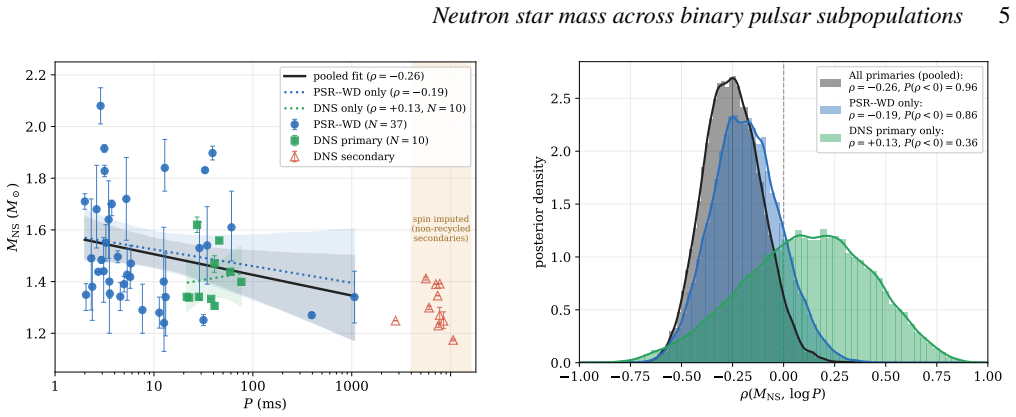
In a hierarchical Bayesian framework applied to ~50 systems, the pooled recycled neutron star population exhibits an anti-correlation between mass and spin period (ρ = −0.26), with 96% of the posterior probability at ρ < 0 and the 90% credible interval excluding zero. This holds after accounting for radio-detectability selection. Double neutron star systems alone show a positive correlation (ρ = +0.13) as expected if moment of inertia drives the relation, but the small sample prevents a firm conclusion. Neutron stars with helium white dwarf companions are found to be marginally more massive than those with carbon-oxygen companions by about 0.06 solar masses.
What carries the argument
Hierarchical Bayesian model that jointly models mass, spin, and orbital parameters while incorporating radio-detectability selection corrections and subpopulation classifications into pulsar-white dwarf versus double neutron star systems.
Load-bearing premise
The hierarchical Bayesian model and its radio-detectability selection correction accurately recover the underlying population distributions without introducing systematic biases that could shift the measured correlation coefficient or its credible interval.
What would settle it
A future sample of recycled pulsars large enough to place the 90% credible interval for the mass-spin correlation coefficient on the positive side or including zero would falsify the reported anti-correlation.
Figures




read the original abstract
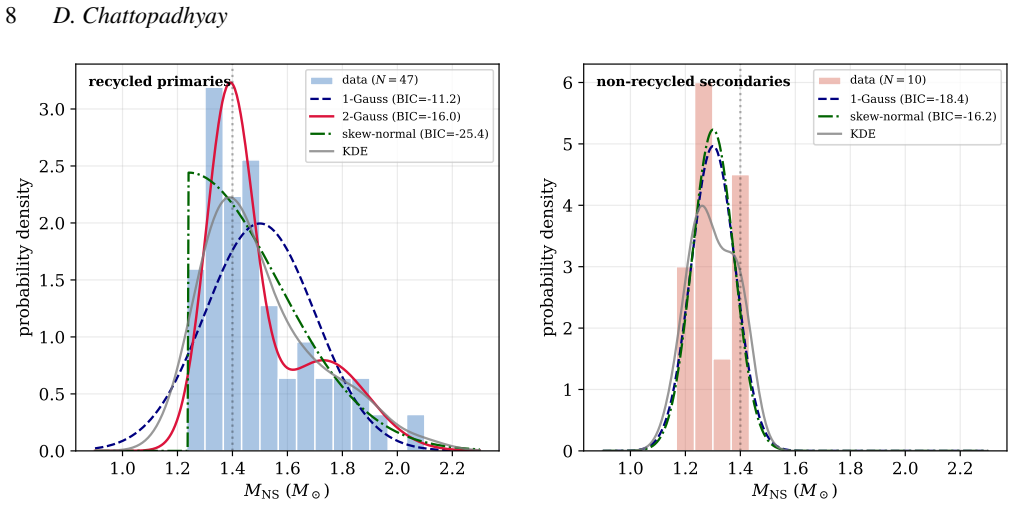
We present a hierarchical Bayesian analysis of the joint mass, spin, and orbital properties of $\sim 50$ Galactic binary radio pulsars with measured neutron star masses, classified by binary type into pulsar-white dwarf (PSR-WD) and double neutron star (DNS) systems. We find moderate evidence for an anti-correlation between neutron star mass and spin period in the pooled recycled population (correlation coefficient $\rho = -0.26$, with $96\%$ of the posterior probability at $\rho<0$; the $90\%$ credible interval excludes zero), robust to the treatment of candidate DNSs and to a radio-detectability selection correction. Although consistent with accretion-driven recycling, the correlation cannot statistically distinguish an accretion origin from a moment of inertia-driven spin-up mechanism, because the neutron star moment of inertia is nearly linear in mass over the observed range. The DNS systems alone instead lean to the positive side expected from the moment-of-inertia mechanism ($\rho=+0.13$), though with only ten systems this is not statistically conclusive. Mass shows no significant correlation with orbital period or inclination, and only a weak one with eccentricity. As a secondary result, neutron stars with helium white dwarf companions are marginally more massive than those with carbon-oxygen/oxygen-neon white dwarf companions ($\Delta \simeq 0.06\,M_\odot$), consistent with more extensive accretion in the helium white dwarf channel. We confirm, in a hierarchical framework, the previously reported correlation between companion mass and orbital eccentricity in double neutron stars ($\rho=+0.82$). We interpret these results within a two-channel picture -- accretion-grown PSR-WD versus birth-mass-dominated DNS.
Editorial analysis
A structured set of objections, weighed in public.
Referee Report
Summary. The manuscript presents a hierarchical Bayesian analysis of the joint mass, spin, and orbital properties of ~50 Galactic binary radio pulsars with measured neutron star masses, classified into PSR-WD and DNS subpopulations. It reports moderate evidence for an anti-correlation between neutron star mass and spin period in the pooled recycled population (ρ = -0.26, 96% posterior probability that ρ < 0, 90% credible interval excludes zero), robust to candidate DNS treatment and radio-detectability selection correction. Secondary results include a marginal mass difference between helium and CO/ONe white dwarf companions, confirmation of the companion mass-eccentricity correlation in DNS systems (ρ = +0.82), and interpretation within a two-channel accretion vs. birth-mass picture. The analysis cannot distinguish accretion-driven recycling from moment-of-inertia effects due to near-linear I(M) over the observed range.
Significance. If the hierarchical model accurately recovers the underlying distributions without selection-induced biases, the results offer useful population-level constraints on neutron star formation channels and recycling physics, with the Bayesian treatment of uncertainties and robustness checks representing a methodological strength. The reported correlation coefficient and credible intervals provide falsifiable predictions for future observations. However, the central claim's reliability hinges on unverified model details, limiting immediate broader impact.
major comments (2)
- [Abstract] Abstract: the claim that the anti-correlation (ρ = -0.26) is 'robust to ... a radio-detectability selection correction' is load-bearing for the central result, yet the functional form of the detection probability (dependence on luminosity, beaming, distance, and spin) is not specified. An incomplete or misspecified selection term could shift the credible interval across zero even if the raw data show none.
- [Hierarchical Bayesian model] The hierarchical Bayesian model section: the manuscript reports posterior probabilities and robustness checks but does not provide the full model specification (priors, likelihood, joint distributions, or how measurement uncertainties are modeled), data tables, or code. This prevents independent verification of whether the reported 96% posterior mass at ρ < 0 is recovered without systematic bias.
minor comments (1)
- [Abstract] The abstract uses '~50' systems; a precise count and breakdown by subpopulation (PSR-WD vs DNS) would improve clarity.
Simulated Author's Rebuttal
We thank the referee for their careful reading of the manuscript and for highlighting issues of model transparency and reproducibility. We address each major comment below and have revised the manuscript accordingly to strengthen the presentation of the selection model and to provide full model specifications.
read point-by-point responses
-
Referee: [Abstract] Abstract: the claim that the anti-correlation (ρ = -0.26) is 'robust to ... a radio-detectability selection correction' is load-bearing for the central result, yet the functional form of the detection probability (dependence on luminosity, beaming, distance, and spin) is not specified. An incomplete or misspecified selection term could shift the credible interval across zero even if the raw data show none.
Authors: We agree that the functional form of the radio-detectability selection function must be stated explicitly to support the robustness claim. In the revised manuscript we have updated the abstract to note that the selection model uses a detection probability that depends on spin period, 1.4 GHz luminosity, and distance (calibrated against the ATNF catalog), with the full implementation described in Section 2.3 as an additional term in the hierarchical likelihood. We have also added a supplementary analysis demonstrating that the 90 % credible interval for ρ remains negative when the selection correction is removed or when its parameters are varied within plausible ranges. revision: yes
-
Referee: [Hierarchical Bayesian model] The hierarchical Bayesian model section: the manuscript reports posterior probabilities and robustness checks but does not provide the full model specification (priors, likelihood, joint distributions, or how measurement uncertainties are modeled), data tables, or code. This prevents independent verification of whether the reported 96% posterior mass at ρ < 0 is recovered without systematic bias.
Authors: We concur that complete model specification is required for independent verification. The revised manuscript adds Appendix A, which gives the full hierarchical model (joint prior on (M, P, e, …), measurement-error likelihoods, and the selection term), the exact prior choices, and the Stan/JAGS code structure. We have also deposited the pulsar data table and the analysis scripts in a public GitHub repository linked from the paper, enabling direct reproduction of the reported posterior probability that ρ < 0. revision: yes
Circularity Check
No significant circularity: correlation coefficients are posterior inferences from data
full rationale
The paper applies hierarchical Bayesian inference to a catalog of ~50 observed binary pulsar systems with measured masses, spins, and orbital parameters. The reported mass-spin correlation coefficient ρ = -0.26 (and its credible interval) is a direct summary statistic of the joint posterior over the population hyperparameters; it is not obtained by fitting a parameter to a subset and then relabeling the fit as a prediction, nor is it defined in terms of itself. The radio-detectability selection function is an explicit modeling choice whose functional form is stated and tested for robustness, but the central claim remains an empirical extraction rather than a tautology. Secondary confirmations of known relations (e.g., companion-mass–eccentricity) are presented as consistency checks, not as load-bearing premises for the primary result. No self-citation chain, ansatz smuggling, or renaming of known results substitutes for the data-driven step.
Axiom & Free-Parameter Ledger
axioms (1)
- domain assumption Neutron star moment of inertia is nearly linear in mass over the observed range
Reference graph
Works this paper leans on
-
[1]
Abbott, B. P. and others. GW170817: Observation of Gravitational Waves from a Binary Neutron Star Inspiral. Phys.\ Rev.\ Lett. 2017. doi:10.1103/PhysRevLett.119.161101. arXiv:1710.05832
work page internal anchor Pith review Pith/arXiv arXiv doi:10.1103/physrevlett.119.161101 2017
-
[2]
Abbott, B. P. and others. GW190425: Observation of a Compact Binary Coalescence with Total Mass 3.4 M_. ApJL. 2020. doi:10.3847/2041-8213/ab75f5. arXiv:2001.01761
-
[3]
doi:10.1093/mnras/sty1065 , adsurl =
MNRAS , year =. doi:10.1093/mnras/sty1065 , adsurl =
-
[4]
doi:10.3847/2041-8213/ab2ed1 , adsurl =
ApJL , year =. doi:10.3847/2041-8213/ab2ed1 , adsurl =
-
[5]
doi:10.1126/science.1233232 , adsurl =
Science , year =. doi:10.1126/science.1233232 , adsurl =
-
[6]
doi:10.1093/mnras/stt559 , adsurl =
MNRAS , year =. doi:10.1093/mnras/stt559 , adsurl =
-
[7]
Phys.\ Rep. , year =. doi:10.1016/0370-1573(91)90064-S , adsurl =
-
[8]
doi:10.1093/mnras/stw575 , adsurl =
MNRAS , year =. doi:10.1093/mnras/stw575 , adsurl =
-
[9]
doi:10.3847/1538-4357/ae1f93 , adsurl =
ApJ , year =. doi:10.3847/1538-4357/ae1f93 , adsurl =
-
[10]
doi:10.1093/mnras/staa756 , adsurl =
MNRAS , year =. doi:10.1093/mnras/staa756 , adsurl =
-
[11]
doi:10.1093/mnras/stab973 , adsurl =
MNRAS , year =. doi:10.1093/mnras/stab973 , adsurl =
-
[12]
doi:10.1051/0004-6361/202346953 , adsurl =
A&A , year =. doi:10.1051/0004-6361/202346953 , adsurl =
-
[13]
ApJ , year =. doi:10.1086/177516 , adsurl =
-
[14]
, year =
Ann.\ Math.\ Stat. , year =
-
[15]
doi:10.3847/1538-4357/ab12e3 , adsurl =
ApJ , year =. doi:10.3847/1538-4357/ab12e3 , adsurl =
-
[16]
PASP , year =. doi:10.1086/670067 , adsurl =
-
[17]
MNRAS , year =. doi:10.1111/j.1365-2966.2010.17319.x , adsurl =
-
[18]
Stat.\ Sci. , year =. doi:10.1214/ss/1177011136 , adsurl =
-
[19]
ApJ , year =. doi:10.1086/519947 , adsurl =
-
[20]
doi:10.1088/0004-637X/778/1/66 , adsurl =
ApJ , year =. doi:10.1088/0004-637X/778/1/66 , adsurl =
-
[21]
doi:10.3847/2041-8213/ac2f3e , adsurl =
ApJL , year =. doi:10.3847/2041-8213/ac2f3e , adsurl =
-
[22]
A standardized catalogue of Fundamental Plane data
MNRAS , year =. doi:10.1046/j.1365-8711.2001.04606.x , adsurl =
-
[23]
doi:10.1093/mnras/stz896 , adsurl =
MNRAS , year =. doi:10.1093/mnras/stz896 , adsurl =
-
[24]
doi:10.1093/mnras/staf1397 , adsurl =
MNRAS , year =. doi:10.1093/mnras/staf1397 , adsurl =
-
[25]
doi:10.1146/annurev-astro-081915-023322 , adsurl =
ARA&A , year =. doi:10.1146/annurev-astro-081915-023322 , adsurl =
-
[26]
Phys.\ Rev. , year =. doi:10.1103/PhysRev.136.B1224 , adsurl =
-
[27]
, year =
Curr.\ Sci. , year =
-
[28]
doi:10.3847/2041-8213/ac8007 , adsurl =
ApJL , year =. doi:10.3847/2041-8213/ac8007 , adsurl =
-
[29]
Ann.\ Stat. , year =. doi:10.1214/aos/1176344136 , adsurl =
-
[30]
doi:10.1093/mnras/stac821 , adsurl =
MNRAS , year =. doi:10.1093/mnras/stac821 , adsurl =
-
[31]
doi:10.3847/1538-4357/aa7e89 , adsurl =
ApJ , year =. doi:10.3847/1538-4357/aa7e89 , adsurl =
-
[33]
doi:10.1038/s41550-025-02487-w , adsurl =
Nature Astronomy , year =. doi:10.1038/s41550-025-02487-w , adsurl =
-
[34]
ApJ , fjournal=
Fournier, Paul , title=. ApJ , fjournal=
-
[35]
An important paper , journal=
-
[36]
Another Unreal Paper , journal=
-
[37]
A Last Unreal Paper , journal=
-
[38]
ApJ , year =. doi:10.1086/173935 , adsurl =
-
[39]
ApJ , year =. doi:10.1086/431543 , adsurl =
-
[40]
AJ , year =. doi:10.1086/428488 , adsurl =
work page internal anchor Pith review doi:10.1086/428488
-
[41]
doi:10.3847/2041-8213/adc25e , adsurl =
ApJL , year =. doi:10.3847/2041-8213/adc25e , adsurl =
-
[42]
URL https://doi.org/10.1088/1674-4527/ada3b7
RAA , year=. doi:10.1088/1674-4527/ada3b7 , adsurl=
-
[43]
doi:10.1088/0004-637X/711/2/764 , adsurl=
ApJ , year=. doi:10.1088/0004-637X/711/2/764 , adsurl=
-
[44]
doi:10.1093/mnras/staa2994 , adsurl=
MNRAS , year=. doi:10.1093/mnras/staa2994 , adsurl=
-
[45]
doi:10.1103/PhysRevD.77.124017 , adsurl=
Phys.\ Rev.\ D , year=. doi:10.1103/PhysRevD.77.124017 , adsurl=
-
[46]
Res.\ Astron.\ Astrophys. , year=. doi:10.1088/1674-4527/ad8eb0 , adsurl=
-
[47]
doi:10.3847/1538-4365/aab5b0 , adsurl=
ApJS , year=. doi:10.3847/1538-4365/aab5b0 , adsurl=
-
[48]
doi:10.3847/1538-4357/ab2bef , adsurl=
ApJ , year=. doi:10.3847/1538-4357/ab2bef , adsurl=
- [49]
-
[50]
doi:10.1093/mnras/staf124 , adsurl=
MNRAS , year=. doi:10.1093/mnras/staf124 , adsurl=
-
[51]
doi:10.3847/1538-4357/aaf37d , adsurl=
ApJ , year=. doi:10.3847/1538-4357/aaf37d , adsurl=
-
[52]
doi:10.1051/0004-6361/202452490 , adsurl=
A&A , year=. doi:10.1051/0004-6361/202452490 , adsurl=
-
[53]
doi:10.1093/mnras/stx1559 , adsurl=
MNRAS , year=. doi:10.1093/mnras/stx1559 , adsurl=
-
[54]
doi:10.1051/0004-6361/202245802 , adsurl=
A&A , year=. doi:10.1051/0004-6361/202245802 , adsurl=
-
[55]
doi:10.3847/2041-8213/ad614a , adsurl=
ApJL , year=. doi:10.3847/2041-8213/ad614a , adsurl=
-
[56]
doi:10.1051/0004-6361/202452550 , adsurl=
A&A , year=. doi:10.1051/0004-6361/202452550 , adsurl=
-
[57]
doi:10.1051/0004-6361/202347723 , adsurl=
A&A , year=. doi:10.1051/0004-6361/202347723 , adsurl=
-
[58]
and Mellema, Garrelt and Mao, Yi and Iliev, Ilian T
MNRAS , year=. doi:10.1111/j.1365-2966.2012.21124.x , adsurl=
-
[59]
doi:10.3847/1538-4357/ad3631 , adsurl=
ApJ , year=. doi:10.3847/1538-4357/ad3631 , adsurl=
-
[60]
doi:10.1051/0004-6361/202450933 , adsurl=
A&A , year=. doi:10.1051/0004-6361/202450933 , adsurl=
-
[61]
doi:10.1051/0004-6361/202244732 , adsurl=
A&A , year=. doi:10.1051/0004-6361/202244732 , adsurl=
-
[62]
doi:10.1051/0004-6361/202245132 , adsurl=
A&A , year=. doi:10.1051/0004-6361/202245132 , adsurl=
-
[63]
doi:10.1093/mnras/stw483 , adsurl=
MNRAS , year=. doi:10.1093/mnras/stw483 , adsurl=
-
[64]
doi:10.1093/mnras/stad169 , adsurl=
MNRAS , year=. doi:10.1093/mnras/stad169 , adsurl=
-
[65]
doi:10.1051/0004-6361/202348861 , adsurl=
A&A , year=. doi:10.1051/0004-6361/202348861 , adsurl=
-
[66]
doi:10.1051/0004-6361/202142670 , adsurl=
A&A , year=. doi:10.1051/0004-6361/202142670 , adsurl=
-
[67]
doi:10.1093/mnras/staa1027 , adsurl=
MNRAS , year=. doi:10.1093/mnras/staa1027 , adsurl=
-
[68]
doi:10.1093/mnras/stw2947 , adsurl=
MNRAS , year=. doi:10.1093/mnras/stw2947 , adsurl=
-
[69]
doi:10.1051/0004-6361/202141450 , adsurl=
A&A , year=. doi:10.1051/0004-6361/202141450 , adsurl=
-
[70]
doi:10.3847/2041-8213/ac03b8 , adsurl=
ApJL , year=. doi:10.3847/2041-8213/ac03b8 , adsurl=
-
[71]
doi:10.1093/mnras/staa3466 , adsurl=
MNRAS , year=. doi:10.1093/mnras/staa3466 , adsurl=
-
[72]
doi:10.1088/0004-637X/787/1/82 , adsurl=
ApJ , year=. doi:10.1088/0004-637X/787/1/82 , adsurl=
-
[73]
doi:10.1103/PhysRevX.11.041050 , adsurl=
Phys.\ Rev.\ X , year=. doi:10.1103/PhysRevX.11.041050 , adsurl=
-
[74]
doi:10.1093/mnras/stu1223 , adsurl=
MNRAS , year=. doi:10.1093/mnras/stu1223 , adsurl=
-
[75]
doi:10.1093/mnras/stad1648 , adsurl=
MNRAS , year=. doi:10.1093/mnras/stad1648 , adsurl=
-
[76]
doi:10.3847/1538-4357/ad1canzon , adsurl=
ApJ , year=. doi:10.3847/1538-4357/ad1canzon , adsurl=
-
[77]
doi:10.3847/0004-637X/829/1/55 , adsurl=
ApJ , year=. doi:10.3847/0004-637X/829/1/55 , adsurl=
-
[78]
doi:10.1088/0004-637X/812/2/143 , adsurl=
ApJ , year=. doi:10.1088/0004-637X/812/2/143 , adsurl=
-
[79]
doi:10.1038/s41586-020-2439-x , adsurl=
Nature , year=. doi:10.1038/s41586-020-2439-x , adsurl=
-
[80]
doi:10.1126/science.aav7272 , adsurl=
Science , year=. doi:10.1126/science.aav7272 , adsurl=
-
[81]
ApJL , year=. doi:10.1086/505742 , adsurl=
discussion (0)
Sign in with ORCID, Apple, or X to comment. Anyone can read and Pith papers without signing in.